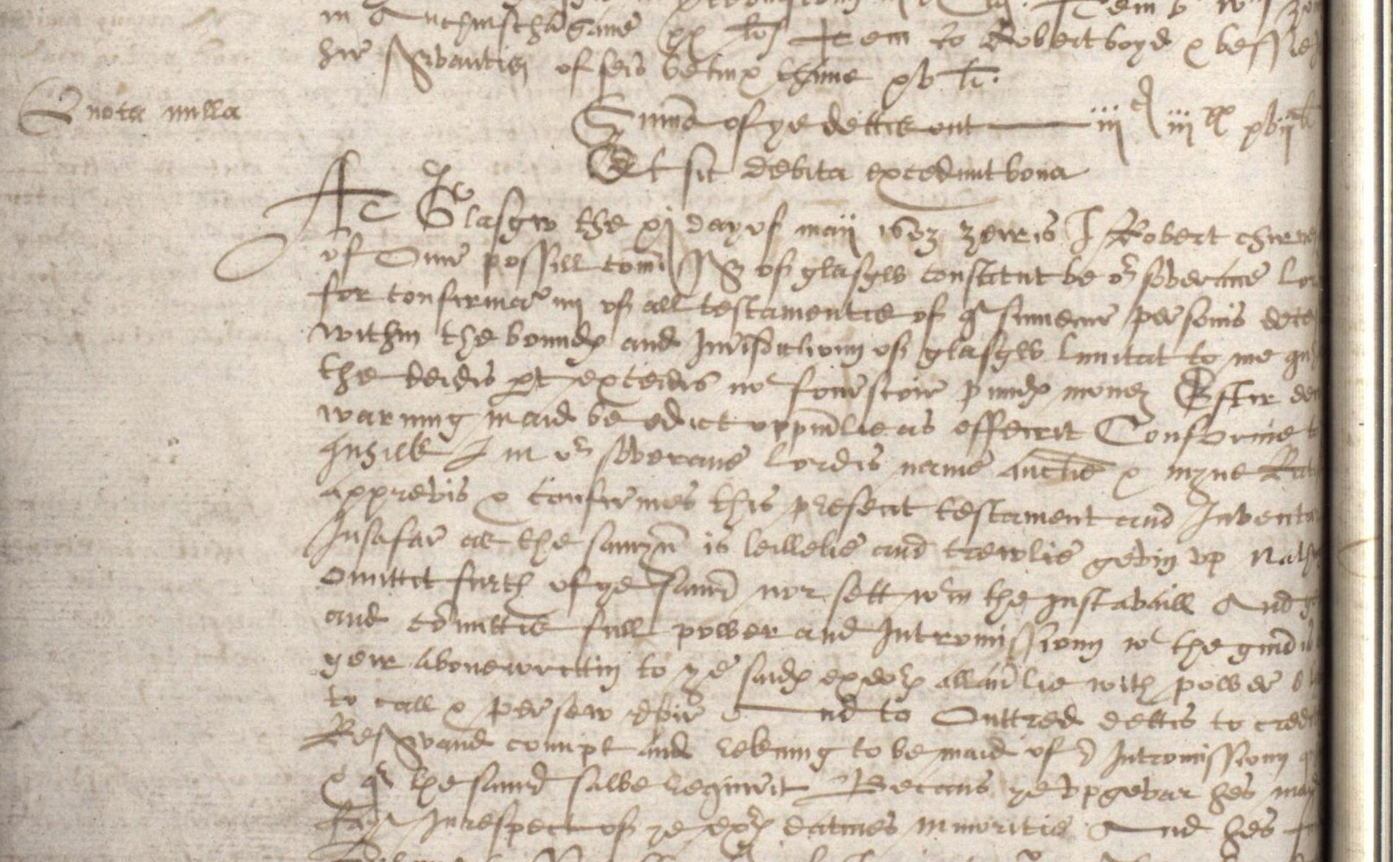
Five image-led steps separate Geillis Glasgow's identity and household from executor procedure, agricultural inventory, debts and final confirmation. Numbered boxes are reading aids, not claims beyond the ink. National Records of Scotland, Glasgow Commissary Court CC9/7/3, images 113-114, Crown copyright; accessed through Scotland's People wills and testaments.
NameRelationship / roleUncertain
New to secretary hand? Start with the shapes.
Follow the writing line. Ascenders rise above small letters; descenders fall below them. A neighbouring line can cross the word you are reading.
Count the short strokes. These are called minims. Joined i, m, n and u shapes can be ambiguous; compare a clear repeated word by the same clerk rather than guessing from a modern alphabet.
Separate reading from expansion. A contraction is not a fully written modern word. Square brackets retain doubtful letters or editorial additions. A familiar legal formula is a clue, not permission to fill a gap.
Then assess the relationship. Reading a name securely is not the same as proving kinship. Look for the actual role words and who they refer to.
Choose a name or relationship below. Compare the original ink, a paper-free view and the same spelling in a secretary-hand teaching font. Open the reasoning only when you need it.
01Initial and descender in the testatrix's nameInitial and descender in the testatrix's nameInspect reading
Proposed readingGeillis glasgw
The identity step identifies Geillis Glasgow as spouse of Thomas Wilson. This trace is confined to the name and does not infer parentage or kinship with any other Glasgow named in the testament.
01 Original word Untouched manuscript02 Ink on white Derived from the original pixels
Open the original above if this browser cannot process the image.
03 Same spelling, another hand Joscelyn teaching font
Geillis glasgwLoading the secretary-hand teaching font...
Geillis glasgw
The white-background view suppresses paper colour; reviewed focus boundaries exclude separable neighbouring fragments where available. It does not restore missing strokes. Colour follows retained source pixels inside proposed letter groups, not a reconstructed pen path. Ambiguous crossings remain neutral where reviewed; other crossing ink may still belong to another line.
The font repeats the proposed spelling, not this clerk's handwriting. Similarity is a teaching aid, not confirmation; uncertainties remain in the reading above.
Locate the word in its passage Original contextThe identity step identifies Geillis Glasgow as spouse of Thomas Wilson. This trace is confined to the name and does not infer parentage or kinship with any other Glasgow named in the testament.Reading, meaning and uncertainty
Expansion: Geillis Glasgow
Confidence: high for the maintained name reading
Evidence boundary: The two visible G/g features are consistent with the walkthrough's existing Geillis glasgw reading; they do not identify the later James Glasgow as kin.
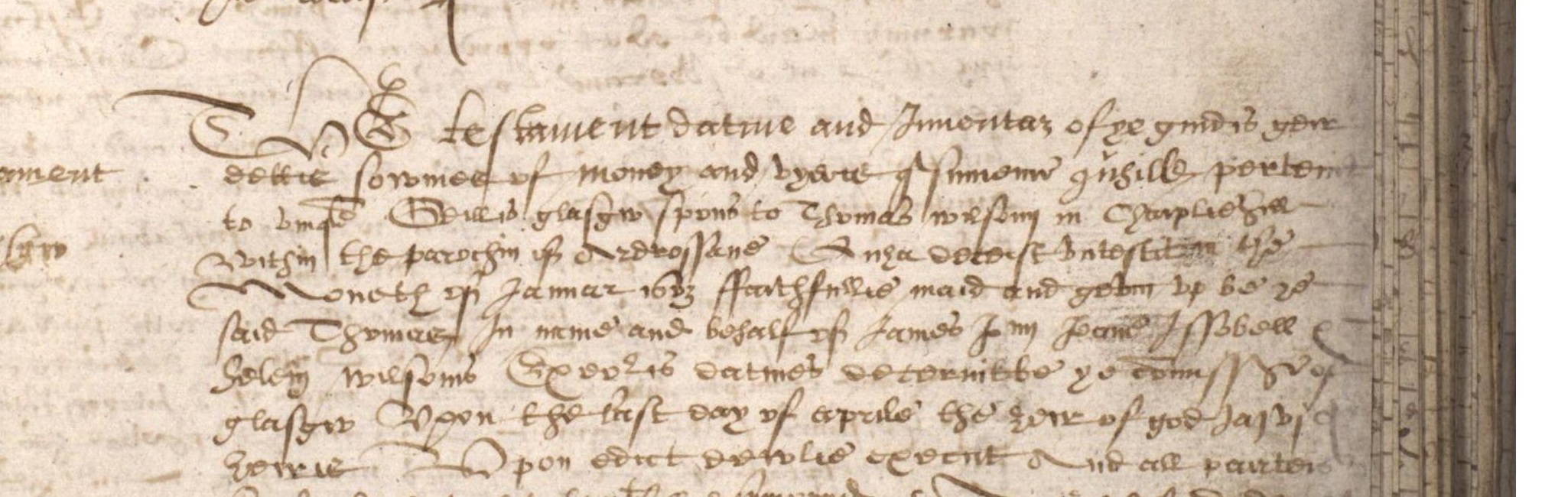
umq[uhi]le Geillis glasgw spous to Thomas wilson in Chaplehill / within the parochin of Ardrossane ... moneth of Januar 1603
In modern English
The late Geillis Glasgow, spouse of Thomas Wilson at Chaplehill in Ardrossan parish, died intestate in January 1603.
How to read it
Box 1 isolates Geillis's name. Box 2 begins with the literal relationship word spous and continues through Thomas Wilson; that word, not proximity alone, establishes marriage. Box 3 contains the January date. The place continues beyond the boxes as Chaplehill within Ardrossan parish.
What this establishes
Geillis's married identity, Chaplehill/Ardrossan setting and January 1603 death month.
What it does not establish
It names neither parent and does not identify the later James Glasgow as kin.
High for the name, spouse, locality and month/year.
Slow reading
Inspect the words, not just the conclusion.
Compare the original strokes with the proposed reading. Tall or trailing strokes from neighbouring lines may enter a sample; the notes distinguish what is visible from what remains uncertain.
Phrase 01
Geillis glasgw
Geillis Glasgow
Magnified from the same manuscript image. No letters have been redrawn.
Look at the strokes
The capital G begins with a broad open loop before the narrow e-i sequence.
The doubled l in Geillis rises above the surrounding short letters as two close ascenders.
The final w of glasgw finishes in a compact upturned stroke rather than a modern rounded w.
Compare in this hand: The same abbreviated glasgw form recurs with James in step 4.
Reading limits: The surname is abbreviated, but the personal name and surname are clear.
Phrase 02
spous to Thomas wilson
spouse to Thomas Wilson
Magnified from the same manuscript image. No letters have been redrawn.
Look at the strokes
The long initial stroke of Thomas rises well above the following minims.
The word spous is written as one low connected sequence immediately before to.
Wilson begins with a broader capital than the compact lower-case letters that follow.
Compare in this hand: This explicit spous wording should be contrasted with the role word executors in step 2.
Reading limits: No uncertainty in the spouse wording; spelling is contemporary.
Phrase 03
moneth of Januar 1603
month of January 1603
Magnified from the same manuscript image. No letters have been redrawn.
Look at the strokes
Januar opens with a long descending initial stroke and then a clearly separated rounded a.
The terminal r is short and raised compared with the preceding a.
The four Arabic numerals are written on the same baseline after the month.
Compare in this hand: Step 5 contains the later May confirmation date in the same clerk's hand.
Reading limits: The day of death is not supplied here; only the month and year are visible.
02
National Records of Scotland, Glasgow Commissary Court CC9/7/3, image 113; Crown copyright
2. Keep the April executor decree separate from kinship
Click the manuscript to enlarge
Choose a phrase to locate it in the manuscript. Only its outline is shown, so overlapping strokes stay readable.
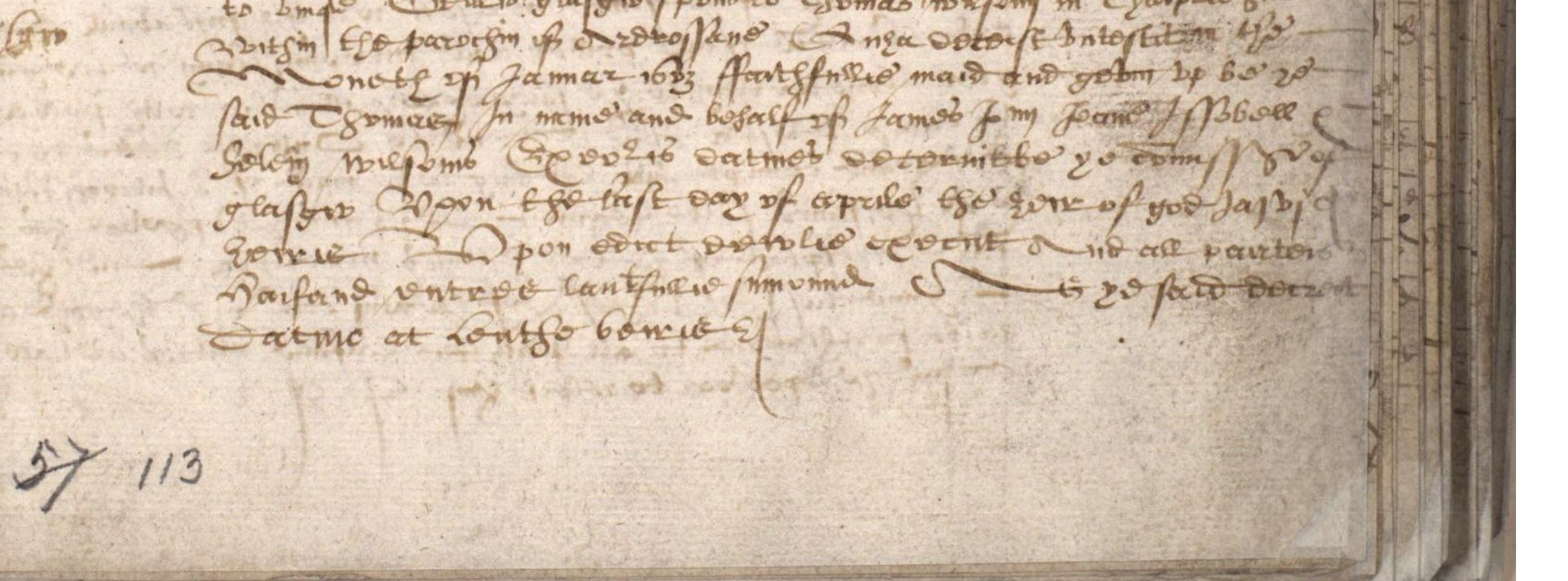
James [unresolved] Isobell & Bessie wilson ... executors dative ... / glasgw upon the last day of Aprile ...
In modern English
James, Isobel and Bessie Wilson are named in the executor passage; the appointment follows a Glasgow commissary decree on the last day of April 1603.
How to read it
Box 1 pulls the executor-role wording, while Box 2 follows the next dated line through last day of Aprile. Box 3 marks Dative at length, a closing procedural note. The words defining how the three Wilsons relate to Geillis are obscured, so the office cannot be converted into sonship or daughtership.
What this establishes
The named group participates in the dative-executor appointment and the decree was on 30 April 1603.
What it does not establish
Executor appointment alone does not prove that James, Isobel or Bessie was Geillis's child.
High for the April decree; moderate for the named group; low for the missing relationship words.
Slow reading
Inspect the words, not just the conclusion.
Compare the original strokes with the proposed reading. Tall or trailing strokes from neighbouring lines may enter a sample; the notes distinguish what is visible from what remains uncertain.
Phrase 01
[the] executors dative
the court-appointed executors
Magnified from the same manuscript image. No letters have been redrawn.
Look at the strokes
The tall initial stroke of executors is followed by a compressed chain of rounded letters.
Dative is written with an enlarged initial and a final e turning upward.
The two role words occupy the same line rather than being marginal additions.
Compare in this hand: The dative terminology recurs in the closing note marked in Box 3.
Reading limits: Surrounding words are faded; the administrative role is clearer than the relationship clause.
Phrase 02
upon the last day of Aprile
on the last day of April
Magnified from the same manuscript image. No letters have been redrawn.
Look at the strokes
The long s in last descends slightly below the line and differs from the short final s.
Aprile begins with an enlarged open capital A.
The terminal e of Aprile ends in a light rising hairline.
Compare in this hand: The May date in step 5 is a later confirmation event, not a competing reading of this line.
Reading limits: The phrase gives 30 April by calendar convention; the numeral 30 is not written.
Phrase 03
Dative at length
dative [appointment recorded] at length
Magnified from the same manuscript image. No letters have been redrawn.
Look at the strokes
Dative begins with a long horizontal entry stroke leading into the capital.
The g in length drops below the baseline before a tall h ascender.
The phrase stands alone as a closing docket beneath the main clause.
Compare in this hand: It echoes executors dative in Box 1 and confirms the procedural nature of the passage.
Reading limits: The phrase is legible; its exact archival function is summarized rather than over-translated.
03
National Records of Scotland, Glasgow Commissary Court CC9/7/3, image 114; Crown copyright
3. Read an agricultural inventory, not a family list
Click the manuscript to enlarge
Choose a phrase to locate it in the manuscript. Only its outline is shown, so overlapping strokes stay readable.
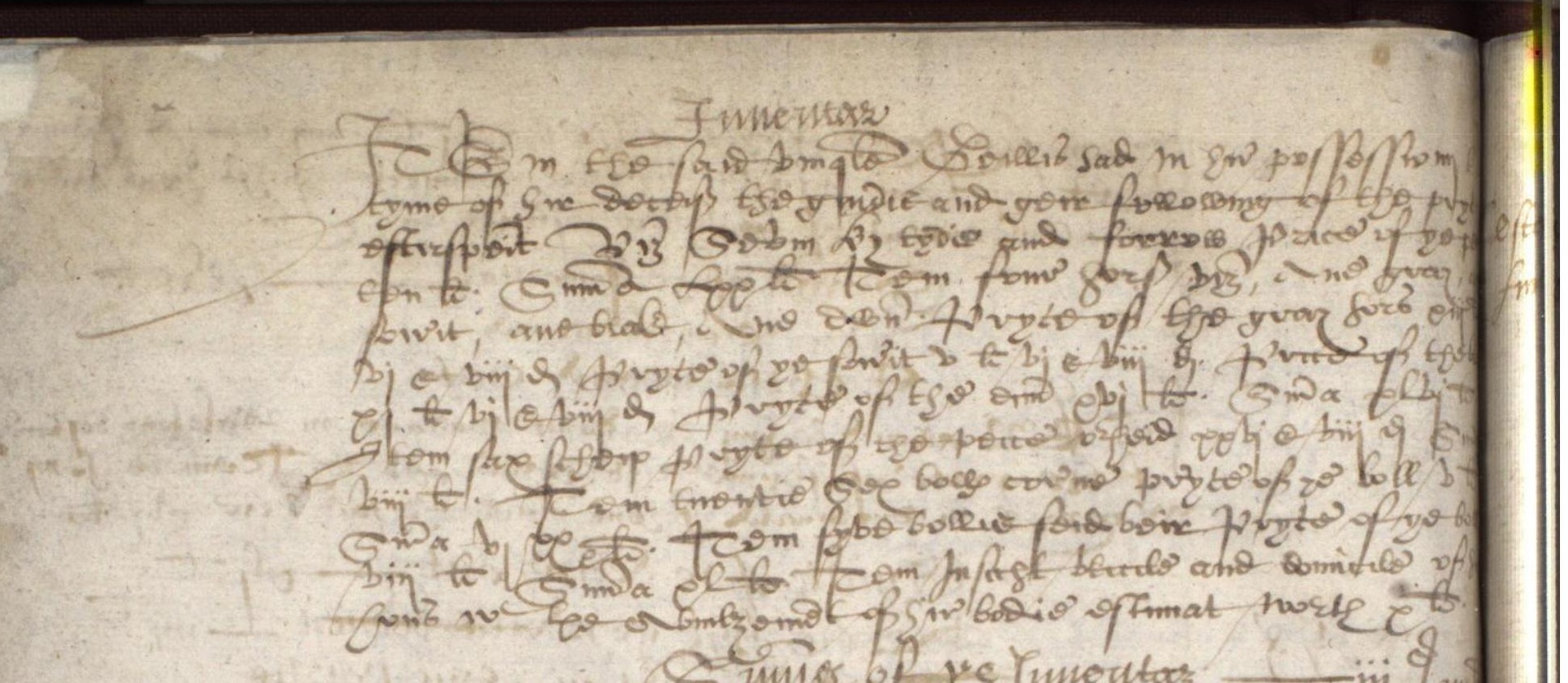
Inventar ... sevin ky ... ane blak kow ... insight plenissing and domicilis
In modern English
The estate inventory lists cattle, sheep, crops or grain and household furnishings before a total.
How to read it
Box 1 is the centred heading. Boxes 2 and 3 pull visible livestock phrases; Box 4 marks the household plenishing entry. The repeated Item structure and price columns show accounting entries. Several adjacent quantities are too faded to normalize safely.
What this establishes
Geillis's estate was agricultural and included livestock and household goods.
What it does not establish
Ownership of farm goods does not identify a father, child or heir, and the unclear valuations should not be treated as exact.
High for the record type and broad asset classes; moderate-low for quantities and values.
Slow reading
Inspect the words, not just the conclusion.
Compare the original strokes with the proposed reading. Tall or trailing strokes from neighbouring lines may enter a sample; the notes distinguish what is visible from what remains uncertain.
Phrase 01
Inventar
Inventory
Magnified from the same manuscript image. No letters have been redrawn.
Look at the strokes
The enlarged I begins with a looped entry stroke that reaches left of the word.
The central v/n minim sequence is tightly joined.
The final r finishes with a short upward hook.
Compare in this hand: The same heading convention appears in the John Glasgow entry, step 2.
Reading limits: The heading is clear despite faint show-through.
Phrase 02
sevin ky
seven cows
Magnified from the same manuscript image. No letters have been redrawn.
Look at the strokes
The initial s is a long secretary-form stroke rather than a modern round s.
The v has a sharp central angle between the two rounded e/i groups.
The y in ky descends well below the baseline with a returning tail.
Compare in this hand: Another kyne form appears in the John inventory, showing a different late-seventeenth-century hand.
Reading limits: The livestock phrase is readable; the following modifier and price are not.
Phrase 03
ane blak kow
one black cow
Magnified from the same manuscript image. No letters have been redrawn.
Look at the strokes
The a of ane is open at the top and joins directly into a narrow n.
The k in blak rises with a tall angled arm above the other letters.
Kow ends in the same compact w form used in the clerk's abbreviated surnames.
Compare in this hand: This singular animal follows the plural sevin ky entry immediately above.
Reading limits: The phrase is likely, but adjacent words and its valuation remain faint.
Phrase 04
insight plenissing and domicilis
household furnishings and utensils
Magnified from the same manuscript image. No letters have been redrawn.
Look at the strokes
Insight begins with a short i followed by a long descending s-like stroke and a tall h near the end.
Plenissing contains repeated close minims and a long medial s.
Domicilis has two tall l strokes near its close.
Compare in this hand: This household entry follows the livestock and crop items in Boxes 2 and 3.
Reading limits: The core phrase is visible; surrounding valuation words and figures remain faint.
04
National Records of Scotland, Glasgow Commissary Court CC9/7/3, image 114; Crown copyright
4. Place James Glasgow inside the debts-awand section
Click the manuscript to enlarge
Choose a phrase to locate it in the manuscript. Only its outline is shown, so overlapping strokes stay readable.
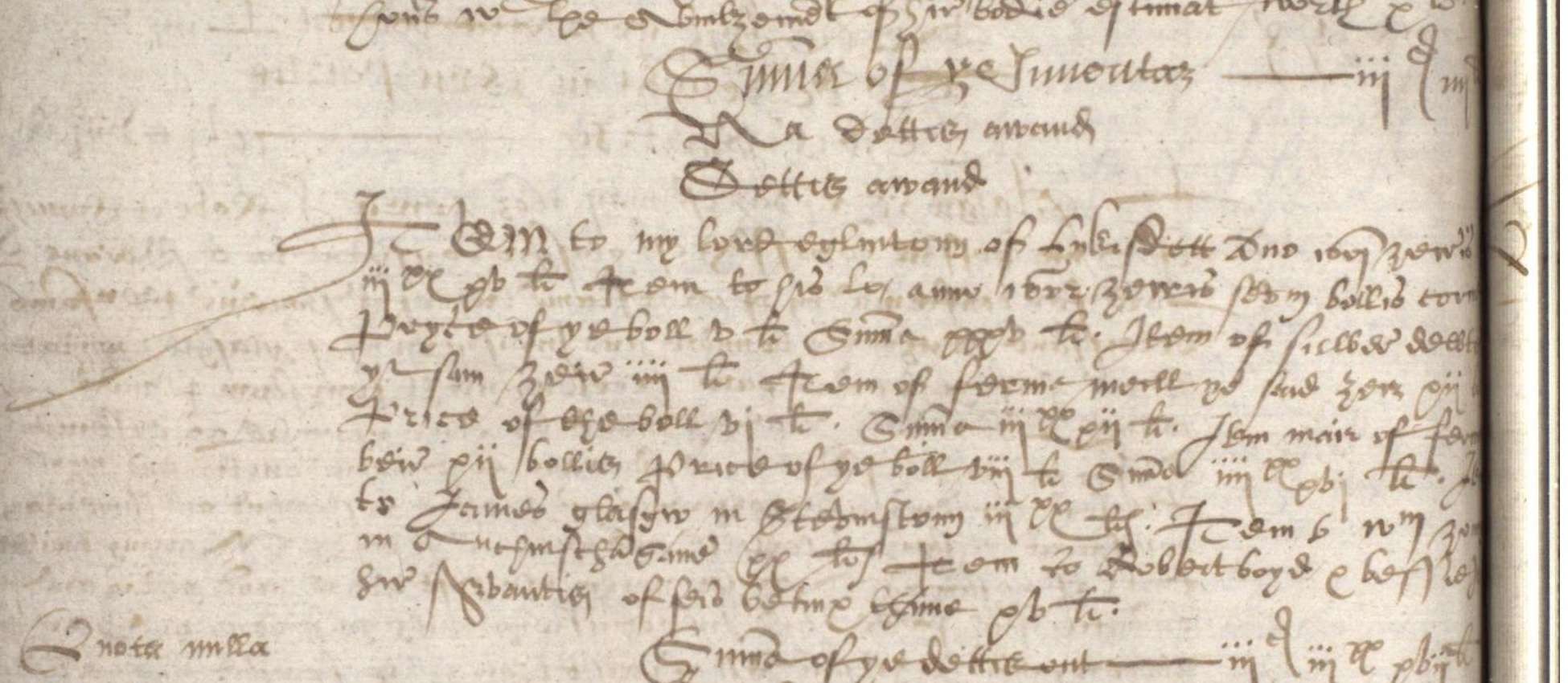
Dittis awand ... my lord of Eglintoun ... James glasgw in Stevinstoun ... Robert boyd & bessie ... servantie
In modern English
The estate owed rent or ferm to the lord of Eglinton, money to James Glasgow in Stevenston, and past wages to Robert Boyd and Bessie.
How to read it
Box 1 is the debt heading. Box 2 identifies the superior or landlord account. Box 3 contains James Glasgow with Stevenston, and Box 4 contains the servant names. Because James appears under debts awand, his role here is creditor/payee; no kin word accompanies him.
What this establishes
A financial connection between Geillis's estate and James Glasgow in Stevenston, plus wage debt to named servants.
What it does not establish
It does not call James Geillis's father or brother, and it does not identify servant Bessie with Bessie Wilson.
High for the section, James Glasgow/Stevenston and Robert Boyd; moderate for Bessie's surname and sums.
Slow reading
Inspect the words, not just the conclusion.
Compare the original strokes with the proposed reading. Tall or trailing strokes from neighbouring lines may enter a sample; the notes distinguish what is visible from what remains uncertain.
Phrase 01
Dittis awand
Debts owing [by the estate]
Magnified from the same manuscript image. No letters have been redrawn.
Look at the strokes
Dittis begins with a looped capital whose horizontal entry stroke reaches left.
The doubled t has a shared high cross stroke.
Awand ends with a tall d ascender rising above the preceding letters.
Compare in this hand: The preceding line Na dettis awand refers to debts owing to the estate; this new heading reverses the accounting direction.
Reading limits: The heading is clear; the direction is established by its position after the no-debts-to-estate note and the listed payees.
Phrase 02
my lord of Eglintoun
the lord of Eglinton
Magnified from the same manuscript image. No letters have been redrawn.
Look at the strokes
Lord begins with a tall looped l that descends into the following rounded letters.
Eglintoun has an enlarged open E and a g descending below the baseline.
The terminal oun is a compressed sequence ending in a short n stroke.
Compare in this hand: This name heads the first debt entry immediately below Dittis awand.
Reading limits: The title and place-name are legible; the nature and amount of the rent/ferm following them are less clear.
Phrase 03
James glasgw in Stevinstoun
James Glasgow in Stevenston
Magnified from the same manuscript image. No letters have been redrawn.
Look at the strokes
James begins with a long initial J descending below the line before returning upward.
Glasgw uses the same compact final w abbreviation visible in Geillis's surname in step 1.
Stevinstoun begins with a broad capital S and ends in the tightly joined toun sequence.
Compare in this hand: The same-hand glasgw abbreviation can be compared directly with Geillis glasgw in step 1.
Reading limits: The name and locality are clear; the following sum and reason for payment are unresolved.
Phrase 04
Robert boyd & bessie
Robert Boyd and Bessie
Magnified from the same manuscript image. No letters have been redrawn.
Look at the strokes
Robert has an enlarged R with a long leftward entry loop.
Boyd contains a y descender that passes below the shared baseline.
Bessie begins with a looped lower-case b and has a long s in the middle of the word.
Compare in this hand: The following servantie phrase, outside the box, defines their wage-related role.
Reading limits: Robert Boyd and Bessie are legible; Bessie's surname is not securely visible.
05
National Records of Scotland, Glasgow Commissary Court CC9/7/3, image 114; Crown copyright
5. Date confirmation eleven days after the April decree
Click the manuscript to enlarge
Choose a phrase to locate it in the manuscript. Only its outline is shown, so overlapping strokes stay readable.
At Glasgow the xj day of Maii 1603 yeiris ... confirme the present testament and Inventar
In modern English
At Glasgow on 11 May 1603 the commissary confirmation process records and confirms the testament and inventory.
How to read it
Boxes 1 and 2 form one dated opening: At Glasgow and the xj day of Maii 1603. Box 3 follows the later line naming the present testament and Inventar. This is confirmation, eleven days after the 30 April executor decree, not Geillis's death date.
What this establishes
The place and date of confirmation and the legal character of the closing passage.
What it does not establish
The confirmation formula does not add parents or children and should not be mined for invisible boilerplate.
High for Glasgow, 11 May 1603 and the testament/inventory language; lower for names inside the faded formula.
Slow reading
Inspect the words, not just the conclusion.
Compare the original strokes with the proposed reading. Tall or trailing strokes from neighbouring lines may enter a sample; the notes distinguish what is visible from what remains uncertain.
Phrase 01
At Glasgow
At Glasgow
Magnified from the same manuscript image. No letters have been redrawn.
Look at the strokes
At begins with a large sweeping capital A whose entry stroke reaches left.
Glasgow has a broad capital G followed by compact connected lower-case letters.
The final w turns upward in the same manner as the abbreviated surnames above.
Compare in this hand: This is a place in the confirmation formula, unlike glasgw used as Geillis's and James's surname in steps 1 and 4.
Reading limits: The place reading is clear; capitalization is editorial.
Phrase 02
the xj day of Maii 1603
the 11th day of May 1603
Magnified from the same manuscript image. No letters have been redrawn.
Look at the strokes
The Roman xj is separated from the surrounding words and has a descending final j.
Maii begins with a broad looped M followed by two short i strokes.
The year uses four Arabic numerals placed before yeiris.
Compare in this hand: Step 2's last day of Aprile is the earlier executor decree; this line is the confirmation date.
Reading limits: The Roman day numeral reads xj; it is not a marriage or death date.
Phrase 03
present testament and Inventar
present testament and inventory
Magnified from the same manuscript image. No letters have been redrawn.
Look at the strokes
Present begins with a tall looped p descender entering from below the baseline.
Testament contains a long s and repeated tall t strokes crossed high.
Inventar again uses the enlarged initial seen in the inventory heading.
Compare in this hand: Inventar repeats the heading in step 3 and ties the confirmation to the same estate account.
Reading limits: The phrase is readable; the surrounding confirmation boilerplate is only partly legible.
Full case analysisInterpretation, supporting evidence, changed readings and remaining questions.
Modern interpretation
What the record says
Geillis Glasgow was expressly the spouse of Thomas Wilson at Chaplehill in Ardrossan parish and died intestate in January 1603.
Thomas supplied the testament for a court-appointed executor group including James, Isobel and Bessie Wilson. The compressed words around James do not safely establish sonship or extend any kin term to Isobel and Bessie.
James Glasgow in Stevenston is named under debts owed by the estate. That is a creditor or payee association, not a kinship statement.
The estate was agricultural and debt-heavy. It owed rent or ferm to the lord of Eglinton and past wages to Robert Boyd and a servant Bessie whose surname is not secure.
The executor decree was dated 30 April 1603 and confirmation 11 May 1603; neither is a death date.
Evidence and limits
What it establishes
Confirmed: spouse Thomas Wilson, Chaplehill in Ardrossan parish, intestacy and January 1603 death month.
Confirmed: James, Isobel and Bessie Wilson occur in the dative-executor clause; the appointment is administrative.
Unresolved after a closer crop: the words following James cannot securely be read as a kin term or safely attached to all three Wilsons.
Confirmed: James Glasgow in Stevenston is embedded in the debts-awand-out section and has no visible kin term.
Confirmed: Robert Boyd and Bessie are wage creditors described as servants; Bessie's surname and identity remain unresolved.
Confirmed: the lord of Eglinton is a rent/ferm creditor, not a family identification.
What changed in this reading
Old: relationship wording after James Wilson was simply unresolved. New: a tighter reread tested possible sonship but rejected promotion; the relationship remains unresolved because the compressed strokes admit more than one reading.
Old: James Glasgow was recorded as a Stevenston payee. New: confirmed unchanged after checking the whole debt direction and neighbouring entries.
Old: Robert Boyd and Bessie were recorded as servants. New: confirmed unchanged; no surname or identity is supplied for Bessie.
No walkthrough text or geometry changed because no featured reading crossed a confidence threshold.
Still open
Do not fill these gaps with assumptions
Exact wording between James and Isobel/Bessie Wilson and the relationship, if any, of each executor to Geillis.
Whether the compressed phrase contains a kin term, an additional personal name or an abbreviation.
James Glasgow of Stevenston's identity and any kinship to Geillis.
The servant Bessie's surname and identity.
Several inventory quantities, debt purposes, sums, confirmation names and closing formulae.
Full working transcriptionLine-oriented readings, unresolved text and a downloadable plain-text version.
Square brackets mark uncertainty, editorial expansions or missing text. Ellipses mark omitted or unresolved wording. Numbering identifies lines in this working reading, not official manuscript line numbers. This is not a complete diplomatic edition.
Image / passage 113, opening and executor clause
The testament dative and Inventar of the guidis geir
debtes soumes of money and utheris q[uhil]kis pertenit
to umq[uhi]le Geillis glasgw spous to Thomas wilson in Chaplehill
within the parochin of Ardrossane quha deceist intestat the
moneth of Januar 1603 faithfullie maid and gevin up be the
said Thomas in name and behalf of James [relationship or additional-name wording unresolved] Isobell &
Bessie wilson [wording unresolved] executors dative [lawfully]
[appointed] to the said umq[uhi]le be decreit of the Commissar of
glasgw upon the last day of Aprile the yeir of god above written
[procedural wording partly unresolved]
Dative at length
Image / passage 114, inventory and debts
Inventar
[Agricultural inventory: cattle, sheep, crop/grain and household plenishing; quantities and values only partly legible]
Summa of the Inventar [amount unresolved]
Na dettis awand
Dittis awand
Item to my lord of Eglintoun of maill ferme [sum unresolved]
[Rent/ferm entries continue]
Item to James glasgw in Stevinstoun [sum and purpose unresolved]
Item to Robert boyd & bessie [surname unresolved], servants, for thair
servantie of the byrun tyme [sum unresolved]
Summa of the dettis awand [sum unresolved]
Et sic debita excedunt bona
Image / passage 114, confirmation
At Glasgow the xj day of Maii 1603 yeiris Robert [surname unresolved]
[confirmation formula and authority partly unresolved]
[the commissar] confirms the present testament and Inventar
[caution, administration and closing wording partly unresolved]
Source files and reading provenanceOriginal references, pages examined and the limits of this review.
Source coverage and reading provenance
High for Geillis, Thomas Wilson, Chaplehill/Ardrossan, dates, the executor group, and James Glasgow's debt-section placement. Low for the words defining the Wilson executors' relationships and for account figures. No kinship is inferred from executor, creditor, landlord or servant status.
Reviewed: 2026-09-10. Method: LLM-assisted fresh visual reread from original images.
Pages examined
PDF page 1 / image 113: Geillis entry in lower half; preceding estate excluded
PDF page 2 / image 114: inventory, debts and confirmation
Supplied local source files
1603_Gillis.pdf
The full originals remain in the local research archive. Selected unaltered crops are shown above for reading and commentary, with separate switchable highlights. Image credit: Crown copyright, National Records of Scotland / ScotlandsPeople. Duplicate downloads are not independent evidence. Consult the original using the reference above through ScotlandsPeople.
All associated profiles and identity comparisonsIncludes possible and rejected associations, not just proved relatives.