A surname is not a pedigree. The testaments reveal real households; burgess admissions, apprenticeships and property transfers help us decide which households belong together.
Confirmed / reconfirmedProbableUnresolvedRejected reading or match
Continuing the investigation · 10 September 2026
Following the missing links
These searches test connections between the households, not the handwriting again. A newly located catalogue or a clearer research target is not a newly proved relative. Unavailable records are identified rather than counted as negative evidence.
Targeted record follow-up
Ayrshire: follow the tenancies and the women's estates
Can the Corsinkell father-and-sons group be connected to Geillis and Katherine Glasgow, or to the later James Glasgow married to Margaret Smith at Brekpleughe?
Unresolved
The local network is real, but the missing kinship clause has not been found. The 1571 Corsinkell sons already have record-defined identities: James Glasgow-3921 and John Glasgow-4061, sons of James elder Glasgow-1168. Do not replace John-4061 with the unproved Kilwinning candidate John-3193. The most discriminating unexamined sources are now the estates of Margaret Smith in 1632, Agnes Glasgow in 1628 and John Mathie of Ibert in 1607, rather than another unrestricted search for James Glasgow.
Records, reasoning and search limitsConfirmed / reconfirmed
Established evidence rechecked
The 1559-60 Stevenston list contains a wider Glasgow, Wilson, Weir and Mathie network.
The printed page was visually inspected. Matthew Glasgow shares the Ardeer Nether entry with John Mathie. Michael Glasgow appears at Brakpleuch with John and Robert Wilson and also at Dubbs. Ninian Weir appears at Hawkhill and Hullerhirst Over. Geillis Wilson appears at Corscraig; she is not thereby identified with Geillis Glasgow of the 1603 testament. Repeated names at separate holdings may represent one tenant or namesakes.
The creditor James in Geillis's estate is not yet identified as either a particular Corsinkell James or Margaret Smith's husband.
The 1603 original identifies James Glasgow in Stevenston as someone the estate owed. It supplies no age, father, wife or Corsinkell/Brekpleughe designation for him. A shared parish and an expected name are not a record-to-record identity bridge. The possibility of close local kin remains worth testing.
Margaret Smith's 1632 estate is a more specific test of the later Brekpleughe household than the existing James profile attachment.
The published calendar identifies her as James Glasgow's spouse at Brekpleughe, Stevenston. It does not identify him as the younger Corsinkell tenant first recorded in1559-60. The72-73year interval requires an actual continuity record. It is not a conclusive age contradiction: a confirmation date does not establish when a spouse died or that he remained alive at confirmation. The original may name children, heirs, creditors and the husband's living/deceased status.
Agnes Glasgow's 1628 estate is a direct route to testing the proposed Glasgow-Smith parentage.
The index calls Agnes the spouse of John Logane, trumpmaker in Stevenston, but names neither parent. That is a distinct, searchable household. Her estate could supply the missing parental or sibling identifiers; the index cannot confirm Agnes as Margaret Smith's daughter. Preserve existing attachments while recording the uncertainty, rather than following older notes that recommended leaving parents blank.
John Mathie of Ibert's estate could test the proposed link between the city and Glencairn households.
The calendar entry for John of Ibert, Kilmaronock, confirmed9November1607, was independently recovered. Maintained research uses January1607 tutory retours for his brother Matthew and children James, David, Agnes and Margaret. His original testament could add a wife, an older child or an identifying associate. It is not currently evidence that Jonet Mathie, married to John Glasgow in1618, was his daughter or granddaughter.
The records support probable collateral Glasgow kin, but do not identify a father for Michael or connect James elder to William of Glasgow burgh.
Maintained research places Michael as an adult Glencairn-network witness in1549 and a probable match to the later Brakpleuch tenant. His generation and locality make brother/cousin of James elder a better hypothesis than son. Matthew of Ardeer is a possible son or nephew. These are qualified kin hypotheses, not new explicit relationships from this follow-up. James elder's attachment to William Glasgow-1098 remains uncertain.
Reconciled maintained Glasgow-1168/3921 findings with indexed NRS GD39/5/59. The record-defined John is Glasgow-4061; Glasgow-3193 is only a comparison. No new parental bridge.
NRS and indexed web searches for Glasgow with Brekpleughe, Brakpleuch, Breckpleuch and Stevenston
No additional person-identifying succession instrument located. Results mostly repeated the testament calendar, the teind list or unrelated modern place references. This is limited indexed coverage, not a search of all underlying deeds.
Published1559-60 teind list, Stevenston parish
Downloaded the public scholarly PDF and visually inspected printedp.331. The groupings and distinct Wilson/Weir search leads are genuine. No manuscript folio, household kinship or equivalence of repeated tenants was inferred.
Glasgow testament calendar: Margaret Smith/Brekpleughe, Agnes Glasgow/trumpmaker, John Mathie/Ibert
Retrieved the public edition text and recovered the entries. No corresponding original1632 PDF was found among supplied testament filenames. The calendar is a finding aid and does not supply the missing kinship clauses.
Ninian Weir/Hullerhirst and Wilson/Chaipliehill indexed searches
No relevant kinship-bearing original located. The published Weir index section also has fragmented OCR date columns; no exact date or relationship was promoted from those fragments.
Indexed WikiTree searches for Ninian Weir of Stevenston, Geillis Wilson in1559 and John Wilson at Brakpleuch
No compatible profile identified in the returned indexed results. Live API and a complete duplicate audit were not undertaken; these remain HOLD research leads, not ready-to-create profiles or newly attached relatives.
Early Glasgow burgh kinship bridge: targeted protocol recheck
Do the Bridgegait conveyance to Archibald Glasgow and Isobell Newlands, or the later rear-title, expressly connect Robert Glasgow, Archibald Glasgow, Isobella Glasgow wife of Archibald Herbesoun, and the proved John Glasgow son of William Glasgow and Esbell Brade?
Unresolved
No explicit kinship bridge was found in the newly inspected target abstracts. Protocol 84 proves Archibald Glasgow and Isobell Newlands were spouses and names Robert Glasgow as a witness; protocol 205 identifies John Glasgow only as the eastern neighbour of the relevant back tenement. Neither calls any of them child, sibling, heir, or other relative. This is consistent with, and does not weaken, the maintained probable sibling reconstruction supported by the wider property, craft, witness, and Herbesoun network. John remains the only member of this group directly proved as William and Esbell's son by protocol 1196 (1534).
Records, reasoning and search limitsConfirmed / reconfirmed
Result of this search
On 21 May 1551 Elizabeth Beith sold the specified fore-and-back Bridgegait tenement to Archibald Glasgow and Isobell Newlands, spouses; Robert Glasgow was one of the witnesses.
Direct reading of Renwick's printed abstract: it names the spouses, the tenement's north-side Bridgegait boundaries (Thomas Bargill west; St Roche chaplainry east), and witnesses including Robert Glasgow. It contains no kin term between Robert and either purchaser.
On 31 January 1554/55, a back tenement held by Thomas Bargill lay with John Glasgow's lands on its east; the act does not state how John acquired his adjacent property or relate him to Archibald, Robert, or the Newlands spouses.
Direct reading of Renwick's printed abstract: protocol 205 describes the Bargill/Paterson rear-title boundary and names John Glasgow only as adjacent owner. No familial, succession, or conveyance clause connects the Glasgow parties.
The target recheck found no contradiction to the maintained conclusion that Robert, Archibald, and Isobella are probable, not documented, siblings of John Glasgow.
The two checked acts independently preserve the documented spouse/witness/adjoining-title pattern but lack an express kin clause. Absence of a kin term in these abstracts cannot disprove the broader reconstruction or establish an unrelated family.
Renwick vol. I, protocol 84, 21 May 1551, Archibald Glasgow and Isobell Newlands
Inspected public-domain OCR/printed abstract. Spouses and Robert Glasgow witness confirmed; no explicit kin term.
Renwick vol. I, protocol 205, 31 January 1554/55, rear title beside John Glasgow
Inspected public-domain OCR/printed abstract. John Glasgow appears only as eastern adjoining owner; no title-transfer or kin clause.
Renwick vol. II, protocols 307 and 402
Internet Archive target-item OCR endpoint returned HTTP 503. Alternate Internet Archive catalogue search found only series identifiers for vols. I, V, and VIII-X; no volume-II item was exposed under that prefix. No content was treated as inspected or cited.
Alternate Wikimedia Commons digitized scan for Renwick vol. II
Public Commons file-catalogue search for the expected Volume-II identifier returned zero matches; no text inspected.
Google Books public metadata for an alternate Renwick vol. II digitization
Public API request returned HTTP 429 before metadata could be inspected; no text or bibliographic claim added.
Renwick vol. II, 1559/60 Herbesoun/Glasgow acts
Search discovery located only volume-level catalogue references, not a newly inspectable entry; no claim added.
Renwick vols. V-VII Robert Rowand, Herbesoun, and fisher-group target protocols
Not re-read in this bounded pass because they are maintained baseline association evidence and no fresh explicit-kin lead emerged from the bridge-title check.
Andrew Glasgow of [Corsoun?], Calder Cleir: later holding and locality follow-up
Can a later primary rental, tack, deed or parish record identify Elizat Stevinsoun or Robert Glasgow as successor to Andrew Glasgow's holding, and can the testament locality safely be equated with Corstoun/Costoun?
Unresolved
No later record located in this bounded pass names Andrew's widow Elizat, his proved son Robert, or a succession from Andrew. The NRS catalogue confirms a Calder Cleir estate geography and identifies the relevant Calder estate series, but its catalogue descriptions do not name the family. A distinct Costoun rental is first catalogued for 1663-1695 (including 1674), too late and not shown to be Andrew's locality. The 1641 apprenticeship identifies James as son of a Robert Glasgow serving at Wester Duddingston, but provides no Andrew, Elizat, Corsoun/Corstoun, Calder Cleir, land, or succession bridge; it cannot identify that Robert as Andrew's son.
Records, reasoning and search limitsConfirmed / reconfirmed
Result of this search
Calder Cleir was a named commonty in the Kirknewton/East Calder area and is related in the NRS catalogue to the Morton papers (GD150).
NRS catalogue descriptions for the 1806 and 1839 plans call the subject Calder Cleir/Calderclear commonty and place it at Kirknewton, Midlothian; both list GD150 as related material. This establishes a geographic research corridor, not Andrew's exact farm or tenure.
The highest-value unexamined primary series remains the Morton estate material for the Barony of Caldercleir.
The NRS catalogue assigns GD150/696-757 to the Barony of Caldercleir, 1506-1824, and GD150/320-493 to general deeds, 1551-1597. Catalogue-level access is open, but no digitised item image or person-level description naming Andrew, Elizat or Robert was found in this pass.
Costoun/Couston cannot presently be substituted for the manuscript [Corsoun?]/printed Corstoun locality.
GD119/450 is catalogued as accounts relating to Costoun, including a rental for 1674, with date range 1663-1695. It supplies neither Andrew Glasgow, Elizat Stevinsoun nor Robert Glasgow, and its date is at least 65 years after Andrew's 1598 confirmation. The catalogue does not equate Costoun with Corsoun/Corstoun in Andrew's testament.
Robert Glasgow of Wester Duddingston remains a distinct, unbridged candidate rather than Andrew and Elizat's proved son.
The published Edinburgh apprenticeship register records on 16 June 1641 James Glasgow, son of Robert Glasgow, servant to William Crichtoun in Wester Duddingston, apprenticed to William Sclaitter, weaver. This proves a father-son statement for James and that Robert's service/residence description, but does not name Andrew, Elizat, Calder Cleir, Corsoun/Corstoun, or an inherited holding. It therefore does not discriminate Robert Glasgow-1156 as Andrew's son.
NRS catalogue and web indexes: GD150, Caldercleir, Andrew/Robert Glasgow
Confirmed GD150/696-757 as Barony of Caldercleir, 1506-1824, and GD150/320-493 as 1551-1597 deeds; no catalogue-described item naming Andrew, Elizat or Robert. Underlying material requires item-level archive consultation.
NRS catalogue and web indexes: Corsoun, Corstoun, Costoun/Couston with Glasgow
No person-level Andrew/Elizat/Robert hit. GD119/450 surfaced as later Costoun accounts/rental, but the description supplies no place equivalence or Glasgow name.
NRS catalogue: Calder Cleir geography
RHP523 and RHP93287 confirm the Calder Cleir/Calderclear commonty in the Kirknewton/East Calder area and related GD150 provenance; they do not locate Andrew's holding.
Published Edinburgh apprentices: James son of Robert Glasgow, Wester Duddingston, 1641
The published entry is real and directly identifies James's father Robert, but has no Andrew/Elizat/Calder or holding reference; it leaves the proposed bridge unproved.
Exact web searches for Andrew Glasgow + Costoun and Robert Glasgow + Costoun
No relevant early-Lothian primary or derivative record found; results were later/unrelated same-name material.
Targeted record follow-up
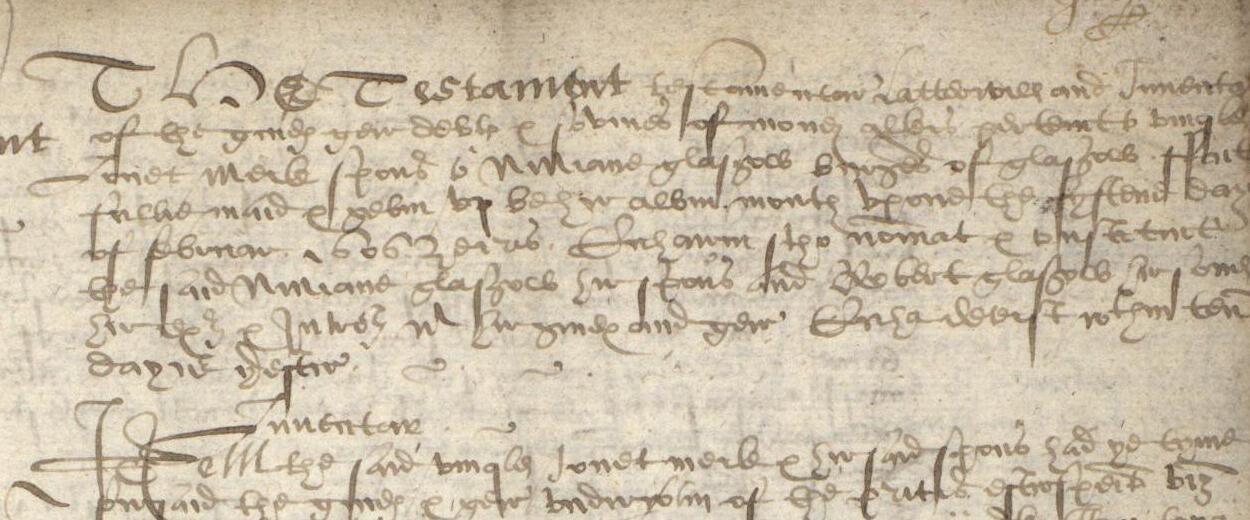
Jonet Meik: why the husband's name is probably Niniane
Does the 1607 testament name Niniane or Williame Glasgow as Jonet Meik's husband, and which relationships can actually be read?
Probable
Niniane remains the better reading. A fresh initial reading as William did not survive comparison with the repeated names and the clerk's tall l strokes. This strengthens the explanation of the maintained reading rather than changing the family tree. Robert is expressly Jonet's son; the disputed letters concern her husband's forename, not Robert's relationship to her.
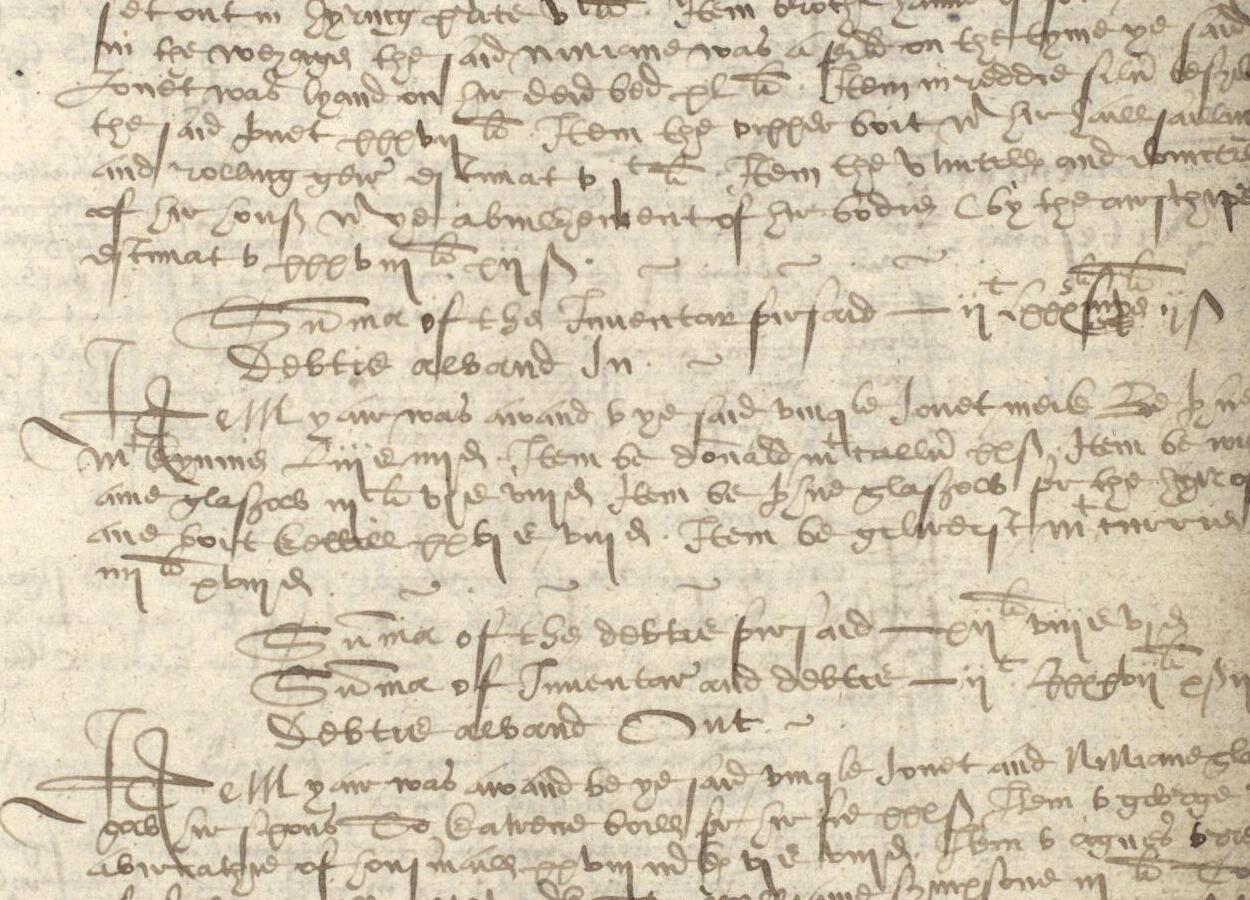
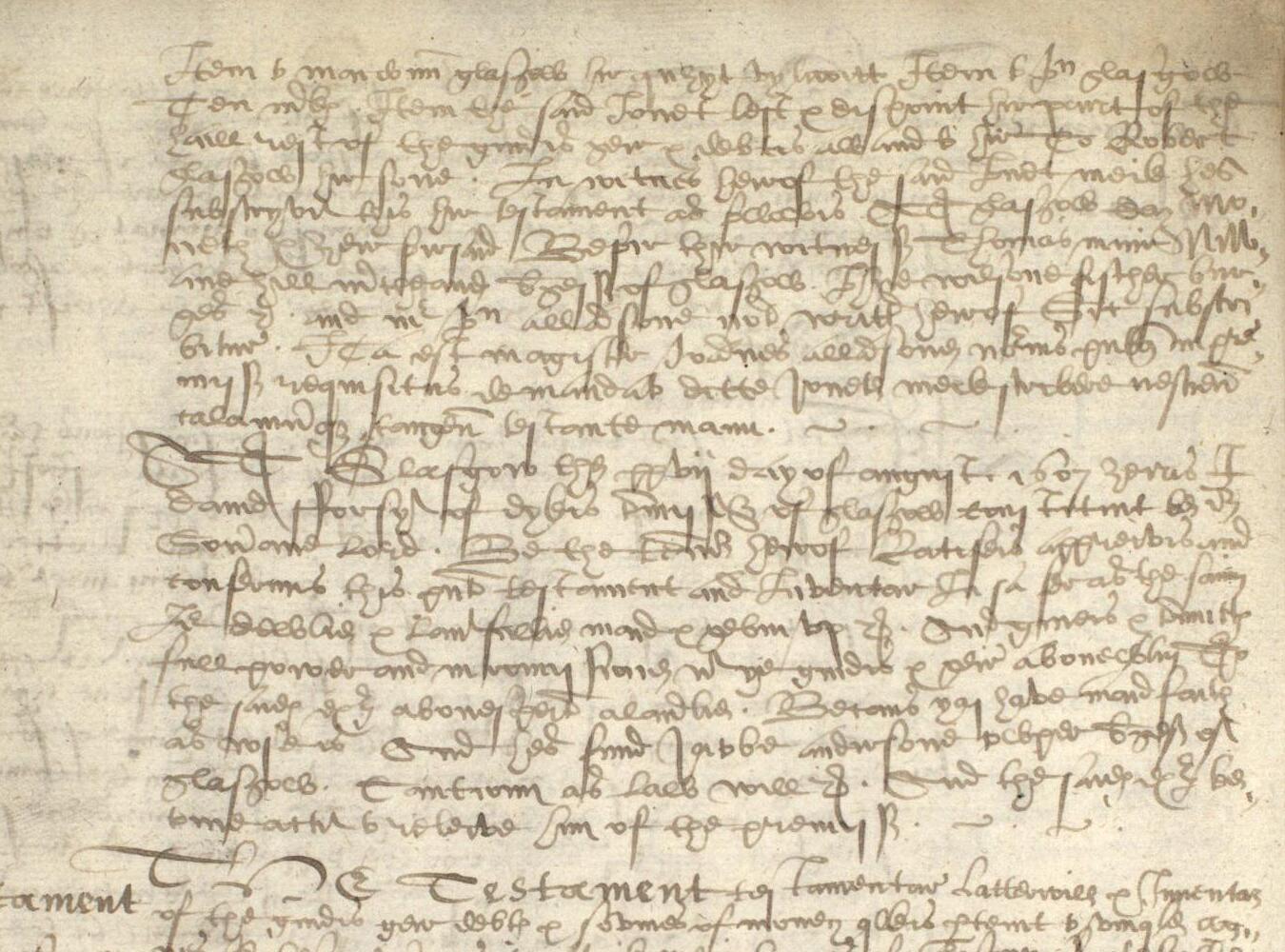
CC9/7/5, image 82: compare the short strokes in the husband's forename with the taller l strokes in latterwill above. The name recurs in the executor clause. This is an unretouched crop, not a reconstructed word.Image 82, lower passage: another occurrence supplies a same-document comparison. Repetition helps test the letter sequence; it does not make an uncertain name certain by itself.Image 83: Robert is again called hir sone in the residue. The words following Marioun Glasgow remain unclear and must not be silently expanded into a niece or daughter relationship.Records, reasoning and search limitsProbable
Established evidence rechecked
Three occurrences favour Niniane rather than Williame, but the reading remains probable.
The opening spouse clause, executor clause and accounting passage share a capital-N-like start, a sequence of short n/i strokes and an apparent ending -ane. The regular paired tall l ascenders expected in a full Williame are not apparent; tall l strokes are visible in the same hand's latterwill. Short repeated strokes can be ambiguous, and no securely isolated same-hand William comparator was established. The letter comparison therefore favours Niniane without claiming certainty or using the expected family as proof.
Robert Glasgow is directly identified as Jonet's son in two different clauses.
The executor passage names Robert Glasgow hir sone; the residue again names Robert Glasgow hir sone. This is explicit maternity, independently of the husband's disputed forename. Identifying this record-defined Robert with other Robert Glasgow records still requires the family and chronology comparison already maintained in the wider study.
The bequest to Marioun does not yet establish a niece, daughter or sister relationship.
The visible name Marioun Glasgow is followed by hir nycht[?] and further uncertain wording apparently introducing a bequeathed object. The ambiguous token is not relationship-grade evidence. Do not automatically identify this beneficiary with the Marioun called Ninian's sister in his 1613 testament, or fill the gap with a kinship term merely because the same surname occurs.
The testament date, death interval and confirmation date must remain separate.
The maintained reading is an oral testament on [15?] February 1606, death an unread number of days afterwards, and confirmation on [27?] August 1607. Today's comparison agrees with that earlier reading. Neither an exact death date nor a February 1607 death should be manufactured from the catalogue year. The uncertain day numbers retain their question marks.
Identify the PDF filed under archival number CC000900007-00005-00082 rather than a personal name
It is the already-maintained Jonet Meik testament, not the missing John Mathie of Ibert original. The other Jonet PDF contains the same archive pages in a different wrapper/compression; the files are not independent witnesses.
Test a fresh William reading against repeated names and same-clerk letterforms
The initial William reading was withdrawn before publication. Niniane remains probable; Robert's explicit relationship and the existing date readings are unchanged.
Leith: four dated child records to compare with the 1662 testament
Which parish entries can test the family of Archibald Glasgow and Agnes Watson, and might they connect the maltman to William Glasgow's shoemaker son?
Unresolved
Public WikiTree biographies provide four precise record leads for children attached to Archibald Glasgow and Agnes Watson: Archibald (1654), John (1656), George (1658) and William (1660). Three names agree with the sons in the inspected 1662 testament. This makes the parish household a useful comparison, but the original parish images have not been inspected in this pass. The profiles' attachment to Archibald born in 1618 is not independent evidence that the maltman and the 1647 shoemaker were one man.
Records, reasoning and search limitsConfirmed / reconfirmed
Result of this search
The official index guide does not distinguish birth dates from baptism dates; the original entry is needed.
Scotland'sPeople explains that its old-parish-register index date may be a birth or baptism date and more usually is baptism. This supports keeping the four profile dates as acquisition leads rather than treating every BirthDate field as a proved birth. NRS coverage information places the dates within the broad surviving South Leith register period, but neither coverage nor a film number proves a particular entry's contents. No original parish image was obtained in this continuation.
Archibald: profile date 8 October 1654; FamilySearch record FQMH-M86.
The public Glasgow-3079 profile names Archibald Glasgow and Agnes Watson as parents and cites the Scotland Births and Baptisms index for Archbald Glasgowe, 1654. Its structured BirthDate is 1654-10-08, but the biography does not establish whether that exact date is birth or baptism. Check the original parish entry before treating it as either. The record image and index details were not independently read in this pass.
John: profile date 27 April 1656; FamilySearch record XY75-RRX.
Glasgow-3516 names the same parents and cites the Scotland Births and Baptisms index for Johne Glasgow, 1656. The exact day comes from the profile's structured BirthDate, not an inspected register. John is not among the three sons named in the 1662 testament. Check both the parish entry and any burial evidence; his omission does not by itself prove that he died before 1662, was unrelated, or has been mistranscribed.
George: reported South Leith baptism 16 May 1658; FamilySearch record FQMH-CXH.
Glasgow-2714 explicitly describes this as a baptism at South Leith and names Archibald Glasgow and Agnes Watson as parents. Unlike the other profiles' date fields, the biography supplies an event type and parish, but this remains a derivative report. Direct retrieval of the FamilySearch record returned an internal error; no register image, witnesses or paternal occupation were available for inspection.
William: profile date 15 October 1660; FamilySearch record FQMH-DD9.
Glasgow-3080 names Archibald Glasgow and Agnes Watson as parents and cites the Scotland Births and Baptisms index for William Glasgow, 1660. Its date field supplies 1660-10-15; birth versus baptism and the register wording still need inspection. A matching name among the 1662 sons supports the household comparison, not an automatic identification of the father with the earlier shoemaker.
The 1646 Margaret Hilstones marriage is a separate, precisely cited comparison target, not a proved first marriage of Agnes Watson's husband.
The current Glasgow-3078 biography cites Archbald Glasgow and Margaret Hilstones, 14 April 1646, South Leith OPR 692/2, 90/310, FR3086. This is a parish marriage reference, not an Edinburgh commissary testament reference. The original should be compared for occupation and identifying associates. A remarriage is possible; neither it nor a supposed clerical substitution of Agnes's name has been demonstrated.
Robert Glasgow and Euphame Lorimer's 1666 Edinburgh burgess entry is not evidence of kinship with the Leith Archibalds.
The printed roll identifies Robert as a cordiner admitted through his wife Euphame, daughter of the late Andrew Lorimer, beltmaker. It does not name Archibald or a Leith family relationship. This entry was already cited locally. A contradictory automated statement in Glasgow-3938's findings has now been corrected: the secure Robert-Euphame household must not be automatically assigned to the Robert who married Jonet Thomsone in 1652. The underlying transcript is retained as identity-separation evidence, with no attachments changed.
NRS parish-register coverage and alternative film-catalogue access
South Leith OPR 692/2 has early coverage beginning in 1599. A secondary film catalogue identifies GS film 1067770 for an early register and films 1067770-1067781 for the wider parish-register/index run. These are acquisition leads, not exact image references for the four children. Confirm each record's parish and event type. No authenticated image access was available.
Read the current public Glasgow-3078 biography and the child/sibling biographies returned for Glasgow-2714
Recovered the dated four-child checklist and the exact reported 1646 marriage citation. Profile relationships and dates are derivative leads, not independent confirmation of the father's identity.
Find local findings.md dossiers for Glasgow-2714, Glasgow-3079, Glasgow-3080 and Glasgow-3516
None of those four specific handoff files exists. This does not establish that no relevant evidence exists elsewhere in the repository.
Open George's cited FamilySearch record FQMH-CXH and search for independently available parish evidence
The direct page returned an internal error; targeted web searches returned no usable historical record. No primary parish image was inspected and no absence-of-record conclusion follows.
Compare the Edinburgh burgess entries with existing James and Robert Glasgow dossiers
James Glasgow's 20 June 1649 admission, repeating the 16 June 1641 apprenticeship to William Sclaitter, is already documented under Glasgow-1150. Robert's 4 July 1666 admission is also already recorded. Neither is a new discovery; the useful new outcome was correcting the conflicting Robert profile assignment.
Archibald Glasgow of Leith: shoemaker and maltman identity test
Can Archibald Glasgow, son of William Glasgow the Leith mealmaker and documented as a shoemaker in 1647, be identified as Archibald Glasgow, maltman and indweller in Leith, whose 1662 testament names Agnes Watson and sons Archibald, George, and William?
Unresolved
The identity remains unresolved. The 1639 apprenticeship, William Glasgow's 1646 testament, and the 1647 retour securely identify one Archibald Glasgow of Leith as William's son and a shoemaker. The 1662 original testament securely identifies an Archibald Glasgow of Leith as a maltman, husband of Agnes Watson, and father of Archibald, George, and William, but it gives no parentage, former occupation, guild status, property history, or other statement connecting him to William's son. The uncommon name, same town, and compatible chronology make identity possible, but they do not overcome the explicit occupational discontinuity. No marriage, child baptism, deed, property record, or guild record bridging the two descriptions was found in this bounded pass; a change from shoemaker to maltman must not be assumed.
Records, reasoning and search limitsConfirmed / reconfirmed
Established evidence rechecked
On 23 October 1639 Archibald Glasgow, son of William Glasgow, mealmaker in Leith, was entered as apprentice to Thomas Park, cordiner.
A digitized scan of the printed apprentice-register transcript reads: "Glasgow, Archibald, son to William G., mealmaker in Leith, with Thomas Park, cordiner." This is a derivative printed transcript of the burgh record, not the original minute.
William Glasgow's testament connects the 1639 apprentice's stated father to an Archibald Glasgow who was William's lawful son and sole executor.
The original commissary-court scan describes William Glasgow as a mealmaker and indweller in Leith and records Archibald Glasgow as his lawful son and only executor dative. It supplies no occupation for Archibald, so it supports the father-son chain but does not bridge the later trades.
On 1 May 1647 Archibald Glasgow, shoemaker and inhabitant of Leith, was retoured heir of William Glasgow, mealmaker and inhabitant there, his father.
The digitized scan of the printed official retour abstract reads: "ARCHIBALDUS GLASGOW, calcearius incola villæ de Leith, heres Willielmi Glasgow farinarii incolæ dictæ villæ, patris." Calcearius identifies Archibald as a shoemaker. This is a published abstract referencing, but not itself reproducing, original retour xix.128.
The 1662 testament belongs to Archibald Glasgow, maltman and indweller in Leith, and names Agnes Watson and lawful sons Archibald, George, and William.
The original commissary-court scan opens with "Archibald Glasgow maltman Indweller In leith". It identifies Agnes Watson as his spouse/relict and tutor and Archibald, George, and William as his lawful sons and sole executors. The record does not name his father and does not call him a shoemaker, cordiner, or former shoemaker.
No source found in this pass bridges the shoemaker documented in 1647 to the maltman documented in 1662.
The local dossier and cached record corpus contain the two endpoint descriptions but no marriage, baptism, sasine, deed, guild entry, or property statement using both occupations or supplying the 1662 man's parentage. Targeted exact-name, spouse, child-mother, trade, and NRS catalogue searches returned no relevant historical record. This is a bounded negative result, not proof that no bridge exists.
The current association of the 1662 maltman testament with WikiTree profile Glasgow-3078 is not independently proved by the records examined.
Same uncommon name, Leith residence, and a fifteen-year interval are compatible with one man, but the only explicit occupations differ: shoemaker in 1647 and maltman in 1662. The 1662 record lacks the father William or another unique identifier, and cached profile data only repeats the attachment rather than supplying a primary bridge.
Unread local Glasgow-3078 dossier, profile cache, and research plan
Found a secure 1639-1647 father-son and shoemaker chain and the separately described 1662 maltman family, but no bridging record. The profile attachment is derivative and does not resolve the conflict.
Cached repository records for exact Archibald Glasgow/Agnes Watson combinations, children Archibald, George, and William, and shoemaker/maltman role overlap
No independent marriage, baptism, guild, deed, sasine, or property record bridging the identities was located.
Exact web searches for Archibald Glasgow with Agnes Watson or Watsone in Leith
No relevant historical result; returned results were unrelated people or later periods. Failed search, not negative proof.
Exact and variant web searches combining Archibald Glasgow with shoemaker, cordiner, maltman, or Thomas Park
No source spanning the occupations was returned. Failed search, not negative proof.
Indexed web searches for George Glasgow or William Glasgow with mother Agnes Watson in Leith
No relevant baptism or family index entry was returned. Failed search, not negative proof.
National Records of Scotland online-catalogue web index for exact Archibald Glasgow in Leith
No relevant catalogue item was returned; visible hits were unrelated records. This does not search unindexed record contents.
Internet Archive scan of the printed Edinburgh apprentice register
The known volume and page citation are preserved in the local dossier; direct browser retrieval returned an internal error in this pass. It remains a digitized derivative transcript rather than the original burgh minute.
Internet Archive scan of the printed retour abstracts
The known volume, retour number, date, and exact Latin abstract are preserved in the local dossier; direct browser retrieval returned an internal error in this pass. It remains an official published abstract rather than original retour xix.128.
Montfoid: test the rent clause before joining the families
Is Bessie Robertson's 1610 confirmation the unnamed Montfoid tenant's testament quoted by Paterson, and can it help identify her husband John Glasgow?
Unresolved
A published extract gives a testable lead: an unnamed Montfoid tenant, said to have died in February 1606, owed Lady Jean Boyd one boll of rent meal, and the testament was confirmed on 17 August 1610. Bessie Robertson, spouse of John Glasgow in Montfoid, has the same confirmation date in the testament calendar. The shared estate and date make her testament worth comparing, but the extract omits the tenant's name. No death date or migration to Quothquan is proved by this match alone.
Records, reasoning and search limitsConfirmed / reconfirmed
Established evidence rechecked
The calendar identifies Bessie Robertson as John Glasgow's spouse in Montfoid on the record confirmed 17 August 1610.
The existing calendar citation identifies the spouse and locality. It does not give a marriage date, establish the husband's parentage, or identify him with the later Quothquan deceased. The current Bessie profile is Robertson-33965; no new spouse profile is needed. Its sparse biography adds no independent death evidence.
Paterson describes an unnamed estate tenant's February 1606 death and a distinctive rent creditor, not a named Glasgow death.
The text across printed pp. 53-54 discusses Hugh Montfoid of that Ilk and his wife Jean Boyd. It reports Lady Montfoid as creditor for a boll of rent meal in an unnamed tenant's testament, gives that tenant's death as February 1606, and gives confirmation as 17 August 1610. The death clause refers to the tenant, not to Hugh or Jean. Neither Bessie Robertson nor John Glasgow is named in this passage. This is a nineteenth-century account quoting an earlier record, not the original testament itself.
The rent clause supplies a stronger comparison than surname or confirmation date alone.
Obtain Bessie's original and look for Jeane Boyd, Lady Montfoid, as creditor for ane boll of ferme meill, together with the opening death clause and confirmation. If those distinctive details agree, the unnamed printed extract can be assigned much more securely. Until then, keep February 1606 as a candidate comparison date, not Bessie's death field. A court may confirm several estates on the same day.
The Montfoid husband, the Mid Calder father and the Quothquan deceased remain a three-record identity hypothesis.
The 1610 Montfoid calendar proves a spouse pair; the 1608 and 1609 Mid Calder baptism records name a local father John; the 1650 Quothquan testament identifies John and his sister Bessie Glasgow. None of these records supplies the missing cross-place link. Bessie the spouse Robertson and Bessie the sister Glasgow have different documented roles and must not be conflated. Preserve the existing uncertain working attachments while seeking a deed, tenancy succession or testament clause naming a second locality or the relevant relatives.
Read the antecedent of the search snippet beginning with 1606 on printed p. 54
The full pp. 53-54 passage concerns Hugh Montfoid and Jean Boyd and quotes an unnamed tenant's testament. It does not name a Glasgow. The complete context prevents the tenant's death from being assigned to the wrong person.
Identify the existing Bessie Robertson profile through the public WikiTree API
Glasgow-3296's spouse is Robertson-33965. Her biography cites the printed testament calendar; her death field is empty. No original-image or death-date evidence was added by that biography.
Find a source route that could prove the Montfoid-to-Quothquan identity
The recovered passage supplies a specific original-testament comparison, but no cross-place family link. A proposed move is not established by this bounded search.
The missing protocols: John Glasgow's neighbouring properties, 1556-1557
Do protocols 307 and 402 supply the missing family connection among the early Glasgow burgesses?
Unresolved
The correct second volume has now been recovered and both entries examined in its digitized printed text. They name John Glesgw as a neighbouring landholder, not as a party transferring property or as a witness. They improve the property chronology, but neither supplies a Glasgow parent, spouse or sibling. Existing probable family connections remain probable: these entries neither prove nor disprove them.
Records, reasoning and search limitsConfirmed / reconfirmed
Result of this search
On 6 August 1556, John Glesgw's land formed the eastern boundary of property sold to Andrew Morsoune and Jonet Gilleis.
Protocol 307, printed p. 15, describes Allan Roger and Jonet Scheles as spouses and the purchasers Andrew Morsoune and Jonet Gilleis as spouses. The back tenement and adjacent yard have John Glesgw's land on the east, Thomas Bargille on the south and Richard Ros on the west. John is a boundary reference only. No Glasgow-name person occurs in its witness list. This reading is from the digitized published abstract, not an inspection of the original manuscript.
On 22 November 1557, John Glesgw again appears as an eastern neighbour; the explicit father-son relationship belongs to the Bargilly family.
Protocol 402, printed p. 41, records John Bargilly receiving sasine as heir of his deceased father Thomas Bargillye and selling the back-tenement piece to James Schelis, mason. Andrew Morsoune bounds it on the north and west, Patrick Patersoune otherwise Schelis on the south, and John Glesgw on the east. The repeated neighbouring owners help trace the locality. The father named in this entry is Thomas Bargillye, not a Glasgow. John Glesgw is neither a party nor a witness.
A boundary name must not be converted into a family relationship or a fresh proof of personal survival.
An adjoining property can continue to be described by a previous owner's name. These entries securely attest the boundary descriptions, but do not independently establish John's parentage, prove he was present or alive on either transaction date, or uniquely identify him with an existing WikiTree profile. The established William-to-John relationship rests on the separately cited direct records, not these two boundaries.
Find the actual digitized volume containing protocols 307 and 402 rather than guessing an Internet Archive volume number
Recovered Internet Archive item abstractsprotoc04robegoog. Its title page identifies vol. II, William Hegait's Protocols, 1555-60; both target entries and printed-page citations are present. The identifier's '04' is not the printed volume number.
Distinguish explicit Glasgow kinship from property bounds and other families' kinship
Both Glasgow references are eastern boundaries. The express spouses in 307 and father-son succession in 402 concern other surnames. No additional Glasgow kinship established.
1534-1633 · property, marriage and burgess evidence
Start with the family the records actually connect
William Glasgow and Esbell Brade provide a firmer starting point than an assumed universal ancestor called John Glasgow, born about 1475. Their descendants can be followed through explicit parent-child property transactions. The surrounding fisher and Herbesoun families probably belong to the same immediate kin group, but their exact places need a different confidence label.
Confirmed / reconfirmed
William Glasgow + Esbell Brade → their son John
On 31 December 1534 William, with Esbell's consent, transferred property to their son John and John's wife Jonet/Janet Spreull, reserving their own liferents. Protocol 1196 explicitly supplies the parent-child link; it is not inferred from neighbouring property.
This does not identify William's father. The older John in the same property block remains a separate identity and parentage problem.
The maintained protocol sequence names John's father William in 1564, John's son William in 1565, Stephen as late John's son and Jonet as his mother in 1575, and George as younger William's heir in 1586. The 1586 follow-up expressly calls Margaret Herbesoun George's mother.
Stephen's relationship to George follows by combining those parent-child records, not merely from Stephen acting as curator. Jonet's stated maternity of Stephen should not silently be extended to every son of John.
Robert the fisher, Archibald and Isobella: probable siblings of John
Repeated adjoining properties, the fishing trade, witnesses and the Herbesoun in-law network support Robert Glasgow, Archibald Glasgow and Isobella Glasgow as probable children of William and siblings of John. This is a meaningful family hypothesis, stronger than a single shared surname.
No inspected clause explicitly calls these three William's children. Close collateral kin remain an alternative. Elizabeth Glasgow, wife of Alexander Kaine, has weaker support and should not receive the same probability label automatically.
George + Margaret Stewart; daughters Jonat and Margaret
Protocol 3492 records George's marriage contract with Margaret, daughter of Alexander Stewart, on 13 November 1598. The burgess admissions of John Stewart in 1624 and James Stewart in 1633 identify their wives Jonat and Margaret respectively as daughters of George Glasgow, merchant.
The admissions establish George's fatherhood, not the daughters' mother. The Mid Calder baptism of a George in 1605 is a different record and should not be substituted for this adult merchant.
1596-1613 · Glasgow fishers and two testament households
Ninian's family is clearer than his supposed descendants
The burgess register gives Ninian a father; the testaments give him siblings, a wife and a son. The crucial distinction is between a securely stated relationship and identifying the particular same-named person on the tree.
Confirmed / reconfirmed
Robert Glasgow, fisher → Ninian, his second son
The 23 October 1596 admission expressly identifies Ninian as Robert Glasgow the fisher and burgess's second son. That wording was independently recovered in the published register text during this pass.
The documentary father is secure. Identifying him with Robert Glasgow-1096 is strongly supported by the maintained locality/trade research, but the admission does not identify Robert's own father or Ninian's mother. Nor does second son identify which surviving brother was older.
The 1613 original directly calls Robert his son, John his brother and Marioun his sister. Jonet Hutchesoun is called his spouse. These are explicit kin terms rather than deductions from executorship.
Full versus half siblings is unstated. John of Hirmenschelis, already dead by 1577, is not a viable identification for the brother receiving a legacy in 1613. A match to Glasgow-1030 is also not established by this clause.
Jonet Meik → son Robert; probable Ninian household connection
The 1607 record twice calls Robert Jonet Meik's son. Her husband's crowded forename is probably Niniane; the surname and Glasgow burgess context fit the Ninian household. Combined with the 1613 son Robert, this is a strong household reconstruction, while the forename and cross-record identities remain distinguishable from the direct maternity wording.
Jonet Hutchesoun, the later spouse, must not automatically replace Jonet Meik as Robert's mother. Marioun in the 1607 will has an unresolved following word; do not identify her as daughter, niece or Ninian's sister merely from her name.
A possible William occurrence and support wording survive near the damaged part of the 1613 record. The decisive kinship words are physically lost; another William occurrence in accounts does not restore them.
Neither sonship nor the identity of the Leith mealmaker can be confirmed from this damage. The old statement that the manuscript clearly says his son William is superseded.
1618-1662 · apprenticeship, probate and service as heir
A secure father and son, with an occupational identity question
The Leith line does not depend on recovering Ninian's damaged words. William the mealmaker and Archibald the shoemaker are connected by independent records. The 1662 maltman's household is also explicit, but equating that man with the earlier shoemaker needs to remain visible as a separate question.
Confirmed / reconfirmed
William, mealmaker → Archibald, apprentice and shoemaker
Archibald's 23 October 1639 apprenticeship names William Glasgow, mealmaker in Leith, as father and Thomas Park, cordiner, as master. William's testament, confirmed in 1646, calls Archibald his lawful son and sole executor. The 1 May 1647 retour again calls William his father, distinguishing both men's occupations and Leith residence.
The 1618 South Leith baptism is compatible with this established identity chain. The independent apprenticeship and retour provide the more discriminating evidence. William died in September 1644, not in the 1646 confirmation year.
Archibald, maltman + Agnes Watson; sons Archibald, George and William
The 1662 testament explicitly names Agnes as spouse and the three Glasgow boys as his lawful sons. The will was made in January; the opening records death in February and confirmation in May. These are distinct events.
The manuscript itself does not establish that this maltman was the shoemaker in the 1647 retour. A change of trade is possible, but possibility is not the missing identity record. Retain the maintained Glasgow-3078 association as an identity comparison, not a new proof.
Thomas, weaver in Edinburgh, helps oversee the minor sons and writes the will; William, weaver in Leith, appears as a creditor. They are useful collateral candidates because of their names, places and roles around this household.
Neither role says brother. Captain George Cock is also an overseer; an office held alongside a namesake is not a kinship formula. The adult creditor William must not silently be confused with Archibald's minor son William.
1571-1637 · Corsinkell, Stevenston, Chaplehill and Saltcoats
A local network, not yet one proved pedigree
The Ayrshire evidence supplies a named father-and-sons group at Corsinkell and separate Wilson, Weir and Glasgow households nearby. Geillis's debt to James Glasgow in Stevenston is a promising point of contact, but it is not a statement that the women were his daughters or sisters.
Confirmed / reconfirmed
James Glasgow elder → sons James and John at Corsinkell
NRS GD39/5/59, dated 9 February 1571, describes the Corsinkell occupiers as James Glasgow elder, James and John his sons, and Christian Campbell. This is an explicit relationship in the archival catalogue abstract, unlike an inferred family assembled from rent payments.
The catalogue description was recovered in indexed search during this pass; the original deed was not inspected. The men's relationship to later Stevenston James or to Geillis and Katherine remains open. Christian Campbell's inclusion does not identify her as a wife or mother.
Geillis + Thomas Wilson; James, Isobell and Bessie Wilson
Geillis's spouse Thomas acts for named executors James, Isobell and Bessie Wilson. The compressed words after James remain unresolved. Her estate owed money to James Glasgow in Stevenston, placing him in the same local economic network.
A tempting provisional reading of son was withdrawn after closer inspection. The executor group is clear; its exact kinship is not. The debt establishes the direction of the financial relationship, not ancestry.
Katherine Glasgow + Thomas Weir; the three minor Weirs
William, James and probably Jonet Weir are minor executors associated with Katherine and her husband Thomas. Their names, minority and the household context make them very probably the couple's children.
No secure child term has been recovered. Describe probable children explicitly rather than either promoting them to proved or treating them as unrelated. No reviewed clause makes Katherine and Geillis sisters.
John of Saltcoats → Katherine and Agnes; widow Isobell Gray
The 1637 testament repeatedly calls Katherine and Agnes John's lawful children and calls him their father. Isobell Gray is his widow; John Broune the sailor is cautioner.
The daughter is Agnes, not Mary. The record does not establish the widow's maternity. Do not import this household into the Glasgow-1030 and Jonet Mathie family merely because both men were sailors.
1577-1641 · Hirmenschelis, Croftmalloch and Corstoun
Use the children and land, not just the repeated forenames
The newly revisited continuations strengthen the household evidence. They do not turn three separate Lothian records into successive generations of one family. The best connecting evidence will identify the same child, spouse or holding in a later record.
Confirmed / reconfirmed
John of Hirmenschelis → Katherine and probable Androw
The genuine continuation, image 277, again names Katherine and the probably read Androw Glasgow as executors to late John, their father. It supports the child relationship independently within the same testament, not as a separate historical source.
Androw's forename remains qualified. The unrelated Andrew Hutcheson screenshot appended to the PDF is excluded. No inspected record identifies this child with Andrew who died at Corstoun in 1598.
The 1580 record repeatedly calls Cuthbert Margaret's son. Margaret was sometime wife of John Edstoun at Croftmalloch, but the son's own surname is Kaddell/Keddell, not silently Easton. The reread also clarifies financial associates Michael Mertyn and Roland Dundas.
Cuthbert's father is not stated. A previous Kaddell union is a research hypothesis, not an identified husband. The clearer account names are useful for tracing the locality but do not create relatives.
Andrew + Elizat Stevinsoun → Robert; daughters Marion, Jonet and Isobel
Image 124 explicitly identifies Robert as Andrew's son begotten upon Elizat, his wife. The record also names the three daughters and a conditional provision if Elizat was pregnant. The will is dated 6 February 1597/8, followed by Andrew's death on 7 February; confirmation was 10 July 1598.
Robert's maternity is explicit here, unlike many widow-and-children clauses. The conditional unborn child is not a proved birth. Corstoun is the printed index's normalization; the manuscript place remains provisionally read as Corsoun.
Robert of Corstoun and Robert of Wester Duddingston
The 16 June 1641 apprentice entry names James as son of Robert Glasgow, servitor to William Crichtoun in Wester Duddingston, apprenticed to William Sclaitter, weaver. This is an explicit later father-son household and supplies an employer and master to trace.
It does not call Robert a son of Andrew or connect him to Corstoun. The matching forename alone is insufficient to identify the 1598 child with the Duddingston father. Keep the two documented Roberts separate pending a bridge.
Separate the Johns before building another generation
Quothquan is a valuable locality anchor, but it cannot erase three different probate histories. The 1650 sibling clause is particularly useful. Later executors and court officers must not be turned into sons simply because they manage a Glasgow estate.
Confirmed / reconfirmed
John in the 1650 case ↔ Bessie Glasgow, his sister
The supplied continuation names Bessie Glasgow in Quothquan as executrix to late John Glasgow, her brother. This gives a real sibling pair even though the opening page is missing.
The missing opening prevents recovering every identifying detail. It does not license merging this deceased John with the John who died in 1661 or the later 1685 case.
The renewed name audits distinguish the personal names from their probate roles. In particular, Thomas's description in the 1662 material is not a secure sonship clause; the William 1673 executor and caution names should be read in their procedural context.
Neither a sole executor nor a cautioner is automatically a child or sibling. Use the case audit for the revised readings rather than inherited tree labels.
John of Quothquan + widow Jonet, surname still under review
The 1685 original supplies a widow, Jonet, and identifies the estate's legal participants. William Wilkie is a procurator fiscal and William Watson a cautioner, not documented Glasgow relatives.
The widow's surname remains qualified in the manuscript audit. No direct child or parent relationship has been recovered here; existing attached children are not confirmed by this testament.
Before 1500 and beyond Scotland · boundaries of the evidence
Do not turn a research container into a common ancestor
The earliest useful family model is a set of documented households and probable kin groups, not a single all-encompassing root. A large early profile can collect uncertain research branches without proving it fathered every branch attached beneath it.
Unresolved
The several early Johns are not one proved man
The maintained medieval research distinguishes Glasgow burgess John de Glasgu in 1447/1455, John Glasgw witnessing Stirling records in 1475/1479-80, John de Glasgow alias Smith in a 1506 transaction, and the older John in later Glasgow property titles.
No inspected chain joins all these identities or makes them the ancestor of every later Glasgow bearer. Alias Smith does not itself prove the man's occupation or a father-son relationship with another Smith.
The newly resolved names improve the Scottish households against which later migration candidates can be tested. They do not provide a named emigrant linking these families to the early Irish roots.
A Y-DNA cluster can guide paternal-line comparisons, but does not select a particular sixteenth-century father or supply an undocumented Scotland-to-Ulster generation. No such migration or universal-founder link is claimed by this pass.
Glasgow burgh: find the missing kinship-bearing conveyance
The probable Robert/Archibald/Isobella sibling group has repeated property and in-law support. One explicit inheritance or sibling clause could connect a large part of the earliest burgh families.
Leith: bridge the shoemaker and maltman without assuming a trade change
William-to-Archibald is secure. A marriage, deed or guild record carrying Agnes Watson and a trade identifier could determine whether the 1662 sons extend that same line.
Corstoun: follow Andrew's widow and Robert's succession
The testament gives a specific mother, father, child and holding. A later tenancy transfer could identify Robert and distinguish him from the Duddingston father.
Ayrshire: follow the particular James Glasgow of Stevenston
Geillis's creditor and the named Corsinkell father-and-sons group are concrete targets. A rental or testament identifying the same James could connect the Wilson and Weir networks without inventing siblings.
Ninian and Quothquan: resolve the named siblings
John and Marioun in 1613, and Bessie with her deceased brother in 1650, are relationship-bearing leads. Distinguishing these people will do more for the tree than treating every executor or creditor as family.
Back to the handwriting
15 cases reconsidered
The audit includes creditors, witnesses, executors and unresolved names, not just people already placed in the family tree. Findings include reconfirmations; they are not all newly discovered people.
This is an LLM-assisted working reading. Some important names remain uncertain because strokes overlap, the scan is faint or the physical leaf is damaged. Brackets are not decorative: they preserve those limits.
The 15-case scope includes 14 testament cases and one baptism. Duplicate PDFs are not independent corroboration; repeated wording within one testament is still one source.
Every supplied page being considered does not mean every word or sum was deciphered. John 1650 still lacks its opening leaf. The 1577 John PDF also contains one unrelated screenshot, excluded from his evidence.
Confirmed readings, proved kinship and cross-record identity are different questions. The status on each relationship card is qualified by its accompanying text; the name-audit statuses must not be copied into tree relationship settings automatically.
Some wider evidence is carried forward from maintained research, not newly inspected manuscripts. Source notes below distinguish fresh original readings, published-record text, archival catalogue descriptions and prior research.
No live WikiTree profile was edited or detached in this pass. Live profile access was unavailable, so current attachments were not reverified. No claim is made that all early families or every illegible name have been solved.
Renwick, Abstracts of Protocols: vol. IV no.1196 (31 Dec1534); vol.III nos.805 and847 (1564-65); vol.VII no.2189 p.110 (17 Jun1575); vol.IX nos.2903 p.103 and2916 p.107 (1586). Probable sibling assessment uses the additional adjoining-property and Herbesoun evidence documented in the maintained local kinship-circle page.
Protocol1196 rechecked in saved primary-edition OCR on10Sep2026. Other protocol readings and the probable kin assessment carried forward from research/free-space-pages/pages/020-glasgow-kinship-circle.wiki; not a fresh collation of all manuscripts.
Published1925: p.24, Ninian23Oct1596; p.61, John Stewart25Nov1624; p.86, James Stewart18Jul1633. The latter two admissions name daughters of George Glasgow, merchant.
Public edition text independently downloaded and consulted10Sep2026; exact page references also preserved in the existing profile source extracts. OCR is a finding aid, not a new manuscript transcription.
13Nov1598, printedpp.86-87: George Glasgw's marriage contract with Margaret Stewart, daughter of Alexander Stewart, with Dowhill and Briggate property.
Carried forward from the maintained source extract research/Glasgow-1099/sources/1598_protocol_3492_extract.txt; not freshly collated with the manuscript.
Archibald, son of William Glasgow, mealmaker in Leith, to Thomas Park, cordiner23Oct1639; James, son of Robert Glasgow, servitor to William Crichtoun in Wester Duddingston, to William Sclaitter, weaver16Jun1641.
Published-record text independently downloaded and consulted10Sep2026. The1639 entry also has a maintained Findmypast transcript capture in Glasgow-3078/findings.md.
Inquisitionum...Abbreviatio, vol.II, General Retour3278, originalxix.128: Archibald, shoemaker in Leith, heir of William, mealmaker in the same town, his father.
Latin published-abstract text independently downloaded and consulted10Sep2026. The OCR mangles the item number; the existing source citation and following3279 supply the catalogue numbering. Original retour not newly inspected.
Letters of reversion concerning rent from Corsinkell in Stevenston; catalogue names James Glasgow elder, James and John his sons, and Christian Campbell among occupiers.
NRS indexed catalogue description retrieved10Sep2026. Direct catalogue fetch was unavailable; original deed not inspected.
Separate medieval and early-modern documentary people; no universal John1475 pedigree or named Scotland-to-Ireland bridge established by the testaments.
Local maintained research consulted10Sep2026; medieval originals and live WikiTree attachments were not newly inspected in this pass.