Skip to page content
Catalogue · 08 Sep 2026

Illustrated manuscript reading

Johne Glasgow, Hirmenschelis: inventory and confirmation

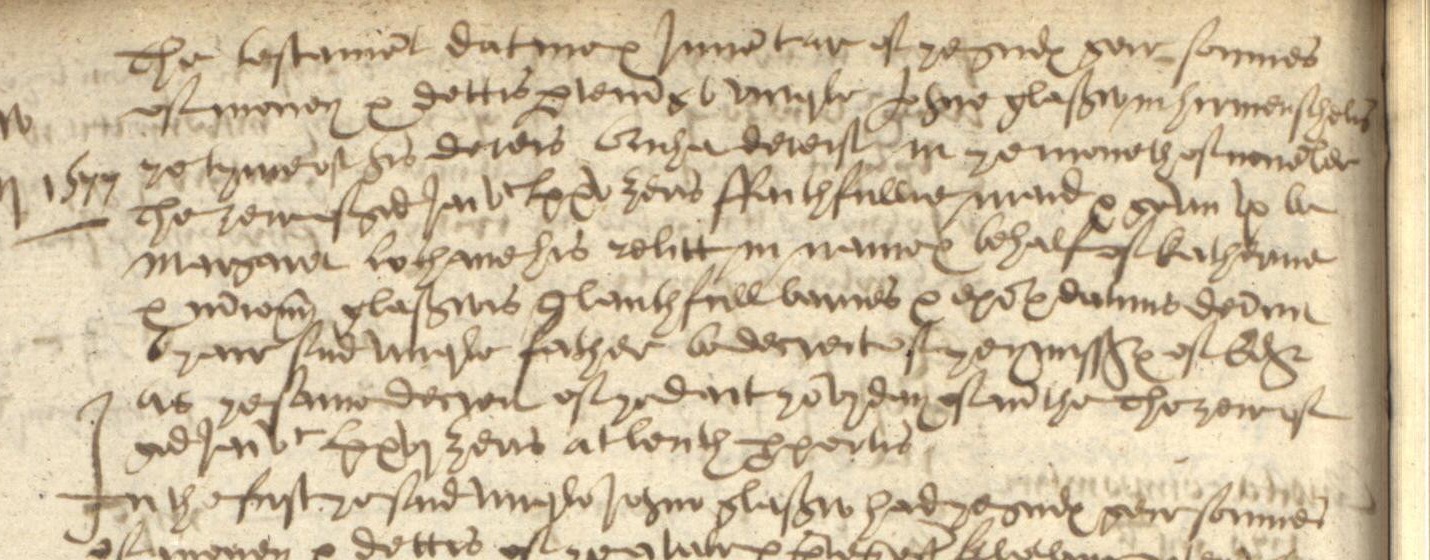
4 May 1577 (marginal court date); death in March, year unresolved

NRS Edinburgh Commissary Court CC8/8/5, images 276-277; both record images freshly reviewed

Second manuscript pass · 10 September 2026

The names, reconsidered

New readings and unchanged uncertainties are both recorded. A confirmed name or role does not by itself confirm a WikiTree identity or a relationship.

Read the name and relationship audit (8 findings, not a count of unique people)
Unresolved

Margaret [surname unresolved]; Hoghame-like and Cochrane-like surname parses remain alternatives; the possessive before 'lauchfull barnis' is [his/thair?]

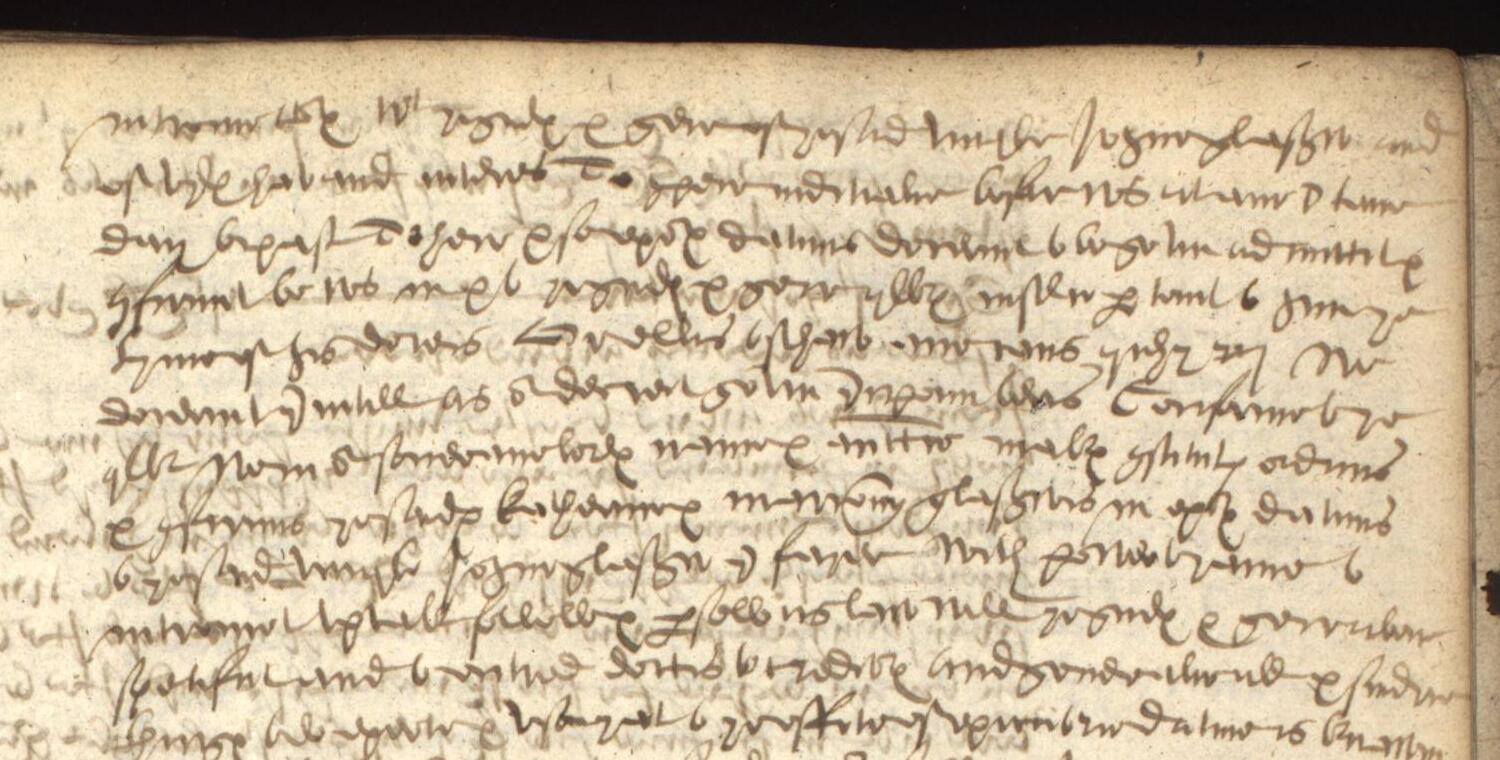
image 276 opening

Earlier reading / question
Margaret [Cochrane?] / surname unresolved; children described with [his?]
Why this reading
The given name and following 'his relict' are clear, but intrusive strokes and crowded joins prevent a defensible surname segmentation. The separate possessive before 'lauchfull barnis' is not securely distinguishable as 'his' or 'thair'.
Effect on the family
Confirms Margaret as John's widow. If the disputed possessive is 'thair' with John and Margaret as antecedent it could support maternity, but the visible letters do not make that direct evidence secure.
Confirmed / reconfirmed

m[ar]iory Glasgow (Marjory)

image 276 opening and image 277 confirmation

Earlier reading / question
Superseded model reading: Androw[?] Glasgow
Why this reading
Accepted supplied human reading by Double_Show_9316, endorsed by the project owner on 10 September 2026. The unsupported initial a and earlier Androw-specific segmentation are retired. The confirmation repeats the name group within the same record, not as a separately established diplomatic spelling.
Effect on the family
Marjory is a named lawful child of John. Acceptance of her name does not prove a later profile identity or Margaret's maternity.
Probable

Hirmenschelis-like manuscript form; normalized place unresolved

image 276 opening and outgoing rent debt

Earlier reading / question
hirmenschelis[?]
Why this reading
The place recurs after John and in the rent-creditor entry, but internal minims remain ambiguous.
Effect on the family
Places John's estate in a rural tenancy context but does not connect him to another Glasgow family.
Confirmed / reconfirmed

Katherine and Marjory Glasgow are lawful children and executors to the late John, their father

image 276 children clause and image 277 confirmation

Earlier reading / question
Superseded child-name reading Androw; confirmation previously not freshly read
Why this reading
The children/father wording on image 276 is repeated in the same testament's confirmation. The second child's accepted name is supplied by the human m[ar]iory reading; the old Androw interpretation is superseded.
Effect on the family
Confirms John as their father; the second occurrence is corroboration within the same record, not an independent source.
Probable

James Stevinsoun [probable] of Hirmenschelis-like place; Thomas Kerslaw [probable], servant; Katherin Glasgow, servant

image 276 outgoing debts

Earlier reading / question
James Stevinsoun[?], Thomas Kerslaw[?], Katherin Glasgow servant
Why this reading
The role words, rent and fee contexts are clear; the first two surnames remain palaeographically qualified.
Effect on the family
These are creditors/servants, not stated kin. Katherin the servant cannot be merged with Katherine the child from this wording alone.
Unresolved

Alexander Paterson and William Douglas are the clearest; Patrick, Henry, William Flint-like, John surnames/localities, Baillie, Mathie and Murray entries remain partly unresolved

image 276 incoming debts

Earlier reading / question
Patrick [surname], Henry [surname], Alexander Paterson, William Flint?, William Douglas, several Johns, William Weir, Baillie/Mathie/Murray entries
Why this reading
Full-section enlargement distinguishes several forenames and two surnames, but crowding and account strokes defeat safe completion of every name/place.
Effect on the family
Financial associates only; no kinship is inferred from debt entries.
Rejected reading or match

separate Andro Hutcheson confirmation fragment

nested PDF page 3

Earlier reading / question
possible continuation because the download header was reused
Why this reading
The manuscript margin reads as a confirmation of Andro Hutcheson and its physical fragment differs from image 277; the header is reused metadata.
Effect on the family
Prevents importing Hutcheson names or wording into John's family.
Unresolved

court date 4 May 1577 confirmed; death month March confirmed; death year and April decree day unresolved

image 276 dates

Earlier reading / question
death in March, year unresolved; appointment day unresolved
Why this reading
The marginal day/month/year is clear, while the embedded year/day numerals remain crowded.
Effect on the family
Avoids treating the court date as John's death date.

See how the evidence fits the early families

Follow the handwriting

The people behind the words.

Follow John, his widow Margaret, and his named children Katherine and Marjory. The accepted reading of Marjory's name is m[ar]iory, supplied by human contributor Double_Show_9316. Margaret's surname remains uncertain; the contributor favours hochaine and suggests a possible Hutchin connection. The confirmation belongs to the same testament, not an independent record. Widowhood does not by itself prove maternity.

NameRelationship / roleUncertain
New to secretary hand? Start with the shapes.

Follow the writing line. Ascenders rise above small letters; descenders fall below them. A neighbouring line can cross the word you are reading.

Count the short strokes. These are called minims. Joined i, m, n and u shapes can be ambiguous; compare a clear repeated word by the same clerk rather than guessing from a modern alphabet.

Separate reading from expansion. A contraction is not a fully written modern word. Square brackets retain doubtful letters or editorial additions. A familiar legal formula is a clue, not permission to fill a gap.

Then assess the relationship. Reading a name securely is not the same as proving kinship. Look for the actual role words and who they refer to.

Who appears in these passages?

Select a name to jump to its manuscript evidence.

Community transcription / human reading

A human contributor's reading

Margaret's surname could be hochame, but personally I see hochaine as more the likely possibility. Hochaine may be a phonetic variant of the surname Hutchin.

Widow's surname
The contributor prefers hochaine, with hochame as an alternative. This differs from the site's earlier Hoghame and Cochrane suggestions. Hochaine is now included prominently as a human reading, rather than silently normalizing the manuscript to a modern surname.
Hutchin / Hutcheson lead
The contributor proposes that Hochaine may be a phonetic variant of Hutchin. The project owner's reply connects this suggestion with Hutcheson-family research. This is a useful surname and family-network hypothesis, not confirmation that Margaret belongs to a particular Hutchin or Hutcheson family.
The child's name
The accepted reading is m[ar]iory, modernized as Marjory. Double_Show_9316 initially writes m[ar]jory and then explains m[ar]iory, rejecting Marion on the final strokes and terminal loop. The project owner accepts this human correction and notes that the initial a required by the earlier model reading is unsupported. Androw is superseded, not an equal competing reading.
Relationship boundary
The quoted his relict identifies Margaret as John's widow. The contributor's closing reference to 'her mother's name' is an interpretation, not independent proof that Margaret was the named children's mother. The widow, child and father clauses must be distinguished from an unproved maternity link.
Read the contributor's full transcription and discussion

The contributor states that i/j, u/v and ʒ/y spellings have been modernized. Square brackets mark expansions; the contributor's {??} marks an unresolved passage.

The testim[en]t dative & Inv[en]tar of the gudis geir soumes
of money & dettis p[er]tein[in]g to umq[uhi]le Johne glasgw in hirmenschelis
the tyme of his deceis Quha decesit in the moneth of nov[em]ber
the yeir of god IMVClxxv yers Faithfullie maid & gevin up be
Margaret hochaine his relict in name & behalf of Katherine
& m[ar]jory glasgwis {??}thfull bairnes & ex[ecuto]ris dec[er]nit
to thair seid umq[uhi]le father be Decreit of the [com]miss[ar]y of Ed[inburgh]
as the same decreit of the dait the vi day of m[ar]che the yeir of
god IMVClxxvi yeirs at lenth p[ro]pertis.

The project owner's Hutcheson connection

Thank you, that makes a lot of sense actually as there's a connection to the Hutcheson family in that period!

project owner, original poster

Marjory or Marion?

Interesting, would be an unusual name - no other Marjory's until the 1900s. Does it maybe say Marion instead? With a long “n” + a terminal loop?

project owner, original poster

I'm fairly confident that it reads "m[ar]iory", though of course I could be wrong. Even though I'm open to other possibilities, I definitely don't see Marion-- there are far too many strokes for the last letter to be simply "n" for one thing, and on top of that if this were Marion then the terminal loop would need to be decorative-- not something I've seen from this writer anywhere else. On the other hand, Margery/Marjory wasn't that rare a name in this period-- in fact, it was often used interchangeably with Margaret, which makes sense considering that was her mother's name.

Double_Show_9316

Discussion pasted by the project owner on 10 September 2026. The supplied comments display '1y ago' and 'Edited 1y ago'; no original thread URL or exact posting date was supplied. The attribution and wording below are preserved from that excerpt, not independently authenticated against Reddit.

The reading desk

One name. Three ways to look.

Choose a name or relationship below. Compare the original ink, a paper-free view and the same spelling in a secretary-hand teaching font. Open the reasoning only when you need it.

01John GlasgowFind Johne glasgw in the opening identificationInspect reading

Proposed readingvmqle Johne glasgw

The middle line of the narrow opening crop names the deceased. Read along that line before following the taller strokes above or below it. Some strokes from the neighbouring lines intrude into the same vertical space.

01 Original word Untouched manuscript
02 Ink on white Derived from the original pixels

Open the original above if this browser cannot process the image.

03 Same spelling, another hand Joscelyn teaching font
JohneLoading the secretary-hand teaching font...

Johne

Colour key: proposed letter groups

The white-background view suppresses paper colour; reviewed focus boundaries exclude separable neighbouring fragments where available. It does not restore missing strokes. Colour follows retained source pixels inside proposed letter groups, not a reconstructed pen path. Ambiguous crossings remain neutral where reviewed; other crossing ink may still belong to another line.

Colour mode uses the same key for explicitly matched source groups and letters in the teaching word. Unmapped or inseparable forms are not evidence of a match. The font repeats the proposed spelling, not this clerk's handwriting; similarity is a teaching aid, not confirmation.

Locate the word in its passage Original context
Start at the broad loop and upright of J around x=330-435, then follow the writing rightwards to x=910. The surname begins with the descending g around x=610. The next word after the surname is outside the selected name.
Selected letter-group evidence
Walk through the reading 5 steps
  1. Original source detail

    Step 01

    Keep to the name's writing line

    Use the low connected bodies as your guide. The word before the large initial is the shortened deceased formula, vmqle. Its expansion is a reading convention; do not look for every letter of the modern word deceased in the ink.

  2. Original source detail

    Step 02

    Locate the large J

    The opening initial has a tall upright near x=405 and a broad loop extending left beneath it. Compare both parts in the complete Johne crop. Colour comes from the image pixels, not a guessed line drawn through the letter.

  3. Original source detail

    Step 03

    Treat the joined middle as a group

    The remaining strokes of Johne occupy the compact group immediately to the right. Several are joined and blurred. Read the complete group beside the repeated name in the confirmation instead of assigning each dark patch to an independent modern letter.

  4. Original source detail

    Step 04

    Anchor the surname with its first g and looped l

    After the small gap, the first g drops below the writing line and turns left. The following l makes a small tall loop. These two different shapes, one descending and one rising, are useful landmarks for the beginning of glasgw.

  5. Original source detail

    Step 05

    Find the long s, then keep the ending together

    After the low a comes the tall, sloping form read as long s. Its shaft descends through the writing line. The final g and w are connected. Compare the same sequence in the confirmation rather than expecting the surname to resemble modern Glasgow; no o should be inserted into this diplomatic reading.

Compare the same clerk's writing 3 source examples
Johne glasgw

Compare the whole repeated name. Start with the tall initial, then the surname's descending g, rising l and tall s. Its smaller size and overlapping neighbouring strokes prevent a literal one-to-one outline match.

Johne

Another occurrence lower in the family passage. Compare the initial and the joined word rather than demanding identical outlines.

glasgw

The lower same-clerk surname offers a word-level comparison. The ink is original; repeated writing within this document is not independent genealogical evidence.

Reading, meaning and uncertainty

Expansion: The deceased John Glasgow. The written name is retained as Johne glasgw; vmqle is an abbreviation conventionally expanded as umquhile, meaning deceased here.

Confidence: Strong for the two-name reading as a sequence, supported by its repetition in the confirmation. The blurred joins inside Johne do not support a confident stroke-by-stroke allocation. The following place-name is outside this study.

Evidence boundary: The crop supports the proposed name Johne glasgw. The confirmation repeats the same name, providing a better check than matching it to a modern printed alphabet. The location and any identification with a modern profile require their own evidence.

02MargaretMargaret: follow the short name before the surnameInspect reading

Proposed readingmargaret

The first name is followed by an uncertain surname and then his relict. That sequence identifies a widow; it does not by itself identify the mother of the children named later.

01 Original word Untouched manuscript
02 Ink on white Derived from the original pixels

Open the original above if this browser cannot process the image.

03 Same spelling, another hand Joscelyn teaching font
margaretLoading the secretary-hand teaching font...

margaret

Colour key: proposed letter groups

The white-background view suppresses paper colour; reviewed focus boundaries exclude separable neighbouring fragments where available. It does not restore missing strokes. Colour follows retained source pixels inside proposed letter groups, not a reconstructed pen path. Ambiguous crossings remain neutral where reviewed; other crossing ink may still belong to another line.

Colour mode uses the same key for explicitly matched source groups and letters in the teaching word. Unmapped or inseparable forms are not evidence of a match. The font repeats the proposed spelling, not this clerk's handwriting; similarity is a teaching aid, not confirmation.

Locate the word in its passage Original context
Find the line beginning near the left margin with a broad m. The surname begins after the gap near x360. The descending g belongs to Margaret; the much taller strokes behind the end of the name come from the line above.
Selected letter-group evidence
Walk through the reading 4 steps
  1. Original source detail

    Step 01

    Establish the word gap

    Start at the broad m and stop before the separate looped beginning. Including that next word would turn the surname into extra letters of Margaret.

  2. Original source detail

    Step 02

    Find the descending anchor

    Locate the loop below the middle of the first name. Its position after the broad opening and before the short finishing run is the useful g anchor.

  3. Original source detail

    Step 03

    Read the small letters as groups

    Work left to right: m | ar | g | are | t. The bars are teaching divisions, not spaces or claims that each joining stroke can be assigned with certainty.

  4. Original source detail

    Step 04

    Separate identity from relationship

    The next two words his relict provide the widow relationship. The first name alone supplies no maternity claim.

Compare the same clerk's writing 2 source examples
name

Use the run of short uprights inside name to compare the clerk's treatment of m. It is a shape comparison, not evidence from another person.

barnis

Compare the compressed a/r/n-like body strokes. Their close joining explains why the middle of Margaret is best taught in groups.

Reading, meaning and uncertainty

Expansion: Margaret

Confidence: High for the name; medium for the exact boundaries of the small joined middle letters.

Evidence boundary: Margaret is a supported reading. Read the name as a sequence of connected shapes, not eight independently clear printed letters.

03Widow's surnameThe widow's surname: keep the difficult middle openInspect reading

Proposed reading[surname uncertain; Hoghame? is a candidate]

This word lies between Margaret and his relict. Double_Show_9316 favours hochaine, with hochame possible, and suggests a phonetic Hutchin connection. The surname remains unresolved; the earlier Hoghame/Cochrane image-group tests below are not a settled modern identification. This surname uncertainty is separate from the accepted Marjory reading for the child.

01 Original word Untouched manuscript
02 Ink on white Derived from the original pixels

Open the original above if this browser cannot process the image.

03 Same spelling, another hand Joscelyn teaching font
hoghameLoading the secretary-hand teaching font...

hoghame

Colour key: proposed letter groups

The white-background view suppresses paper colour; reviewed focus boundaries exclude separable neighbouring fragments where available. It does not restore missing strokes. Colour follows retained source pixels inside proposed letter groups, not a reconstructed pen path. Ambiguous crossings remain neutral where reviewed; other crossing ink may still belong to another line.

Colour mode uses the same key for explicitly matched source groups and letters in the teaching word. Unmapped or inseparable forms are not evidence of a match. The font repeats the proposed spelling, not this clerk's handwriting; similarity is a teaching aid, not confirmation.

Locate the word in its passage Original context
The word starts around x365 with a tall loop and ends before the separate his near x525. Its descending central stroke overlaps the ascender of the surname on the next line. Small overlap with the following h is retained intentionally.
Selected letter-group evidence
Walk through the reading 5 steps
  1. Original source detail

    Step 01

    Locate the surname independently

    Find the gap after Margaret and the separate his to the right. Work only on the word between them; do not begin by writing a modern surname over the image.

  2. Original source detail

    Step 02

    Establish the visible anchors

    The safest anchors are a high loop at the beginning, a small rounded body next, a conspicuous looping middle, and a low run toward the end.

  3. Original source detail

    Step 03

    Test Hoghame

    Ask whether the initial can be h, whether the middle supplies both g and h, and whether the final short strokes really give m rather than n. The first letter alone cannot settle the word.

  4. Original source detail

    Step 04

    Test Cochrane

    This candidate needs a defensible initial C and a chr sequence in the difficult middle. The current crop does not display those as three independently secure letters.

  5. Original source detail

    Step 05

    Stop at the evidence limit

    Retain an uncertain surname in the transcription. A clearer original image or an independently identified, same-clerk occurrence of the name is needed before choosing a normalized spelling.

Compare the same clerk's writing 3 source examples
his

The h provides a local looped-ascender comparison for the opening of the surname. Similarity supports a test; the two shapes are not identical.

glasgwis

The central tall and descending forms show the danger of reading only the middle-height bodies. This lower line also supplies the crossing ink near the uncertain surname.

name

The repeated short uprights provide a meaningful m/n comparison. They do not prove how many letters the surname contains.

Reading, meaning and uncertainty

Expansion: No settled modern surname. Do not normalize to Hoghame or Cochrane as a fact.

Confidence: Unsettled. The supplied human contributor favours hochaine over hochame and proposes a possible Hutchin connection. The older Hoghame/Cochrane image-group tests below have not been reconciled with that reading.

Evidence boundary: The contributor's Hochaine reading and possible Hutchin link are recorded as substantive new leads. Neither the older Hoghame/Cochrane interpretations nor a normalized Hutchin/Hutcheson identity is established here. Compare the supplied human transcription with the original before assigning Margaret to a family.

04His relictHis relict: the relationship that is explicitInspect reading

Proposed readinghis relict

The phrase follows Margaret and her uncertain surname. It is an explicit widow description. It does not, without more wording, make Margaret the mother of Katharine and Marjory.

01 Original word Untouched manuscript
02 Ink on white Derived from the original pixels

Open the original above if this browser cannot process the image.

03 Same spelling, another hand Joscelyn teaching font
hisLoading the secretary-hand teaching font...

his

Colour key: proposed letter groups

The white-background view suppresses paper colour; reviewed focus boundaries exclude separable neighbouring fragments where available. It does not restore missing strokes. Colour follows retained source pixels inside proposed letter groups, not a reconstructed pen path. Ambiguous crossings remain neutral where reviewed; other crossing ink may still belong to another line.

Colour mode uses the same key for explicitly matched source groups and letters in the teaching word. Unmapped or inseparable forms are not evidence of a match. The font repeats the proposed spelling, not this clerk's handwriting; similarity is a teaching aid, not confirmation.

Locate the word in its passage Original context
The looped h starts near x525; a clear gap follows his, and relict begins near x610. Keep the lower loop of h and the long terminal cross-stroke of relict in view.
Selected letter-group evidence
Walk through the reading 3 steps
  1. Original source detail

    Step 01

    Find his after the surname

    Locate the tall looped h and the two shorter shapes to its right, then the space before the next word.

  2. Original source detail

    Step 02

    Read the next word as a whole

    Follow the angled opening, rounded body, raised loop and crossed ending of relict. The whole-word shape is more secure than every letter boundary.

  3. Original source detail

    Step 03

    State only the relationship written

    His relict means his widow. Keep that direct statement separate from a claim that she was the named children's mother.

Compare the same clerk's writing 2 source examples
l in glasgwis

The narrow raised loop gives a direct same-clerk comparison for l in relict.

ending of Margaret

Compare the rightward terminal movement, while recognizing that the relict ending is more heavily crossed.

Reading, meaning and uncertainty

Expansion: his widow

Confidence: High for the relationship phrase; individual joined letters remain less distinct.

Evidence boundary: The widow relationship is supported directly. Any maternity conclusion requires separate evidence or a securely read relationship clause.

05KatharineKatharine: the name at the end of the lineInspect reading

Proposed readingkath[a?]rine (probable katharine)

The name follows in name & behalf of and is followed, across the line break, by & m[ar]iory glasgwis. The line break does not end the naming phrase.

01 Original word Untouched manuscript
02 Ink on white Derived from the original pixels

Open the original above if this browser cannot process the image.

03 Same spelling, another hand Joscelyn teaching font
katharineLoading the secretary-hand teaching font...

katharine

Colour key: proposed letter groups

The white-background view suppresses paper colour; reviewed focus boundaries exclude separable neighbouring fragments where available. It does not restore missing strokes. Colour follows retained source pixels inside proposed letter groups, not a reconstructed pen path. Ambiguous crossings remain neutral where reviewed; other crossing ink may still belong to another line.

Colour mode uses the same key for explicitly matched source groups and letters in the teaching word. Unmapped or inseparable forms are not evidence of a match. The font repeats the proposed spelling, not this clerk's handwriting; similarity is a teaching aid, not confirmation.

Locate the word in its passage Original context
The name's own initial k is around x1155-1195. The long descending stroke just to its left belongs to the preceding of. A dark stroke from the line above crosses the middle of the name. The broad region retains these neighbours so they can be distinguished.
Selected letter-group evidence
Walk through the reading 5 steps
  1. Original source detail

    Step 01

    Find the actual initial

    Ignore the very long stroke descending just left of the name: it belongs to of. Begin with the compact loop-and-arm letter at about x1160.

  2. Original source detail

    Step 02

    Follow k, then the small a

    The k has a rightward arm, then a separate small body follows. These are the easiest opening anchors.

  3. Original source detail

    Step 03

    Separate the crossing line

    At the middle, a dark descending stroke arrives from the line above. The thinner loop and lower return belong to the target name. This is why a full coloured outline would overstate the reading.

  4. Original source detail

    Step 04

    Keep the uncertain vowel visible

    After the th-like group, the putative a is not independently clear. Show kath[a?]rine as the cautious literal guide and Katharine as the probable reading.

  5. Original source detail

    Step 05

    Continue on the next line

    The naming phrase continues at the left with an ampersand and the next personal name. The line break is a page-layout feature, not the end of the family statement.

Compare the same clerk's writing 3 source examples
b at the start of barnis

Both b and the proposed k have upper loops. The k's additional rightward arm helps distinguish them; this is a comparison of different letters, not a claim of a second k.

his

Its h shows a high loop and lower extension. Use that scale of movement when looking for h in the crowded middle of Katharine.

name

Compare the short connected uprights and terminal exit. These explain why a word can be legible while its internal letter boundaries remain uncertain.

Reading, meaning and uncertainty

Expansion: Katharine; the internal vowel and fine letter divisions remain uncertain.

Confidence: High for the k opening; probable for the whole name; lower for the joined middle.

Evidence boundary: Katharine is a defensible whole-name reading. The image does not justify presenting every middle letter as a separately certain outline.

06Marjorym[ar]iory: read the name as MarjoryInspect reading

Proposed readingm[ar]iory

The ampersand links this child to Katherine on the preceding line. Read the name before the shared surname glasgwis. The supplied human contributor reads m[ar]iory; that is the current reading used here.

01 Original word Untouched manuscript
02 Ink on white Derived from the original pixels

Open the original above if this browser cannot process the image.

03 Same spelling, another hand Joscelyn teaching font
marioryLoading the secretary-hand teaching font...

mariory

Colour key: proposed letter groups

The white-background view suppresses paper colour; reviewed focus boundaries exclude separable neighbouring fragments where available. It does not restore missing strokes. Colour follows retained source pixels inside proposed letter groups, not a reconstructed pen path. Ambiguous crossings remain neutral where reviewed; other crossing ink may still belong to another line.

Colour mode uses the same key for explicitly matched source groups and letters in the teaching word. Unmapped or inseparable forms are not evidence of a match. The font repeats the proposed spelling, not this clerk's handwriting; similarity is a teaching aid, not confirmation.

Locate the word in its passage Original context
Find the large ampersand at the left of the next line, then the short name beginning around x185. Do not include the ampersand or the following surname as letters of the name. The wide lower margin keeps the final returning stroke.
Selected letter-group evidence
Walk through the reading 5 steps
  1. Original source detail

    Step 01

    Locate the child's name

    Return to the left of the line below Katherine. The ampersand continues the list. The selected name comes next; stop before the separate surname glasgwis.

  2. Original source detail

    Step 02

    Begin with m, not an assumed a

    The accepted reading begins m. The project owner's correction rejects the unsupported initial a required by the earlier model guess. Superficial similarity in later strokes is not a reason to keep that guess as a live alternative.

  3. Original source detail

    Step 03

    Understand m[ar]iory

    Square brackets mark expanded letters: read m plus the expansion ar, followed by iory. The teaching model shows mariory with ar left neutral. Modern Marjory uses j where the transcription has i.

  4. Original source detail

    Step 04

    Follow the contributor's reasoning about the ending

    Double_Show_9316 reads m[ar]iory and rejects Marion: the contributor describes too many final strokes for n and explains that Marion would require a decorative terminal loop not otherwise seen in this writer. This is attributed human analysis, not a fresh model tracing.

  5. Original source detail

    Step 05

    Keep the relationship claim separate

    The shared surname and child/father clauses identify Marjory as one of John's named children. They do not, by themselves, identify a later adult profile or establish Margaret as her mother.

Compare the same clerk's writing 1 source examples
Second child's name in the confirmation

Compare the repeated name group in the same testament. Marjory is identified from the accepted opening reading; this smaller occurrence is not claimed as a new independent letter-by-letter transcription.

Reading, meaning and uncertainty

Expansion: Mariory, modernized as Marjory. The bracketed ar is an expansion, not two separately written letters.

Confidence: Accepted reading: m[ar]iory, supplied by human contributor Double_Show_9316 and accepted by the project owner.

Evidence boundary: The named child is Marjory Glasgow. The earlier model reading Androw is superseded, not a competing current reading. Accepting the name does not establish a later profile identity or prove Margaret's maternity.

07GlasgwisGlasgwis: compare the repeated surname in this passageInspect reading

Proposed readingglasgwis (probable; ending less secure than the core)

The word follows the second personal name. Its position supports reading the two names together with a following surname, but does not independently resolve the pronoun before lauchfull barnis.

01 Original word Untouched manuscript
02 Ink on white Derived from the original pixels

Open the original above if this browser cannot process the image.

03 Same spelling, another hand Joscelyn teaching font
glasgwisLoading the secretary-hand teaching font...

glasgwis

Colour key: proposed letter groups

The white-background view suppresses paper colour; reviewed focus boundaries exclude separable neighbouring fragments where available. It does not restore missing strokes. Colour follows retained source pixels inside proposed letter groups, not a reconstructed pen path. Ambiguous crossings remain neutral where reviewed; other crossing ink may still belong to another line.

Colour mode uses the same key for explicitly matched source groups and letters in the teaching word. Unmapped or inseparable forms are not evidence of a match. The font repeats the proposed spelling, not this clerk's handwriting; similarity is a teaching aid, not confirmation.

Locate the word in its passage Original context
The word begins around x342. Its tall middle stroke reaches upward toward the widow surname, and its lower strokes approach the next line. The region intentionally retains both extents.
Selected letter-group evidence
Walk through the reading 5 steps
  1. Original source detail

    Step 01

    Read the distinctive sequence

    Start with the descending first letter, then the raised loop, a small low body, and the very long middle upright. These structural landmarks can be compared without first knowing the surname.

  2. Original source detail

    Step 02

    Compare the upper occurrence

    The surname after the upper John repeats the same g, looped l, low body and tall middle-stroke sequence. This is same-clerk evidence within the same document image.

  3. Original source detail

    Step 03

    Compare the lower occurrence

    The surname near the bottom repeats the pattern again. Its more open spacing helps distinguish the central long stroke from the rounded shape to its right.

  4. Original source detail

    Step 04

    Reassess the ending separately

    The final strokes in the children's line appear to give wis, but the comparison words should not be used to force an identical suffix. Keep the core and ending confidence separate.

  5. Original source detail

    Step 05

    Leave the following connector unresolved

    There is another descending round-headed sign after the surname. Its identity is not supplied by recognizing Glasgow.

Compare the same clerk's writing 3 source examples
glasg... after John in the upper line

Compare the complete repeated sequence: descending initial, looped second letter, short body, long central stroke, and rounded lower element. The region preserves tall strokes and neighbouring crossings.

glasg... after John near the bottom

This is a second same-clerk surname occurrence with more open spacing. It supports the core surname reading without determining the ending in the children's line.

s at the end of his

Compare the rising terminal stroke and small low return when assessing the last letter of glasgwis.

Reading, meaning and uncertainty

Expansion: Glasgow surname; retain glasgwis as the provisional literal form.

Confidence: High for the Glasg- core and surname recognition; medium for the exact final letters.

Evidence boundary: Two other occurrences of the same surname in this image provide stronger evidence than a modern printed alphabet. They confirm the characteristic glasg- sequence; the final wis-like group still needs qualification.

08Lauchfull barnisLauchfull barnis: read the status separately from the pronounInspect reading

Proposed readinglauchfull barnis

The phrase follows the surname and an unresolved connector. It describes lawful children, but the uncertain connector must be resolved before relying on this crop alone for its exact grammatical possessor.

01 Original word Untouched manuscript
02 Ink on white Derived from the original pixels

Open the original above if this browser cannot process the image.

03 Same spelling, another hand Joscelyn teaching font
lauchfullLoading the secretary-hand teaching font...

lauchfull

Colour key: proposed letter groups

The white-background view suppresses paper colour; reviewed focus boundaries exclude separable neighbouring fragments where available. It does not restore missing strokes. Colour follows retained source pixels inside proposed letter groups, not a reconstructed pen path. Ambiguous crossings remain neutral where reviewed; other crossing ink may still belong to another line.

Colour mode uses the same key for explicitly matched source groups and letters in the teaching word. Unmapped or inseparable forms are not evidence of a match. The font repeats the proposed spelling, not this clerk's handwriting; similarity is a teaching aid, not confirmation.

Locate the word in its passage Original context
The first clear loop of lauchfull is around x580, after the separate round-headed descending sign near x545. The word has tall and low strokes extending into neighbouring lines; barnis begins around x780.
Selected letter-group evidence
Walk through the reading 4 steps
  1. Original source detail

    Step 01

    Separate the unresolved sign

    Before the first clear loop of lauchfull there is a round-headed descending sign. Keep it as its own unresolved element.

  2. Original source detail

    Step 02

    Read the first word in groups

    Follow l | auc | hf | ull. These teaching groups preserve the tall and low extensions that would disappear in a crop fitted only to the ordinary body height.

  3. Original source detail

    Step 03

    Find the new b of barnis

    The tall loop begins the next word. Its rounded body distinguishes it from an extra l at the end of lauchfull.

  4. Original source detail

    Step 04

    Translate only what is secure

    Lauchfull barnis means lawful children. The identity of the possessor belongs to the still-uncertain connector, not to these two words alone.

Compare the same clerk's writing 3 source examples
l in glasgwis

Compare the initial raised loop and low exit with the start of lauchfull.

h in his

This clear local h shows the full vertical scale of the letter; it is a useful caution against trimming the hf group.

s in his

Compare the terminal rise and lower return with the end of barnis.

Reading, meaning and uncertainty

Expansion: lawful children

Confidence: High for the phrase overall; the joined internal letters are taught as groups.

Evidence boundary: The words lauchfull barnis are supported. Do not silently translate the preceding unclear sign as his or their, and do not infer maternity from the widow wording.

09Unresolved signThe sign before lauchfull: unresolved ink, not an expanded pronounInspect reading

Proposed reading[unresolved sign or abbreviation]

The sign lies between glasgwis and lauchfull barnis. Its interpretation affects how the kinship phrase is translated.

01 Original word Untouched manuscript
02 Ink on white Derived from the original pixels

Open the original above if this browser cannot process the image.

03 Same spelling, another hand Joscelyn teaching font

No settled reading.
A font would supply letters the manuscript has not established.

Unresolved

Colour key: proposed letter groups

The white-background view suppresses paper colour; reviewed focus boundaries exclude separable neighbouring fragments where available. It does not restore missing strokes. Colour follows retained source pixels inside proposed letter groups, not a reconstructed pen path. Ambiguous crossings remain neutral where reviewed; other crossing ink may still belong to another line.

Colour mode uses the same key for explicitly matched source groups and letters in the teaching word. Unmapped or inseparable forms are not evidence of a match. The font repeats the proposed spelling, not this clerk's handwriting; similarity is a teaching aid, not confirmation.

Locate the word in its passage Original context
Look just after the surname ending and before the small loop beginning lauchfull. A rounded head sits near the writing line and a long stroke descends through the space occupied by the next line.
Selected letter-group evidence
Walk through the reading 3 steps
  1. Original source detail

    Step 01

    Keep the neighbouring word boundary

    The small loop beginning lauchfull sits to the right of the larger descending sign. Do not merge them simply to match an expected phrase.

  2. Original source detail

    Step 02

    Separate shape from expansion

    Describe the round head and descending movement first. A diplomatic transcript should retain uncertainty until a securely comparable abbreviation or clearer source resolves it.

  3. Original source detail

    Step 03

    Preserve the genealogical limit

    The secure widow phrase and the words lawful children remain useful. They do not authorize supplying an unread pronoun or making a new maternity claim.

Compare the same clerk's writing 2 source examples
initial g of glasgwis

This is a visual comparison of descending structures only. A similar lower movement is not proof that the unresolved sign is g or any particular abbreviation.

initial l of lauchfull

The small raised loop to the right makes the boundary between the unresolved sign and the following word easier to see.

Reading, meaning and uncertainty

Expansion: No expansion assigned.

Confidence: Low; insufficient for a choice of his, thair or another expansion.

Evidence boundary: Leave an explicit gap or uncertainty marker. Neither the expected legal formula nor the recognized surname proves the sign's reading.

10Names repeatedLocate the two names repeated in the confirmationInspect reading

Proposed readingKatharine [Marjory] glasgwis

The two forenames and shared surname are followed by an appointment formula, with the deceased's name and father clause on the next line. Compare this occurrence with the accepted m[ar]iory in the opening; both are within the same testament.

01 Original word Untouched manuscript
02 Ink on white Derived from the original pixels

Open the original above if this browser cannot process the image.

03 Same spelling, another hand Joscelyn teaching font
KatharineLoading the secretary-hand teaching font...

Katharine

Colour key: proposed letter groups

The white-background view suppresses paper colour; reviewed focus boundaries exclude separable neighbouring fragments where available. It does not restore missing strokes. Colour follows retained source pixels inside proposed letter groups, not a reconstructed pen path. Ambiguous crossings remain neutral where reviewed; other crossing ink may still belong to another line.

Colour mode uses the same key for explicitly matched source groups and letters in the teaching word. Unmapped or inseparable forms are not evidence of a match. The font repeats the proposed spelling, not this clerk's handwriting; similarity is a teaching aid, not confirmation.

Locate the word in its passage Original context
Find the large looped k near x=500, then follow the line through the second forename around x=725-905 and the surname around x=895-1110. The line immediately below begins the clause naming the deceased.
Selected letter-group evidence
Walk through the reading 5 steps
  1. Original source detail

    Step 01

    Begin at Katharine's distinctive initial

    The name starts with a large looped k at about x=500. It looks unlike a printed K: first locate its tall curved part, then its low arm running right. Do not treat the loop as a separate letter.

  2. Original source detail

    Step 02

    Follow Katharine as a connected word

    Follow the connected letter bodies from the initial towards x=700. A pronounced descending part appears near the beginning of the group; the name ends with a turning terminal stroke near x=690. The narrow humps in between cannot safely be counted as if each were a complete printed letter.

  3. Original source detail

    Step 03

    Isolate the second forename without filling gaps

    Keep the second forename together. This is the repeated name of Marjory, identified from the accepted opening reading m[ar]iory. The compact strokes here are not newly divided into verified individual letters; no intervening ampersand is securely isolated.

  4. Original source detail

    Step 04

    Recognise the surname by its repeated core

    The group after the second forename begins with a descending g, rises into l, and includes the same tall s seen in the deceased's surname. Compare the core glasgw with the line below before considering the extra ending.

  5. Original source detail

    Step 05

    Keep the plural ending attached to the surname

    There are additional strokes after the core glasgw, supporting the reading glasgwis. The following separate word is in. Keep the surname ending inside its own box so that in is not accidentally absorbed into the surname.

Compare the same clerk's writing 2 source examples
glasgw

The deceased's surname on the next line provides the closest comparison for the children's surname core. Compare the order of descending g, rising l and tall s, allowing for different joins and the added ending in glasgwis.

glasgw

The wider opening occurrence makes the surname's sequence easier to see. Compare these actual ink forms; no generic alphabet is needed to establish that the same sequence recurs.

Reading, meaning and uncertainty

Expansion: Katherine and Marjory Glasgow. Here [Marjory] identifies the second child from the accepted family-declaration reading; it is not a claim to have independently deciphered every letter of this smaller occurrence.

Confidence: Marjory is the accepted name from the opening declaration. The exact compressed letter boundaries in this confirmation and an intervening ampersand are not independently resolved.

Evidence boundary: The confirmation repeats the named children and father relationship within the same record. Use the opening's accepted Marjory reading without presenting the retired Androw hypothesis as a live alternative.

11Their fatherCheck the repeated name and the father clauseInspect reading

Proposed readingJohne glasgw [thair] father

This clause occurs on the line below the two forenames and shared surname. The surrounding confirmation formula is not completely transcribed here. The relationship wording must be read in that connected passage, not detached from it.

01 Original word Untouched manuscript
02 Ink on white Derived from the original pixels

Open the original above if this browser cannot process the image.

03 Same spelling, another hand Joscelyn teaching font
JohneLoading the secretary-hand teaching font...

Johne

Colour key: proposed letter groups

The white-background view suppresses paper colour; reviewed focus boundaries exclude separable neighbouring fragments where available. It does not restore missing strokes. Colour follows retained source pixels inside proposed letter groups, not a reconstructed pen path. Ambiguous crossings remain neutral where reviewed; other crossing ink may still belong to another line.

Colour mode uses the same key for explicitly matched source groups and letters in the teaching word. Unmapped or inseparable forms are not evidence of a match. The font repeats the proposed spelling, not this clerk's handwriting; similarity is a teaching aid, not confirmation.

Locate the word in its passage Original context
On the line below Katherine and Marjory, locate the tall J around x=445. The surname ends around x=710. A compact abbreviation follows; the clearer father begins with a tall crossed f around x=780.
Selected letter-group evidence
Walk through the reading 6 steps
  1. Original source detail

    Step 01

    Move down one line from the two forenames

    Find the same large-initial-plus-surname sequence on the next line. Its position beneath the names is the locator; the connected wording supplies the relationship. An adjacent line by itself would not prove kinship.

  2. Original source detail

    Step 02

    Compare Johne glasgw with the opening

    The J here is narrower and extends down between neighbouring strokes. After the joined forename, the surname repeats the descending g, rising l and tall s. Compare the complete sequence with the opening image rather than requiring identical outlines at a different scale.

  3. Original source detail

    Step 03

    Pause at the abbreviation before father

    Immediately after glasgw is a compact sign with a short horizontal stroke and a curved descending part. The proposed expansion is thair, meaning their. The full letters t-h-a-i-r cannot be pointed to separately in this occurrence, so the expansion is shown in brackets.

  4. Original source detail

    Step 04

    Anchor father on the crossed f

    The next word begins with a tall stem crossed near the level of the short letter bodies. Follow the connected word rightwards and compare the complete word with the family declaration. Keep crossing ink distinct from a confident reconstruction of the f.

  5. Original source detail

    Step 05

    Check the father's word in the family declaration

    Open the parallel phrase thair said vmqle father in the family image. Its father again begins with a long crossed f and continues into similarly joined letters. The fuller parallel helps interpret the shortened confirmation wording, but does not make its abbreviation fully legible.

  6. Original source detail

    Step 06

    Keep the evidential claim within the passage

    Read the children's names, the deceased's repeated name and the father clause together. Marjory is the accepted name; the compact possessive remains an expansion. Neither the name nor the role by itself establishes a verified modern profile identity.

Compare the same clerk's writing 3 source examples
Johne glasgw

The opening identification supplies the same proposed name. Compare the whole sequence and its distinctive rising and descending landmarks; the two occurrences are not identical stencils.

thair said vmqle father

This visually inspected family phrase is the comparison for the father clause. The fuller wording assists the expansion of the confirmation's compact thair form. Strokes from adjoining lines overlap its crop; they should not be traced into the phrase.

father

Start with the long crossed f, then compare the connected remainder with the confirmation's father. This is a source-specific word comparison rather than a generic secretary-hand alphabet.

Reading, meaning and uncertainty

Expansion: John Glasgow, their father. Here [thair] expands the compact abbreviated form before father; it is not a transcription of five fully written letters.

Confidence: Strong for the repeated name and father; moderate for the isolated abbreviated form expanded as thair. The family declaration provides a visually inspected parallel father phrase.

Evidence boundary: The repeated name and father wording support John Glasgow as father of the named children, Katherine and Marjory. The compact abbreviation remains an expansion; the accepted name does not establish a later profile identity.

Teaching typeface: Joscelyn by Peter S. Baker, based on a different Renaissance secretary hand. SIL Open Font License. Source images remain separate and unchanged.

NRS Edinburgh Commissary Court CC8/8/5, image 276

Identify John before following his family

Original opening naming the deceased Johne Glasgow; the outline includes the preceding deceased abbreviation.
Click the manuscript to enlarge

Choose a phrase to locate it in the manuscript. Only its outline is shown, so overlapping strokes stay readable.

NRS Edinburgh Commissary Court CC8/8/5, image 276. Cropped from the supplied original; © Crown copyright, National Records of Scotland / ScotlandsPeople. Coloured boxes are reading aids, not part of the manuscript.

On the page

vmqle Johne glasgw in hirmenschelis[?]

In modern English

the late John Glasgow in Hirmenschelis [?]

How to read it

The name-by-name study above separates the large initial, joined forename and repeated surname. Vmqle is an abbreviated deceased formula, conventionally expanded as umquhile. Do not mistake strokes from the line above for additional letters in John's name.

What this establishes

John Glasgow is the deceased subject whose goods and debts are inventoried.

What it does not establish

The name alone does not establish another generation, resolve the place spelling or securely date John's death.

John Glasgow is strongly supported; the place remains uncertain.

NRS Edinburgh Commissary Court CC8/8/5, image 276

Separate the widow, the children and the role words

Original passage naming Margaret as widow, followed by Katherine and Marjory Glasgow and the lawful-children clause.
Click the manuscript to enlarge

Choose a phrase to locate it in the manuscript. Only its outline is shown, so overlapping strokes stay readable.

NRS Edinburgh Commissary Court CC8/8/5, image 276. Cropped from the supplied original; © Crown copyright, National Records of Scotland / ScotlandsPeople. Coloured boxes are reading aids, not part of the manuscript.

On the page

Margaret [surname uncertain] his relict in name & behalf of kath[a?]rine / & m[ar]iory glasgwis [unresolved sign] lauchfull barnis

In modern English

Margaret [surname uncertain], his widow, acting for Katherine and Marjory Glasgow, [unresolved sign], lawful children

How to read it

Start with Margaret, then the separate surname and his relict, meaning his widow. Katherine is at the right of this line; return to the left of the next for & m[ar]iory glasgwis. Double_Show_9316's m[ar]iory reading is accepted: the bracketed ar is an expansion and i is modernized to j in Marjory. The previous model guess is superseded. The separate sign before lauchfull remains unresolved and must not silently become his or thair.

What this establishes

Margaret is described as John's widow. The following grouped names are governed by the lawful-children phrase; the later father clause identifies John as their father.

What it does not establish

Margaret's surname and maternity remain unresolved. Hochaine, with a possible Hutchin/Hutcheson connection, is a human-supplied research lead, not proof of a particular family identity.

Marjory is the accepted human reading. The widow, child and father roles are strongly supported; Katherine's compressed spelling, Margaret's surname and the possessive sign retain their existing qualifications.

NRS Edinburgh Commissary Court CC8/8/5, image 276

Follow the first father clause back to the named children

The next line of the same original passage refers to the children's deceased father.
Click the manuscript to enlarge

Choose a phrase to locate it in the manuscript. Only its outline is shown, so overlapping strokes stay readable.

NRS Edinburgh Commissary Court CC8/8/5, image 276. Cropped from the supplied original; © Crown copyright, National Records of Scotland / ScotlandsPeople. Coloured boxes are reading aids, not part of the manuscript.

On the page

to thair said vmqle father

In modern English

to their said deceased father

How to read it

Read along the lower line, not along the long strokes crossing it from the children's line. Thair refers back to the children; said and the deceased abbreviation point back to the named John. Compare the conspicuous long f with the corresponding letter in the continuation's father.

What this establishes

The clause identifies the deceased John as father of the named children; this conclusion does not depend solely on their executor role.

What it does not establish

It does not supply maternity, birth order, additional children or another generation.

The father relationship is strongly supported; expansions of shortened forms must be distinguished from fully written letters.

NRS Edinburgh Commissary Court CC8/8/5, image 277; John entry only

Compare the repeated names and father clause

John's confirmation continuation: separately selectable children names, deceased John's name and father clause.
Click the manuscript to enlarge

Choose a phrase to locate it in the manuscript. Only its outline is shown, so overlapping strokes stay readable.

NRS Edinburgh Commissary Court CC8/8/5, image 277; John entry only. Cropped from the supplied original; © Crown copyright, National Records of Scotland / ScotlandsPeople. Coloured boxes are reading aids, not part of the manuscript.

On the page

Katharine [Marjory] glasgwis ... Johne glasgw [thair] father

In modern English

Katherine and Marjory Glasgow ... John Glasgow, [their] father

How to read it

The upper selected line repeats the children's names; the next repeats John's name and the father wording. [Marjory] identifies the second child from the accepted opening reading m[ar]iory, not a fresh independent decipherment of every compressed letter here. No intervening ampersand is securely isolated. [Thair] expands the compact mark before father. The omitted appointment formula is not presented as fully transcribed.

What this establishes

The continuation reinforces the father relationship within the same testament and supplies useful comparisons for the names.

What it does not establish

This is not an independent record. It supplies no secure maternity wording and does not establish a later profile identity for either child.

Marjory is the accepted name from the opening. The repeated John Glasgow name and father role are strongly supported; the confirmation's compact letter boundaries and abbreviated possessive remain qualified.

Manuscript detail

Full case analysisInterpretation, supporting evidence, changed readings and remaining questions.

Modern interpretation

What the record says

This is a court-appointed estate inventory for the late John Glasgow. It says he died in March, but the death-year numerals cannot be securely read in this review. The marginal court date is 4 May 1577.

Margaret, whose surname remains unresolved, is expressly his widow. She submits the inventory in the name and on behalf of Katherine and Marjory Glasgow (accepted human reading m[ar]iory), called lawful children and administrators appointed to their deceased father. The possessive before 'lauchfull barnis' is not securely distinguishable as 'his' or 'thair': a 'thair' reading with John and Margaret as antecedent could support maternity, but the visible letters do not make that direct evidence secure.

The estate includes cattle, a mare, sheep, oats, barley, household goods and clothing. The debts list financial associates. A separate outgoing-debt entry names Katherine Glasgow as a servant owed wages; that description alone does not demonstrate that she is the same Katherine as the named child.

Image 277 continues the confirmation and repeats the named children and their late father John. Marjory is identified from the accepted opening reading, not a separately completed letter-by-letter reading of this confirmation. It adds no further maternity wording. The following testament on image 277 and the Andro Hutcheson fragment on PDF page 3 are separate records.

Evidence and limits

What it establishes

  • Image 276, opening lines 7-9: widowhood and the children's paternal relationship are stated independently of executor status. The explicit later 'thair said vmqle father' supports John as father. The earlier possessive before 'lauchfull barnis' remains unresolved as 'his/thair?', so Margaret's maternity is possible but not securely stated.
  • Image 276, outgoing debts lines 35-38: the rent creditor's place appears consistent with Hirmenschelis; the creditor and servant names remain working readings, not proved family connections.
  • Image 276, line 38: the outgoing-debt total is visibly six pounds. Other account totals are not sufficiently secure to replace the older ledger numerals.
  • Image 277 repeats the child/executor/father relationship for Katherine and Marjory, with John as their father. The accepted name Marjory comes from the supplied human m[ar]iory reading of the opening. This is corroboration within the same testament, not an independent source.
  • The nested PDF supplies images 276 and 277. Its third page is excluded because the manuscript itself identifies a separate Andro Hutcheson confirmation despite the reused John Glasgow header.

What changed in this reading

  • Confirms Margaret's explicit widowhood while refining the maternity issue: the disputed 'his/thair?' could support maternity if read as 'thair' with the couple as antecedent, but it is not secure enough to prove it.
  • Accepted human correction: m[ar]iory, modernized as Marjory, supersedes the earlier model reading Androw. Double_Show_9316 supplied the reading; the project owner accepts it and notes the lack of support for the initial a required by the old guess. The old Androw letter segmentation is retired.
  • Freshly reads image 277 rather than merely noting its presence; it repeats the children/executor/father relationship and closes the record-boundary gap.
  • Confirms from its own manuscript wording that PDF page 3 is an unrelated Andro Hutcheson fragment, not a third page of John's testament.
  • Provides a line-oriented working reading of the supplied inventory/debt page rather than treating the older prose inventory summary as manuscript transcription.
  • Enlarged full-letter samples explain the named children, widowhood and father clauses. Margaret's surname remains unresolved rather than privileging the earlier Cochrane suggestion.

Still open

Do not fill these gaps with assumptions

  • Death-year numerals, precise appointment day, Margaret's surname, several place spellings remain provisional.
  • Most livestock valuations, incoming-debt amounts and final estate totals need a further palaeographic check.
  • Do not merge Katherine the servant with Katherine the child without additional evidence.
Full working transcriptionLine-oriented readings, unresolved text and a downloadable plain-text version.

LLM-assisted working transcription

Read the manuscript passages

Download text

Square brackets mark uncertainty, editorial expansions or missing text. Ellipses mark omitted or unresolved wording. Numbering identifies lines in this working reading, not official manuscript line numbers. This is not a complete diplomatic edition.

Image / passage 276

  1. [Margin] Johne glasgw
  2. quarto maij 1577
  3. The testament dative & Inventar of the gudis geir soumes
  4. of money & dettis pertening to vmqle Johne glasgw in hirmenschelis[?]
  5. the tyme of his deceis Quha deceissit in the moneth of marche
  6. the zeir of god jm vc [illegible] zeiris faithfullie maid & gevin vp be
  7. Margaret [surname unresolved] his relict in name & behalf of katharine
  8. & m[ar]iory glasgwis [his/thair?] lauchfull barnis & ex[ecutouris?] dativis decernit
  9. to thair said vmqle father be decreit of the commissaris of Edr
  10. as the samin decreit of the dait the [illegible] day of aprile[?] the zeir of
  11. god jm vc lxxvij zeiris at lenth proportis
  12. In the first the said vmqle Johne glasgw had the gudis geir soumes
  13. of money & dettis of the availl & prices following pertening to
  14. him the tyme of his deceis foirsaid Viz tua ky price of pece v li[?]
  15. Summa x li[?] Item tua zowng nolt of tua zeir auld price of the pece
  16. iiij merkis Summa v li vj s viij d[?] ane meir [valuation illegible] Item [quantity illegible] zowis
  17. & wedderis price of the pece [illegible] Summa [illegible] Item [quantity illegible]
  18. in the barne & barnzaird ten bollis aittis price of the boll tua merkis
  19. Summa [illegible] Item tua bollis beir price of the haill v li[?] Item
  20. in vtensilis & domicilis with the abulzementis of his body estimat to [illegible]
  21. Summa of the Inventar [amount unresolved]
  22. Followis the dettis awand to the deid
  23. Item thair wes awand to the said vmqle Johne glasgw be [illegible]
  24. in the [illegible] [amount illegible] Item be patrik [surname illegible] in eist [place illegible] [amount illegible] Item be
  25. henry [surname illegible] wifsoun[?] in addistoun[?] [amount illegible] Item be alexr patersoun
  26. [amount illegible] Item be wm flint[?] in [place illegible] [amount illegible] Item be wm douglas in
  27. [place illegible] [amount illegible] Item be Johne [surname illegible] [amount illegible]
  28. Item be Johne wilsoun in [place illegible] [amount illegible] Item be Johne millar[?] in the
  29. [place illegible] [amount illegible] Item be Johne mathie in [place illegible] [amount illegible] Item be the
  30. said Johne millar for ane boll [amount illegible] Item be wm weir awand for half ane
  31. boll of aittis [amount illegible] Item be [name illegible] baillie[?] Item be James mathie[?] [amount illegible]
  32. in [place illegible] [amount illegible] Item be [name illegible] murray in [place illegible] [amount illegible] schillingis
  33. Summa of the dettis awand to the deid [amount unresolved]
  34. Summa of the Inventar with the dettis [amount unresolved]
  35. Followis the dettis awand be the deid
  36. Item thair wes awand be the said vmqle Johne glasgw to James stevinsoun[?]
  37. of hirmenschelis[?] for the rest of his maill [amount illegible] Item to thomas kerslaw[?]
  38. servand for his fee [amount illegible] Item to katherin glasgw servand for hir fee [amount illegible]
  39. Summa of the dettis awand be the deid vj li
  40. Restis of free geir the dettis deducit [amount unresolved]
  41. To be dividit in thrie p[artis?] the deidis pairt [amount unresolved]
  42. Quhairof the quot is [amount unresolved]
  43. Quhilk [illegible] vnderstanding that [illegible] hir intromissioun
  44. following maid be [illegible] [confirmation continues]

Image / passage 277

  1. [Continuation of confirmation formula; opening words and several legal phrases remain unresolved.]
  2. [illegible] Katharine [Marjory] glasgwis in executouris dativis to the said vmqle Johne glasgw thair father
  3. with power to thame to intromet [with the goods and gear; intervening words unresolved]
  4. [illegible] satisfie and pay the dettis [illegible]
  5. [remaining execution and confirmation formula unresolved]
  6. [John Glasgow's entry ends before the following testament on image 277.]
Source files and reading provenanceOriginal references, pages examined and the limits of this review.

Source coverage and reading provenance

The source-image review supports the widow/child/father roles, repeated confirmation and record boundaries. The second child's accepted name, m[ar]iory / Marjory, follows the supplied human transcription endorsed by the project owner, not a fresh model re-reading. Locality forms remain provisional; Margaret's surname, several associates and account numerals remain uncertain. Full coverage means the complete supplied record span was inspected, not that every legal or financial word is deciphered. In image 277, [Marjory] identifies the repeated child from the opening rather than supplying an independently verified diplomatic spelling.

Reviewed: 2026-09-10. Method: LLM-assisted source review with supplied human name correction accepted by the project owner.

Pages examined

  • Image 276, complete supplied page, including opening, inventory, debts and start of confirmation
  • Image 277, continuation of John's confirmation through the end of his entry; the following testament on the same register page is excluded
  • PDF page 3, inspected only to establish that it is an unrelated Andro Hutcheson fragment and excluded from John's record

Supplied local source files

  • ScotlandsPeople_CC000800008-00005-00276-.jpg
  • 1577_John.pdf

The full originals remain in the local research archive. Selected unaltered crops are shown above for reading and commentary, with separate switchable highlights. Image credit: Crown copyright, National Records of Scotland / ScotlandsPeople. Duplicate downloads are not independent evidence. Consult the original using the reference above through ScotlandsPeople.

All associated profiles and identity comparisonsIncludes possible and rejected associations, not just proved relatives.
Earlier saved reading and research notesPreserved for comparison; later corrections above take precedence. These may include pages absent from the newly supplied scans.

Abbreviations are expanded and punctuation supplied. [Name?] marks a tentative reading; […] marks unresolved text.

Opening

Johne Glasgw. Quarto Maij 1577.

The testament dative & inventar of the gudis, geir, sowmes of money & dettis pertening to umquhile Johne Glasgw in [place unclear], the tyme of his deceis, quha deceissit in the moneth of Marche, the zeir of God Iᵐ Vᶜ [numerals unclear], faithfullie maid & gevin up be Margaret [Cochrane?], his relict, in name & behalf of Katharine & [Androw?] Glasgwis, [pronoun unclear] lauchfull barnis & executouris dativis decernit to thair said umquhile father be decreit of the commissaris of Edinburgh, as the samin decreit of the dait the [day unclear] day of [Apryle?], the zeir of God Iᵐ Vᶜ lxxvij zeiris, at lenth proportis.

Inventory

John's possessions included two cows at £5 each, two two-year-old cattle at four merks each, a mare, sheep of mixed ages, apparently ten bolls of oats in the barn and barnyard, two bolls of barley valued together at £5, household utensils and furnishings, and his clothing. Some quantities, individual valuations and the total remain unresolved in the manuscript reading.

Debts due to and by the estate

The section headed Followis the dettis awand to the deid lists people who owed John money. Recoverable but variably secure names include Alexander Paterson, William [Flint?], William Douglas, John Wilson, John [Millar?], John Mathie, William [Weir?], Peter [Baillie?], James [Mathie?], and a person surnamed Murray. Grain, including a boll of oats, occurs in some entries. These are financial associates, not stated relatives.

The debts owed by John include the balance of rent to James [Stevinsoun?] of [place unclear], wages to Thomas [surname unclear], servant, and wages to Katherin Glasgow, servant. The recorded outgoing debts total £6. The free estate was then divided into three parts, but the remaining figures have not been securely read.

Confirmation

The useful surviving wording includes:

… the saidis Katharine & [Androw?] Glasgwis in executouris dativis to the said umquhile Johne Glasgw thair father, with power to thame to intromet … satisfie and pay the dettis …

In modern English, Katherine and [Andrew?] Glasgow were confirmed as court-appointed administrators of their late father John's estate, with authority to take charge of it and pay its debts.

Back to all transcriptions

Your research notebook.

Select 2 people to compare their evidence.