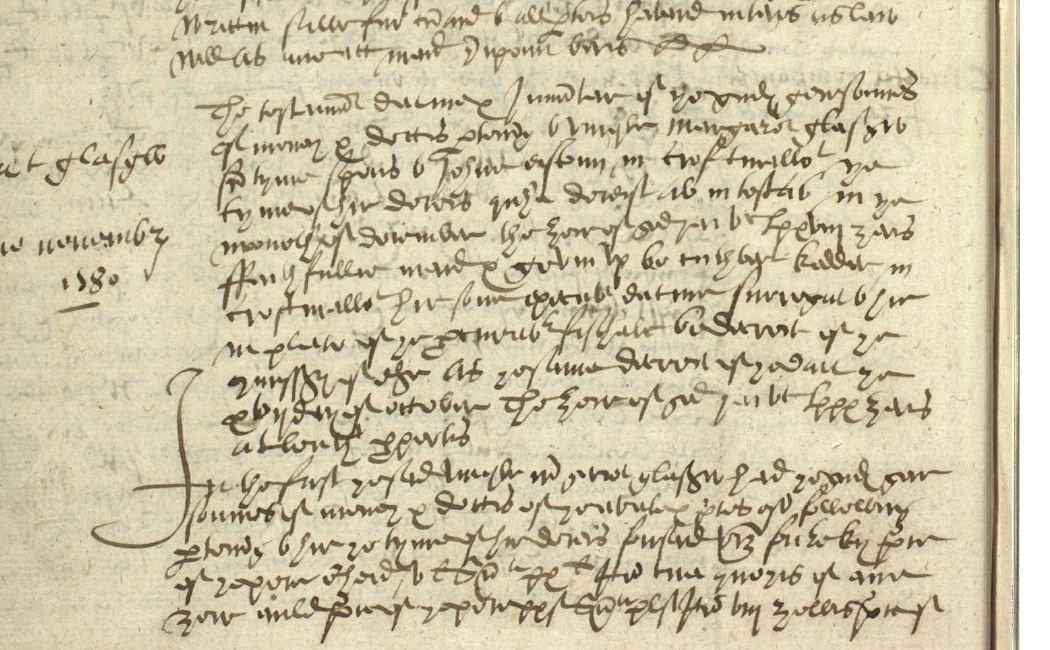
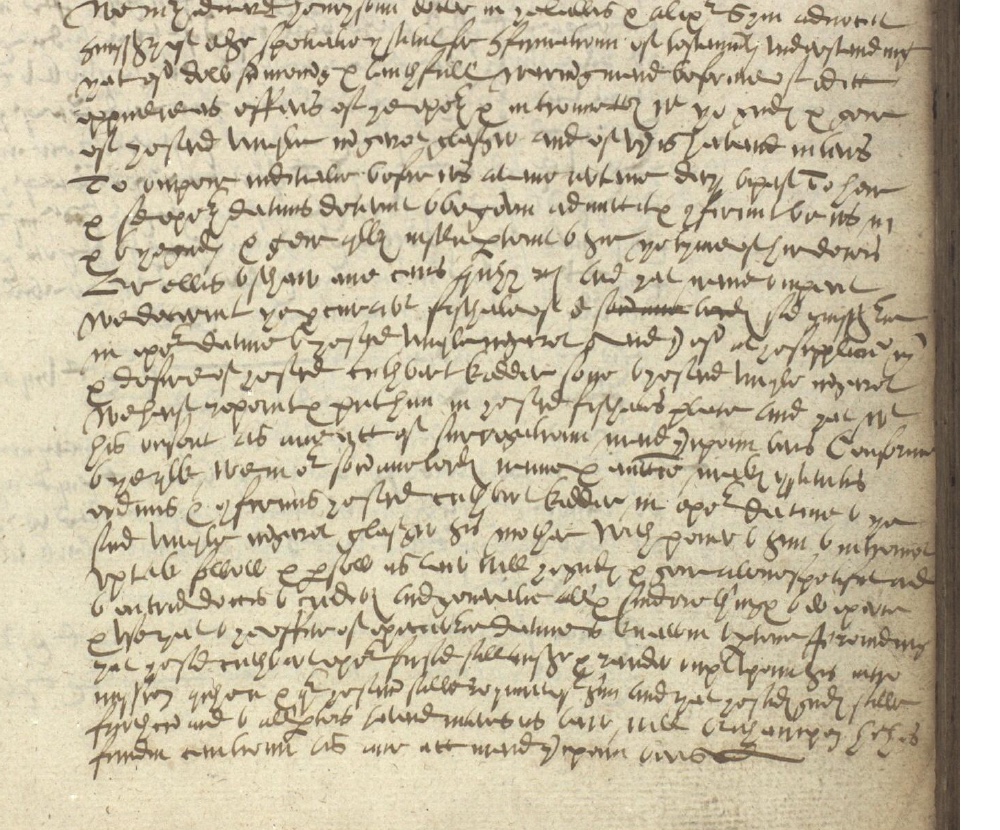
Margaret's mother-son relationship appears twice: once in the inventory opening and again in the confirmation. Reading both passages keeps the relationship distinct from the executor appointment and from the preceding estate higher on image 355.
NameRelationship / roleUncertain
New to secretary hand? Start with the shapes.
Follow the writing line. Ascenders rise above small letters; descenders fall below them. A neighbouring line can cross the word you are reading.
Count the short strokes. These are called minims. Joined i, m, n and u shapes can be ambiguous; compare a clear repeated word by the same clerk rather than guessing from a modern alphabet.
Separate reading from expansion. A contraction is not a fully written modern word. Square brackets retain doubtful letters or editorial additions. A familiar legal formula is a clue, not permission to fill a gap.
Then assess the relationship. Reading a name securely is not the same as proving kinship. Look for the actual role words and who they refer to.
Choose a name or relationship below. Compare the original ink, a paper-free view and the same spelling in a secretary-hand teaching font. Open the reasoning only when you need it.
01The marital word in ‘sumtyme spous to’The marital word in ‘sumtyme spous to’Inspect reading
Proposed readingspous
The existing reading is ‘sumtyme spous to Johne estoun’, the phrase identifying John Easton as Margaret Glasgow’s husband.
01 Original word Untouched manuscript02 Ink on white Derived from the original pixels
Open the original above if this browser cannot process the image.
03 Same spelling, another hand Joscelyn teaching font
spousLoading the secretary-hand teaching font...
spous
Colour key: proposed letter groups
The white-background view suppresses paper colour; reviewed focus boundaries exclude separable neighbouring fragments where available. It does not restore missing strokes. Colour follows retained source pixels inside proposed letter groups, not a reconstructed pen path. Ambiguous crossings remain neutral where reviewed; other crossing ink may still belong to another line.
The font repeats the proposed spelling, not this clerk's handwriting. Similarity is a teaching aid, not confirmation; uncertainties remain in the reading above.
Locate the word in its passage Original contextThe target is the word ‘spous’ in the phrase ‘sumtyme spous to’, centred at approximately x=333–399 and y=157–198. A descending stroke from the line above overlaps the opening of the word, so that intersection is context rather than traced evidence for the initial s.
Selected letter-group evidence
traced p: bowl and descending shaft
Untouched source detail. Neighbouring ink is retained.
What is visible
The second letter has a compact bowl at the writing line and a narrow shaft descending well below it; both features are visibly inked in the source.
Why this reading
The bowl-plus-descender structure is the diagnostic lower-case p form used for this comparison.
Where it differs
The bowl is angular and joined into the following letter rather than a detached modern rounded p.
What remains uncertain
Only the clearly visible bowl and descending shaft are traced. The opening s and its intersection with a stroke descending from the line above are deliberately left untraced.
Reading, meaning and uncertainty
Expansion: spouse
Confidence: high
Evidence boundary: The literal marital reading ‘spous’ is retained. The source securely supports the traced p, but overlapping ink prevents a responsible isolated trace of the opening s; this word does not by itself establish any relationship beyond the marital statement in its own phrase.
vmqle Margaret glasgw sumtyme spous to Johne estoun
In modern English
the late Margaret Glasgow, sometime spouse of John Easton
How to read it
The fresh testament begins at this lower-page heading. Read each enlarged sample by following the dark connected strokes rather than expecting modern separated letters: Margaret's capital has a long entry stroke, while the tall s in spous rises above its neighbours. Sumtyme spous to is the marital phrase; it does not make every Easton elsewhere on the page a relative.
What this establishes
The estate belongs to Margaret Glasgow, and John Easton is explicitly named as her husband.
What it does not establish
This phrase does not identify the father of Margaret's son.
high
Slow reading
Inspect the words, not just the conclusion.
Compare the original strokes with the proposed reading. Tall or trailing strokes from neighbouring lines may enter a sample; the notes distinguish what is visible from what remains uncertain.
Phrase 01
Margaret glasgw
Margaret Glasgow
Magnified from the same manuscript image. No letters have been redrawn.
Look at the strokes
The capital M begins with a tall, looped entry stroke before the smaller connected letters.
The final t of Margaret rises above the middle strokes and runs directly toward the surname.
In glasgw the final compressed cluster lacks the round modern -ow shape, an expected abbreviated-looking Scots spelling here.
Compare in this hand: The same name reappears lower on image 356 in the confirmation sample, where the capital M and compressed glasgw ending provide a same-record check.
Reading limits: The given name and surname are clear; this sample does not identify her son's father.
Phrase 02
sumtyme spous to
sometime spouse of
Magnified from the same manuscript image. No letters have been redrawn.
Look at the strokes
The long s at the start of spous looks more like a modern f without a full crossbar.
The p has a strong descending stroke below the body of the word.
The short word to is joined closely after spous, so the phrase reads as one flowing unit.
Reading limits: The marital formula is secure; 'sometime' describes status, not a date.
Phrase 03
Johne estoun
John Easton
Magnified from the same manuscript image. No letters have been redrawn.
Look at the strokes
Johne begins with a large descending-and-returning capital J stroke.
The h has a tall ascender and the terminal e is a small open loop.
estoun is written continuously with a long initial stroke and a compact -oun ending.
Reading limits: The name is secure; the line does not say he fathered Cuthbert.
02
NRS Edinburgh Commissary Court CC8/8/8, image 355
Follow the executor's name to 'her son'
Click the manuscript to enlarge
Choose a phrase to locate it in the manuscript. Only its outline is shown, so overlapping strokes stay readable.
gevin vp be cuthbert kaddell[?] ... hir sone executour dative
In modern English
given up by Cuthbert Kaddell [?] ... her son, executor dative
How to read it
Hir sone is the kin phrase: 'her son'. In the enlarged samples, first find the tall opening stroke of Cuthbert, then use the separate short phrase hir sone as the decisive relationship evidence. Executor dative describes his court-appointed role; without hir sone, the office alone would allow a creditor or other suitable administrator.
What this establishes
Cuthbert is expressly called Margaret's son.
What it does not establish
His appointment as executor does not itself prove kinship, and the record does not call John Easton his father.
high for the mother-son wording; moderate for Cuthbert's surname spelling
Slow reading
Inspect the words, not just the conclusion.
Compare the original strokes with the proposed reading. Tall or trailing strokes from neighbouring lines may enter a sample; the notes distinguish what is visible from what remains uncertain.
Phrase 01
cuthbert kaddell [?]
Cuthbert Kaddell/Keddell [?]
Magnified from the same manuscript image. No letters have been redrawn.
Look at the strokes
The capital C is an open sweeping curve rather than a closed modern C.
The tall h and b rise above the other letters in cuthbert and help divide the name.
The surname begins with a tall k-like stroke, but the crowded middle minims make the exact vowel spelling insecure.
Compare in this hand: Image 356 repeats Cuthbert's surname more distinctly as keddell, supporting the person while showing spelling variation.
Reading limits: Cuthbert is clear; Kaddell versus Keddell remains provisional.
Phrase 02
hir sone
her son
Magnified from the same manuscript image. No letters have been redrawn.
Look at the strokes
The h starts with a tall ascender before the two short strokes of ir.
sone begins with a long s whose descending sweep can resemble f to a modern reader.
The final e is a small open loop attached to the preceding n.
Compare in this hand: The confirmation reverses this same relationship as Cuthbert 'sone' and Margaret 'his mother'.
Reading limits: The kin wording is explicit even though the father's identity is not stated.
03
NRS Edinburgh Commissary Court CC8/8/8, image 356
Check the relationship a second time
Click the manuscript to enlarge
Choose a phrase to locate it in the manuscript. Only its outline is shown, so overlapping strokes stay readable.
cuthbert keddell sone to the said vmqle Margaret ... the said vmqle Margaret glasgw his mother
In modern English
Cuthbert Keddell, son of the said late Margaret ... the said late Margaret Glasgow, his mother
How to read it
The confirmation reverses the relationship wording: first Cuthbert is Margaret's sone, then Margaret is called his mother. Compare the two pulled-out rows rather than relying on the executor label: the reciprocal possessives make the maternity explicit, while still leaving paternity unstated. The two formulations are repeated evidence inside one record, not two independent sources.
What this establishes
Margaret and Cuthbert are explicitly mother and son in a second part of the record.
What it does not establish
The repetition still does not identify Cuthbert's father.
high for the relationship; moderate for the Keddell spelling
Slow reading
Inspect the words, not just the conclusion.
Compare the original strokes with the proposed reading. Tall or trailing strokes from neighbouring lines may enter a sample; the notes distinguish what is visible from what remains uncertain.
Phrase 01
cuthbert keddell
Cuthbert Keddell
Magnified from the same manuscript image. No letters have been redrawn.
Look at the strokes
The open capital C and tall h/b strokes match the earlier occurrence.
The surname's initial k rises sharply before a compact sequence of short strokes.
The doubled final l appears as two taller near-parallel strokes at the word end.
Compare in this hand: Compare the earlier image-355 form labelled kaddell [?]; this clearer repetition favours Keddell without erasing the first form's uncertainty.
Reading limits: The surname is more legible here but period spelling need not be fixed.
Phrase 02
sone
son
Magnified from the same manuscript image. No letters have been redrawn.
Look at the strokes
The opening long s descends and can be mistaken for f.
The o is a small closed oval followed by the paired humps of n.
The final e curls upward in a small loop.
Compare in this hand: The same relationship word occurs after hir in the opening passage.
Reading limits: The word is clear and directly links Cuthbert to Margaret.
Phrase 03
Margaret glasgw
Margaret Glasgow
Magnified from the same manuscript image. No letters have been redrawn.
Look at the strokes
The capital M has the same high looped entrance seen on image 355.
Margaret contains alternating short humps broken by the tall final t.
glasgw again closes in a tight final cluster rather than a modern fully rounded -gow.
Compare in this hand: This repetition checks the lower-page opening's Margaret glasgw in the same record.
Reading limits: The identity is secure; no paternal statement follows from the name alone.
Phrase 04
his mother
his mother
Magnified from the same manuscript image. No letters have been redrawn.
Look at the strokes
The pronoun his is short and closely joined before a visible gap.
mother is anchored by the tall h in its middle, not by a modern printed t shape.
The ending -er is compressed into a small rising finish.
Compare in this hand: This reciprocal phrase confirms the earlier hir sone wording from the opposite direction.
Reading limits: It establishes maternity, not that John Easton was Cuthbert's father.
Full case analysisInterpretation, supporting evidence, changed readings and remaining questions.
Modern interpretation
What the record says
Margaret Glasgow, sometime wife of John Easton, died intestate in December, apparently 1578. Her estate was administered later; 8 November 1580 is the marginal confirmation date, not her death date.
Cuthbert Kaddell/Keddell of the same provisionally read residence is expressly called her son in the opening. The confirmation again calls him son of the deceased Margaret and calls Margaret his mother. These kinship phrases independently establish their mother-son relationship; executor appointment alone is not the basis.
The inventory records livestock, six bolls of oats, household furnishings and clothing. Debts receivable include James Easton and Michael Mertyn. A debt to Roland Dundas concerns a year's teind. Those financial connections do not establish kinship.
The totals are consistent with the earlier reading of goods at 47 pounds 14 shillings 8 pence; receivables 10 pounds 10 shillings; gross estate 58 pounds 4 shillings 8 pence; debts payable 20 shillings; net estate 57 pounds 4 shillings 8 pence; and one half as the deceased's portion. Individual numeral forms remain marked provisional in the working lines rather than silently supplied from the arithmetic.
Evidence and limits
What it establishes
Image 355, opening lines 6-10: 'sumtyme spous to Johne estoun' and 'hir sone' identify different relationships. The son's surname is not Easton in the supplied reading; John Easton's paternity is not stated.
Image 356, confirmation lines 32 and 36-37: 'sone to the said vmqle Margaret' and 'his mother' independently confirm the maternity stated in the opening.
Image 355: the upper estate and its confirmation end before the new Margaret heading and lower opening. Names from that preceding estate must not be attributed to Margaret's household or executors.
Image 356, lines 12-18: the deduction and division support an estate-account reading, not an additional family distribution identifying another child.
The complete two-image span specified by the digital header is supplied and has been visually examined. Coverage is full, but substantial confirmation formula and some figures remain unresolved.
What changed in this reading
Freshly confirms the material mother-son conclusion and the prohibition on changing Cuthbert's surname to Easton without independent evidence.
Confirms the preceding-estate boundary on image 355 and the distinction between death and confirmation dates.
The older aggregate account reading is compatible with the supplied images, but several numeral shapes remain provisional in this new literal working reading.
A focused reread improves two associate names from bracketed readings to Michael Mertyn and Roland Dundas; neither is assigned a family relationship.
The appointment decree day is left unresolved here; the older tentative [16?] October reading is not independently confirmed.
Separates line-oriented manuscript wording from modern interpretation and from the older formatted ledger table. No older narrative has been presented as if it were a fresh literal transcription.
Still open
Do not fill these gaps with assumptions
Croftmelloch[?] remains a provisional manuscript spelling; Croftmalloch is the previously indexed place label.
Confirm the death-year and inventory numeral forms, livestock quantities, and the October appointment day.
The cautioner's name and substantial portions of the confirmation formula need another palaeographic pass.
The record does not identify Cuthbert's father.
Full working transcriptionLine-oriented readings, unresolved text and a downloadable plain-text version.
Square brackets mark uncertainty, editorial expansions or missing text. Ellipses mark omitted or unresolved wording. Numbering identifies lines in this working reading, not official manuscript line numbers. This is not a complete diplomatic edition.
Image / passage 355, Margaret entry only
[Margin] Margaret glasgw
octavo novembris
1580
The testament dative & Inventar of the guidis geir soumes
of money & dettis pertening to vmqle Margaret glasgw
sumtyme spous to Johne estoun in croftmelloch[?] the
tyme of hir deceis quha deceissit ab intestato in the
moneth of december the zeir of god jm vc lxxviij[?] zeiris
faithfullie maid & gevin vp be cuthbert kaddell[?] in
croftmelloch[?] hir sone executour dative surrogate in hir
[illegible] place of the executouris [illegible] be decreit of the
commissaris of Edr as the samin decreit of the dait the
[illegible] day of october the zeir of god jm vc lxxx zeiris
at lenth proportis
In the first the said vmqle Margaret glasgw had the guidis geir
soumes of money & dettis of the availl & prices following
pertening to hir the tyme of hir deceis foirsaid Viz first be [illegible]
of the price of [illegible] Item tua [ky?] price of ane
[amount illegible] price of the [illegible] Item ij zeir auld[?] [continues]
Image / passage 356
the pece [amount illegible] Item viij gimmer & dinmont[?] price of
pece [amount illegible] Item viij [wedderis?] viij hoggis price of the pece [amount illegible]
[amount illegible] Item in the barne & barnzaird sex bollis aittis price of the
boll [amount illegible] Summa [amount illegible] Item in vtensilis & domicilis
wt the abulzementis of hir bodie estimat [amount illegible]
Summa of the Inventar xlvij li xiiij s viij d[?]
Followis the dettis awand to the deid
Item thair wes awand to the said vmqle Margaret glasgw be James
estoun in wester quhitburne[?] viij li Item be michaell mertyn l s
Summa of the dettis awand to the deid x li x s[?]
Summa of the Inventar wt the dettis lviij li iiij s viij d[?]
Followis the dettis awand be the deid
Item thair wes awand be the said vmqle Margaret glasgw to roland
dundas for the zeiris teind of the zeir of god jm vc lxxviij zeiris
[amount illegible] the [illegible] mair nor the rest [illegible]
Summa of the dettis awand be the deid xx s
Restis of free geir the dettis deducit lvij li iiij s viij d[?]
To be dividit in tua the deidis pairt xxviij li xij s iiij d[?]
Quhairof the quot is [amount illegible]
[Margin] Quotta [illegible]
We [name illegible] Jhonsoun [illegible] & alexr [name illegible] advocat
commissaris of Edr speciallie constitut for confirmatioun of testamentis [illegible]
[illegible] [remaining execution formula unresolved]
[illegible] as our act maid thairupoun [illegible]
Source files and reading provenanceOriginal references, pages examined and the limits of this review.
Source coverage and reading provenance
Both PDF pages were rendered at 170 dpi and visually examined, with enlarged crops for the opening, accounts and confirmation; prior saved readings were consulted only after the initial fresh image pass. High confidence in the three mother-son expressions and document boundaries; moderate confidence in dates/aggregate accounts; low confidence in some names, figures and legal formula. Full coverage describes the supplied span, not a fully resolved diplomatic edition. Original spellings are retained where legible; superscripts are lowered and uncertain expansions bracketed.
PDF page 1 / image 355: Margaret's entry begins in lower part; preceding estate excluded
PDF page 2 / image 356: continuation inventory, debts and confirmation through end of page
Supplied local source files
1580_Margaret.pdf
The full originals remain in the local research archive. Selected unaltered crops are shown above for reading and commentary, with separate switchable highlights. Image credit: Crown copyright, National Records of Scotland / ScotlandsPeople. Duplicate downloads are not independent evidence. Consult the original using the reference above through ScotlandsPeople.
All associated profiles and identity comparisonsIncludes possible and rejected associations, not just proved relatives.
Earlier saved reading and research notesPreserved for comparison; later corrections above take precedence. These may include pages absent from the newly supplied scans.
Direct genealogical result
Margaret Glasgow was the mother of Cuthbert Kaddell/Keddell. The record calls him hir sone, later sone to the said umquhile Margaret, and calls Margaret his mother. Margaret was the sometime wife of John Easton, but the record does not identify Cuthbert's father.
The Edinburgh Commissary Court testament-dative and inventory is NRS CC8/8/8, images 355–356. Margaret's entry begins in the lower part of the first image and continues into the confirmation on the second; the upper part of the first image belongs to the preceding estate. Margaret died ab intestato—without a will—in December, apparently 1578. The appointment decree appears dated [16?] October 1580, and the clear marginal confirmation date is 8 November 1580. The 1580 date is therefore not her date of death.
The opening family clause reads in part:
The testament dative & inventar of the guidis, geir, soumes of money & dettis pertening to umquhile Margaret Glasgw, sumtyme spous to Johne Estoun in [Croftmelloch?] … quha deceissit ab intestato in the moneth of December, the zeir of God jᵐ vᶜ [lxxviij?] … gevin up be Cuthbart Kaddell in [Croftmelloch?], hir sone, executour dative surrogate …
The confirmation repeats the relationship independently:
… the said Cuthbert Keddell, sone to the said umquhile Margaret …
… confirmis the said Cuthbert Keddell in executour dative to the said umquhile Margaret Glasgw, his mother …
The spelling Croftmalloch is supplied by the published index rather than silently expanded from the difficult manuscript hand. Likewise, the son's surname is preserved in both manuscript forms, Kaddell and Keddell; it should not be converted to Easton merely because Margaret had been John Easton's wife.
Margaret's estate account
Margaret's inventory includes two cows, two one-year-old heifers, sheep including hoggis or young sheep, six bolls of oats in the barn and barnyard, household utensils and furnishings, and her clothing. Several individual livestock quantities and prices remain unresolved, but the aggregate figures are unusually clear and reconcile:
Account
Amount
Evidence note
Goods and possessions
£47 14s 8d
Inventory total
Debts receivable
£10 10s
James Estoun in Wester Quhitburne owed £8; [Michaell Mertyn?] apparently owed 50s
Gross estate
£58 4s 8d
Inventory plus debts receivable
Debt payable
£1
Owed to Roland Dundas in an entry concerning a year's teind or tithe
Net estate
£57 4s 8d
Gross estate less 20s
Recorded deceased's portion
£28 12s 4d
One half of the net estate
James Easton and the tentatively read Michael Mertyn appear as debtors, not stated relatives. The possible cautioner's name in the later formula also remains unresolved. The secure family conclusion depends on the three explicit mother–son phrases, not on those account names or on Cuthbert's executor appointment alone.