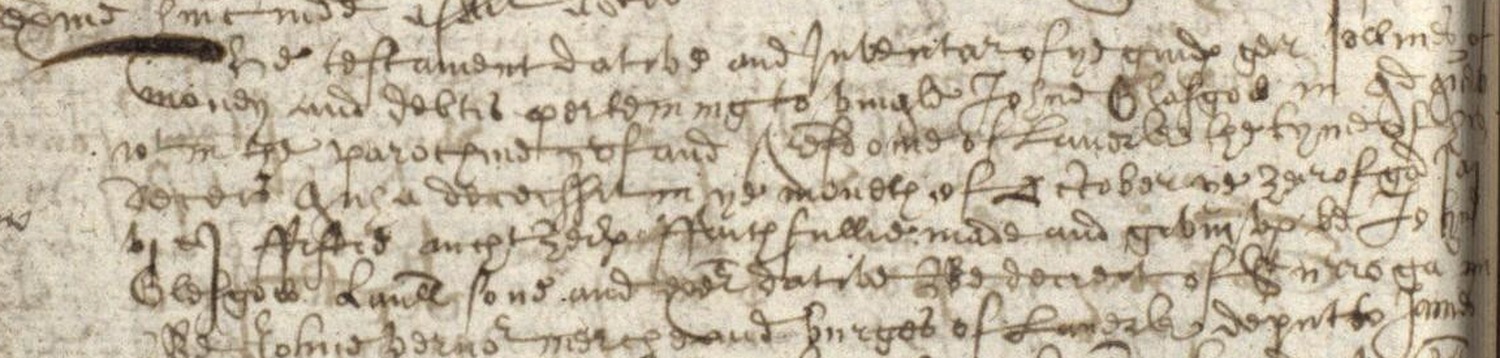
The place designation is more secure than the proposed family reading. Enlarging the two surviving John Glasgow forms shows what can actually be read, while the unboxed words around them remain too faded or grammatically uncertain to create a family link.
NameRelationship / roleUncertain
New to secretary hand? Start with the shapes.
Follow the writing line. Ascenders rise above small letters; descenders fall below them. A neighbouring line can cross the word you are reading.
Count the short strokes. These are called minims. Joined i, m, n and u shapes can be ambiguous; compare a clear repeated word by the same clerk rather than guessing from a modern alphabet.
Separate reading from expansion. A contraction is not a fully written modern word. Square brackets retain doubtful letters or editorial additions. A familiar legal formula is a clue, not permission to fill a gap.
Then assess the relationship. Reading a name securely is not the same as proving kinship. Look for the actual role words and who they refer to.
Choose a name or relationship below. Compare the original ink, a paper-free view and the same spelling in a secretary-hand teaching font. Open the reasoning only when you need it.
01Name features before the locality readingName features before the locality readingInspect reading
Proposed readingJohn Glasgow
This is the readable name in the locality step. The adjoining Quothquan/Libberton wording and any relationship are outside this letterform study.
01 Original word Untouched manuscript02 Ink on white Derived from the original pixels
Open the original above if this browser cannot process the image.
03 Same spelling, another hand Joscelyn teaching font
John GlasgowLoading the secretary-hand teaching font...
John Glasgow
The white-background view suppresses paper colour; reviewed focus boundaries exclude separable neighbouring fragments where available. It does not restore missing strokes. Colour follows retained source pixels inside proposed letter groups, not a reconstructed pen path. Ambiguous crossings remain neutral where reviewed; other crossing ink may still belong to another line.
The font repeats the proposed spelling, not this clerk's handwriting. Similarity is a teaching aid, not confirmation; uncertainties remain in the reading above.
Locate the word in its passage Original contextThis is the readable name in the locality step. The adjoining Quothquan/Libberton wording and any relationship are outside this letterform study.Reading, meaning and uncertainty
Expansion: John Glasgow
Confidence: high for the personal name
Evidence boundary: The visible J and descending g support the maintained reading John Glasgow, without resolving the following faded descriptor or asserting sonship.
... John Glasgow in Quodquen ... / within the parochin of Libbertoun ...
In modern English
John Glasgow in Quothquan, within Libberton parish.
How to read it
The opening puts the deceased's name on the line beneath the testament heading. The following line supplies the parish designation. Quodquen is the maintained literal place form normalized as Quothquan in the working reading, but its right-edge position and cramped text make it harder to inspect than the name. The locality words remain deliberately unboxed rather than being presented as equally clear letter-by-letter demonstrations.
What this establishes
The record concerns a John Glasgow in the Quothquan/Libberton locality.
What it does not establish
A name and locality do not alone identify a particular WikiTree John or establish relationships to other Quothquan Glasgows.
High for the maintained locality reading; the right-edge place spelling is less easy to inspect in this crop.
Slow reading
Inspect the words, not just the conclusion.
Compare the original strokes with the proposed reading. Tall or trailing strokes from neighbouring lines may enter a sample; the notes distinguish what is visible from what remains uncertain.
Phrase 01
John Glasgow
John Glasgow
Magnified from the same manuscript image. No letters have been redrawn.
Look at the strokes
John begins with a tall descending J followed by the smaller joined ohn letters.
The h rises above the o and n before a visible word space.
Glasgow opens with a broad looped G and has a lower g loop beneath the baseline.
The final ow ends in a fine stroke before the cramped locality wording.
Compare in this hand: The next image repeats John Glasgow in a paler administrative continuation.
Reading limits: The personal name is secure; this box does not independently demonstrate the adjacent Quodquen or Libbertoun spellings.
02
National Records of Scotland, CC14/5/6, image 139; Crown copyright
2. Do not fill the gap with a presumed son
Click the manuscript to enlarge
Choose a phrase to locate it in the manuscript. Only its outline is shown, so overlapping strokes stay readable.
... the said John Glasgow [following words unresolved] ... / the said defunct ...
In modern English
John Glasgow is named in the confirmation, but the following description and its grammatical connection remain unresolved.
How to read it
The name is visible toward the right of the first line, but the following faded words are not secure enough to transcribe as lawfull or to connect grammatically to the deceased. A familiar confirmation formula is not permission to supply sone. The walkthrough therefore enlarges only the readable name and keeps the missing relationship wording visible as unresolved rather than turning it into a genealogical edge.
What this establishes
John Glasgow is named in the administrative continuation.
What it does not establish
This crop does not securely prove that an executor was the deceased's lawful son or establish the executor's full identity.
Low for the proposed relationship phrase; no sonship asserted.
Slow reading
Inspect the words, not just the conclusion.
Compare the original strokes with the proposed reading. Tall or trailing strokes from neighbouring lines may enter a sample; the notes distinguish what is visible from what remains uncertain.
Phrase 01
John Glasgow
John Glasgow
Magnified from the same manuscript image. No letters have been redrawn.
Look at the strokes
The pale capital J descends below the compact ohn group.
A visible word space separates the forename from the darker looped G of Glasgow.
The surname's lower g loop and final ow remain recognizable despite fading and show-through.
The following ink is materially fainter and more crowded than the boxed name.
Compare in this hand: The darker John Glasgow in the locality step provides a same-record comparison for the capital J, looped G and final ow.
Reading limits: Only the name is secure here. The following descriptor, its subject and any claimed sonship remain unresolved.
Full case analysisInterpretation, supporting evidence, changed readings and remaining questions.
Modern interpretation
What the record says
This is the testament dative and inventory of John Glasgow in Quothquan, Libberton parish, Lanarkshire. It places his death in 1661 but the month remains unreadable.
Thomas Glasgow is readable in the giver-up/executor-dative passage. The ink immediately after his name does not securely read 'lawful son', and the page-break continuation does not safely establish its grammatical subject.
James Hamilton is the commissary confirming the estate. His presence is official rather than familial.
No parent-child relationship is created from Thomas's participation or from the later occurrence of John Glasgow in the legal continuation.
Evidence and limits
What it establishes
Newly improved reading: Thomas Glasgow can be named in the giver-up/executor-dative context, but his exact capacity and descriptor remain unresolved.
Excluded reading: the marks after Thomas and around the page-break occurrence of John do not prove 'lawful son'.
Confirmed: deceased John Glasgow lived in Quodquen within Libberton parish and the sheriffdom of Lanark and died in 1661.
Confirmed: James Hamilton acts as commissary of Lanark, not as executor or kin.
The 1661/1662 John is kept distinct from the 1650 and 1685 Quothquan Johns unless another record bridges them.
What changed in this reading
The previous review left the giver-up wholly unnamed. This reread promotes Thomas Glasgow as a probable-to-secure personal-name reading while retaining brackets around his descriptor and exact executorial capacity.
The former proposed sonship remains rejected: neither proximity nor expected confirmation wording substitutes for visible kinship ink.
No WikiTree identity is assigned from name and locality alone.
Still open
Do not fill these gaps with assumptions
John's exact death month in 1661
The words immediately following Thomas Glasgow and whether Thomas personally held the executor-dative office or acted in another representative capacity
The grammatical subject and descriptor around the page-break occurrence of John Glasgow
Inventory goods, values, debtors, creditors, totals, cautioner, and closing names
A secure WikiTree match or relationship to either the 1650 or 1685 John
Full working transcriptionLine-oriented readings, unresolved text and a downloadable plain-text version.
Square brackets mark uncertainty, editorial expansions or missing text. Ellipses mark omitted or unresolved wording. Numbering identifies lines in this working reading, not official manuscript line numbers. This is not a complete diplomatic edition.
Image / passage NRS image 138
[preceding testament excluded]
The testament dative and inventar of the guidis geir soumes of
money and debtis perteining to umquhile John Glasgow in Quodquen within the
parochin of Libbertoun and sheriffdome of Lanark the tyme of his deceis
quha deceist in the moneth of [illegible] the yeir of God 1661 yeiris
faithfullie maid and givin up be Thomas Glasgow [descriptor illegible]
in name of executour dative [appointment wording illegible]
[inventory, debts, and sums mostly illegible]
James Hamiltoun commissar of Lanark [confirmation formula continuing]
Image / passage NRS image 139
[continuation of confirmation and executor-dative authority]
[the said] John Glasgow [following descriptor and grammatical subject unresolved]
[administration, caution, and closing formula partly illegible]
[separate following testament beginning 13 January 1662 excluded]
Source files and reading provenanceOriginal references, pages examined and the limits of this review.
Source coverage and reading provenance
High for the deceased's name, Quodquen/Libberton locality, 1661 death year, entry boundaries, and James Hamilton's office. Moderate for the name Thomas Glasgow. Low for Thomas's following descriptor and any claimed sonship; no kinship is asserted.
NRS image 138 (John entry begins in the lower part)
NRS image 139 (John entry concludes at the head; following testament excluded)
Supplied local source files
ScotlandsPeople_CC001400005-00006-00138-.jpg
ScotlandsPeople_CC001400005-00006-00139-.jpg
The full originals remain in the local research archive. Selected unaltered crops are shown above for reading and commentary, with separate switchable highlights. Image credit: Crown copyright, National Records of Scotland / ScotlandsPeople. Duplicate downloads are not independent evidence. Consult the original using the reference above through ScotlandsPeople.
All associated profiles and identity comparisonsIncludes possible and rejected associations, not just proved relatives.
No existing profile has been identified securely for this record.