Issobell Gray his relict
page 478, opening
- Earlier reading / question
- Isobell Gray read as relict
- Why this reading
- Direct widow term in opening
- Effect on the family
- Confirms John's widow; does not state maternity of the children
Illustrated manuscript reading
Death December 1636; court proceedings April 1637, precise day unresolved
National Records of Scotland, Glasgow Commissary Court, CC9/7/27, register pages 478-480
Second manuscript pass · 10 September 2026
New readings and unchanged uncertainties are both recorded. A confirmed name or role does not by itself confirm a WikiTree identity or a relationship.
page 478, opening
pages 479-480, children/executor and caution clauses
page 480, caution
whole entry versus Glasgow-1030
Follow the handwriting
The Saltcoats estate administration explicitly names John Glasgow's widow and twice identifies Katherine and Agnes as his lawful children. It does not call the widow their mother, and the household evidence excludes Glasgow-1030 as the present identification.
Follow the writing line. Ascenders rise above small letters; descenders fall below them. A neighbouring line can cross the word you are reading.
Count the short strokes. These are called minims. Joined i, m, n and u shapes can be ambiguous; compare a clear repeated word by the same clerk rather than guessing from a modern alphabet.
Separate reading from expansion. A contraction is not a fully written modern word. Square brackets retain doubtful letters or editorial additions. A familiar legal formula is a clue, not permission to fill a gap.
Then assess the relationship. Reading a name securely is not the same as proving kinship. Look for the actual role words and who they refer to.
Learn with the archive: Secretary-hand tutorial · Testament vocabulary.
Select a name to jump to its manuscript evidence.
The reading desk
Choose a name or relationship below. Compare the original ink, a paper-free view and the same spelling in a secretary-hand teaching font. Open the reasoning only when you need it.
Proposed readinghis lawfull bairnes
The walkthrough reads this clause with the named daughters and the later thair father phrase. It expressly establishes children of the deceased John Glasgow, not their mother's identity.
Open the original above if this browser cannot process the image.
his lawfull bairnes
The white-background view suppresses paper colour; reviewed focus boundaries exclude separable neighbouring fragments where available. It does not restore missing strokes. Colour follows retained source pixels inside proposed letter groups, not a reconstructed pen path. Ambiguous crossings remain neutral where reviewed; other crossing ink may still belong to another line.
The font repeats the proposed spelling, not this clerk's handwriting. Similarity is a teaching aid, not confirmation; uncertainties remain in the reading above.
Expansion: his lawful children
Confidence: high for the child relationship
Evidence boundary: The visible ascenders help make the existing lawfull bairnes reading inspectable; it supports the daughters' stated child status but says nothing about maternity.
Teaching typeface: Joscelyn by Peter S. Baker, based on a different Renaissance secretary hand. SIL Open Font License. Source images remain separate and unchanged.
NRS CC9/7/27, register page 478; Crown copyright, National Records of Scotland.
Choose a phrase to locate it in the manuscript. Only its outline is shown, so overlapping strokes stay readable.
On the page
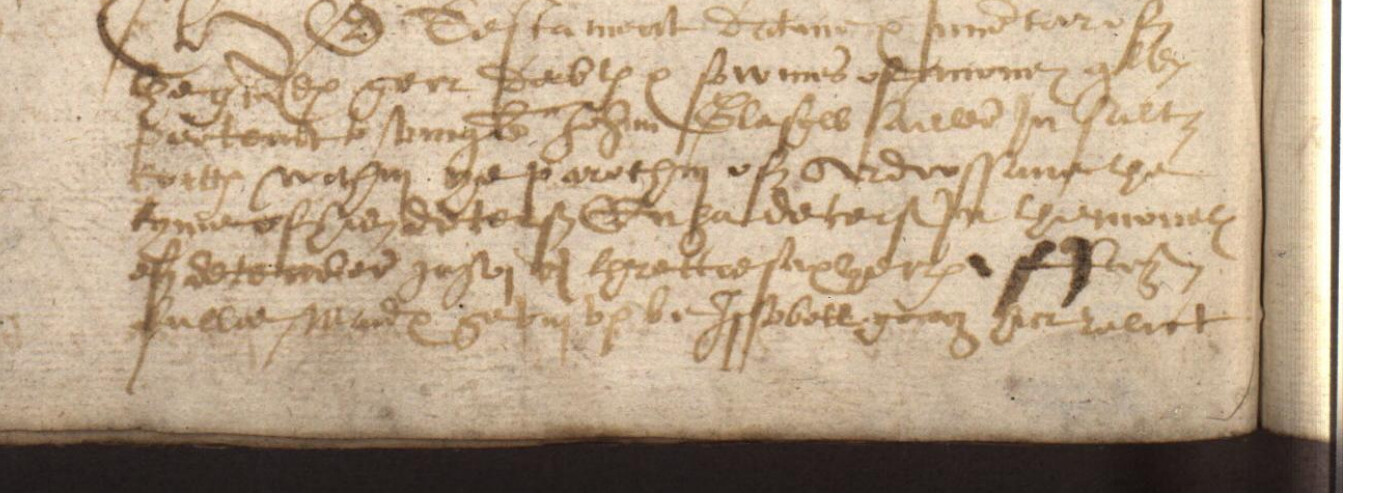
vmqle Johne glasgow sailler in Salt-coittis within the parochin of Ardrossane ... maid & gevin up be Issobell gray his relict
In modern English
the late John Glasgow, sailor in Saltcoats within the parish of Ardrossan ... made and given up by Isobell Gray, his widow
The occupation and locality travel with John's name across a line break: Salt- ends the first line and coittis begins the next. Later, Issobell Gray is followed by his relict, the period legal description of his widow. Widowhood is explicit; motherhood is not, and an administrator could act for children without being their mother.
John Glasgow was a sailor in Saltcoats and Isobell Gray was his widow.
It does not identify him with Glasgow-1030 or state that Isobell was the mother of the children named on the next page.
high
Slow reading
Compare the original strokes with the proposed reading. Tall or trailing strokes from neighbouring lines may enter a sample; the notes distinguish what is visible from what remains uncertain.
Phrase 01
John Glasgow, sailor in Salt-
Reading limits: The person, occupation and split locality are clear; the locality must be completed from the next line.
Phrase 02
coittis, completing Saltcoats
Compare in this hand: The caution clause later writes Saltcoittis in one continuous locality form.
Reading limits: This is a line-wrap continuation, not a second place.
Phrase 03
Isobell Gray, his widow
Reading limits: Widow is explicit; no word in this sample calls Isobell the daughters' mother.
NRS CC9/7/27, register page 479; Crown copyright, National Records of Scotland.
Choose a phrase to locate it in the manuscript. Only its outline is shown, so overlapping strokes stay readable.
On the page
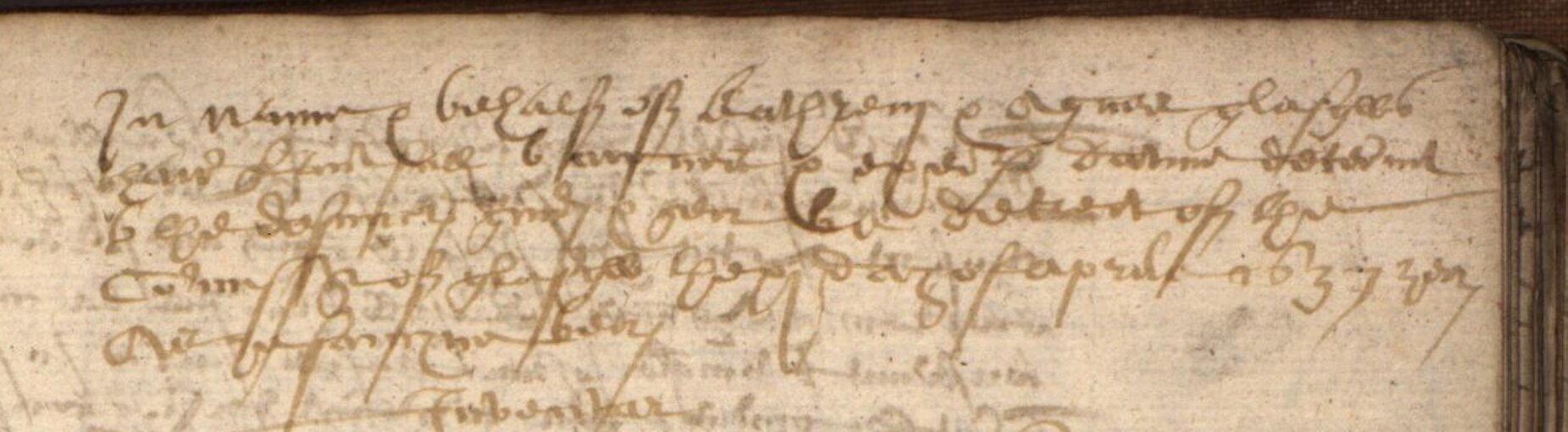
In name & behalff of Kathrein & Agnes glasgow his lawfull bairnes ... to the defunct thair father
In modern English
In the name and on behalf of Katherine and Agnes Glasgow, his lawful children ... to the deceased, their father.
Read the first line for both names, the next for his lawfull bairnes, and the following line for thair father. The Scots word bairnes means children, while thair father repeats the paternal relationship from the children's perspective. The double wording makes John their father independently of representation, but still does not name their mother.
Katherine and Agnes Glasgow were lawful children of the deceased John Glasgow.
The clause does not expressly identify Isobell Gray as their mother or name a daughter Mary.
high
Slow reading
Compare the original strokes with the proposed reading. Tall or trailing strokes from neighbouring lines may enter a sample; the notes distinguish what is visible from what remains uncertain.
Phrase 01
Katherine and Agnes Glasgow
Compare in this hand: The caution clause repeats both daughters in the same order.
Reading limits: The first forename is visibly Kathrein; Katherine is a modernized expansion.
Phrase 02
his lawful children
Compare in this hand: The closing caution repeats lawfull bairnes of before John's name.
Reading limits: Children is explicit; the phrase does not specify daughters except through the feminine forenames.
Phrase 03
their father
Reading limits: The paternal relationship is explicit; the phrase names no mother.
NRS CC9/7/27, register page 480; Crown copyright, National Records of Scotland.
Choose a phrase to locate it in the manuscript. Only its outline is shown, so overlapping strokes stay readable.
On the page
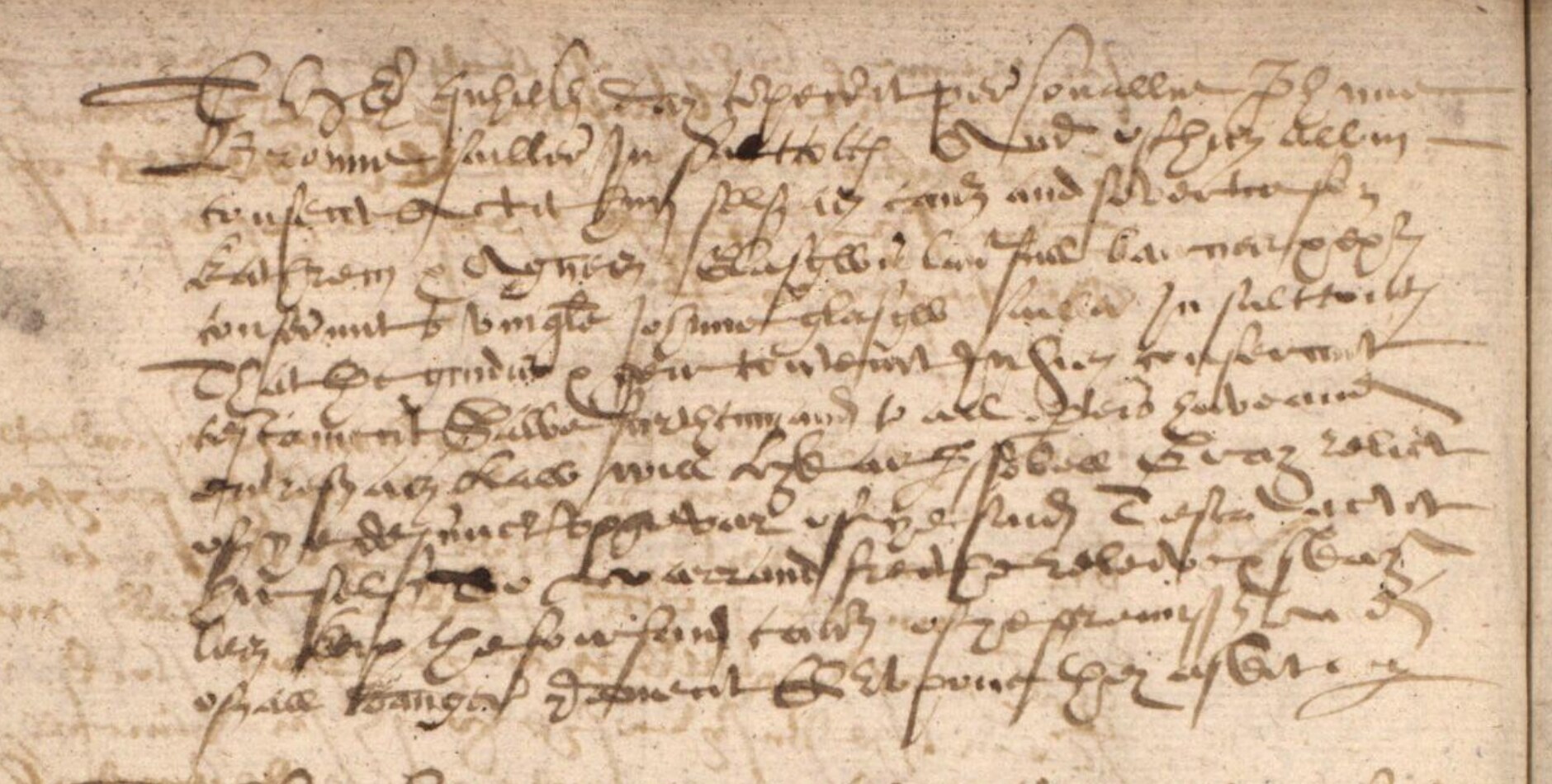
Johne Broune sailler in Saltcoittis ... as cautioun ... Kathrein & Agnes glasgow lawfull bairnes of vmqle Johne glasgow sailler in Saltcoittis
In modern English
John Brown, sailor in Saltcoats ... as cautioner ... Katherine and Agnes Glasgow, lawful children of the late John Glasgow, sailor in Saltcoats.
Follow the wrap from Johne at the right end of one line to Broune at the left of the next. That man is introduced as cautioner, a guarantor, not as kin. Lower down, the clause repeats both daughters, lawfull bairnes of, and the deceased Saltcoats sailor. The repetition corroborates the relationship inside the same testament but is not an independent source.
The same record independently repeats the daughters' relationship to the Saltcoats sailor within its closing administration.
Repetition within one testament is not an independent source, and John Brown's cautioner role proves no ancestry. The household remains distinct from Glasgow-1030 and Jonet Mathie's family.
high
Slow reading
Compare the original strokes with the proposed reading. Tall or trailing strokes from neighbouring lines may enter a sample; the notes distinguish what is visible from what remains uncertain.
Phrase 01
John
Reading limits: The forename is complete; Broune continues on the next line.
Phrase 02
Brown
Reading limits: The surname is secure; the line identifies John Brown as cautioner, not a relative.
Phrase 03
Katherine and Agnes Glasgow
Compare in this hand: Compare the same ordered pair on register page 479.
Reading limits: The names are secure; modern Katherine expands the manuscript's Kathrein.
Phrase 04
lawful children of
Compare in this hand: The earlier page uses his lawfull bairnes for the same two daughters.
Reading limits: The child relationship is explicit; lawful is a legal status term, not evidence of maternity.
Phrase 05
the late John Glasgow, sailor in Saltcoats
Compare in this hand: This full locality form checks the split opening wording on register page 478.
Reading limits: The phrase identifies the deceased father; it does not identify him as Glasgow-1030.
Modern interpretation
John Glasgow was a sailor in Saltcoats within Ardrossan parish and died in December 1636.
Isobell Gray is expressly his relict or widow. Katherine and Agnes Glasgow are expressly his lawful children, and the deceased is called their father. Their executor role is additional administration, not the basis for the relationship.
John Broune, another sailor in Saltcoats, acted as cautioner. The record gives no kin term for him.
The record does not state that Isobell was the children's mother and does not name Mary as a child.
The household remains distinct from Glasgow-1030 and Jonet Mathie: no bridge in this testament connects them.
Evidence and limits
Still open
LLM-assisted working transcription
Square brackets mark uncertainty, editorial expansions or missing text. Ellipses mark omitted or unresolved wording. Numbering identifies lines in this working reading, not official manuscript line numbers. This is not a complete diplomatic edition.
High for John, occupation/locality, Isobell as relict, Katherine and Agnes as lawful children, and John Broune as cautioner. High that the testament supplies no bridge to Glasgow-1030. Low for faded account parties and precise administrative day.
Reviewed: 2026-09-10. Method: LLM-assisted fresh visual reread from original images.
The full originals remain in the local research archive. Selected unaltered crops are shown above for reading and commentary, with separate switchable highlights. Image credit: Crown copyright, National Records of Scotland / ScotlandsPeople. Duplicate downloads are not independent evidence. Consult the original using the reference above through ScotlandsPeople.
This is an expanded working transcription. [word?] marks a tentative reading and […] unresolved text.
The Testament dative & Inventar of the guids geir debts & sowmes of money quhilk perteinit to umquhile Johne Glasgw sailler in Saltcoittis within the parochin of Ardrossane the tyme of his deceis quha deceist in the moneth of December jaj vjᶜ threttie sex zeirs, faithfullie maid & gevin up be Issobell gray his relict
In name & behalf off Kathrein & Agnes Glasgw, bairnes lawfull & executores dative decernit to the defunct thair father Be decreit of the Commissar of Glasgw the [xxj?] day of Aprile 1637 zeirs As the […] beiris.
The first inventory item appears to concern an old fishing boat and its equipment, but overlapping and show-through ink make that reading tentative. Household contents, utensils, furnishings and John's clothing follow. The valuations and total have not been securely transcribed.
Under debts owed to John, Johne Broune in Saltcoittis is securely named as owing borrowed money. Further entries may name [Agnes Stewart?] and Thomas [Broune?], but those readings should remain qualified. Under debts owed by John, the creditor's first name is Johne and the surname may be [Russall?]; the purpose and sums remain unresolved. The net estate was to be divided in three parts, with the deceased's part calculated separately.
Johne Boyle of Kelburne, Commissar of Glasgw approved and confirmed the administration after public notice and granted authority over the estate. The bond of caution then begins:
The quhilk day compeirit personalie Johne Broune sailler in Saltcoittis And of his awin consent actit him self as cautioner and souertie for Kathrein & Agnes Glasgwis lawfull bairnes, executores [confirmit?] to umquhile Johne Glasgw sailler in Saltcoittis.
That the guids & geir contenit in thair testament sallbe furthcumand to all pairties haveand entres thairto as law will And Issobell Gray relict of the defunct, gevar up of the said Testament, […]
John Brown's financial and surety roles do not, by themselves, establish kinship.
John Glasgow, a sailor in Saltcoats in Ardrossan parish, died in December 1636. Isobell Gray, his widow, submitted the inventory for Katherine and Agnes Glasgow, his lawful children. The court had appointed the daughters to administer their father's estate. John's possessions apparently included an old fishing boat and equipment as well as household goods and clothing, but much of the valuation remains difficult to read.
John Brown in Saltcoats owed the estate money and a sailor of that name and place later became guarantor for Katherine and Agnes. The two occurrences may concern one man, but the record does not explicitly say so. The court confirmed the administration on an uncertain day, apparently 21 April 1637, and Isobell undertook to protect the guarantor against loss.