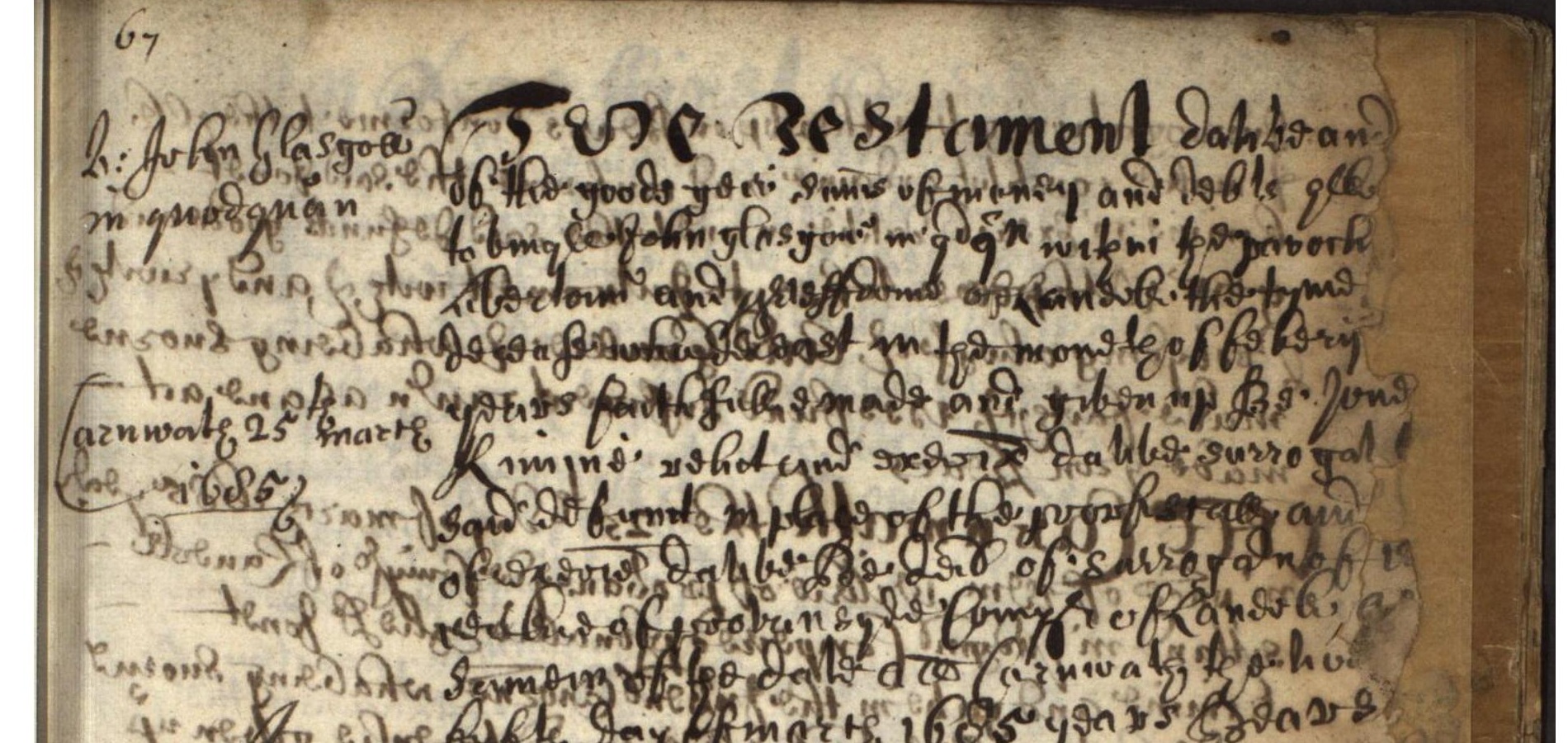
Four image-led steps separate John Glasgow's identity and widow from the damaged inventory, the procurator's request and the court confirmation. Heavy show-through is visible and is treated as a source limit, not silently repaired. National Records of Scotland, Lanark Commissary Court CC14/5/12, images 67-68, Crown copyright; accessed through Scotland's People wills and testaments.
NameRelationship / roleUncertain
New to secretary hand? Start with the shapes.
Follow the writing line. Ascenders rise above small letters; descenders fall below them. A neighbouring line can cross the word you are reading.
Count the short strokes. These are called minims. Joined i, m, n and u shapes can be ambiguous; compare a clear repeated word by the same clerk rather than guessing from a modern alphabet.
Separate reading from expansion. A contraction is not a fully written modern word. Square brackets retain doubtful letters or editorial additions. A familiar legal formula is a clue, not permission to fill a gap.
Then assess the relationship. Reading a name securely is not the same as proving kinship. Look for the actual role words and who they refer to.
Choose a name or relationship below. Compare the original ink, a paper-free view and the same spelling in a secretary-hand teaching font. Open the reasoning only when you need it.
01Name strokes in the testament headingName strokes in the testament headingInspect reading
Proposed readingJohn Glasgow
The walkthrough's identity step concerns the deceased John Glasgow. This small study does not resolve Jonet's uncertain surname, William Watson's place, or any unexpressed kinship.
01 Original word Untouched manuscript02 Ink on white Derived from the original pixels
Open the original above if this browser cannot process the image.
03 Same spelling, another hand Joscelyn teaching font
John GlasgowLoading the secretary-hand teaching font...
John Glasgow
The white-background view suppresses paper colour; reviewed focus boundaries exclude separable neighbouring fragments where available. It does not restore missing strokes. Colour follows retained source pixels inside proposed letter groups, not a reconstructed pen path. Ambiguous crossings remain neutral where reviewed; other crossing ink may still belong to another line.
The font repeats the proposed spelling, not this clerk's handwriting. Similarity is a teaching aid, not confirmation; uncertainties remain in the reading above.
Locate the word in its passage Original contextThe walkthrough's identity step concerns the deceased John Glasgow. This small study does not resolve Jonet's uncertain surname, William Watson's place, or any unexpressed kinship.Reading, meaning and uncertainty
Expansion: John Glasgow
Confidence: high for the deceased's name
Evidence boundary: These visible name features support the maintained John Glasgow reading, but do not convert administrative roles into family relationships.
umq[uhi]le John Glasgow in Quothquan within the paroch of Libberton ... deceist intestat in the moneth of ffebruary ... Jonet [Kinnie?] relict and executrix dative
In modern English
The late John Glasgow in Quothquan, Libberton parish, died intestate in February 1685. Jonet [Kinnie?], his widow, served as executrix dative.
How to read it
Box 1 follows the deceased's name into Quothquan. Box 2 carries the parish wording. Box 3 contains the intestacy and February phrase. Box 4 contains Jonet's name and the adjoining role words. Relict proves widowhood; executrix dative describes a court-appointed estate office. The surname remains qualified because show-through crosses its minims.
What this establishes
John's record-defined residence and death month, plus Jonet's explicit widow and executrix roles.
What it does not establish
It does not name a child or parent, and it does not bridge John to the 1608 Mid Calder baptism.
High for identity, locality, month/year and roles; moderate-low for Jonet's surname.
Slow reading
Inspect the words, not just the conclusion.
Compare the original strokes with the proposed reading. Tall or trailing strokes from neighbouring lines may enter a sample; the notes distinguish what is visible from what remains uncertain.
Phrase 01
John Glasgow in Quothquan
John Glasgow in Quothquan
Magnified from the same manuscript image. No letters have been redrawn.
Look at the strokes
John begins with a tall black J whose lower curve returns into the short o-h-n group.
Glasgow has a broad looped capital G and a final w formed by two pointed strokes.
Quothquan shows two separate q descenders, one at the opening and one in the second syllable.
Compare in this hand: John Glasgow recurs in the procurator's clause in step 3, helping distinguish name strokes from show-through.
Reading limits: The name and Quothquan are secure; several overlying reverse-page strokes cross the line.
Phrase 02
within the paroch of Libberton
within the parish of Libberton
Magnified from the same manuscript image. No letters have been redrawn.
Look at the strokes
Within begins with a wide w followed by a row of narrow minims in ithin.
Paroch contains a tall h ascender at its end.
Libberton begins with an upright looped L and has two tall strokes in bb.
Compare in this hand: The following line adds the presbytery of Lanark, keeping this a geographic designation.
Reading limits: Libberton is legible despite bleed-through; the exact spelling is preserved.
Phrase 03
deceist intestat in the moneth of ffebruary
died intestate in the month of February
Magnified from the same manuscript image. No letters have been redrawn.
Look at the strokes
Intestat contains a long s-like vertical and two tall t strokes crossed near their tops.
Ffebruary begins with a doubled initial f convention, both strokes extending below the baseline.
The final y has a long descending tail that curves back toward the word.
Compare in this hand: The 1685 year appears on the next line; step 4 supplies the later March court date.
Reading limits: The month is clear; no February day is stated.
Phrase 04
Jonet [Kinnie?] relict and executrix dative
Jonet [Kinnie?], widow and court-appointed executrix
Magnified from the same manuscript image. No letters have been redrawn.
Look at the strokes
Jonet begins with a long initial J descending below the line.
Relict has a tall l and final t crossed by a light horizontal stroke.
Executrix begins with an enlarged loop and ends in a distinct x-shaped crossing.
Compare in this hand: Jonet's appointment is carried into the court confirmation in step 4.
Reading limits: Relict and executrix dative are secure. Reverse-page ink crosses the surname, so Kinnie remains provisional.
02
National Records of Scotland, Lanark Commissary Court CC14/5/12, image 67; Crown copyright
2. Treat the dark middle as an inventory with source damage
Click the manuscript to enlarge
Choose a phrase to locate it in the manuscript. Only its outline is shown, so overlapping strokes stay readable.
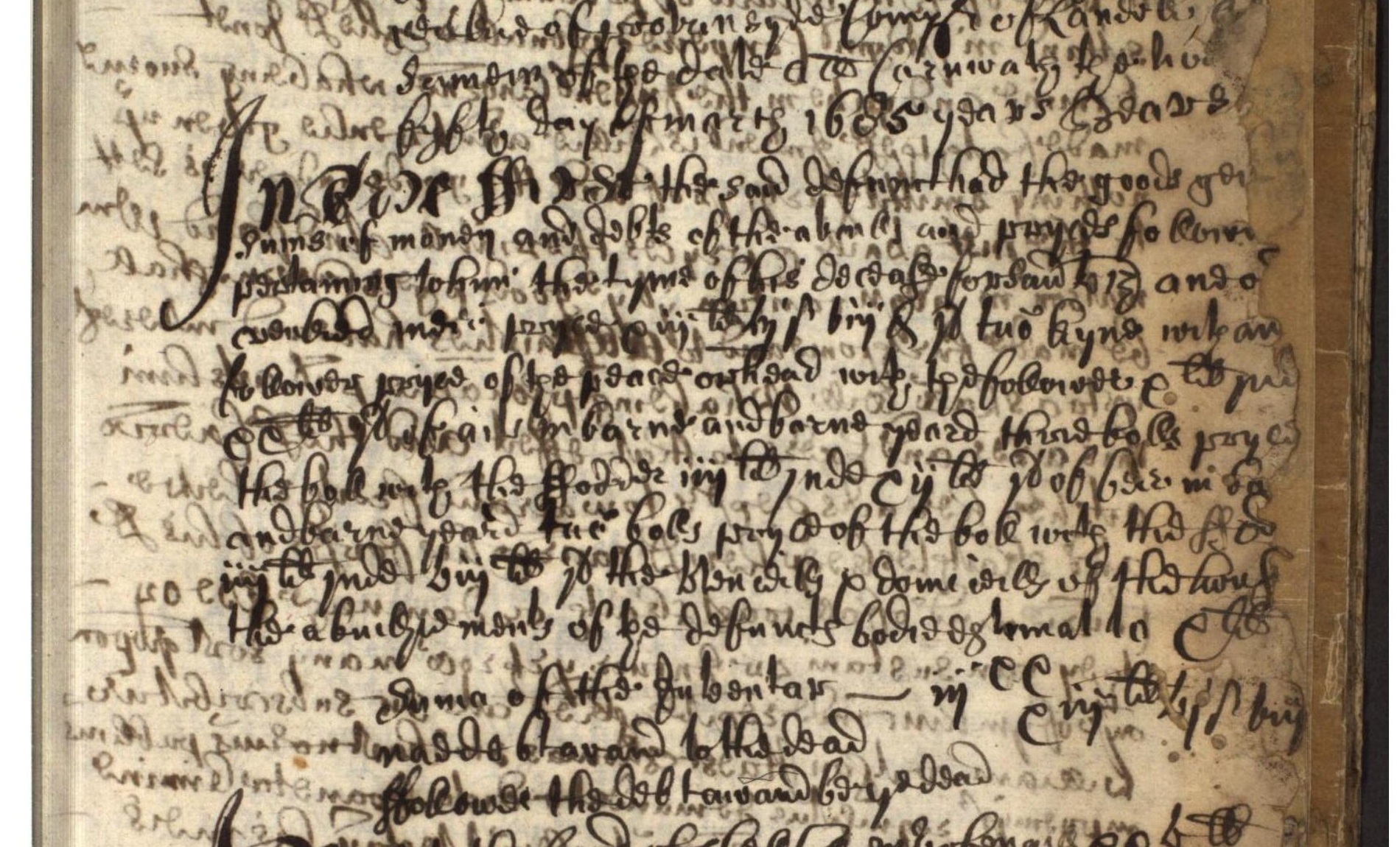
Inventar ... Item two kyne ... the abulzement of the defuncts bodie ... Summa of the Inventar
In modern English
The inventory includes livestock, farm produce or fodder, household/farm goods and the deceased's clothing, but most exact quantities and prices remain obscured.
How to read it
Box 1 is the large heading. Box 2 pulls the clearest livestock phrase. Box 3 marks the clothing valuation, and Box 4 the total heading. The heavy dark lines crossing these entries are show-through and overwriting; the walkthrough therefore stops short of invented item totals.
What this establishes
The estate included livestock and ordinary farm/household property.
What it does not establish
The damaged list cannot support exact wealth calculations or family relationships.
High for the inventory structure and broad classes; low to moderate for individual quantities and valuations.
Slow reading
Inspect the words, not just the conclusion.
Compare the original strokes with the proposed reading. Tall or trailing strokes from neighbouring lines may enter a sample; the notes distinguish what is visible from what remains uncertain.
Phrase 01
Inventar
Inventory
Magnified from the same manuscript image. No letters have been redrawn.
Look at the strokes
The initial I is a very tall black stroke extending below the baseline into a broad curve.
The middle n-v-e sequence is compressed into alternating thick and thin joins.
The final r is short and hooked upward.
Compare in this hand: This large display heading contrasts with the smaller same word in Summa of the Inventar below.
Reading limits: The heading is clear even though reverse-page writing crosses it.
Phrase 02
Item two kyne
Item: two cows
Magnified from the same manuscript image. No letters have been redrawn.
Look at the strokes
Item begins with a tall upright I and a compact tem group.
The w in two is formed from two pointed downstrokes.
Kyne has a long y descender and a final e turning upward.
Compare in this hand: Geillis's earlier hand writes the related cattle word ky in step 3 of her walkthrough.
Reading limits: Two kyne is legible; the milk/follower description and price alongside it are less secure.
Phrase 03
abulzement of the defuncts bodie
clothing/personal apparel of the deceased's body
Magnified from the same manuscript image. No letters have been redrawn.
Look at the strokes
Abulzement begins with an open capital A and a tall looped b.
Defuncts has a long descending f and a tightly joined unct sequence.
Bodie ends with a clearly separated i dot and a final e curl.
Compare in this hand: This conventional personal-apparel item follows the agricultural property entries.
Reading limits: The phrase is substantially legible; its appended valuation is obscured.
Phrase 04
Summa of the Inventar
Total of the inventory
Magnified from the same manuscript image. No letters have been redrawn.
Look at the strokes
Summa begins with a broad capital S whose lower curve reaches under the word.
The double m appears as a run of narrow minims.
Inventar retains a taller initial than the surrounding words despite the darker ink crossing it.
Compare in this hand: The total heading closes the inventory before the separate debt account.
Reading limits: The words are legible; the numeric sum at the right is not dependable.
03
National Records of Scotland, Lanark Commissary Court CC14/5/12, image 67; Crown copyright
3. Read William Wilkie as an officer, not a relative
Click the manuscript to enlarge
Choose a phrase to locate it in the manuscript. Only its outline is shown, so overlapping strokes stay readable.
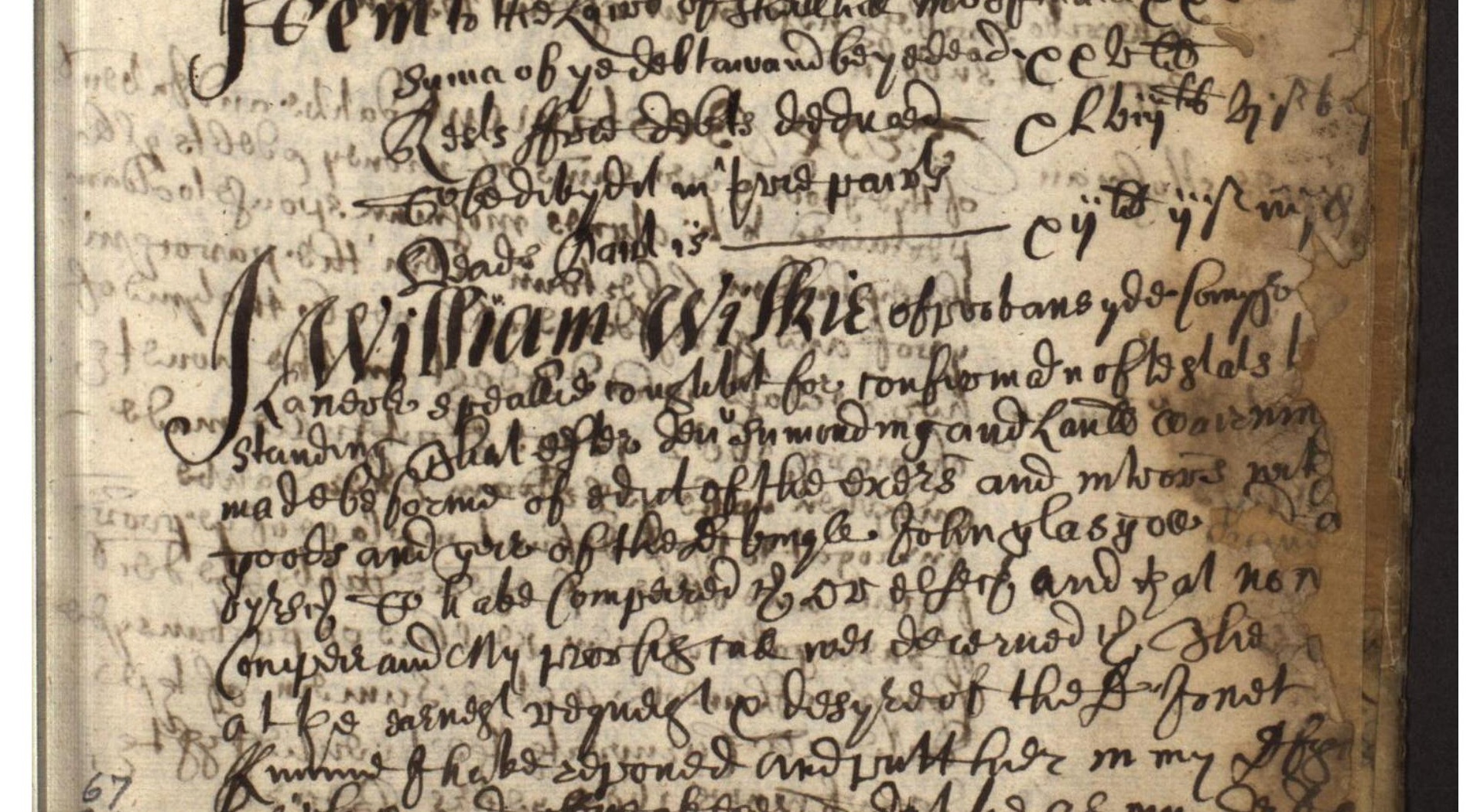
I William Wilkie procurator fiscall of this court ... goods and geir of the said umq[uhi]le John Glasgow
In modern English
William Wilkie appears as procurator fiscal in the court request concerning the late John Glasgow's estate.
How to read it
Box 1 is the officer's personal name and Box 2 his title. Box 3 returns to John Glasgow as the deceased whose goods are in process. The role label controls interpretation: William is conducting procedure, not being introduced as kin.
What this establishes
William Wilkie's official participation in the estate process.
What it does not establish
It does not make William Wilkie a brother, son or other relative of John or Jonet.
High for William Wilkie and procurator fiscal; moderate for the surrounding legal formula.
Slow reading
Inspect the words, not just the conclusion.
Compare the original strokes with the proposed reading. Tall or trailing strokes from neighbouring lines may enter a sample; the notes distinguish what is visible from what remains uncertain.
Phrase 01
William Wilkie
William Wilkie
Magnified from the same manuscript image. No letters have been redrawn.
Look at the strokes
William begins with a very large W built from deep pointed strokes and a leftward entry flourish.
The doubled l rises as two tall parallel ascenders.
Wilkie repeats the pointed W but ends with a small dotted i and curled e.
Compare in this hand: The second W is smaller but shares the same angular downstroke pattern as the first.
Reading limits: The name is clear; reverse-page text intersects but does not replace its strokes.
Phrase 02
procurator fiscall
procurator fiscal
Magnified from the same manuscript image. No letters have been redrawn.
Look at the strokes
Procurator opens with a tall looped p whose descender falls below the baseline.
The c and r are open, narrow forms separated by visible pen lifts.
Fiscall contains a long s and ends with two tall l ascenders.
Compare in this hand: Unlike relict and executrix in step 1, this title belongs to a court officer.
Reading limits: The title is clear; spelling fiscall is literal.
Phrase 03
umq[uhi]le John Glasgow
the late John Glasgow
Magnified from the same manuscript image. No letters have been redrawn.
Look at the strokes
Umqle is heavily abbreviated, with the q descender carrying much of the form.
John begins with the same tall descending J seen in step 1.
Glasgow ends in the same sharply pointed w as the opening name.
Compare in this hand: The repeated John Glasgow form confirms that this clause still concerns the same deceased.
Reading limits: The name is secure; the conventional expansion of umqle is editorially supplied.
04
National Records of Scotland, Lanark Commissary Court CC14/5/12, image 68; Crown copyright
4. Separate Jonet's oath from William Watson's caution
Click the manuscript to enlarge
Choose a phrase to locate it in the manuscript. Only its outline is shown, so overlapping strokes stay readable.
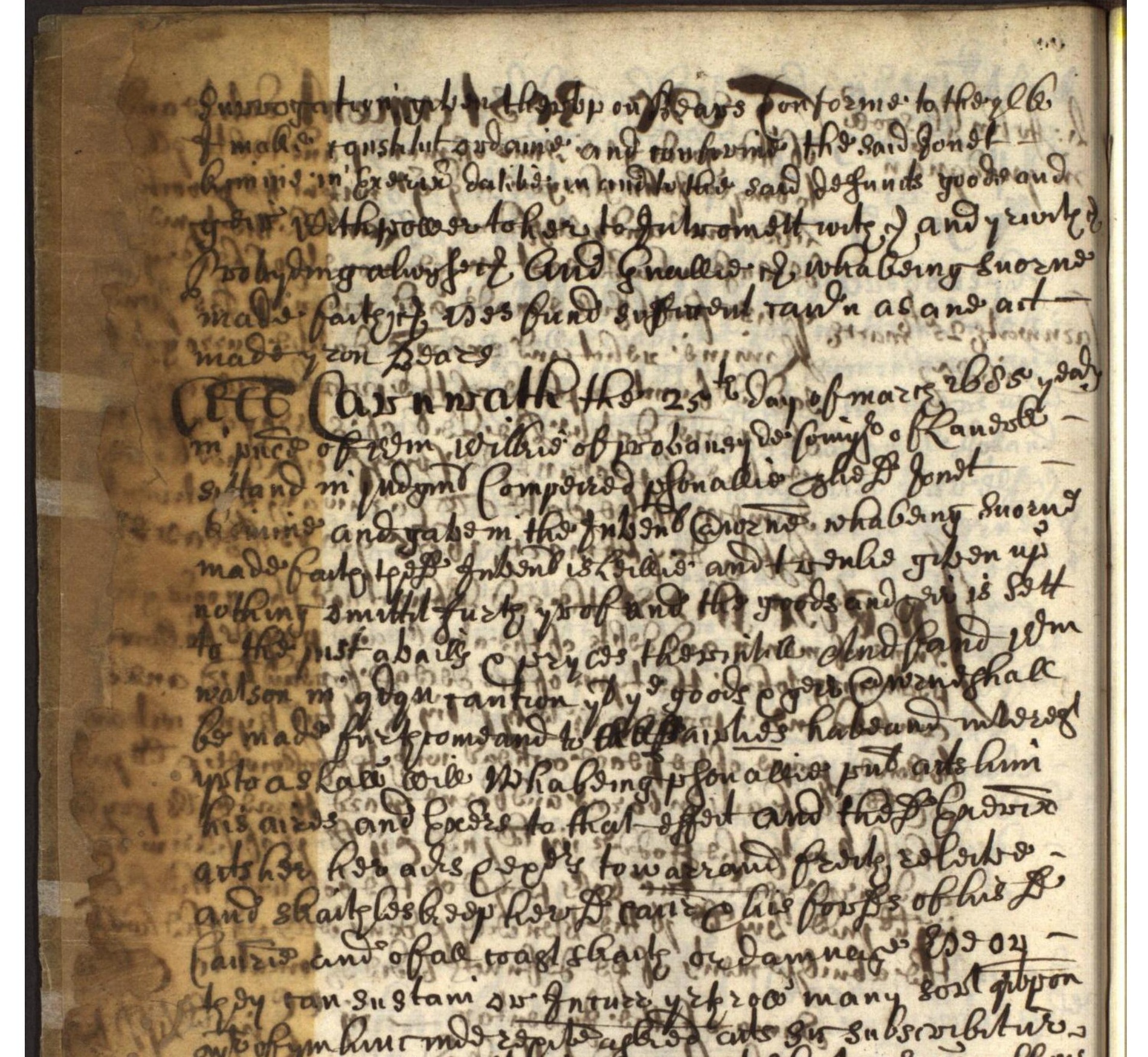
At Carnwath the 25 day of March 1685 ... compeired personallie Jonet [Kinnie?] ... William Watson ... cautioner ... goods ... furthcoming to all parties haveand interes
In modern English
At Carnwath on 25 March 1685, Jonet personally presented and swore the inventory; William Watson acted as cautioner for the estate goods.
How to read it
Box 1 is the dated court opening. Box 2 follows Jonet's personal appearance and oath context. Box 3 isolates William Watson with the cautioner wording, and Box 4 follows the guarantee that goods be forthcoming to interested parties. These are distinct procedural acts, not family descriptions.
What this establishes
The proceeding date, Jonet's personal estate oath and William Watson's security role.
What it does not establish
It does not identify William Watson as kin and adds no child or parent for John.
High for the date and role distinction; moderate for Jonet's surname and William's place designation.
Slow reading
Inspect the words, not just the conclusion.
Compare the original strokes with the proposed reading. Tall or trailing strokes from neighbouring lines may enter a sample; the notes distinguish what is visible from what remains uncertain.
Phrase 01
At Carnwath the 25 day of March 1685
At Carnwath, 25 March 1685
Magnified from the same manuscript image. No letters have been redrawn.
Look at the strokes
Carnwath begins with a large open C followed by connected arnwath strokes.
The Arabic 25 is separated from day by a small gap.
March has a broad M and a final h ascender rising above the line.
Compare in this hand: The same 25 March date is docketed on image 67; this full clause identifies the proceeding place.
Reading limits: Carnwath and the date are clear; this is a court date, not John's death date.
Phrase 02
compeired personallie Jonet
Jonet appeared personally
Magnified from the same manuscript image. No letters have been redrawn.
Look at the strokes
Compeired begins with an open capital C and contains a long p descender.
Personallie has a tall long-s form and two adjacent l ascenders.
Jonet begins with the familiar long descending J at the right end of the line.
Compare in this hand: The same given name and J form appear beside relict and executrix in step 1.
Reading limits: Jonet is secure; her surname follows elsewhere and remains uncertain.
Phrase 03
William Watson [in place unresolved] cautioner
William Watson, cautioner/surety
Magnified from the same manuscript image. No letters have been redrawn.
Look at the strokes
William opens with the same deep pointed W construction seen in William Wilkie on image 67.
Watson has a distinct tall W and a long s before the final on.
Cautioner begins with a large open C and ends with a short raised r.
Compare in this hand: William Wilkie in step 3 is procurator fiscal; William Watson here has the different role cautioner.
Reading limits: The name and cautioner role are readable; the intervening place designation is not.
Phrase 04
furthcoming to all parties haveand interes
made available to all parties having an interest
Magnified from the same manuscript image. No letters have been redrawn.
Look at the strokes
Furthcoming begins with a tall f descending below the line.
Parties has a p descender and a long s at the end.
Interes closes with a long final s-like stroke after the compact tere sequence.
Compare in this hand: This obligation explains the practical purpose of Watson's cautioner role in Box 3.
Reading limits: The core phrase is legible; adjoining legal words are obscured by show-through.
Full case analysisInterpretation, supporting evidence, changed readings and remaining questions.
Modern interpretation
What the record says
John Glasgow lived at Quothquan in Libberton parish and died intestate in February 1685.
Jonet, probably surnamed Kinnie, is expressly his relict or widow and executrix dative. The surname remains qualified because crossing ink prevents a secure letter-by-letter reading.
William Wilkie is procurator fiscal, John Wyllie is commissary of Lanark, and William Watson is cautioner. These are three separate court roles and none supplies kinship.
No child, parent, or sibling is named, so the testament does not bridge this John to the 1608 Mid Calder baptism or to either earlier Quothquan John.
Evidence and limits
What it establishes
Confirmed, not newly discovered: John Glasgow in Quothquan, Libberton parish; intestate death in February 1685; Jonet as widow and executrix dative.
Probable but unresolved surname: Kinnie remains the leading reading for Jonet and must retain a question mark.
Confirmed role separation: William Wilkie is procurator fiscal; John Wyllie is commissary; William Watson is cautioner.
Unresolved localities: the designations after John Wyllie and William Watson are not safe to normalize.
Confirmed negative: no child or parent is named in the supplied testament.
What changed in this reading
No family conclusion changed; the widow and officer/cautioner distinctions are reconfirmed.
The reread adds John Wyllie explicitly to the role audit while preserving his unread place designation.
Jonet's surname remains probable Kinnie rather than being promoted from damaged ink.
The three Quothquan John records remain separate record-defined people unless external evidence links them.
Still open
Do not fill these gaps with assumptions
Jonet's surname beyond probable Kinnie
The place designations of John Wyllie and William Watson
Complete livestock, crop, debt, and valuation figures
Closing names and signatures obscured by show-through
Any child, parent, or sibling of John and any bridge to the 1608 baptism or earlier Quothquan records
Full working transcriptionLine-oriented readings, unresolved text and a downloadable plain-text version.
Square brackets mark uncertainty, editorial expansions or missing text. Ellipses mark omitted or unresolved wording. Numbering identifies lines in this working reading, not official manuscript line numbers. This is not a complete diplomatic edition.
Image / passage 1 / image 67
The Testament dative and Inventar of the goods geir soumes of money and debts
pertaining to umquhile John Glasgow in Quothquan within the paroch of Libberton
and presbitry of Lanark who deceist intestat in the moneth of ffebruary 1685
faithfully made and given up be Jonet [Kinnie?] relict and executrix dative
[request concerning the office and goods of the late John Glasgow]
Image / passage 2 / image 68
[continuation of executor-dative authority]
At Carnwath the 25 day of March 1685
in presence of John Wyllie of [place unresolved] Commissar of Lanark
compeired personallie Jonet [Kinnie?] and gave in the within Inventar
[Jonet swore the inventory faithful and true]
William Watson in [place unresolved] cautioner
[goods to be forthcoming to all parties having interest]
[closing formula and signatures partly unresolved]
[following Morgan testament excluded]
Source files and reading provenanceOriginal references, pages examined and the limits of this review.
Source coverage and reading provenance
High for John, Quothquan/Libberton, February 1685, Jonet's widow and executrix roles, William Wilkie's fiscal office, John Wyllie's commissary office, and William Watson's caution. Moderate-low for Kinnie and low for the two place designations and damaged financial detail.
The full originals remain in the local research archive. Selected unaltered crops are shown above for reading and commentary, with separate switchable highlights. Image credit: Crown copyright, National Records of Scotland / ScotlandsPeople. Duplicate downloads are not independent evidence. Consult the original using the reference above through ScotlandsPeople.
All associated profiles and identity comparisonsIncludes possible and rejected associations, not just proved relatives.