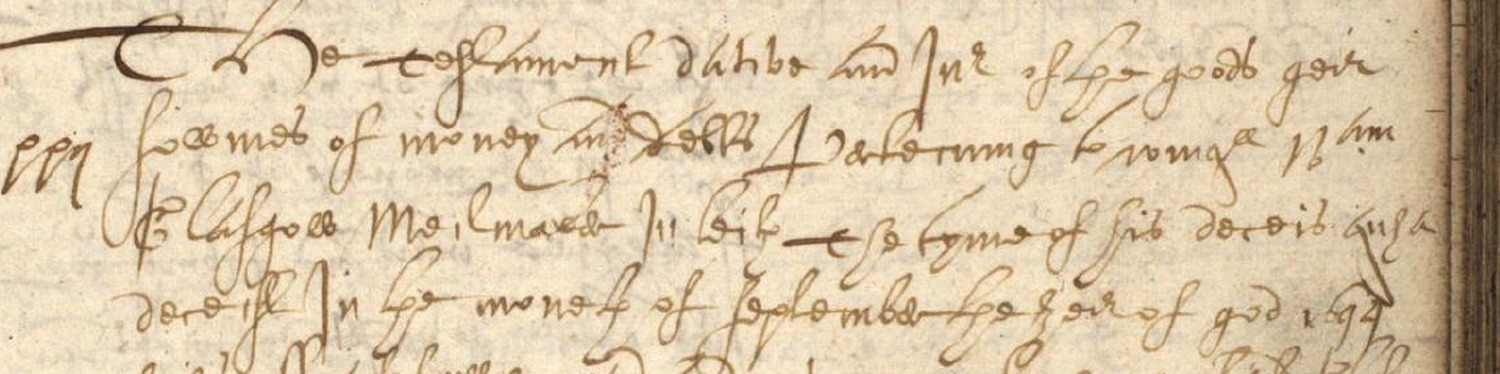
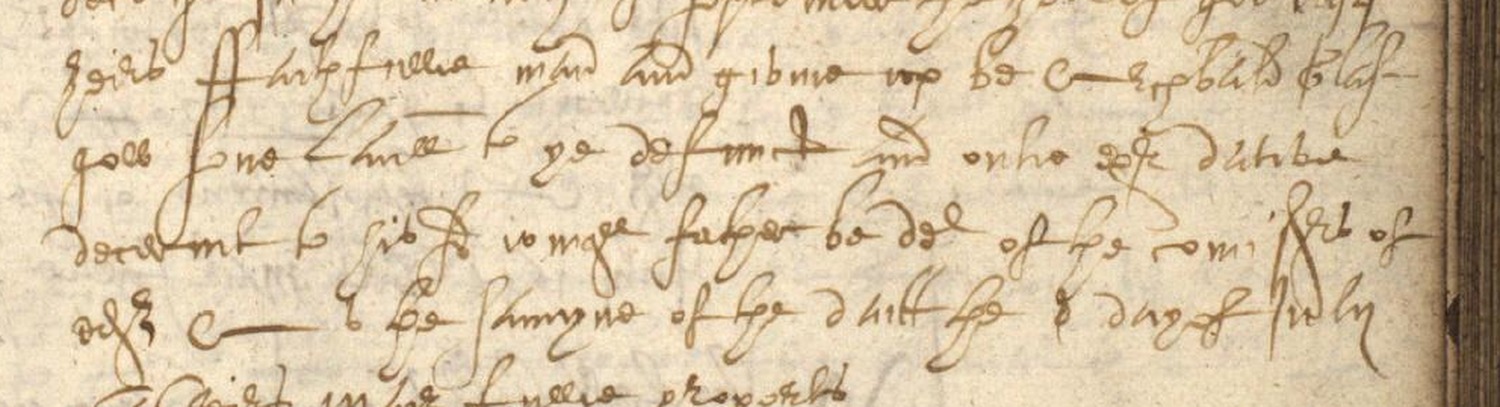
Read the identity across its line break, then distinguish the explicit sonship from the executor appointment. The enlarged words show the secretary-hand letterforms used for the name and kinship terms; these remain source-image excerpts, not a complete transcription.
NameRelationship / roleUncertain
New to secretary hand? Start with the shapes.
Follow the writing line. Ascenders rise above small letters; descenders fall below them. A neighbouring line can cross the word you are reading.
Count the short strokes. These are called minims. Joined i, m, n and u shapes can be ambiguous; compare a clear repeated word by the same clerk rather than guessing from a modern alphabet.
Separate reading from expansion. A contraction is not a fully written modern word. Square brackets retain doubtful letters or editorial additions. A familiar legal formula is a clue, not permission to fill a gap.
Then assess the relationship. Reading a name securely is not the same as proving kinship. Look for the actual role words and who they refer to.
Choose a name or relationship below. Compare the original ink, a paper-free view and the same spelling in a secretary-hand teaching font. Open the reasoning only when you need it.
01The ending of sone: separate the body letters from crossing strokesThe ending of sone: separate the body letters from crossing strokesInspect reading
Proposed readingsone (n/e detail)
The complete passage calls Archibald a lawful son and later names the deceased as father. This close comparison deliberately isolates the final n and e; it does not pretend that the oversized, crossing strokes to the left are simple modern letter shapes.
01 Original word Untouched manuscript02 Ink on white Derived from the original pixels
Open the original above if this browser cannot process the image.
03 Same spelling, another hand Joscelyn teaching font
sone (n/e detail)Loading the secretary-hand teaching font...
sone (n/e detail)
The white-background view suppresses paper colour; reviewed focus boundaries exclude separable neighbouring fragments where available. It does not restore missing strokes. Colour follows retained source pixels inside proposed letter groups, not a reconstructed pen path. Ambiguous crossings remain neutral where reviewed; other crossing ink may still belong to another line.
The font repeats the proposed spelling, not this clerk's handwriting. Similarity is a teaching aid, not confirmation; uncertainties remain in the reading above.
Locate the word in its passage Original contextThe complete passage calls Archibald a lawful son and later names the deceased as father. This close comparison deliberately isolates the final n and e; it does not pretend that the oversized, crossing strokes to the left are simple modern letter shapes.Reading, meaning and uncertainty
Expansion: son
Confidence: High for the complete relationship phrase in context.
Evidence boundary: The relationship is supported by the complete sone lawfull and father wording, not merely by a familiar-looking suffix or by appointment as executor.
... umq[uhi]le Wm / Glasgow Meilmaker in leith ...
In modern English
The late William Glasgow, mealmaker in Leith.
How to read it
The compact abbreviation Wm stands at the right end of one line; Glasgow begins the next. The line break is layout, not a break between people. Meilmaker and in leith follow the surname and supply occupation and residence. The tall loops, long descenders and compressed minim groups shown in the enlarged words are normal features of this hand, so the reading depends on the whole word and its position rather than on modern letter shapes alone.
What this establishes
The record identifies a deceased William Glasgow as a Leith mealmaker.
What it does not establish
This identity line does not name his parents or prove a relationship to any earlier Glasgow family.
High for identity, occupation and locality.
Slow reading
Inspect the words, not just the conclusion.
Compare the original strokes with the proposed reading. Tall or trailing strokes from neighbouring lines may enter a sample; the notes distinguish what is visible from what remains uncertain.
Phrase 01
Wm
William
Magnified from the same manuscript image. No letters have been redrawn.
Look at the strokes
The capital W is compressed into steep joined strokes rather than a modern printed W.
A small raised m follows the larger initial and sits close to the right edge of the line.
The final hairline turns down and right, so the whole abbreviation needs more than the height of the central letter body.
Reading limits: The abbreviation is secure in this naming formula; it does not preserve the omitted letters of William.
Phrase 02
Glasgow
Glasgow
Magnified from the same manuscript image. No letters have been redrawn.
Look at the strokes
The large opening G has an open upper loop and a lower stroke that returns beneath the baseline.
The middle las is tightly joined, with narrow vertical strokes that can look like an undivided zigzag at first sight.
The second g sends a long loop below the writing line.
The final ow is shallower and runs into a fine exit stroke toward Meilmaker.
Compare in this hand: The same surname is split as glas- and -gow in the sonship passage below, which helps confirm the g and final ow forms.
Reading limits: The surname reading is clear; the surrounding ink strokes from the adjacent line are not part of the word.
Phrase 03
Meilmaker
mealmaker
Magnified from the same manuscript image. No letters have been redrawn.
Look at the strokes
The capital M begins with a tall downstroke and broad turn before the smaller letters.
The eil sequence is compressed into short connected strokes; the dot above i separates it from an extra minim.
The k has a taller stem and angled arm near the middle of the word.
The final er is lighter and more tightly joined than the opening syllable.
Reading limits: Meilmaker is the visible Scots spelling; mealmaker is the modern occupational rendering, not a claim that the manuscript uses modern spelling.
Phrase 04
leith
Leith
Magnified from the same manuscript image. No letters have been redrawn.
Look at the strokes
The opening l rises well above the small e and i.
A dot is visible above the short i stroke.
The t is crossed within the joined middle of the word.
The final h has a tall looped ascender and a return stroke to the baseline.
Reading limits: The place-name is clear; capitalization is modernized in the expansion.
02
National Records of Scotland, CC8/8/62, image 461; Crown copyright
2. The relationship is stated, not inferred
Click the manuscript to enlarge
Choose a phrase to locate it in the manuscript. Only its outline is shown, so overlapping strokes stay readable.
... be Archibald glas- / gow sone law[fu]ll to the defunct and onlie ex[ecuto]r dative / ... his s[ai]d umq[uhi]le father ...
In modern English
Given up by Archibald Glasgow, lawful son of the deceased and sole executor dative; the deceased is also called his father.
How to read it
Archibald appears toward the right of the first complete line; glas- ends at the page edge and -gow resumes at the left of the next line. Immediately after the completed surname come sone and lawfull. The executor description follows as a separate legal office. The following line calls the deceased his father, a second kinship expression within the same record rather than independent corroboration.
What this establishes
Archibald is explicitly William's son as well as his executor.
What it does not establish
Executor status alone would not prove sonship; this passage also does not identify Archibald's mother.
High for the explicit son/father wording.
Slow reading
Inspect the words, not just the conclusion.
Compare the original strokes with the proposed reading. Tall or trailing strokes from neighbouring lines may enter a sample; the notes distinguish what is visible from what remains uncertain.
Phrase 01
Archibald
Archibald
Magnified from the same manuscript image. No letters have been redrawn.
Look at the strokes
The opening capital is larger than the following compact rch group.
The b and final d rise above the main letter body with narrow looped ascenders.
The final d finishes just before the separately boxed surname fragment at the line edge.
Reading limits: The forename is clear in context, although several joined middle strokes are not shaped like modern print.
Phrase 02
glas-
Glasgow, first-line fragment
Magnified from the same manuscript image. No letters have been redrawn.
Look at the strokes
The fragment begins with the same loop-and-descender g used in the complete surname above.
The las letters are compact and connected along one baseline.
A short horizontal continuation mark follows s at the right edge, signalling that the word continues on the next line.
Compare in this hand: Compare the complete Glasgow in the identity step, especially its opening g and compact las sequence.
Reading limits: This is not a separate abbreviated surname; the hyphen and next-line -gow complete it.
Phrase 03
gow
Glasgow, next-line continuation
Magnified from the same manuscript image. No letters have been redrawn.
Look at the strokes
The resumed g starts close to the left margin and drops below the body of o and w.
The o is a small closed loop attached directly to the g.
The final w is formed from two shallow joined humps before the pen lifts.
Compare in this hand: Joined to the preceding glas-, this matches the complete surname in the identity step.
Reading limits: The leading hyphen in the display label marks editorial continuation; it is not an extra manuscript letter.
Phrase 04
sone
son
Magnified from the same manuscript image. No letters have been redrawn.
Look at the strokes
The opening secretary s is a long rising stroke, easily mistaken for f when isolated.
The o is a small loop followed by the two close strokes of n.
The terminal e is a light open turn at the right of the word.
Reading limits: The Scots spelling sone is visible and supplies the kinship directly; the modern expansion drops the final e.
Phrase 05
lawfull
lawful
Magnified from the same manuscript image. No letters have been redrawn.
Look at the strokes
The initial l is a tall loop rising above the compact aw group.
The w is made from linked angular strokes rather than rounded modern humps.
The f has a long descending stroke, while the final ull compresses several vertical minims together.
Reading limits: The doubled l spelling is literal; lawful is the modernized form.
Phrase 06
father
father
Magnified from the same manuscript image. No letters have been redrawn.
Look at the strokes
The opening f rises and also sends a long stroke below the baseline.
The a and t are small and tightly joined after that dominant first letter.
The h has a tall loop, while the final er closes in a lighter rightward turn.
Compare in this hand: This repeats the direction of the earlier sone lawfull statement from Archibald's viewpoint.
Reading limits: The word is clear; it is a second expression in the same testament, not a separate source.
Full case analysisInterpretation, supporting evidence, changed readings and remaining questions.
Modern interpretation
What the record says
William Glasgow was a mealmaker in Leith and died in September 1644.
Archibald Glasgow is expressly William's lawful son and sole executor dative. The next line calls William his late father, reinforcing the direct relationship within the same source.
The testament is dative and its July 1646 proceedings are not William's death date.
Names in the debt and confirmation sections, including a possible John debtor and William Craufurd in an administrative role, do not establish a brother or other kin.
Evidence and limits
What it establishes
Confirmed: William Glasgow, mealmaker in Leith, died September 1644.
Confirmed: Archibald Glasgow is sone lawfull to the defunct and sole executor dative.
Confirmed: his said late father independently restates William's relationship to Archibald within the entry.
Confirmed: no John Glasgow is named as William's brother or executor.
Unresolved: a possible John in the debt continuation is an account party, not a stated relative.
Probable: William Craufurd occurs in the confirmation/caution procedure; exact occupation/locality and role remain unresolved.
What changed in this reading
Old: Archibald's lawful sonship and sole executorship were maintained. New: confirmed unchanged from the opening and reinforced by the following father wording.
Old: supposed brother/executor John was rejected. New: confirmed unchanged; any possible John on image 462 belongs to the debt list and carries no kin term.
Old: William Craufurd's occupation/locality was unresolved. New: still unresolved after enlargement; no kinship is assigned.
No walkthrough text or geometry changed because the core sonship conclusion remains unchanged.
Still open
Do not fill these gaps with assumptions
Complete names and roles of the debt parties on images 461-462.
William Craufurd's exact occupation/locality and administrative role.
Internal executor-decree day distinct from the marginal 22 July confirmation date.
William's spouse, parents and any children other than Archibald.
Full working transcriptionLine-oriented readings, unresolved text and a downloadable plain-text version.
Square brackets mark uncertainty, editorial expansions or missing text. Ellipses mark omitted or unresolved wording. Numbering identifies lines in this working reading, not official manuscript line numbers. This is not a complete diplomatic edition.
Image / passage 461, opening
[Margin:] Wm Glasgow xxij of July 1646
The testament dative and Inv[entar] of the goods geir
soumes of money and debtis perteining to umq[uhi]le Wm
Glasgow Meilmaker in leith [wording unresolved] the tyme of his deceis quha
deceissit in the moneth of september the yeir of god 1644
yeiris faithfullie maid and givine up be Archibald glas-
gow sone lawfull to the defunct and onlie ex[ecuto]r dative
decreit to his said umq[uhi]le father be decreit of the commissaris of
Edinburgh [decree wording/day partly unresolved]
Image / passage 461-462, inventory and debts
[household goods, clothing and receivables; sums omitted]
Followes the debtis awine to the deid
[several debtor names and amounts unresolved]
Item be Jon[e?] [surname unresolved] [debt wording unresolved]
[a further associate, possibly Alexander, and bond/rent wording unresolved]
Summa of the debtis awine to the deid [amount unresolved]
Summa of the Inventar wt the debtis [amount unresolved]
Source files and reading provenanceOriginal references, pages examined and the limits of this review.
Source coverage and reading provenance
High for William's occupation, Leith residence, September 1644 death and Archibald's lawful sonship/sole executorship. High that no brother John is established. Low for several debtor names and detailed confirmation roles.
Reviewed: 2026-09-10. Method: LLM-assisted fresh visual reread from original images.
Pages examined
PDF page 1 / image 461: opening in lower half, inventory and beginning of debt list; preceding estate excluded
PDF page 2 / image 462: debt continuation and confirmation; following estate excluded
Supplied local source files
William_1646.pdf
The full originals remain in the local research archive. Selected unaltered crops are shown above for reading and commentary, with separate switchable highlights. Image credit: Crown copyright, National Records of Scotland / ScotlandsPeople. Duplicate downloads are not independent evidence. Consult the original using the reference above through ScotlandsPeople.
All associated profiles and identity comparisonsIncludes possible and rejected associations, not just proved relatives.