Three crops separate the Leith household, the explicit sons and the January will date. The enlarged words show how the same hand forms names, long s, looped ascenders and abbreviations. The source states family relationships, but those clauses do not by themselves resolve every same-name profile identification.
NameRelationship / roleUncertain
New to secretary hand? Start with the shapes.
Follow the writing line. Ascenders rise above small letters; descenders fall below them. A neighbouring line can cross the word you are reading.
Count the short strokes. These are called minims. Joined i, m, n and u shapes can be ambiguous; compare a clear repeated word by the same clerk rather than guessing from a modern alphabet.
Separate reading from expansion. A contraction is not a fully written modern word. Square brackets retain doubtful letters or editorial additions. A familiar legal formula is a clue, not permission to fill a gap.
Then assess the relationship. Reading a name securely is not the same as proving kinship. Look for the actual role words and who they refer to.
Choose a name or relationship below. Compare the original ink, a paper-free view and the same spelling in a secretary-hand teaching font. Open the reasoning only when you need it.
01Lawfull sones: the long forms are not modern printed lettersLawfull sones: the long forms are not modern printed lettersInspect reading
Proposed readinglawfull sones
The three sons are named across the line break. This panel compares a tall loop in lawfull with the long opening form in sones. The crop preserves neighbouring strokes so their overlap is visible rather than erased.
01 Original word Untouched manuscript02 Ink on white Derived from the original pixels
Open the original above if this browser cannot process the image.
03 Same spelling, another hand Joscelyn teaching font
lawfull sonesLoading the secretary-hand teaching font...
lawfull sones
The white-background view suppresses paper colour; reviewed focus boundaries exclude separable neighbouring fragments where available. It does not restore missing strokes. Colour follows retained source pixels inside proposed letter groups, not a reconstructed pen path. Ambiguous crossings remain neutral where reviewed; other crossing ink may still belong to another line.
The font repeats the proposed spelling, not this clerk's handwriting. Similarity is a teaching aid, not confirmation; uncertainties remain in the reading above.
Locate the word in its passage Original contextThe three sons are named across the line break. This panel compares a tall loop in lawfull with the long opening form in sones. The crop preserves neighbouring strokes so their overlap is visible rather than erased.Reading, meaning and uncertainty
Expansion: lawful sons
Confidence: High for the relationship wording; identity with the earlier shoemaker remains a separate question.
Evidence boundary: The testament identifies lawful sons, but these letterforms do not establish whether their father was the Archibald documented as a shoemaker in 1647.
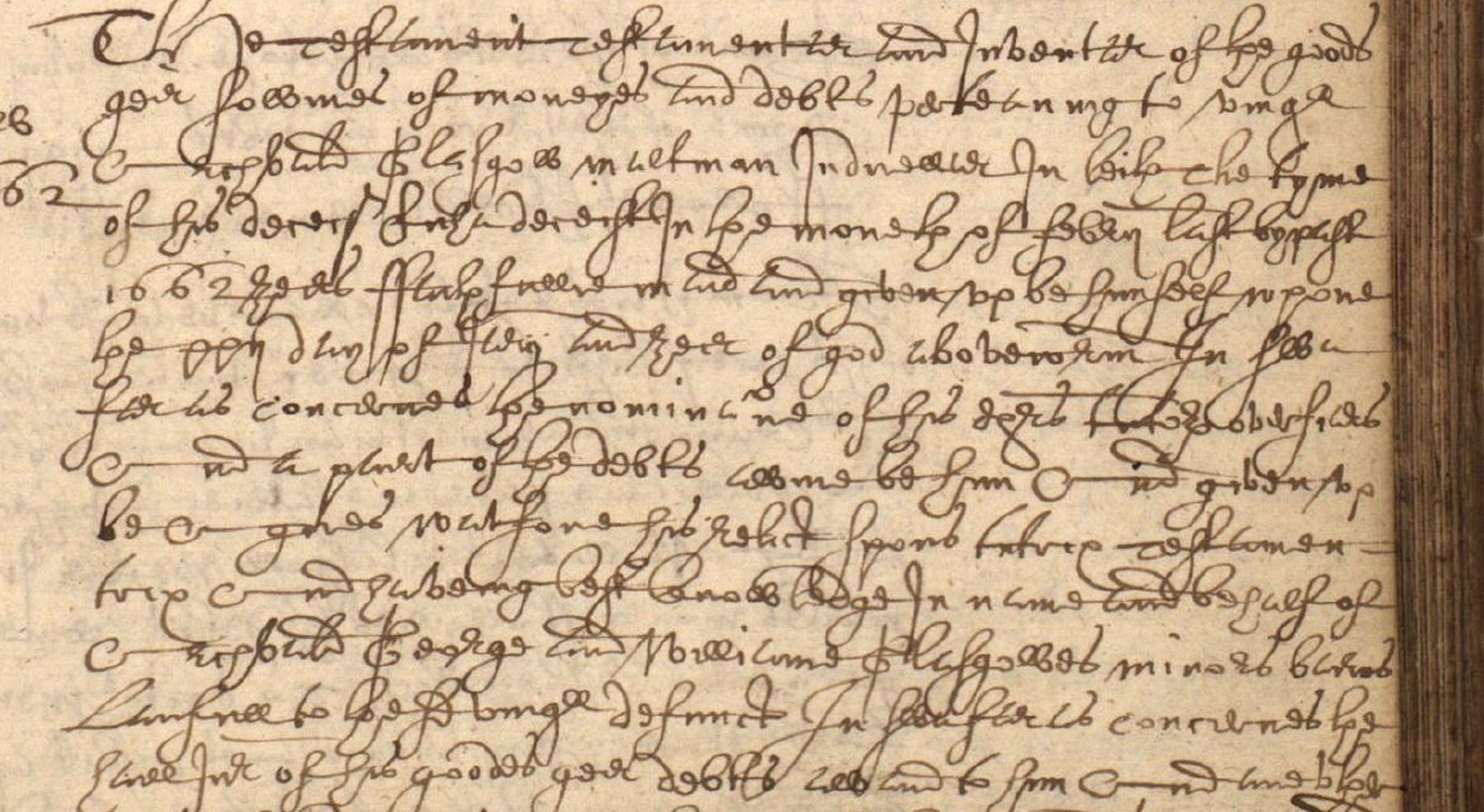
Archibald Glasgow maltman Indweller In leith ... / be Agnes Watsone his relict spous ...
In modern English
Archibald Glasgow, maltman living in Leith; Agnes Watson, his surviving spouse.
How to read it
The designation in leith follows Indweller near the top. Further down, Agnes Watsone is immediately followed by his relict spous. In seventeenth-century Scots legal usage, relict identifies the surviving spouse. That explicit relationship wording must be kept separate from the later tutorship and administration language, which describes legal functions rather than additional kinship.
What this establishes
The record locates this maltman in Leith and expressly identifies Agnes as his widow.
What it does not establish
It does not establish a marriage date, Agnes's parents, or the maltman's identity with every earlier Archibald record.
High for the residence and spouse wording.
Slow reading
Inspect the words, not just the conclusion.
Compare the original strokes with the proposed reading. Tall or trailing strokes from neighbouring lines may enter a sample; the notes distinguish what is visible from what remains uncertain.
Phrase 01
Archibald Glasgow
Archibald Glasgow
Magnified from the same manuscript image. No letters have been redrawn.
Look at the strokes
The capital A opens with a broad loop before the narrow joined rch strokes.
Tall ascenders in b and d rise above the middle letters of Archibald.
Glasgow begins with a conspicuous looped G and contains a lower g loop beneath the baseline.
The final ow runs into a fine exit stroke before maltman.
Compare in this hand: The same forename recurs in abbreviated form in the sons step; the full form here supports that expansion.
Reading limits: The full name is clear; this clause identifies the testator but does not distinguish every namesake outside the document.
Phrase 02
leith
Leith
Magnified from the same manuscript image. No letters have been redrawn.
Look at the strokes
The opening l rises in a tall narrow loop above the other letters.
The short e and dotted i sit low between the two tall outer letters.
The t is crossed, and the final h closes with a loop and returning foot.
Reading limits: The place-name is secure; the modern expansion supplies capitalization only.
Phrase 03
Agnes Watsone
Agnes Watson
Magnified from the same manuscript image. No letters have been redrawn.
Look at the strokes
The capital A is larger and more open than the following gnes sequence.
The g in Agnes drops below the baseline in a narrow loop.
Watsone begins with a broad angular W and ends with a small open e.
The tall t and long s-like stroke break up the otherwise compact surname.
Reading limits: Watsone is the literal spelling; Watson is the normalized surname.
Phrase 04
his relict spous
his surviving spouse
Magnified from the same manuscript image. No letters have been redrawn.
Look at the strokes
The initial h of his has a tall loop, followed by a short i and compact final s.
Relict is separated as its own word, with a tall l at the start and crossed t at the end.
Spous begins with a long secretary s and finishes in a small terminal s stroke.
The three words occupy one continuous phrase immediately after Agnes's name.
Reading limits: Spous is the visible Scots spelling of spouse; relict means surviving spouse here, not merely an estate representative.
02
National Records of Scotland, CC8/8/70, image 691; Crown copyright
2. Three names followed by my lawful sons
Click the manuscript to enlarge
Choose a phrase to locate it in the manuscript. Only its outline is shown, so overlapping strokes stay readable.
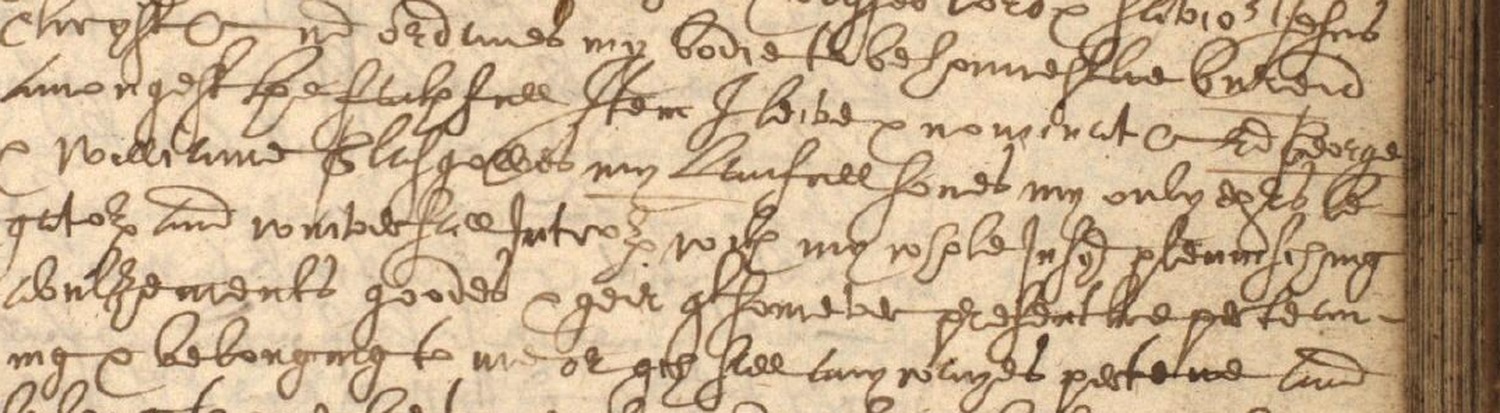
... Arch[ibal]d George / & Williame Glasgowes my lawfull sones my onlie ex[ecuto]ris ...
In modern English
Archibald, George and William Glasgow, my lawful sons and my sole executors.
How to read it
The first two forenames stand at the right end of the nomination line; William and the shared surname continue at the left of the next. The abbreviated Archibald is expanded from its surviving letters and the full form elsewhere in this hand. The plural phrase my lawfull sones grammatically qualifies the three-name group. The following executor wording states their legal role and is not being used to infer the relationship.
What this establishes
Archibald, George and William are explicitly the testator's sons and are appointed executors.
What it does not establish
This clause alone does not assign birth dates, distinguish every namesake or prove that no other child had ever existed.
High for the three-name group and sonship; the first forename is abbreviated.
Slow reading
Inspect the words, not just the conclusion.
Compare the original strokes with the proposed reading. Tall or trailing strokes from neighbouring lines may enter a sample; the notes distinguish what is visible from what remains uncertain.
Phrase 01
Archd
Archibald
Magnified from the same manuscript image. No letters have been redrawn.
Look at the strokes
The enlarged capital A has the same broad opening movement as the full Archibald in the household step.
The surviving rch strokes are tightly compressed before the shortened ending.
A raised terminal d and abbreviation stroke signal omitted internal letters rather than a different forename.
Compare in this hand: The full Archibald Glasgow near the start of the testament supplies a same-hand comparison for the expansion.
Reading limits: Archibald is the conventional and context-supported expansion; the omitted letters are not individually written.
Phrase 02
George
George
Magnified from the same manuscript image. No letters have been redrawn.
Look at the strokes
The capital G is an open loop larger than the following letters.
The middle or is compact, while the second g drops below the baseline.
The final e is a small rightward turn immediately before the line edge.
Reading limits: The forename is clear despite crowding at the right margin.
Phrase 03
Williame Glasgowes
William Glasgow; the surname applies to the named sons
Magnified from the same manuscript image. No letters have been redrawn.
Look at the strokes
Williame starts with a broad angular W followed by two close l strokes and a dotted i.
The final e of Williame is lighter and joins visually toward the following surname.
Glasgowes has a large opening G, a descending lower g and a clearly continued terminal es.
The phrase begins at the left margin because it continues the list from the preceding line.
Reading limits: The literal terminal -es belongs to the manuscript grammar; the expansion normalizes the individual surname without treating it as a different family name.
Phrase 04
my lawfull sones
my lawful sons
Magnified from the same manuscript image. No letters have been redrawn.
Look at the strokes
The y in my drops below the line and leads into a visible word space before lawfull.
Lawfull has tall l strokes and a long descending f amid a dense group of minims.
Sones begins with a long secretary s and ends with a light open e-s sequence.
The plural ending agrees with the three preceding forenames.
Reading limits: The relationship and plural are explicit; this clause does not establish birth order or whether other children existed.
03
National Records of Scotland, CC8/8/70, image 692; Crown copyright
3. The January date belongs to making the will
Click the manuscript to enlarge
Choose a phrase to locate it in the manuscript. Only its outline is shown, so overlapping strokes stay readable.
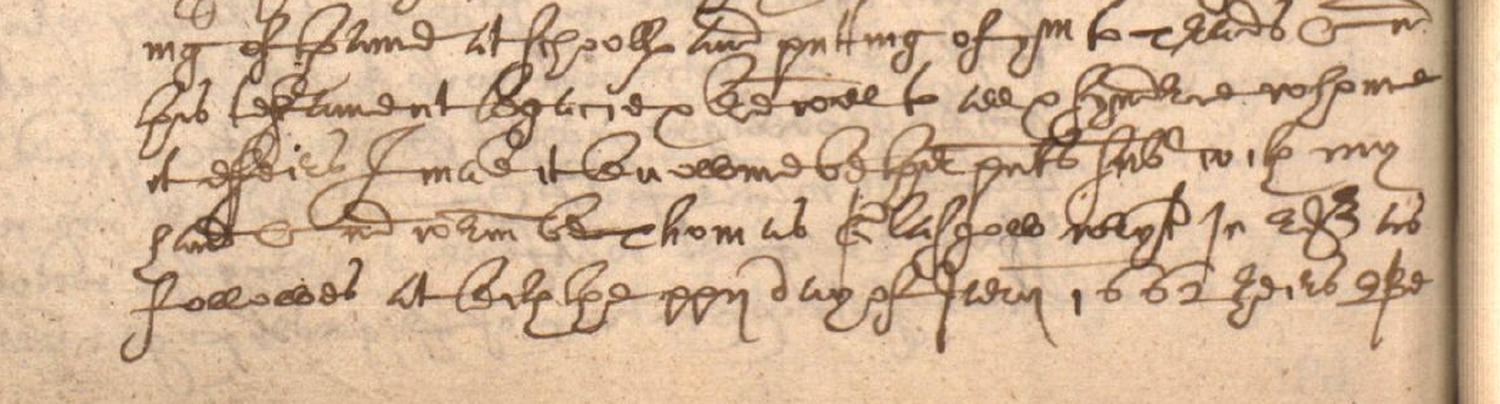
... writtin be Thomas Glasgow weaver In ed[inbu]r[gh] ... / at leith the [xxiij?] day of Jan[uar] 1662 yeiris ...
In modern English
Written by Thomas Glasgow, weaver in Edinburgh; at Leith on an uncertain day in January 1662.
How to read it
Read the writer's name in the upper line separately from the place-and-date formula below. The enlarged month begins with a long descending J and a contracted January form; the preceding day numeral remains too uncertain to promote. This closing date belongs to making the will, not to the marginal May confirmation or the separate February death statement.
What this establishes
The will was made in January 1662 and names Thomas Glasgow as its writer.
What it does not establish
It does not establish the precise January day or make Thomas a relative. It is not a birth, marriage or death date.
High for January 1662; uncertain for the day numeral.
Slow reading
Inspect the words, not just the conclusion.
Compare the original strokes with the proposed reading. Tall or trailing strokes from neighbouring lines may enter a sample; the notes distinguish what is visible from what remains uncertain.
Phrase 01
Thomas Glasgow
Thomas Glasgow
Magnified from the same manuscript image. No letters have been redrawn.
Look at the strokes
Thomas begins with a larger crossed capital T followed by a tall looped h.
The final s of Thomas is a long secretary form rather than a modern rounded s.
Glasgow opens with a broad looped G and contains a lower g loop beneath the baseline.
The final ow runs toward, but remains separable from, the following occupational wording.
Reading limits: The name is clear; nothing in this boxed name itself states that Thomas is related to the testator.
Phrase 02
Jan[uar] 1662
January 1662
Magnified from the same manuscript image. No letters have been redrawn.
Look at the strokes
The month begins with a large J whose stem descends far below the other letters.
The letters after Jan are compressed and partly raised in the conventional contracted month form.
The four digits are separately visible, with a tall 1 and rounded final 2.
The date sits in the lower closing line, beneath Thomas Glasgow's name.
Reading limits: January and 1662 are secure; the exact letters represented by the contraction and the preceding day numeral remain qualified.
Full case analysisInterpretation, supporting evidence, changed readings and remaining questions.
Modern interpretation
What the record says
Archibald Glasgow was a maltman living in Leith and died in February 1662.
Agnes Watson is expressly his surviving spouse. She acts as testamentary tutor and estate administrator for their minor children.
Archibald, George, and William Glasgow are expressly called his lawful sons and are his sole executors and equal beneficiaries after debts.
Captain George Cock and Thomas Glasgow, weaver in Edinburgh, are overseers. Thomas also wrote the will and appears in the caution procedure, but no surviving clause calls him Archibald's brother or other relative.
William Glasgow, weaver in Leith, is a creditor. His shared surname does not establish kinship.
Evidence and limits
What it establishes
Confirmed explicit family: wife/widow Agnes Watson; lawful sons Archibald, George, and William Glasgow.
Confirmed legal roles: the sons are sole executors; Agnes is tutor/intromissatrix during minority; George Cock and Thomas Glasgow are overseers.
Confirmed associates: Walter Roddie and Robert Stewart are witnesses; Sir John Nisbet acts in confirmation; Thomas Glasgow is writer and appears in caution procedure.
Confirmed account participants include John Greig, William Couper, John Watson, Robert Cunningham, William Paterson, William Glasgow the Leith weaver, and James Nisbet the apothecary; the account does not state that any is kin.
The testament defines a Leith maltman. Association with Glasgow-3078 is useful but not proved by this document alone because the securely documented 1647 heir was a Leith shoemaker.
What changed in this reading
No wife-or-sons conclusion changed; the explicit household is reconfirmed after a complete page-by-page name audit.
The reread inventories overseers, witnesses, officials, account parties, and servants separately and excludes unsupported kinship for both Thomas Glasgow and creditor William Glasgow.
The profile association is now expressly qualified at the occupation seam: maltman in 1662 versus shoemaker in the independent 1639/1647 chain.
Still open
Do not fill these gaps with assumptions
Exact January day on which the will was made
Agnes the servant's surname and whether Jonet's surname is Dickson
Several debtor/creditor names, all sums, and portions of the financial account
Any kinship between Archibald and overseer/writer Thomas Glasgow or creditor William Glasgow
Whether the 1662 Leith maltman is identical to Glasgow-3078, the separately documented Leith shoemaker
Full working transcriptionLine-oriented readings, unresolved text and a downloadable plain-text version.
Square brackets mark uncertainty, editorial expansions or missing text. Ellipses mark omitted or unresolved wording. Numbering identifies lines in this working reading, not official manuscript line numbers. This is not a complete diplomatic edition.
Image / passage 1 / image 689
The testament testamentar and Inventar [of] umquhile Archibald Glasgow
maltman Indweller In leith [who] deceissit in the moneth of ffebry [1662]
givine up be Agnes Watsone his relict spous tutrix testamentar
in name and behalf of Archibald George and Williame Glasgowes minoris bairnes
lawfull to the said umquhile defunct
Image / passage 2 / image 690
[the three sons] he nominat his onlie executoris in his latterwill
[inventory of malt, bear, household plenishing, and clothing]
Debtis awand to the deid: Jon Greig in Northleith; Williame Couper in Leith; Jon Watsone [and names/sums partly unresolved]
Debtis awand be the deid: Robert Cunynghame maltman in Leith; Williame Patersone; Williame Glasgow weiber in Leith; James Nisbit apothecar [and sums partly unresolved]
Image / passage 3 / image 691
[servants' wages:] Agnes [surname illegible] and Jonet Dick[sone?]
I Archibald Glasgow maltman and Indweller in Leith [latterwill]
Archibald George and Williame Glasgowes my lawfull sones my onlie executoris
[goods to the three sons equally]
my weilbelovit spous Agnes Watsone [as] intromissatrix and tutrix
Image / passage 4 / image 692
for the weill and behoove of my said childrene by the advice and consent of
captane George Cocke burges in Edinburgh and Thomas Glasgow weaver in Edinburgh as oversiars
[Agnes to administer during the children's minority with the overseers' consent]
this testament [was] writtin be Thomas Glasgow weaver in Edinburgh
at Leith the [day numeral unresolved] day of Jan[uar] 1662
Image / passage 5 / image 693
witnesses Walter Roddie Indweller in Edinburgh and Robert Stewart stabler in Leith
[subscriptions of Archibald Glasgow, Walter Roddie, and Robert Stewart]
Sir John Nisbet [commissary/confirmation formula]
Thomas Glasgow weaver in Edinburgh [caution procedure]
[following James Davidsone testament excluded]
Source files and reading provenanceOriginal references, pages examined and the limits of this review.
Source coverage and reading provenance
High for Archibald's name, maltman occupation, Leith residence, Agnes Watson as wife/widow, the three lawful sons, their executorship, and the stated roles of George Cock and Thomas Glasgow. Moderate for some account names and low for servant surnames and complete financial detail. The profile identity remains qualified.
The full originals remain in the local research archive. Selected unaltered crops are shown above for reading and commentary, with separate switchable highlights. Image credit: Crown copyright, National Records of Scotland / ScotlandsPeople. Duplicate downloads are not independent evidence. Consult the original using the reference above through ScotlandsPeople.
All associated profiles and identity comparisonsIncludes possible and rejected associations, not just proved relatives.