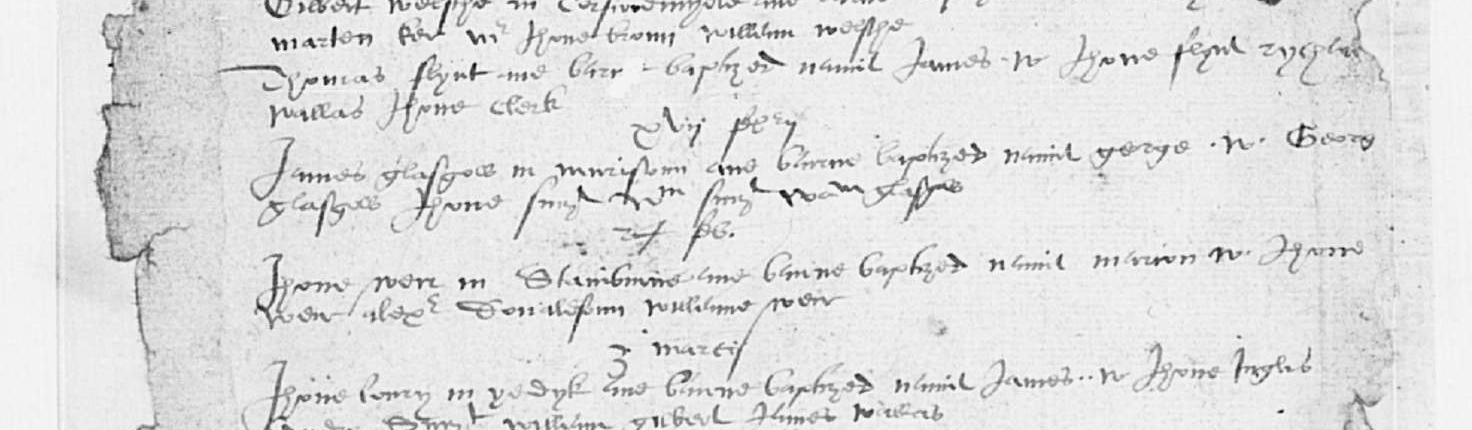
This is a parish-register baptism, not a testament. Read the date heading with the baptism formula, then keep James Glasgow, the named parent, separate from George Glasgow, who appears after the witness marker.
NameRelationship / roleUncertain
New to secretary hand? Start with the shapes.
Follow the writing line. Ascenders rise above small letters; descenders fall below them. A neighbouring line can cross the word you are reading.
Count the short strokes. These are called minims. Joined i, m, n and u shapes can be ambiguous; compare a clear repeated word by the same clerk rather than guessing from a modern alphabet.
Separate reading from expansion. A contraction is not a fully written modern word. Square brackets retain doubtful letters or editorial additions. A familiar legal formula is a clue, not permission to fill a gap.
Then assess the relationship. Reading a name securely is not the same as proving kinship. Look for the actual role words and who they refer to.
Choose a name or relationship below. Compare the original ink, a paper-free view and the same spelling in a secretary-hand teaching font. Open the reasoning only when you need it.
01The child’s name after ‘namit’The child’s name after ‘namit’Inspect reading
Proposed readinggeorge
The existing baptism reading is ‘ane bairne baptizit namit george’; this occurrence names the child, unlike the later witness George Glasgow.
01 Original word Untouched manuscript02 Ink on white Derived from the original pixels
Open the original above if this browser cannot process the image.
03 Same spelling, another hand Joscelyn teaching font
georgeLoading the secretary-hand teaching font...
george
The white-background view suppresses paper colour; reviewed focus boundaries exclude separable neighbouring fragments where available. It does not restore missing strokes. Colour follows retained source pixels inside proposed letter groups, not a reconstructed pen path. Ambiguous crossings remain neutral where reviewed; other crossing ink may still belong to another line.
The font repeats the proposed spelling, not this clerk's handwriting. Similarity is a teaching aid, not confirmation; uncertainties remain in the reading above.
Locate the word in its passage Original contextThe existing baptism reading is ‘ane bairne baptizit namit george’; this occurrence names the child, unlike the later witness George Glasgow.Reading, meaning and uncertainty
Expansion: George
Confidence: high
Evidence boundary: The existing parent/child/witness distinction remains unchanged: this is the child’s George within the baptism formula.
xvij feb[ruar?] / James glasgow in muirestoun[?] ane bairne baptizit namit george
In modern English
17 February: James Glasgow in Muirestoun [?], a child baptised named George
How to read it
Xvij is the Roman numeral 17. Read down from that heading to James's entry, then across to baptizit and namit george. The long descenders cross into the next line's space, so the word-study boxes are intentionally tall. Ane bairne baptizit namit george is the operative phrase: 'a child baptised, named George'. The line records baptism, not an explicitly stated birth.
What this establishes
George was baptised on 17 February 1605, and James Glasgow is the parent named in the entry's formula.
What it does not establish
It does not state George's birth date, name his mother, or securely resolve the residence spelling.
high for the baptism date, James, and child George; moderate for Muirestoun
Slow reading
Inspect the words, not just the conclusion.
Compare the original strokes with the proposed reading. Tall or trailing strokes from neighbouring lines may enter a sample; the notes distinguish what is visible from what remains uncertain.
Phrase 01
xvij feb[ruar?]
17 February
Magnified from the same manuscript image. No letters have been redrawn.
Look at the strokes
xvij is formed by crossed x strokes, a v, two short i minims and a descending final j.
The j descender drops below the numeral line and curls left.
The following month abbreviation begins with a tall f and a raised abbreviation mark.
Reading limits: The day numeral is clear; the expanded source excerpt preserves the complete raised month flourish with surrounding margin.
Phrase 02
James glasgow
James Glasgow
Magnified from the same manuscript image. No letters have been redrawn.
Look at the strokes
The capital J has a long descending stroke that loops left below the line.
James ends in a long s whose stroke can resemble f.
glasgow begins on the following line with a tall looped g and a compact final w.
Compare in this hand: The wider witness crop repeats this same James glasgow at the entry start.
Reading limits: The name is clear; the line's formula identifies him as the named parent, not necessarily the father under every possible register convention.
Phrase 03
baptizit
baptised
Magnified from the same manuscript image. No letters have been redrawn.
Look at the strokes
The initial b rises in a tall narrow loop.
The p descends below the body letters, while the t near the end rises and crosses lightly.
The final -zit is compressed into angular strokes typical of the clerk's connected hand.
Reading limits: The action is baptism; the word supplies no birth date.
Phrase 04
namit george
named George
Magnified from the same manuscript image. No letters have been redrawn.
Look at the strokes
namit is a low run of joined humps ending in a taller t.
george starts with a looped descender and contains a second rounded g-like form near its end.
A visible word gap separates the naming verb from the child's forename.
Compare in this hand: The witness's Georg at the far right of the wider crop has the same open capital-like initial but a different role after W.
Reading limits: George is the child named by the baptism formula; this sample does not name a mother.
James glasgow ... namit george . W. Georg / glasgow Johne smyth Wm[?] [illegible]
In modern English
James Glasgow ... named George. Witnesses: George Glasgow, John Smith, William [?] ...
How to read it
Read the entry as a two-line unit. James begins the first line; after the child-naming words, the isolated W. changes the role to witnesses. Georg closes that line and glasgow resumes at the far left below. The expanded source excerpt preserves the complete lower continuation; keeping the two pieces separate prevents a false single-line box.
What this establishes
James Glasgow is the named parent, while a different role is assigned to George Glasgow as a witness.
What it does not establish
The entry does not call the witness George the child's grandfather or otherwise state how he was related.
high for the parent/witness distinction; low for the final witness
Slow reading
Inspect the words, not just the conclusion.
Compare the original strokes with the proposed reading. Tall or trailing strokes from neighbouring lines may enter a sample; the notes distinguish what is visible from what remains uncertain.
Phrase 01
James glasgow
James Glasgow, the named parent
Magnified from the same manuscript image. No letters have been redrawn.
Look at the strokes
The large J descends below the line before returning into ames.
The long s at the end of James runs toward the next word.
The surname's opening g descender overlaps the space used by the following line.
Compare in this hand: This is the same entry-start name isolated in the baptism step.
Reading limits: The register formula names James as parent; it does not display a separate kin word such as father.
Phrase 02
W.
Witness or witnesses
Magnified from the same manuscript image. No letters have been redrawn.
Look at the strokes
The marker is visually isolated after the child's name and before Georg.
Its two broad joined downstrokes form a compact W unlike the surrounding lower-case words.
The following dot reinforces its abbreviated function.
Reading limits: The role change is clear in context; the exact singular/plural expansion is editorial.
Phrase 03
Georg
George, first half of the witness's name
Magnified from the same manuscript image. No letters have been redrawn.
Look at the strokes
The opening G is a dark looped form larger than the following letters.
The internal eor is a sequence of small connected loops.
The final g descends and finishes just before the line break.
Compare in this hand: The child's george occurs earlier on this same line, but this occurrence follows the witness marker.
Reading limits: The forename is secure; its surname must be taken from the next line.
Phrase 04
glasgow
Glasgow, continuation of George's witness name
Magnified from the same manuscript image. No letters have been redrawn.
Look at the strokes
The surname restarts at the left margin directly below Georg.
The opening g has a deep looped descender.
The final w is a compact zig-zag of connected strokes.
Compare in this hand: The same surname shape appears after James at the start of the preceding line.
Reading limits: The expanded source excerpt preserves the full continuation and its lower margin; the line break, not the surname, is uncertain.
Full case analysisInterpretation, supporting evidence, changed readings and remaining questions.
Modern interpretation
What the record says
Under 17 February, the register records a child named George being baptised to James Glasgow, whose residence is provisionally read as Muirestoun. The witnesses include George Glasgow and John Smith; the remaining name is unresolved.
This is a baptism entry among other baptisms and marriages. It contains no testament, inventory, estate administration or death statement. The mother's name is not supplied in this entry.
Evidence and limits
What it establishes
Target entry, lines 1-3: the source type is positively identified by both the ScotlandsPeople header and the wording 'ane bairne baptizit namit george'. It must not be catalogued as a 1605 testament merely because it was filed under testaments/Edinburgh/.
Target entry, line 2: James Glasgow is the named parent in the register's baptism formula. The witness George Glasgow is separately named and must not be substituted for the parent or assigned a grandfather relationship.
The local public registry contains Glasgow-1082, George Glasgow, labelled 17 February 1605 at Mid Calder. This is a strong correspondence of name, date and parish; the date is a baptism date in this supplied record, not an independently stated birth date.
What changed in this reading
No george-1605 testament attempt exists in research/transcriptions/index.json. This is a newly classified baptism source, not an additional will.
The existing public registry describes 17 February 1605 as the life-start date; this image specifically supports baptism on that date.
Fresh full-page and entry-level rereading confirms the James-parent/George-witness distinction; the residence and final witness remain unresolved rather than forced from context.
Still open
Do not fill these gaps with assumptions
Confirm the residence spelling muirestoun[?] and the final witness name against other entries in the same register hand.
No mother, actual birth date or relationship between the witness George Glasgow and the child is stated.
Full working transcriptionLine-oriented readings, unresolved text and a downloadable plain-text version.
Square brackets mark uncertainty, editorial expansions or missing text. Ellipses mark omitted or unresolved wording. Numbering identifies lines in this working reading, not official manuscript line numbers. This is not a complete diplomatic edition.
Image / passage OPR page 7, target entry only
xvij feb[ruar?]
James glasgow in muirestoun[?] ane bairne baptizit namit george . W. Georg
glasgow Johne smyth Wm[?] [illegible]
Source files and reading provenanceOriginal references, pages examined and the limits of this review.
Source coverage and reading provenance
High confidence in document type, parish, baptism date and James/George names; moderate confidence in Muirestoun; low confidence in the final witness. Target entry is fully supplied, but uncertain readings remain. Original spellings are retained where legible; bracketed expansions are provisional. Neighboring entries were inspected to locate boundaries, not transcribed as part of George's entry.
The full originals remain in the local research archive. Selected unaltered crops are shown above for reading and commentary, with separate switchable highlights. Image credit: Crown copyright, National Records of Scotland / ScotlandsPeople. Duplicate downloads are not independent evidence. Consult the original using the reference above through ScotlandsPeople.
All associated profiles and identity comparisonsIncludes possible and rejected associations, not just proved relatives.