Skip to page content
Catalogue · 08 Sep 2026

Illustrated manuscript reading

Andro Glasgow, [Corsoun?], Caldercleir: inventory and opening of latter will

10 July 1598 marginal date; will 6 February 1597 as written; death 7 February [1597 as written?]

NRS Edinburgh Commissary Court CC8/8/32, images 123-124; both record images freshly reviewed

Second manuscript pass · 10 September 2026

The names, reconsidered

New readings and unchanged uncertainties are both recorded. A confirmed name or role does not by itself confirm a WikiTree identity or a relationship.

Read the name and relationship audit (8 findings, not a count of unique people)
Unresolved

[Corsoun?] in Calder Cleir; Corstoun is a printed-index normalization, not a fresh ink resolution

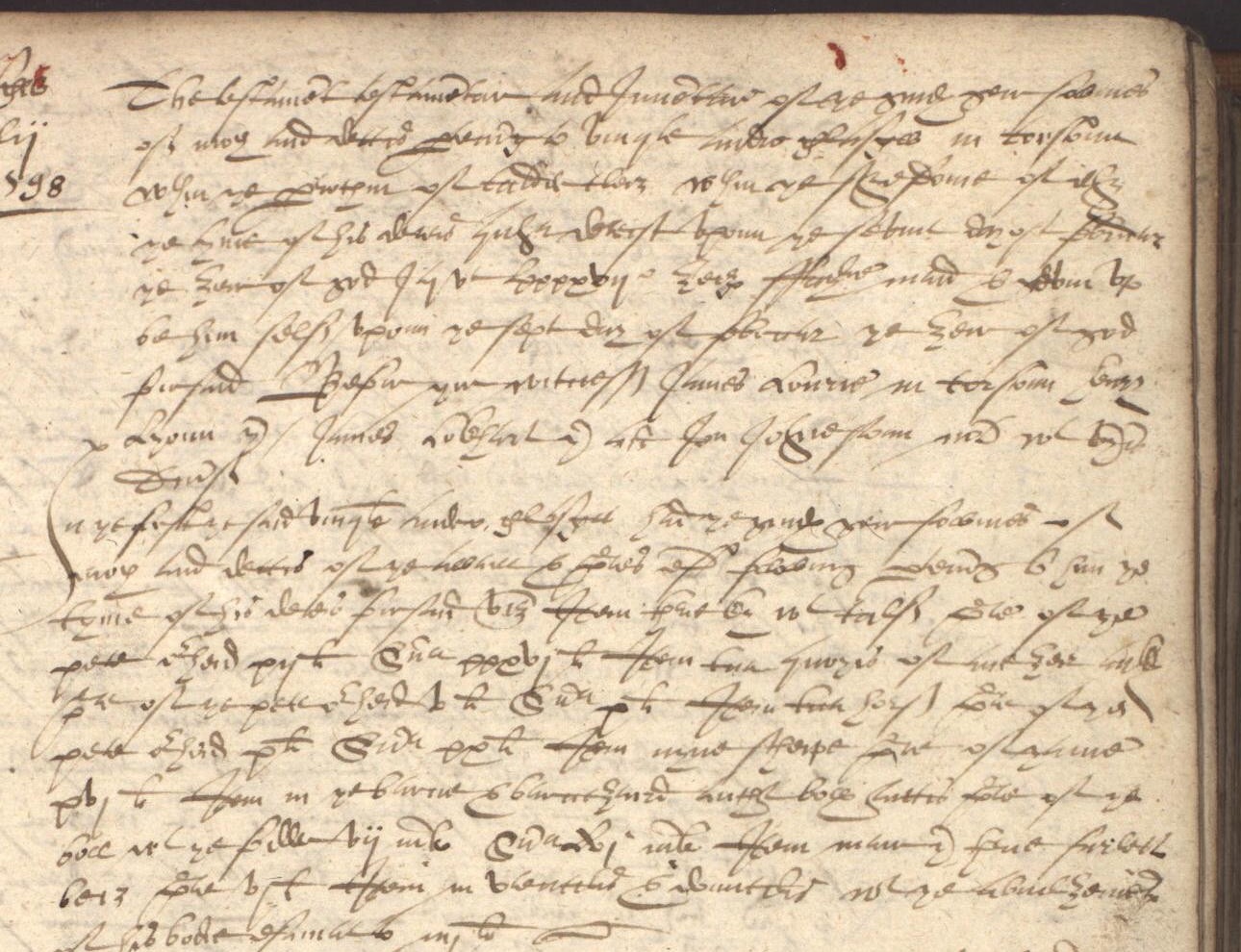
image 123 opening

Earlier reading / question
corsoun[?], Calder cleir[?]
Why this reading
Calder is strong but the residence and parish qualifier contain ambiguous joins. The printed index independently supplies Corstoun.
Effect on the family
Places the household in the Calder district but cannot itself bridge Andrew to another profile or family.
Confirmed / reconfirmed

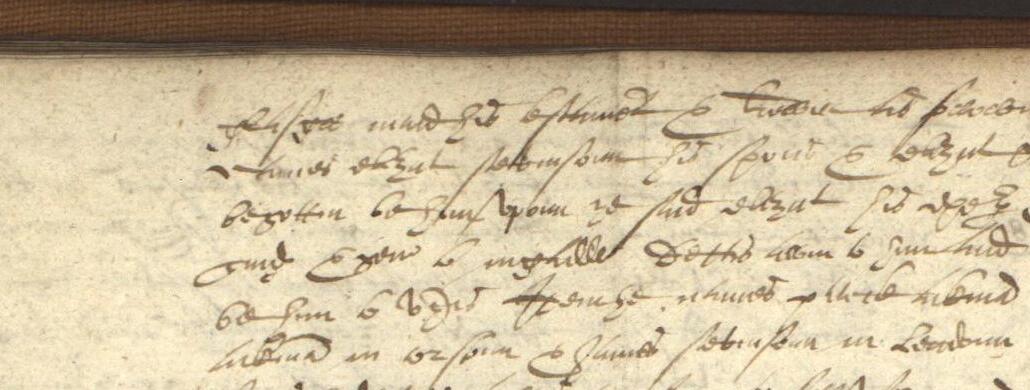
Elizat Stevinsoun 'his spous'; Robart Glasgow 'his sone begottin be him vpoun the said Elizat his wyff'

image 124 family clause

Earlier reading / question
older continuation reported Elizat and Robert; fresh review pending
Why this reading
Both spouse and parentage clauses are directly visible on the recovered continuation.
Effect on the family
Confirms Andrew and Elizat as Robert's parents. Robert's profile identity remains open.
Confirmed / reconfirmed

Marione, Jonet and Isobell named after Andrew's son and cancelled daughter-word sequence

image 124 alternative distribution

Earlier reading / question
Marion, Janet and Isobel reported as daughters
Why this reading
The three names and surrounding dispositive grammar are visible; the cancelled word is recorded rather than silently restored.
Effect on the family
Confirms three daughters of Andrew. The clause does not expressly identify Elizat as their mother.
Confirmed / reconfirmed

'incais his said spous be with bairne' / if not with child alternative

image 124 pregnancy condition

Earlier reading / question
unborn child provision reported
Why this reading
The conditional structure is visible across the distribution passage.
Effect on the family
Does not prove that another child was conceived or born and must not generate a person profile.
Probable

Elizat is to retain Andrew's land or holding until Robart came to age; exact tenure word unresolved

image 124 succession clause

Earlier reading / question
Elizat to retain land until Robert came of age
Why this reading
The names, age transition and succession sense are visible; the specific land/tenure noun is not secure.
Effect on the family
Shows Robert was below the relevant age and intended to succeed, but does not prove ownership type or exact age.
Probable

James Stevinsoun is a probable adviser/associate; exact locality and kinship unstated

image 124 counsel passage

Earlier reading / question
James Stevisoun named adviser; relationship unknown
Why this reading
The surname is consistent with the clearer wife surname, but surrounding advisory wording and place are only partly legible.
Effect on the family
May be part of Elizat's network but cannot be called her father or brother.
Unresolved

John Mure and Stevenson forms are the clearest; witness surnames, Isobell's surname, her deceased husband's surname, several creditor names and localities remain unresolved

image 123 witnesses and account names

Earlier reading / question
James [surname], James [surname], John [surname], John Mure, Isobell [surname] relict of John [surname], Stevenson and creditor names partly illegible
Why this reading
Full-page and account-section enlargement did not provide enough separated letterforms for safe completion.
Effect on the family
Witnesses and financial associates are not assigned as relatives.
Rejected reading or match

Andrew's will and closing end above the next lower testament

image 124 lower boundary

Earlier reading / question
continuation falsely treated as missing/unread
Why this reading
The separate lower entry has its own opening and margin date; it is outside Andrew's record.
Effect on the family
Prevents importing the next testator's people into Andrew's household.

See how the evidence fits the early families

Follow the handwriting

The people behind the words.

Image 123 identifies Andrew and begins his latter will; image 124 continues without a gap. The continuation directly names Elizat Stevinsoun as his spouse, Robert as their son, and Marione, Jonet and Isobell as Andrew's daughters, while keeping the possible unborn child conditional.

NameRelationship / roleUncertain
New to secretary hand? Start with the shapes.

Follow the writing line. Ascenders rise above small letters; descenders fall below them. A neighbouring line can cross the word you are reading.

Count the short strokes. These are called minims. Joined i, m, n and u shapes can be ambiguous; compare a clear repeated word by the same clerk rather than guessing from a modern alphabet.

Separate reading from expansion. A contraction is not a fully written modern word. Square brackets retain doubtful letters or editorial additions. A familiar legal formula is a clue, not permission to fill a gap.

Then assess the relationship. Reading a name securely is not the same as proving kinship. Look for the actual role words and who they refer to.

Who appears in these passages?

Select a name to jump to its manuscript evidence.

The reading desk

One name. Three ways to look.

Choose a name or relationship below. Compare the original ink, a paper-free view and the same spelling in a secretary-hand teaching font. Open the reasoning only when you need it.

01The decedent’s forename in the inventory openingThe decedent’s forename in the inventory openingInspect reading

Proposed readingandro

The existing transcription identifies the late Andro Glasgow as the decedent; ‘Andrew’ is the normalised form, not a claim that every modern letter appears on the page.

01 Original word Untouched manuscript
02 Ink on white Derived from the original pixels

Open the original above if this browser cannot process the image.

03 Same spelling, another hand Joscelyn teaching font
androLoading the secretary-hand teaching font...

andro

The white-background view suppresses paper colour; reviewed focus boundaries exclude separable neighbouring fragments where available. It does not restore missing strokes. Colour follows retained source pixels inside proposed letter groups, not a reconstructed pen path. Ambiguous crossings remain neutral where reviewed; other crossing ink may still belong to another line.

The font repeats the proposed spelling, not this clerk's handwriting. Similarity is a teaching aid, not confirmation; uncertainties remain in the reading above.

Locate the word in its passage Original context
The existing transcription identifies the late Andro Glasgow as the decedent; ‘Andrew’ is the normalised form, not a claim that every modern letter appears on the page.
Reading, meaning and uncertainty

Expansion: Andrew

Confidence: high

Evidence boundary: The trace is illustrative of the already maintained subject-name reading and does not alter the established record or family conclusions.

Teaching typeface: Joscelyn by Peter S. Baker, based on a different Renaissance secretary hand. SIL Open Font License. Source images remain separate and unchanged.

NRS Edinburgh Commissary Court CC8/8/32, image 123

Identify Andrew and the record type

Opening of Andrew Glasgow's testament-testamentar and inventory on image 123.
Click the manuscript to enlarge

Choose a phrase to locate it in the manuscript. Only its outline is shown, so overlapping strokes stay readable.

NRS Edinburgh Commissary Court CC8/8/32, image 123. Cropped from the supplied original; © Crown copyright, National Records of Scotland / ScotlandsPeople. Coloured boxes are reading aids, not part of the manuscript.

On the page

The testament testamentar and Inventar ... pertening to vmqle andro glasgw in corsoun[?] within the parochin of calder cleir[?]

In modern English

The testament-testamentar and inventory ... belonging to the late Andrew Glasgow in Corsoun [?], in the parish of Calder Cleir [?]

How to read it

Testament testamentar signals that a will follows the inventory. In the enlarged words, the tall ascenders and long terminal strokes cross the ruled baseline, so the boxes deliberately include space above and below. Vmqle means deceased. The residence and parish spellings remain provisional because crowded minims can support more than one vowel sequence.

What this establishes

Andrew Glasgow is the deceased testator associated with this inventory and surviving will opening.

What it does not establish

The opening does not name his wife or children, and the uncertain locality spellings should not be normalized from this image alone.

high for Andrew and the record type; moderate for the localities

Slow reading

Inspect the words, not just the conclusion.

Compare the original strokes with the proposed reading. Tall or trailing strokes from neighbouring lines may enter a sample; the notes distinguish what is visible from what remains uncertain.

Phrase 01

andro glasgw

Andrew Glasgow

Magnified from the same manuscript image. No letters have been redrawn.
Look at the strokes
  1. andro starts with a small open a followed by connected n-d-r strokes rather than a capitalized modern form.
  2. The d has a tall looped ascender that rises well above the other letters.
  3. glasgw ends in a compressed w-like series of angled strokes.

Compare in this hand: The last visible line of image 123 repeats 'said andro' with the same tall d.

Reading limits: The personal name is secure; the box does not include the preceding deceased abbreviation.

Phrase 02

corsoun [?]

Corsoun [?], a residence

Magnified from the same manuscript image. No letters have been redrawn.
Look at the strokes
  1. The word begins with an open c-like curve.
  2. The middle contains several shallow joined humps that make the exact vowel sequence difficult.
  3. The final -oun-like group rises into a long terminal stroke near the page edge.

Reading limits: Corsoun is a plausible reading, not a normalized place identification.

Phrase 03

calder cleir [?]

Calder Cleir [?], the parish wording

Magnified from the same manuscript image. No letters have been redrawn.
Look at the strokes
  1. calder begins with an open c and has a tall looped d near its middle.
  2. A visible gap separates calder from cleir.
  3. cleir finishes with a long rising terminal stroke, while its middle letters are faint and tightly linked.

Reading limits: Calder is strong; the following qualifier remains provisional.

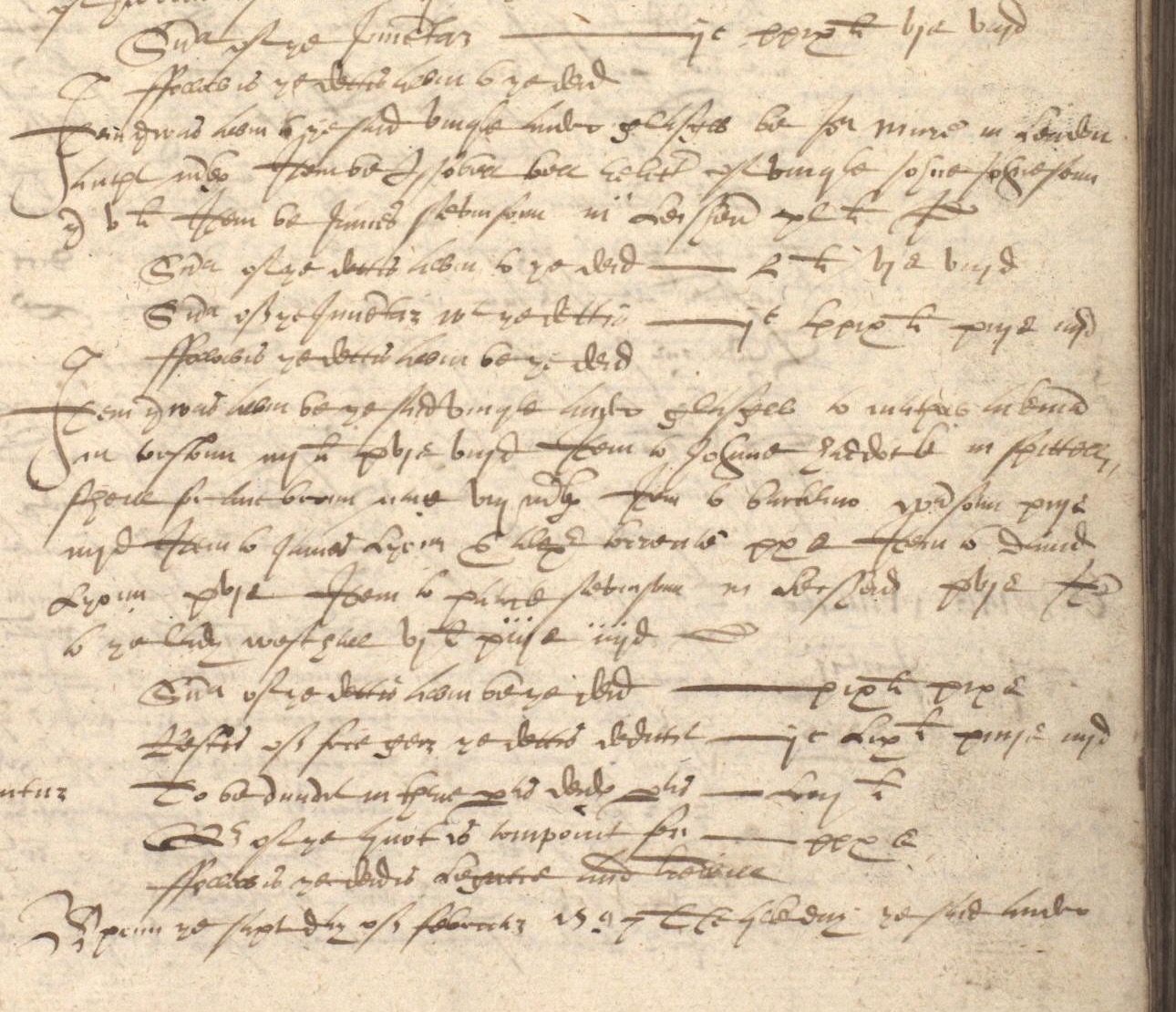
NRS Edinburgh Commissary Court CC8/8/32, image 123; continued on image 124

Stop where the supplied image stops

Bottom of image 123 showing the heading Followis the deidis latter will and its first dated line.
Click the manuscript to enlarge

Choose a phrase to locate it in the manuscript. Only its outline is shown, so overlapping strokes stay readable.

NRS Edinburgh Commissary Court CC8/8/32, image 123; continued on image 124. Cropped from the supplied original; © Crown copyright, National Records of Scotland / ScotlandsPeople. Coloured boxes are reading aids, not part of the manuscript.

On the page

Followis the deidis latter will / Vpoun the sext day of februar 1597 The said day the said andro [continues]

In modern English

The deceased's latter will follows. On 6 February 1597, on that day, the said Andrew ... [continues beyond this crop]

How to read it

Latter will means the testamentary directions following the estate account. Read the heading as one line, then move to the dated line below; its long capitals and descenders overlap neighbouring ruled space. The written date is 1597; interpreting it as 1597/8 is a calendar convention, not different lettering on the page. The sentence continues on image 124.

What this establishes

Andrew's latter will begins on 6 February 1597 as written.

What it does not establish

Image 123 alone contains no visible wife, son, daughter, or unborn-child clause; those relationships come from the freshly read continuation on image 124.

high for the heading, written date, and page limitation

Slow reading

Inspect the words, not just the conclusion.

Compare the original strokes with the proposed reading. Tall or trailing strokes from neighbouring lines may enter a sample; the notes distinguish what is visible from what remains uncertain.

Phrase 01

Followis the deidis latter will

The deceased's latter will follows

Magnified from the same manuscript image. No letters have been redrawn.
Look at the strokes
  1. Followis begins with a large flourished F whose lower curve extends below the body letters.
  2. The long s at the end of Followis descends and can resemble f.
  3. latter has two tall t strokes; will closes with paired upright l strokes.

Reading limits: The heading is secure and announces the will section; it is not itself a kinship statement.

Phrase 02

sext day of februar 1597

sixth day of February 1597

Magnified from the same manuscript image. No letters have been redrawn.
Look at the strokes
  1. sext has a long opening s and a tall crossed final t.
  2. The y of day descends in a long diagonal sweep below the line.
  3. februar begins with a long f-like stroke; the four final numerals are darker and more angular than the words.

Reading limits: 1597 is what is written; 1597/8 is an editorial calendar interpretation.

Phrase 03

said andro

the said Andrew

Magnified from the same manuscript image. No letters have been redrawn.
Look at the strokes
  1. said is a compact linking word with a tall d at its end.
  2. andro repeats the connected lower-case form used in the opening.
  3. The final o finishes in a light rightward exit stroke close to the crop edge.

Compare in this hand: Compare andro in the opening line above; both occurrences show the distinctive tall looped d.

Reading limits: The phrase is secure, but the continuation beyond it is outside this crop.

NRS Edinburgh Commissary Court CC8/8/32, image 124, top continuation

Elizat is spouse; Robert is their son

Top of image 124 continuing Andrew Glasgow's will and naming Elizat Stevinsoun and Robert Glasgow.
Click the manuscript to enlarge
NRS Edinburgh Commissary Court CC8/8/32, image 124, top continuation. Cropped from the supplied original; © Crown copyright, National Records of Scotland / ScotlandsPeople. Coloured boxes are reading aids, not part of the manuscript.

On the page

Elizat stevinsoun his spous and Robart glasgw his sone begottin be him vpoun the said Elizat his wyff

In modern English

Elizat Stevenson, his spouse, and Robert Glasgow, his son begotten by him upon the said Elizat his wife

How to read it

The manuscript supplies both relationship terms. His spous links Elizat to Andrew; his sone links Robert to Andrew; begottin ... vpoun the said Elizat his wyff explicitly supplies Robert's maternity. The modern Elizabeth/Stevenson forms are expansions, not replacement manuscript readings.

What this establishes

Andrew and Elizat were spouses, and Robert was their son.

What it does not establish

It does not identify an existing WikiTree profile for Robert or prove that Elizat was mother of every daughter named later.

high

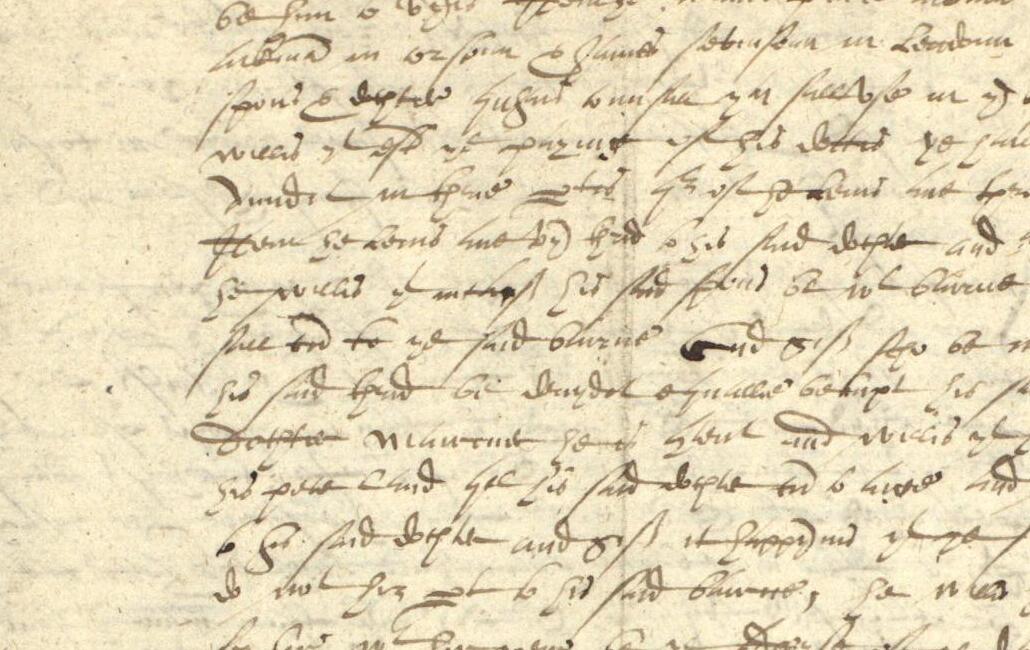
NRS Edinburgh Commissary Court CC8/8/32, image 124, dispositive clauses

Named daughters and a conditional unborn child

Image 124 clauses distributing Andrew Glasgow's estate among Robert, Marione, Jonet and Isobell and providing conditionally for a possible unborn child.
Click the manuscript to enlarge
NRS Edinburgh Commissary Court CC8/8/32, image 124, dispositive clauses. Cropped from the supplied original; © Crown copyright, National Records of Scotland / ScotlandsPeople. Coloured boxes are reading aids, not part of the manuscript.

On the page

incais his said spous be with bairne ... and gif scho be not with bairne ... his said sone and his said [dochter- struck through] Marione Jonet Isobell ... his said Robart cum to aige

In modern English

If his spouse was pregnant, provision was made for that child; if she was not, Andrew's share was distributed among his son and his daughters Marione, Jonet and Isobell. Robert had not yet reached the stated age.

How to read it

The pregnancy wording is conditional and cannot be converted into a born child. The three women's names follow a cancelled daughter-word sequence but are identified by the surrounding dispositive grammar as Andrew's daughters. The later age clause makes Robert's future succession relevant without supplying his exact age.

What this establishes

Andrew had named daughters Marione, Jonet and Isobell, and Robert was below the relevant age or majority for the land succession.

What it does not establish

It does not prove that another child was born, identify the daughters' mother, resolve the land tenure, or establish matches to candidate profiles.

high for the names, family roles and conditional sense; moderate for the land-succession detail

Manuscript detail

Full case analysisInterpretation, supporting evidence, changed readings and remaining questions.

Modern interpretation

What the record says

The supplied page is Andrew Glasgow's testament-testamentar and inventory. His residence is provisionally read as Corsoun in the parish of Caldercleir, sheriffdom of Edinburgh. It records his death on 7 February and says that he gave up the inventory himself on 6 February. The latter-will opening at the bottom expressly bears 6 February 1597 as written.

The inventory includes cows with calves, young cattle, horses, sheep, oats, barley, household furnishings and clothing. Incoming and outgoing accounts name financial associates, but their appearance here does not establish family relationships.

The continuation freshly confirms Elizat Stevinsoun as Andrew's spouse and Robert Glasgow as his son begotten upon Elizat his wife. It names daughters Marione, Jonet and Isobell in the alternative distribution, provides for a possible unborn child only conditionally, and directs that Elizat retain the land or holding until Robert came of age.

Evidence and limits

What it establishes

  • Image 123, lines 4-9: this is a testament-testamentar, distinct from a testament-dative. The decedent's own act on the sixth and death on the seventh are legible; uncertain year numerals in the opening should be checked against the clearer 1597 at the latter-will opening.
  • Image 123, line 42: 6 February 1597 is the written latter-will date. The existing record describes this as 1597/8 under the pre-1600 Scottish year convention; that is a dating interpretation, not a different date written on the image.
  • Image 123, lines 24-36: financial associates and possible Stevenson names are not described here as Andrew's parents, children or siblings.
  • Image 124, family clause: 'Elizat stevinsoun his spous' and 'Robart glasgw his sone begottin be him vpoun the said Elizat his wyff' directly establish Andrew and Elizat as Robert's parents.
  • Image 124, distribution: Marione, Jonet and Isobell are named after wording identifying Andrew's daughters; Elizat is not expressly called their mother in this clause.
  • Image 124, contingency and succession: a possible child in utero is conditional, not evidence of a birth, while Robert had not yet reached the stated age and was intended to succeed to Andrew's land or holding.
  • Image 124 record boundary: Andrew's entry ends before the separate lower testament; no names from that next entry are assigned to his family.

What changed in this reading

  • Closes the false continuation gap by freshly reading image 124 from the nested PDF and supplied PNGs; coverage is now full for the two-image record span.
  • Freshly supports the testament type, Caldercleir setting, sixth/seventh-February sequence and the written 1597 latter-will date.
  • Freshly confirms rather than merely carrying forward Elizat Stevinsoun, Robert, and daughters Marione, Jonet and Isobell from the older continuation review.
  • Keeps the unborn-child provision conditional and separates Robert's explicit maternity from the daughters' unstated maternity.
  • The outgoing Stevenson name may be patrik rather than James in one entry. The present reading is too uncertain for an identity correction; retain a flagged financial-name query.

Still open

Do not fill these gaps with assumptions

  • Residence spelling, witnesses, creditor names and most account numerals remain unresolved.
  • The outgoing Stevenson name requires comparison with a clearer same-hand example; no genealogical conclusion should depend on it.
  • The exact land or tenure term, adviser localities, and much of the closing formula on image 124 remain unresolved.
Full working transcriptionLine-oriented readings, unresolved text and a downloadable plain-text version.

LLM-assisted working transcription

Read the manuscript passages

Download text

Square brackets mark uncertainty, editorial expansions or missing text. Ellipses mark omitted or unresolved wording. Numbering identifies lines in this working reading, not official manuscript line numbers. This is not a complete diplomatic edition.

Image / passage 123

  1. [Margin] Andro glasgw
  2. decimo Julij
  3. 1598
  4. The testament testamentar and Inventar of the guidis geir soumes
  5. of money and dettis pertening to vmqle andro glasgw in corsoun[?]
  6. within the parochin of calder cleir[?] within the schirefdome of Edr
  7. the tyme of his deceis quha deceissit vpoun the sevint day of februar
  8. the zeir of god jm vc lxxxxvij[?] zeiris faithfullie maid & gevin vp
  9. be him self vpoun the sext day of februar the zeir of god
  10. foirsaid In presens of the witnessis James [surname illegible] in corsoun[?] [illegible]
  11. [illegible] James [surname illegible] [illegible] Johne [surname illegible] [illegible]
  12. [illegible]
  13. In the first the said vmqle andro glasgw had the guidis geir soumes of
  14. money and dettis of the availl & prices efter following pertening to him the
  15. tyme of his deceis foirsaid Viz Item thrie ky wt thair calfis price of the
  16. pece viij li[?] Summa xxiiij li[?] Item tua zowng[?] of ane zeir auld
  17. price of the pece [amount illegible] Summa [amount illegible] Item tua horss price of the
  18. pece x li[?] Summa xx li[?] Item nyne scheip price of the pece [illegible]
  19. [amount illegible] Item in the barne & barnzaird aucht bollis aittis price of the
  20. boll at the [illegible] iiij merkis[?] Summa [amount illegible] Item mair [quantity illegible] firlott
  21. beir price of [illegible] Item in vtensilis & domicilis with the abulzementis
  22. of his bodie estimat to [amount illegible]
  23. Summa of the Inventar [amount unresolved]
  24. Followis the dettis awin to the deid
  25. Item thair wes awin to the said vmqle andro glasgw be Jo[hn?] mure in [place illegible]
  26. [amount illegible] Item be Isobell [surname illegible] relict of vmqle Johne [surname illegible]
  27. [amount illegible] Item be James stevinsoun in [place illegible] x li[?]
  28. Summa of the dettis awin to the deid [amount unresolved]
  29. Summa of the Inventar wt the dettis [amount unresolved]
  30. Followis the dettis awin be the deid
  31. Item thair wes awin be the said vmqle andro glasgw to [name illegible]
  32. in corsoun[?] [amount illegible] Item to Johne keddell[?] in [place illegible]
  33. [illegible] for ane broun hors [amount illegible] Item to [name illegible] [amount illegible]
  34. [illegible] Item to James [surname illegible] [illegible] Item to David
  35. lyoun [amount illegible] Item to patrik stevinsoun[?] in [place illegible] [amount illegible] Item
  36. to the laird westhall[?] [amount illegible]
  37. Summa of the dettis awin be the deid [amount unresolved]
  38. Restis of free geir the dettis deducit [amount unresolved]
  39. To be dividit in thrie the deidis pairt [amount unresolved]
  40. Quhairof the quot is componit for [amount unresolved]
  41. Followis the deidis latter will
  42. Vpoun the sext day of februar 1597 The said day the said andro [continues]

Image / passage 124

  1. [Continuation from 'The said day the said andro' on image 123; opening legal words partly unresolved.]
  2. [illegible] Elizat stevinsoun his spous and Robart glasgw his sone
  3. begottin be him vpoun the said Elizat his wyff [illegible]
  4. [authority to intromet with goods, gear and movable debts; intervening words unresolved]
  5. [counsel/adviser passage including James Stevinsoun; exact locality and other wording unresolved]
  6. [distribution passage] incais his said spous be with bairne to him [illegible]
  7. and gif scho be not with bairne [illegible]
  8. his said sone and his said [word beginning dochter-, struck through] Marione Jonet Isobell
  9. [illegible] his said Robart cum to aige [illegible]
  10. [land/holding to be used by Elizat until Robert came to age; tenure word unresolved]
  11. [illegible] Elizat his spous do not hir pairt to his said bairnis [illegible]
  12. [closing notarial and confirmation formula partly unresolved]
  13. [Andrew Glasgow's entry ends before the following testament on image 124.]
Source files and reading provenanceOriginal references, pages examined and the limits of this review.

Source coverage and reading provenance

Fresh visual review of both images and enlarged crops, with the earlier saved account consulted afterwards. High confidence in document type, written will date, Elizat as spouse, Robert's explicit parentage, the three daughter names, conditional unborn-child wording and record boundary; moderate confidence in the land-succession sense; low confidence in many financial names, sums, localities and legal formula. Full coverage describes the supplied span, not a complete diplomatic transcript.

Reviewed: 2026-09-10. Method: LLM-assisted fresh image review.

Pages examined

  • Image 123, complete supplied page, inventory and debts through first line of latter will
  • Image 124, continuation of latter will, family dispositions, land succession, closing and record boundary

Supplied local source files

  • ScotlandsPeople_CC000800008-00032-00123-.jpg
  • 1598_Andrew.pdf
  • 1598_Andrew_p1.png
  • 1598_Andrew_p2.png
  • p2_300_dpi.png

The full originals remain in the local research archive. Selected unaltered crops are shown above for reading and commentary, with separate switchable highlights. Image credit: Crown copyright, National Records of Scotland / ScotlandsPeople. Duplicate downloads are not independent evidence. Consult the original using the reference above through ScotlandsPeople.

All associated profiles and identity comparisonsIncludes possible and rejected associations, not just proved relatives.
Earlier saved reading and research notesPreserved for comparison; later corrections above take precedence. These may include pages absent from the newly supplied scans.
Direct genealogical result
Andrew Glasgow named Elizat Stevinsoun as his wife and expressly identified Robert Glasgow as their son. He also named daughters Marion, Janet and Isobel. His provision for a child with whom Elizat might be pregnant is conditional and does not prove that another child was born.

This testament-testamentar and inventory is NRS CC8/8/32, images 123–124. Andrew lived at a place provisionally read as [Corsoun?] in the parish of [Calder Clair/Cleir], within the sheriffdom of Edinburgh. He made the will on 6 February 1597 as written, died on 7 February, and was confirmed on 10 July 1598. Because the official Scottish year then began on 25 March, the February dates are conventionally recorded as 1597/8; this adjusts the year numbering, not the calendar day.

The strongest parentage clause reads:

First, he nomis Elizat Stevinsoun his spous and Robart Glasgw his sone, begottin be him vpoun the said Elizat his wyff, to intromet with his guidis and geir and moveabill dettis awin to him, and to pay his dettis awin be him to vtheris.

Elizat is the manuscript form and probably represents Elizabeth; it should remain visible in research notes. Stevinsoun, his spous and the parentage wording are clearer. James Stevisoun appears among the named advisers whose counsel Elizat and Robert were to use, but the testament does not state whether he was her father, brother or another relative.

Andrew's possessions and accounts

The inventory appears to include three cows with calves valued at £8 each, two yearling cattle, two horses valued at £10 each or £20 together, nine sheep, eight bolls of oats in the barn and barnyard, four firlots of barley, household utensils and furnishings, and Andrew's clothing. The number of cows and several valuations remain tentative, and neither the inventory total nor the debt totals have been securely transcribed.

Among the people apparently owing Andrew money are John Mure, a person described as the widow of a deceased John whose full name remains unclear, and James Stevisoun. The debts owed by Andrew include an item for a brown horse and entries involving David Lyoun, James Stevisoun and a laird tentatively read as [Westhall?]. These financial names are research leads, not evidence of kinship.

Distribution, land and the children

After debts, Andrew directed that the free estate be divided into three parts: one third to Elizat and a second third to Robert. For Andrew's own third he provided:

… incais his said spous be with bairne to him, the samin sall [pass?] to the said bairne. And gif scho be not with bairne, that his said thrid be deuidit equallie betuix his said sone and his said [word beginning dochter…, struck through] Marione, Jonet, Isobell.

The named women are therefore Andrew's daughters, although the same explicit maternal wording used for Robert is not repeated for them. No profile should be created for the merely possible unborn child.

Andrew further directed that Elizat should bruik his [word unclear] land quhill his said Robart cum to aige, after which the holding was to pass to Robert. This establishes intended succession within Andrew's household and shows that Robert had not attained the relevant age or majority. It does not establish whether the land was heritable or tenanted, from whom Andrew obtained it, or any descent from the Glasgow burgh family.

The will also provides that, if Elizat his spous do not hir pairt to his said bairnis, she was to be removed from the administration. The closing notarial formula indicates that the notary signed at Andrew's direction because Andrew could not write. The remaining execution and confirmation formula is only partly resolved.

The current profile candidates for Robert, Marion, Janet and Isobel remain identity hypotheses, not established matches. The strongest next evidence would be a Caldercleir estate rental, tack, transfer, marriage or later testament carrying the Corsoun residence, Stevenson connection or Andrew-to-Robert succession into another record.
Back to all transcriptions

Your research notebook.

Select 2 people to compare their evidence.