Read the complete source notebook 17 studies · original records and citations
Household and children
Alexander’s life in its local setting
Alexander’s records describe a family rooted in a small part of County Antrim, with children whose later lives lead beyond it. His clearest surviving household is at Lisnagaver in 1851: an Antrim-born farmer, his wife Mary, and three children. Earlier baptisms recover the beginnings of that family; later marriages and the Elder tenancy connect it to the next generation. The probable Gortahar death completes the broad outline, with the last identity link still open.
The places in his life
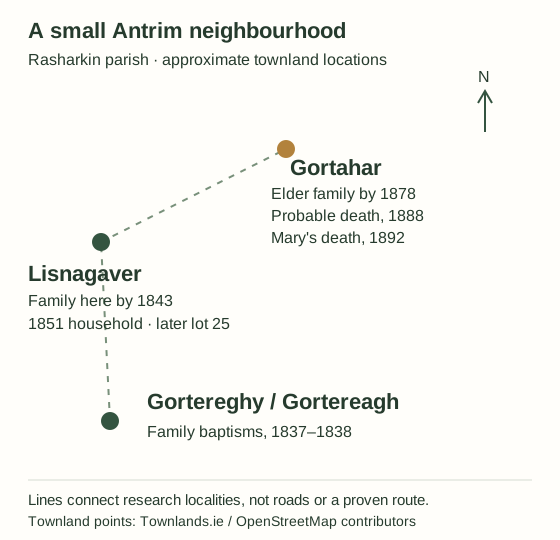
Townland locator, not a property map. Locations from Townlands.ie, using OpenStreetMap data. Open the illustration for full size.
Gortereghy, written Gortereagh in the baptism transcription, adjoins Lisnagaver to the south. Gortahar lies northeast, beyond Moneyleck. They are distinct townlands within the same parish. The map shows approximate modern townland locations, not reconstructed houses or field boundaries.
Both spouses reported first marriage in 1836. Their children’s baptisms place them at Gortereagh in 1837–38 and Lisnagaver by 1843. That suggests a change in the family’s recorded residence between neighbouring townlands; it does not date a move precisely or establish a return to a paternal home. Mary’s possible local family connections deserve investigation in their own right.
The census’s farmer and literate household, the small assessed tenancy and the children’s marriages recover part of Alexander’s circumstances. Later records call him a labourer, and his son-in-law succeeds him on the holding. These changes are compatible with an altered working role as he aged, but their cause is unknown. No inspected source establishes eviction, poverty, or illness-induced retirement. The record sequence and farm analysis distinguish those observations from assumptions about his life.
The following account traces marriage and children, examines the surviving household, then follows the farm, probable death and paternal connections. Missing parentage is one question within that family history.
Marriage, Mary’s family and the children
Alexander Glasgow and Mary/Molly McCaughan are a documented couple. Their 1851 household reports first marriage in 1836, but no original marriage entry has been located. Rasharkin Presbyterian’s surviving marriage register begins in 1845; First Kilraughts material (Coleraine Family History Society film 197, marriages from 1831) remains a focused alternative.
The marriage-year statement fits the first directly located record sequence. The published transcription of the original Rasharkin Presbyterian register, PRONI MIC1P/292, records the same parental couple at Gortereagh: James Glascaw was born 17 January and baptised 9 February 1837 to Alex and Mary McAughin; an incomplete 1838 entry records a Glascow child of Alex and Molly McAughern; and a later James Glascow was born 9 October 1843 and baptised 7 January 1844 to Alex and Molly McAughern at Lisnagaver. The named transcription can be checked at Rasharkin Presbyterian baptisms. The register transcription preserves Mary/Molly and McAughin/McAughern. The repeated parental names and residences support their identification with Mary McCaughan while retaining the spellings actually recorded.
The Gortereagh residence is meaningful maternal context, but it is not a parentage proof. The 1834 tithe list includes William and James McCaheran there, a spelling compatible with the recorded McAughin/McAughern/McCaughan forms. This makes a McCaughan family connection a reasonable explanation to test for the newly married couple’s residence, perhaps through Mary's people or a subtenancy. It does not prove that either man was Mary's father, nor that the first son James was named for a maternal grandfather. The 1851 Lisnagaver evidence supplies a more concrete lead: Mary McCaheren, 22, lived with farmer Archibald McCaheren, 60, and Elizabeth in house 31. She is the strongest currently located candidate for the later 1855 bride who named her father as Archy, but that is a separate McCaughan problem. It does not establish Mary Glasgow’s parentage. Likewise, the household of widowed Sarah McCaghrin and grandchildren beside widowed Margaret Elder and children is evidence of a local network of families and neighbours, not an expressed kinship.
The Gortereagh names are recorded in the 1834 Rasharkin tithe book, PRONI FIN/5/A/236; the 1851 McCaheren and Elder groupings are in Lisnagaver houses 31 and 5. These are separate record observations, not confirmed maternal relatives. See the National Archives census collection and PRONI tithe-book guide.
Six children, with different kinds of evidence
| Child | Dates supported by records | Evidence and what remains uncertain |
|---|---|---|
| James Glasgow (Glasgow-3939) | Born 17 January 1837; baptised 9 February | Rasharkin entry 75 names Alex and Mary McAughin at Gortereagh. Reuse of James in 1843 suggests this child died young; no death or burial has been found. |
| Unnamed Glasgow child (Glasgow-3940) | Entry in the 1838 baptism sequence | Entry 106 names Alex and Molly McAughern at Gortereagh. The parent relationship is documented; the forename and precise birth/baptism dates are not preserved in the transcription. No death date is proved. |
| Robert Glasgow (Glasgow-938) | Born about 1840–41 | Aged 10 in 1851 and 25 at his 1866 marriage. Both records name Alexander as father. The imported exact date 6 November 1840 has no identified supporting record. |
| Mary Glasgow, later Elder (Glasgow-3167) | Aged 28 at marriage in 1871; birth year uncertain | Her marriage names Alexander Glasgow, farmer, and gives Lisnagaver residence. Husband Robert Elder’s later occupation of Alexander’s lot and her role at her mother’s 1892 death strengthen the family identification. She is not listed in house 35 in 1851. |
| James Glasgow (Glasgow-973) | Born 9 October 1843; baptised 7 January 1844 | Rasharkin entry 203 names Alex and Molly McAughern at Lisnagaver. The seven-year-old son in 1851 fits this child. His later life remains under investigation. |
| Ann Glasgow, later McCracken (Glasgow-438) | Born about 1846–47; married 13 October 1876 | Four-year-old daughter in 1851; her 1876 marriage independently names Alexander Glasgow, labourer. The 1888 informant, formerly read as Nancy and compared with Ann, is now read as Mary. |
Sources: Rasharkin Presbyterian baptism transcription, entries 75, 106 and 203, from PRONI MIC1P/292; 1851 household image; the civil marriages linked in the record table below. The baptism evidence is a named transcription; the original incomplete 1838 entry still needs inspection. The two James entries represent separate children, not a duplicate caused by a date discrepancy.
What the gaps mean
The early children are documented separately from their inferred deaths. The table’s reuse-of-name argument does not supply an exact death date. Nor does the incomplete 1838 transcription identify its child as Samuel: an original copy of MIC1P/292, entry 106 is needed to read the missing name and dates.
The transcription has no entries for 1840 or 1841, around Robert’s likely birth. Failure to find his baptism in that transcription is therefore weak evidence against the known parentage: the census and marriage positively establish his father. The missing original marriage, incomplete baptism entry and missing burial records are different gaps and need different searches.
The unnamed child would have been about twelve or thirteen in 1851. No resident, absent-person or household-death entry records that child in the maintained return audit. That omission weighs against an uncomplicated survival-and-emigration reconstruction, but cannot fix a death date or guarantee that the return was complete. The same return also omits a daughter who was certainly living: Mary, later Mrs Elder, appears nowhere in it, so the child’s absence is not evidence of an early death. The candidate Samuel Glasgow in Michigan was rejected because no American record supplied the required Antrim/parent bridge and the proposal also had to explain this omission. An impossible February date in a later cemetery transcription cannot name the child. The child’s assessment preserves the comparison.
Mary’s parentage research: new findings and limits
The current evidence does not prove the parents of Mary (McCaughan) Glasgow. The complete 1851 Rasharkin-derived return contains several distinct McCaheren/McCaughern/McCaghrin households, including Mary McCaheren, age 70, as Margaret Taylor’s mother-in-law; none identifies Mary Glasgow or names her parents. The Rasharkin baptism transcription separately records Eliza McAughern with Thomas, Archy McAughern with Elizabeth Kilpatrick, and James McAughern with John and Jane McAuly. These establish a local network, not one merged family.
Other documented candidate clusters include William and James McCaheran at Gortereghy; Alexr. McCaughan at Unchenagh in Finvoy; and John McCaughey/McCahan at Drumadarragh. The National Archives census-search-form database adds a later Gortahar family: Thomas McCaughern/McCaughan, son of John McCaughern and Mary Gormley. None is directly connected to Mary Glasgow.
Authenticated FamilySearch searches for Mary McCaughan, McAughin, McAughern and McCaheren in the relevant period returned no indexed result. The apparent Alexander–Mary McCaughan hits are a different Catholic Culfeightrin/Ballycastle family, including Mary M’caughan’s 7 April 1867 baptism to Alex M’caughan and Cath Quinn. A Mary McCaughern–William Marks cluster is later and unrelated.
The strongest unresolved route is the pre-1831 Kilraughts–Dervock Reformed Presbyterian society material, PRONI CR5/32A/1 and related catalogue references CR5/32/1/1/1–2. The guide describes member-by-society lists, baptisms, marriages, deaths, removals and emigrations from about 1804–1831. Since Mary was probably born about 1811, a household entry could name her parents. Kilraughts and Dervock operated together until their 1831 division, so both contexts must be searched. The manuscript has not been inspected; this is a high-priority evidence target, not proof.
Sources: Rasharkin Presbyterian baptism transcription; North Antrim tithe material; Ulster Lees Ballymoney study; FamilySearch search; PRONI Guide to Church Records; RootsIreland County Antrim sources; Ballymoney church history.
1851 census: the complete household
The original return for Lisnagaver house 35 contains these five completed person rows. It is the strongest single record of Alexander’s immediate household: relationships, ages, occupation, birthplace, literacy and marriage year appear together. The National Archives catalogue record identifies the return; image reference 007246523_00175.
1851: the five recorded household members
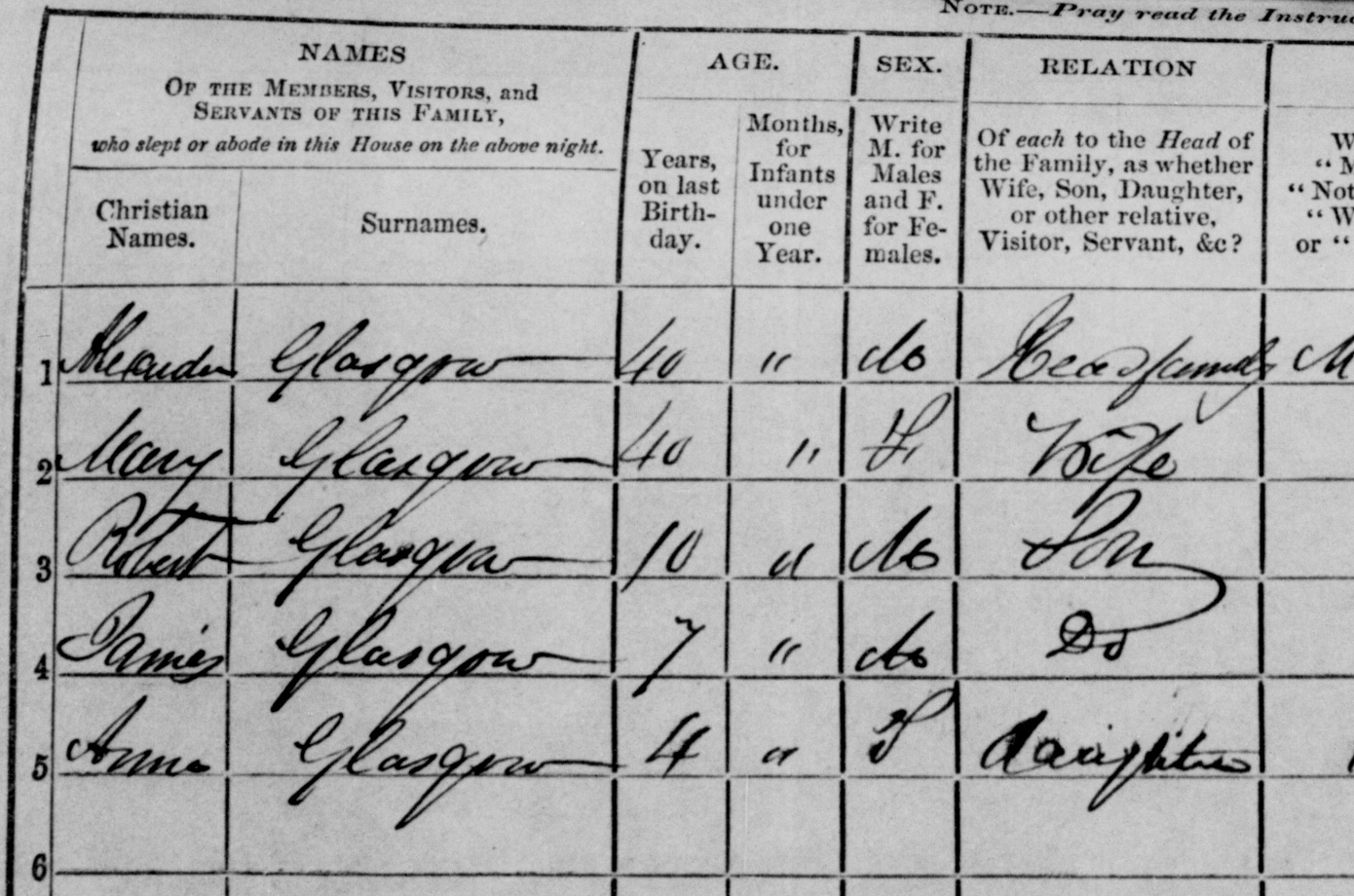
National Archives of Ireland · Census of Ireland 1851, Antrim, Kilconway, Rasharkin, Lisnagaver, house 35; image 007246523_00175, first five person rows. · Full original record. Original pixels; reading guides are removable.
Reading
Names and relationship columns, with abbreviations expanded: Alexander Glasgow, 40, head of family; Mary Glasgow, 40, wife; Robert Glasgow, 10, son; James Glasgow, 7, “Do” [ditto, son]; Ann Glasgow, 4, daughter.
Why it matters
This is the complete set of five named persons on the household table. It directly places Robert, James and Ann in Alexander’s household as his children. Mary’s relationship to the head is explicitly “Wife”. The blank lower rows are visible in the accompanying full-table context crop and original image.
Limits of this excerpt
The census describes the people recorded in this household; it does not establish that these were all the couple’s children. The first forename is abbreviated. Name descenders cross the next row: the overlapping strokes remain unchanged, so inspect one highlighted name at a time.
| Person | Relationship; age | Occupation | Birthplace | Literacy; marital information |
|---|---|---|---|---|
| Alexander Glasgow | Head; 40 | Farmer | Antrim | Reads and writes; married; first marriage 1836 |
| Mary Glasgow | Wife; 40 | None entered | Antrim | Reads; married; first marriage 1836 |
| Robert Glasgow | Son; 10 | At school | Antrim | Reads; unmarried |
| James Glasgow | Son; 7 | At school | Antrim | Reads; unmarried |
| Ann Glasgow | Daughter; 4 | None entered | Antrim | Literacy blank; unmarried |
What this establishes. Alexander and Mary were recorded as spouses, with Robert, James and Ann as their children, in one Antrim household. It supports the approximate births and reported 1836 marriage year. It does not name Alexander’s parents, or locate every child born to the couple. In particular, Mary’s absence from this return does not outweigh her later father-naming marriage and family evidence.
The remaining person rows are blank. The maintained return audit and the published transcription, page 183 record no absent-person or 1841–51 household-death entry for house 35. That is a statement about this return, not proof that no child or other relative had died. The transcript is another rendering of the same census, not independent corroboration.
1851 census: both spouses reported 1836
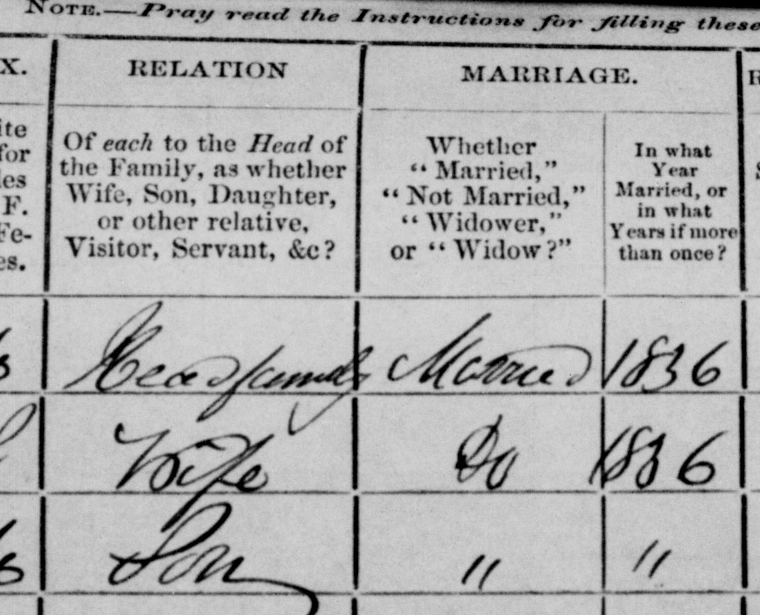
National Archives of Ireland · Census of Ireland 1851, Antrim, Kilconway, Rasharkin, Lisnagaver, house 35; image 007246523_00175, marriage columns, rows 1–2. · Full original record. Original pixels; reading guides are removable.
Reading
Head of family — Married — 1836. Wife — Do [ditto, married] — 1836.
Why it matters
The year 1836 appears separately beside Alexander and Mary. The column heading asks the year of marriage, or years if married more than once. Both entries report one year, 1836; this is original census evidence for their reported marriage year.
Limits of this excerpt
This is a retrospective statement in the 1851 census, not a located marriage register entry. It supplies neither an exact wedding date nor a marriage place. The names are outside this focused crop; their rows are shown in the household excerpt and full-table context.
Neighbouring households
| House | Recorded household | What it establishes |
|---|---|---|
| 34 | John Glasgow, 50; wife Margaret, 30; daughter Ann, 3; Samuel Glasgow, 60, brother and unmarried linen weaver | John and Samuel are expressly brothers. Neither is called Alexander’s brother. |
| 35 | Alexander, Mary, Robert, James and Ann | The household transcribed above. |
| 36 | John Watters, blacksmith, and family | A separate household intervenes between Alexander and Thomas. |
| 37 | Thomas Glasgow, 35; Mary Ann and daughters | A nearby Glasgow family of compatible generation. Proximity supports investigation, not siblinghood. |
Sources: National Archives 1851 Lisnagaver returns 34, 35 and 37, original-image audit maintained in the case findings. John’s reported census age conflicts with his later gravestone age; it should not be used to force a generation gap between him and Alexander.
Following the children into adult life
Robert: the recorded son and the Scottish continuation
Robert, aged ten in 1851, is directly recorded as Alexander and Mary’s son in the same Lisnagaver household. His 5 April 1866 marriage to Jane Graham independently calls him a Lisnagaver farmer and names his father Alexander Glasgow, farmer. Those two records make Robert Glasgow-938 the documented child, with estimated birth about 1840–41 from the census and marriage ages. The often repeated exact 6 November 1840 birth date has no identified supporting original. His probable identification with a later Gortereghy valuation occupier is useful local continuity, but that identification is separate from the proved father–son relationship.
Robert’s later family is followed into Glasgow, Scotland, in the maintained account, which cites a 1871 Scottish census index for Robert and an 1881 index for the younger Alexander. Alexander Glasgow (Glasgow-937), born about 1871, is the next historical generation in that family reconstruction. The Irish census and marriage provide the direct father–son argument for Alexander-951 and Robert; the Scottish continuation relies here on the maintained census references, not newly inspected original images. The copied exact birth date for the younger Alexander had been cited to the same index used for the census, so it is not adopted as an independently verified birth in this account. Exact Scottish address chronology and Robert’s reported 1902 death remain checks on their own originals.
This carries the story beyond the Antrim farm without making every copied detail equally secure. The tested descendant’s confirmed paternal ancestry reaches Alexander-951; the Y-DNA section explains the genetic comparison without listing living generations.
1866: Robert’s father was Alexander, a farmer
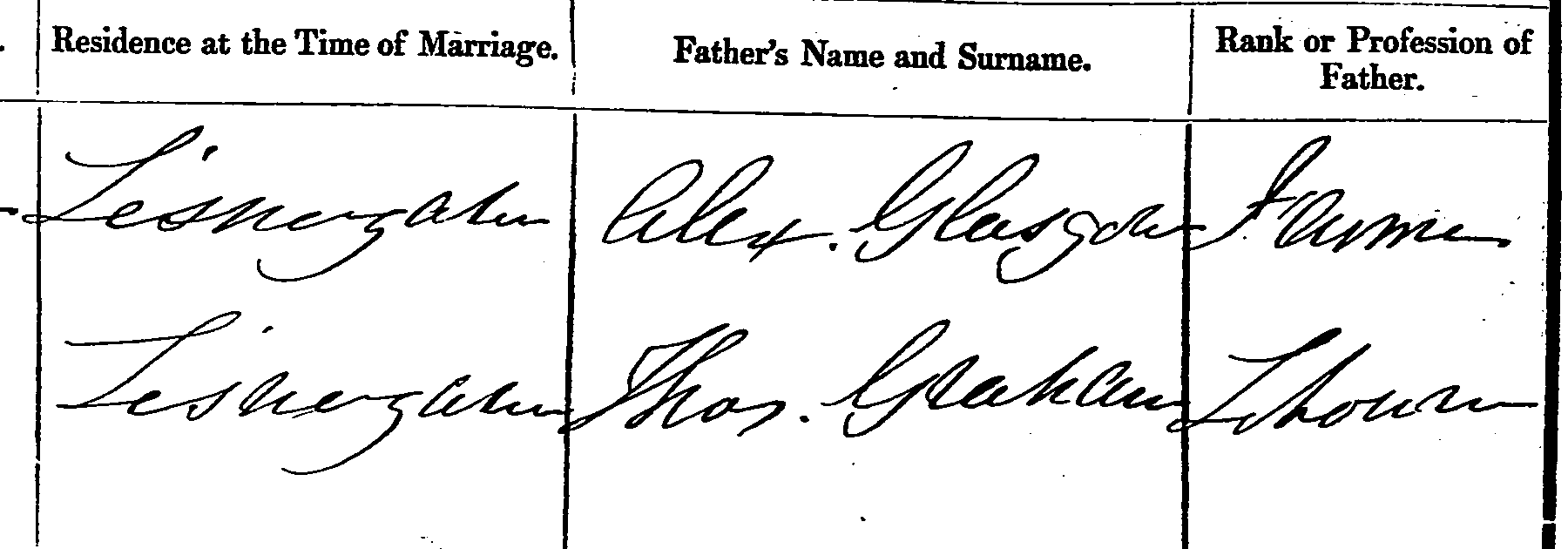
General Register Office of Ireland / IrishGenealogy.ie · Civil marriage register, Churchtown, Tamlaght O’Crilly, Ballymoney registration district, 5 April 1866, entry 144; Robert Glasgow and Jane Graham; image 8240963. · Full original record. Original pixels; reading guides are removable.
Reading
Groom’s row: Lisnagaver [normalized place reading]; Alex. Glasgow; Farmer. The lower row belongs to Jane Graham and names Thos. Graham, labourer.
Why it matters
The full entry identifies the groom as Robert Glasgow, aged 25, a bachelor farmer. The focused crop preserves the printed father heading and his father’s name and occupation. Together with Robert’s Lisnagaver residence, it supports continuity with the ten-year-old son in the 1851 household.
Limits of this excerpt
“Alex.” and “Thos.” are abbreviations; expansions are Alexander and Thomas. The residence is normalized to Lisnagaver; retain the original strokes when comparing the place spelling. This marriage does not name Robert’s mother. Some pen flourishes cross column rules.
The precise Scottish birth-image leads and the misplaced 1902 death citation are assessed in the next research tests. Neither has yet been inspected; the direct Irish father–son evidence remains secure.
James: a strong Michigan candidate, still an open identity
The second James, Glasgow-973, has an unusually clear Irish identity: the 1843–44 baptism and his age seven appearance in the 1851 household establish him as Alexander and Mary’s child. His subsequent association with the James Glasgow buried at Tecumseh, Michigan is strong but still unproved. The Michigan household is well reconstructed: the original 1884 Michigan census image gives a forty-year-old Irish-born baggage agent, and the Brookside register identifies the associated wife and daughters. His daughter Minnie’s 1941 death certificate reports James as born in County Antrim. That narrows the comparison materially but names neither Alexander nor Mary and gives no Lisnagaver detail. The 1869 original marriage return, naturalisation papers, or a passenger record is still required before the Michigan life becomes Alexander’s son’s biography.
Ann: a later marriage
Ann, Glasgow-438, is likewise direct family evidence. She was aged four in 1851 and her 13 October 1876 marriage to Robert McCracken calls her a full-age spinster of Lisnagaver and names Alexander Glasgow, labourer, as father. The occupational wording matters because it independently makes the 1888 Gortahar death’s “labourer” compatible with the former Lisnagaver farmer; it is not grounds to split the two men. The informant at Alexander’s 1888 death, formerly read as Nancy Glasgow and compared with Ann, is now read as Mary Glasgow, so Ann is no longer in question as that informant.
1876: Ann’s father was Alexander, a labourer
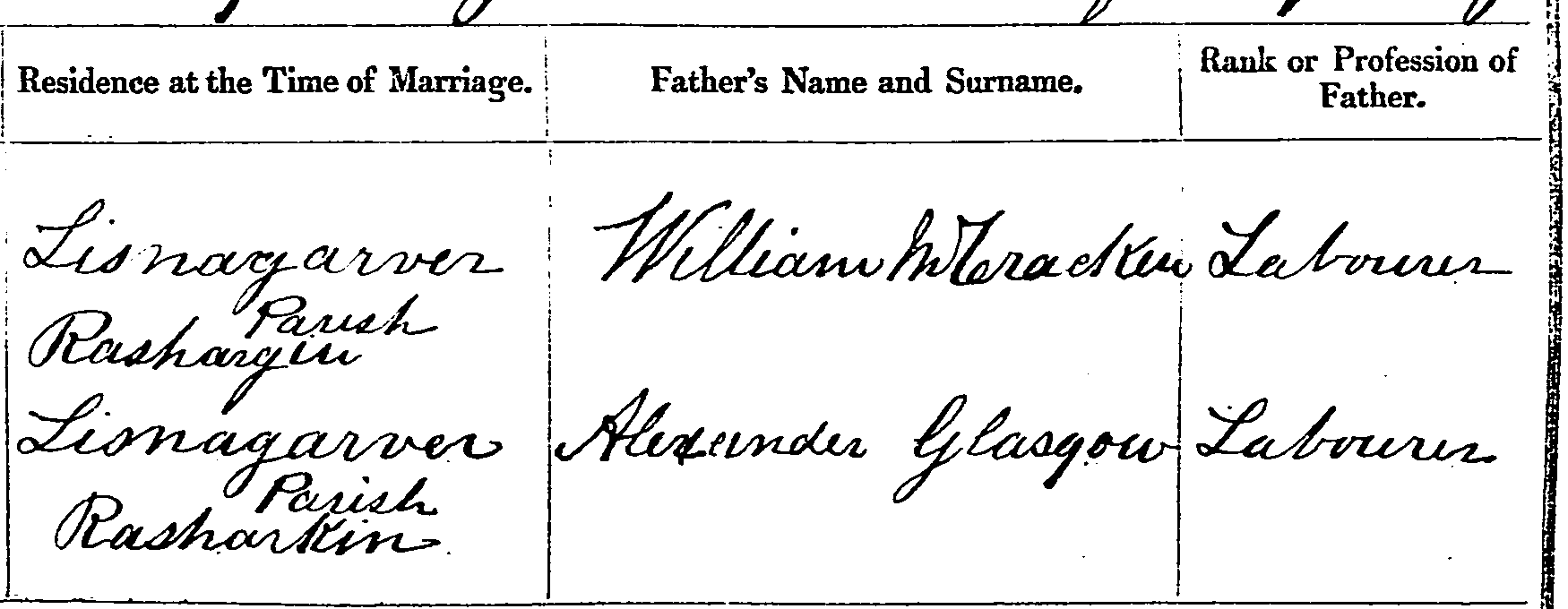
General Register Office of Ireland / IrishGenealogy.ie · Civil marriage register, Ballymoney Register Office, 13 October 1876, entry 191; Robert McCracken and Ann Glasgow; image 8097170. · Full original record. Original pixels; reading guides are removable.
Reading
Bride’s row (lower): Lisnagaver / Parish / Rasharkin; Alexander Glasgow; Labourer. The upper row belongs to Robert McCracken and names William McCracken, labourer.
Why it matters
The full entry identifies Ann as a full-age spinster of Lisnagaver. The father’s occupation is expressly labourer in 1876, twelve years before the Gortahar death. Alexander’s later description as a labourer therefore does not, by itself, distinguish that deceased man from the former Lisnagaver farmer.
Limits of this excerpt
The father name and occupation are secure readings. This marriage supports Ann’s link to the Lisnagaver family. The 1888 informant, formerly read as Nancy and compared with Ann, is now read as Mary. The bride’s name and date are outside this focused crop and visible in the context crop and original entry.
Mary: the daughter whose records connect the households
Mary Glasgow-3167 is not in the 1851 return but is securely added by her 14 June 1871 marriage to Robert Elder: aged 28, resident Lisnagaver, she named Alexander Glasgow, farmer, as father. Her marriage, Robert Elder’s succession to lot 25, and the Gortahar deaths create the high-confidence bridge between the Lisnagaver couple and Mary McCaughan’s later identity. Mary Glasgow’s 17 February 1892 death return records daughter Mary Elder as informant. It does not state a maiden surname or husband, and its reported age 89 conflicts with the retained c.1811 estimate; those limits belong beside the identification, not beneath it.
Mary’s later household also contains an instructive name conflict. Her granddaughter’s 1908 birth records Samuel Elder, son of Jane Elder, with no father named; the 1911 household calls him Samuel Glasgow. The surname is genuinely present in the census, not merely a modern transcription mistake. These records help reconstruct the continuing family, but neither identifies his father. It would be circular to invent a Glasgow father and then use that invented relationship to strengthen Alexander’s ancestry.
Mary’s absence in 1851 is consequently an unresolved location question within a well-supported later family identification. It does not erase the 1871 father statement. Nor does it establish that she was the Maryan in John of Glenleslie’s household: the roughly nine-year conflict between their implied birth years requires explanation, and no located record joins those two identities. A search of the surviving 1851 returns on 6 October 2026 found no child Mary Glasgow of suitable age elsewhere in Rasharkin parish. Her later census ages, 60 in 1901 and 72 in 1911, place her birth about 1838–41, and she may be the unnamed child baptised in 1838; the original register entry has not been examined.
Parents and wider relatives
1892 New York probate notice: Mary and Ann named as Alexander’s children
Nancy Glasgow's will and the 23 January 1892 probate notice connect the Irish Glasgow, Dysart and Anderson households. The notice names James, Mary and Ann as children of Alexander formerly of Rasharkin. Their identification with this family is probable, supported by the separate Lisnagaver marriage/baptism records. Nancy's will names Margaret Kennedy as niece and Robert Anderson as nephew. The complete notice has now been inspected; the earlier OCR-only limitation is superseded.
Relationship assessment, 21 September 2026. The will and citation favour a probable sibling network; they do not name Alexander's father or prove full rather than half siblinghood. Elizabeth Anderson is identified through the baptism evidence, not named as a parent in the notice. John-867's recorded father is a conditional candidate; his identity with the Desertoghill flax grower is another unproved step.
Omission of Thomas's descendants does not exclude Thomas or Daniel. Alexander’s son Robert-938 is omitted although he was living: the Belfast News-Letter of 6 January 1892 calls Jane Graham “wife of Robert Glasgow, formerly of Rasharkin”, eight days before the citation. The list was therefore incomplete even within Alexander’s own family. Residence of Daniel Neely somewhere in New York does not establish the informant's knowledge. The notice concerns real and personal property: Matter of De Voe distinguishes their representation rules. Inspect Nancy's petition, heir schedule, amendments and service papers before interpreting the notice as an exhaustive pedigree.
Current assessment, 29 September 2026: John Glasgow, farmer, remains the probable shared father. The death notice and original docket have now been checked, and the Glenleslie namesake tested. See new evidence and competing theories; the 21 September conditional wording above records the earlier audit.
New evidence and competing parentage tests, 29 September 2026
Result: John Glasgow, farmer (Glasgow-4090), remains Alexander's probable father; no direct parent statement has been recovered. The record-defined father in John-867's marriage, the proposed Desertoghill occupier and the older Glenleslie John are three separate identities. This review does not upgrade a family link or identify Alexander's mother. The tests below reduce some alternatives without turning omissions or uncertain ages into proof.
A death-week notice missed by exact-name searching
The original Plattsburgh Sentinel, 6 November 1891, p. 8, reports Nancy Glasgow's death at Plattsburgh on 31 October 1891, aged about 75, and her funeral on Monday afternoon at the Peristrome Presbyterian church. Original newspaper page. The full-page PDF, extracted text and an unaltered crop are preserved under research/Glasgow-4070/record-excerpts/.
This independently corroborates the cemetery transcription's death date and identifies the American church context. The reported age suggests birth about 1815–16, whereas Nancy's own January 1889 will says about 68, suggesting 1820–21. Neither approximate age should be silently replaced by the other. The maintained census indexes give still other ages: 30 in 1860, 50 in 1870 and 65 in 1880 (MC7C-HHK, M8FF-ZQD, MZZF-HDJ). These are not new original-image inspections in this review; they reinforce that neither selected birth estimate is a proved bound. The notice names no relatives or Irish birthplace. The reconstructed Samuel-to-Nancy birth span is consequently about 25–31 years, subject to all sibling identifications and ages; it does not establish two marriages.
Search scope: exact "Nancy Glasgow" in the NYS newspaper collection returned 12 pages, largely repeated probate notices; that search missed the death notice. A Clinton County Glas* search, 1 October–30 November 1891, returned 53 pages; the first 20 results were reviewed and the 6 November page was then read visually. A Nancy-only Clinton search, 1891–1894, returned 96 pages; only its first 20 were reviewed. These are bounded index searches, not a search of every newspaper page.
Nancy Glasgow: death and funeral notice, November 1891

NYS Historic Newspapers · Plattsburgh Sentinel, 6 November 1891, p. 8, death notices · Full original record. Original pixels; reading guides are removable.
Reading
In Plattsburgh, October 31, 1891, NANCY GLASGOW, aged about 75 years. Funeral was held on Monday afternoon at the Peristrome Presbyterian church.
Why it matters
Independently corroborates Nancy’s death date and American funeral context. Age about 75 implies birth about 1815–16, conflicting with her will’s about-68 age in January 1889.
Limits of this excerpt
Both ages are approximate. The notice names no relatives or Irish birthplace and does not establish Alexander’s parentage.
Probate: expand the record series, distinguish the generations
The broader FamilySearch probate catalogue 223236, Probate records, 1790–1969, contains 19 films and additional minutes and letters series; the narrower will catalogue 319520 alone cannot establish that a petition or later tax report was never filmed. The broader catalogue does not advertise a separate petition-packet or tax-report series. That is a catalogue limitation, not proof that the records do not survive.
The original Nancy docket, DGS 005115656, image 34 of 575, volume 6, p. 6, was visually inspected rather than accepted solely from the AI transcript. It records the 14 January 1892 petition, service by publication, probate and letters on 9 May, a special guardian for minor heirs, an inventory and appointment of Cabell McLean as collateral inheritance tax appraiser in March 1894, and filing of his report on 28 April 1894. The exact March day and the guardian's name are not confidently read here. The docket does not reproduce the petition, report or a kinship schedule.
The guardian entry is not evidence that all the cited children were a generation younger. Nancy's will separately names Robert Wallace Anderson, son of her deceased nephew Robert Anderson, and retains $500 for him until 21. He supplies a concrete younger beneficiary who could explain a guardian, though the docket does not identify the guardian's ward. Nancy also calls him a nephew; the will's terminology must be interpreted against the documented relationship rather than assumed to be perfectly precise. The earlier Robert Anderson and Margaret Kennedy relationships remain the principal explicit kin terms used in the sibling reconstruction.
The G index in the preceding minutes volume, DGS 005115623, image 12, was inspected with no Glasgow entry found. A full-text query for +Glasgow confined to that DGS returned zero. Neither is an image-by-image search of the volume or a negative search of the complete estate file. Public web searches for Nancy with Walworth/McLean found no independently accessible tax report; no contact or paid retrieval was undertaken.
Competing explanations and their discriminating tests
| Explanation | Test and result | Present assessment |
|---|---|---|
| One Glasgow father, John farmer, for the probable Nancy sibling group | Alexander's cited children fit his independently documented family; John-867's James Garvin and Ann fit the separate cited branch; John-867's 1846 marriage names father John, farmer. Known birth surnames in the Dysart, Anderson and McClelland branches are Glasgow. | Leading, probable. The common-father inference is economical, but shared surnames alone do not prove full or paternal half-siblinghood. A kinship-bearing sibling record could test it independently of Nancy's petition. |
| Different Glasgow fathers linked through one mother | A mother marrying two Glasgow men could preserve all the surnames. No record or identified second marriage supports it. Ordinary maternal-only siblinghood with a differently named father fits the surnames less well. | Possible, presently unsupported. It cannot be excluded merely because it needs another same-surname marriage. |
| Glenleslie John-1022 as father of the whole reconstructed group | His 1851 return records a daughter Nancy who died in 1847 aged 36. She cannot be the Nancy who lived in Plattsburgh through 1891. Assigning both Nancys to him requires an unexplained second living daughter of the same name, or a change to the proposed sibling group. 1851 census transcript. | Disfavoured as a single-family reconstruction. This does not exclude every half-sibling or collateral connection. John-867's corrected death is 1885, not 1895; the older age-based objection founded on 1895 must not be reused. |
| Older Alexander and Rosanna as Alexander-951's parents; Thomas and Daniel his brothers | Contemporary Canadian deeds prove a Thomas–Daniel sibling family, but do not name Alexander-951. The parent tradition has no inspected contemporary foundation. Their descendants' absence from Nancy's citation remains inconclusive. | Weaker alternative, not disproved. An original parent statement for an independently established Thomas–Daniel sibling, plus a bridge to Alexander, is required. |
| The 1834 Robert occupier as Alexander's father | Tithe co-occupation does not give age or kinship. If he were the man who died in 1868 aged 71, he would be too young for the normal father model under either Alexander birth estimate; that identity is itself unproved. | Unresolved tenant identity. A brother/uncle interpretation remains available; no age can be transferred between unidentified namesakes. |
| John farmer equals the 1796 Desertoghill flax grower | Samuel's Derry birth and John-867's Antrim birth fit movement across the Bann, but John's wife and daughter also have Derry births in 1851. County crossings do not date a single permanent move. | Separate, unproved identity hypothesis. A tenancy succession, named child or prior residence is needed. |
Collateral searches that do not depend on correspondence
Mary Thompson has a new indexed family candidate. FamilySearch's Scottish civil-registration index records Mary Thomson, aged 37, marrying William Sneddon, aged 45, widower and collier, on 9 November 1860, with Mary's parents Robert Thomson and Mary Glasgon Thomson. Indexed bride; indexed mother. Document information gives 008056939_011_M9H1-8LK, image 32. The image-availability dialog requires a FamilySearch centre or affiliate library; the original was not inspected. The older extracted index XT1H-TBC places this marriage at Old Monkland, Lanarkshire. Both indexes concern the same event, not independent corroborating marriages. A mother born before about 1805 could belong to Nancy's older sibling generation, but no Irish origin, Nancy relationship or mother's parents have been established. Treat this as a candidate, not an identification of Glasgow-4093.
The existing Mary-4093 biography also reports an unproved Tannybrake widow of William Thompson, dying in 1888 aged 73; its original was not inspected here. If that age is right, she would have been about eight at the Scottish daughter’s c.1823 birth. Keep those candidates separate unless an age or identity correction is established. Mary’s own birth date and birthplace are unestablished; the unsupported catalogue estimate 1874 is withdrawn.
An exact indexed mother-name search for Mary Glasgow with child surname Thompson returned six results. These included Anna Thompson, born about 1870, daughter of John Thompson and Mary Glasgow, married at Spokane in 1898, and James Thompson, born about 1880 in Iowa, with the same parental names, married in British Columbia in 1913. They are later-generation alternatives; their common parental names do not prove one family or membership of Nancy's branch. Exact Glasgon and Glasgon Thomson mother-name variants returned zero in the tested combinations, while a fuzzy Mary Thomson search surfaced the Scottish marriage. This demonstrates why zero exact-name results cannot close the branch.
A follow-up query for daughter Mary with parents Robert Thomson and Mary Glasgow returned only the already located marriage, despite supplied death-year terms; no separate death was identified among the returned records. A strict principal Mary / spouse Robert Thomson / father surname Glasgow query returned zero. Neither result excludes the family: index fields, surname variants and collection coverage remain limitations.
Lizzie of John's cited branch remains unidentified. The 1880 West Troy census candidate, Irish-born domestic servant Lizzie Glasgow, aged 21, in James O. Wood's household (FamilySearch MZCY-D41), has no inspected parent statement. Public web index searches for Lizzie/Elizabeth Glasgow or Glascow at West Troy/Watervliet and with James Garvin found no independent parentage record. These are index misses, not searches of all civil registers. A namesake remains possible.
Next independent tests: follow the Mary Thomson–Sneddon candidate into censuses and death indexes for birthplace and mother's parents; distinguish Ann Glasgow McClelland's own death from her sons' already known parent statements; confirm Robert-938's reported 1902 Scottish death from its original (the 6 January 1892 notice shows he was living when the citation omitted him); examine probate letters/minutes and the 1894 appraisal if accessible. A record naming one sibling's father is more useful than accumulating more neighbouring tenants. The petition is valuable but is not the only route to resolution. No email, message or live WikiTree edit was made in this review.
Alexander’s immediate parents: the remaining comparisons
John Glasgow, farmer, is the leading conditional father hypothesis. It depends on Alexander and John-867 sharing a father within Nancy's probable sibling network. Older Alexander/Rosanna and the Glenleslie family remain unproved; omissions from Nancy's notice do not categorically exclude them. The comparison below preserves the separate evidence for each route.
The immediate local family tests
| Local explanation | Evidence carrying real weight | Why it does not yet select a parent |
|---|---|---|
| First relationship to resolve: the Thomas–Daniel family, possibly children of older Alexander and Rosanna | Contemporary Lisnagaver households, adjoining later holdings and a repeated Marks witness network establish association. Daniel’s will independently proves Thomas his brother. The descendant account names Thomas’s parents. | No record makes Alexander their brother. Neighbourhood, congregation and holdings overlap as evidence of local association. Applying Thomas’s parent names requires establishing both their historical basis and Alexander’s same-parent relationship. |
| Parallel household test: the unidentified Robert of Lisnagaver, 1834 | A real local occupier, with a Robert also in the 1836 house list. This is a stronger local lead than an otherwise unconnected pedigree. | Neither his age nor relationship is recorded. Identifying him as Glenleslie Robert is another unproved step, not supporting evidence. He could be a father, brother, uncle or unrelated occupier. |
| Parallel family test: father John, named by John Glasgow of Lisnagaver | John’s 1846 marriage names father John, farmer; the census calls Samuel John’s brother. | Alexander is not called their brother. Brotherhood alone would not prove both parents were shared. This father is not automatically John of Glenleslie. |
These are research priorities, not numerical odds or mutually exclusive family trees. Robert could be an uncle while Thomas was a cousin. A father not yet identified in the records remains an open possibility.
What the original Canadian deeds change
The 1861 deed now establishes the Canadian connection for Thomas and Daniel: their documented siblings include Robert and Samuel of Prescott, John the watchmaker, Mary Glasgow Black and brother James. Mary Black’s deed identifies six children, including John and Rose Ann of Drumoolish. Their family records now provide a specific local route to the siblings’ parents, independently of the repeated Alexander-and-Rosanna tradition.
The 1868 father statement belongs to Alexander Glasco of Rochester, express agent, son of James the Prescott carpenter. It cannot be transferred to Alexander-951 without a wife, age, birthplace or migration bridge. The carpenter’s identity with Robert’s brother also remains to be established because the daughters’ property shares do not fit a simple division of the will’s sixth. James is a named family hypothesis to test; the deed has not selected him as Alexander-951’s father. The full family and property analysis distinguishes the established relationships from these identity steps.
Evidence that should change the weighting
The 1868 Robert death could weaken the father hypothesis. The previously inspected Ballymoney index gives age 71, implying birth about 1796–97. If that man were the 1834 occupier, he would have been about 14–15 at Alexander’s c.1811 birth, or 7–8 at the probable death’s c.1804 birth estimate. That is adverse father-age evidence, not confirmation of an older generation. The occupier’s identity is still unknown, so the calculation does not presently exclude him.
An older Alexander is not required by the tithe. Alexander-951 could have occupied land in 1834 at about twenty-three, or about thirty under the earlier birth estimate. Gortereagh residence after marriage and omission from the 1836 house section do not prove inheritance or co-residence with a parent. The land analysis explains the limits of the surviving coverage and acreage comparisons.
The tradition has less independent support than its repetition suggests. The public 2020 reply copies the 2007 post; the 2018 pedigree file cites a member tree. The private correspondent believed Thomas’s parent names and separately asked whether Alexander was his brother. Her source is unknown, so neither independence nor copying is established. The clockmaker tradition supplies useful context but misplaces Daniel’s generation if it calls Thomas’s documented brother his uncle. Rosanna’s surname Shaw and reported 1822 death do not become independent evidence for this parentage.
The genetic family and the immediate father are different levels of the question. The Larne analysis explains why the wider connection is a priority and compares two routes into Alexander’s generation. The local candidates still need a record or independently traced comparison line that distinguishes their particular families.
Other immediate-parent candidates and collateral roles
| Hypothesis and present status | Supporting evidence | Contrary or missing evidence; required assumption | Discriminating evidence to seek |
|---|---|---|---|
| Robert of Glenleslie (Glasgow-1367): weak | Census age and 1803 marriage permit parenthood | No Lisnagaver bridge; must distinguish him from the tithe occupier | Relationship record bridging the separately documented households. |
| John of Glenleslie (Glasgow-1022): weak identity proposal | Nearby father-John model | Age problems; Mary/Maryan ages differ substantially; neither bridge proved | Identify the marriage father; resolve granddaughter identity and her parent. |
| Adam of Inishrush (Glasgow-3902): weak as immediate father; useful collateral anchor | Nearby documented family | Monument omits Alexander; unnamed census male cannot identify him | Named-child register or estate record. |
| Adam (Glasgow-1622): open, distinct identity | James's 1851 marriage names father Adam | Names no Alexander; cannot merge the two Adams | Identify James and father, then test sibling connection. |
| John of Inishrush/Ohio (Glasgow-822): weakened as father; useful collateral and DNA comparison | Relevant documented family | Family register lists nine children, no Alexander | Independent family or church evidence naming Alexander; the two Bible-image inspections are complete. |
| James of Larne (Glasgow-3986): weak rival father candidate | Suitable age; Alexander used James twice for sons | Naming and generation only; Larne, not Lisnagaver; a rival to the probable father John Glasgow, farmer, not a link above him (if Samuel was John farmer's son, James, reported born about 1773, is too young to be John farmer's father) | A Lisnagaver or Larne record naming Alexander's father. |
| Robert of Coltrim (Glasgow-3941): low priority | Documented older householder | Children unnamed; distinct from Glenleslie and unidentified Lisnagaver Robert | Named family record establishing a bridge. |
The first son’s name James is meaningful family evidence, but it does not identify a paternal grandfather or select the Larne man. Mary/Molly’s parents remain unknown, and James and William McCaheran occur locally. Naming could reflect either side of the family; the surviving child sequence cannot establish a fixed naming rule.
Retired or excluded: the imported Robert-and-Catherine parental pair is superseded; Robert’s biological possibility remains separately open. Catherine has no independent maternity evidence. James-1702 is excluded by the maintained chronology; John-1657 is a rejected practical lead in a distinct family. Detailed candidate sources and exclusions remain accessible.
For parentage, the first record priority is the family-group material in PRONI CR5/32/1/1/1–2, alongside the actual source behind the Thomas parent tradition. Extract named households and dated admissions/removals across Alexander’s childhood, rather than another surname-only list. The existing enquiry remains pending. Reconstruct the unidentified Robert and father John in parallel, without merging them into convenient profiles. The next tests retain the exact references.
Rosanna’s maternity must be assessed separately from older Alexander’s paternity: even paternal half-brotherhood with Thomas would not transfer Thomas’s mother. Mary/Molly’s McCaughan connections concern Alexander’s wife, not his own mother.
The wider family: proved links and open bridges
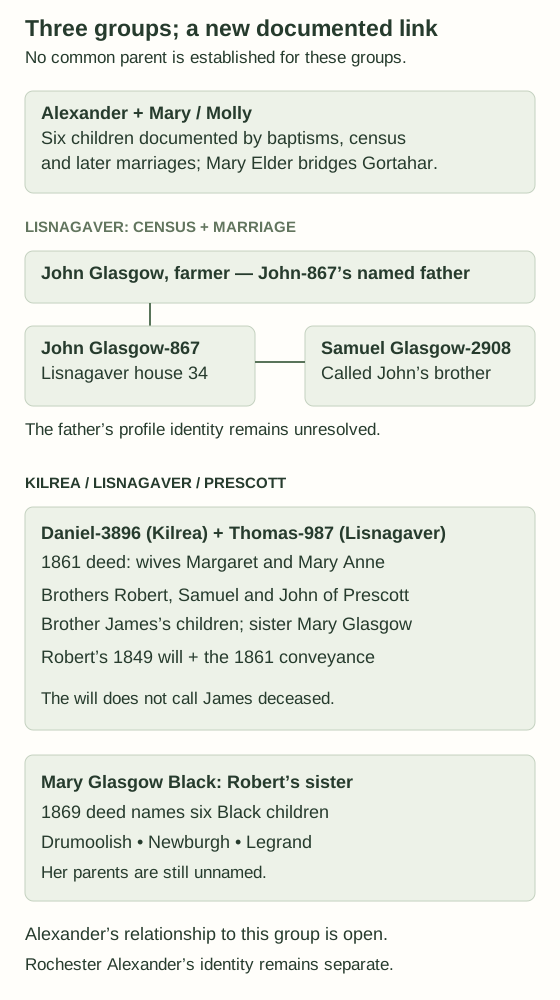
The Irish–Canadian sibling connection is now documented by the will and 1861 deed. The Black-family deed adds a named Drumoolish branch. Alexander’s parentage remains unresolved.
The Lisnagaver evidence supports a local Glasgow network; it does not yet yield a single reconstructed pedigree. The starting point is the 1851 sequence. House 34 contains John Glasgow, farmer, with wife Margaret and his unmarried brother Samuel, a linen weaver. House 35 contains Alexander and Mary with their children. House 37 contains Thomas Glasgow and Mary Ann. A Watters household separates Alexander and Thomas. The layout establishes a small same-surname farming cluster and useful geographic proximity; enumeration order is not a kinship statement or a property map.
John Glasgow-867 and Samuel Glasgow-2908 belong to a specific father-John branch. John’s original 16 November 1846 marriage names his father as John Glasgow, farmer. The 1851 household expressly calls Samuel John’s brother. That chain directly establishes the brotherhood and names John-867’s father and his occupation. Extending that father statement to Samuel assumes they shared a father; the census does not distinguish full from half brothers. It does not identify that father with John Glasgow-1022, the older Glenleslie man, and it does not make Alexander another son. The corrected memorial/death identification is 1885 aged 78, implying birth about 1806–07; the former 1895-based age objection is superseded. The 1851 census age implies an earlier birth about 1801. Neither age identifies his father with Glenleslie John. Any maintained attachment to John-1022 is an uncertain identification of the father, not an additional record and not evidence for Alexander’s parentage.
The distinction matters because the neighbouring tenancy pattern is tempting but not decisive. The 1834 tithe names Alexander and Robert Glasgow at Lisnagaver, while later valuation lots 24, 25 and 26 are associated with John, Alexander and Thomas under Robert Harvey. Acreage, field-book and adjacency arguments can suggest tenancy succession or a broader network. They cannot establish a biological descent, and Plantation-measure tithe acreage cannot be numerically matched to statute-measure valuation acreage to manufacture an inheritance. The 1836 field book names Robert Glasgow and Archibald McCaughan junior in the house section but does not name Alexander; its land section does not supply occupier names. It therefore cannot decide who lived together, who inherited, or whether Alexander was a brother of John or Thomas.
Thomas Glasgow-987 and Daniel Glasgow-3896 have a stronger relationship argument than Alexander has with either. Daniel’s 1871 will, indexed through the PRONI Wills Calendar, calls the late Thomas his brother and identifies Daniel Neely Glasgow as nephew; Daniel Neely’s 28 June 1888 marriage in turn names Thomas Glasgow, farmer, as his father. Those two records establish Daniel and Thomas as brothers. Thomas’s PRONI calendar administration adds that the Lisnagaver farmer died 21 June 1870 and administration went to widow Mary Anne on 7 September. It was an intestate administration, not a will, and it names no parent, sibling or heir beyond the widow. It cannot be used to extend the proved brotherhood into a parentage for Alexander.
Alexander may be a brother or cousin of Thomas and Daniel. Shared locality, associated land, church context and descendant testimony make that a worthwhile research model. No confirmed Y-DNA comparison with an independently documented Thomas or Daniel descendant is supplied in this case. None of those sources says that Alexander was their brother, so the three men are not a proved sibling set. The 2020 correspondence records the older Alexander-and-Rosanna belief, but provides no demonstrably independent parentage source: the correspondent said she believed Thomas’s parents were Alexander and Rosanna, separately wondered whether the user’s Alexander was Thomas’s brother, and supplied neither a record citation nor usable autosomal-match data. The later FamilySearch Pedigree Resource File entries derive from an Ancestry member tree and conflict even on Rosanna’s reported death day. They show the circulation of a tradition, not its verification.
The Irish–Canadian family: what the original deeds establish
The Canadian connection is now supported by an explicit transaction. In the registered deed of 30 July 1861, B465, Daniel Glasgow of Kilrea, County Londonderry, watchmaker, and Thomas Glasgow, farmer of the County Antrim townland written Lislagaver/Lisnagaver, sell Samuel Glasgow of Prescott two undivided sixths of the Centre Street property. Their wives are Margaret and Mary Anne, and the deed expressly derives the interests from Robert Glasgow's will. Place, occupation, wives and the already proved Daniel–Thomas brotherhood identify these men with Daniel-3896 and Thomas-987. This resolves the former uncertainty about whether the will's Irish brothers were the known Kilrea and Lisnagaver men.
Robert's will of 9 October 1849, B12, registered in 1856, gives one sixth each to brothers Daniel, Samuel, John and Thomas, one sixth to sister Mary, and one sixth collectively to the children of brother James. Combined with B465, this places Daniel and Thomas in the same documented sibling group as Samuel of Prescott-4010 and Robert. The original does not call James deceased: the earlier death-before-1849 inference is withdrawn. It names no parents.
| Original record | People, property and transaction | What it establishes |
|---|---|---|
| B12, 9 October 1849; registered 13 November 1856, DGS 008200419, images 35–36, pp.9–10 | Robert's six shares, including one collectively for brother James's children. Executors Alexander McWilliam and Samuel Glasgow. | Direct sibling wording. Alexander Glasgow witnesses the 1856 registration request; that is a different role from beneficiary. James's death is not stated. |
| B13, 30 October 1856, image 36, pp.10–11 | John Glasgow, Prescott watchmaker, and wife Jane sell Samuel, merchant, one sixth for £125; Jane releases dower. Registered 13 November. | An actual acquisition of a share. John's trade also gives a specific occupational comparison with his brother Daniel. |
| B395, 23 November 1860, image 208, pp.336–337 | Eliza Jane Glasco, Rochester, New York, spinster, eldest daughter of James Glasco, formerly of Prescott, carpenter, sells Samuel one ninth for £33 6s 8d. Registered 22 December. | Explicit father–daughter relationship and residence. No explicit derivation from Robert's will. The copied registration signature says James although the grantee is Samuel. |
| B465, 30 July 1861, images 240–241, pp.397–398 | Daniel and Margaret of Kilrea; Thomas and Mary Anne of Lisnagaver; two sixths to Samuel for $1,000 Canadian currency, expressly under Robert's will; executed at Coleraine. | The direct Irish identification and inheritance link. The official abstract gives registration 7 October 1861. The deed opening and closing copy differ on the July day; the opening date is used here. |
| B601, 27 June 1863, image 316, pp.542–543 | Mary Glasco, Rochester spinster, second eldest daughter of James, formerly Prescott carpenter, sells Samuel one ninth for £33 6s 8d. Alexander Glasgow of Prescott, gentleman, witnesses. Registered 3 August. | Identifies a second daughter of the carpenter. It does not identify the witness as Alexander-951 or explicitly describe the interest as a share under Robert's will. |
These deeds concern Lot 12 south of Dibble Street and a 3,400-square-foot part of Lot 11, the house at 388 Centre Street. The municipal designation report, printed pp.31–32, and the 2017 property account agree on 388. The former 280 reference was a project citation error. OnLand's official parcel search identifies PIN 68159-0153, Plan 19, Block 2; the historical abstract, p.71, connects the same Lot 11 strip to Robert's 5 April 1841 purchase from Susannah Jessup. Samuel's 251 Water Street West, Plan 19, Block 2, part Lot 16, remains a separate property.
James's family: a promising identification with an unresolved title problem
Eliza Jane and Mary are explicitly sisters and daughters of James the Prescott carpenter. Identifying that James with Robert's brother is a strong property-based hypothesis, because both daughters convey interests in the same two parcels to Samuel. It is not yet proved by an express kinship or inheritance clause. Each daughter's one-ninth interest is also recorded in the official abstract. Together they exceed the one-sixth collective share given to James's children in Robert's will. Earlier ownership, additional inherited interests or a record error must be examined before treating these as a simple distribution of that sixth. The fractions cannot responsibly supply a child count.
The 1868 Alexander deed has now been inspected. C114, 25 March 1868, DGS 008200420, image 120, pp.164–165, identifies Alexander Glasco of Rochester, Monroe County, New York, express agent, son of James Glasco formerly of Prescott, carpenter. Through attorney Macneil Clarke he conveys one eighteenth for $166.66 to Mary Eno Glasgow, widow of the late Samuel Glasgow. The accompanying C113 power of attorney was made at Rochester on 28 December 1867; both instruments were registered on 18 August 1868. The abstract's August date is therefore registration, not the deed's execution date.
This positively identifies a son of James the carpenter alongside Eliza Jane and Mary. It supplies three named children, without claiming a complete family or resolving how their title shares arose. It identifies a Rochester express agent, not a Lisnagaver farmer: linking him to Alexander-951 would require an independent wife, age, birthplace or migration bridge. No such bridge was found in this inspection, so this father statement is not assigned to Alexander-951. The earlier Prescott witness named Alexander is a relevant comparison, but the shared name does not prove he was the express agent either. Mary Eno is the widow's recorded name; the document does not establish Eno as a maiden surname.
Mary Glasgow Black and the Drumoolish connection
The original C298 deed of 15 September 1869, registered 1 July 1870, explicitly identifies Mary Black, formerly Mary Glasgow, as sister of the late Robert Glasgow of Prescott. It names her six children and conveys the family’s interest to Samuel’s widow for $800. This is another direct Irish bridge: two of the children reside at Drumoolish, County Londonderry. The deed gives a record-based family to compare with the wider Bann Valley and Inishrush evidence; it does not name Mary’s parents or make her a daughter of Adam.
| Child of Mary Glasgow Black | Residence and description in the deed | Spouse or estate detail |
|---|---|---|
| John Black | Drumoolish, County Londonderry; yeoman | Wife Martha joins. |
| Rose Ann Black | Drumoolish; spinster | Living party. |
| Jane Miller | Newburgh, Orange County, New York | Wife of Robert Miller. |
| Agnes Black | Newburgh; spinster | Living party. |
| Thomasina Montgomery | Legrand, Marshall County, Iowa | Wife of Mathew Montgomery. |
| Elizabeth Black | Newburgh; spinster | Had died unmarried and intestate; the five named siblings are described as her heirs. |
The six child interests are expressed as six sixth-parts of Mary’s one-sixth interest; the five surviving siblings also account for Elizabeth’s part. This explains a subdivision within this particular branch. It does not resolve the Rochester daughters’ ninths. Mary Black, Robert’s sister, is distinct from Mary Glasco of Rochester, James the carpenter’s daughter. The deed names Mary Eno Glasgow as Samuel’s widow, but does not establish Eno as her maiden surname.
Consequences for Alexander's parentage
The Canadian records now expand Daniel and Thomas's documented family, which makes their brothers' and sister's records directly relevant to this enquiry. They still do not name Daniel or Thomas's parents, and they do not establish Alexander-951 as another brother. The Alexander-and-Rosanna tradition remains a hypothesis about Thomas's parents. Alexander's possible place among James's children now has named family and property records to test, but the carpenter's identity with Robert's brother and any connection between his Rochester son and Alexander-951 must each be demonstrated.
The 1861 deed also places wives Margaret and Mary Anne in the recorded family transaction. It strengthens the identification of the existing Irish couples and gives a later dated occurrence of Daniel's wife before his widowed death in 1871. It does not supply either woman's maiden name or establish the mother of every child. No new Y-DNA result was obtained: documentary linkage to the Prescott brothers expands the family that can be compared with Alexander's paternal line, without proving a genetic match or the joining generation.
Separate Canadian estate leads
The bare estate index entries Samuel Glasgow, 1875 and James E., 1900–09 remain unassigned. Younger Samuel-4021, two at his next birthday in the 1851 household, is an alternative to the merchant; James E.-4017, five at his next birthday, is a specific comparison for the later James E. entry. These are separate from James the carpenter and the Centre Street deeds.
The 1851 Prescott census contains eight household members, six probable children. With two later sons reported by local history, eight possible children are accounted for, leaving two of the reported ten unaccounted for by those sources. Library and Archives Canada fonds R6229-0-0-E / MG24-I39 concerns a Niagara farmer who died about 1830 and is excluded as this merchant's archive.
The remaining distinct family groups are Alexander's household; John-867 and Samuel-2908's father-John branch; and the now connected Kilrea–Lisnagaver–Prescott sibling group. No record yet joins them under a common parent. The new Irish bridge is established; Alexander's position within that wider family remains the question.
The 2020 correspondent identified a descent through Catherine, described as Thomas and Mary Ann’s sixth daughter, and reported an autosomal match. The supplied message contains no shared-cM total, segment information, checked descent or source for the parent names. Her belief about Thomas’s parents and her separate question about Alexander’s brotherhood are two claims that require separate tests. The reported match is a lead to evaluate for other shared ancestral routes as well as this paternal hypothesis. The correspondence is summarised without publishing the private message or correspondent’s identity.
The farm and the 1888 death
The complete record sequence and the farm
The sequence follows the named couple and their children across church, census, land and civil records. A father named on an adult child’s marriage is evidence of parentage; it does not by itself prove that he was alive on the marriage date.
| Date | Record and recorded detail | Identification and evidential value |
|---|---|---|
| 5 June 1829, derivative extracts | Belfast News-Letter, page 4, article 015: “Alex. Glasgow, Lisnagaver” in the inspected alert; independently located by townland in the newspaper index | Original inspected 3 October 2026: freehold application 2324, Alex. Glasgow of Lisnagaver, with lands in Kilconway barony, Lisnagaver townland. No age, kin or successful admission stated; competing identities remain. |
| 1834 | Rasharkin tithe book, PRONI FIN/5/A/236, folio 17: Alexr Glasgow, 29 acres at Lisnagaver; Robt Glasgow separately, 35 acres | Plausible early occurrence of this Alexander, who would have been about 23. No age or kinship distinguishes him from a possible older namesake. |
| 1836 | Lisnagaver valuation field book, pp.194–197: Robert Glasgow and Archibald McCaughan junior named in the house section; Alexander absent | The land section has no occupier names. This is not proof that Alexander held no land or lived in either named household. |
| 1836, reported in 1851 | Both spouses give 1836 as first-marriage year in the census image | A contemporaneously recorded retrospective statement; an original marriage entry is still missing. |
| 9 February 1837 | Baptism entry 75: Jas Glascaw, born 17 January; Alex and Mary McAughin; Gortereagh | Direct transcribed parent names, residence and child’s birth/baptism dates. |
| 1838 sequence | Baptism entry 106: unnamed Glascow child; Alex and Molly McAughern; Gortereagh | Repeated couple and locality. The personal name and exact dates remain missing, separately from the documented parents. |
| 7 January 1844 | Baptism entry 203: James, born 9 October 1843; Alex and Molly McAughern; Lisnagaver | Establishes the later James and places the family at Lisnagaver by his birth. |
| 1851 | Original house 35 census, transcribed above | The principal household identity, approximate ages and reported marriage year. |
| Griffith’s Valuation and 1863–78 revisions | Alexander on Lisnagaver lot 25, house, offices and land; PRONI VAL/12/B/4/16A–B | Continuing landholding beside John and Thomas Glasgow. An occupier’s name can outlast his actual occupation; it is not a continuous life certificate. |
| 5 April 1866 | Robert Glasgow–Jane Graham marriage: Robert, 25, farmer of Lisnagaver; father Alexander Glasgow, farmer | Connects the 1851 son to his adult family. Jane’s Gortereghy residence also links the adjoining locality. |
| 14 June 1871 | Mary Glasgow–Robert Elder marriage: Mary, 28, spinster of Lisnagaver; father Alexander Glasgow, farmer | Father-naming record for an additional daughter. Robert, 40, farmer of Gortereghy, names father Nathaniel Elder. Witnesses William Graham and John Collins state no kinship. |
| 13 October 1876 | Ann Glasgow–Robert McCracken marriage: Ann, full-age spinster of Lisnagaver; father Alexander Glasgow, labourer | Supports the 1851 daughter’s later identity and shows that “labourer” was used for her father before the probable 1888 death. |
| 1879–88 revision volume | Alexander struck from lot 25 in VAL/12/B/4/16C; changes annotated 1881, 1882 and 1886; Robert Elder in possession by VAL/12/B/4/16D, 1889–98 | Supports the daughter/son-in-law land connection. No annotation establishes an exact death date or says that the transfer was inheritance. |
| 16 May 1888 | Gortahar civil death, entry 348: Alexander Glasgow, married labourer, 84; daughter Mary Glasgow present | Best-supported death identification, assessed separately below. |
| 17 February 1892 | Gortahar death of Mary Glasgow, entry 234: widow, reported age 89; daughter Mary Elder informant | Strong indirect link between Alexander’s documented daughter and the elderly Glasgow couple at Gortahar. The register does not name Mary’s deceased husband. |
The reported 1829 occurrence: an age and identity test
The original newspaper alert of 12 September 2025 was inspected directly on 13 September 2026. Its MyHeritage result, 12021-100828509, does quote “Alex. Glasgow, Lisnagaver” from the Belfast News-Letter, 5 June 1829. The British Newspaper Archive issue index independently locates the Lisnagaver entry in page 4, article 015. Its OCR mangles Glasgow, explaining why a surname search missed the article while a townland search found it. These are two derivative extracts of one newspaper occurrence, not two independent historical records.
The original newspaper page was inspected on 3 October 2026, closing the earlier access gap. Its heading lists persons applying to register their freeholds for the forthcoming Ballymoney division sessions at Ballymena. Entry 2324 names Alex. Glasgow of Lisnagaver, with lands in Kilconway barony, townland of Lisnagaver. This records an application, not successful admission. No age or relative is stated; the individual value column is not securely read. The statutory qualification and the man’s identity remain separate checks.
| Identity being tested | Approximate age on 5 June 1829 | What further registration records could distinguish |
|---|---|---|
| Alexander-951 using the 1851 census age | About 18 | The notice is a freehold application. Any statutory age requirement must be verified before using it to test this census-based age. |
| Alexander-951 using the probable 1888 death age | About 25 | Fits an adult occurrence more comfortably, but depends on both the death identification and the reported death age being correct. |
| An older Alexander, possibly the man represented by Glasgow-3904 | About 59 if the estimated 1770 birth is used | A senior/junior label, occupation, related party or other identifying detail might support an older namesake. Name and townland alone do not establish one. |
The important distinction is between an older birth date for the same man and a second, older man. Even if the notice proves adult status, it would not automatically make the subject Alexander's father. Conversely, identifying the subject from the 1888 age and then using him to validate that same death identification would be circular. No birth estimate or parent ranking changes on this application alone.
If the subject is Alexander-951, the occurrence would support a premarital Lisnagaver association before the couple's Gortereagh baptisms of 1837–38 and their documented Lisnagaver residence by 1843. That would make a temporary residence near Mary's possible family a more focused hypothesis; it would not prove a move, tenancy or inheritance.
The supplied extract also lists Robert Elder of Gortaragh, Arthur O'Neil of Tehorney, Henry and James Wallace of Culmore, James Tomb of Ballymaconly and James Elder of Drumcon. Their combined names and literal place spellings are useful for locating the correct column despite imperfect OCR. Their co-listing does not establish adjoining holdings, successful registration or kinship. The 1829 Robert Elder cannot comfortably be the later son-in-law whose 1871 marriage gives age forty and father Nathaniel; the corresponding 1894 death gives age sixty-four. Those dates place that Robert's birth around 1830–31. A different Elder generation is therefore the appropriate comparison, and Gortaragh is left unnormalised pending the page.
The next test is the corresponding registration record or session minute, together with the statutory qualification, seeking another identifier for applicant 2324. The earlier PRONI freeholder-search negative does not dispose of this inspected newspaper application. The surname-search failure was an OCR limitation: the exact townland retrieved article 015. Search outcomes do not identify the named man.
What the land records can establish
Alexander could have been the 1834 occupier at about twenty-three. An older namesake remains possible, but the name alone does not require one. In the 1836 field book, the house section names Robert Glasgow and Archibald McCaughan junior; the land section supplies no occupier names. Alexander’s omission cannot prove he held no land, lived with Robert, or had not yet formed a household.
The farm and the Elder connection
| Lisnagaver lot | Occupier | Area in valuation | Immediate lessor |
|---|---|---|---|
| 24 | John Glasgow | 21 acres, 2 roods, 25 perches | Robert Harvey |
| 25 | Alexander Glasgow | 8 acres, 2 roods, 10 perches | Robert Harvey |
| 26a | Thomas Glasgow | 32 acres, 3 roods, 15 perches | Robert Harvey |
Source: General Valuation of Ireland and PRONI valuation revision books, Lisnagaver, VAL/12/B/4/16A–D. The 1834 tithe’s Plantation acreage and the valuation’s statute acreage cannot be directly equated to reconstruct an inheritance. The earlier near-equality argument is superseded. Adjoining holdings do not establish three brothers or a particular father.
Robert Elder’s succession to the same numbered holding is more specific than two surname occurrences in one parish. It supports continuity between Alexander’s family and his daughter’s husband. The immediate lessor was Robert Harvey: this is an estate tenancy, not evidence of freehold ownership. Neither succession nor the annotated revision years prove inheritance or an exact death date. The independent civil records that carry the Elder family to Gortahar are set out once, in the death-identification chain.
The later 1901 and 1911 Gortahar Elder households are supporting family continuations, not censuses of Alexander. Their contribution to Alexander’s family account is explained above; complete household details remain on Mary’s page.
Testing the 1888 death identification
The death at Gortahar on 16 May 1888 remains the best-supported located match for Alexander Glasgow of Lisnagaver (Glasgow-951), but its identification is probable rather than uniquely proved. The case rests on a connected family and landholding sequence. The register supplies an exact death date; uncertainty concerns the deceased’s identity, not the precision of that date.
The record and its limits
Original death entry 348 supplies the following details. The informant’s age and marital status are not recorded; no wife, parent, birthplace or former Lisnagaver address identifies the deceased more narrowly.
The register at a glance
| Field | Entry 348 |
|---|---|
| Registration | Dirraw registrar’s district, Ballymoney union, County Antrim |
| Death | 16 May 1888, Gortahar |
| Name and status | Alexander Glasgow; male; married |
| Age and occupation | 84 years; labourer |
| Cause | Gangrene, three months, certified |
| Informant | Mary Glasgow, her mark; daughter; present at death; Gortahar |
| Registration date | 25 May 1888 |
1888: Alexander Glasgow’s death at Gortahar
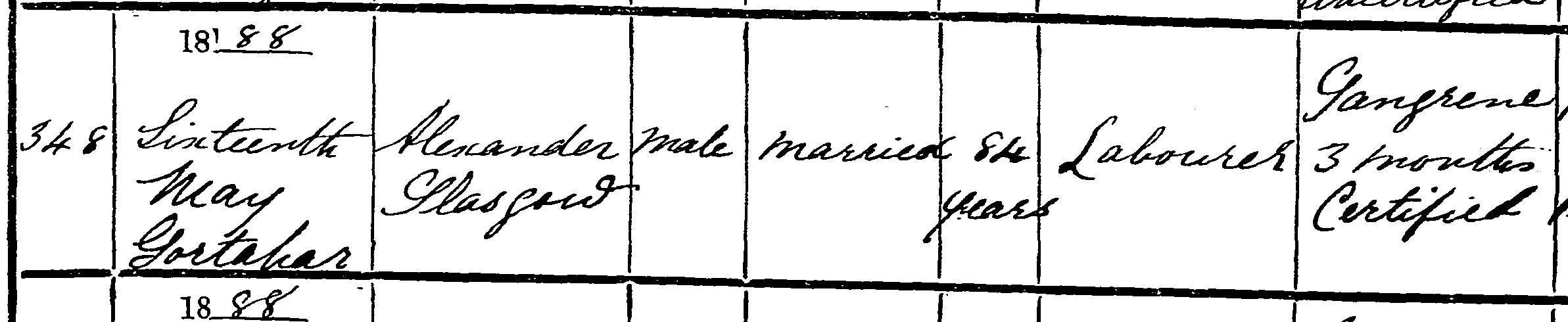
General Register Office of Ireland / IrishGenealogy.ie · Civil death register, Dirraw registrar’s district, Ballymoney union, Antrim, 1888, entry 348; image 4766466. · Full original record. Original pixels; reading guides are removable.
Reading
1888 / Sixteenth / May / Gortahar; Alexander / Glasgow; male; married; 84 years; Labourer; Gangrene / 3 months / Certified.
Why it matters
The entry gives the exact death date, 16 May 1888, and place Gortahar. Its age and occupation are reported record details. Identification with Alexander of Lisnagaver rests on the wider family evidence, including Ann’s 1876 father description and the Mary Elder connection.
Limits of this excerpt
The recorded age 84 implies birth about 1804, about seven years earlier than the 1851 age suggests. The death entry gives no wife’s name, birthplace, father or former Lisnagaver residence. The date is secure; attribution to Glasgow-951 remains a strong circumstantial identification.
The informant: Mary Glasgow, daughter, at Gortahar
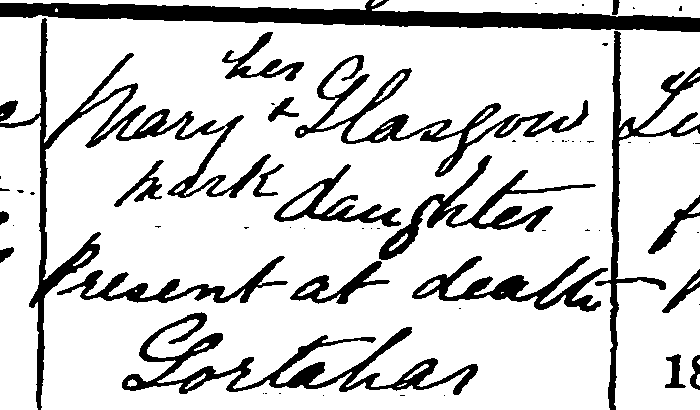
General Register Office of Ireland / IrishGenealogy.ie · Civil death register, Dirraw, Ballymoney union, 1888, entry 348; informant column for Alexander Glasgow; image 4766466. · Full original record. Original pixels; reading guides are removable.
Reading
Mary Glasgow, her + mark; daughter; present at death; Gortahar.
Why it matters
The register expressly identifies the informant as the deceased’s daughter, says she was present, and supplies Gortahar as her residence. These words are direct record evidence. The forename reads Mary: it matches the registrar’s “Mary” in entries 345, 330 and 358 and differs from his “Nancy” in entry 355. Alexander’s daughter Mary, by then Mrs Elder of Gortahar, is the natural candidate.
Limits of this excerpt
The forename was read as Mary on 24 August 2026, changed to Nancy on 13 September and corrected back to Mary on 6 October 2026 after comparison with the registrar’s other entries. The image is the registrar’s quarterly copy; the local register has not been viewed. The surname Glasgow is unexpected for a daughter married since 1871: a maiden-name entry, the wife Mary Glasgow with the relationship mis-entered, or the Mary Ellen Glasgow born in 1867 are the open readings. The “her mark” notation sits between the name lines and is preserved unchanged.
The informant’s forename is Mary. It was read as Mary on 24 August 2026, changed to Nancy on 13 September, and compared again on 6 October with the same registrar’s other entries. It matches his “Mary” in entry 345 on the same page (Mary Smith) and in entries 330 and 358 on the adjoining pages (Mary McCaw, Mary McFall), and differs from his “Nancy” in entry 355 (Nancy McKay): four letters ending “ary”, without the separate n and c of his Nancy. The online image is the registrar’s quarterly copy. The local register, held by GRONI, has not been viewed and would settle both the forename and the surname.
The identity chain, in dependency order
- The 1851 Lisnagaver house-35 return establishes Alexander and wife Mary, both reported aged 40, with children Robert, James and Ann. This is the starting household; its identity does not depend on either Gortahar death.
- Mary Glasgow’s 14 June 1871 marriage identifies a 28-year-old Lisnagaver spinster, daughter of Alexander Glasgow, farmer, marrying Robert Elder, 40, farmer of Gortereghy. It directly establishes the bride’s father. Linking that father to the established Lisnagaver household uses name, residence and occupation; the marriage does not name her mother.
- PRONI valuation revisions, VAL/12/B/4/16C–D, follow Alexander’s removal from Lisnagaver lot 25 and Robert Elder’s subsequent occupation. Succession to the particular holding strengthens the identification of Robert with the daughter’s husband. The book neither declares an inheritance nor records Alexander’s destination or exact death. It supplies a separate administrative connection, not another explicit statement of kinship.
- The 16 September 1878 birth of Jane Matilda Elder places Robert Elder and Mary, maiden surname Glass, at Gortahar. The spelling is retained as written. The parents and later household continuity support identification with the 1871 couple; the shortened surname alone would be insufficient.
- Mary Glasgow’s death on 17 February 1892, entry 234, records a widow aged 89 at Gortahar, with daughter Mary Elder present. That named relationship supplies the strongest connection between the elderly Glasgow woman and the Elder family. With the preceding marriage and household evidence, it supports the high-confidence identification of the widow as Mary McCaughan (McCaughan-222). It does not name her deceased husband.
- The 1888 death of a married Alexander Glasgow in the same townland fits the husband of that widow. This last step remains inferential: neither death expressly identifies the other deceased as spouse. The informant, Mary Glasgow, daughter, fits this family, although Alexander’s daughter Mary had been Mrs Elder since 1871.
A second Gortahar death four weeks earlier belongs to the same family circle. Entry 333 records James Anderson, widower and retired farmer, reported age 94, who died at Gortahar on 18 April 1888 with his son James present. He fits the husband of Elizabeth (Glasgow) Anderson (Glasgow-4071), Alexander’s probable sister, who died there in 1868. Alexander therefore spent his last years in the townland where his probable sister’s family had long lived. The entry names no Glasgow; it is context for the townland and does not itself identify Alexander.
The 1901 and 1911 Elder households strengthen the family continuation. They are not independent sightings of Alexander. Likewise, the two civil deaths cannot first be assumed to concern a married couple and then cited as independent proof of that assumption. Their combined value depends on the independently established Elder connection.
Ages and occupation: compatibility with genuine conflicts
| Person | 1851 reported age | Later death age | Approximate discrepancy |
|---|---|---|---|
| Alexander | 40, implying c.1811 | 84 in 1888, implying c.1804 | Seven years older than expected |
| Mary | 40, implying c.1811 | 89 in 1892, implying c.1803 | Eight years older than expected |
The two death ages describe near-contemporary people, as does the census, and both imply births several years earlier. This parallel is compatible with one elderly couple whose ages were reported differently across records. It does not prove shared identity: the informants may have had incomplete knowledge, the census ages may be inaccurate, or a namesake could be involved. Neither age should silently replace the maintained approximate birth estimate. The paired pattern becomes relevant only after the family connection has been established.
Alexander’s change from farmer to labourer is less problematic. Ann Glasgow’s 13 October 1876 marriage to Robert McCracken already calls her father Alexander a labourer. Thus the 1888 occupation is compatible with the known father twelve years earlier; it does not require a different man. Conversely, labourer is too common an occupation to identify him by itself.
The informant and the competing Alexander
The informant reads Mary Glasgow, daughter. Alexander’s daughter Mary (Glasgow-3167) lived at Gortahar and is the natural candidate. She had been Mrs Elder since 1871, and the same registrar entered her as “Mary Elder, daughter” at her mother’s death in 1892, so the surname Glasgow in 1888 needs explaining. Three readings are possible: the daughter was entered under her maiden surname; the informant was Alexander’s wife Mary Glasgow, who was living, and “daughter” is a slip for “wife”; or she was Mary Ellen Glasgow, born at Lisnagaver on 14 February 1867 to an unmarried Mary Glasgow, and “daughter” stands for a granddaughter. Each belongs to the Lisnagaver family. The earlier comparison with Ann (Glasgow-438), made while the forename was read as Nancy, is withdrawn.
Alexander of Glenleslie (Glasgow-2385) is a genuine competing labourer. His 1847 marriage to Mary Anne Martin and 1851 household distinguish a coherent family with wife Mary Ann and son John. A reported age of 35 in 1851 implies about 72 in 1888, twelve years below the death age. No located record connects this household to Gortahar or the Elder succession, or gives it a daughter Mary. He is weaker, not excluded.
The reported 1882 death of his wife is unverified. Her current WikiTree biography, checked through the live API, supplies no identifiable original death registration and includes an 1848 Sydney marriage description concerning Mary Ann Cupid. That material cannot establish the Irish wife’s death. Even a verified death would require checking remarriage before using the 1888 married status to exclude her husband.
Comparing the named candidates
| Candidate | Fit to the Gortahar death | Present assessment |
|---|---|---|
| Alexander of Lisnagaver, Glasgow-951 | Known family reaches Gortahar; father described as labourer by 1876; widow and daughter fit the Elder network | Best current fit; probable. The age conflict remains; the informant, read as Mary Glasgow, fits this family. |
| Alexander of Glenleslie (Glasgow-2385), born about 1816; husband of Mary Anne Martin | A real Antrim labourer namesake. He would have been about 72, a worse age fit to 84. No located Gortahar or Elder connection, or daughter Mary, identifies him with the death | Weaker alternative, not conclusively excluded. Trace his later household and wife independently before any reassignment. |
| Older Alexander (Glasgow-3904), estimated birth c.1770 in the parent tradition | Would have been about 118 in 1888; neither the reported generation nor family history fits | No plausible claim on present chronology. His own estimated identity is not an original death identification. |
Thomas’s daughter Nancy Glasgow (Glasgow-1362) was considered as the informant while the forename was read as Nancy. With the forename read as Mary, she is no longer a candidate.
The old 22 May 1852 death belongs to an unsupported Australian reconstruction of a different family. The submitted DNA-project ancestor label repeating “d.1852” is not a death record.
What would change the conclusion?
The local register original of entry 348, a record showing which Mary Glasgow lived at Gortahar in 1888, or a burial or notice naming the Gortahar man’s wife or former residence, would strengthen the leading identification. A securely identified death of Alexander-951 elsewhere, or an independently documented Glenleslie-to-Gortahar household with a daughter Mary, would challenge it. Tracing the Glenleslie son’s reported 1870 marriage offers a specific next step toward later family residence; that profile-derived lead still needs its original. Present evidence supports retaining 16 May 1888, Gortahar, probable identification, with the identity chain and its dependencies visible.
Original excerpts shown here were checked against the saved images. The Mary–Robert Elder 1871 marriage and Mary Glasgow 1892 death remain linked above and supported by the earlier maintained readings; both images were retrieved and read again on 6 October 2026 and agree with those readings; no excerpt has been cut from them.
DNA and the proposed Larne connection
Y-DNA: the connection and the competing histories
Alexander Glasgow (Glasgow-951) is the project owner’s oldest confirmed direct paternal ancestor. The documented descent reaches Alexander; his parents remain unknown. A tested male-line descendant has Big Y-700 placement R-FT20271, also found in a tested descendant of James J Glasgow (Glasgow-2738), born about 1809–10. These are historical ancestors represented by descendant results, not people who were themselves tested. The shared branch establishes paternal genetic kinship between the tested lines. It does not extend either documentary pedigree automatically. FamilyTreeDNA Glasgow project results, checked 13 September 2026.
This gives the parentage investigation a concrete family network. Alexander’s connection to James J’s line is established genetically even though the bridge between their families is missing. James J’s proposed father Robert Glasgow (Glasgow-2769) and proposed earlier connection to Archibald Glasgow (Glasgow-2304) remain hypotheses. Inserting them into a proved descent would assume the answer. See James J’s evidence and open parentage question.
What close STR matching can tell us
The maintained comparison gives genetic distance three at Y-111 between the Alexander and James J descendant lines. That makes their connection a valuable research priority. It does not mean three generations: STR changes accumulate unevenly, and observed distance is not the number of father-to-son transmissions. FTDNA’s explanation of genetic distance.
Another Glasgow line is closer on the larger callable Big Y STR comparison. Consequently James J is the nearest comparison on the specified Y-111 panel, not demonstrably Alexander’s nearest genealogical cousin. The inspected August 2026 Block Tree contains no exclusive named downstream branch joining only these two lines. Wider Y-DNA study and comparison evidence.
Brothers, paternal cousins and descendants of more distant collateral branches remain distinguishable historical hypotheses; the present DNA cannot choose among them. Their similar estimated birth years do not locate their common ancestor. A connection through an earlier generation, followed by migration in one branch, remains compatible with the results. A specific migration route is not established. An exact ancestor, date or cousin degree requires evidence connecting the named people, supported where possible by additional independent descendant comparisons.
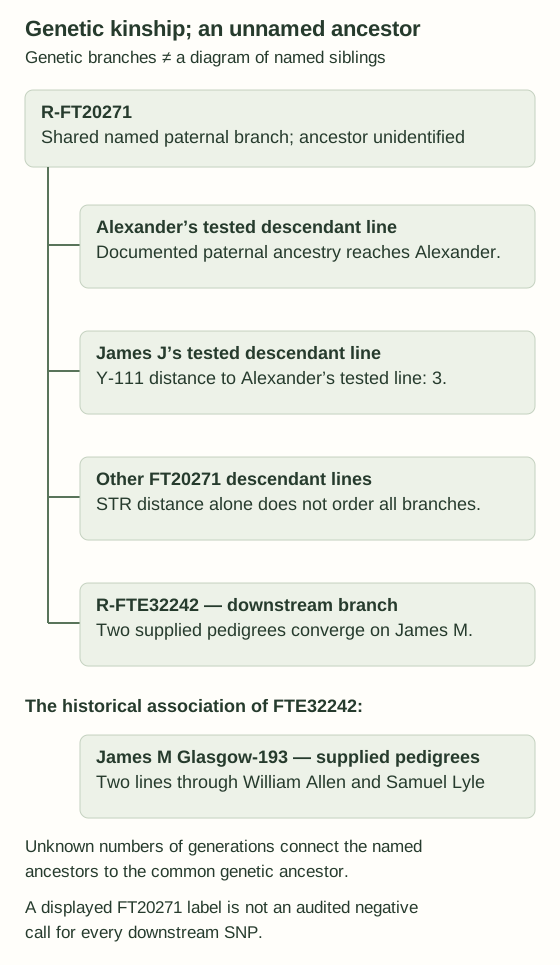
Genetic topology from the supplied August 2026 Block Tree and the public project. Historical associations depend on the stated descendant pedigrees; the unnamed genetic branch is not a named person.
The SNP evidence matrix
The abbreviated branch path is R-FT4811 → R-FT32941 → R-FT25406 → R-FT20271, with FTE32242 downstream. Historical names below label descendant lines, not tested historical people.
State key: D = derived, the changed state; A = ancestral, the pre-mutation state supported by a direct call; U = unresolved in the reviewed evidence; UT = untested at SNP level in the supplied comparison. A no-call means an attempted call was inconclusive and remains unresolved. Not independently reviewed describes the evidence or pedigree audit, not a genotype. No row is labelled no-call without evidence of an actual no-call.
| Historical paternal line | FT20271 | FT6135 | FTE32242 | Provenance and pedigree qualification |
|---|---|---|---|---|
| Alexander Glasgow (Glasgow-951) | D: direct audit and public placement | A: direct reliable call | U: basal display is insufficient to prove ancestral | Public project, 13 Sep 2026; private call audit, 11 Aug 2026. Established descendant line in this case; Alexander's parents remain unknown. |
| James J Glasgow (Glasgow-2738) | D: public placement | U: direct state not independently reviewed | U: basal display only | Public project, 13 Sep 2026; Aug administrator mapping. Descent to James J is distinguished from his uncertain attachment to Robert-2769 and Archibald-2304. |
| Reported William Glasgow (Glasgow-591), c.1655 | D: reported public placement | U | U: basal display only | Aug 2026 project evidence; early pedigree not independently established here. |
| Reported Robert Glasgow (Glasgow-12), through John M (Glasgow-1965) | D: reported public placement | D: supplied comparison | U: basal display only | Aug call comparison; maintained Y-DNA study maps this result through John M with a probable private continuation. This is a reported son-line of Robert, not an independently verified earlier root. |
| Reported Robert Glasgow, through William (Glasgow-563) | D: reported public placement | D: supplied comparison | U: basal display only | Aug call comparison; the maintained pedigree audit identifies William’s line. The older James c.1700 ancestor label is not an independent test of Robert’s father or grandfather. |
| James M Glasgow (Glasgow-193), through William Allen (Glasgow-2182) | D: upstream of displayed child | U: direct call required | D: public child-branch association | Aug 2026 project and Block Tree evidence; historical association conditional on the supplied father-to-son pedigree. |
| James M Glasgow, through Samuel Lyle (Glasgow-192) | D: upstream of displayed child | U: direct call required | D: public child-branch association | Same dated evidence; independently documented descent still needs checking at the relevant joining generations. |
| Reported Robert Glasgow of Kilwaughter (Glasgow-1143) | UT | UT | UT | Aug 2026 Y-111 comparison only. The ancestor label is a candidate identification; STR grouping does not establish FT20271 membership. |
| Reported James of Kilwaughter, later South Carolina (Glasgow-1144) | UT | UT | UT | Maintained historical mapping and Y-37 comparison, reviewed 13 Sep 2026. Public broad haplogroup/STR grouping does not establish FT20271. Audit the descendant path before assigning its result to this ancestor. |
| Reported John of Inishrush, later Ohio (Glasgow-822) | UT | UT | UT | Maintained historical mapping and Y-67 comparison, reviewed 13 Sep 2026. Public broad haplogroup/STR grouping does not establish FT20271. Audit the descendant path before assigning its result to this ancestor. |
Public source: FamilyTreeDNA Glasgow project. Safe study context: Y-DNA research. Private-call results above are a summary of the maintained August audit, not an independently reproducible public genotype dataset.
The maintained pedigree audit places the two FT6135 comparison results through Robert’s sons William and John M, with different confidence in their later continuations. The older James c.1700 label must not be counted as an independent test above Robert.
The FT6135 difference is real in the audited Alexander result and the two supplied comparison results. Its position outside the currently accepted child-branch display makes it a candidate grouping signal, not an established new branch. Resolve FT6135 in both James M son-lines first: derived results would support inheritance at or above Robert under the reported pedigrees and a simple inheritance model; ancestral results would contradict that simple model and require checking pedigrees, recurrence or reversion. Inadequate coverage would leave the issue open. Neither outcome alone identifies Alexander's father.
The two FTE32242-positive son-lines associate that branch with James M's descendants, conditionally on their pedigrees. To locate it below Robert generally requires a reliable ancestral result in a separately documented Robert line. A basal FT20271 label supplies no such result. Missing entries in a variants-only file likewise do not prove ancestral states. FTDNA SNP and match guidance.
For Alexander and James J, compare existing consented calls at named and private variants with coverage and pedigree checks. A shared additional derived state could refine their genetic grouping; it would not make the historical men brothers or identify the mutation's generation. A separately documented Alexander son-line could distinguish variants inherited through Alexander or earlier from changes arising later in one descendant line. STR distance and rounded private-variant averages reuse existing observations: they do not independently date the common ancestor. No narrow common-ancestor date is justified here.
One Robert-associated line and one James M descendant are identical at Y-111 despite different displayed SNP branches. STR similarity therefore cannot recover every branching event. The previous STR reconstruction’s approximate 1750 horizon also reuses marker evidence and has unconstrained dates conflicting with known genealogy; it is not an independent historical date.
The table is available as CSV and JSON, with its dated provenance and unresolved states. A public branch placement can be rechecked at the project; the private-call summary requires the underlying consented files for replication.
The Larne reconstruction connects these genetic comparisons to the actual American and Irish family hypotheses, with each missing generation assessed separately.
The Larne connection: a working family reconstruction
The Larne connection: a working family reconstruction
The Larne–Kilwaughter family remains a priority hypothesis for the origin of Alexander's wider paternal family, but the connection is indirect and no record makes it. Alexander's line shares the Y-DNA branch FT20271 with the line of James J, whose descent from the Kilwaughter family rests on two unproved generations, and the same branch also contains Scottish and Moneymore lines. It is not a father hypothesis: any Larne connection must join above John Glasgow, farmer, Alexander's probable father, and no record names John's father. The useful model connects an Irish branch with a branch that moved to South Carolina in the 1770s. Robert of Tennessee, born in South Carolina about 1790–94, is proposed as James J's father. He is not proposed as the father of Alexander, Thomas or Daniel. Their ages therefore supply no objection to that American parentage.
There are two questions to solve together: which older Larne household supplied the Irish branch, and how that branch could join John Glasgow, farmer, Alexander's probable father. James Glasgow of Larne (Glasgow-1509), reportedly born in 1737, is a concrete candidate for the earlier generation. Identifying him with Glasgow-3905 means testing whether he was Adam of Inishrush's father: 3905 represents that unidentified parental role, rather than a second man established by records. Its placeholder status neither supports nor disqualifies James.
The American branch has a coherent chronology
| Connection | Evidence and present assessment |
|---|---|
| Robert of Kilwaughter (1143) → James (1144), born 1731 | Directly named as father and son in the image-checked 1764 Ballykeel lease, alongside the congregation-register and Wilson inheritance evidence. The lease of 13 February 1738/9 independently associates Robert, wife Rachel and James junior; it does not itself call James a son. |
| James → Archibald (2304), about 1769–1818 | James's 1775 will and the 1817 equity complaint name Archibald among his children. This is a record-supported connection, not merely a tree attachment. |
| Archibald → Robert of Tennessee (2769) | A substantive missing-son hypothesis. The 1800 Newberry household contains one boy under ten. Archibald's monument-named son James was born about 1806 and cannot be that boy. Robert's early-1790s birth fits. |
| Robert → James J (2738), born about 1809/10 | Both report South Carolina origins; Robert's 1820 household has a boy aged 10–15, and James later has a documented Giles County land trail. No located record names Robert as James's father. |
The Kilwaughter chronology associates James's family with the 1772 Irish petition; his 1775 will places him in South Carolina. These fit the reported 1772/73 migration without proving an exact voyage. If Robert was James J's father, their South Carolina births followed by Robert's 1814 Tennessee militia service fit a later move within America. The Irish collateral branch can have remained in Ireland throughout.
The age fit is stronger when calculated properly. Robert's 1820 and 1840 brackets, combined with Archibald's under-ten boy in 1800, allow 5 August 1790–7 August 1794, if all three returns concern him and their age bands are accurate. His 1850 age of sixty requires a modest discrepancy; it favours the older end of the working range. That older end also gives a more comfortable fatherhood age for James J around 1809/10. The woman aged 16–25 in Archibald's 1800 household could have been about sixteen to twenty at an early-1790s birth if near the older end of her range. Her age is a constraint to check, not a general exclusion of the family. Census dates: 1800, 1820, 1840.
This makes Archibald a worthwhile leading named candidate for Robert's father. It does not make Robert the uniquely established father of James J. James Glasgow (2439), born about 1787, and Sarah form another age-compatible Newberry household. Its 1831 estate should be compared with Archibald's. Robert's Bradshaw Creek associates and James J's district-six land trail still need joining. The 1848 deed proves James's residence then; its recital of an 1845 title bond proves the earlier transaction, not necessarily residence in 1845.
James of Larne fits the missing older generation
James was a Belfast ropemaker when he took the 1760 Larne ropewalk lease. That gives the hypothesis a real adult and a property trail near Adam's estimated birth, rather than a name supplied only by a pedigree. The 1773 affidavit says he was over thirty. It supports the older James identity, although the especially good generational fit below depends on his reported 1737 birth.
| Person to compare with James's household | James's approximate age at the reported birth | Evidence for the proposed connection |
|---|---|---|
| Adam of Inishrush (3902), about 1758 | 21 | A normal father–son interval. Adam's monument names a son James, providing modest naming support. The full child order is unknown; James cannot be called Adam's first son. No record yet joins Adam to the ropemaker. |
| William (3324), about 1763 | 26 | The strongest existing child hypothesis: William's daughter Jane Shutter supplies distinctive support for descent from James and Janet Shutter. William's own household is established by the published monument. |
| John of Inishrush, later Ohio (822), 1767 | 30 | John and Adam have a substantial Inishrush family association and may be brothers. Making James their common father is an additional hypothesis; John's own naming sequence also supports an alternative older Adam. |
| Older Alexander (3904), estimated about 1770 | 33 | A coherent possible brother of Adam. His own existence and family are reconstructed principally from the later Thomas-parent tradition; no record names James as his father. |
| Younger James of Larne (3986), about 1773 | 36 | An already identified possible son, associated with the 1795 merchant and 1797 junior records. He was earlier considered as a possible father of Alexander; he is now only a weak rival to John Glasgow, farmer (see below). |
| Robert of Glenleslie (1367), about 1779 | 42 | Fits chronologically as another possible child in the broader reconstruction. No record makes him James's son, and he is not securely identified with the Lisnagaver tithe occupier. |
The 1762 marriage is the main household condition. It postdates Adam's estimated birth by about four years. If James fathered Adam, Adam could belong to an earlier relationship, a premarital birth, or a chronology needing correction. None is established. Janet Shutter must not acquire maternity merely because she was James's later reported wife. The original marriage and earlier Belfast records could distinguish these possibilities.
Nor does James have to move to Inishrush himself. His 1768 sale transferred the ropewalk interest, but Holmes's 1799 will still names a James Glasgow, roper, in Larne. An adult son could have moved independently. The ropemaker, the younger tanner James (3991), and the younger merchant must remain distinct record groups; selling a workshop is not evidence of a family migration by itself.
Possible Larne routes now run through John Glasgow, farmer
Alexander's probable father is John Glasgow, farmer, named as John-867's father in 1846 (see the parentage comparison). Any Larne connection must therefore join above John, not replace him. If Samuel (born about 1789 to 1791 by his 1851 census age and his age at death in 1875) was John farmer's son, as the 1851 "brother" entry implies, John farmer was born about 1770 or earlier. Every link above John is unproved.
| Route above John Glasgow, farmer | Links and how far each is supported | What would settle it |
|---|---|---|
| The present WikiTree attachment: Hugh-1499 → John-4179 of Larne, married 1769 → John, farmer (Glasgow-4090) | Hugh → John-4179: possible, on locality and generation only; the Larne monument does not name a son John. John-4179 → John, farmer: unresolved, with no record, and a son of a 1769 marriage would be barely twenty at Samuel's birth. On WikiTree this link carries no uncertain flag. | A Larne record of a son John, or a Rasharkin or Desertoghill record naming John farmer's father. |
| The ropemaker: James-1509 → John, farmer | Unresolved. James was born before 27 October 1743; nothing names a son John. Chronologically possible only. | The same. |
| William of Larne: William-1505 → John, farmer | Unresolved, with no record. The older version through John of Glenleslie (Glasgow-1022) needs John farmer to be that John, which is disfavoured: his 1851 household records a daughter Nancy who died in 1847 aged 36, while Nancy of Plattsburgh, Alexander's probable sister, lived to 1891. | John farmer's identity and father. |
| A County Londonderry origin: the 1796 Desertoghill John, or one of the two Hugh households at Tamlaght O'Crilly in 1740 → John, farmer | That the Desertoghill John is John, farmer, is possible: Samuel's reported Londonderry birth and the 1846 marriage at Garvagh fit, but the Desertoghill residence in the 1846 entry is the bride's. A Tamlaght Hugh as his father is unresolved, on parish-level locality only. | Identity and parentage records for John. |
The earlier routes through older Alexander-3904 and younger James-3986 are withdrawn as routes, because each puts a different father in John's place. Older Alexander and Rosanna remain a weaker rival parent hypothesis; Alexander-3904's birth about 1770 is only an estimate, so chronology does not decide whether he could be John farmer's father. James-3986, reported born about 1773, is too young to be John farmer's father if Samuel was John farmer's son, and barely possible even if John farmer need only be the father of John-867 and Alexander; he remains only a weak naming-based rival. Adam of Inishrush, born 1757/8, is too young to be John farmer's father if Samuel was John farmer's son; the comparison of the ropemaker with Adam is a collateral question.
Hugh, a recurring Larne forename (Hugh-1499, died 1767; the Hugh deceased by February 1843), occurs nowhere among John farmer's probable children or documented grandchildren, so naming gives the first route no support. The absence excludes nothing.
The earlier Adam → older Alexander route compresses the generations: Adam born about 1758 would be twelve at the older Alexander's estimated 1770 birth, while Rose born about 1767 would be three. Moving the older Alexander's birth later and proposing an earlier mother can make Adam's paternity biologically possible, but adds conditions unsupported by records. A brother or cousin relationship is the more natural version to investigate. This chronological preference does not itself prove their kinship.
Where the DNA and the wider catalogue narrow the search
The DNA evidence is positive family evidence. Alexander's established descendant line and James J's line share R-FT20271, are three steps apart at Y-111 and share DYS714=27. Alongside James J's South Carolina origin and the documented Kilwaughter emigrant family, that makes the Larne connection worth pursuing ahead of an arbitrary same-surname pedigree. The American household evidence was not derived from the DNA, so their agreement is meaningful. But the proposed links from James J to Robert and Archibald are the very links being tested: they cannot also be counted as an independent proof that the match descends from Archibald.
There are already two additional historical comparison routes in the public project: a reported Robert-1143 line tested at Y-111, and a reported John-822 line tested at Y-67. They place the Larne and Inishrush questions within the same broader STR research network. Their public broad haplogroup labels do not yet establish either as FT20271-positive. Auditing those descent paths and obtaining resolved SNP states would test the proposed geographic connection more directly than treating all current FT20271 matches as interchangeable. John's omission of Alexander from his family Bible weakens John as Alexander's father, not John as a collateral relative.
The proposed older Larne tree must also be tested. James-1509’s imported and live attachment is to William-1505, while the reviewed catalogue also carries a competing Hugh hypothesis. A William Glasgow, merchant of Larne, witnessed the 1760 lease; his identification with William-1505 needs checking against the other adult Williams. The derivative 1737 baptism names Hugh. Hugh-1503's monument names a different adult son James, born about 1747/48. Both cannot casually be treated as the same child; identifying both as surviving sons of one Hugh would need explanation. William and Hugh's 1736 joint tenancy establishes association, while the proposed connections from them and Robert-1143 to Robert-1502 remain unproved. This is the unsettled joining generation, rather than a reason to disregard the well-supported branches below it.
A second origin model remains useful: the two Hugh Glasgow householders recorded in Tamlaght O'Crilly in 1740, followed by a parish Hugh in 1772, could represent local continuity behind Adam. John's Bible gives sons Adam–James–John and second daughter Maria, suggesting older Adam and Maria under a conventional naming pattern. That pattern is not fully followed, and applying it to Adam-3902 depends on the unproved brotherhood. These are substantive local alternatives. They prevent treating a good Larne reconstruction as already the only surviving family.
The research can now be narrower: test Archibald's missing adult son in estate 647; test the Larne household through William-3324's surviving 1815 will, D300/1/5/49, the 1762 marriage and earlier Belfast records; identify Alexander's immediate family in CR5/32/1/1/1–2; and resolve the DNA placement of the specific Larne and Inishrush comparison lines. Each addresses a particular missing connection. The research priorities explain the outcomes to look for.
Larne-line assessment — reviewed 21 September 2026
The archived chronology reports John Glasgow's 1769 marriage to Rose Allan, now represented by Glasgow-4179. Its c.1745–48 birth estimate is not a baptism. Hugh-1503's memorial and the derivative child list do not name John; this supplies no positive father identification but does not establish an exclusion from an exhaustive family register. Inspect MIC/1B/6 and compare estate/deed succession.
The earlier proposed father–son bridge from this John to a second John born c.1760–70 is unsupported and chronologically awkward: most of the range precedes the 1769 marriage. Establish an actual child or same-person bridge rather than supply an intervening generation. The ropemaker James's parentage and the two James baptism identities remain qualified as in the household discussion above; a chronology's assignment does not resolve them.
The assertion that the two branches must split before 1669 is withdrawn. A reported c.1600 FT20271 estimate for the whole haplogroup does not date the common ancestor of a particular subset. Moreover, James J's links to Robert and Archibald are unproved, and the reported Robert-1143/James-1144 Larne comparison lines are SNP-unresolved in the maintained matrix. FamilyTreeDNA explains its estimate ranges. Neither an eighteenth-century connection nor an older common origin is established.
The 1796 Desertoghill John is a documented flax-premium recipient, but the father identification is unproved. The compiler's Antrim coverage is selected northern parishes and cannot exclude Larne/Kilwaughter. His two-wheel award records a premium, not an exclusive occupation or genealogical distance.
Priorities remain the original marriage/baptisms, William-3324's 1815 will D300/1/5/49, Killoquin rent roll D3209/1, and tested descent paths for the named Larne comparison lines. The PRONI pre-1858 Name Search remains relevant; the later Will Calendars cannot exhaust that earlier period.
John’s uncertain father and corrected marriage — 21 September 2026
John Glasgow of Larne (Glasgow-4179) is now attached to Hugh Glasgow (Glasgow-1499) as an uncertain son, with low confidence. This is a working hypothesis based on locality and generation, not a record naming his father. Older William (Glasgow-1505) remains viable. No mother is attached; Hugh's wife Ann is not thereby identified as John's mother.
The duplicate marriage has been resolved: Rose Allan (Allan-6611) is the wife of the Larne John, married in 1769 according to the archived Kilwaughter/Larne chronology. Allan-8249 now redirects to Allan-6611, the older ID required by WikiTree. Both Rose profiles cited the same marriage; neither supplied an independent Rose baptism. Her estimated birth about 1750 and inferred County Antrim birthplace remain uncertain. The chronology's 1745–48 birth estimate concerns John, not Rose.
John Glasgow of West Calder (Glasgow-2846), son of John Glasgow (Glasgow-2847) and Margaret Anderson, remains a separate identity. Rose has been detached from him. The 1747 Scottish baptism citation has not been re-inspected beyond the existing citation because FamilySearch requires sign-in. No inspected evidence joins that Scottish child to the Larne groom; this separation does not prove that they could never be the same man.
The original PRONI MIC/1B/6 marriage and baptism entries and the named lives in the 1751/1767 endorsements to lease D2977/3A/4/81/72A remain the tests for Hugh versus William. The Larne memorial, pp.47–48, does not name John and is not proved to enumerate every surviving child.
New original evidence — 21 September 2026
The 20 December 1764 Ballykeel lease, memorial 159661, explicitly names “Jas Glasgow son of the sd Robt” on its continuation. Robert of Ballykeel/Kilwaughter leased Hugh Shannon half the lower farm, about 31½ acres. Both original images were inspected. This directly strengthens Robert-1143 → James-1144; Robert's father and the connection to the 1653/1669 householders remain unproved. The third life is Elinor [surname unclear on the saved image; machine-read Jones] otherwise Agnew, the landlord's daughter.
| Further record | New finding and boundary |
|---|---|
| 1749 mortgage, memorial 97407 | Hugh Glasgow, Larne merchant, and Hugh Shutter jointly lent against Old Town property. Strong candidate Hugh-1499; no kin stated. This provides an earlier documented Glasgow–Shutter business connection. |
| 1874 deed reciting 1779 and 1832 leases | James Glasgow's 2 October 1779 Newtown lease was renewed to Anne and Jane Glasgow on 25 February 1832. Hugh Glasgow's former tenement bounded it on the west. Title succession is established; the James and women's profile identities and kinship remain unresolved. The monument wife Jane died 1820 and cannot automatically be the 1832 Jane. |
| 1784 lease, memorial 278037 | Image reads Tanner, strengthening James-3991's separate occupational sequence. Sworn 17 August, registered 23 August 1790. The collection label 1734–1736 is misleading for this image. |
| NRS GD154/514–515(c 1653), /525(c 1690), /530(Nov 1692), /532(1693–1708) | Exact tenant/rental records located; inspected item descriptions say Open / On site. Tenant names and original contents remain unread. These are targeted tests for the early generations, not new Glasgow occurrences. |
The next decisive steps are the Agnew tenant comparisons and the named lives/recitals in the 1736 lease renewals. William's 1815 copy will and Elizabeth's 1824 renewal remain unread. The Belfast captain's 1686 will date does not itself prove death; the 1669 Kilwaughter householder's continuity into 1726 also needs testing.
Other leads and search history
Mary Anne M‘Caughern witness in the John Glasgow family
At Finvoy Parish Church on 18 February 1875, Ann Glasgow, daughter of John Glasgow, married Francis Bellingham (marriage note). The witnesses were Thomas Bellingham and Mary Anne M‘Caughern. This is a useful record-level link between John’s Glasgow family and the McCaughern network around Lisnagaver.
The witness remains unidentified. The register says Mary Anne rather than Mary/Molly, uses a different surname spelling, and does not establish that Alexander’s wife was living in 1875. Other McCaughan/McAughern households existed locally. This supports a cautious network observation, not an identification of Mary Anne with Alexander’s wife or proof that Alexander and John were related.
The Black branch and Robert’s possible witness
The original 5 April 1866 marriage return for Robert Glasgow and Jane Graham names Robert’s father as Alexander Glasgow, farmer, and records John Black as a witness. The return gives no address or relationship, so the witness identity is not settled.
A specific candidate emerges from the Canadian deed research. The 13 March 1862 marriage return identifies John Black of Drumoolish as a full-age bachelor, farmer, son of Robert Black, farmer; Martha Savage, 20, was of Knockaduff and daughter of William Savage. The names, townland and farming context make this a strong identity anchor for the deed’s John and Martha.
The Churchtown baptism transcription records Elizabeth Black, 31 July 1845, daughter of Robert Black and Mary Glasgow, resident Drumoolish (page 7, entry 116; PRONI MIC 1P/347A/1). This supplies a named parental couple for the Black branch, but the original image remains unchecked and 31 July is a baptism date, not an established birth date. The same transcription has “Thomson Black,” 10 January 1843, with mother transcribed “Gear” and marked illegible; it must not be changed to Thomasina without the image.
The 1831 census transcription lists Robert Black at Drumolish, house 57, with two males and one female, but the occupants are unnamed and several Black households occur in the townland. The December 1862 report and 5 November 1863 baptisms support continuity for John and Martha’s family, although the reported 20 December birth and nine-month baptism age conflict.
Assessment: the 1866 witness is established; identifying him as the John Black, son of Robert Black and Mary Glasgow, is plausible but unproved. Even if confirmed, it would show contact with Alexander’s son, not shared parentage or brotherhood. Obtain the Elizabeth and 1843 baptism images, investigate Robert Black and Mary Glasgow’s marriage and household, and compare further Churchtown witness occurrences before drawing a kinship conclusion.
How the evidence supports this account
The account separates the recorded event, the identification of its people, and the conclusion drawn from it. A baptism can directly name a child’s parents while leaving the child’s later identity unknown. A death can have an exact date while remaining a probable match to Alexander. These are different questions and should carry different qualifications.
How the sources work together
| Source group | Information close to the event | Principal limitation | How it is used here |
|---|---|---|---|
| Rasharkin baptisms | Child, named parents, dates and family residence in the maintained transcription | This is a transcription of a register; the incomplete 1838 original has not been inspected | Establishes the early couple and children; missing transcription fields remain missing |
| 1851 original census | One household’s relationships, reported ages, occupations, literacy and marriage years | Birth ages and the 1836 marriage year are retrospective reports; this is not a list of every child ever born | Anchors the household and approximate birth chronology |
| Adult children’s marriages | Bride/groom, residence, spouse and named father | Usually does not name the mother; father details do not by themselves establish that he was alive | Bridges children into adult households using the combined name, place and family evidence |
| Tithe, valuation and revision records | Assessed occupier, holding, lessor and administrative changes | Different surveys, measures and effective dates; tenancy does not establish kinship or ownership | Tracks property associations and tests the Elder succession without inventing an inheritance |
| Civil deaths | Death date, place, reported age/status and informant | Age may be retrospective or uncertain; neither Gortahar death names the other spouse | Supports the death identification through the independently established family network |
| Later traditions, trees and correspondence | What a descendant or compiler reported and when | Copying may create apparent corroboration; an unsourced belief is not a second parent record | Preserves the origins of hypotheses and directs specific follow-up |
| Descendant DNA | Tested genetic relationships, with the panel and result specified | Linking a result to a historical ancestor depends on the descent; mutation evidence cannot fill every documentary gap | Establishes the paternal cluster and tests competing branch arrangements |
An index, a transcription and a tree quoting the same original do not provide three independent confirmations. The surname-project report, STR reconstruction and later discussion can likewise reuse the same genetic observations. Independent civil, church and land records are valuable because they offer different routes through the identity problem; even then, their logical dependencies must remain visible.
What an unsuccessful search means
Missing evidence is useful only when we know what should have been recorded and what survives. The unnamed 1838 child’s absence from all relevant parts of the household return has more bearing on a survival hypothesis than an unrestricted web search finding nothing. It still cannot establish a death date by itself. A gap in the baptism transcription, a register starting after the marriage, and an archive image requiring onsite access are three different limitations.
The research history records completed searches and the wider register of inaccessible originals and unresolved identities; the focused next tests appear below. The next work is prioritised by the proposition it could resolve, not by the number of databases left to search. No numerical parent score is treated as a probability or allowed to replace these source-based arguments.
The next records that could change the conclusions
Priority after the 29 September review: test independent sibling parent statements, beginning with the Mary Thomson–Sneddon indexed family and Ann McClelland's own death, and verify expected-versus-cited relatives. Nancy's petition and the docketed 1894 appraisal remain valuable if accessible; resolution is not dependent on correspondence. Reopen the pre-1858 probate route through PRONI Name Search; the later calendar is not an exhaustive test. Thomas's 1870 administration and the indexed Larne estates already contradict the blanket zero-result claim. Keep the existing specific record targets below.
The first task could distinguish the early Alexander identities directly. The American and Larne tests still address the wider family reconstruction. The Canadian deeds now establish the Irish sibling connection and identify the Rochester and Black families. Their earlier family records and unresolved title fractions form the next collateral tests.
| Question | Exact record or bounded target | Current status | Alternative outcomes and consequence |
|---|---|---|---|
| 1. What kind of 1829 Lisnagaver occurrence is this Alexander? | Check the corresponding freeholder registration records or session minutes for applicant 2324, Alex. Glasgow of Lisnagaver, after the inspected 5 June 1829 newspaper application. Seek age, qualification, occupation or another identifying detail; the newspaper itself states no age or kin. | Original inspected 3 October 2026: Belfast News-Letter, 5 June 1829, p.4; applicant 2324, Alex. Glasgow of Lisnagaver, with lands in Kilconway barony, townland of Lisnagaver. This is a freehold application, not proof of admission. No age or kin is stated; identity and the age discrepancy remain unresolved. | Age or qualification wording could distinguish the census-age man, the same man with an earlier birth, or an older namesake. No adulthood rule, freehold status or fatherhood follows from the snippet. |
| 2. Was Archibald’s missing son Robert of Tennessee? | Newberry estate index: Archibald, 1818 estate 647, box 27, package 57; adult distributions, receipts, releases and powers of attorney. Compare the 1810 Archald census, image 4433429_00206, and James-2439’s 1831 estate 1643, box 63, package 158. | Indexes located; no matching estate packet or 1810 household image found in the saved material reviewed. Estate 646 is a separate guardianship proceeding. | A named Robert in Tennessee, a kinship clause or a receipt identifying the missing boy could establish or redirect the American branch. An omitted adult in a guardianship list is not an exclusion. James-2439’s heirs test an alternative father for James J. |
| 3. Did the Inishrush family come from James of Larne? | William-3324’s surviving 1815 will, PRONI D300/1/5/49; MIC/1B/6, the reported 1762 James–Janet marriage and earlier baptisms; Belfast records before the 1760 ropewalk lease; Adam’s Inishrush tenancy in D1062/1/5 and the Vintners rentals. | Specific catalogue targets and existing source trails; will clauses, original marriage and relevant tenancy succession remain uninspected. | Look for named siblings, nephews, places, predecessors and any recorded prior marriage. An Adam of Inishrush or a Larne origin would bridge the branches. A different named father would redirect the hypothesis. Janet’s reported 1762 marriage must not supply maternity for Adam born about 1758. |
| 4. Who were Alexander and Mary’s parents? | Reported 1836 marriage in surviving First Kilraughts material, film 197; Ballymoney/Kilraughts family and society registers PRONI CR5/32/1/1/1–2 | Not inspected; the existing PRONI enquiry remains pending. Rasharkin’s surviving marriage register starts in 1845 | Named parents or an explicit family group could decide a candidate. Witness names supply leads, not automatic kinship. Failure in an incomplete or later-starting register cannot exclude the marriage. |
| 5. How do James’s Rochester family and the remaining title interests connect? | C114, 25 March 1868: Alexander Glasco, Rochester express agent, son of James the Prescott carpenter; compare B395/B601 daughters Eliza Jane and Mary, earlier parcel interests and the remaining family records. Separately resolve the Samuel 1875 and James E. 1900–09 estate-index rows. Follow Mary Glasgow Black’s identified children at Drumoolish, Newburgh and Legrand from C298. | Original B12/B13/B395/B465/B601 and C113/C114/C298 inspected. Irish Daniel and Thomas identified; Rochester Alexander’s identity with Alexander-951 unproved. Ninth and eighteenth interests remain unreconciled with the will’s sixth. | The named carpenter’s children provide a concrete family to reconstruct. Establish their earlier lives and title interests before equating their father with Robert’s brother or assigning James to Alexander-951. The abstract dates are not automatically execution dates. Mary Black’s documented branch offers a separate local route to the siblings’ parents. |
| 6. Can existing DNA distinguish the closest paternal branches? | Audit the existing reported Robert-1143 (Y-111), James-1144 (Y-37) and John-822 (Y-67) descendant paths and whether further SNP results already exist. Compare consented James J calls and coverage with Alexander’s line; retain the FT6135/FTE32242 comparison in the Robert-12 family. | The matrix identifies direct calls, displayed placements and unresolved states | Resolved SNP states in these particular Larne and Inishrush lines test the proposed branch connections. A matching downstream state could strengthen a narrower grouping; differing states require mutation placement and pedigree review. A broad STR group or an absent variant-list entry is not a negative SNP call. Establish the useful historical split before proposing a new paid test. |
| 7. Which Alexander died, and which Mary reported it? | Original John Martin Glascow–Mary Gibson marriage, 10 November 1870, reported index; view the local register original of death entry 348 (GRONI) and trace Mary Ellen Glasgow, born at Lisnagaver on 14 February 1867 | The marriage remains a profile-derived lead; original access blocked. The informant’s forename was corrected from Nancy to Mary on 6 October 2026, which fits the Lisnagaver family. Ignore the copied contradictory Coleraine/County Offaly location. | A compatible father Alexander and Glenleslie context would locate the rival’s later family. The local original would show whether the informant was entered as Glasgow or Elder; a daughter Mary in the Glenleslie family would reopen the comparison. Neither a common name nor an unmarked father-deceased field proves identity or survival. Verify Mary Ann Martin’s alleged 1882 death and any remarriage before using marital status to exclude her husband. |
| 8. Does Scottish Robert belong to the Irish couple? | James’s 10 July 1869 birth, film 008065881 image 256; corroborate with Agnes’s 19 August 1875 birth, film 008066640 image 244 | Exact image references recovered; access blocked, originals unread | Read the parents’ marriage date/place: agreement with 5 April 1866 supplies a much stronger identity bridge than parental names alone. A conflicting marriage requires a namesake review; a blank field leaves the bridge open. Two siblings may repeat the same parents’ report. Then verify the copied 1871/1881/1891 households against all family members. |
| 9. Does Robert’s death name Alexander and Mary? | Alleged 27 November 1902 death; Camlachie 644/2/849 | Citation is misplaced beneath daughter Mary in the copied brief; verify the subject first | Matching parents and wife Jane Graham would strengthen the Scottish bridge and add later family testimony. Different parents need reconciliation. A deceased-father statement would set an upper boundary, not identify the 1888 death. |
| 10. What does the original 1838 baptism say? | Rasharkin Presbyterian MIC1P/292, entry 106, with neighbouring entries | Named transcription incomplete; original not inspected | A readable name and dates would identify the documented child more precisely. Marginal wording may help; no invented name or exact death follows from a blank or damaged entry. |
An access failure leaves a record uninspected; it is not a negative search. Completed searches remain in the research history. The ScotlandsPeople birth-register guide explains the marriage fields sought in the Scottish births, without establishing what these unread entries contain.
Free newspaper search ledger · 30 September 2026
Sources and coverage
- News4Clues: New York links to HRVH Historical Newspapers. Its county browser lists Columbia, Dutchess, Greene, Orange, Putnam, Rockland, Ulster and Westchester. Clinton County/Plattsburgh and Monroe County/Rochester are outside that displayed coverage. Searches could nevertheless find reprinted notices.
- News4Clues: Michigan links to Sandusky District Library genealogy and its DigitalTotes collection. The collection identifies itself as Sandusky, Sanilac County, Michigan. Searches below cover its entire searchable collection, including cemetery entries, histories and obituaries, with no date restriction. This is not a comprehensive Tecumseh/Lenawee County newspaper collection.
HRVH searches
All publications; full text. Quotation marks request an exact phrase; AND
requires both terms; ~5 allows words within five positions, according to the
collection's search help.
| Query | Dates | Observed result / inspection |
|---|---|---|
"Nancy Glasgow" |
All dates | 0 |
"Nancy Glascow" |
All dates | 0 |
"Nancy Glasco" |
All dates | 0 |
"Nancy Glascoe" |
All dates | 0 |
Nancy AND Glasgow |
All dates | 378; first 20 result snippets reviewed |
Nancy AND Glasgow |
1850–1900 | 20; all 20 result snippets reviewed; no family match established |
Nancy AND Glascow |
All dates | 3; snippets dated 1982, 1993 and 1999; no historical family match established |
"Nancy Glasgow"~5 |
1850–1900 | 0 |
"Alexander Glasgow" |
1810–1900 | 0; also initially checked over 1850–1900 |
"Alexander Glasco" |
1810–1900 | 0; also initially checked over 1850–1900 |
"John Glasgow" |
1810–1900 | 0 |
"Ann Glasgow" |
1810–1900 | 0 |
The broad Nancy results included fiction, other Nancys and references to Glasgow as a place. Reviewing snippets does not exclude every possible occurrence on the underlying pages. None of these HRVH results was adopted as genealogical evidence. The collection's help warns that its searchable OCR can contain errors.
Sandusky searches
| Query | Search mode | Observed result / inspection |
|---|---|---|
Glasgow |
Words close together | 320 items; first 15 catalogue entries reviewed |
James Glasgow |
All words | 246 items; first 15 catalogue entries reviewed; separate words on an issue do not identify a person |
James Glasgow |
Exact phrase | 1 item: Sanilac County Press, 4 August 1966; original viewer opened, relevant wording unread |
Minnie Boland |
All words | 95 items; first 15 issue titles reviewed |
Minnie Boland |
Exact phrase | 0 |
Minnie Glasgow |
Exact phrase | 0 |
Glascow |
All words | 9 items; all displayed titles reviewed; one cemetery entry opened |
The opened Alex Glascow cemetery entry gives Lakeside Cemetery, Port Huron,
St Clair County, section F; DOB 9/6/1842, DOD 10/28/1915. Those dates are
reported exactly as displayed. This man cannot be Alexander-951 or the
c.1807 Canadian Alexander. The repeated title in the results did not provide an
independent family identification. Record identifier:
bfcde6e6-c692-4011-b87a-adc61846d131, collection tote
5524c4b6-602f-4732-8b31-6a3285eed301.
The 1966 newspaper hit remains an uninspected lead, not a rejected match.
The viewer showed no readable page; direct image viewing and the browser's
asset export did not yield a usable image. Its issue identifier is
bc793c16-f3ad-4a9c-b942-79fad8d8bc69, tote
897f97b8-e88e-4c4d-b452-a136042dfcad. A late issue can contain historical
material, so its date alone does not exclude relevance. A James Glascow
exact-phrase attempt was also submitted, but its completed result was not
captured; it is not counted as a negative search.
Consequence and remaining work
The new collections are useful supplementary routes, but their coverage does not close the principal Plattsburgh, Rochester or Tecumseh searches. No identity or parentage confidence changes. The existing 1891 Plattsburgh notice and 1896 Tecumseh report remain the relevant located newspaper evidence. Nancy's estate and independent sibling parent statements remain stronger tests of Alexander's parentage. No correspondence or live WikiTree edit was made.
Y-DNA testing recommendation — 6 October 2026
Private family details withheld.
1. First, at no cost. Through the project administrator, and with the testers' consent, obtain:
Private family details withheld.
Confirm that each tester is willing to upgrade and that a usable sample is held.
Private family details withheld.
3. Reading the outcomes, assuming the testers' reported pedigrees are correct (a disagreement between the two kits points first to a pedigree break):
Private family details withheld.
Private family details withheld.
The public-page placements cited here are summarised readings of 6 October 2026 and should be confirmed on the project page before ordering.