Individual research record
Alexander Glasgow
1811 – after 1861
Glasgow-951 · 7 mapped associations
At a glance
Identity & family
Tree links organise the family; documentary status still varies.
- Birth
- 1811 · County Antrim, Ireland, United Kingdom
- Death
- after 1861 · Glasgow, Lanarkshire, Scotland, United Kingdom
- Parents
- Alexander Glasgowuncertain
- Spouses
- Mary (McCaughan) Glasgow
- Children
- Anna GlasgowJames GlasgowJames GlasgowMary Ann (Glasgow) ElderRobert GlasgowUnknown Glasgow
- Gender
- Male
- WikiTree
- Glasgow-951
- Research clusters
- Descendants of Alexander Glasgow (c.1811) Descendants of Unknown Glasgow (before 1740) Unplaced South African Glasgow records
- Mapped descendants
- 75
Comparison context
These child positions and checks are the subject details used to rank possible parents below.
Naming sequence used by the parentage model
Known-position checks: 0 support · 1 conflict. Ordinals retain unnamed children and recognise reused names.
Estimate and relationship notes
- The export reports 4 children but 6 named child profiles are recoverable from this export.
Relationship comparison
Potential parents or duplicates
Compare scored leads with the subject details above—not proof.
Possible fathers5 leads
Possible Father
Samuel GlasgowGlasgow-2908
- plausible 20-year parent-child age gap (+18)
- same specific indexed locality despite wider place-label differences: lisnagaver townland (+10)
- 3 independent unlinked-profile clue types converge (+5): household chronology, locality, naming
a different linked father is explicitly uncertain (−6; an existing hypothesis still needs resolving); the subject's current profile explicitly says its birth details are unproved (score capped at 39)
Show complete scoring
- plausible 20-year parent-child age gap (+18)
- candidate's birth is 43 years before the subject's earliest dated child (1834), a compatible grandparent-generation interval (+4)
- same specific indexed locality despite wider place-label differences: lisnagaver townland (+10)
- same research cluster (+0; grouping is not kinship evidence)
- candidate's sibling and niece/nephew network repeats names in the subject's descendant line (three rarest at most): Ellen +8 (16 public profiles; sibling Ellen Glasgow); Alexander +3 (59 public profiles; niece/nephew Alexander Glasgow); Andrew +3 (31 public profiles; sibling Andrew Glasgow) (+14 total)
- 3 independent unlinked-profile clue types converge (+5): household chronology, locality, naming
Deductions and cautions: a different linked father is explicitly uncertain (−6; an existing hypothesis still needs resolving); the subject's current profile explicitly says its birth details are unproved (score capped at 39)
Possible Father
John GlasgowGlasgow-209
- plausible 31-year parent-child age gap (+18)
- known spouse Peninnah (Thomas) Glasgow had a plausible maternal age (33) at the subject's birth (+7)
- 3 independent unlinked-profile clue types converge (+5): household chronology, locality, naming
a different linked father is explicitly uncertain (−6; an existing hypothesis still needs resolving); the subject's current profile explicitly says its birth details are unproved (score capped at 39)
Show complete scoring
- plausible 31-year parent-child age gap (+18)
- candidate's birth is 54 years before the subject's earliest dated child (1834), a compatible grandparent-generation interval (+4)
- mapped Portglenone — regional family-tradition reference is 7.3 km from the subject's birth-period Gortereghy townland (+2; one or both placements are unproved)
- subject's birth fits between children attributed to the same parental couple (1807–1821) (+6; other parent Peninnah (Thomas) Glasgow)
- known spouse Peninnah (Thomas) Glasgow had a plausible maternal age (33) at the subject's birth (+7)
- candidate's sibling and niece/nephew network repeats names in the subject's descendant line (three rarest at most): Jane +5 (71 public profiles; niece/nephew Jane Glasgow; +2 repetition bonus); Alexander +3 (59 public profiles; sibling Alexander Glasgow) (+8 total)
- 3 independent unlinked-profile clue types converge (+5): household chronology, locality, naming
Deductions and cautions: a different linked father is explicitly uncertain (−6; an existing hypothesis still needs resolving); the subject's current profile explicitly says its birth details are unproved (score capped at 39)
Show 3 lower-scoring possible fathers
Possible Father
John GlasgowGlasgow-1657
- plausible 45-year parent-child age gap (+18)
- 3 independent unlinked-profile clue types converge (+5): household chronology, locality, naming
- candidate's birth is 68 years before the subject's earliest dated child (1834), a compatible grandparent-generation interval (+4)
a different linked father is explicitly uncertain (−6; an existing hypothesis still needs resolving); the subject's current profile explicitly says its birth details are unproved (score capped at 39)
Show complete scoring
- plausible 45-year parent-child age gap (+18)
- candidate's birth is 68 years before the subject's earliest dated child (1834), a compatible grandparent-generation interval (+4)
- mapped Cross townland, Ballymoney parish is 10.4 km from the subject's birth-period Lisnagaver townland (+2; one or both placements are unproved)
- subject's birth fits between children attributed to the same parental couple (1799–1815) (+6; other parent Jane (McClure) Glasgow)
- known spouse Jane (McClure) Glasgow had a bounded, possibly plausible maternal age (38) at the subject's birth (+3)
- uncommon given names recur in both otherwise distinct descendant branches: Jane +9 (71 public profiles; subject branch: Jane Graham (Glasgow) Reid, Jane Graham Glasgow; candidate branch: Jane (Glasgow) Adams, Jane Glasgow Armstrong; +6 repetition bonus) (+9 total)
- 3 independent unlinked-profile clue types converge (+5): household chronology, locality, naming
Deductions and cautions: a different linked father is explicitly uncertain (−6; an existing hypothesis still needs resolving); the subject's current profile explicitly says its birth details are unproved (score capped at 39)
Possible Father
William GlasgowGlasgow-2915
- possible 51-year parent-child age gap (+10)
- candidate's birth is 74 years before the subject's earliest dated child (1834), a compatible grandparent-generation interval (+4)
- subject's birth fits within the candidate's overall child-bearing span (1799–1815) (+3; children are not tied to one spouse)
a different linked father is explicitly uncertain (−6; an existing hypothesis still needs resolving); same country, but no indexed locality overlap (−10); descendant-name recurrence has no independent household, record, migration or specific-locality anchor (score capped at 39); the subject's current profile explicitly says its birth details are unproved (score capped at 39)
Show complete scoring
- possible 51-year parent-child age gap (+10)
- candidate's birth is 74 years before the subject's earliest dated child (1834), a compatible grandparent-generation interval (+4)
- subject's birth fits within the candidate's overall child-bearing span (1799–1815) (+3; children are not tied to one spouse)
- uncommon given names recur in both otherwise distinct descendant branches: Minnie +12 (9 public profiles; subject branch: Minnie Glasgow; candidate branch: Minnie Glasgow); Alexander +9 (59 public profiles; subject branch: Alexander Glasgow, Alexander Glasgow; candidate branch: Alexander Glasgow, Alexander Glasgow; +6 repetition bonus); Jane +9 (71 public profiles; subject branch: Jane Graham (Glasgow) Reid, Jane Graham Glasgow; candidate branch: Jane Glasgow, Jane Glasgow; +6 repetition bonus) (+38 total including +8 multi-name bonus)
- descendant branches share only a broad migration destination country (+1; weak alone): united states
Deductions and cautions: a different linked father is explicitly uncertain (−6; an existing hypothesis still needs resolving); same country, but no indexed locality overlap (−10); descendant-name recurrence has no independent household, record, migration or specific-locality anchor (score capped at 39); the subject's current profile explicitly says its birth details are unproved (score capped at 39)
Possible Father
John GlasgowGlasgow-1022
- 3 independent unlinked-profile clue types converge (+5): household chronology, locality, naming
- candidate's birth is 83 years before the subject's earliest dated child (1834), a compatible grandparent-generation interval (+4)
- less typical 60-year parent-child age gap (+2)
a different linked father is explicitly uncertain (−6; an existing hypothesis still needs resolving); descendant-name recurrence has no independent household, record, migration or specific-locality anchor (score capped at 39); the subject's current profile explicitly says its birth details are unproved (score capped at 39)
Show complete scoring
- less typical 60-year parent-child age gap (+2)
- candidate's birth is 83 years before the subject's earliest dated child (1834), a compatible grandparent-generation interval (+4)
- mapped Glenleslie townland is 9.4 km from the subject's birth-period Lisnagaver townland (+2; one or both placements are unproved)
- subject's birth fits within the candidate's overall child-bearing span (1779–1825) (+3; children are not tied to one spouse)
- uncommon given names recur in both otherwise distinct descendant branches: Jane +9 (71 public profiles; subject branch: Jane Graham (Glasgow) Reid, Jane Graham Glasgow; candidate branch: Jane Glasgow, Jane Glasgow; +6 repetition bonus); Ellen +8 (16 public profiles; subject branch: Ellen Jane (Glasgow) Barr; candidate branch: Ellen Glasgow); Alexander +7 (59 public profiles; subject branch: Alexander Glasgow, Alexander Glasgow; candidate branch: Alexander Glasgow; +4 repetition bonus) (+32 total including +8 multi-name bonus)
- descendant branches share only a broad migration destination country (+1; weak alone): scotland, united states
- 3 independent unlinked-profile clue types converge (+5): household chronology, locality, naming
Deductions and cautions: a different linked father is explicitly uncertain (−6; an existing hypothesis still needs resolving); descendant-name recurrence has no independent household, record, migration or specific-locality anchor (score capped at 39); the subject's current profile explicitly says its birth details are unproved (score capped at 39)
Possible mothers5 leads
Possible Mother
Catherine (Unknown) GlasgowUnknown-540856
- plausible 28-year parent-child age gap (+18)
- candidate's birth is 51 years before the subject's earliest dated child (1834), a compatible grandparent-generation interval (+4)
- subject's birth fits between children attributed to the same parental couple (1801–1822) (+6; other parent Robert Glasco)
same country, but no indexed locality overlap (−10); the subject's current profile explicitly says its birth details are unproved (score capped at 39)
Show complete scoring
- plausible 28-year parent-child age gap (+18)
- candidate's birth is 51 years before the subject's earliest dated child (1834), a compatible grandparent-generation interval (+4)
- subject's birth fits between children attributed to the same parental couple (1801–1822) (+6; other parent Robert Glasco)
- uncommon given names recur in both otherwise distinct descendant branches: Alexander +7 (59 public profiles; subject branch: Alexander Glasgow, Alexander Glasgow; candidate branch: Alexander Glasgow; +4 repetition bonus); Jane +7 (71 public profiles; subject branch: Jane Graham (Glasgow) Reid, Jane Graham Glasgow; candidate branch: Jane Glasgow, Jane Glasgow; +4 repetition bonus); Agnes +5 (46 public profiles; subject branch: Agnes Glasgow, Agnes Glasgow; candidate branch: Agnes May Glasgow; +2 repetition bonus) (+27 total including +8 multi-name bonus)
- descendant branches share only a broad migration destination country (+1; weak alone): scotland, united states
Deductions and cautions: same country, but no indexed locality overlap (−10); the subject's current profile explicitly says its birth details are unproved (score capped at 39)
Possible Mother
Rosanna UnknownUnknown-761034
- candidate is already linked as parent of 2 exact subject sibling profiles (+20): Daniel Glasgow, Thomas Glasgow
- candidate's birth is 56 years before the subject's earliest dated child (1834), a compatible grandparent-generation interval (+4)
- candidate is the spouse of the linked opposite-sex parent (+8; tree couple clue)
the subject's current profile explicitly says its birth details are unproved (score capped at 39)
Show complete scoring
- candidate is the spouse of the linked opposite-sex parent (+8; tree couple clue)
- bounded birth date gives a parent-child age gap of at least 33 years (+10; true age remains uncertain)
- candidate's birth is 56 years before the subject's earliest dated child (1834), a compatible grandparent-generation interval (+4)
- mapped Killoquin electoral division is 1.6 km from the subject's birth-period Lisnagaver townland (+3; one or both placements are unproved)
- same research cluster (+0; grouping is not kinship evidence)
- subject's birth fits between children attributed to the same parental couple (1796–1815) (+6; other parent Older Alexander Glasgow)
- candidate is already linked as parent of 2 exact subject sibling profiles (+20): Daniel Glasgow, Thomas Glasgow
- the candidate and the subject's linked father Older Alexander Glasgow are jointly recorded as parents of 2 exact sibling profiles (+14; strong couple-structure clue)
Deductions and cautions: the subject's current profile explicitly says its birth details are unproved (score capped at 39)
Show 3 lower-scoring possible mothers
Possible Mother
Jane (McClure) GlasgowMcClure-6341
- plausible 38-year parent-child age gap (+18)
- candidate's birth is 61 years before the subject's earliest dated child (1834), a compatible grandparent-generation interval (+4)
- weak broad-area overlap: antrim (+1; not a locality match)
the subject's current profile explicitly says its birth details are unproved (score capped at 39)
Show complete scoring
- plausible 38-year parent-child age gap (+18)
- candidate's birth is 61 years before the subject's earliest dated child (1834), a compatible grandparent-generation interval (+4)
- weak broad-area overlap: antrim (+1; not a locality match)
- subject's birth fits between children attributed to the same parental couple (1799–1815) (+6; other parent John Glasgow)
- uncommon given names recur in both otherwise distinct descendant branches: Jane +9 (71 public profiles; subject branch: Jane Graham (Glasgow) Reid, Jane Graham Glasgow; candidate branch: Jane (Glasgow) Adams, Jane Glasgow Armstrong; +6 repetition bonus) (+9 total)
Deductions and cautions: the subject's current profile explicitly says its birth details are unproved (score capped at 39)
Possible Mother
Nancy Glasgow CunninghamGlasgow-543
- plausible 25-year parent-child age gap (+18)
- 3 independent unlinked-profile clue types converge (+5): household chronology, locality, naming
- candidate's birth is 48 years before the subject's earliest dated child (1834), a compatible grandparent-generation interval (+4)
the subject's current profile explicitly says its birth details are unproved (score capped at 39)
Show complete scoring
- plausible 25-year parent-child age gap (+18)
- candidate's birth is 48 years before the subject's earliest dated child (1834), a compatible grandparent-generation interval (+4)
- mapped Portglenone — regional family-tradition reference is 7.3 km from the subject's birth-period Gortereghy townland (+2; one or both placements are unproved)
- candidate's sibling and niece/nephew network repeats names in the subject's descendant line (three rarest at most): Jane +5 (71 public profiles; niece/nephew Jane Glasgow; +2 repetition bonus); Alexander +3 (59 public profiles; sibling Alexander Glasgow) (+8 total)
- 3 independent unlinked-profile clue types converge (+5): household chronology, locality, naming
Deductions and cautions: the subject's current profile explicitly says its birth details are unproved (score capped at 39)
Possible Mother
Eliza GlasgowGlasgow-3906
- plausible 21-year parent-child age gap (+18)
- the same sex-aware parent-name position recurs independently in sibling households: Thomas Glasgow → Eliza Glasgow (+9)
- candidate's birth is 44 years before the subject's earliest dated child (1834), a compatible grandparent-generation interval (+4)
the subject's current profile explicitly says its birth details are unproved (score capped at 39)
Show complete scoring
- plausible 21-year parent-child age gap (+18)
- candidate's birth is 44 years before the subject's earliest dated child (1834), a compatible grandparent-generation interval (+4)
- mapped St Nossonus — Tamlaght O'Crilly Lower graveyard is 7.2 km from the subject's birth-period Gortereghy townland (+2; one or both placements are unproved)
- same research cluster (+0; grouping is not kinship evidence)
- the same sex-aware parent-name position recurs independently in sibling households: Thomas Glasgow → Eliza Glasgow (+9)
Deductions and cautions: the subject's current profile explicitly says its birth details are unproved (score capped at 39)
How parent leads are calculated
Automated leads use birth surnames—not married surnames—as parental eligibility, role-specific biological age limits, bounded and approximate-date uncertainty, household chronology, specific time-aware localities, mapped distance, tenancy succession, migration destinations and sex-aware Scottish naming positions across generations. People already attached as the subject's parents stay in the identity summary and are excluded from this alternative-candidate list, regardless of relationship confidence. The main calibration uses clues available on disconnected profiles; existing parent and sibling links are retained as comparison context rather than treated as transferable evidence. Common ordered names and grandparent-to-child echoes receive a small non-zero weight, so a John or James match can support several independent criteria without producing a lead alone. Rare names, repeated bearers and bundles across otherwise distinct branches receive substantially more weight according to catalogue frequency. An exact migration place is weighted by its rarity and repetition across both branches; a shared destination country is worth only one point. Extra weight is added only when at least three independent clue types converge: naming, locality, specific migration, household chronology or collateral networks. Sparse profiles retain a clearly labelled chronology-only fallback instead of disappearing. Countries, states, counties and research clusters do not count as a shared locality, and fallback, broad representative or kin-inferred coordinates are excluded from distance scoring. Shared descendant profiles are removed before branch-name comparison. A candidate already recorded as a parent-in-law is excluded. A confident or independently supported parent is treated as settled; uncertain and unassessed attachments remain open to alternative comparison. A different linked parent, an uncle/aunt or grandparent path, and a matching existing child profile prevent an alternative from being classified as a strong direct-parent lead until the underlying tree conflict or duplicate is resolved. Familiar forms such as Bessie are normalised. Surname remains an eligibility filter worth zero points.
Naming customs, shared farms and occupations are circumstantial. Children, spouses and collateral relatives may be missing, and tree-derived family networks are not independent evidence. Scores rank research leads; they do not prove parentage.
Same-name candidate
Alexander GlasgowGlasgow-3506
- same first and last name (+18)
- birth years within 6 (+10)
- shared recorded place (+20)
No indexed conflict
Full comparison detail
- same first and last name (+18)
- birth years within 6 (+10)
- shared recorded place (+20)
Conflicts: No indexed conflict
Same-name candidate
Alexander GlasgowGlasgow-2822
- same first and last name (+18)
- birth years within 2 (+25)
- overlapping locality (+8)
unassessed father attachments differ (−5)
Full comparison detail
- same first and last name (+18)
- birth years within 2 (+25)
- overlapping locality (+8)
- child given-name pattern overlaps: Mary
Conflicts: unassessed father attachments differ (−5)
How duplicate leads are calculated
Dates are eligibility gates, not merely deductions: chronologically impossible people are excluded. Dates, places, spouses, parent certainty and children's profiles and names are then compared. A high score is a prompt to inspect records, not a merge recommendation.
Open only what you need
Research & records
Latest case researchThe current conclusion from the durable research case file.Updated
Current conclusion
New gap audit and searches, 18 August 2026
No new record proves Alexander's parents. The older Alexander/Rosanna model remains the leading specific hypothesis, and the probable Alexander-Thomas relationship remains unchanged. The useful result of this pass is a sharper division between sources already exhausted, sources already requested, and record groups that have not yet been searched.
#### Newly identified direct-parentage source, 19 August 2026
A fresh audit of the full PRONI church guide and live eCatalogue found a record group missing from the earlier target list: Ballymoney/Dervock/Kilraughts Reformed Presbyterian register, `CR5/32/1/1/1-2`, 1804-1844. The catalogue's full description says it contains lists of members by society for Dervock and Kilraughts, with baptisms, marriages, deaths and removals including emigration; Kilraughts coverage runs to about 1831. An Ulster Historical Foundation account describes the same volume as containing almost annual congregational censuses.
This is now the single best direct-parentage source. It spans Alexander's circa 1811 birth and Rosanna's reported 23 October 1822 death, and its family-group lists may show Alexander with a father even if no baptism survives. It could also test whether clockmaker Daniel and Thomas belonged to the same parental household. PRONI marks the original CR5/32/1/1/1 On-Site Only. The open archival copy CR5/32/1/1/2 has no remote digital-record link either, so the images could not be searched from here; a targeted PRONI lookup or visit is required. A targeted request for every surname variant hit, its household or society heading, and adjacent context was sent to PRONI on 19 August 2026 as a reply to the existing enquiry. No paid work was authorised; an estimate was requested first.
Nearby early Church of Ireland registers were also audited: Kilrea baptisms begin in 1801 (MIC1/54/2-3, 55), Ahoghill and Finvoy in 1811, Loughguile in 1802, and Killaig Presbyterian in 1805. The online Kilrea transcription and graveyard list contain no Glasgow, but both are explicitly partial and omit the critical 1809-11 baptism span, so this is not a valid negative. The exact Rosanna death date found in the 2007 descendant post produced no independent online record.
The watchmaker-Daniel trail was checked against the live/local profiles before use. It duplicates existing work: Daniel Glasgow (Glasgow-3896) is already proved by his will as Thomas's brother and David's father. It remains evidence for the clockmaker tradition, not new proof that Alexander was their brother. The Michigan James material likewise supplies no parent or sibling identifier and is now treated as an identity lead rather than the next parentage search.
#### James's Michigan identity lead materially strengthened
Alexander's son James Glasgow (Glasgow-973) now has a strong, but still unproved, later-life candidate. The Brookside Cemetery register at Tecumseh, Michigan, records James Glasgow 1843-1896 with wife Mary Baird and their children. More importantly, the original 1941 Michigan death certificate of daughter Minnie J. Boland names her father as James Glasgow, born County Antrim, Ireland. Alexander's proved son was born at Lisnagaver, County Antrim, on 9 October 1843.
This is the best post-1851 candidate yet found, but it does not identify James's parents or exact birthday. Keep the identity unproved until a marriage, naturalisation, census, passenger record or original death entry connects the Michigan man to Alexander/Mary, Lisnagaver or a known sibling. Michigan GENDIS gives the death as 30 July 1896, not the 29 August date in the current profile note. A supposed Dromore valuation error has also been resolved: the entry is real, but original PRONI revision books carry James Glasgow on the same small house-and-garden holding at Dromore from 1863-79 through 1891-1901. That continuing local valuation identity is unlikely to be the Tecumseh man. Full evidence and source images are in the focused Glasgow-973 handoff.
The original 1884 Michigan state census now makes this more than a cemetery coincidence. It records James, 40, an Irish-born baggage agent, with wife Mary and daughters Minnie, Maggie and Bertha: the complete family independently found in the Brookside register. It still does not supply his parents or exact birthplace, so it strengthens but does not prove the identification.
A newly located contemporary report in the *Michigan Messenger*, 1 August 1896, p. 1, confirms the official date: James disappeared on Wednesday and his body was found in the Raisin River near Blood's bridge on Thursday, 30 July. It identifies him as the long-serving Lake Shore depot baggage master and describes distinctive injuries—a scar across a previously broken nose and one or two missing fingers on his right hand. This is valuable identifying evidence for other American records, but it still names no parent or Irish locality. The report's age estimate of about 55 suggests about 1841 and is less exact than the 1843 cemetery year and age 40 in 1884. See the saved clipping and assessment.
#### Michigan Samuel rejected as the 1838 child
The 1838 baptism was already represented by Unknown Glasgow (Glasgow-3940), attached to Alexander and Mary. It was not a new discovery. The live profile records death before 1841, evidently as an inference rather than from a death record.
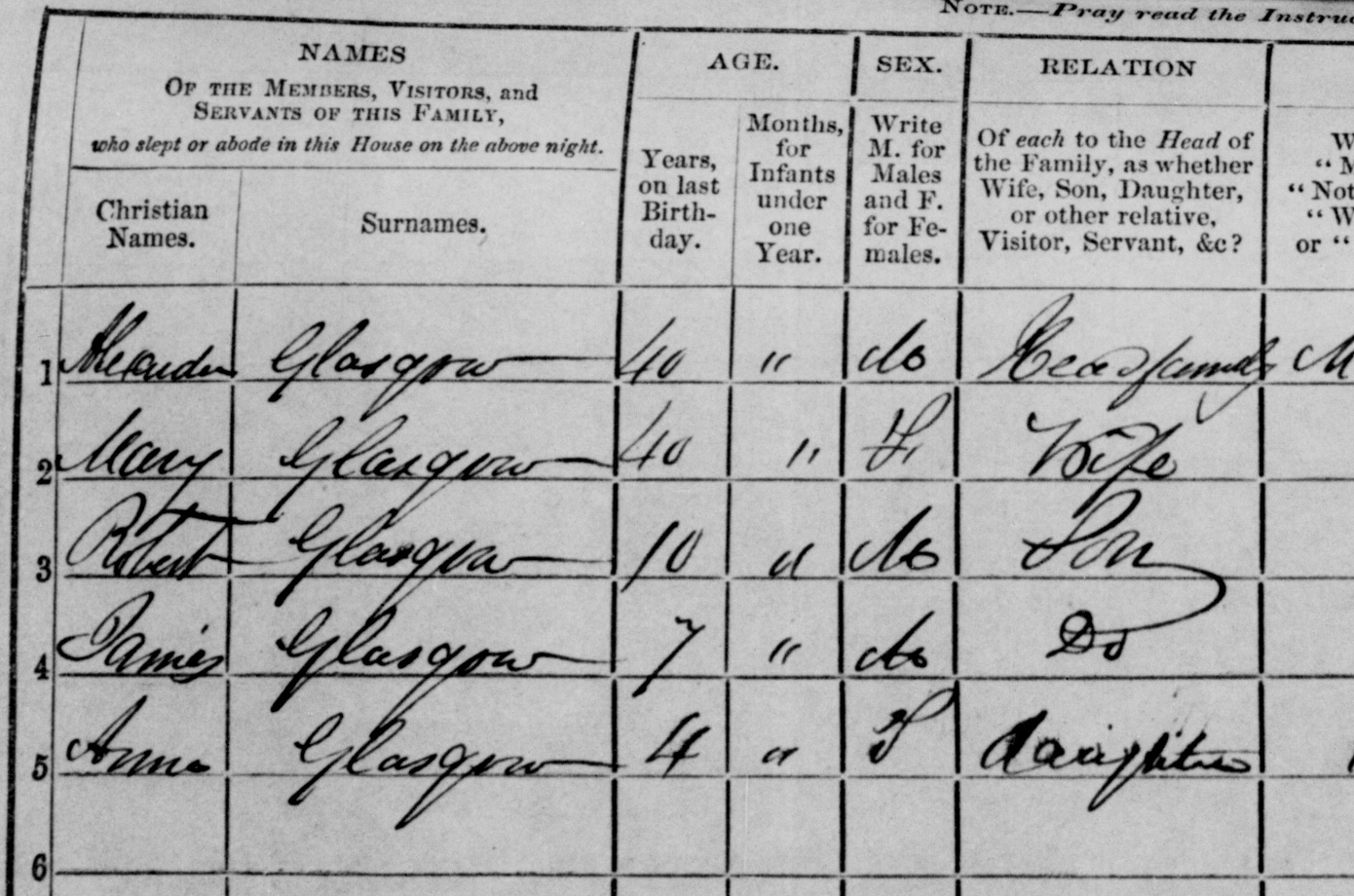
The inference is reasonable but not conclusive. The 1851 Lisnagaver household lists Alexander, Mary, Robert, James and Ann, with no additional person marked resident, absent, or dead since 1841. The National Archives explains that this census recorded household members absent on census night and family members who had died since 1841. Nearby returns demonstrate both categories, including children away as servants or pupils. If the 1838 child belonged to this same family and was still alive in 1851, a 12- or 13-year-old would ordinarily be expected either in the household or its absent section; if the child died from 1841 onward, the mortality section should ordinarily record the death.
Samuel Glasgow of Franklin/Blissfield, Michigan, therefore should not be identified with Glasgow-3940. His compatible age and Irish birth are only surname-level coincidence, while the family census is contrary evidence and no American record names County Antrim or Alexander and Mary. Samuel reported about 37 years in the United States in 1894, implying immigration around 1857, so the same-person theory requires the unexplained omission of a living 13-year-old from every section of Alexander's 1851 return. The Pleasant View transcription's impossible 29 February 1838 date further prevents exact-date matching. Retain the Michigan records only as a rejected-candidate audit; do not attach Samuel to this family. Full reasoning is in the focused Glasgow-3940 handoff.
#### Searches completed in this pass
- Two independent Griffith transcriptions and the original PRONI
valuation-revision folios establish James Glasgow at Dromore plot 18b. In VAL/12/B/3/13A, 13B and 13C the holding is consistently a house and small garden valued at 10 shillings, under James and later Robert Hood. The name remains through the 1891-1901 volume. This corrects the previous false negative and strongly separates the Dromore occupier from Alexander's possible Michigan son, but does not identify the local James or Alexander's parents.
- The current PRONI Guide to Church Records
confirms that Rasharkin Presbyterian marriages survive only from 1845, whereas Second Portglenone MIC1P/357 has marriages from 1822. First Portglenone marriages also begin only in 1845; the other nearby Presbyterian congregations inspected begin too late. Second Portglenone is therefore the only known nearby surviving Presbyterian marriage register early enough for Alexander and Mary's circa-1836 marriage. The 13 August PRONI request already targets the correct register; there is no overlooked early Rasharkin marriage book.
- Variant and locality searches in PRONI Name Search
returned no Glasgow at Rasharkin or Lisnagaver. The only potentially relevant new item was John Glask in the 1740 Protestant Householders return: PRONI indexes him to Clogh parish and Kilconway barony, while the surviving transcription places him at Dunaghy. The original does not survive, and Glask may be another surname rather than a Glasgow variant. Treat this only as a weak locality lead, not as a relative. See the County Antrim transcription, row 1992.
- The same PRONI search found a pre-1858 will-index entry for James Glasgow of
Drumeen dated 23 May 1820, but PRONI states that the original does not survive. It cannot supply heirs or relationships and is presently a dead end. No new Rasharkin-area Glasgow will, 1766 religious-census entry or 1775 dissenters' petition entry was found.
- A proposed 1831 Rasharkin household search is not possible: the
National Archives of Ireland's survival list shows no surviving 1831 returns for County Antrim. Do not spend further effort looking for an ordinary 1831 Lisnagaver or Gortereagh census return.
- A sweep of the current merged Glasgow/Glasco One-Tree export found no plausible
WikiTree woman born in Ireland about 1785-1825 and dying in Scotland whose statutory death could identify Alexander's proposed parents. This is a negative result for WikiTree coverage only, not for the ScotlandsPeople civil index; women missing from WikiTree remain the point of that search.
#### Important unsearched people and record groups
- Await PRONI's search/quotation for `CR5/32/1/1/1-2`. The request sent on
19 August asks for every entry in the 1804-44 Dervock, Kilraughts and Ballymoney society lists, baptisms, marriages, deaths and removals, with the page before and after each hit. Test specifically for Alexander about 1810-11, Rosanna's reported death on 23 October 1822, Thomas about 1815, Daniel and any Robert, William or older Alexander. Preserve household/society headings: they may be the evidence that establishes the parent-child group.
- **Search the pension census-search forms for the known children as well as
hypothetical sisters' children.** Query James Glasgow and Ann (Glasgow) McCracken (Glasgow-438) with father Alexander and mother Mary/Molly McCaughan, McAughin or McAughern. The National Archives search-form collection can include parents and townland and may preserve the applicant's later address or a reconstructed household. The live results service was unavailable during this pass, so this remains untested rather than negative.
- **Search Ballymoney Poor Law Union records after Alexander disappears from
lot 25.** The local database describes an outdoor-relief register, 1847-99, PRONI `BG/5/EA/1` and the first workhouse register, 1843-49, `BG/5/G/1`. Alexander's substantial farm makes the famine-era outdoor register a poor prospect because the enabling legislation excluded holders of more than a quarter acre. The higher-value search is the later BG/5/G admission, infirmary and death material after his valuation holding was struck out, when an elderly or widowed Alexander or Mary might name a townland, relative or settlement history.
- Check Rasharkin school records for James and Robert. The official
PRONI school index identifies Rasharkin National School as SCH/94, with Dromore SCH/546 and several other parish schools also surviving. Attendance registers can record age, religion, father's address and occupation, previous school and sometimes work or emigration on leaving. They normally omit the father's name, so this is primarily a route to James's later identity, not direct proof of Alexander's father.
- Complete the formal Scottish female-death search. The One-Tree sweep did
not replace a ScotlandsPeople search under both maiden and married surnames. Prioritise Ireland-born Glasgow women born about 1790-1822 whose census households point to Antrim or the Bann Valley. A Scottish death registration naming both parents remains one of the few single documents capable of proving the proposed older Alexander and Rosanna together.
The best immediate order is: search CR5/32/1/1/1-2; await the already-requested Second Portglenone and Killoquin material; search Scottish collateral death certificates; then check the later Ballymoney poor-law registers. More Y-DNA modelling is unlikely to distinguish a father within the same early-eighteenth- century node until another documented branch tests.
Daughter Ann identified in a later record, 13 August 2026
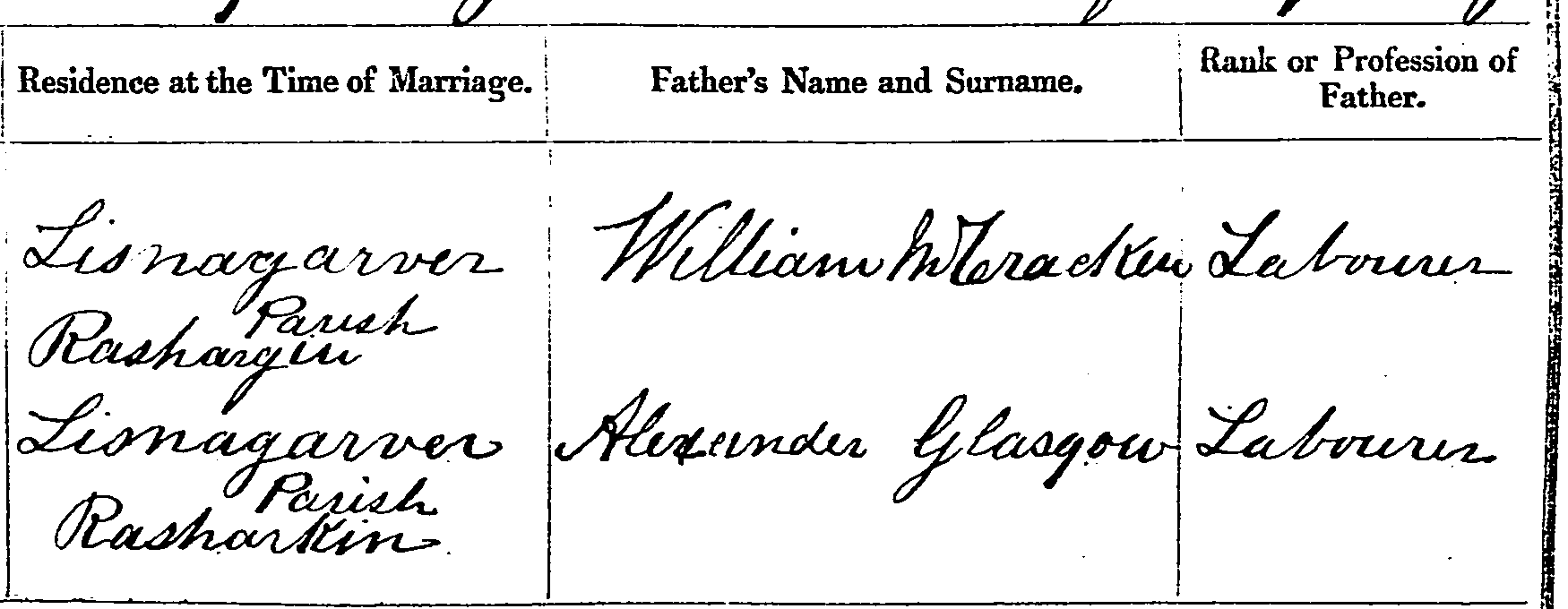
The original 13 October 1876 Ballymoney marriage of Robert McCracken and Ann Glasgow records Ann as a full-age spinster of Lisnagaver, daughter of Alexander Glasgow, labourer. This is a strong continuation of Alexander and Mary's four-year-old daughter in the 1851 Lisnagaver household: she would have been about 29 in 1876. The existing profile [[Glasgow-438]] is therefore the leading identity and should be updated with the marriage after a final live duplicate check. Its birth place Lisnagarvey, Lisburn should be corrected to Lisnagaver, County Antrim. The certificate proves Ann's father independently but does not name Alexander's father. Saved register page.
Ann and Robert's son William James McCracken was born at Lisnagaver on 21 September 1877 and died there the next day. Ann registered both events. This identifies one grandchild of Alexander but closes that descendant line; no later child or secure later household has yet been found. See the focused [[Glasgow-438]] research handoff.
Robert's father William may belong to the McCracken household at Carnfinton, the reported birthplace of Thomas Glasgow's wife Mary Ann McCracken. Marriages there identify William's likely children James William and Elizabeth, with James witnessing Elizabeth in 1889. If Ann's Robert was their brother and the older Mary Ann was William's sister, Ann married the nephew of Thomas's wife. That two-step model is a promising affinal argument for an Alexander–Thomas family network, but neither McCracken edge is yet proved.
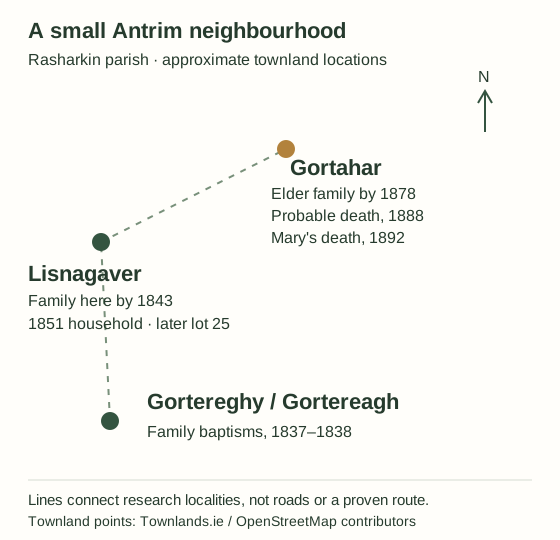
Alexander Glasgow-951 is directly documented at Gortereagh in 1837-38 and at Lisnagaver by 1843-51. Thomas Glasgow-987 is his probable brother; Daniel Glasgow-3896 is Thomas's proved brother. No record directly calls Alexander their brother.
The original 1871 marriage records Mary Glasgow as 28, not 38. It directly names her father as Alexander Glasgow, farmer, and her husband Robert Elder later succeeded Alexander on Lisnagaver lot 25. This strongly identifies Mary as Alexander-951's daughter, but excludes the proposed identification with Maryan, 17, in John Glasgow-1022's 1851 household: Maryan would have been about 37 in
- The marriage therefore supplies no basis for making John Alexander's father.
Older Alexander Glasgow-3904 and Rosanna remain the leading specific parent hypothesis from descendant tradition, still unproved.
Missing-sister civil-marriage audit, 13 August 2026
The suggested missing-sister route has now been tested systematically in the free Irish civil marriage collection. A surname-and-variant search for 1845-1875 found 23 Glasgow/Glascow brides in Ballymoney, Ballymena, Antrim, Magherafelt and Coleraine registration districts. Five were already assigned: Alexander's daughter Mary Elder; Thomas's daughters Jane Jamison and Margaret Jebb; Mary Montgomery, whose father was Hugh Glasgow; and Annie Bellingham of a separate documented branch. Coleraine supplied no Glasgow bride.
The original certificates for all 18 remaining women were inspected. None named Alexander as her father, none resided at Lisnagaver, and no witness tied one to the known Lisnagaver family. Their named fathers were James (five brides), Robert (four), William (three), Hugh (two), Samuel (two), Henry (one) and Andrew (one). This substantially reduces the chance that an unmarried or late-marrying sister remained locally and married after civil registration began, although it cannot exclude a sister who married before 1845, outside the five-district corridor, or after emigration.
The register pages are preserved locally under sources/candidate_sister_marriages/.
The best no-PRONI continuation is now to search through the sister's children, not only under her unknown married name. The National Archives of Ireland 1841/1851 census-search database has a dedicated Maiden Surname of Mother field. A search for mother Glasgow, restricted first to Rasharkin, Kilconway and adjoining Antrim/Londonderry localities, could expose pension applicants whose mother was an otherwise missing Glasgow sister and recover the claimed 1841/1851 household. The live results service timed out on 13 August, so this search remains pending rather than negative.
Scottish statutory deaths from 1855 are the other high-value route. Women are indexed under maiden and married surnames, and an original death registration can name both parents, including the mother's maiden surname. Search women born in Ireland about 1790-1822 under Glasgow as either surname, then prioritise Antrim/Rasharkin-linked census households. This route could prove both older Alexander and Rosanna in one record; the Irish bride audit could only test the father.
The land pattern slightly weakens any simple claim that Alexander and Thomas merely divided one father's Lisnagaver farm. In 1834 Alexander held about 29 acres and Robert about 35. The later John-plus-Alexander holdings total about 30 acres, while Thomas held about 33 acres. This is compatible with two older tenant blocks descending separately, although tenancy transfers need not follow blood relationships and it does not exclude brotherhood. John belongs to a documented father-John branch, so the cluster was not one obvious nuclear family.
A new collateral route may identify Thomas's parents without first proving Alexander's sibling edge. Daniel Neely Glasgow, Thomas's proved son, was a labourer residing in New York when his twins were born in September 1889. An Irish-born cemetery labourer who died as Daniel Glascow at Troy on 12 February 1931 is a strong same-person candidate. His death certificate 9941 could name Thomas and Mary Ann; the identification remains unproved until an original US record supplies matching family detail.
Thomas's reported emigrant son Alexander is now bounded to a likely birth in about 1851-1863: he was absent from Thomas's 1851 household, was not in the public Rasharkin baptism transcription through 1846, and no suitable civil birth appears from registration's start in 1864. Exact-name, Ireland-born Ancestry searches returned no matching Alexander Glasgow in the 1900, 1910, 1920 or 1930 US censuses. The official South African archive index is more promising: a same-named adult was defendant in Cape Supreme Court proceedings in 1893 and 1898. Follow-up identifies both matters as Cape Town commercial/property disputes: Gerhard Myburgh's executors brought the 1893 motion and mortgage holder Maria Lacey Welch brought the 1898 recovery action. His identity and origin remain unproved.
A concrete paternal collateral result has now been established. The public FamilyTreeDNA Glasgow Project places the target's direct-male-line Big Y-700 kit B580327 at R-FT20271. Four named Big Y kits report separate roots at that same terminal branch: B696189 (reported line to William Glasgow, born c.1655, Scotland), 1002232 (tested descendant of James J Glasgow-2738, with a reported deeper South Carolina root), 200475 (a descendant line reporting Robert Glasgow 1749-1836 and corresponding to Robert Glasgow-12), and 959947 (reported James Glasgow c.1700, grandfather of Robert 1749). Two kits, 999763 and 478604, sit on downstream R-FTE32242. The supplied tester identities and current WikiTree paternal paths place both beneath Robert's son James M. Glasgow (`Glasgow-193`): 999763 descends through James's son William Allen Glasgow (`Glasgow-2182`), while 478604 descends through Samuel Lyle Glasgow (`Glasgow-192`). They therefore represent two son-lines of James-193, not merely two unspecified descendants of Robert-12.
The administrator notes correct an earlier label. Kit 1002232 descends through James J Glasgow-2738; James's attachment to Robert Glasgow-2769 is still uncertain and must not be presented as part of the proved tester pedigree. The live match screen reports both marker kit 325862 and the related unnumbered FT25406 Big Y line against Henry Glasgo 1774-1849. Henry is Glasgo-21, a grandson of Jeremiah Glasgo-23; Jeremiah remains the deeper ancestor rather than the earliest-known-ancestor label displayed for these tests.
The full STR and private-variant extract supports a provisional visual topology inside FT20271. Alexander's B580327 and 1002232 share DYS714=27. Kits 959947, 200475, 999763 and 478604 share the combination DYS19=15, DYS456=16 and DYS712=19; within that pattern 959947 differs at DYS650=20, 200475 and 999763 are identical across the displayed Y-111 panel, and 478604 differs from 999763 at the first CDY copy. This is an STR-inferred topology, not confirmed mutation direction. Only FTE32242 is a confirmed internal child SNP. DYS712 is itself a rapidly mutating Y-STR: a 367-pair father-son study observed 17 mutations and estimated a rate of about 46.3 x 10^-3 per meiosis. Its shared 19 state is therefore a useful secondary clue but particularly vulnerable to recurrence or back-mutation; it must not be treated as a clade-defining event. Mutation-rate study
The downloaded raw bundle resolves the private block more precisely. Kit B580327 has five exported private variants: 12648194 A>G, 14337402 T>C, 14339231 G>C, 15066888 A>T and 15973436 A>C. Its VCF also has a sixth lineage-specific PASS call at 26534797 C>G (depth 25). The non-matching screen labels that position FT124483, but FT124483 is the different allele C>A at the same multi-allelic site. It does not define a shared branch among the other matches. All six calls are PASS at depth 25-78 and are absent from every displayed match.
The bundle also permits direction to be assigned for the numeric match-side differences: all 15 lie inside the B580327 quality BED and have no derived call in its VCF. Most usefully, both 959947 and 200475 list FT6135 C>T at 19389846, while B580327 has a direct PASS ancestral call there (GT 0/0, 34 reference-C reads, one T read, one A read, depth 40) inside the quality BED. At FT20271 itself B580327 has a direct PASS derived call (GT 1/1, 57 alternate-T reads, depth 60), also inside the quality BED. That shared off-tree state reinforces their common DYS19=15, DYS456=16, DYS712=19 pattern. Because FTDNA still leaves both kits terminal at FT20271, FT6135 is a candidate pairing signal, not yet a confirmed child branch.
The three possible FT6135 outcomes are now explicit. Direct derived-T calls in both James M. kits would place FT6135 at or above Robert Glasgow-12 and show that the pairwise omission was only a display/export limitation. Direct ancestral-C calls in both would prevent that placement and require recurrence, reversion, or a pedigree/tester-mapping review. No-call or inadequate coverage would leave the marker unresolved. “Not displayed” is therefore not treated as ancestral.
The FTDNA Block Tree screenshot supplied 12 August 2026 confirms the exact block structure. R-FT25406 is a four-SNP block (FT25406, FT16394, FT18145, FT26594) beneath R-FT32941/FTA35069. R-FT20271 is a three-SNP child block (FT20271, FGC5690, FT16542). It contains five basal samples, including B580327, plus two samples on child R-FTE32242. The displayed private-variant summaries are one basal FT25406 sample averaging 4, five basal FT20271 samples averaging 3, and two FTE32242 samples averaging 1.
Those averages reconcile closely with the directional lists once multiallelic, recurrent and off-tree calls are excluded: approximately 5, 1, 5, 1, 4 tree-counted private variants across the five basal FT20271 tips, 1, 2 across the two FTE32242 tips, and 4 on the basal FT25406 tip. This independently validates the orientation analysis. It also supplies an important warning: 200475 and 999763 are Y-111 identical, but 999763 is FTE32242-positive while 200475 remains basal FT20271. Zero STR distance does not eliminate a real downstream SNP split.
The B580327 DYS export is complete across all 829 supplied STR/FTY fields. It provides a durable reference profile but, without another tester's equivalent export, does not add pairwise distances beyond the existing 622-666-marker Big Y comparisons.
Those comparisons produce two different nearest neighbours. 1002232 is the closest FT20271 result on the standard Y-111 panel at GD 3, while B696189 has the fewest mismatches across the larger callable Big Y STR comparison at 3/650. Neither shares a downstream SNP with B580327 on the Block Tree. The present data therefore do not justify choosing either line as Alexander's nearer paper-tree cousin.
Relative to B580327, the live Big Y STR mismatch counts are 3/650 for B696189, 4/662 for 1002232, 4/666 for 999763, 4/659 for 478604, 5/660 for 959947, and 7/622 for 200475. These extended-marker counts and the familiar Y-111 genetic distances measure different marker sets, so their rankings need not agree.
The complete B580327 Y-111 match screen contains 17 matches: nine Big Y tests and eight marker-only tests. Six Big Y matches are within FT20271 or its FTE32242 child; one is at upstream FT25406; and two are on the different FTA30932 branch. The closest confirmed FT20271 match is the 1002232 line at GD 3. Three unplaced Farrier/Ferrier tests are also notably close at GD 4, 4 and 5. They report Henry Ferrier born about 1758 in Woodnesborough, Kent, or William Farrier and Susanna Abell married in Philadelphia in 1796. Because all three have only broad R-M269 labels, the STR closeness does not show whether they carry FT20271. It could reflect a surname change, deeper paternal kinship or STR convergence. A Big Y upgrade from one of those lines is the most direct test.
The remaining marker-only matches include an unanchored Glasgow line at GD 5, the reported Robert Glasgow 1749-1839 line at GD 6 with a broad R-Z18 label, the Henry Glasgo 1774-1849 line and an unanchored Phillips line at GD 9, and Robert Glasgow-1143 at GD 10. These remain upgrade candidates rather than confirmed placements inside FT20271.
The dates and origin reported for 999763 closely identify its earliest named line with Robert Glasgow-12, born in 1749 at Moneymore and died in 1839 in Adams County, Ohio. The independent Glasgow Family Genealogy database gives that Robert the same February 1749 Londonderry birth and July 1839 Adams County death. Thus Alexander's paternal line and Robert-12's paternal line are now shown to be genetic cousin lineages sharing a direct paternal ancestor. This is concrete kinship evidence, but neither source identifies the common man or the cousin degree. It does not prove Robert-12, his attached father James Glasgow-1024, or any member of that tree was Alexander's father or grandfather.
There is also a nearer-looking candidate connection to the East Antrim tree. FTDNA kit 254947 reports Robert Glasgow, born about 1710 and living after 1772 in Northern Ireland, a close identity match to Robert Glasgow-1143. Its 111-marker Y-STR result was placed in the project's older FT25406 working group with the lines later resolved by Big Y below FT20271. The 2016 independent report also grouped this kit with the same distinctive Glasgow Y-STR cluster. Because 254947 has not taken Big Y, it is strong paternal-cluster evidence but not the same SNP-level proof as the B580327/999763 comparison. Robert-1143 is therefore a high-value possible older paternal relative, not a proved ancestor, uncle or numbered cousin.
The inherited 22 May 1852 death date is rejected, not merely uncertain. Its traceable context is a derivative Australian reconstruction for an Alexander Glasgow of Windsor, New South Wales, with a different wife and child cluster. No migration or original death record joins that man to Mary McCaughan, Lisnagaver or Gortereagh. Alexander-951's death remains after 1851 and unproved.
The two proposed candidates now separate cleanly. James Glasgow-1702 is excluded: he was born in 1799, only about twelve years before Alexander, and his 1851 marriage independently names his own father as William. Robert Glasgow-1367 is chronologically possible, but remains a weak candidate. The 1820 lease, 1827 tithe and 1831 census securely document a Coltrim man now kept separate as Glasgow-3941; nothing bridges him to Glasgow-1367. The latter is securely documented at Glenleslie in the 1851 census and 1854 will index. Neither man is identified with the separate 1834 Lisnagaver Robert, and no record names Alexander as a son of any of them.
The expanded male-profile sweep produces one genuinely useful alternate lead: Adam Glasgow-1622. An original 1851 marriage proves that Adam's son James, born about 1812/13, was a farmer of Inishrush. James is virtually Alexander's contemporary and could be a brother or cousin, but the record does not connect the two men. Adam is a collateral lead only, not a parent conclusion.
Live-profile audit 5 August 2026: the updated biography correctly treats the older Alexander/Rosanna reconstruction as uncertain, leaves Rosanna's surname unknown and no longer presents Shaw as established. The structured death still incorrectly sends Alexander to Glasgow, Scotland, in 1851. Its request to inspect the original tithe page is now superseded by the manuscript findings below.
Life and record timelineChronological mapped occurrences and their underlying sources.7 records
Early family at Gortereagh / Gortereghy
Probably brother of Daniel and Thomas, but no inspected record explicitly calls him their brother.
Source and mapping detail
WikiTree profile export for Glasgow-951
No sufficiently specific citation match found.
Precision: Townland centrepoint
Big Y-700 branch R-FT20271
Kit B580327 shares R-FT20271 with several Glasgow paternal lines; kit 999763 is downstream at R-FTE32242 and closely identifies the Robert Glasgow-12 line. This proves a shared direct paternal ancestor but not the common man's identity or cousin degree.
Source and mapping detail
FamilyTreeDNA Glasgow Project Y-DNA results
No sufficiently specific citation match found.
Precision: Townland centrepoint
Earlier Y-STR cluster analysis
The independent report grouped five Glasgow kits in one distinctive paternal cluster; the newer Big Y result supplies the more precise SNP relationship.
Source and mapping detail
Legacy Tree Glasgow Y-DNA report
No sufficiently specific citation match found.
Precision: Townland centrepoint
Seven named Big Y kits in the close branch
Newly integrated kits 959947 and 478604 expand the demonstrated paternal cluster; kit 1002232's documented pedigree reaches James J Glasgow-2738, whose father remains uncertain.
Source and mapping detail
FamilyTreeDNA Glasgow Project Y-DNA results
No sufficiently specific citation match found.
Precision: Profile-associated representative point
Farmer at Lisnagaver
The census documents his household at Lisnagaver.
Source and mapping detail
WikiTree profile export for Glasgow-951
Candidate matched on record type, year, place; inspect before treating it as the underlying record.
Precision: Townland centrepoint
Motion by executors of Gerhard Myburgh's estate
Same-name candidate for Thomas Glasgow's reported son; the index gives no origin or family and does not prove identity with the 1898 defendant.
Source and mapping detail
NAAIRS: Executors of Gerhard Myburgh v Alexander Glasgow
No sufficiently specific citation match found.
Precision: Court-jurisdiction representative point
Maria Welch v Alexander Glasgow; recovery of money
Maria Lacey Welch's mortgage activity strengthens a Cape Town property/debt context; the index supplies no defendant age, origin, occupation or family.
Source and mapping detail
NAAIRS: Maria Welch v Alexander Glasgow
No sufficiently specific citation match found.
Precision: Court-jurisdiction representative point
Case-file source findingsSource extracts and analysis regenerated from findings.md.1 section(s)
Source findings
| Source | Finding | Assessment |
|---|---|---|
| Ireland, Inland Revenue Wills & Administration, Will Registers, 1828-1879, 1870 Belfast index entry (researcher-supplied transcription) | An indexed Lisnagaver entry names Mary A. Glasgow and Thomas Glasgow. Thomas Glasgow-987 died there on 21 June 1870 and his wife was Mary Ann; the image headings and name roles remain uninspected. | Strong lead to Thomas's probate and probably his widow, but it does not name Alexander or state a sibling relationship. The full registered will—not the index—could become direct evidence if it identifies Alexander as Thomas's brother or Mary as his niece. |
PRONI original Rasharkin tithe book FIN/5/A/236, folio 17; saved manuscript image and transcription | In 1834 Alexr Glasgow held 29a 0r 0p at Lisnagaver and paid £22 6s; the next separate entry, Robt Glasgow, held 35a 0r 0p and paid £28. The red 4 and 5 are entry numbers, not ages. | Direct occupier and acreage evidence. The book gives no age, residence, lease relationship or kinship. It does not prove either entry is Glasgow-951 or Glasgow-1367. |
| Rasharkin Presbyterian baptisms | James, child of Alex Glascaw and Mary McAughin, was born at Gortereagh in 1837; an incomplete 1838 Glasgow entry names Alex and Molly McAughern there; another James was born at Lisnagaver in 1843. | Contemporary identity and movement evidence. |
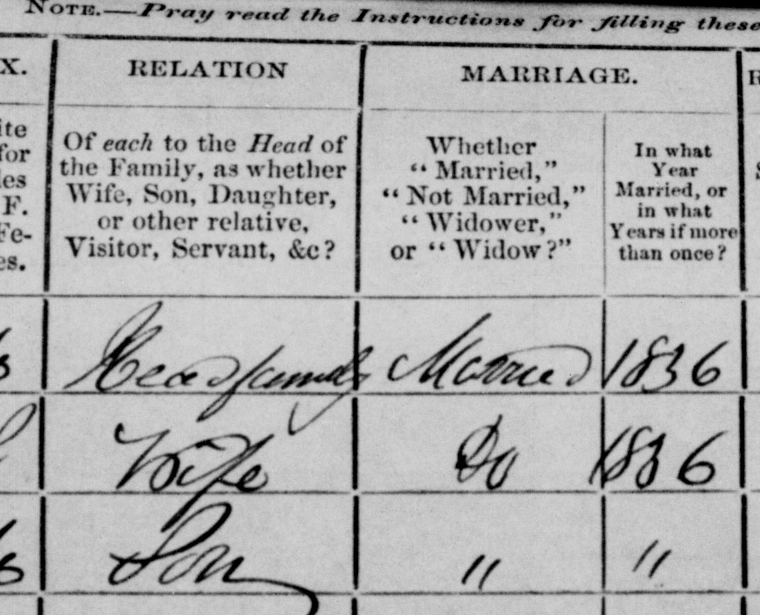
| 1851 census, Lisnagaver house 35 | Alexander, 40, Antrim-born farmer, lived with Mary and children Robert, James, and Ann. | Direct household evidence. |
| Robert/Jane marriage, 1866; saved copy | Son Robert named Alexander Glasgow, farmer, as his father. Robert lived at Lisnagaver and Jane at Gortereghy. | Direct father statement and continuity after 1851. |
| Daniel's original 1871 will and Daniel Neely Glasgow's 1888 marriage | Daniel and Thomas of the Lisnagaver family were brothers. | High-confidence collateral proof, but it does not name Alexander. |
| Griffith's Valuation, Rasharkin | Alexander and Thomas were listed at Lisnagaver; Daniel and Robert were at adjoining Gortereghy. | Supports one local kin network. Younger Robert Glasgow-938 is the best Gortereghy Robert candidate, which would make him Daniel's probable nephew if Alexander was Daniel's brother. |
| 1851 census, Lisnagaver house 37 | Thomas, 35, County Antrim-born farmer, headed a nearby Lisnagaver household. | Direct identity/locality evidence; enumeration proximity alone does not prove siblinghood. |
| 2007 descendant account | Names an older Alexander and Rosanna as Thomas's parents and preserves a confused Kilrea-clockmaker tradition. | Late family testimony supporting uncertain parents; it does not prove Alexander's sibling relationship or Rosanna's surname. |
| NARSSA search guidance, old complete NAAIRS index and follow-up audit | Alexander Glasgow occurs in Cape Supreme Court files: KAB CSC 2/6/1/146 ref. 286 (1893), executors of Cape Town merchant Gerhard Myburgh v Alexander Glasgow; and KAB CSC 2/1/1/350 ref. 123 (1898), Maria Lacey Welch v Alexander Glasgow for recovery of money. Welch's repeated mortgage bonds and both named parties' Cape Town identities place the defendant in a commercial/property orbit. An exact search through 1960 also found TAB MHG 913/43, Eliza Glasgow's 1943 estate entry, which says predeceased spouse Alexander; no link between that husband and the Cape defendant is proved. | Stronger localisation, not identity proof. The two cases may concern one man, but file copies are required for age, origin, occupation, address, associates and signature. Eliza's death notice is a separate high-value identity test. |
| Public Ancestry US census searches, exact Alexander Glasgow and Ireland birthplace, born 1857 +/-10 | No exact match appeared in the 1900, 1910, 1920 or 1930 US federal census collections. Broader-name results were excluded when the Ireland filter was tightened. | Bounded negative; spelling/indexing errors and pre-1900 death remain possible. It makes the Cape files the better current destination lead. |
PRONI valuation revision books VAL/12/B/4/16A and 16B; 1863-66 image, 1865-78 image | Lot 25, Lisnagaver, continued in Alexander Glasgow's name beside John on lot 24 and Thomas on lot 26. Thomas's entry changed to his representatives after his 1870 death, while Alexander's did not. | Strong continuity for the Lisnagaver occupier, but valuation entries can lag and do not prove Alexander was alive throughout the volume. |
1834 tithe compared with VAL/12/B/4/16A | The 1834 Alexander and Robert holdings total exactly 64a. The later adjacent Glasgow lots 24-26 (John 21a 2r 25p; Alexander 8a 2r 10p; Thomas 32a 3r 15p) total 63a 0r 10p, only 0a 3r 30p less. John plus Alexander total 30a 0r 35p, close to the earlier Alexander's 29a; Thomas's 32a 3r 15p is close to Robert's 35a. | Strong evidence that the same Glasgow land block was later redistributed from two holdings into three, subject to changed survey/boundary methods. It supports a local family succession but does not state whether the 1834 men were fathers, brothers or namesakes. |
| Original marriage of John Glasgow and Margaret Garvin, 1846 plus the 1851 Lisnagaver census | The John later occupying lot 24 is the married Lisnagaver farmer whose household included brother Samuel; John's marriage names his father as John Glasgow, farmer. | This breaks the proposed simple inheritance model in which lots 24-26 were three sons of the 1834 Alexander/Robert pair. At least John belonged to a father-John branch, so acreage continuity shows a Glasgow tenancy block, not one proved sibling division. |
| Samuel Glasgow's civil death, 17 August 1875 | Samuel died at Lisnagaver aged 85, a bachelor and weaver; Elizabeth Rose of Lisnagaver was present at death. | This is the same unmarried linen-weaver whom the 1851 census called John's brother. It identifies Glasgow-2908 and Glasgow-3472 as duplicate profiles for one man and strengthens the separate father-John branch. |
| Civil death index, Robert Glasgow, 1868 | An otherwise unassigned Robert Glasgow died in Ballymoney registration district in the first quarter of 1868 aged 71 (group ID 957324, vol. 1, p. 126), implying birth about 1796/97. | This cannot be the Glenleslie Robert whose will was indexed in 1854. His age is compatible with the unidentified 1834 Lisnagaver occupier. The certificate is now the highest-value civil-record order because a residence or informant could identify that man. |
| Civil death index, Margaret Glasgow, 1867 | An unassigned Margaret Glasgow died in Ballymoney registration district in the first quarter of 1867 aged 66 (group ID 1045678, vol. 4, p. 144). | Possible spouse-generation companion to the 1868 Robert, but there is no relationship evidence yet. Order only as a secondary check. |
| Original marriage of James Glasgow and Rosanna Barkley, 17 March 1851 | James, 38, farmer of Inishrush, named his father as Adam Glasgow, farmer. | Proves a local Adam-and-son-James unit in Alexander's generation. James could be Alexander's brother or cousin, but no record connects them; do not attach Alexander to Adam Glasgow-1622. |
PRONI revision books VAL/12/B/4/16C and 16D; 1879-88 image, 1889-98 image | Alexander was struck from lot 25 during the 1879-88 book. The annotations are dated 1881, 1882 and 1886; by the next book Robert Elder occupied the holding. Unlike John Glasgow's lot 24, lot 25 did not pass to an identifiable Glasgow successor. | New direct land evidence narrows the administrative change, but names no parent or heir. |
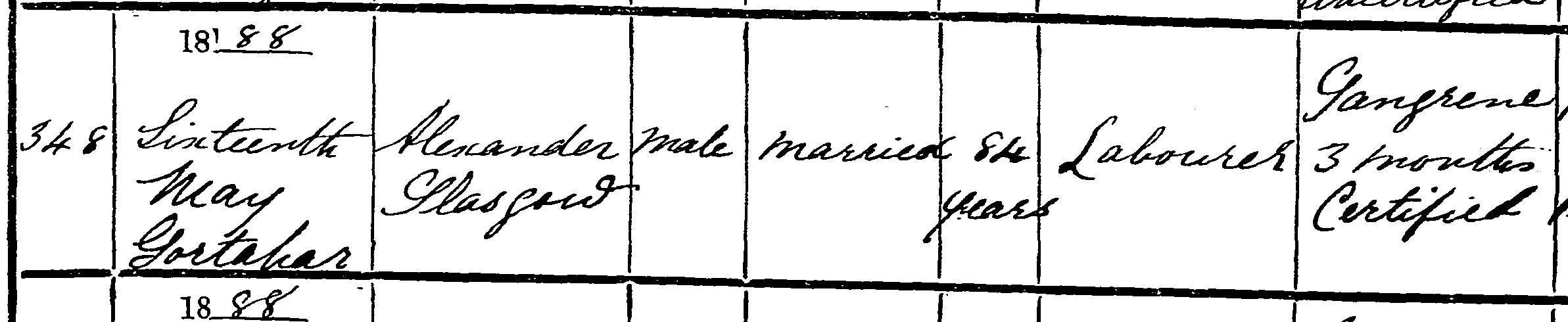
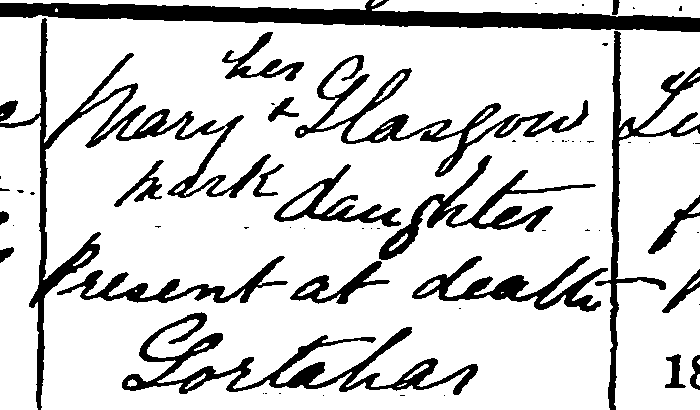
| Irish civil death index, 1864-87 | No Alexander Glasgow death was registered in Ballymoney district. The only Ballymoney result through 1888 was an 84-year-old labourer who died at Gortahar on 16 May 1888, informed by daughter Nancy; register image. | The 1888 man matches separate profile Glasgow-2717 (born about 1804), not the 1811 Lisnagaver farmer. Alexander-951's death remains unfound. |
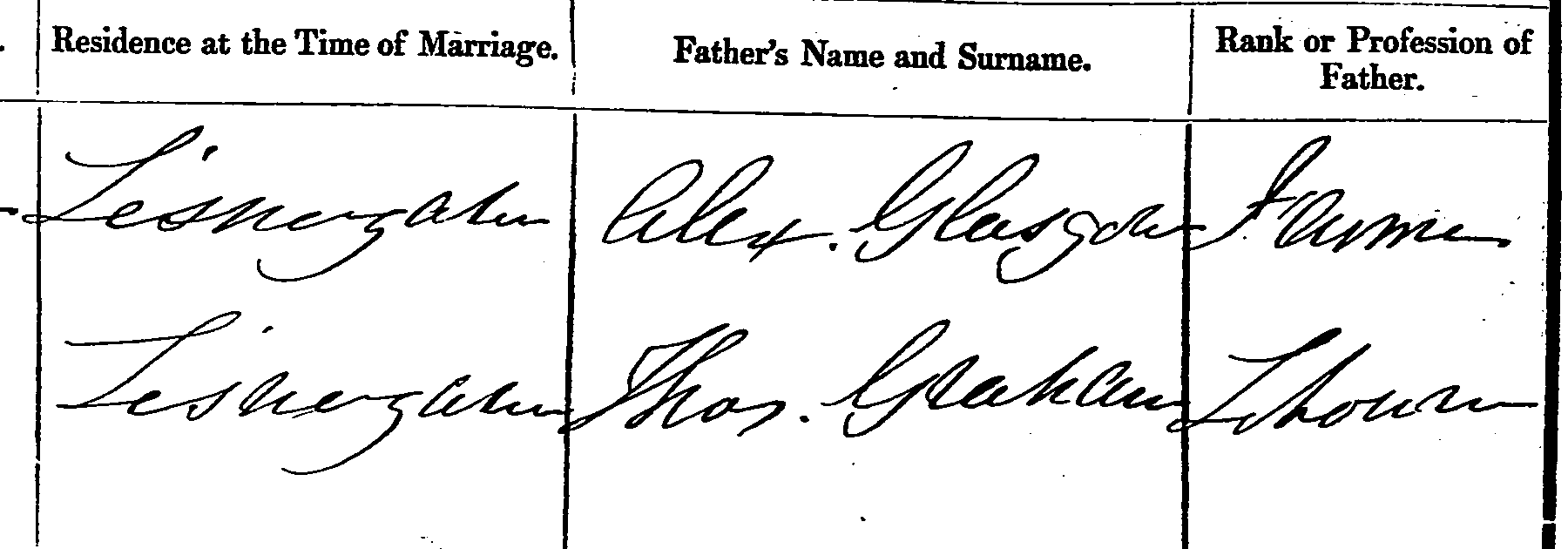
| Original marriage of Robert Elder and Mary Glasgow, 14 June 1871 | Robert, 40, bachelor and farmer of Gortereghy, named father Nathaniel Elder. Mary, 28, spinster of Lisnagaver, named father Alexander Glasgow, farmer. Witnesses were William Graham and John Collins. | Direct father statement and land-network evidence. Mary's age excludes identity with Maryan, 17 in 1851; the witnesses do not supply a Glasgow kinship link. |
| PRONI `VAL/12/B/3/13A-C`, Dromore plot 18b | Three original revision books carry James Glasgow in a house and small garden from 1863-79 through 1891-1901. | Corrects the earlier transcription error and strongly distinguishes this continuing local occupier from the possible Tecumseh identity; it gives no relationship to Alexander. |
| 1901 Gortahar census presentation and 1911 household | In 1901 Mary Elder, 60, headed a household with children Mary, Robert and Jane. In 1911 Robert J. Elder, 36, lived with mother Mary, sister Jane M. and two-year-old nephew Samuel Glasgow. | Strong candidate continuation of the 1871 Elder-Glasgow marriage and a documented close Elder-Glasgow relationship. Exact identity and Samuel's parents remain unresolved pending original census forms and civil registrations. |
| WikiTree+ derivative Australian compilation | The 22 May 1852 claim occurs in a conflated reconstruction for an Alexander Glasgow associated with Windsor, New South Wales, a different wife and an Australian child group. | Source-contamination identification. Remove the date from Alexander-951; it is not evidence about the Lisnagaver farmer. |
| FamilyTreeDNA Glasgow Project Y-DNA results and administrator comparison notes supplied 11 August 2026 | Big Y-700 kit B580327, reporting Alexander Glasgow born 1811 in Ireland, is R-FT20271. B696189, 1002232, 200475 and 959947 have the same terminal SNP. 999763 and 478604 are downstream at R-FTE32242. The supplied B580327-relative table reports GD 3 to 1002232, 5 to B696189, 6 to 200475 and 999763, and 7 to 959947 and 478604, all at Y-111. | Direct paternal genetic kinship between the Big Y-tested lines. STR distance is not a cousin degree. Ancestor labels and profile mappings still require documentary proof. |
Private B580327 matches, Named/Private Variants CSVs and VCF/BED bundle supplied 11 August 2026; FTDNA matching guide | Five exported private calls plus 26534797 C>G form a six-state B580327 block; all are PASS at depth 25-78. The latter is a different allele at the FT124483 site, not FT124483 C>A. FT20271 is directly derived (GT 1/1, 57 alternate reads, DP60); FT6135 is directly ancestral (GT 0/0, 34 reference reads, DP40). All named sites are covered by the BED. All 15 numeric match-only positions are covered ancestral calls in B580327. Kits 959947 and 200475 both differ from B580327 at FT6135 C>T. | Resolves variant direction relative to B580327 and supplies a candidate 959947/200475 pairing. FT6135 remains off-tree, and none of B580327's private states can be assigned to Alexander himself without a second descendant test. |
| Private FTDNA Block Tree screenshot supplied 12 August 2026 | Confirms FT25406/FT16394/FT18145/FT26594 as one four-SNP block; FT20271/FGC5690/FT16542 as its three-SNP child; five basal FT20271 samples; two FTE32242 samples; displayed private averages 4, 3 and 1 for the basal FT25406, basal FT20271 and FTE32242 groups. | Directly validates the sample topology and is consistent with the directional private-variant counts. The image contains living tester names and remains local rather than being published. |
Same FTDNA project, kit 254947 | Reports Robert Glasgow, born about 1710 and living after 1772 in Northern Ireland, closely matching Glasgow-1143; its Y-111 pattern sits in the older project group ancestral/adjacent to the Big Y-resolved FT20271 lines. | Strong candidate paternal-cluster connection, but not SNP-level proof because this tester has not upgraded to Big Y. |
| Legacy Tree's 2016 Glasgow Y-DNA report | Before the newer Big Y tests, the report independently identified kits 200475, 254947, N18544, 325862 and 333002 as one distinctive Glasgow Y-STR group; four reported Northern Irish origins. It explains that shared Y-chromosome mutations require a direct-line paternal ancestor. | Useful independent history of the genetic cluster. STR grouping alone is less precise than the current shared Big Y SNP. |
| Glasgow Family Genealogy: Robert Glasgow, 1749-1839 | Gives Robert a February 1749 birth in Londonderry and July 1839 death in Adams County, Ohio, matching Glasgow-12 and the earliest-ancestor label of FTDNA kit 999763. | Strong identity match for the documented genetic-cousin line; derivative pedigree details still require record-level checking. |
Evidence assessmentWhat is supported, uncertain or disputed in the current case model.20 claims
Documented or strongly supported
Alexander Glasgow was recorded in Lisnagaver townland (1851).
Farmer at Lisnagaver
Robert Glasgow was son of Alexander Glasgow
Robert's original 1866 marriage names father Alexander, farmer; baptisms and locality evidence identify the family across Gortereagh and Lisnagaver.
James Glasgow-1702 cannot be Alexander's father.
James was born in 1799, only about twelve years before Alexander, and his 1851 marriage names his own father as William.
Alexander remained the named occupier of Lisnagaver lot 25 through the 1865-78 valuation volume and was struck out during the 1879-88 volume; the holding passed outside the Glasgow surname.
The PRONI revision books preserve the continuous lot number and acreage. The later volume annotates changes in 1881, 1882 and 1886, and Robert Elder is the occupier by 1889. This does not identify a parent or precise death date.
Working hypotheses and conflicts
Alexander Glasgow was recorded in Gortereghy townland (c.1811).
Early family at Gortereagh / Gortereghy
Alexander Glasgow was brother of Thomas Glasgow
Compatible age, Lisnagaver/Gortereagh movement, adjacent 1851 cluster, and the later Alexander-and-Rosanna account form a coherent case; no inspected source directly says brother. The acreage pattern is not simple sibling inheritance: Thomas's later holding approximates the 1834 Robert block, while John plus Alexander approximate the 1834 Alexander block.
Alexander Glasgow was brother of Daniel Glasgow
Follows from Alexander's probable brotherhood with Thomas and Daniel's proved brotherhood with Thomas. The possible Gortereghy Daniel/Robert land association is supportive but not identity or relationship proof.
Alexander Glasgow was son of Older Alexander Glasgow
This stacks Alexander's probable siblinghood with Thomas on the late account naming Thomas's parents. No record directly names younger Alexander's parents.
Robert Glasgow-1367 is chronologically possible as Alexander's father but is not proved.
His 1803 marriage and large 1831 Coltrim household allow a son born in 1811, but no record proves that the unidentifiable 1834 Lisnagaver Robert was the Robert recorded at Glenleslie in 1851 or names Alexander as his son.
Case-file assessments
Candidate-father assessment
| Candidate | Verdict | Reason |
|---|---|---|
John Glasgow-1022 | Unsupported by the Mary evidence | Mary was 28 in 1871 and cannot be the Maryan aged 17 in 1851. No source calls Alexander John's son. |
James Glasgow-1702 | Excluded | Born/baptised 1799; Alexander was born about 1811. James was only about twelve. His adult marriage names father William and supplies no Rasharkin/Lisnagaver link. |
Robert Glasgow-1367 | Biologically possible; evidentially weak | His reported 1803 marriage could accommodate a son born about 1811, but only the 1851 census and 1854 will index securely identify him at Glenleslie. Nothing bridges him to Glasgow-3941 at Coltrim or the distinct 1834 Lisnagaver Robert, and no source calls Alexander his son. |
Robert Glasgow-3941 | Separate unresolved Coltrim man | The 1820 lease, 1827 tithe and 1831 census securely identify one Robert at Coltrim, but give no ages or names of family members. No record links him to Alexander or to the Lisnagaver holding. |
Adam Glasgow-1622 | Best new alternate/collateral lead | His proved son James was born about 1812/13 and lived at Inishrush, making James an age-and-region match for a possible brother/cousin of Alexander. The marriage does not name James's mother, Adam's residence or any Alexander. |
| An unidentified James | Weak naming-pattern lead | Alexander's first recorded son was James and the name was reused after that child apparently died. This is compatible with a paternal grandfather James, but traditional naming was not universal and the complete child order and maternal grandparents are unknown. |
| Older Alexander and Rosanna | Leading specific hypothesis; uncertain | Supported only by late descendant testimony and Alexander's probable relationship to Thomas; no contemporary parent statement has been found. |
Relationship conclusion
Use the following working topology:
older Alexander Glasgow (Glasgow-3904) [UNCERTAIN FATHER] + Rosanna, surname unknown [UNCERTAIN MOTHER] | +-- Daniel Glasgow (Glasgow-3896) [PROVED brother of Thomas] +-- Alexander Glasgow (Glasgow-951) [PROBABLE brother] +-- Thomas Glasgow (Glasgow-987) [PROVED brother of Daniel]
The older Alexander/Rosanna links remain a descendant-tradition hypothesis, not proof. John Glasgow-1022 has no supporting parent evidence. Adam Glasgow-3902 may be collateral, but Rose is chronologically excluded as mother of the older Alexander; keep those further upstream edges detached.
Cluster placement
The strongest unit is the trans-county Bann Valley locality itself: Kilrea in Londonderry and Gortereagh, Moneyleck and Lisnagaver in the Rasharkin/Killoquin district of Antrim. Daniel and Thomas must remain together because their sibling edge is proved. A standalone cluster is therefore safer than assigning the trio to the older Kilwaughter Antrim Founders merely from county and Y-DNA.
John Glasgow-867 and Samuel Glasgow-2908 are another proved brother pair at Lisnagaver and belong in the same locality cluster, but their exact relationship to Alexander, Daniel and Thomas remains unknown.
Research questionsOpen problems, missing bridges and the next records to inspect.1 open
Which original or indexed records identify the parents?
No inspected contemporary record identifies either parent. James-1702 is excluded; Robert-1367 remains only a possible older relative. An unidentified James is a weak naming-pattern lead, while older Alexander and Rosanna rest on late testimony.
Missing bridge: A contemporary record explicitly identifying the parent or parents.
Next records to inspect
- T/1459 — Robert Harvey was immediate lessor of Glasgow lots 24-26 and estate papers could name family relationships.
- MIC/1P/357 — Search for Alexander Glasgow and Mary McCaughan circa 1836 and record witnesses/residences.
- PRONI FIN/5/A/236 — Bill MacAfee, North Antrim Tithe Applotment Books arranged in document order (https://www.billmacafee.com/182030stithe/tithenorthantrimrevisionorder.pdf), Lisnagaver, 1834; original PRONI FIN/5/A/236, folio 17.
- PRONI VAL/12/B/4/16B — Public Record Office of Northern Ireland, valuation revision books for Lisnagaver, Rasharkin parish, PRONI VAL/12/B/4/16B–D, lot 25; valuation revision-book search (https://apps.proni.gov.uk/Val12B/Search.aspx).
- PRONI eCatalogue — The land sequence was checked in PRONI's revision-book search (https://apps.proni.gov.uk/Val12B/Search.aspx), the PRONI eCatalogue (https://apps.proni.gov.uk/eCatNI_IE/SearchPage.aspx), Lisnagaver townland reference (https://www.townlands.ie/antrim/kilconway/rasharkin/killoquin/lisnagaver/) and Slater's directory (https://www.failteromhat.com/slater/0192.pdf).
- marriage — The later Elder family was checked through the 1871 Elder–Glasgow marriage (https://www.irishgenealogy.ie/files/civil/marriage_returns/marriages_1871/11341/8162804.pdf), an 1897 civil death (https://www.irishgenealogy.ie/files/civil/deaths_returns/deaths_1897/05858/4660280.pdf), the Ballymoney civil search (https://www.irishgenealogy.ie/search/?church-or-civil=civil&event-birth=1&lastname=Elder&location=Ballymoney&per_page=100) and 1901 Lisnagaver census browse (https://downtheroad.dev/pt/census?county=Antrim&tab=browse&townland=Lisnagaver&year=1901).
- MIC.1P/292 — inspect the original Rasharkin Presbyterian baptism images under MIC.1P/292 for Alexander and Thomas's entries, including adjacent pages and marginal notes;
- MIC.1P/347A/1 — inspect Churchtown Presbyterian MIC.1P/347A/1 from June 1871 through about 1890 for children of Robert Elder and Mary Glasgow;
Case-file priorities and cautions
Recommended next Y-DNA actions
- Upgrade Kilwaughter kit
254947from Y-111 to Big Y-700. Its placement
inside FT20271, at parent FT25406, or outside the cluster would distinguish three materially different relationships to Alexander's line.
- Obtain complete Big Y bundles for
1002232andB696189to make direct
private/named-variant and extended-STR comparisons with B580327. Keep the proved tester pedigree to James J Glasgow-2738 separate from his uncertain father Robert Glasgow-2769 and candidate grandfather Archibald Glasgow-2304, and audit the pedigree attaching B696189 to Glasgow-591.
- Obtain VCF/BED and variant exports for
999763,478604,959947and
200475. Direct calls in all four lines are needed to resolve whether off-tree FT6135 belongs above Robert Glasgow-12, below him, or is a recurrent/reverted result. Absence from a display is not a negative call.
- Upgrade
B835762to Big Y-700 as a second East Antrim test, preferably after
or alongside 254947.
- Recruit a second documented male-line descendant of Alexander through a
different son from B580327's line. Shared private states would place an Alexander-level branch; unshared states would be later mutations.
- Upgrade one of the three close Farrier/Ferrier Y-111 matches—preferably one
of the two independent William Farrier/Susanna Abell lines—to test surname change/shared ancestry against STR convergence. Their kit numbers are not in the supplied export.
- Lower priority: Big Y upgrades for
N18544and the unnumbered Glasgow Y-111
match would place two remaining surname lines currently supported only by STR similarity.
For each existing Big Y kit request the Big Y Matches, Named Variants, Private Variants, VCF, BED and DYS/STR CSV files from the same date, plus a current Block Tree screenshot. BAM files are not required for the first-pass comparisons.
Highest-value unresolved records
- **PRONI
CR5/32/1/1/1-2, Ballymoney/Dervock/Kilraughts Reformed
Presbyterian register, 1804-44.** This contains society membership lists, baptisms, marriages, deaths and removals; Kilraughts extends to about 1831. It uniquely spans Alexander's birth and Rosanna's reported death and may preserve whole family groups. The original is on-site only and the open copy has no remote viewer.
- The privately held Killoquin archive sold in March 2014. Mullocks lot 238
contained three rent books naming tenants, holdings, rents and arrears for 1772-74, another tenant rental beginning in 1835, and an 1865 petition with a full tenant list. The 1835 book begins precisely at the transition from the 1834 tithe Alexander/Robert holdings. It was first offered by John Nicholson as lot 218 on 19 November 2013, where it passed, then sold by Mullocks on 18 March 2014. The buyer is not public. This is now the best identified documentary source for the missing preceding generation.
- PRONI `D2972/1`, 1869 Killoquin Estate maps. The catalogue says these maps
cover Lisnagaver and name tenants and field areas. Comparing their plot layout with the 1834 and valuation acreages could establish how the two older Glasgow holdings became lots 24-26. The maps are open but not online.
- PRONI `D3209/1`, 1790 Killoquin rent roll and arrears. It explicitly
includes Lisnagaver and is the best identified source for the preceding tenant generation. It is open but not online. PRONI's live catalogue confirms the item is the May 1789 rent roll plus November 1788/May 1789 arrears and is annotated for proposed ejectments. A scoped search/copy enquiry was sent on 13 August 2026; request and evidence test.
- Second Portglenone Presbyterian `MIC/1P/357`. Its marriage register begins
in 1822 and could contain Alexander and Mary's circa-1836 marriage, including witnesses or residence. It is not available in the public digital sources inspected here and requires PRONI access or a commissioned lookup. The live catalogue uses the form MIC1P/357; its marriages cover 1822–1910 and baptisms begin only in 1821, too late for Alexander's own circa-1810 birth. The same enquiry requests a 1834–38 variant-name marriage search and asks whether the 1829–34 stipend list can be checked for Alexander, Daniel or Thomas.
- Robert Glasgow's 1868 Ballymoney death certificate. Use civil index group
ID 957324, quarter 1, volume 1, page 126. A Lisnagaver residence or a Glasgow informant could identify the Robert who held 35 acres there in 1834; another residence would exclude him.
- Troy death certificate 9941 for Daniel `Glascow`, died 12 February 1931.
This man is a strong candidate for Daniel Neely Glasgow, Thomas's son. A genealogy copy naming Thomas Glasgow and Mary Ann McCracken, or spouse Mary Jane Boyd, would prove the identity; a conflicting family would exclude it.
- **Order or commission the two Cape Supreme Court files for Alexander
Glasgow.** Start with KAB CSC 2/1/1/350 ref. 123 (1898), then KAB CSC 2/6/1/146 ref. 286 (1893). Compare residence, occupation, age, origin, spouse/associates and signature. The named-party audit now points to Cape Town commercial/property activity. If this is Thomas's son, trace a documented direct male-line descendant for the best DNA test of the Alexander-Thomas brother hypothesis. The current official Western Cape research contact and an exact unsent copy request are saved in south_africa_archive_copy_request_draft.md.
- Inspect Eliza Glasgow's 1943 Transvaal estate file, TAB MHG 913/43. The
index calls her husband Alexander predeceased. Extract her birthplace, parents, age, children and all details about Alexander, but do not merge him with the Cape defendant without a matching identifier. The same draft gives the verified Pretoria research contact and a separate copy enquiry.
- **Audit the
999763and200475tester pedigrees back from their proved
generations.** 999763 is the most useful because its earliest named man closely matches Robert Glasgow-12. Locate the first generation at which that line and Alexander's line acquire different private Big Y variants; the branch estimate can then guide documentary work toward the correct century.
The targeted source audit is preserved as alexander_daniel_thomas_target_audit_2026-08-13.tsv.
T1459/7 and T1459/9 have now been opened and eliminated. They concern Thomas and James Fleming's 18-acre Moneyleck holding (1830/1846), not a Glasgow lease or Lisnagaver. The original 1834 tithe book has also now been checked; it supplies acreage but no parentage or relationship annotation.
Sources and provenanceStructured citations and source-quality classifications.43 sources
Source or provenance: quality describes the record layer, not every conclusion drawn from it.
- original 1851 Census of Ireland (https://www.census.nationalarchives.ie/pages/1851/Antrim/Kilconway/Rasharkin/Lisnagaver/35/), Lisnagaver household 35.
- original Richard John Torrens, Rasharkin Presbyterian Church Baptisms, 1834–1846 (https://genealogy.torrens.org/BannValley/church/RasharkinP/Baptisms_1834.html), transcription by Barbara Braswell, particularly entries 75, 106 and 203 (accessed 16 July 2026). The page warns that faded or difficult entries may contain transcription errors. The original register is PRONI MIC.1P/292.
- original Bill MacAfee, North Antrim Tithe Applotment Books arranged in document order (), Lisnagaver, 1834; original PRONI FIN/5/A/236, folio 17
- derivative 1851 Irish Census Returns: comma-delimited transcription (https://durrushistory.com/wp-content/uploads/2012/10/1851irishcensusreturnscommadelimitedtextfilejul24_071.pdf), Glenleslie household 35, p. 104 (accessed 16 July 2026).
- unknown John Grenham, Church records for Rasharkin (https://www.johngrenham.com/records/church.php?civilparish=Rasharkin&civilparishid=347&search_type=full), Presbyterian entry citing PRONI MIC.1P/292: baptisms from 1834 and marriages from 1845 (accessed 16 July 2026).
- unknown John Grenham, Historic Presbyterian church records for County Antrim (https://www.johngrenham.com/records/county_church_full.php?county=Antrim&denomination=Presbyterian&location=Public+Record+Office+of+Northern+Ireland&search_type=full), Second Portglenone entry citing PRONI MIC.1P/357, marriages from 1822 (accessed 2026).
- original National Archives of Ireland, Census of Ireland, 1851, Lisnagaver, Rasharkin, County Antrim, household 35, Alexander Glasgow household; household images () (accessed 16 July 2026
- original General Register Office of Ireland, civil marriage register (https://civilrecords.irishgenealogy.ie/churchrecords/images/marriage_returns/marriages_1866/11531/8240963.pdf), Robert Glasgow and Jane Graham, 1866.
- original General Register Office of Ireland, civil marriage register, Ballymoney registration district, marriage of Robert Elder and Mary Glasgow, 14 June 1871, Churchtown, parish of Tamlaght O'Crilly, County Londonderry; digital image (https://www.irishgenealogy.ie/files/civil/marriage_returns/marriages_1871/11341/8162804.pdf).
- unknown Public Record Office of Northern Ireland, valuation revision books for Lisnagaver, Rasharkin parish, PRONI VAL/12/B/4/16B–D, lot 25; valuation revision-book search (https://apps.proni.gov.uk/Val12B/Search.aspx). Alexander remained named through the 1865–1878 volume and was later replaced by Robert Elder.
- unknown Lisnagaver Townland, County Antrim (), administrative divisions and adjoining-townland map (accessed 2026
- original Public Record Office of Northern Ireland, Tithe Applotment Book for the parish of Rasharkin, 1834, PRONI FIN/5/A/236, manuscript folio 17, Lisnagaver entries for Alexr and Robt Glasgow; digital image accessed 5 August 2026 through the PRONI eCatalogue (https://apps.proni.gov.uk/eCatNI_IE/SearchPage.aspx).
- original 1843–1844 | Lisnagaver | Residence in James's birth and baptism entry. |- | 1851 | Lisnagaver | Alexander was a farmer and head of household 35. |- | Valuation era | Lisnagaver, lot 25 | Alexander occupied a house, offices and 8 acres, 2 roods and 10 perches under Robert Harvey. General Valuation of Ireland, Lisnagaver, Rasharkin civil parish, County Antrim, lots 24–26; original valuation extract reproduced be
- unknown First Garvagh Presbyterian Church Marriages, 1845–1889 (), entry dated 6 September 1864 for William Elder and Ellen J
- derivative Churchtown Presbyterian Church Baptisms (https://genealogy.torrens.org/BannValley/church/TamlaghtP/Baptisms.html), description of PRONI MIC.1P/347A/1 and the limited online transcription (accessed 7 August 2026).
- original General Register Office of Ireland, civil death register, Dervock registrar's district, entry 285, Mary Jane Elder, died 11 June 1897 at Lisnagaver, aged 65; digital image (https://www.irishgenealogy.ie/files/civil/deaths_returns/deaths_1897/05858/4660280.pdf).
- original 1901 census browse: Lisnagaver, County Antrim (https://downtheroad.dev/pt/census?county=Antrim&tab=browse&townland=Lisnagaver&year=1901), house 7, John and Robert Elder (accessed 7 August 2026). This is a derivative census presentation; the original household and house forms should be inspected.
- unknown {| class="wikitable sortable" style="padding:20px; width:100%;" |+ Nearby Glasgow households at Lisnagaver in 1851 |- ! style="background-color:#E1F0B4;" | Household ! style="background-color:#E1F0B4;" | Family Head ! style="background-color:#E1F0B4;" | Age ! style="background-color:#E1F0B4;" | Occupation ! style="background-color:#E1F0B4;" | Notes |- | 34 | John Glasgow | 50 | Farmer | His unmarried brother Samuel G
- unknown Glasgow Surname DNA Project (), public project information and results (accessed 2026
- tree_only FamilyTreeDNA Discover, R-FT20271 () (accessed 2026
- unknown Trying to find Glasgow (https://www.genesreunited.co.uk/boards/board/general_topics/thread/465937), descendant post dated 25 January 2007, concerning Thomas Glasgow of Lisnagaver and his family (accessed 16 July 2026). This is later family testimony, not a contemporary record.
- unknown Public Record Office of Northern Ireland, Will Calendars (https://apps.proni.gov.uk/willscalendar_ie/willssearch.aspx), will of Daniel Glasgow of Kilrea, proved 1871.
- original General Register Office of Ireland, civil marriage register (https://www.irishgenealogy.ie/files/civil/marriage_returns/marriages_1888/10763/5925382.pdf), Daniel Neely Glasgow and Mary Jane Boyd, 28 June 1888.
- tree_only FamilyTreeDNA Glasgow Surname Project, public Y-DNA results (https://www.familytreedna.com/public/Glasgow?iframe=ydna-results-overview), kit B580327.
- unknown Public Record Office of Northern Ireland, Guide to Church Records (https://www.proni.gov.uk/files/proni/2026-01/PRONI%20Guide%20to%20Church%20Records.pdf), Ballymoney Reformed Presbyterian material; see also the PRONI eCatalogue (https://apps.proni.gov.uk/eCatNI_IE/SearchPage.aspx), references CR5/32/1/1/1–2.
- unknown 473, under "Watch & Clock Makers"; digital copy () (accessed 16 July 2026
- unknown The clockmaker story therefore appears to have shifted by a generation, by the descendant's perspective or through ordinary family-memory error. James Shaw's occupation at Kilrea does not establish that he was Rosanna's brother. Rosanna's surname remains unknown. If Shaw is retained in a linked profile, it should be marked uncertain and described as a discarded or weak working hypothesis rather than a genealogical
- unknown Richard John Torrens, Rasharkin Presbyterian Graveyard (), Glasgow memorial for John Glasgow and Margaret Garvin (accessed 2026
- original bout 1890 for children of Robert Elder and Mary Glasgow. * Record birth dates, baptism dates, residences, maternal surnames, sponsors and marginal notes. * Identify their son John and determine whether he was the informant at Mary Jane Elder's 1897 death. * Search Ballymoney civil births for Elder () from 1871 onward and inspect original images for father Robert, mother Mary formerly Glasgow, and Lisnagaver or Gorter…
- tree_only WikiTree profile export for Glasgow-951
Technical profile and raw captureDataset metadata, machine dossier and captured WikiTree biography.Advanced
WikiTree profile information
Glasgow-951
Alexander Glasgow
Updated 2026-08-20
Dataset: ONT_Glasco_2026-08-18T16_05.json · generated 2026-08-20
WikiTree biography, citations and relationship snapshot
Glasgow-951 was captured 2026-08-20T17:12:00+00:00; WikiTree profile revision 2026-08-20.
Profile location claims
| Event | Date | Location | Status |
|---|---|---|---|
| birth | — | County Antrim, Ireland | WikiTree profile field |
| death | — | Glasgow, Lanarkshire, Scotland, United Kingdom | WikiTree profile field |
| marriage | 1836-00-00 | Ireland | WikiTree relationship field |
Immediate relationship snapshot
| Relationship | Person | WikiTree ID | Dates and places returned |
|---|---|---|---|
| Parents | Alexander Glasgow | Glasgow-3904 | 1778-00-00 · 0000-00-00 |
| Children | Mary Ann Elder | Glasgow-3167 | 1834-00-00 · County Antrim, Ireland · 0000-00-00 |
| Children | James Glasgow | Glasgow-3939 | 1837-01-17 · County Antrim, Ireland · 1841-00-00 |
| Children | Unknown Glasgow | Glasgow-3940 | 1838-00-00 · Rasharkin, County Antrim, Ireland · 1841-00-00 |
| Children | Robert Glasgow | Glasgow-938 | 1840-11-06 · Rasharkin, County Antrim, Ireland · 1902-11-27 · 58 East Rose St, Glasgow, Scotland, United Kingdom |
| Children | James Glasgow | Glasgow-973 | 1843-10-09 · Lisnagaver, Rasharkin, County Antrim, Ireland · 0000-00-00 |
| Children | Anna Glasgow | Glasgow-438 | 1847-00-00 · Lisnagarvey, Lisburn and Castlereagh, Ireland · 0000-00-00 |
| Siblings | Daniel Glasgow | Glasgow-3896 | 1796-00-00 · 1871-10-16 · Kilrea, County Londonderry, Ireland |
| Siblings | Thomas Glasgow | Glasgow-987 | 1815-00-00 · County Antrim, Ireland · 1870-06-21 · Lisnagaver, County Antrim, Ireland |
| Spouses | Mary Glasgow | McCaughan-222 | 1817-00-00 · Lisnagaver, County Antrim, Ireland · 1866-00-00 · 1836-00-00 · Ireland |
Profile categories
Glasgow Name Study Glasgow_Name_Study
Record-bearing passages
- Biography Alexander Glasgow was born about 1810 or 1811 in County Antrim, Ireland. The 1851 census recorded him as forty, County Antrim-born and a farmer. 1851 Census of Ireland (https://www.census.nationalarchives.ie/pages/1851/Antrim/Kilconway/Rasharkin/Lisnagaver/35/), Lisnagaver household 35.
- Alexander married Mary, also called Molly, McCaughan or McAughern about 1836. Rasharkin Presbyterian baptism transcriptions place the family at Gortereghy in 1837–38 and Lisnagaver by 1843–44. Barbara Braswell, transcript of Rasharkin Presbyterian baptisms, 1834–1846 (https://genealogy.torrens.org/BannValley/church/RasharkinP/Baptisms_1834.html), entries for the children of Alexander Glasgow and Molly McAughern; original register PRONI MIC1P/292.
James, baptised in 1837, who probably died before the name was reused;
- an incompletely transcribed child recorded in 1838;
- Robert Glasgow, born about 1840;
- James Glasgow, born about 1843; and
- Anna or Ann Glasgow, born about 1847.
- The original 1834 tithe book records an Alexander Glasgow holding twenty-nine acres at Lisnagaver and a Robert Glasgow holding a separate thirty-five acres. Bill MacAfee, North Antrim Tithe Applotment Books arranged in document order (https://www.billmacafee.com/182030stithe/tithenorthantrimrevisionorder.pdf), Lisnagaver, 1834; original PRONI FIN/5/A/236, folio 17. The Alexander entry may be this man or an older namesake. It does not supply an age or relationship.
- Griffith's Valuation and the later revision books continue Alexander on Lisnagaver lot 25. His name remained through the 1865–78 revision volume and was struck out in the 1879–88 volume; Robert Elder held the lot by 1889. This proves tenancy continuity, not a death date.
- Alexander was alive in 1851. His exact death date and place have not been found. The former claim that he died in Glasgow, Scotland in 1852 or 1861 belongs to a conflated identity. The documented migration to Scotland begins with his son Robert, not Alexander. Family Alexander married Mary "Molly" McCaughan about 1836, probably in County Antrim.
- The detailed 1851 census transcription records 1836 as the first-marriage year for both Alexander and Mary. 1851 Irish Census Returns: comma-delimited transcription (https://durrushistory.com/wp-content/uploads/2012/10/1851irishcensusreturnscommadelimitedtextfilejul24_071.pdf), field definitions and Lisnagaver households 34–37, p. 183 (accessed 16 July 2026). This is a transcription of the same census return, not independent evidence.
- No original marriage entry has been identified. The surviving Rasharkin Presbyterian marriage register begins only in 1845 and is therefore too late to contain their marriage. John Grenham, Church records for Rasharkin (https://www.johngrenham.com/records/church.php?civilparish=Rasharkin&civilparishid=347&search_type=full), Presbyterian entry citing PRONI MIC.1P/292: baptisms from 1834 and marriages from 1845 (accessed 16 July 2026).
- Second Portglenone Presbyterian Church remains a specific candidate because its surviving marriage register begins in 1822 under PRONI reference MIC.1P/357. John Grenham, Historic Presbyterian church records for County Antrim (https://www.johngrenham.com/records/county_church_full.php?county=Antrim&denomination=Presbyterian&location=Public+Record+Office+of+Northern+Ireland&search_type=full), Second Portglenone entry citing PRONI MIC.1P/357, marriages from 1822 (accessed 2026). It should not, however, be described as the known or presumed marriage congregation until an entry is found.
- Mary's surname appears in a published transcription of the Rasharkin Presbyterian baptism register as McAughin and McAughern. Her given name appears as both Mary and Molly. Richard John Torrens, Rasharkin Presbyterian Church Baptisms, 1834–1846 (https://genealogy.torrens.org/BannValley/church/RasharkinP/Baptisms_1834.html), transcription by Barbara Braswell, particularly entries 75, 106 and 203 (accessed 16 July 2026). The page warns that faded or difficult entries may contain transcription errors. The original register is PRONI MIC.1P/292.
- {| class="wikitable sortable" style="padding:20px; width:100%;" |+ Children and candidate child of Alexander Glasgow |- ! style="background-color:#E1F0B4;" | Child ! style="background-color:#E1F0B4;" | Birth / Age ! style="background-color:#E1F0B4;" | Residence ! style="background-color:#E1F0B4;" | Evidence and Assessment |- | James Glasgow | Born 17 January 1837 | Gortereagh | Baptised 9 February 1837. The published transcription names Alex Glascaw and Mary McAughin as his parents. The later reuse of James suggests that he died before October 1843, but no burial has been identified and the original register should be checked before treating this as proved. |- | Unknown Glasgow | Entry dated 1838 | Gortereagh | An incomplete transcription names Alex Glascow and Molly McAughern. The child's personal name and dates were not preserved. The entry should not be assigned to Robert, Ann or another known child without inspection of the original register. |- | Robert Glasgow | About 1840 or 1841 | County Antrim | Recorded as Alexander and Mary's ten-year-old son in 1851. National Archives of Ireland, Census of Ireland, 1851, Lisnagaver, Rasharkin, County Antrim, household 35, Alexander Glasgow household; household images (http://www.census.nationalarchives.ie/pages/1851/Antrim/Kilconway/Rasharkin/Lisnagaver/35/) (accessed 16 July 2026). His 1866 marriage independently names his father as Alexander Glasgow, farmer. General Register Office of Ireland, civil marriage register, entry 142, marriage of Robert Glasgow and Jane Graham, 5 April 1866, Churchtown, parish of Tamlaght O'Crilly, County Londonderry; digital image (https://civilrecords.irishgenealogy.ie/churchrecords/images/marriage_returns/marriages_1866/11531/8240963.pdf). Proved son. |- | Mary Glasgow | Age 28 in 1871; exact birth year unresolved | Lisnagaver in 1871 | Married Robert Elder in 1871 and named her father as Alexander Glasgow, farmer. General Register Office of Ireland, civil marriage register, Ballymoney registration district, marriage of Robert Elder and Mary Glasgow, 14 June 1871, Churchtown, parish of Tamlaght O'Crilly, County Londonderry; digital image (https://www.irishgenealogy.ie/files/civil/marriage_returns/marriages_1871/11341/8162804.pdf). Robert's later succession to Alexander's exact lot 25 holding strongly identifies her father with the Lisnagaver farmer. Public Record Office of Northern Ireland, valuation revision books for Lisnagaver, Rasharkin parish, PRONI VAL/12/B/4/16B–D, lot 25; valuation revision-book search (https://apps.proni.gov.uk/Val12B/Search.aspx). Alexander remained named through the 1865–1878 volume and was later replaced by Robert Elder. Her mother and possible identification with Maryan Glasgow remain unresolved. |- | James Glasgow | Born 9 October 1843 | Lisnagaver | Baptised 7 January 1844. The transcription names Alex and Molly McAughern as his parents, and he was Alexander and Mary's seven-year-old son in 1851. |- | Ann Glasgow | About 1846 or 1847 | County Antrim | Recorded as Alexander and Mary's four-year-old daughter in 1851. |}
- The published baptism transcription contains no baptism entries for 1840 or 1841. Robert's missing baptism is therefore most likely a record-coverage or transcription issue and is not evidence that he belonged to another family. Residences and Farming Lisnagaver, Gortereghy and Moneyleck are separate adjoining townlands in Rasharkin civil parish, barony of Kilconway, County Antrim. Lisnagaver Townland, County Antrim (https://www.townlands.ie/antrim/kilconway/rasharkin/killoquin/lisnagaver/), administrative divisions and adjoining-townland map (accessed 2026).
- The records place Alexander within this small area over several decades:
- {| class="wikitable sortable" style="padding:20px; width:100%;" |+ Residence and land-record sequence |- ! style="background-color:#E1F0B4;" | Date ! style="background-color:#E1F0B4;" | Place ! style="background-color:#E1F0B4;" | Record and Assessment |- | 1834 | Lisnagaver | The Rasharkin Tithe Applotment Book records separate holdings for Alexr Glasgow, 29 acres, and Robt Glasgow, 35 acres. Public Record Office of Northern Ireland, Tithe Applotment Book for the parish of Rasharkin, 1834, PRONI FIN/5/A/236, manuscript folio 17, Lisnagaver entries for Alexr and Robt Glasgow; digital image accessed 5 August 2026 through the PRONI eCatalogue (https://apps.proni.gov.uk/eCatNI_IE/SearchPage.aspx). The identity of the 1834 Alexr with this Alexander is unproved. |- | 1837–1838 | Gortereagh | Residence in the transcribed baptism entries for Alexander and Mary's children. |- | 1843–1844 | Lisnagaver | Residence in James's birth and baptism entry. |- | 1851 | Lisnagaver | Alexander was a farmer and head of household 35. |- | Valuation era | Lisnagaver, lot 25 | Alexander occupied a house, offices and 8 acres, 2 roods and 10 perches under Robert Harvey. General Valuation of Ireland, Lisnagaver, Rasharkin civil parish, County Antrim, lots 24–26; original valuation extract reproduced below. |- | Later revision sequence | Lisnagaver, lot 25 | Alexander remained named in VAL/12/B/4/16B, covering 1865–1878. He was struck out during the later revision sequence and Robert Elder was occupier by the volume beginning in 1889. The books bracket the tenancy change; they do not prove Alexander's death date. |}
- The changing descriptions may reflect residence on one side of a townland boundary and landholding on the other rather than a substantial migration. No exact move date should be inferred. Original 1834 Tithe Holding The original Rasharkin Tithe Applotment Book records two separate Glasgow holdings at Lisnagaver in 1834:
- In the later valuation, the Glasgow holdings numbered 24–26—occupied by John Glasgow, Alexander and Thomas Glasgow—totalled 63 acres, 0 roods and 10 perches.
- One plausible interpretation is that substantially the same Glasgow land block was subsequently redistributed from two holdings into three. Changed survey methods, boundaries or the inclusion and exclusion of marginal land could also account for part of the difference. The comparison therefore supports continuity of a local Glasgow landholding network, but it does not establish either succession or kinship.
- The comparison also does not prove that the Alexr Glasgow recorded in 1834 was the man born about 1811. An older namesake such as Alexander Glasgow remains possible, as does a connection with Robert Glasgow. Griffith's Valuation The original Griffith's Valuation page for Lisnagaver records Alexander, John and Thomas Glasgow on three consecutive numbered principal holdings, all under the same immediate lessor, Robert Harvey.
- {| class="wikitable sortable" style="width:100%;" |+ Glasgow holdings at Lisnagaver |- ! Map lot ! Occupier ! Immediate lessor ! Description ! Area ! Approximate decimal acres |- | 24 | John Glasgow | Robert Harvey | House, offices and land | 21 acres, 2 roods, 25 perches | 21.66 |- | 25 | Alexander Glasgow | Robert Harvey | House, offices and land | 8 acres, 2 roods, 10 perches | 8.56 |- | 26a | Thomas Glasgow | Robert Harvey | House, offices and land | 32 acres, 3 roods, 15 perches | 32.84 |- | 26b | John M‘Cochrane | Thomas Glasgow | House | No land recorded | — |}
- Alexander, John and Thomas were therefore not merely three men of the same surname somewhere in Lisnagaver. They occupied lots 24, 25 and 26, held from the same landlord, and each principal holding included a house, offices and agricultural land.
- Alexander's holding, at 8 acres, 2 roods and 10 perches, was considerably smaller than John's holding of about 21.66 acres and Thomas's holding of about 32.84 acres. This could reflect subdivision of an earlier holding, different lease arrangements or independently acquired tenancies. Acreage alone does not establish how the men were related.
- Thomas also acted as immediate lessor of the house occupied by John M‘Cochrane on lot 26b. This indicates that Thomas controlled the principal lot 26 holding and sublet at least one associated dwelling. It may reflect a different tenancy or economic position from Alexander and John, although it does not establish ownership of the land.
- The valuation names Alexander Glasgow as occupier of lot 25 rather than his widow, representatives or estate. In the absence of another identified Alexander at Lisnagaver, this was probably the farmer recorded there in the 1851 census.
- Valuation records could lag behind an occupier's death, departure or informal transfer. The sequence therefore cannot be used as a precise life record. It does, however, make the history of lot 25 central to the identification of Alexander's later family network. Mary Glasgow and the Elder Network The original 1871 marriage entry records:
- The registrar's district was Ballymoney, not Ballymena. Civil-birth searches for children of this marriage should therefore begin with Ballymoney registrations, while allowing for births registered in adjoining districts.
- Mary's stated residence, her father's name and occupation, and Robert Elder's subsequent succession to Alexander's exact lot 25 holding provide a coherent land-and-marriage chain. Taken together, they make it very likely that Mary was a daughter of Alexander of Lisnagaver.
- William Glasgow's presence as a marriage witness adds a significant same-surname FAN connection. The marriage does not state his relationship to Mary. He may have been a brother, uncle, cousin or unrelated associate and should not be attached to the family without another record.
- A published transcription of a 1864 Presbyterian marriage records William Elder, farmer of Ballymaconnally, as a son of Nathaniel Elder, farmer. Robert Elder was a witness. First Garvagh Presbyterian Church Marriages, 1845–1889 (https://genealogy.torrens.org/BannValley/church/GarvaghP1/Marriages/1845-1889marr.html), entry dated 6 September 1864 for William Elder and Ellen J. McMaster (accessed 7 August 2026). This is a transcription; the original register should be inspected.
- Because Robert's 1871 marriage names the same father and occupation, William was probably Robert's brother or another close paternal relative. The transcription does not by itself prove the exact relationship.
- Churchtown Presbyterian's baptism register survives under PRONI reference MIC.1P/347A/1. The online transcription covers only an earlier portion ending in 1863; the later original register is therefore a principal source for reconstructing Robert and Mary's children. Churchtown Presbyterian Church Baptisms (https://genealogy.torrens.org/BannValley/church/TamlaghtP/Baptisms.html), description of PRONI MIC.1P/347A/1 and the limited online transcription (accessed 7 August 2026).
- A Mary Jane Elder died at Lisnagaver on 11 June 1897, aged 65. She was described as married and the wife of a farmer; John Elder, son, reported the death. General Register Office of Ireland, civil death register, Dervock registrar's district, entry 285, Mary Jane Elder, died 11 June 1897 at Lisnagaver, aged 65; digital image (https://www.irishgenealogy.ie/files/civil/deaths_returns/deaths_1897/05858/4660280.pdf).
- A separate 1901 census transcription places a 71-year-old John Elder and his 27-year-old son Robert in house 7 at Lisnagaver. 1901 census browse: Lisnagaver, County Antrim (https://downtheroad.dev/pt/census?county=Antrim&tab=browse&townland=Lisnagaver&year=1901), house 7, John and Robert Elder (accessed 7 August 2026). This is a derivative census presentation; the original household and house forms should be inspected.
- Until Robert and Mary's children and the separate Elder households at Lisnagaver have been reconstructed, the 1897 deceased cannot safely be identified as the Mary Glasgow who married Robert Elder in 1871. The Lisnagaver Glasgow Network Several Glasgow households appear together in the surviving Lisnagaver census fragment.
- {| class="wikitable sortable" style="padding:20px; width:100%;" |+ Nearby Glasgow households at Lisnagaver in 1851 |- ! style="background-color:#E1F0B4;" | Household ! style="background-color:#E1F0B4;" | Family Head ! style="background-color:#E1F0B4;" | Age ! style="background-color:#E1F0B4;" | Occupation ! style="background-color:#E1F0B4;" | Notes |- | 34 | John Glasgow | 50 | Farmer | His unmarried brother Samuel Glasgow, aged 60, was also present. |- | 35 | Alexander Glasgow | 40 | Farmer | Lived with Mary, Robert, James and Ann. |- | 36 | John Watters | — | Blacksmith | Intervening non-Glasgow household. |- | 37 | Thomas Glasgow | 35 | Farmer | Lived with Mary Ann and their children. |}
- Enumeration order does not prove that the houses stood immediately beside one another. It does establish that John, Samuel, Alexander and Thomas belonged to the same small Lisnagaver residential cluster.
- The census explicitly identifies John and Samuel as brothers. It does not call John, Samuel, Alexander and Thomas one sibling group.
- The later valuation adds a separate land-based connection: John, Alexander and Thomas occupied the consecutive principal holdings 24, 25 and 26 under the same immediate lessor.
- The combined census, land and church evidence therefore supports a close Glasgow family-and-neighbour network at Lisnagaver while leaving the precise relationships unresolved. Alexander and Thomas The contemporary Rasharkin Presbyterian baptism register creates a stronger connection between Alexander and Thomas than census proximity or repeated forenames alone.
Alexander's son James was born at Lisnagaver on 9 October 1843;
- Thomas's daughter Eliza was born there on 17 October 1843.
- The two children were born eight days apart in the same small townland and appear in the same Presbyterian register.
born in County Antrim about five years apart;
- farmers;
- able to read and write;
- associated with the same Presbyterian congregation;
- recorded within the same Lisnagaver–Gortereagh–Moneyleck micro-area;
- heads of closely grouped Lisnagaver households in 1851;
- and later occupiers of consecutive valuation lots under the same lessor.
- No surviving record presently calls them brothers. Thomas should therefore be treated as Alexander's probable close relative and possible brother, not as a proved sibling. Thomas and Daniel A reported will record for Daniel Glasgow of Kilrea identifies Thomas Glasgow as his "late brother" and Daniel Neely Glasgow as a nephew. Will of Daniel Glasgow of Kilrea, proved 1871, reported in accumulated family research as identifying Thomas Glasgow as his "late brother". The original probate copy and complete archival citation are still required.
- It does not establish Alexander's relationship to either man. Death Alexander was alive when the 1851 census was taken.
- He was probably the Alexander named as occupier of lot 25 during the valuation era and remained named through the revision volume covering 1865–1878.
- Valuation entries could remain unchanged after an occupier's death or removal. The revision sequence therefore cannot be converted into a precise death date.
- The Glasgow Surname DNA Project includes participant-submitted pedigree metadata giving an 1852 death year for an Alexander Glasgow born in 1811. Glasgow Surname DNA Project (https://www.familytreedna.com/groups/glasgow/about), public project information and results (accessed 2026). No civil, church, burial, probate or other contemporary record has been located supporting that exact date.
- The valuation sequence does not by itself disprove death in 1852, because a deceased tenant's name could remain in the books for some time. It does mean that 1852 should not be treated as established merely from participant-supplied pedigree data.
- His death should therefore be recorded conservatively as:
Date: after 1851;
- Place: unknown. Y-DNA Glasgow Surname DNA Project kit B580327 has a Big Y result within haplogroup R-FT20271 and a participant-supplied paternal pedigree ending with an Alexander Glasgow born about 1811 in County Antrim.
- The account is partly corrected by documentary evidence. Daniel Glasgow of Kilrea called the late Thomas his brother in his 1871 will, and Daniel Neely Glasgow's 1888 marriage names Thomas Glasgow, farmer, as his father. Public Record Office of Northern Ireland, Will Calendars (https://apps.proni.gov.uk/willscalendar_ie/willssearch.aspx), will of Daniel Glasgow of Kilrea, proved 1871. General Register Office of Ireland, civil marriage register (https://www.irishgenealogy.ie/files/civil/marriage_returns/marriages_1888/10763/5925382.pdf), Daniel Neely Glasgow and Mary Jane Boyd, 28 June 1888. Daniel and Thomas are therefore proved brothers.
- Alexander is their probable brother because he belonged to the same small Lisnagaver/Kilrea cluster, was of a compatible age and is included in the later family reconstruction. No contemporary record calls him their brother or names The older Alexander as his father, so both his parent links remain uncertain.
- John Glasgow of Glenleslie has not been proved as Alexander's father. The Mary Glasgow once used to connect them was twenty-eight in 1871 and cannot be John's granddaughter Maryan, who was already seventeen in 1851. Son Robert and Gortereghy Robert's 1866 marriage explicitly names his father as Alexander Glasgow, farmer. Robert was a Lisnagaver farmer and his bride Jane Graham lived at Gortereghy. General Register Office of Ireland, civil marriage register (https://civilrecords.irishgenealogy.ie/churchrecords/images/marriage_returns/marriages_1866/11531/8240963.pdf), Robert Glasgow and Jane Graham, 1866. This directly proves Robert's parentage and makes him the best candidate for the Robert Glasgow carried at Gortereghy in Griffith's Valuation and later revision books. Y-DNA A direct male-line descendant of Alexander has taken a Big Y-700 test. Kit B580327 is assigned to R-FT20271. FamilyTreeDNA Glasgow Surname Project, public Y-DNA results (https://www.familytreedna.com/public/Glasgow?iframe=ydna-results-overview), kit B580327.
- The result proves a shared direct paternal Glasgow ancestor. It does not show whether Alexander's father was the older Alexander, John of Glenleslie, Robert of Glenleslie or another collateral man. It supports retaining plausible uncertain attachments while documentary evidence is sought. Highest-priority surviving parentage source PRONI's Ballymoney Reformed Presbyterian register, references CR5/32/1/1/1–2, covers 1804–1844 and includes Dervock and Kilraughts society lists, baptisms, marriages, deaths and removals. It spans Alexander's probable 1810–11 birth and Rosanna's reported death in 1822. A household or society entry placing a child Alexander with named parents could provide the direct evidence still missing. Public Record Office of Northern Ireland, Guide to Church Records (https://www.proni.gov.uk/files/proni/2026-01/PRONI%20Guide%20to%20Church%20Records.pdf), Ballymoney Reformed Presbyterian material; see also the PRONI eCatalogue (https://apps.proni.gov.uk/eCatNI_IE/SearchPage.aspx), references CR5/32/1/1/1–2.
- A targeted request covering Glasgow, Glascow, Glasco, Glascoe and similar spellings was sent to PRONI on 19 August 2026. No result has yet been received, so the source is a pending evidence target rather than proof of either parent. Additional sources consulted The 1851 household can also be viewed through the National Archives' earlier census page (http://www.census.nationalarchives.ie/pages/1851/Antrim/Kilconway/Rasharkin/Lisnagaver/35/) and the detailed census transcription (https://durrushistory.com/wp-content/uploads/2012/10/1851irishcensusreturnscommadelimitedtextfilejul24_071.pdf). The land sequence was checked in PRONI's revision-book search (https://apps.proni.gov.uk/Val12B/Search.aspx), the PRONI eCatalogue (https://apps.proni.gov.uk/eCatNI_IE/SearchPage.aspx), Lisnagaver townland reference (https://www.townlands.ie/antrim/kilconway/rasharkin/killoquin/lisnagaver/) and Slater's directory (https://www.failteromhat.com/slater/0192.pdf).
- Church and family searches included the Rasharkin church-register inventory (https://www.johngrenham.com/records/church.php?civilparish=Rasharkin&civilparishid=347&search_type=full), County Antrim Presbyterian register inventory (https://www.johngrenham.com/records/county_church_full.php?county=Antrim&denomination=Presbyterian&location=Public+Record+Office+of+Northern+Ireland&search_type=full), Rasharkin Presbyterian graveyard (https://genealogy.torrens.org/BannValley/church/RasharkinP/graveyard.html), Tamlaght baptisms (https://genealogy.torrens.org/BannValley/church/TamlaghtP/Baptisms.html) and Garvagh marriages (https://genealogy.torrens.org/BannValley/church/GarvaghP1/Marriages/1845-1889marr.html). The later Elder family was checked through the 1871 Elder–Glasgow marriage (https://www.irishgenealogy.ie/files/civil/marriage_returns/marriages_1871/11341/8162804.pdf), an 1897 civil death (https://www.irishgenealogy.ie/files/civil/deaths_returns/deaths_1897/05858/4660280.pdf), the Ballymoney civil search (https://www.irishgenealogy.ie/search/?church-or-civil=civil&event-birth=1&lastname=Elder&location=Ballymoney&per_page=100) and 1901 Lisnagaver census browse (https://downtheroad.dev/pt/census?county=Antrim&tab=browse&townland=Lisnagaver&year=1901). None identifies Alexander's parents.
- The Y-DNA assessment uses both the Glasgow project page (https://www.familytreedna.com/groups/glasgow/about) and the R-FT20271 haplotree page (https://discover.familytreedna.com/y-dna/R-FT20271). Parentage No surviving baptism, marriage entry, will, lease, gravestone, census relationship or civil record located for this profile explicitly names Alexander's parents.
- {| class="wikitable sortable" style="padding:20px; width:100%;" |+ Parentage evidence and competing hypotheses |- ! style="background-color:#E1F0B4;" | Candidate / Hypothesis ! style="background-color:#E1F0B4;" | Evidence ! style="background-color:#E1F0B4;" | Assessment |- | John Glasgow of Glenleslie | John's 1851 household included Maryan Glasgow, aged 17 and described as his granddaughter. The Mary who married Robert Elder in 1871 named Alexander Glasgow as her father. | Possible, conditional on the two Marys being one woman. Even then, "granddaughter" would not expressly state whether John was her paternal or maternal grandfather. |- | Older Alexander Glasgow and Rosanna | A descendant account concerning Thomas Glasgow names Thomas's parents as Alexander and Rosanna and reports Rosanna's death about 23 October 1822. Trying to find Glasgow (https://www.genesreunited.co.uk/boards/board/general_topics/thread/465937), descendant post dated 25 January 2007, concerning Thomas Glasgow of Lisnagaver and his family (accessed 16 July 2026). This is later family testimony, not a contemporary record. | Family tradition and working hypothesis. Applying it to this Alexander requires proof that he and Thomas shared parents. |- | Robert Glasgow or the 1834 Robt Glasgow | Robt Glasgow held a separate 35-acre Lisnagaver tithe holding in 1834 and may have belonged to an older generation. | Possible older relative; insufficient evidence for father. |- | John Glasgow and Mary Arthur of Inishrush | Their reported family-Bible sequence includes children born before and after Alexander's estimated birth year, but no Alexander. | Weak alternative. No documentary bridge has been found. |}
- No candidate currently reaches a documentary standard of probable father. John Glasgow of Glenleslie John Glasgow's 1851 Glenleslie household included his granddaughters Ann Glasgow, aged 18, and Maryan Glasgow, aged 17. National Archives of Ireland, Census of Ireland, 1851, Glenleslie, Dunaghy parish, County Antrim, household 21, John Glasgow household; see detailed transcription (https://durrushistory.com/wp-content/uploads/2012/10/1851irishcensusreturnscommadelimitedtextfilejul24_071.pdf), pp. 103–104.
- The discovery that Mary Glasgow of Lisnagaver married Robert Elder in 1871 and named her father as Alexander Glasgow makes this household more relevant than it previously appeared.
- It would not, however, prove that John was Alexander's father. The census describes Maryan only as John's granddaughter and does not state whether the link ran through her father or mother.
- The identity of the two Marys therefore has to be established independently before the Glenleslie relationship can be used as parentage evidence. Descendant Account: Alexander and Rosanna A descendant of Thomas Glasgow's daughter Jane posted a family account in 2007 naming Thomas's parents as Alexander and Rosanna. The account also reports that Rosanna died on or about 23 October 1822 and that Thomas possibly had two uncles at Kilrea who were clockmakers.
- The account is not primary evidence and gives no original source for the preceding generation. It does, however, reportedly identify Thomas's wife, several children and Lisnagaver residence correctly.
- The first remains plausible but unproved. The second rests on descendant testimony rather than a contemporary record.
- The reported Daniel Glasgow will identifies Thomas as Daniel's brother, not nephew. The clockmaker story therefore appears to have shifted by a generation, by the descendant's perspective or through ordinary family-memory error.
- James Shaw's occupation at Kilrea does not establish that he was Rosanna's brother.
- Rosanna's surname remains unknown. If Shaw is retained in a linked profile, it should be marked uncertain and described as a discarded or weak working hypothesis rather than a genealogical conclusion. Robert Glasgow of Lisnagaver Robert Glasgow or the Robt Glasgow recorded at Lisnagaver in 1834 remains a significant place-based candidate for Alexander's father or older close relative.
Robert and Alexander held the two separately assessed Glasgow holdings at Lisnagaver in the original 1834 tithe;
- Robert's 35-acre holding and Alexander's 29-acre holding together formed a 64-acre block;
- Alexander was only about twenty-three in 1834 if the census age is accurate, so Robert may have represented an older generation;
- Alexander later named a son Robert;
- the name Robert recurs in related or possibly related Glasgow branches.
the tithe gives no ages or relationships;
- the identity of the tithe Robert with Robert Glasgow is not yet securely established;
- no document yet shows Robert's holding passing directly to Alexander;
- no direct bridge has been found between Robert and the later lots 24–26 occupiers;
- naming patterns alone are weak evidence.
- Alexander's presumed birth about 1810 or 1811 falls directly into this sequence.
- Unless his census age is materially wrong or the transcription is incomplete, adding another child at that point is chronologically awkward. John and Mary should therefore not be proposed as Alexander's parents without new evidence. Glenleslie Parentage and the Separate Alexander John Glasgow and Rose Alexander of Glenleslie were previously treated as possible parents of this Alexander.
- John and Rose were a real couple living at Glenleslie in 1851. The presence of William Alexander, described as John's brother-in-law, supports Rose's maiden surname being Alexander. 1851 Irish Census Returns: comma-delimited transcription (https://durrushistory.com/wp-content/uploads/2012/10/1851irishcensusreturnscommadelimitedtextfilejul24_071.pdf), Glenleslie household 21, pp. 103–104 (accessed 16 July 2026).
John and Rose belonged to the Glenleslie cluster rather than Lisnagaver;
- Rose was alive in 1851, whereas the Rosanna in Thomas's descendant tradition was reportedly dead by 1822;
- a separate Alexander Glasgow lived at Glenleslie with Mary Ann and their son John;
- no record directly identifies John or Rose as parents of the Lisnagaver Alexander.
- The separate Glenleslie Alexander was born about 1816 and must not be merged with this Lisnagaver farmer. 1851 Irish Census Returns: comma-delimited transcription (https://durrushistory.com/wp-content/uploads/2012/10/1851irishcensusreturnscommadelimitedtextfilejul24_071.pdf), Glenleslie household 35, p. 104 (accessed 16 July 2026).
- The similarity between the names Rose, Rose Ann and Rosanna is not sufficient to merge the two women or their families. Other Weak Reconstructions The birth year 1788 sometimes assigned to the proposed older Alexander is unsupported and should not be relied upon. It is also difficult to reconcile with treating Daniel Glasgow, born about 1795 or 1796, as his son.
- James Glasgow senior of Ballybogy and an older Robert Glasgow at Doonbought remain possible members of the wider local network, but neither presently has a direct documented bridge to Alexander. Mary Glasgow and Maryan Glasgow The 1871 marriage register clearly records Mary Glasgow as aged 28, implying birth about 1842 or 1843.
- Maryan Glasgow was aged 17 in John Glasgow's Glenleslie household in 1851, implying birth about 1833 or 1834.
- The age conflict is substantial. It does not by itself disprove identity because marriage ages could be understated or otherwise inaccurate, but the two records should not be treated as matching without further evidence.
- The 1897 Mary Jane Elder was aged 65, implying birth about 1831 or 1832, which is much closer to Maryan's census age. That death cannot yet be used as confirmation because the entry does not name her husband or parents, and another Elder household existed at Lisnagaver.
- If Maryan was Alexander's daughter, her apparent birth about 1833 or 1834 would also precede Alexander and Mary's reported first-marriage year of 1836.
Maryan was born to Alexander and Mary before their marriage;
- Maryan was Alexander's daughter by a previous relationship;
- the reported first-marriage year or census age is inaccurate;
- Maryan was the child of another son or daughter of John Glasgow;
- or Maryan and the 1871 Mary were separate women.
- No surviving record presently distinguishes these possibilities.
- Current assessment: Mary, the 1871 bride, was probably a daughter of Alexander of lot 25. Her identification with Maryan Glasgow is possible and worth active investigation, but remains unproved. The profiles should remain separate until the Elder children, the 1897 deceased and the relevant 1901 households have been reconstructed. John and Samuel Branch The 1851 census explicitly identifies Samuel Glasgow as John Glasgow's brother. It does not identify either man as Alexander's or Thomas's brother.
- John's reported age conflicts with a Rasharkin gravestone:
the 1851 transcription suggests birth about 1800 or 1801;
- the gravestone says he died on 20 June 1895 aged 78, suggesting birth about 1816 or 1817. Richard John Torrens, Rasharkin Presbyterian Graveyard (https://genealogy.torrens.org/BannValley/church/RasharkinP/graveyard.html), Glasgow memorial for John Glasgow and Margaret Garvin (accessed 2026).
- The 1846 civil marriage of John Glasgow and Margaret Garvin is therefore an important proxy-parent record for this adjacent branch.
- The full registration image should be obtained for John's residence, occupation, father's name and occupation, witnesses, church and minister.
Any father named there applies first to John and Samuel only. It should not automatically be extended to Alexander or Thomas. Identity and Record Cautions
- The 1871 Elder–Glasgow marriage belongs to the Ballymoney registration district, not Ballymena.
- The witness William Glasgow is an important associate but is not yet identified.
- The 1897 Mary Jane Elder should not be attached as Robert Elder's wife solely from surname and residence.
- The 1834 Alexr Glasgow of Lisnagaver may be this Alexander or an older namesake. The tithe gives no age or relationship.
- This Alexander should not be confused with Alexander Glasgow, born about 1816, who lived at Glenleslie with Mary Ann and their son John.
- The alleged Barony, Lanarkshire, marriage of 12 June 1838 concerns another couple. Alexander and Mary already had a child born at Gortereagh in January 1837.
- No Scottish or Australian death should be attached without evidence connecting the record to Mary McCaughan, Lisnagaver or the known children.
- Lisnagaver in Rasharkin parish is not Lisnagarvey, the former name of Lisburn.
- Mary's age of 40 in 1851 supports a birth about 1810 or 1811, not 1817 or 1818.
- Robert Glasgow's exact birth date of 6 November 1840 has not been established by the records cited here.
- The red 4 and 5 on the 1834 tithe page are entry numbers, not ages. Robert Glasgow, Son of Alexander Robert Glasgow was recorded as Alexander and Mary's ten-year-old son in 1851.
- His civil marriage to Jane Graham on 5 April 1866 independently names his father as Alexander Glasgow, farmer.
- Robert's reported Scottish death on 27 November 1902 in Glasgow remains potentially useful because a Scottish death registration would normally identify both parents, including the mother's maiden surname, if known to the informant.
- The original Scottish death record should be obtained before relying on parent details copied from online trees. Female and Affinal Network The Rasharkin baptism transcription also names adult Glasgow women in the same regional generation, including:
- Their husbands' wills, children's marriages, witnesses, gravestones and tenancy records may nevertheless preserve relationships omitted from male land records.
- The same register records McAughern households in or near Lisnagaver. This does not prove a relationship to Mary, but it makes the local McAughern network worth reconstructing.
- The newly identified William Glasgow witness at Mary's 1871 marriage should be added to this FAN network and investigated alongside the existing male and female associates. Land and Estate Records The tithe and valuation sources identify occupiers or persons responsible for land. They do not automatically establish ownership, residence or kinship.
- The land evidence is nevertheless unusually useful here because it provides exact parcels, acreage and succession rather than surname-only appearances.
- Priority record groups include:
the original 1834 Rasharkin Tithe Applotment Book under PRONI FIN/5/A/236 and related microfilm material;
- the original Griffith's Valuation page and map for Lisnagaver;
- the complete Lisnagaver valuation-revision sequence, including VAL/12/B/4/16B–D and subsequent volumes;
- Killoquin estate map and related material under D/2972;
- title-deed schedules concerning Moneyleck under T/1459;
- early Bateson-Harvey estate accounts under D/3300/256/1;
- any Harvey estate rentals, lease books, arrears ledgers, assignments, surrenders, notices to quit and tenant correspondence covering approximately 1820–1890.
- PRONI reference D3209/1 is a 1790 Killoquin rent roll and arrears account that explicitly includes Lisnagaver, Gortereghy and Moneyleck. A targeted request for its complete Lisnagaver section was sent to PRONI on 13 August 2026; it may identify an earlier Glasgow tenant generation but cannot alone prove Alexander's father.
- The land search should follow numbered parcels and transactions rather than surnames alone.
one Glasgow occupier replacing another on the same parcel;
- "representatives of" wording;
- a widow inserted after a deletion;
- division or consolidation of plots;
- transfers between Glasgow and Elder occupiers;
- common map-number roots;
- an estate assignment naming a son, brother, daughter or son-in-law;
- or an explicit surrender and regrant explaining the transition from Alexander Glasgow to Robert Elder.
- Lot 25 is now especially important because the marriage evidence provides a plausible reason for an Elder son-in-law to succeed Alexander there.
- Lots 24 and 26 should still be traced in parallel. Their histories may reveal whether the Glasgow block was divided among relatives from an earlier common tenancy. Church Records Highest-priority church work includes:
inspect the original Rasharkin Presbyterian baptism images under MIC.1P/292 for Alexander and Thomas's entries, including adjacent pages and marginal notes;
- search Second Portglenone Presbyterian MIC.1P/357 for Glasgow marriages from 1822 to 1845, particularly Alexander and Mary about 1834–1838 and Thomas and Mary Ann about 1838–1842;
- inspect Churchtown Presbyterian MIC.1P/347A/1 from June 1871 through about 1890 for children of Robert Elder and Mary Glasgow;
- collect every Glasgow, McAughern, McCracken, Elder, Garvin and related witness rather than searching only the target couples;
- examine any surviving session, communicant, stipend, pew-rent, Sunday-school or congregational-account material.
- Pre-civil Presbyterian marriage entries may not name fathers. Residences, witnesses and repeated associates may be the most useful surviving details. DNA Research The most informative next test remains Big Y-700 for a documented direct male-line descendant of Thomas Glasgow.
- Thomas Glasgow's documented male-line descendants; # Daniel Glasgow's documented male-line descendants; # John Glasgow or Samuel Glasgow's documented male-line descendants; # more distant project members with well-sourced north-Irish Glasgow pedigrees.
A Big Y match should be interpreted below R-FT20271 rather than merely at that broad haplogroup level. Priority ResearchPriority 1 — reconstruct Robert and Mary's children
- Inspect PRONI MIC.1P/347A/1, Churchtown Presbyterian baptisms, from June 1871 through about 1890 for children of Robert Elder and Mary Glasgow.
- Record birth dates, baptism dates, residences, maternal surnames, sponsors and marginal notes.
- Identify their son John and determine whether he was the informant at Mary Jane Elder's 1897 death.
- Search Ballymoney civil births for Elder (https://www.irishgenealogy.ie/search/?church-or-civil=civil&event-birth=1&lastname=Elder&location=Ballymoney&per_page=100) from 1871 onward and inspect original images for father Robert, mother Mary formerly Glasgow, and Lisnagaver or Gortereghy residence. Priority 1 — distinguish the Elder households
- Obtain the original 1901 Form A, B1 and B2 returns for house 7, Lisnagaver, occupied by John Elder and his son Robert.
- Establish John's marital status and occupation and compare the property description with the valuation revision books.
- Trace every Elder holding at Lisnagaver through VAL/12/B/4/16C–D and subsequent volumes rather than assuming that all Elders there belonged to one household.
- Determine which Elder household occupied Alexander's former lot 25 and whether later subdivision created additional Elder tenancies. Priority 1 — identify William Glasgow
- Search Churchtown Presbyterian, Rasharkin Presbyterian and Ballymoney civil records for William Glasgow in the Lisnagaver, Gortereghy and Tamlaght O'Crilly area before and after 1871.
- Compare his residence, occupation, father, witnesses and landholding with Alexander's known family.
- Search for William as a witness to other Glasgow, Elder, McCaughan/McAughern or Graham events.
- Do not attach him as Mary's brother without a direct record. Priority 1 — complete the lot 24–26 land sequence
- Trace lots 24, 25 and 26 through every available valuation-revision volume.
- Record every dated deletion, insertion and occupier change.
- Note "representatives of" wording, acreage changes, subdivisions and consolidations.
- Establish the earliest securely dated transition from Alexander Glasgow to Robert Elder on lot 25.
- Compare the later parcels with the 1834 64-acre tithe block. Priority 2 — reconstruct Nathaniel Elder's family
- Obtain the original 6 September 1864 marriage entry for William Elder and Ellen J. McMaster and verify Robert Elder's witness signature.
- Search marriages, baptisms, deaths and valuation records for children of Nathaniel Elder, farmer, particularly Robert and William.
- A record expressly naming Robert and William as brothers would establish the witness network independently. Priority 2 — resolve Mary/Maryan
- Reconstruct Maryan Glasgow forward from the 1851 Glenleslie census.
- Determine whether she appears in any marriage, death, church or emigration record under that identity.
- Reconstruct all children of Robert Elder and Mary Glasgow for maternal-age evidence and naming patterns.
- Determine whether the 1897 Mary Jane Elder was Robert's wife.
- Search for records naming Mary's mother.
- Keep Mary and Maryan as separate profiles until the evidence converges. Priority 2 — church and estate records
- Inspect PRONI MIC.1P/292 for the original Rasharkin Presbyterian baptism entries and adjacent pages.
- Search PRONI MIC.1P/357, Second Portglenone Presbyterian marriages, about 1834–1838, for Alexander Glasgow variants and Mary McCaughan, McAughin or McAughern variants.
- Examine Killoquin estate material under D/2972.
- Examine Moneyleck title-deed schedules under T/1459.
- Examine Bateson-Harvey estate accounts under D/3300/256/1.
- Search additional Harvey estate rentals, leases, assignments and tenant correspondence for Lisnagaver, Gortereghy and Moneyleck. Priority 2 — adjacent Glasgow branches
- Obtain the 1846 civil marriage image for John Glasgow and Margaret Garvin.
- Record John's father, occupation, residence, witnesses and church.
- Treat any resulting father identification as applying first to John and Samuel only.
- Investigate whether John, Samuel or their children appear as witnesses or successors in the Alexander/Thomas land and church network. Priority 3 — probate and paternal-network testing
- Obtain the complete probate copy and archival citation for Daniel Glasgow's will.
- Seek a contemporary source for Rosanna's reported death on or about 23 October 1822.
- Recruit a documented direct male-line descendant of Thomas Glasgow for Big Y testing.
- Compare recent downstream and private variants with kit B580327 rather than relying solely on shared placement in R-FT20271. Cape Supreme Court records Cape Supreme Court indexes name an Alexander Glasgow in an 1893 estate motion and in Maria Welch v. Alexander Glasgow in 1898. These records belong to the Cape Town property and debt context relevant to this profile, but the indexes give no age, birthplace, occupation or family. Identity with this Alexander remains unproved, and the two proceedings are not proved to concern one man. Underlying record source: alexander glasgow (https://www.nationalarchives.gov.za/node/737). Sources
Profile source citations
- 1851 Census of Ireland (https://www.census.nationalarchives.ie/pages/1851/Antrim/Kilconway/Rasharkin/Lisnagaver/35/), Lisnagaver household 35. source link 1
- Barbara Braswell, transcript of Rasharkin Presbyterian baptisms, 1834–1846 (https://genealogy.torrens.org/BannValley/church/RasharkinP/Baptisms_1834.html), entries for the children of Alexander Glasgow and Molly McAughern; original register PRONI MIC1P/292. source link 1
- In 1851 Alexander and Mary headed Lisnagaver household 35 with Robert, James and Ann. Nearby households were headed by John Glasgow and his brother Samuel, and by Thomas Glasgow. The original 1834 tithe book records an Alexander Glasgow holding twenty-nine acres at Lisnagaver and a Robert Glasgow holding a separate thirty-five acres. Bill MacAfee, North Antrim Tithe Applotment Books arranged in document order (https://www.billmacafee.com/182030stithe/tithenorthantrimrevisionorder.pdf), Lisnagaver, 1834; original PRONI FIN/5/A/236, folio 17. source link 1
- 1851 Irish Census Returns: comma-delimited transcription (https://durrushistory.com/wp-content/uploads/2012/10/1851irishcensusreturnscommadelimitedtextfilejul24_071.pdf), field definitions and Lisnagaver households 34–37, p. 183 (accessed 16 July 2026). This is a transcription of the same census return, not independent evidence. source link 1
- John Grenham, Church records for Rasharkin (https://www.johngrenham.com/records/church.php?civilparish=Rasharkin&civilparishid=347&search_type=full), Presbyterian entry citing PRONI MIC.1P/292: baptisms from 1834 and marriages from 1845 (accessed 16 July 2026). source link 1
- John Grenham, Historic Presbyterian church records for County Antrim (https://www.johngrenham.com/records/county_church_full.php?county=Antrim&denomination=Presbyterian&location=Public+Record+Office+of+Northern+Ireland&search_type=full), Second Portglenone entry citing PRONI MIC.1P/357, marriages from 1822 (accessed 2026). source link 1
- Richard John Torrens, Rasharkin Presbyterian Church Baptisms, 1834–1846 (https://genealogy.torrens.org/BannValley/church/RasharkinP/Baptisms_1834.html), transcription by Barbara Braswell, particularly entries 75, 106 and 203 (accessed 16 July 2026). The page warns that faded or difficult entries may contain transcription errors. The original register is PRONI MIC.1P/292. source link 1
- The later reuse of James suggests that he died before October 1843, but no burial has been identified and the original register should be checked before treating this as proved. |- | Unknown Glasgow | Entry dated 1838 | Gortereagh | An incomplete transcription names Alex Glascow and Molly McAughern. The child's personal name and dates were not preserved. The entry should not be assigned to Robert, Ann or another known child without inspection of the original register. |- | Robert Glasgow | About 1840 or 1841 | County Antrim | Recorded as Alexander and Mary's ten-year-old son in 1851. National Archives of Ireland, Census of Ireland, 1851, Lisnagaver, Rasharkin, County Antrim, household 35, Alexander Glasgow household; household images (http://www.census.nationalarchives.ie/pages/1851/Antrim/Kilconway/Rasharkin/Lisnagaver/35/) (accessed 16 July 2026). source link 1
- General Register Office of Ireland, civil marriage register, entry 142, marriage of Robert Glasgow and Jane Graham, 5 April 1866, Churchtown, parish of Tamlaght O'Crilly, County Londonderry; digital image (https://civilrecords.irishgenealogy.ie/churchrecords/images/marriage_returns/marriages_1866/11531/8240963.pdf). source link 1
- General Register Office of Ireland, civil marriage register, Ballymoney registration district, marriage of Robert Elder and Mary Glasgow, 14 June 1871, Churchtown, parish of Tamlaght O'Crilly, County Londonderry; digital image (https://www.irishgenealogy.ie/files/civil/marriage_returns/marriages_1871/11341/8162804.pdf). source link 1
- Public Record Office of Northern Ireland, valuation revision books for Lisnagaver, Rasharkin parish, PRONI VAL/12/B/4/16B–D, lot 25; valuation revision-book search (https://apps.proni.gov.uk/Val12B/Search.aspx). Alexander remained named through the 1865–1878 volume and was later replaced by Robert Elder. source link 1
- |- | Ann Glasgow | About 1846 or 1847 | County Antrim | Recorded as Alexander and Mary's four-year-old daughter in 1851. |} The published baptism transcription contains no baptism entries for 1840 or 1841. Robert's missing baptism is therefore most likely a record-coverage or transcription issue and is not evidence that he belonged to another family. Residences and Farming Lisnagaver, Gortereghy and Moneyleck are separate adjoining townlands in Rasharkin civil parish, barony of Kilconway, County Antrim. Lisnagaver Townland, County Antrim (https://www.townlands.ie/antrim/kilconway/rasharkin/killoquin/lisnagaver/), administrative divisions and adjoining-townland map (accessed 2026). source link 1
- Public Record Office of Northern Ireland, Tithe Applotment Book for the parish of Rasharkin, 1834, PRONI FIN/5/A/236, manuscript folio 17, Lisnagaver entries for Alexr and Robt Glasgow; digital image accessed 5 August 2026 through the PRONI eCatalogue (https://apps.proni.gov.uk/eCatNI_IE/SearchPage.aspx). source link 1
- |- | 1843–1844 | Lisnagaver | Residence in James's birth and baptism entry. |- | 1851 | Lisnagaver | Alexander was a farmer and head of household 35. |- | Valuation era | Lisnagaver, lot 25 | Alexander occupied a house, offices and 8 acres, 2 roods and 10 perches under Robert Harvey. General Valuation of Ireland, Lisnagaver, Rasharkin civil parish, County Antrim, lots 24–26; original valuation extract reproduced below.
- The books bracket the tenancy change; they do not prove Alexander's death date. |} The changing descriptions may reflect residence on one side of a townland boundary and landholding on the other rather than a substantial migration. No exact move date should be inferred. Original 1834 Tithe Holding The original Rasharkin Tithe Applotment Book records two separate Glasgow holdings at Lisnagaver in 1834: * Alexr Glasgow — 29 acres, comprising 10 acres first quality, 10 acres second quality and 9 acres third quality. * Robt Glasgow — 35 acres, comprising 11 acres first quality, 10 acres second quality and 14 acres third quality. The red numbers 4 and 5 beside their names are consecutive entry numbers, not ages. The men appear on separate lines with separate acreages and assessments. The manuscript states no relationship between them. The two holdings total exactly 64 acres. In the later valuation, the Glasgow holdings numbered 24–26—occupied by John Glasgow, Alexander and Thomas Glasgow—totalled 63 acres, 0 roods and 10 perches. The difference is less than one acre. One plausible interpretation is that substantially the same Glasgow land block was subsequently redistributed from two holdings into three. Changed survey methods, boundaries or the inclusion and exclusion of marginal land could also account for part of the difference. The comparison therefore supports continuity of a local Glasgow landholding network, but it does not establish either succession or kinship. Two competing possibilities remain important: # the 1834 Alexr and Robt were members of an older generation whose holdings were later divided among John, Alexander and Thomas; or # the 1834 Alexr was this Alexander, then about twenty-three, and the later valuation reflects subdivision or reorganisation during his own lifetime. The tithe itself does not distinguish between these interpretations. The comparison also does not prove that the Alexr Glasgow recorded in 1834 was the man born about 1811. An older namesake such as Alexander Glasgow remains possible, as does a connection with Robert Glasgow. Griffith's Valuation The original Griffith's Valuation page for Lisnagaver records Alexander, John and Thomas Glasgow on three consecutive numbered principal holdings, all under the same immediate lessor, Robert Harvey. {| class="wikitable sortable" style="width:100%;" |+ Glasgow holdings at Lisnagaver |- ! Map lot ! Occupier ! Immediate lessor ! Description ! Area ! Approximate decimal acres |- | 24 | John Glasgow | Robert Harvey | House, offices and land | 21 acres, 2 roods, 25 perches | 21.66 |- | 25 | Alexander Glasgow | Robert Harvey | House, offices and land | 8 acres, 2 roods, 10 perches | 8.56 |- | 26a | Thomas Glasgow | Robert Harvey | House, offices and land | 32 acres, 3 roods, 15 perches | 32.84 |- | 26b | John M‘Cochrane | Thomas Glasgow | House | No land recorded | — |} Alexander, John and Thomas were therefore not merely three men of the same surname somewhere in Lisnagaver. They occupied lots 24, 25 and 26, held from the same landlord, and each principal holding included a house, offices and agricultural land. The consecutive lot numbers strongly suggest that the holdings were physically close. The valuation map should still be consulted before stating that every plot directly adjoined or shared a boundary. Alexander's holding, at 8 acres, 2 roods and 10 perches, was considerably smaller than John's holding of about 21.66 acres and Thomas's holding of about 32.84 acres. This could reflect subdivision of an earlier holding, different lease arrangements or independently acquired tenancies. Acreage alone does not establish how the men were related. Thomas also acted as immediate lessor of the house occupied by John M‘Cochrane on lot 26b. This indicates that Thomas controlled the principal lot 26 holding and sublet at least one associated dwelling. It may reflect a different tenancy or economic position from Alexander and John, although it does not establish ownership of the land. The valuation names Alexander Glasgow as occupier of lot 25 rather than his widow, representatives or estate. In the absence of another identified Alexander at Lisnagaver, this was probably the farmer recorded there in the 1851 census. The revision books strengthen the continuity of that tenancy by continuing Alexander's name into VAL/12/B/4/16B, covering 1865–1878, before Robert Elder later replaced him. Valuation records could lag behind an occupier's death, departure or informal transfer. The sequence therefore cannot be used as a precise life record. It does, however, make the history of lot 25 central to the identification of Alexander's later family network. Mary Glasgow and the Elder Network The original 1871 marriage entry records: * Robert Elder, aged 40, bachelor and farmer of Gortereghy; * Mary Glasgow, aged 28, spinster of Lisnagaver; * Robert's father, Nathaniel Elder, farmer; * Mary's father, Alexander Glasgow, farmer; * witnesses William Glasgow and John Collins. The registrar's district was Ballymoney, not Ballymena. Civil-birth searches for children of this marriage should therefore begin with Ballymoney registrations, while allowing for births registered in adjoining districts. Mary's stated residence, her father's name and occupation, and Robert Elder's subsequent succession to Alexander's exact lot 25 holding provide a coherent land-and-marriage chain. Taken together, they make it very likely that Mary was a daughter of Alexander of Lisnagaver. William Glasgow's presence as a marriage witness adds a significant same-surname FAN connection. The marriage does not state his relationship to Mary. He may have been a brother, uncle, cousin or unrelated associate and should not be attached to the family without another record. A published transcription of a 1864 Presbyterian marriage records William Elder, farmer of Ballymaconnally, as a son of Nathaniel Elder, farmer. Robert Elder was a witness. First Garvagh Presbyterian Church Marriages, 1845–1889 (https://genealogy.torrens.org/BannValley/church/GarvaghP1/Marriages/1845-1889marr.html), entry dated 6 September 1864 for William Elder and Ellen J. McMaster (accessed 7 August 2026). This is a transcription; the original register should be inspected. source link 1
- Churchtown Presbyterian Church Baptisms (https://genealogy.torrens.org/BannValley/church/TamlaghtP/Baptisms.html), description of PRONI MIC.1P/347A/1 and the limited online transcription (accessed 7 August 2026). source link 1
- General Register Office of Ireland, civil death register, Dervock registrar's district, entry 285, Mary Jane Elder, died 11 June 1897 at Lisnagaver, aged 65; digital image (https://www.irishgenealogy.ie/files/civil/deaths_returns/deaths_1897/05858/4660280.pdf). source link 1
- 1901 census browse: Lisnagaver, County Antrim (https://downtheroad.dev/pt/census?county=Antrim&tab=browse&townland=Lisnagaver&year=1901), house 7, John and Robert Elder (accessed 7 August 2026). This is a derivative census presentation; the original household and house forms should be inspected. source link 1
- {| class="wikitable sortable" style="padding:20px; width:100%;" |+ Nearby Glasgow households at Lisnagaver in 1851 |- ! style="background-color:#E1F0B4;" | Household ! style="background-color:#E1F0B4;" | Family Head ! style="background-color:#E1F0B4;" | Age ! style="background-color:#E1F0B4;" | Occupation ! style="background-color:#E1F0B4;" | Notes |- | 34 | John Glasgow | 50 | Farmer | His unmarried brother Samuel Glasgow, aged 60, was also present. |- | 35 | Alexander Glasgow | 40 | Farmer | Lived with Mary, Robert, James and Ann. |- | 36 | John Watters | — | Blacksmith | Intervening non-Glasgow household. |- | 37 | Thomas Glasgow | 35 | Farmer | Lived with Mary Ann and their children. |} Enumeration order does not prove that the houses stood immediately beside one another. It does establish that John, Samuel, Alexander and Thomas belonged to the same small Lisnagaver residential cluster. The census explicitly identifies John and Samuel as brothers. It does not call John, Samuel, Alexander and Thomas one sibling group. The later valuation adds a separate land-based connection: John, Alexander and Thomas occupied the consecutive principal holdings 24, 25 and 26 under the same immediate lessor. The combined census, land and church evidence therefore supports a close Glasgow family-and-neighbour network at Lisnagaver while leaving the precise relationships unresolved. Alexander and Thomas The contemporary Rasharkin Presbyterian baptism register creates a stronger connection between Alexander and Thomas than census proximity or repeated forenames alone. Alexander and Mary or Molly used the congregation while associated with Gortereagh and Lisnagaver. Thomas and Mary Ann McCracken used the same congregation while associated with Moneyleck and Lisnagaver. Most notably: * Alexander's son James was born at Lisnagaver on 9 October 1843; * Thomas's daughter Eliza was born there on 17 October 1843. The two children were born eight days apart in the same small townland and appear in the same Presbyterian register. Alexander and Thomas were also: * born in County Antrim about five years apart; * farmers; * able to read and write; * associated with the same Presbyterian congregation; * recorded within the same Lisnagaver–Gortereagh–Moneyleck micro-area; * heads of closely grouped Lisnagaver households in 1851; * and later occupiers of consecutive valuation lots under the same lessor. This is substantial FAN evidence for a close relationship. No surviving record presently calls them brothers. Thomas should therefore be treated as Alexander's probable close relative and possible brother, not as a proved sibling. Thomas and Daniel A reported will record for Daniel Glasgow of Kilrea identifies Thomas Glasgow as his "late brother" and Daniel Neely Glasgow as a nephew. Will of Daniel Glasgow of Kilrea, proved 1871, reported in accumulated family research as identifying Thomas Glasgow as his "late brother". The original probate copy and complete archival citation are still required.
- He was probably the Alexander named as occupier of lot 25 during the valuation era and remained named through the revision volume covering 1865–1878. Valuation entries could remain unchanged after an occupier's death or removal. The revision sequence therefore cannot be converted into a precise death date. The Glasgow Surname DNA Project includes participant-submitted pedigree metadata giving an 1852 death year for an Alexander Glasgow born in 1811. Glasgow Surname DNA Project (https://www.familytreedna.com/groups/glasgow/about), public project information and results (accessed 2026). source link 1
- If the submitted pedigree is correct, the result places Alexander's direct paternal line within a wider north-Irish or Scottish Glasgow Y-DNA cluster. It does not identify his father, and the pedigree itself remains participant-supplied family-tree information rather than an independent genetic finding. FamilyTreeDNA estimates the common ancestor represented by R-FT20271 at approximately the seventeenth century. FamilyTreeDNA Discover, R-FT20271 (https://discover.familytreedna.com/y-dna/R-FT20271) (accessed 2026). source link 1
- “Trying to find Glasgow,” Genes Reunited (https://www.genesreunited.co.uk/boards/board/general_topics/thread/465937), descendant account posted 25 January 2007. source link 1
- Public Record Office of Northern Ireland, Will Calendars (https://apps.proni.gov.uk/willscalendar_ie/willssearch.aspx), will of Daniel Glasgow of Kilrea, proved 1871. source link 1
- General Register Office of Ireland, civil marriage register (https://www.irishgenealogy.ie/files/civil/marriage_returns/marriages_1888/10763/5925382.pdf), Daniel Neely Glasgow and Mary Jane Boyd, 28 June 1888. source link 1
- General Register Office of Ireland, civil marriage register (https://civilrecords.irishgenealogy.ie/churchrecords/images/marriage_returns/marriages_1866/11531/8240963.pdf), Robert Glasgow and Jane Graham, 1866. source link 1
- FamilyTreeDNA Glasgow Surname Project, public Y-DNA results (https://www.familytreedna.com/public/Glasgow?iframe=ydna-results-overview), kit B580327. source link 1
- Public Record Office of Northern Ireland, Guide to Church Records (https://www.proni.gov.uk/files/proni/2026-01/PRONI%20Guide%20to%20Church%20Records.pdf), Ballymoney Reformed Presbyterian material; see also the PRONI eCatalogue (https://apps.proni.gov.uk/eCatNI_IE/SearchPage.aspx), references CR5/32/1/1/1–2. source link 1 source link 2
- Trying to find Glasgow (https://www.genesreunited.co.uk/boards/board/general_topics/thread/465937), descendant post dated 25 January 2007, concerning Thomas Glasgow of Lisnagaver and his family (accessed 16 July 2026). This is later family testimony, not a contemporary record. source link 1
- | Possible older relative; insufficient evidence for father. |- | John Glasgow and Mary Arthur of Inishrush | Their reported family-Bible sequence includes children born before and after Alexander's estimated birth year, but no Alexander. | Weak alternative. No documentary bridge has been found. |} No candidate currently reaches a documentary standard of probable father. John Glasgow of Glenleslie John Glasgow's 1851 Glenleslie household included his granddaughters Ann Glasgow, aged 18, and Maryan Glasgow, aged 17. National Archives of Ireland, Census of Ireland, 1851, Glenleslie, Dunaghy parish, County Antrim, household 21, John Glasgow household; see detailed transcription (https://durrushistory.com/wp-content/uploads/2012/10/1851irishcensusreturnscommadelimitedtextfilejul24_071.pdf), pp. 103–104. source link 1
- The account is not primary evidence and gives no original source for the preceding generation. It does, however, reportedly identify Thomas's wife, several children and Lisnagaver residence correctly. Applying this parentage to Alexander requires two separate propositions: # Alexander and Thomas were brothers or otherwise shared the same parents. # The descendant account correctly preserved Thomas's parents' names. The first remains plausible but unproved. The second rests on descendant testimony rather than a contemporary record. The attached relationships to an older Alexander Glasgow and Rosanna or Rose Ann may therefore be retained only as uncertain working relationships. The Clockmaker Tradition and Rosanna's Surname Slater's 1846 directory lists two watch and clock makers at Kilrea: * Daniel Glasco; * James Shaw. Isaac Slater, Slater's National Commercial Directory of Ireland (1846), Kilrea, p. 473, under "Watch & Clock Makers"; digital copy (https://www.failteromhat.com/slater/0192.pdf) (accessed 16 July 2026). source link 1
- The clockmaker story therefore appears to have shifted by a generation, by the descendant's perspective or through ordinary family-memory error. James Shaw's occupation at Kilrea does not establish that he was Rosanna's brother. Rosanna's surname remains unknown. If Shaw is retained in a linked profile, it should be marked uncertain and described as a discarded or weak working hypothesis rather than a genealogical conclusion. Robert Glasgow of Lisnagaver Robert Glasgow or the Robt Glasgow recorded at Lisnagaver in 1834 remains a significant place-based candidate for Alexander's father or older close relative. Supporting evidence includes: * Robert and Alexander held the two separately assessed Glasgow holdings at Lisnagaver in the original 1834 tithe; * Robert's 35-acre holding and Alexander's 29-acre holding together formed a 64-acre block; * Alexander was only about twenty-three in 1834 if the census age is accurate, so Robert may have represented an older generation; * Alexander later named a son Robert; * the name Robert recurs in related or possibly related Glasgow branches. Main limitations: * the tithe gives no ages or relationships; * the identity of the tithe Robert with Robert Glasgow is not yet securely established; * no document yet shows Robert's holding passing directly to Alexander; * no direct bridge has been found between Robert and the later lots 24–26 occupiers; * naming patterns alone are weak evidence. Robert is therefore a significant possible father or older relative, but not a proved or presently probable father. John Glasgow and Mary Arthur of Inishrush The Inishrush family Bible reportedly identifies John Glasgow and Mary Arthur and lists their children in a close sequence from 1799 to 1815, including Margaret on 17 October 1810 and John on 4 March 1813, but no Alexander. Inishrush Glasgow family Bible transcription, listing the children of John Glasgow and Mary Arthur from 1799 to 1815. The original image, provenance and full citation should be added to the research space when available.
- 1851 Irish Census Returns: comma-delimited transcription (https://durrushistory.com/wp-content/uploads/2012/10/1851irishcensusreturnscommadelimitedtextfilejul24_071.pdf), Glenleslie household 21, pp. 103–104 (accessed 16 July 2026). source link 1
- 1851 Irish Census Returns: comma-delimited transcription (https://durrushistory.com/wp-content/uploads/2012/10/1851irishcensusreturnscommadelimitedtextfilejul24_071.pdf), Glenleslie household 35, p. 104 (accessed 16 July 2026). source link 1
- Maryan Glasgow was aged 17 in John Glasgow's Glenleslie household in 1851, implying birth about 1833 or 1834. The age conflict is substantial. It does not by itself disprove identity because marriage ages could be understated or otherwise inaccurate, but the two records should not be treated as matching without further evidence. The 1897 Mary Jane Elder was aged 65, implying birth about 1831 or 1832, which is much closer to Maryan's census age. That death cannot yet be used as confirmation because the entry does not name her husband or parents, and another Elder household existed at Lisnagaver. Mary does not appear in Alexander's 1851 household. That is useful negative evidence but not disproof. A teenage daughter could have been living with grandparents, relatives, an employer or another household. If Maryan was Alexander's daughter, her apparent birth about 1833 or 1834 would also precede Alexander and Mary's reported first-marriage year of 1836. Possible explanations include: * Maryan was born to Alexander and Mary before their marriage; * Maryan was Alexander's daughter by a previous relationship; * the reported first-marriage year or census age is inaccurate; * Maryan was the child of another son or daughter of John Glasgow; * or Maryan and the 1871 Mary were separate women. No surviving record presently distinguishes these possibilities. Current assessment: Mary, the 1871 bride, was probably a daughter of Alexander of lot 25. Her identification with Maryan Glasgow is possible and worth active investigation, but remains unproved. The profiles should remain separate until the Elder children, the 1897 deceased and the relevant 1901 households have been reconstructed. John and Samuel Branch The 1851 census explicitly identifies Samuel Glasgow as John Glasgow's brother. It does not identify either man as Alexander's or Thomas's brother. John's reported age conflicts with a Rasharkin gravestone: * the 1851 transcription suggests birth about 1800 or 1801; * the gravestone says he died on 20 June 1895 aged 78, suggesting birth about 1816 or 1817. Richard John Torrens, Rasharkin Presbyterian Graveyard (https://genealogy.torrens.org/BannValley/church/RasharkinP/graveyard.html), Glasgow memorial for John Glasgow and Margaret Garvin (accessed 2026). source link 1
- * The witness William Glasgow is an important associate but is not yet identified. * The 1897 Mary Jane Elder should not be attached as Robert Elder's wife solely from surname and residence. * The 1834 Alexr Glasgow of Lisnagaver may be this Alexander or an older namesake. The tithe gives no age or relationship. * This Alexander should not be confused with Alexander Glasgow, born about 1816, who lived at Glenleslie with Mary Ann and their son John. * The alleged Barony, Lanarkshire, marriage of 12 June 1838 concerns another couple. Alexander and Mary already had a child born at Gortereagh in January 1837. * No Scottish or Australian death should be attached without evidence connecting the record to Mary McCaughan, Lisnagaver or the known children. * Lisnagaver in Rasharkin parish is not Lisnagarvey, the former name of Lisburn. * Mary's age of 40 in 1851 supports a birth about 1810 or 1811, not 1817 or 1818. * Robert Glasgow's exact birth date of 6 November 1840 has not been established by the records cited here. * The red 4 and 5 on the 1834 tithe page are entry numbers, not ages. Robert Glasgow, Son of Alexander Robert Glasgow was recorded as Alexander and Mary's ten-year-old son in 1851. His civil marriage to Jane Graham on 5 April 1866 independently names his father as Alexander Glasgow, farmer. Robert's reported Scottish death on 27 November 1902 in Glasgow remains potentially useful because a Scottish death registration would normally identify both parents, including the mother's maiden surname, if known to the informant. The original Scottish death record should be obtained before relying on parent details copied from online trees. Female and Affinal Network The Rasharkin baptism transcription also names adult Glasgow women in the same regional generation, including: * Elisabeth Glasgow with James Anderson at Drumack; * Charlotte Glasgow with a James Anderson at Drumack; * Jane Glasgow with James Dysart at Granagh and Crushybracken. They should not be attached as Alexander's sisters without a direct bridge. Their husbands' wills, children's marriages, witnesses, gravestones and tenancy records may nevertheless preserve relationships omitted from male land records. The same register records McAughern households in or near Lisnagaver. This does not prove a relationship to Mary, but it makes the local McAughern network worth reconstructing. The newly identified William Glasgow witness at Mary's 1871 marriage should be added to this FAN network and investigated alongside the existing male and female associates. Land and Estate Records The tithe and valuation sources identify occupiers or persons responsible for land. They do not automatically establish ownership, residence or kinship. The land evidence is nevertheless unusually useful here because it provides exact parcels, acreage and succession rather than surname-only appearances. Priority record groups include: * the original 1834 Rasharkin Tithe Applotment Book under PRONI FIN/5/A/236 and related microfilm material; * the original Griffith's Valuation page and map for Lisnagaver; * the complete Lisnagaver valuation-revision sequence, including VAL/12/B/4/16B–D and subsequent volumes; * Killoquin estate map and related material under D/2972; * title-deed schedules concerning Moneyleck under T/1459; * early Bateson-Harvey estate accounts under D/3300/256/1; * any Harvey estate rentals, lease books, arrears ledgers, assignments, surrenders, notices to quit and tenant correspondence covering approximately 1820–1890. PRONI reference D3209/1 is a 1790 Killoquin rent roll and arrears account that explicitly includes Lisnagaver, Gortereghy and Moneyleck. A targeted request for its complete Lisnagaver section was sent to PRONI on 13 August 2026; it may identify an earlier Glasgow tenant generation but cannot alone prove Alexander's father. The land search should follow numbered parcels and transactions rather than surnames alone. Useful findings would include: * one Glasgow occupier replacing another on the same parcel; * "representatives of" wording; * a widow inserted after a deletion; * division or consolidation of plots; * transfers between Glasgow and Elder occupiers; * common map-number roots; * an estate assignment naming a son, brother, daughter or son-in-law; * or an explicit surrender and regrant explaining the transition from Alexander Glasgow to Robert Elder. Lot 25 is now especially important because the marriage evidence provides a plausible reason for an Elder son-in-law to succeed Alexander there. Lots 24 and 26 should still be traced in parallel. Their histories may reveal whether the Glasgow block was divided among relatives from an earlier common tenancy. Church Records Highest-priority church work includes: * inspect the original Rasharkin Presbyterian baptism images under MIC.1P/292 for Alexander and Thomas's entries, including adjacent pages and marginal notes; * search Second Portglenone Presbyterian MIC.1P/357 for Glasgow marriages from 1822 to 1845, particularly Alexander and Mary about 1834–1838 and Thomas and Mary Ann about 1838–1842; * inspect Churchtown Presbyterian MIC.1P/347A/1 from June 1871 through about 1890 for children of Robert Elder and Mary Glasgow; * collect every Glasgow, McAughern, McCracken, Elder, Garvin and related witness rather than searching only the target couples; * examine any surviving session, communicant, stipend, pew-rent, Sunday-school or congregational-account material. Pre-civil Presbyterian marriage entries may not name fathers. Residences, witnesses and repeated associates may be the most useful surviving details. DNA Research The most informative next test remains Big Y-700 for a documented direct male-line descendant of Thomas Glasgow. Suggested recruitment order: # Thomas Glasgow's documented male-line descendants; # Daniel Glasgow's documented male-line descendants; # John Glasgow or Samuel Glasgow's documented male-line descendants; # more distant project members with well-sourced north-Irish Glasgow pedigrees. Autosomal matches or descendants through daughters cannot directly answer the paternal-line question. A Big Y match should be interpreted below R-FT20271 rather than merely at that broad haplogroup level. Priority ResearchPriority 1 — reconstruct Robert and Mary's children * Inspect PRONI MIC.1P/347A/1, Churchtown Presbyterian baptisms, from June 1871 through about 1890 for children of Robert Elder and Mary Glasgow. * Record birth dates, baptism dates, residences, maternal surnames, sponsors and marginal notes. * Identify their son John and determine whether he was the informant at Mary Jane Elder's 1897 death. * Search Ballymoney civil births for Elder (https://www.irishgenealogy.ie/search/?church-or-civil=civil&event-birth=1&lastname=Elder&location=Ballymoney&per_page=100) from 1871 onward and inspect original images for father Robert, mother Mary formerly Glasgow, and Lisnagaver or Gortereghy residence. Priority 1 — distinguish the Elder households * Obtain the original 1901 Form A, B1 and B2 returns for house 7, Lisnagaver, occupied by John Elder and his son Robert. * Establish John's marital status and occupation and compare the property description with the valuation revision books. * Trace every Elder holding at Lisnagaver through VAL/12/B/4/16C–D and subsequent volumes rather than assuming that all Elders there belonged to one household. * Determine which Elder household occupied Alexander's former lot 25 and whether later subdivision created additional Elder tenancies. Priority 1 — identify William Glasgow * Search Churchtown Presbyterian, Rasharkin Presbyterian and Ballymoney civil records for William Glasgow in the Lisnagaver, Gortereghy and Tamlaght O'Crilly area before and after 1871. * Compare his residence, occupation, father, witnesses and landholding with Alexander's known family. * Search for William as a witness to other Glasgow, Elder, McCaughan/McAughern or Graham events. * Do not attach him as Mary's brother without a direct record. Priority 1 — complete the lot 24–26 land sequence * Trace lots 24, 25 and 26 through every available valuation-revision volume. * Record every dated deletion, insertion and occupier change. * Note "representatives of" wording, acreage changes, subdivisions and consolidations. * Establish the earliest securely dated transition from Alexander Glasgow to Robert Elder on lot 25. * Compare the later parcels with the 1834 64-acre tithe block. Priority 2 — reconstruct Nathaniel Elder's family * Obtain the original 6 September 1864 marriage entry for William Elder and Ellen J. McMaster and verify Robert Elder's witness signature. * Search marriages, baptisms, deaths and valuation records for children of Nathaniel Elder, farmer, particularly Robert and William. * A record expressly naming Robert and William as brothers would establish the witness network independently. Priority 2 — resolve Mary/Maryan * Reconstruct Maryan Glasgow forward from the 1851 Glenleslie census. * Determine whether she appears in any marriage, death, church or emigration record under that identity. * Reconstruct all children of Robert Elder and Mary Glasgow for maternal-age evidence and naming patterns. * Determine whether the 1897 Mary Jane Elder was Robert's wife. * Search for records naming Mary's mother. * Keep Mary and Maryan as separate profiles until the evidence converges. Priority 2 — church and estate records * Inspect PRONI MIC.1P/292 for the original Rasharkin Presbyterian baptism entries and adjacent pages. * Search PRONI MIC.1P/357, Second Portglenone Presbyterian marriages, about 1834–1838, for Alexander Glasgow variants and Mary McCaughan, McAughin or McAughern variants. * Examine Killoquin estate material under D/2972. * Examine Moneyleck title-deed schedules under T/1459. * Examine Bateson-Harvey estate accounts under D/3300/256/1. * Search additional Harvey estate rentals, leases, assignments and tenant correspondence for Lisnagaver, Gortereghy and Moneyleck. Priority 2 — adjacent Glasgow branches * Obtain the 1846 civil marriage image for John Glasgow and Margaret Garvin. * Record John's father, occupation, residence, witnesses and church. * Treat any resulting father identification as applying first to John and Samuel only. * Investigate whether John, Samuel or their children appear as witnesses or successors in the Alexander/Thomas land and church network. Priority 3 — probate and paternal-network testing * Obtain the complete probate copy and archival citation for Daniel Glasgow's will. * Seek a contemporary source for Rosanna's reported death on or about 23 October 1822. * Recruit a documented direct male-line descendant of Thomas Glasgow for Big Y testing. * Compare recent downstream and private variants with kit B580327 rather than relying solely on shared placement in R-FT20271. Cape Supreme Court records Cape Supreme Court indexes name an Alexander Glasgow in an 1893 estate motion and in Maria Welch v. Alexander Glasgow in 1898. These records belong to the Cape Town property and debt context relevant to this profile, but the indexes give no age, birthplace, occupation or family. Identity with this Alexander remains unproved, and the two proceedings are not proved to concern one man. Underlying record source: alexander glasgow (https://www.nationalarchives.gov.za/node/737). source link 1 source link 2
Other external links in the profile
- https://www.wikitree.com/index.php?title=Space:Alexander_Glasgow
- https://www.wikitree.com/wiki/Space:Glasgow_DNA
Full captured biography text
Biography
Alexander Glasgow was born about 1810 or 1811 in County Antrim, Ireland.
The 1851 census recorded him as forty, County Antrim-born and a farmer. 1851 Census of Ireland (https://www.census.nationalarchives.ie/pages/1851/Antrim/Kilconway/Rasharkin/Lisnagaver/35/), Lisnagaver household 35.
Alexander married Mary, also called Molly, McCaughan or McAughern about 1836.
Rasharkin Presbyterian baptism transcriptions place the family at Gortereghy in
1837–38 and Lisnagaver by 1843–44. Barbara Braswell, transcript of Rasharkin Presbyterian baptisms, 1834–1846 (https://genealogy.torrens.org/BannValley/church/RasharkinP/Baptisms_1834.html), entries for the children of Alexander Glasgow and Molly McAughern; original register PRONI MIC1P/292.
Their known or probable children include:
* James, baptised in 1837, who probably died before the name was reused;
* an incompletely transcribed child recorded in 1838;
* Robert Glasgow, born about 1840;
* James Glasgow, born about 1843; and
* Anna or Ann Glasgow, born about 1847.
In 1851 Alexander and Mary headed Lisnagaver household 35 with Robert, James and
Ann. Nearby households were headed by John Glasgow and his
brother Samuel, and by Thomas Glasgow.
The original 1834 tithe book records an Alexander Glasgow holding twenty-nine
acres at Lisnagaver and a Robert Glasgow holding a separate thirty-five
acres. Bill MacAfee, North Antrim Tithe Applotment Books arranged in document order (https://www.billmacafee.com/182030stithe/tithenorthantrimrevisionorder.pdf), Lisnagaver, 1834; original PRONI FIN/5/A/236, folio 17. The Alexander entry may be this man or an older namesake. It does not supply an age or relationship.
Griffith's Valuation and the later revision books continue Alexander on
Lisnagaver lot 25. His name remained through the 1865–78 revision volume and was
struck out in the 1879–88 volume; Robert Elder held the lot by 1889. This proves
tenancy continuity, not a death date.
Alexander was alive in 1851. His exact death date and place have not been found.
The former claim that he died in Glasgow, Scotland in 1852 or 1861 belongs to a
conflated identity. The documented migration to Scotland begins with his son
Robert, not Alexander.
Family
Alexander married Mary "Molly" McCaughan about 1836, probably in County Antrim.
The detailed 1851 census transcription records 1836 as the first-marriage year for both Alexander and Mary. 1851 Irish Census Returns: comma-delimited transcription (https://durrushistory.com/wp-content/uploads/2012/10/1851irishcensusreturnscommadelimitedtextfilejul24_071.pdf), field definitions and Lisnagaver households 34–37, p. 183 (accessed 16 July 2026). This is a transcription of the same census return, not independent evidence.
No original marriage entry has been identified. The surviving Rasharkin Presbyterian marriage register begins only in 1845 and is therefore too late to contain their marriage. John Grenham, Church records for Rasharkin (https://www.johngrenham.com/records/church.php?civilparish=Rasharkin&civilparishid=347&search_type=full), Presbyterian entry citing PRONI MIC.1P/292: baptisms from 1834 and marriages from 1845 (accessed 16 July 2026).
Second Portglenone Presbyterian Church remains a specific candidate because its surviving marriage register begins in 1822 under PRONI reference MIC.1P/357. John Grenham, Historic Presbyterian church records for County Antrim (https://www.johngrenham.com/records/county_church_full.php?county=Antrim&denomination=Presbyterian&location=Public+Record+Office+of+Northern+Ireland&search_type=full), Second Portglenone entry citing PRONI MIC.1P/357, marriages from 1822 (accessed 2026). It should not, however, be described as the known or presumed marriage congregation until an entry is found.
Mary's surname appears in a published transcription of the Rasharkin Presbyterian baptism register as McAughin and McAughern. Her given name appears as both Mary and Molly. Richard John Torrens, Rasharkin Presbyterian Church Baptisms, 1834–1846 (https://genealogy.torrens.org/BannValley/church/RasharkinP/Baptisms_1834.html), transcription by Barbara Braswell, particularly entries 75, 106 and 203 (accessed 16 July 2026). The page warns that faded or difficult entries may contain transcription errors. The original register is PRONI MIC.1P/292.
These variants appear to concern one couple. Molly was a familiar form of Mary, not evidence of a second wife. The entries do not establish Mary's parents or the exact original spelling of her surname.
{| class="wikitable sortable" style="padding:20px; width:100%;"
|+ Children and candidate child of Alexander Glasgow
|-
! style="background-color:#E1F0B4;" | Child
! style="background-color:#E1F0B4;" | Birth / Age
! style="background-color:#E1F0B4;" | Residence
! style="background-color:#E1F0B4;" | Evidence and Assessment
|-
| James Glasgow
| Born 17 January 1837
| Gortereagh
| Baptised 9 February 1837. The published transcription names Alex Glascaw and Mary McAughin as his parents. The later reuse of James suggests that he died before October 1843, but no burial has been identified and the original register should be checked before treating this as proved.
|-
| Unknown Glasgow
| Entry dated 1838
| Gortereagh
| An incomplete transcription names Alex Glascow and Molly McAughern. The child's personal name and dates were not preserved. The entry should not be assigned to Robert, Ann or another known child without inspection of the original register.
|-
| Robert Glasgow
| About 1840 or 1841
| County Antrim
| Recorded as Alexander and Mary's ten-year-old son in 1851. National Archives of Ireland, Census of Ireland, 1851, Lisnagaver, Rasharkin, County Antrim, household 35, Alexander Glasgow household; household images (http://www.census.nationalarchives.ie/pages/1851/Antrim/Kilconway/Rasharkin/Lisnagaver/35/) (accessed 16 July 2026). His 1866 marriage independently names his father as Alexander Glasgow, farmer. General Register Office of Ireland, civil marriage register, entry 142, marriage of Robert Glasgow and Jane Graham, 5 April 1866, Churchtown, parish of Tamlaght O'Crilly, County Londonderry; digital image (https://civilrecords.irishgenealogy.ie/churchrecords/images/marriage_returns/marriages_1866/11531/8240963.pdf). Proved son.
|-
| Mary Glasgow
| Age 28 in 1871; exact birth year unresolved
| Lisnagaver in 1871
| Married Robert Elder in 1871 and named her father as Alexander Glasgow, farmer. General Register Office of Ireland, civil marriage register, Ballymoney registration district, marriage of Robert Elder and Mary Glasgow, 14 June 1871, Churchtown, parish of Tamlaght O'Crilly, County Londonderry; digital image (https://www.irishgenealogy.ie/files/civil/marriage_returns/marriages_1871/11341/8162804.pdf). Robert's later succession to Alexander's exact lot 25 holding strongly identifies her father with the Lisnagaver farmer. Public Record Office of Northern Ireland, valuation revision books for Lisnagaver, Rasharkin parish, PRONI VAL/12/B/4/16B–D, lot 25; valuation revision-book search (https://apps.proni.gov.uk/Val12B/Search.aspx). Alexander remained named through the 1865–1878 volume and was later replaced by Robert Elder. Her mother and possible identification with Maryan Glasgow remain unresolved.
|-
| James Glasgow
| Born 9 October 1843
| Lisnagaver
| Baptised 7 January 1844. The transcription names Alex and Molly McAughern as his parents, and he was Alexander and Mary's seven-year-old son in 1851.
|-
| Ann Glasgow
| About 1846 or 1847
| County Antrim
| Recorded as Alexander and Mary's four-year-old daughter in 1851.
|}
The published baptism transcription contains no baptism entries for 1840 or 1841. Robert's missing baptism is therefore most likely a record-coverage or transcription issue and is not evidence that he belonged to another family.
Residences and Farming
Lisnagaver, Gortereghy and Moneyleck are separate adjoining townlands in Rasharkin civil parish, barony of Kilconway, County Antrim. Lisnagaver Townland, County Antrim (https://www.townlands.ie/antrim/kilconway/rasharkin/killoquin/lisnagaver/), administrative divisions and adjoining-townland map (accessed 2026).
The records place Alexander within this small area over several decades:
{| class="wikitable sortable" style="padding:20px; width:100%;"
|+ Residence and land-record sequence
|-
! style="background-color:#E1F0B4;" | Date
! style="background-color:#E1F0B4;" | Place
! style="background-color:#E1F0B4;" | Record and Assessment
|-
| 1834
| Lisnagaver
| The Rasharkin Tithe Applotment Book records separate holdings for Alexr Glasgow, 29 acres, and Robt Glasgow, 35 acres. Public Record Office of Northern Ireland, Tithe Applotment Book for the parish of Rasharkin, 1834, PRONI FIN/5/A/236, manuscript folio 17, Lisnagaver entries for Alexr and Robt Glasgow; digital image accessed 5 August 2026 through the PRONI eCatalogue (https://apps.proni.gov.uk/eCatNI_IE/SearchPage.aspx). The identity of the 1834 Alexr with this Alexander is unproved.
|-
| 1837–1838
| Gortereagh
| Residence in the transcribed baptism entries for Alexander and Mary's children.
|-
| 1843–1844
| Lisnagaver
| Residence in James's birth and baptism entry.
|-
| 1851
| Lisnagaver
| Alexander was a farmer and head of household 35.
|-
| Valuation era
| Lisnagaver, lot 25
| Alexander occupied a house, offices and 8 acres, 2 roods and 10 perches under Robert Harvey. General Valuation of Ireland, Lisnagaver, Rasharkin civil parish, County Antrim, lots 24–26; original valuation extract reproduced below.
|-
| Later revision sequence
| Lisnagaver, lot 25
| Alexander remained named in VAL/12/B/4/16B, covering 1865–1878. He was struck out during the later revision sequence and Robert Elder was occupier by the volume beginning in 1889. The books bracket the tenancy change; they do not prove Alexander's death date.
|}
The changing descriptions may reflect residence on one side of a townland boundary and landholding on the other rather than a substantial migration. No exact move date should be inferred.
Original 1834 Tithe Holding
The original Rasharkin Tithe Applotment Book records two separate Glasgow holdings at Lisnagaver in 1834:
* Alexr Glasgow — 29 acres, comprising 10 acres first quality, 10 acres second quality and 9 acres third quality.
* Robt Glasgow — 35 acres, comprising 11 acres first quality, 10 acres second quality and 14 acres third quality.
The red numbers 4 and 5 beside their names are consecutive entry numbers, not ages. The men appear on separate lines with separate acreages and assessments. The manuscript states no relationship between them.
The two holdings total exactly 64 acres.
In the later valuation, the Glasgow holdings numbered 24–26—occupied by John Glasgow, Alexander and Thomas Glasgow—totalled 63 acres, 0 roods and 10 perches.
The difference is less than one acre.
One plausible interpretation is that substantially the same Glasgow land block was subsequently redistributed from two holdings into three. Changed survey methods, boundaries or the inclusion and exclusion of marginal land could also account for part of the difference. The comparison therefore supports continuity of a local Glasgow landholding network, but it does not establish either succession or kinship.
Two competing possibilities remain important:
# the 1834 Alexr and Robt were members of an older generation whose holdings were later divided among John, Alexander and Thomas; or
# the 1834 Alexr was this Alexander, then about twenty-three, and the later valuation reflects subdivision or reorganisation during his own lifetime.
The tithe itself does not distinguish between these interpretations.
The comparison also does not prove that the Alexr Glasgow recorded in 1834 was the man born about 1811. An older namesake such as Alexander Glasgow remains possible, as does a connection with Robert Glasgow.
Griffith's Valuation
The original Griffith's Valuation page for Lisnagaver records Alexander, John and Thomas Glasgow on three consecutive numbered principal holdings, all under the same immediate lessor, Robert Harvey.
{| class="wikitable sortable" style="width:100%;"
|+ Glasgow holdings at Lisnagaver
|-
! Map lot
! Occupier
! Immediate lessor
! Description
! Area
! Approximate decimal acres
|-
| 24
| John Glasgow
| Robert Harvey
| House, offices and land
| 21 acres, 2 roods, 25 perches
| 21.66
|-
| 25
| Alexander Glasgow
| Robert Harvey
| House, offices and land
| 8 acres, 2 roods, 10 perches
| 8.56
|-
| 26a
| Thomas Glasgow
| Robert Harvey
| House, offices and land
| 32 acres, 3 roods, 15 perches
| 32.84
|-
| 26b
| John M‘Cochrane
| Thomas Glasgow
| House
| No land recorded
| —
|}
Alexander, John and Thomas were therefore not merely three men of the same surname somewhere in Lisnagaver. They occupied lots 24, 25 and 26, held from the same landlord, and each principal holding included a house, offices and agricultural land.
The consecutive lot numbers strongly suggest that the holdings were physically close. The valuation map should still be consulted before stating that every plot directly adjoined or shared a boundary.
Alexander's holding, at 8 acres, 2 roods and 10 perches, was considerably smaller than John's holding of about 21.66 acres and Thomas's holding of about 32.84 acres. This could reflect subdivision of an earlier holding, different lease arrangements or independently acquired tenancies. Acreage alone does not establish how the men were related.
Thomas also acted as immediate lessor of the house occupied by John M‘Cochrane on lot 26b. This indicates that Thomas controlled the principal lot 26 holding and sublet at least one associated dwelling. It may reflect a different tenancy or economic position from Alexander and John, although it does not establish ownership of the land.
The valuation names Alexander Glasgow as occupier of lot 25 rather than his widow, representatives or estate. In the absence of another identified Alexander at Lisnagaver, this was probably the farmer recorded there in the 1851 census.
The revision books strengthen the continuity of that tenancy by continuing Alexander's name into VAL/12/B/4/16B, covering 1865–1878, before Robert Elder later replaced him.
Valuation records could lag behind an occupier's death, departure or informal transfer. The sequence therefore cannot be used as a precise life record. It does, however, make the history of lot 25 central to the identification of Alexander's later family network.
Mary Glasgow and the Elder Network
The original 1871 marriage entry records:
* Robert Elder, aged 40, bachelor and farmer of Gortereghy;
* Mary Glasgow, aged 28, spinster of Lisnagaver;
* Robert's father, Nathaniel Elder, farmer;
* Mary's father, Alexander Glasgow, farmer;
* witnesses William Glasgow and John Collins.
The registrar's district was Ballymoney, not Ballymena. Civil-birth searches for children of this marriage should therefore begin with Ballymoney registrations, while allowing for births registered in adjoining districts.
Mary's stated residence, her father's name and occupation, and Robert Elder's subsequent succession to Alexander's exact lot 25 holding provide a coherent land-and-marriage chain. Taken together, they make it very likely that Mary was a daughter of Alexander of Lisnagaver.
William Glasgow's presence as a marriage witness adds a significant same-surname FAN connection. The marriage does not state his relationship to Mary. He may have been a brother, uncle, cousin or unrelated associate and should not be attached to the family without another record.
A published transcription of a 1864 Presbyterian marriage records William Elder, farmer of Ballymaconnally, as a son of Nathaniel Elder, farmer. Robert Elder was a witness. First Garvagh Presbyterian Church Marriages, 1845–1889 (https://genealogy.torrens.org/BannValley/church/GarvaghP1/Marriages/1845-1889marr.html), entry dated 6 September 1864 for William Elder and Ellen J. McMaster (accessed 7 August 2026). This is a transcription; the original register should be inspected.
Because Robert's 1871 marriage names the same father and occupation, William was probably Robert's brother or another close paternal relative. The transcription does not by itself prove the exact relationship.
Churchtown Presbyterian's baptism register survives under PRONI reference MIC.1P/347A/1. The online transcription covers only an earlier portion ending in 1863; the later original register is therefore a principal source for reconstructing Robert and Mary's children. Churchtown Presbyterian Church Baptisms (https://genealogy.torrens.org/BannValley/church/TamlaghtP/Baptisms.html), description of PRONI MIC.1P/347A/1 and the limited online transcription (accessed 7 August 2026).
A Mary Jane Elder died at Lisnagaver on 11 June 1897, aged 65. She was described as married and the wife of a farmer; John Elder, son, reported the death. General Register Office of Ireland, civil death register, Dervock registrar's district, entry 285, Mary Jane Elder, died 11 June 1897 at Lisnagaver, aged 65; digital image (https://www.irishgenealogy.ie/files/civil/deaths_returns/deaths_1897/05858/4660280.pdf).
The entry does not name her husband or parents.
A separate 1901 census transcription places a 71-year-old John Elder and his 27-year-old son Robert in house 7 at Lisnagaver. 1901 census browse: Lisnagaver, County Antrim (https://downtheroad.dev/pt/census?county=Antrim&tab=browse&townland=Lisnagaver&year=1901), house 7, John and Robert Elder (accessed 7 August 2026). This is a derivative census presentation; the original household and house forms should be inspected.
Until Robert and Mary's children and the separate Elder households at Lisnagaver have been reconstructed, the 1897 deceased cannot safely be identified as the Mary Glasgow who married Robert Elder in 1871.
The Lisnagaver Glasgow Network
Several Glasgow households appear together in the surviving Lisnagaver census fragment.
{| class="wikitable sortable" style="padding:20px; width:100%;"
|+ Nearby Glasgow households at Lisnagaver in 1851
|-
! style="background-color:#E1F0B4;" | Household
! style="background-color:#E1F0B4;" | Family Head
! style="background-color:#E1F0B4;" | Age
! style="background-color:#E1F0B4;" | Occupation
! style="background-color:#E1F0B4;" | Notes
|-
| 34
| John Glasgow
| 50
| Farmer
| His unmarried brother Samuel Glasgow, aged 60, was also present.
|-
| 35
| Alexander Glasgow
| 40
| Farmer
| Lived with Mary, Robert, James and Ann.
|-
| 36
| John Watters
| —
| Blacksmith
| Intervening non-Glasgow household.
|-
| 37
| Thomas Glasgow
| 35
| Farmer
| Lived with Mary Ann and their children.
|}
Enumeration order does not prove that the houses stood immediately beside one another. It does establish that John, Samuel, Alexander and Thomas belonged to the same small Lisnagaver residential cluster.
The census explicitly identifies John and Samuel as brothers. It does not call John, Samuel, Alexander and Thomas one sibling group.
The later valuation adds a separate land-based connection: John, Alexander and Thomas occupied the consecutive principal holdings 24, 25 and 26 under the same immediate lessor.
The combined census, land and church evidence therefore supports a close Glasgow family-and-neighbour network at Lisnagaver while leaving the precise relationships unresolved.
Alexander and Thomas
The contemporary Rasharkin Presbyterian baptism register creates a stronger connection between Alexander and Thomas than census proximity or repeated forenames alone.
Alexander and Mary or Molly used the congregation while associated with Gortereagh and Lisnagaver. Thomas and Mary Ann McCracken used the same congregation while associated with Moneyleck and Lisnagaver.
Most notably:
* Alexander's son James was born at Lisnagaver on 9 October 1843;
* Thomas's daughter Eliza was born there on 17 October 1843.
The two children were born eight days apart in the same small townland and appear in the same Presbyterian register.
Alexander and Thomas were also:
* born in County Antrim about five years apart;
* farmers;
* able to read and write;
* associated with the same Presbyterian congregation;
* recorded within the same Lisnagaver–Gortereagh–Moneyleck micro-area;
* heads of closely grouped Lisnagaver households in 1851;
* and later occupiers of consecutive valuation lots under the same lessor.
This is substantial FAN evidence for a close relationship.
No surviving record presently calls them brothers. Thomas should therefore be treated as Alexander's probable close relative and possible brother, not as a proved sibling.
Thomas and Daniel
A reported will record for Daniel Glasgow of Kilrea identifies Thomas Glasgow as his "late brother" and Daniel Neely Glasgow as a nephew. Will of Daniel Glasgow of Kilrea, proved 1871, reported in accumulated family research as identifying Thomas Glasgow as his "late brother". The original probate copy and complete archival citation are still required.
This supports Daniel and Thomas as brothers.
It does not establish Alexander's relationship to either man.
Death
Alexander was alive when the 1851 census was taken.
He was probably the Alexander named as occupier of lot 25 during the valuation era and remained named through the revision volume covering 1865–1878.
Valuation entries could remain unchanged after an occupier's death or removal. The revision sequence therefore cannot be converted into a precise death date.
The Glasgow Surname DNA Project includes participant-submitted pedigree metadata giving an 1852 death year for an Alexander Glasgow born in 1811. Glasgow Surname DNA Project (https://www.familytreedna.com/groups/glasgow/about), public project information and results (accessed 2026). No civil, church, burial, probate or other contemporary record has been located supporting that exact date.
The valuation sequence does not by itself disprove death in 1852, because a deceased tenant's name could remain in the books for some time. It does mean that 1852 should not be treated as established merely from participant-supplied pedigree data.
His death should therefore be recorded conservatively as:
* Date: after 1851;
* Place: unknown.
Y-DNA
Glasgow Surname DNA Project kit B580327 has a Big Y result within haplogroup R-FT20271 and a participant-supplied paternal pedigree ending with an Alexander Glasgow born about 1811 in County Antrim.
If the submitted pedigree is correct, the result places Alexander's direct paternal line within a wider north-Irish or Scottish Glasgow Y-DNA cluster. It does not identify his father, and the pedigree itself remains participant-supplied family-tree information rather than an independent genetic finding.
FamilyTreeDNA estimates the common ancestor represented by R-FT20271 at approximately the seventeenth century. FamilyTreeDNA Discover, R-FT20271 (https://discover.familytreedna.com/y-dna/R-FT20271) (accessed 2026).
A descendant of Thomas, Daniel, John or Samuel merely testing somewhere within R-FT20271 would therefore not prove an early nineteenth-century brotherhood.
A useful comparison would require:
* each tester's current terminal SNP;
* shared downstream variants below R-FT20271;
* private-variant sharing;
* nearest Big Y matches;
* and an estimated common-ancestor range compatible with the late eighteenth or early nineteenth century.
A different haplogroup in a well-documented Thomas-line tester would disprove a shared direct paternal line. A newly formed recent downstream branch shared by Alexander- and Thomas-line testers would materially strengthen the close-kinship hypothesis.
Further details are maintained in the Alexander Glasgow Research Space (https://www.wikitree.com/index.php?title=Space:Alexander_Glasgow) and the Glasgow DNA research space (https://www.wikitree.com/wiki/Space:Glasgow_DNA).
Research Notes
Current evidence assessmentParents and siblings
Alexander is attached to Alexander Glasgow and Rosanna Unknown
as uncertain parents. A later descendant account names Alexander and Rosanna as
The parents of Thomas of Lisnagaver and describes two Kilrea clockmaker
relatives. “Trying to find Glasgow,” Genes Reunited (https://www.genesreunited.co.uk/boards/board/general_topics/thread/465937), descendant account posted 25 January 2007.
The account is partly corrected by documentary evidence. Daniel
Glasgow of Kilrea called the late Thomas his brother in his 1871 will, and
Daniel Neely Glasgow's 1888 marriage names Thomas Glasgow, farmer, as his
father. Public Record Office of Northern Ireland, Will Calendars (https://apps.proni.gov.uk/willscalendar_ie/willssearch.aspx), will of Daniel Glasgow of Kilrea, proved 1871. General Register Office of Ireland, civil marriage register (https://www.irishgenealogy.ie/files/civil/marriage_returns/marriages_1888/10763/5925382.pdf), Daniel Neely Glasgow and Mary Jane Boyd, 28 June 1888. Daniel and Thomas are therefore proved brothers.
Alexander is their probable brother because he belonged to the same small
Lisnagaver/Kilrea cluster, was of a compatible age and is included in the later
family reconstruction. No contemporary record calls him their brother or names
The older Alexander as his father, so both his parent links remain uncertain.
John Glasgow of Glenleslie has not been proved as Alexander's
father. The Mary Glasgow once used to connect them was twenty-eight in 1871 and
cannot be John's granddaughter Maryan, who was already seventeen in 1851.
Son Robert and Gortereghy
Robert's 1866 marriage explicitly names his father as Alexander Glasgow, farmer.
Robert was a Lisnagaver farmer and his bride Jane Graham lived at Gortereghy. General Register Office of Ireland, civil marriage register (https://civilrecords.irishgenealogy.ie/churchrecords/images/marriage_returns/marriages_1866/11531/8240963.pdf), Robert Glasgow and Jane Graham, 1866. This directly proves Robert's parentage and makes him the best candidate for the Robert Glasgow carried at Gortereghy in Griffith's Valuation and later revision books.
Y-DNA
A direct male-line descendant of Alexander has taken a Big Y-700 test. Kit
B580327 is assigned to R-FT20271. FamilyTreeDNA Glasgow Surname Project, public Y-DNA results (https://www.familytreedna.com/public/Glasgow?iframe=ydna-results-overview), kit B580327.
Kit 1002232, representing the James J Glasgow line, is also
R-FT20271. The two kits are genetic distance three at Y-111, differ at four of
662 compared Big Y STRs and share DYS714=27. A local uncalibrated model places
their likely branching node around 1750 with a displayed 95% interval of
1700–1750. That interval is a research window, not proof of a particular
ancestor: the same model misdates a known control relationship.
The result proves a shared direct paternal Glasgow ancestor. It does not show
whether Alexander's father was the older Alexander, John of Glenleslie, Robert
of Glenleslie or another collateral man. It supports retaining plausible
uncertain attachments while documentary evidence is sought.
Highest-priority surviving parentage source
PRONI's Ballymoney Reformed Presbyterian register, references
CR5/32/1/1/1–2, covers 1804–1844 and includes Dervock and Kilraughts
society lists, baptisms, marriages, deaths and removals. It spans Alexander's
probable 1810–11 birth and Rosanna's reported death in 1822. A household or
society entry placing a child Alexander with named parents could provide the
direct evidence still missing. Public Record Office of Northern Ireland, Guide to Church Records (https://www.proni.gov.uk/files/proni/2026-01/PRONI%20Guide%20to%20Church%20Records.pdf), Ballymoney Reformed Presbyterian material; see also the PRONI eCatalogue (https://apps.proni.gov.uk/eCatNI_IE/SearchPage.aspx), references CR5/32/1/1/1–2.
A targeted request covering Glasgow, Glascow, Glasco, Glascoe and similar
spellings was sent to PRONI on 19 August 2026. No result has yet been received,
so the source is a pending evidence target rather than proof of either parent.
Additional sources consulted
The 1851 household can also be viewed through the National Archives' earlier census page (http://www.census.nationalarchives.ie/pages/1851/Antrim/Kilconway/Rasharkin/Lisnagaver/35/) and the detailed census transcription (https://durrushistory.com/wp-content/uploads/2012/10/1851irishcensusreturnscommadelimitedtextfilejul24_071.pdf). The land sequence was checked in PRONI's revision-book search (https://apps.proni.gov.uk/Val12B/Search.aspx), the PRONI eCatalogue (https://apps.proni.gov.uk/eCatNI_IE/SearchPage.aspx), Lisnagaver townland reference (https://www.townlands.ie/antrim/kilconway/rasharkin/killoquin/lisnagaver/) and Slater's directory (https://www.failteromhat.com/slater/0192.pdf).
Church and family searches included the Rasharkin church-register inventory (https://www.johngrenham.com/records/church.php?civilparish=Rasharkin&civilparishid=347&search_type=full), County Antrim Presbyterian register inventory (https://www.johngrenham.com/records/county_church_full.php?county=Antrim&denomination=Presbyterian&location=Public+Record+Office+of+Northern+Ireland&search_type=full), Rasharkin Presbyterian graveyard (https://genealogy.torrens.org/BannValley/church/RasharkinP/graveyard.html), Tamlaght baptisms (https://genealogy.torrens.org/BannValley/church/TamlaghtP/Baptisms.html) and Garvagh marriages (https://genealogy.torrens.org/BannValley/church/GarvaghP1/Marriages/1845-1889marr.html). The later Elder family was checked through the 1871 Elder–Glasgow marriage (https://www.irishgenealogy.ie/files/civil/marriage_returns/marriages_1871/11341/8162804.pdf), an 1897 civil death (https://www.irishgenealogy.ie/files/civil/deaths_returns/deaths_1897/05858/4660280.pdf), the Ballymoney civil search (https://www.irishgenealogy.ie/search/?church-or-civil=civil&event-birth=1&lastname=Elder&location=Ballymoney&per_page=100) and 1901 Lisnagaver census browse (https://downtheroad.dev/pt/census?county=Antrim&tab=browse&townland=Lisnagaver&year=1901). None identifies Alexander's parents.
The Y-DNA assessment uses both the Glasgow project page (https://www.familytreedna.com/groups/glasgow/about) and the R-FT20271 haplotree page (https://discover.familytreedna.com/y-dna/R-FT20271).
Parentage
No surviving baptism, marriage entry, will, lease, gravestone, census relationship or civil record located for this profile explicitly names Alexander's parents.
Current WikiTree parent relationships, family traditions and nearby same-surname holdings should therefore be treated as research hypotheses rather than proved genealogy.
{| class="wikitable sortable" style="padding:20px; width:100%;"
|+ Parentage evidence and competing hypotheses
|-
! style="background-color:#E1F0B4;" | Candidate / Hypothesis
! style="background-color:#E1F0B4;" | Evidence
! style="background-color:#E1F0B4;" | Assessment
|-
| John Glasgow of Glenleslie
| John's 1851 household included Maryan Glasgow, aged 17 and described as his granddaughter. The Mary who married Robert Elder in 1871 named Alexander Glasgow as her father.
| Possible, conditional on the two Marys being one woman. Even then, "granddaughter" would not expressly state whether John was her paternal or maternal grandfather.
|-
| Older Alexander Glasgow and Rosanna
| A descendant account concerning Thomas Glasgow names Thomas's parents as Alexander and Rosanna and reports Rosanna's death about 23 October 1822. Trying to find Glasgow (https://www.genesreunited.co.uk/boards/board/general_topics/thread/465937), descendant post dated 25 January 2007, concerning Thomas Glasgow of Lisnagaver and his family (accessed 16 July 2026). This is later family testimony, not a contemporary record.
| Family tradition and working hypothesis. Applying it to this Alexander requires proof that he and Thomas shared parents.
|-
| Robert Glasgow or the 1834 Robt Glasgow
| Robt Glasgow held a separate 35-acre Lisnagaver tithe holding in 1834 and may have belonged to an older generation.
| Possible older relative; insufficient evidence for father.
|-
| John Glasgow and Mary Arthur of Inishrush
| Their reported family-Bible sequence includes children born before and after Alexander's estimated birth year, but no Alexander.
| Weak alternative. No documentary bridge has been found.
|}
No candidate currently reaches a documentary standard of probable father.
John Glasgow of Glenleslie
John Glasgow's 1851 Glenleslie household included his granddaughters Ann Glasgow, aged 18, and Maryan Glasgow, aged 17. National Archives of Ireland, Census of Ireland, 1851, Glenleslie, Dunaghy parish, County Antrim, household 21, John Glasgow household; see detailed transcription (https://durrushistory.com/wp-content/uploads/2012/10/1851irishcensusreturnscommadelimitedtextfilejul24_071.pdf), pp. 103–104.
The discovery that Mary Glasgow of Lisnagaver married Robert Elder in 1871 and named her father as Alexander Glasgow makes this household more relevant than it previously appeared.
If Mary Glasgow and Maryan Glasgow were the same woman, John would have been a grandfather of one of Alexander's daughters. That would materially strengthen a parentage connection.
It would not, however, prove that John was Alexander's father. The census describes Maryan only as John's granddaughter and does not state whether the link ran through her father or mother.
The identity of the two Marys therefore has to be established independently before the Glenleslie relationship can be used as parentage evidence.
Descendant Account: Alexander and Rosanna
A descendant of Thomas Glasgow's daughter Jane posted a family account in 2007 naming Thomas's parents as Alexander and Rosanna. The account also reports that Rosanna died on or about 23 October 1822 and that Thomas possibly had two uncles at Kilrea who were clockmakers.
The account is not primary evidence and gives no original source for the preceding generation. It does, however, reportedly identify Thomas's wife, several children and Lisnagaver residence correctly.
Applying this parentage to Alexander requires two separate propositions:
# Alexander and Thomas were brothers or otherwise shared the same parents.
# The descendant account correctly preserved Thomas's parents' names.
The first remains plausible but unproved. The second rests on descendant testimony rather than a contemporary record.
The attached relationships to an older Alexander Glasgow and Rosanna or Rose Ann may therefore be retained only as uncertain working relationships.
The Clockmaker Tradition and Rosanna's Surname
Slater's 1846 directory lists two watch and clock makers at Kilrea:
* Daniel Glasco;
* James Shaw. Isaac Slater, Slater's National Commercial Directory of Ireland (1846), Kilrea, p. 473, under "Watch & Clock Makers"; digital copy (https://www.failteromhat.com/slater/0192.pdf) (accessed 16 July 2026).
This once suggested that Daniel Glasgow and James Shaw were the paternal and maternal clockmaker uncles remembered by Thomas's descendants, leading to the reconstruction of Rosanna's surname as Shaw.
That argument is no longer secure.
The reported Daniel Glasgow will identifies Thomas as Daniel's brother, not nephew. The clockmaker story therefore appears to have shifted by a generation, by the descendant's perspective or through ordinary family-memory error.
James Shaw's occupation at Kilrea does not establish that he was Rosanna's brother.
Rosanna's surname remains unknown. If Shaw is retained in a linked profile, it should be marked uncertain and described as a discarded or weak working hypothesis rather than a genealogical conclusion.
Robert Glasgow of Lisnagaver
Robert Glasgow or the Robt Glasgow recorded at Lisnagaver in 1834 remains a significant place-based candidate for Alexander's father or older close relative.
Supporting evidence includes:
* Robert and Alexander held the two separately assessed Glasgow holdings at Lisnagaver in the original 1834 tithe;
* Robert's 35-acre holding and Alexander's 29-acre holding together formed a 64-acre block;
* Alexander was only about twenty-three in 1834 if the census age is accurate, so Robert may have represented an older generation;
* Alexander later named a son Robert;
* the name Robert recurs in related or possibly related Glasgow branches.
Main limitations:
* the tithe gives no ages or relationships;
* the identity of the tithe Robert with Robert Glasgow is not yet securely established;
* no document yet shows Robert's holding passing directly to Alexander;
* no direct bridge has been found between Robert and the later lots 24–26 occupiers;
* naming patterns alone are weak evidence.
Robert is therefore a significant possible father or older relative, but not a proved or presently probable father.
John Glasgow and Mary Arthur of Inishrush
The Inishrush family Bible reportedly identifies John Glasgow and Mary Arthur and lists their children in a close sequence from 1799 to 1815, including Margaret on 17 October 1810 and John on 4 March 1813, but no Alexander. Inishrush Glasgow family Bible transcription, listing the children of John Glasgow and Mary Arthur from 1799 to 1815. The original image, provenance and full citation should be added to the research space when available.
Alexander's presumed birth about 1810 or 1811 falls directly into this sequence.
Unless his census age is materially wrong or the transcription is incomplete, adding another child at that point is chronologically awkward. John and Mary should therefore not be proposed as Alexander's parents without new evidence.
Glenleslie Parentage and the Separate Alexander
John Glasgow and Rose Alexander of Glenleslie were previously treated as possible parents of this Alexander.
The newly reopened Mary/Maryan question means John cannot simply be dismissed as irrelevant, but the older direct-parent theory remains unproved.
John and Rose were a real couple living at Glenleslie in 1851. The presence of William Alexander, described as John's brother-in-law, supports Rose's maiden surname being Alexander. 1851 Irish Census Returns: comma-delimited transcription (https://durrushistory.com/wp-content/uploads/2012/10/1851irishcensusreturnscommadelimitedtextfilejul24_071.pdf), Glenleslie household 21, pp. 103–104 (accessed 16 July 2026).
Important cautions remain:
* John and Rose belonged to the Glenleslie cluster rather than Lisnagaver;
* Rose was alive in 1851, whereas the Rosanna in Thomas's descendant tradition was reportedly dead by 1822;
* a separate Alexander Glasgow lived at Glenleslie with Mary Ann and their son John;
* no record directly identifies John or Rose as parents of the Lisnagaver Alexander.
The separate Glenleslie Alexander was born about 1816 and must not be merged with this Lisnagaver farmer. 1851 Irish Census Returns: comma-delimited transcription (https://durrushistory.com/wp-content/uploads/2012/10/1851irishcensusreturnscommadelimitedtextfilejul24_071.pdf), Glenleslie household 35, p. 104 (accessed 16 July 2026).
The similarity between the names Rose, Rose Ann and Rosanna is not sufficient to merge the two women or their families.
Other Weak Reconstructions
The birth year 1788 sometimes assigned to the proposed older Alexander is unsupported and should not be relied upon. It is also difficult to reconcile with treating Daniel Glasgow, born about 1795 or 1796, as his son.
No positive evidence currently connects this Alexander to Adam Glasgow and Rose of Inishrush. Their possible relationship belongs in wider-family research, not in the proved biography.
James Glasgow senior of Ballybogy and an older Robert Glasgow at Doonbought remain possible members of the wider local network, but neither presently has a direct documented bridge to Alexander.
Mary Glasgow and Maryan Glasgow
The 1871 marriage register clearly records Mary Glasgow as aged 28, implying birth about 1842 or 1843.
Maryan Glasgow was aged 17 in John Glasgow's Glenleslie household in 1851, implying birth about 1833 or 1834.
The age conflict is substantial. It does not by itself disprove identity because marriage ages could be understated or otherwise inaccurate, but the two records should not be treated as matching without further evidence.
The 1897 Mary Jane Elder was aged 65, implying birth about 1831 or 1832, which is much closer to Maryan's census age. That death cannot yet be used as confirmation because the entry does not name her husband or parents, and another Elder household existed at Lisnagaver.
Mary does not appear in Alexander's 1851 household. That is useful negative evidence but not disproof. A teenage daughter could have been living with grandparents, relatives, an employer or another household.
If Maryan was Alexander's daughter, her apparent birth about 1833 or 1834 would also precede Alexander and Mary's reported first-marriage year of 1836.
Possible explanations include:
* Maryan was born to Alexander and Mary before their marriage;
* Maryan was Alexander's daughter by a previous relationship;
* the reported first-marriage year or census age is inaccurate;
* Maryan was the child of another son or daughter of John Glasgow;
* or Maryan and the 1871 Mary were separate women.
No surviving record presently distinguishes these possibilities.
Current assessment: Mary, the 1871 bride, was probably a daughter of Alexander of lot 25. Her identification with Maryan Glasgow is possible and worth active investigation, but remains unproved. The profiles should remain separate until the Elder children, the 1897 deceased and the relevant 1901 households have been reconstructed.
John and Samuel Branch
The 1851 census explicitly identifies Samuel Glasgow as John Glasgow's brother. It does not identify either man as Alexander's or Thomas's brother.
John's reported age conflicts with a Rasharkin gravestone:
* the 1851 transcription suggests birth about 1800 or 1801;
* the gravestone says he died on 20 June 1895 aged 78, suggesting birth about 1816 or 1817. Richard John Torrens, Rasharkin Presbyterian Graveyard (https://genealogy.torrens.org/BannValley/church/RasharkinP/graveyard.html), Glasgow memorial for John Glasgow and Margaret Garvin (accessed 2026).
The 1846 civil marriage of John Glasgow and Margaret Garvin is therefore an important proxy-parent record for this adjacent branch.
The full registration image should be obtained for John's residence, occupation, father's name and occupation, witnesses, church and minister.
Any father named there applies first to John and Samuel only. It should not automatically be extended to Alexander or Thomas.
Identity and Record Cautions
* The 1871 Elder–Glasgow marriage belongs to the Ballymoney registration district, not Ballymena.
* The witness William Glasgow is an important associate but is not yet identified.
* The 1897 Mary Jane Elder should not be attached as Robert Elder's wife solely from surname and residence.
* The 1834 Alexr Glasgow of Lisnagaver may be this Alexander or an older namesake. The tithe gives no age or relationship.
* This Alexander should not be confused with Alexander Glasgow, born about 1816, who lived at Glenleslie with Mary Ann and their son John.
* The alleged Barony, Lanarkshire, marriage of 12 June 1838 concerns another couple. Alexander and Mary already had a child born at Gortereagh in January 1837.
* No Scottish or Australian death should be attached without evidence connecting the record to Mary McCaughan, Lisnagaver or the known children.
* Lisnagaver in Rasharkin parish is not Lisnagarvey, the former name of Lisburn.
* Mary's age of 40 in 1851 supports a birth about 1810 or 1811, not 1817 or 1818.
* Robert Glasgow's exact birth date of 6 November 1840 has not been established by the records cited here.
* The red 4 and 5 on the 1834 tithe page are entry numbers, not ages.
Robert Glasgow, Son of Alexander
Robert Glasgow was recorded as Alexander and Mary's ten-year-old son in 1851.
His civil marriage to Jane Graham on 5 April 1866 independently names his father as Alexander Glasgow, farmer.
Robert's reported Scottish death on 27 November 1902 in Glasgow remains potentially useful because a Scottish death registration would normally identify both parents, including the mother's maiden surname, if known to the informant.
The original Scottish death record should be obtained before relying on parent details copied from online trees.
Female and Affinal Network
The Rasharkin baptism transcription also names adult Glasgow women in the same regional generation, including:
* Elisabeth Glasgow with James Anderson at Drumack;
* Charlotte Glasgow with a James Anderson at Drumack;
* Jane Glasgow with James Dysart at Granagh and Crushybracken.
They should not be attached as Alexander's sisters without a direct bridge.
Their husbands' wills, children's marriages, witnesses, gravestones and tenancy records may nevertheless preserve relationships omitted from male land records.
The same register records McAughern households in or near Lisnagaver. This does not prove a relationship to Mary, but it makes the local McAughern network worth reconstructing.
The newly identified William Glasgow witness at Mary's 1871 marriage should be added to this FAN network and investigated alongside the existing male and female associates.
Land and Estate Records
The tithe and valuation sources identify occupiers or persons responsible for land. They do not automatically establish ownership, residence or kinship.
The land evidence is nevertheless unusually useful here because it provides exact parcels, acreage and succession rather than surname-only appearances.
Priority record groups include:
* the original 1834 Rasharkin Tithe Applotment Book under PRONI FIN/5/A/236 and related microfilm material;
* the original Griffith's Valuation page and map for Lisnagaver;
* the complete Lisnagaver valuation-revision sequence, including VAL/12/B/4/16B–D and subsequent volumes;
* Killoquin estate map and related material under D/2972;
* title-deed schedules concerning Moneyleck under T/1459;
* early Bateson-Harvey estate accounts under D/3300/256/1;
* any Harvey estate rentals, lease books, arrears ledgers, assignments, surrenders, notices to quit and tenant correspondence covering approximately 1820–1890.
PRONI reference D3209/1 is a 1790 Killoquin rent roll and arrears account that explicitly includes Lisnagaver, Gortereghy and Moneyleck. A targeted request for its complete Lisnagaver section was sent to PRONI on 13 August 2026; it may identify an earlier Glasgow tenant generation but cannot alone prove Alexander's father.
The land search should follow numbered parcels and transactions rather than surnames alone.
Useful findings would include:
* one Glasgow occupier replacing another on the same parcel;
* "representatives of" wording;
* a widow inserted after a deletion;
* division or consolidation of plots;
* transfers between Glasgow and Elder occupiers;
* common map-number roots;
* an estate assignment naming a son, brother, daughter or son-in-law;
* or an explicit surrender and regrant explaining the transition from Alexander Glasgow to Robert Elder.
Lot 25 is now especially important because the marriage evidence provides a plausible reason for an Elder son-in-law to succeed Alexander there.
Lots 24 and 26 should still be traced in parallel. Their histories may reveal whether the Glasgow block was divided among relatives from an earlier common tenancy.
Church Records
Highest-priority church work includes:
* inspect the original Rasharkin Presbyterian baptism images under MIC.1P/292 for Alexander and Thomas's entries, including adjacent pages and marginal notes;
* search Second Portglenone Presbyterian MIC.1P/357 for Glasgow marriages from 1822 to 1845, particularly Alexander and Mary about 1834–1838 and Thomas and Mary Ann about 1838–1842;
* inspect Churchtown Presbyterian MIC.1P/347A/1 from June 1871 through about 1890 for children of Robert Elder and Mary Glasgow;
* collect every Glasgow, McAughern, McCracken, Elder, Garvin and related witness rather than searching only the target couples;
* examine any surviving session, communicant, stipend, pew-rent, Sunday-school or congregational-account material.
Pre-civil Presbyterian marriage entries may not name fathers. Residences, witnesses and repeated associates may be the most useful surviving details.
DNA Research
The most informative next test remains Big Y-700 for a documented direct male-line descendant of Thomas Glasgow.
Suggested recruitment order:
# Thomas Glasgow's documented male-line descendants;
# Daniel Glasgow's documented male-line descendants;
# John Glasgow or Samuel Glasgow's documented male-line descendants;
# more distant project members with well-sourced north-Irish Glasgow pedigrees.
Autosomal matches or descendants through daughters cannot directly answer the paternal-line question.
A Big Y match should be interpreted below R-FT20271 rather than merely at that broad haplogroup level.
Priority ResearchPriority 1 — reconstruct Robert and Mary's children
* Inspect PRONI MIC.1P/347A/1, Churchtown Presbyterian baptisms, from June 1871 through about 1890 for children of Robert Elder and Mary Glasgow.
* Record birth dates, baptism dates, residences, maternal surnames, sponsors and marginal notes.
* Identify their son John and determine whether he was the informant at Mary Jane Elder's 1897 death.
* Search Ballymoney civil births for Elder (https://www.irishgenealogy.ie/search/?church-or-civil=civil&event-birth=1&lastname=Elder&location=Ballymoney&per_page=100) from 1871 onward and inspect original images for father Robert, mother Mary formerly Glasgow, and Lisnagaver or Gortereghy residence.
Priority 1 — distinguish the Elder households
* Obtain the original 1901 Form A, B1 and B2 returns for house 7, Lisnagaver, occupied by John Elder and his son Robert.
* Establish John's marital status and occupation and compare the property description with the valuation revision books.
* Trace every Elder holding at Lisnagaver through VAL/12/B/4/16C–D and subsequent volumes rather than assuming that all Elders there belonged to one household.
* Determine which Elder household occupied Alexander's former lot 25 and whether later subdivision created additional Elder tenancies.
Priority 1 — identify William Glasgow
* Search Churchtown Presbyterian, Rasharkin Presbyterian and Ballymoney civil records for William Glasgow in the Lisnagaver, Gortereghy and Tamlaght O'Crilly area before and after 1871.
* Compare his residence, occupation, father, witnesses and landholding with Alexander's known family.
* Search for William as a witness to other Glasgow, Elder, McCaughan/McAughern or Graham events.
* Do not attach him as Mary's brother without a direct record.
Priority 1 — complete the lot 24–26 land sequence
* Trace lots 24, 25 and 26 through every available valuation-revision volume.
* Record every dated deletion, insertion and occupier change.
* Note "representatives of" wording, acreage changes, subdivisions and consolidations.
* Establish the earliest securely dated transition from Alexander Glasgow to Robert Elder on lot 25.
* Compare the later parcels with the 1834 64-acre tithe block.
Priority 2 — reconstruct Nathaniel Elder's family
* Obtain the original 6 September 1864 marriage entry for William Elder and Ellen J. McMaster and verify Robert Elder's witness signature.
* Search marriages, baptisms, deaths and valuation records for children of Nathaniel Elder, farmer, particularly Robert and William.
* A record expressly naming Robert and William as brothers would establish the witness network independently.
Priority 2 — resolve Mary/Maryan
* Reconstruct Maryan Glasgow forward from the 1851 Glenleslie census.
* Determine whether she appears in any marriage, death, church or emigration record under that identity.
* Reconstruct all children of Robert Elder and Mary Glasgow for maternal-age evidence and naming patterns.
* Determine whether the 1897 Mary Jane Elder was Robert's wife.
* Search for records naming Mary's mother.
* Keep Mary and Maryan as separate profiles until the evidence converges.
Priority 2 — church and estate records
* Inspect PRONI MIC.1P/292 for the original Rasharkin Presbyterian baptism entries and adjacent pages.
* Search PRONI MIC.1P/357, Second Portglenone Presbyterian marriages, about 1834–1838, for Alexander Glasgow variants and Mary McCaughan, McAughin or McAughern variants.
* Examine Killoquin estate material under D/2972.
* Examine Moneyleck title-deed schedules under T/1459.
* Examine Bateson-Harvey estate accounts under D/3300/256/1.
* Search additional Harvey estate rentals, leases, assignments and tenant correspondence for Lisnagaver, Gortereghy and Moneyleck.
Priority 2 — adjacent Glasgow branches
* Obtain the 1846 civil marriage image for John Glasgow and Margaret Garvin.
* Record John's father, occupation, residence, witnesses and church.
* Treat any resulting father identification as applying first to John and Samuel only.
* Investigate whether John, Samuel or their children appear as witnesses or successors in the Alexander/Thomas land and church network.
Priority 3 — probate and paternal-network testing
* Obtain the complete probate copy and archival citation for Daniel Glasgow's will.
* Seek a contemporary source for Rosanna's reported death on or about 23 October 1822.
* Recruit a documented direct male-line descendant of Thomas Glasgow for Big Y testing.
* Compare recent downstream and private variants with kit B580327 rather than relying solely on shared placement in R-FT20271.
Cape Supreme Court records
Cape Supreme Court indexes name an Alexander Glasgow in an 1893 estate motion and in Maria Welch v. Alexander Glasgow in 1898. These records belong to the Cape Town property and debt context relevant to this profile, but the indexes give no age, birthplace, occupation or family. Identity with this Alexander remains unproved, and the two proceedings are not proved to concern one man. Underlying record source: alexander glasgow (https://www.nationalarchives.gov.za/node/737).
SourcesRaw WikiTree biography markup
[[Category:Glasgow Name Study]]
== Biography ==
{{Ireland Native}}
{{Occupation|image=Wikimedia_Commons_photos-3.jpg|text=was a farmer}}
'''Alexander Glasgow''' was born about 1810 or 1811 in County Antrim, Ireland.
The 1851 census recorded him as forty, County Antrim-born and a farmer.<ref name="Census1851">[https://www.census.nationalarchives.ie/pages/1851/Antrim/Kilconway/Rasharkin/Lisnagaver/35/ 1851 Census of Ireland], Lisnagaver household 35.</ref>
Alexander married Mary, also called Molly, McCaughan or McAughern about 1836.
Rasharkin Presbyterian baptism transcriptions place the family at Gortereghy in
1837–38 and Lisnagaver by 1843–44.<ref name="RasharkinBaptisms">[https://genealogy.torrens.org/BannValley/church/RasharkinP/Baptisms_1834.html Barbara Braswell, transcript of Rasharkin Presbyterian baptisms, 1834–1846], entries for the children of Alexander Glasgow and Molly McAughern; original register PRONI MIC1P/292.</ref>
Their known or probable children include:
* James, baptised in 1837, who probably died before the name was reused;
* an incompletely transcribed child recorded in 1838;
* [[Glasgow-938|Robert Glasgow]], born about 1840;
* [[Glasgow-973|James Glasgow]], born about 1843; and
* [[Glasgow-438|Anna or Ann Glasgow]], born about 1847.<ref name="RasharkinBaptisms" /><ref name="Census1851" />
In 1851 Alexander and Mary headed Lisnagaver household 35 with Robert, James and
Ann. Nearby households were headed by [[Glasgow-867|John Glasgow]] and his
brother Samuel, and by [[Glasgow-987|Thomas Glasgow]].<ref name="Census1851" />
The original 1834 tithe book records an Alexander Glasgow holding twenty-nine
acres at Lisnagaver and a Robert Glasgow holding a separate thirty-five
acres.<ref name="Tithe1834">[https://www.billmacafee.com/182030stithe/tithenorthantrimrevisionorder.pdf Bill MacAfee, ''North Antrim Tithe Applotment Books arranged in document order''], Lisnagaver, 1834; original PRONI FIN/5/A/236, folio 17.</ref> The Alexander entry may be this man or an older namesake. It does not supply an age or relationship.
Griffith's Valuation and the later revision books continue Alexander on
Lisnagaver lot 25. His name remained through the 1865–78 revision volume and was
struck out in the 1879–88 volume; Robert Elder held the lot by 1889. This proves
tenancy continuity, not a death date.
Alexander was alive in 1851. His exact death date and place have not been found.
The former claim that he died in Glasgow, Scotland in 1852 or 1861 belongs to a
conflated identity. The documented migration to Scotland begins with his son
Robert, not Alexander.
=== Family ===
Alexander married [[McCaughan-222|Mary "Molly" McCaughan]] about 1836, probably in County Antrim.
The detailed 1851 census transcription records 1836 as the first-marriage year for both Alexander and Mary.<ref name="CensusTranscript">[https://durrushistory.com/wp-content/uploads/2012/10/1851irishcensusreturnscommadelimitedtextfilejul24_071.pdf 1851 Irish Census Returns: comma-delimited transcription], field definitions and Lisnagaver households 34–37, p. 183 (accessed 16 July 2026). This is a transcription of the same census return, not independent evidence.</ref>
No original marriage entry has been identified. The surviving Rasharkin Presbyterian marriage register begins only in 1845 and is therefore too late to contain their marriage.<ref name="ChurchCoverage">John Grenham, [https://www.johngrenham.com/records/church.php?civilparish=Rasharkin&civilparishid=347&search_type=full Church records for Rasharkin], Presbyterian entry citing PRONI MIC.1P/292: baptisms from 1834 and marriages from 1845 (accessed 16 July 2026).</ref>
Second Portglenone Presbyterian Church remains a specific candidate because its surviving marriage register begins in 1822 under PRONI reference MIC.1P/357.<ref name="SecondPortglenone">John Grenham, [https://www.johngrenham.com/records/county_church_full.php?county=Antrim&denomination=Presbyterian&location=Public+Record+Office+of+Northern+Ireland&search_type=full Historic Presbyterian church records for County Antrim], Second Portglenone entry citing PRONI MIC.1P/357, marriages from 1822 (accessed 2026).</ref> It should not, however, be described as the known or presumed marriage congregation until an entry is found.
Mary's surname appears in a published transcription of the Rasharkin Presbyterian baptism register as '''McAughin''' and '''McAughern'''. Her given name appears as both '''Mary''' and '''Molly'''.<ref name="RasharkinBaptisms">Richard John Torrens, [https://genealogy.torrens.org/BannValley/church/RasharkinP/Baptisms_1834.html Rasharkin Presbyterian Church Baptisms, 1834–1846], transcription by Barbara Braswell, particularly entries 75, 106 and 203 (accessed 16 July 2026). The page warns that faded or difficult entries may contain transcription errors. The original register is PRONI MIC.1P/292.</ref>
These variants appear to concern one couple. ''Molly'' was a familiar form of Mary, not evidence of a second wife. The entries do not establish Mary's parents or the exact original spelling of her surname.
{| class="wikitable sortable" style="padding:20px; width:100%;"
|+ '''Children and candidate child of Alexander Glasgow'''
|-
! style="background-color:#E1F0B4;" | Child
! style="background-color:#E1F0B4;" | Birth / Age
! style="background-color:#E1F0B4;" | Residence
! style="background-color:#E1F0B4;" | Evidence and Assessment
|-
| '''[[Glasgow-3939|James Glasgow]]'''
| Born 17 January 1837
| Gortereagh
| Baptised 9 February 1837. The published transcription names Alex Glascaw and Mary McAughin as his parents.<ref name="RasharkinBaptisms" /> The later reuse of James suggests that he died before October 1843, but no burial has been identified and the original register should be checked before treating this as proved.
|-
| '''[[Glasgow-3940|Unknown Glasgow]]'''
| Entry dated 1838
| Gortereagh
| An incomplete transcription names Alex Glascow and Molly McAughern. The child's personal name and dates were not preserved. The entry should not be assigned to Robert, Ann or another known child without inspection of the original register.<ref name="RasharkinBaptisms" />
|-
| '''[[Glasgow-938|Robert Glasgow]]'''
| About 1840 or 1841
| County Antrim
| Recorded as Alexander and Mary's ten-year-old son in 1851.<ref name="CensusHousehold">National Archives of Ireland, ''Census of Ireland, 1851'', Lisnagaver, Rasharkin, County Antrim, household 35, Alexander Glasgow household; [http://www.census.nationalarchives.ie/pages/1851/Antrim/Kilconway/Rasharkin/Lisnagaver/35/ household images] (accessed 16 July 2026).</ref> His 1866 marriage independently names his father as Alexander Glasgow, farmer.<ref name="RobertMarriage1866">General Register Office of Ireland, civil marriage register, entry 142, marriage of [[Glasgow-938|Robert Glasgow]] and [[Graham-21720|Jane Graham]], 5 April 1866, Churchtown, parish of Tamlaght O'Crilly, County Londonderry; [https://civilrecords.irishgenealogy.ie/churchrecords/images/marriage_returns/marriages_1866/11531/8240963.pdf digital image].</ref> '''Proved son.'''
|-
| '''Mary Glasgow'''
| Age 28 in 1871; exact birth year unresolved
| Lisnagaver in 1871
| Married [[Elder-7251|Robert Elder]] in 1871 and named her father as Alexander Glasgow, farmer.<ref name="ElderGlasgow1871">General Register Office of Ireland, civil marriage register, Ballymoney registration district, marriage of [[Elder-7251|Robert Elder]] and Mary Glasgow, 14 June 1871, Churchtown, parish of Tamlaght O'Crilly, County Londonderry; [https://www.irishgenealogy.ie/files/civil/marriage_returns/marriages_1871/11341/8162804.pdf digital image].</ref> Robert's later succession to Alexander's exact lot 25 holding strongly identifies her father with the Lisnagaver farmer.<ref name="LisnagaverRevision25">Public Record Office of Northern Ireland, valuation revision books for Lisnagaver, Rasharkin parish, PRONI VAL/12/B/4/16B–D, lot 25; [https://apps.proni.gov.uk/Val12B/Search.aspx valuation revision-book search]. Alexander remained named through the 1865–1878 volume and was later replaced by Robert Elder.</ref> Her mother and possible identification with [[Glasgow-3167|Maryan Glasgow]] remain unresolved.
|-
| '''[[Glasgow-973|James Glasgow]]'''
| Born 9 October 1843
| Lisnagaver
| Baptised 7 January 1844. The transcription names Alex and Molly McAughern as his parents, and he was Alexander and Mary's seven-year-old son in 1851.<ref name="RasharkinBaptisms" /><ref name="CensusHousehold" />
|-
| '''[[Glasgow-438|Ann Glasgow]]'''
| About 1846 or 1847
| County Antrim
| Recorded as Alexander and Mary's four-year-old daughter in 1851.<ref name="CensusHousehold" />
|}
The published baptism transcription contains no baptism entries for 1840 or 1841. Robert's missing baptism is therefore most likely a record-coverage or transcription issue and is not evidence that he belonged to another family.<ref name="RasharkinBaptisms" />
=== Residences and Farming ===
Lisnagaver, Gortereghy and Moneyleck are separate adjoining townlands in Rasharkin civil parish, barony of Kilconway, County Antrim.<ref name="Townlands">[https://www.townlands.ie/antrim/kilconway/rasharkin/killoquin/lisnagaver/ Lisnagaver Townland, County Antrim], administrative divisions and adjoining-townland map (accessed 2026).</ref>
The records place Alexander within this small area over several decades:
{| class="wikitable sortable" style="padding:20px; width:100%;"
|+ '''Residence and land-record sequence'''
|-
! style="background-color:#E1F0B4;" | Date
! style="background-color:#E1F0B4;" | Place
! style="background-color:#E1F0B4;" | Record and Assessment
|-
| '''1834'''
| Lisnagaver
| The Rasharkin Tithe Applotment Book records separate holdings for Alexr Glasgow, 29 acres, and Robt Glasgow, 35 acres.<ref name="RasharkinTithe1834">Public Record Office of Northern Ireland, ''Tithe Applotment Book for the parish of Rasharkin'', 1834, PRONI FIN/5/A/236, manuscript folio 17, Lisnagaver entries for Alexr and Robt Glasgow; digital image accessed 5 August 2026 through the [https://apps.proni.gov.uk/eCatNI_IE/SearchPage.aspx PRONI eCatalogue].</ref> The identity of the 1834 Alexr with this Alexander is unproved.
|-
| '''1837–1838'''
| Gortereagh
| Residence in the transcribed baptism entries for Alexander and Mary's children.<ref name="RasharkinBaptisms" />
|-
| '''1843–1844'''
| Lisnagaver
| Residence in James's birth and baptism entry.<ref name="RasharkinBaptisms" />
|-
| '''1851'''
| Lisnagaver
| Alexander was a farmer and head of household 35.<ref name="CensusHousehold" />
|-
| '''Valuation era'''
| Lisnagaver, lot 25
| Alexander occupied a house, offices and 8 acres, 2 roods and 10 perches under Robert Harvey.<ref name="GriffithOriginal">''General Valuation of Ireland'', Lisnagaver, Rasharkin civil parish, County Antrim, lots 24–26; original valuation extract reproduced below.</ref>
|-
| '''Later revision sequence'''
| Lisnagaver, lot 25
| Alexander remained named in VAL/12/B/4/16B, covering 1865–1878. He was struck out during the later revision sequence and [[Elder-7251|Robert Elder]] was occupier by the volume beginning in 1889.<ref name="LisnagaverRevision25" /> The books bracket the tenancy change; they do not prove Alexander's death date.
|}
The changing descriptions may reflect residence on one side of a townland boundary and landholding on the other rather than a substantial migration. No exact move date should be inferred.
=== Original 1834 Tithe Holding ===
The original Rasharkin Tithe Applotment Book records two separate Glasgow holdings at Lisnagaver in 1834:
* '''Alexr Glasgow''' — 29 acres, comprising 10 acres first quality, 10 acres second quality and 9 acres third quality.
* '''Robt Glasgow''' — 35 acres, comprising 11 acres first quality, 10 acres second quality and 14 acres third quality.
The red numbers '''4''' and '''5''' beside their names are consecutive entry numbers, not ages. The men appear on separate lines with separate acreages and assessments. The manuscript states no relationship between them.<ref name="RasharkinTithe1834" />
The two holdings total exactly '''64 acres'''.
In the later valuation, the Glasgow holdings numbered 24–26—occupied by [[Glasgow-867|John Glasgow]], Alexander and [[Glasgow-987|Thomas Glasgow]]—totalled '''63 acres, 0 roods and 10 perches'''.<ref name="GriffithOriginal" />
The difference is less than one acre.
One plausible interpretation is that substantially the same Glasgow land block was subsequently redistributed from two holdings into three. Changed survey methods, boundaries or the inclusion and exclusion of marginal land could also account for part of the difference. The comparison therefore supports continuity of a local Glasgow landholding network, but it does not establish either succession or kinship.
Two competing possibilities remain important:
# the 1834 Alexr and Robt were members of an older generation whose holdings were later divided among John, Alexander and Thomas; or
# the 1834 Alexr was this Alexander, then about twenty-three, and the later valuation reflects subdivision or reorganisation during his own lifetime.
The tithe itself does not distinguish between these interpretations.
The comparison also does not prove that the Alexr Glasgow recorded in 1834 was the man born about 1811. An older namesake such as [[Glasgow-3904|Alexander Glasgow]] remains possible, as does a connection with [[Glasgow-1367|Robert Glasgow]].
=== Griffith's Valuation ===
The original Griffith's Valuation page for Lisnagaver records Alexander, John and Thomas Glasgow on three consecutive numbered principal holdings, all under the same immediate lessor, Robert Harvey.<ref name="GriffithOriginal" />
{| class="wikitable sortable" style="width:100%;"
|+ '''Glasgow holdings at Lisnagaver'''
|-
! Map lot
! Occupier
! Immediate lessor
! Description
! Area
! Approximate decimal acres
|-
| 24
| [[Glasgow-867|John Glasgow]]
| Robert Harvey
| House, offices and land
| 21 acres, 2 roods, 25 perches
| 21.66
|-
| 25
| '''Alexander Glasgow'''
| Robert Harvey
| House, offices and land
| 8 acres, 2 roods, 10 perches
| 8.56
|-
| 26a
| [[Glasgow-987|Thomas Glasgow]]
| Robert Harvey
| House, offices and land
| 32 acres, 3 roods, 15 perches
| 32.84
|-
| 26b
| John M‘Cochrane
| Thomas Glasgow
| House
| No land recorded
| —
|}
Alexander, John and Thomas were therefore not merely three men of the same surname somewhere in Lisnagaver. They occupied lots 24, 25 and 26, held from the same landlord, and each principal holding included a house, offices and agricultural land.
The consecutive lot numbers strongly suggest that the holdings were physically close. The valuation map should still be consulted before stating that every plot directly adjoined or shared a boundary.
Alexander's holding, at 8 acres, 2 roods and 10 perches, was considerably smaller than John's holding of about 21.66 acres and Thomas's holding of about 32.84 acres. This could reflect subdivision of an earlier holding, different lease arrangements or independently acquired tenancies. Acreage alone does not establish how the men were related.
Thomas also acted as immediate lessor of the house occupied by John M‘Cochrane on lot 26b. This indicates that Thomas controlled the principal lot 26 holding and sublet at least one associated dwelling. It may reflect a different tenancy or economic position from Alexander and John, although it does not establish ownership of the land.
{{Image
|file=Glasgow-951-1.png
|caption=Original Griffith's Valuation extract showing lots 24–26 at Lisnagaver
|size=L
}}
The valuation names '''Alexander Glasgow''' as occupier of lot 25 rather than his widow, representatives or estate. In the absence of another identified Alexander at Lisnagaver, this was probably the farmer recorded there in the 1851 census.
The revision books strengthen the continuity of that tenancy by continuing Alexander's name into VAL/12/B/4/16B, covering 1865–1878, before Robert Elder later replaced him.<ref name="LisnagaverRevision25" />
Valuation records could lag behind an occupier's death, departure or informal transfer. The sequence therefore cannot be used as a precise life record. It does, however, make the history of lot 25 central to the identification of Alexander's later family network.
=== Mary Glasgow and the Elder Network ===
The original 1871 marriage entry records:
* [[Elder-7251|Robert Elder]], aged 40, bachelor and farmer of Gortereghy;
* Mary Glasgow, aged 28, spinster of Lisnagaver;
* Robert's father, Nathaniel Elder, farmer;
* Mary's father, Alexander Glasgow, farmer;
* witnesses '''William Glasgow''' and John Collins.<ref name="ElderGlasgow1871" />
The registrar's district was '''Ballymoney''', not Ballymena. Civil-birth searches for children of this marriage should therefore begin with Ballymoney registrations, while allowing for births registered in adjoining districts.
Mary's stated residence, her father's name and occupation, and Robert Elder's subsequent succession to Alexander's exact lot 25 holding provide a coherent land-and-marriage chain. Taken together, they make it very likely that Mary was a daughter of Alexander of Lisnagaver.
William Glasgow's presence as a marriage witness adds a significant same-surname FAN connection. The marriage does not state his relationship to Mary. He may have been a brother, uncle, cousin or unrelated associate and should not be attached to the family without another record.
A published transcription of a 1864 Presbyterian marriage records William Elder, farmer of Ballymaconnally, as a son of Nathaniel Elder, farmer. Robert Elder was a witness.<ref name="WilliamElder1864">[https://genealogy.torrens.org/BannValley/church/GarvaghP1/Marriages/1845-1889marr.html First Garvagh Presbyterian Church Marriages, 1845–1889], entry dated 6 September 1864 for William Elder and Ellen J. McMaster (accessed 7 August 2026). This is a transcription; the original register should be inspected.</ref>
Because Robert's 1871 marriage names the same father and occupation, William was probably Robert's brother or another close paternal relative. The transcription does not by itself prove the exact relationship.
Churchtown Presbyterian's baptism register survives under PRONI reference '''MIC.1P/347A/1'''. The online transcription covers only an earlier portion ending in 1863; the later original register is therefore a principal source for reconstructing Robert and Mary's children.<ref name="ChurchtownRegister">[https://genealogy.torrens.org/BannValley/church/TamlaghtP/Baptisms.html Churchtown Presbyterian Church Baptisms], description of PRONI MIC.1P/347A/1 and the limited online transcription (accessed 7 August 2026).</ref>
A Mary Jane Elder died at Lisnagaver on 11 June 1897, aged 65. She was described as married and the wife of a farmer; John Elder, son, reported the death.<ref name="MaryElderDeath1897">General Register Office of Ireland, civil death register, Dervock registrar's district, entry 285, Mary Jane Elder, died 11 June 1897 at Lisnagaver, aged 65; [https://www.irishgenealogy.ie/files/civil/deaths_returns/deaths_1897/05858/4660280.pdf digital image].</ref>
The entry does not name her husband or parents.
A separate 1901 census transcription places a 71-year-old John Elder and his 27-year-old son Robert in house 7 at Lisnagaver.<ref name="Elder1901">[https://downtheroad.dev/pt/census?county=Antrim&tab=browse&townland=Lisnagaver&year=1901 1901 census browse: Lisnagaver, County Antrim], house 7, John and Robert Elder (accessed 7 August 2026). This is a derivative census presentation; the original household and house forms should be inspected.</ref>
Until Robert and Mary's children and the separate Elder households at Lisnagaver have been reconstructed, the 1897 deceased cannot safely be identified as the Mary Glasgow who married Robert Elder in 1871.
=== The Lisnagaver Glasgow Network ===
Several Glasgow households appear together in the surviving Lisnagaver census fragment.<ref name="CensusTranscript" />
{| class="wikitable sortable" style="padding:20px; width:100%;"
|+ '''Nearby Glasgow households at Lisnagaver in 1851'''
|-
! style="background-color:#E1F0B4;" | Household
! style="background-color:#E1F0B4;" | Family Head
! style="background-color:#E1F0B4;" | Age
! style="background-color:#E1F0B4;" | Occupation
! style="background-color:#E1F0B4;" | Notes
|-
| 34
| [[Glasgow-867|John Glasgow]]
| 50
| Farmer
| His unmarried brother [[Glasgow-2908|Samuel Glasgow]], aged 60, was also present.
|-
| 35
| '''Alexander Glasgow'''
| 40
| Farmer
| Lived with Mary, Robert, James and Ann.
|-
| 36
| John Watters
| —
| Blacksmith
| Intervening non-Glasgow household.
|-
| 37
| [[Glasgow-987|Thomas Glasgow]]
| 35
| Farmer
| Lived with Mary Ann and their children.
|}
Enumeration order does not prove that the houses stood immediately beside one another. It does establish that John, Samuel, Alexander and Thomas belonged to the same small Lisnagaver residential cluster.
The census explicitly identifies '''John and Samuel as brothers'''. It does not call John, Samuel, Alexander and Thomas one sibling group.
The later valuation adds a separate land-based connection: John, Alexander and Thomas occupied the consecutive principal holdings 24, 25 and 26 under the same immediate lessor.<ref name="GriffithOriginal" />
The combined census, land and church evidence therefore supports a close Glasgow family-and-neighbour network at Lisnagaver while leaving the precise relationships unresolved.
==== Alexander and Thomas ====
The contemporary Rasharkin Presbyterian baptism register creates a stronger connection between Alexander and Thomas than census proximity or repeated forenames alone.
Alexander and Mary or Molly used the congregation while associated with Gortereagh and Lisnagaver. Thomas and [[McCracken-5681|Mary Ann McCracken]] used the same congregation while associated with Moneyleck and Lisnagaver.<ref name="RasharkinBaptisms" />
Most notably:
* Alexander's son James was born at Lisnagaver on '''9 October 1843''';
* Thomas's daughter Eliza was born there on '''17 October 1843'''.
The two children were born eight days apart in the same small townland and appear in the same Presbyterian register.<ref name="RasharkinBaptisms" />
Alexander and Thomas were also:
* born in County Antrim about five years apart;
* farmers;
* able to read and write;
* associated with the same Presbyterian congregation;
* recorded within the same Lisnagaver–Gortereagh–Moneyleck micro-area;
* heads of closely grouped Lisnagaver households in 1851;
* and later occupiers of consecutive valuation lots under the same lessor.
This is substantial FAN evidence for a close relationship.
No surviving record presently calls them brothers. Thomas should therefore be treated as Alexander's '''probable close relative''' and possible brother, not as a proved sibling.
==== Thomas and Daniel ====
A reported will record for [[Glasgow-3896|Daniel Glasgow]] of Kilrea identifies [[Glasgow-987|Thomas Glasgow]] as his "late brother" and [[Glasgow-2413|Daniel Neely Glasgow]] as a nephew.<ref name="DanielWill">Will of Daniel Glasgow of Kilrea, proved 1871, reported in accumulated family research as identifying Thomas Glasgow as his "late brother". The original probate copy and complete archival citation are still required.</ref>
This supports Daniel and Thomas as brothers.
It does not establish Alexander's relationship to either man.
=== Death ===
Alexander was alive when the 1851 census was taken.<ref name="CensusHousehold" />
He was probably the Alexander named as occupier of lot 25 during the valuation era and remained named through the revision volume covering 1865–1878.<ref name="GriffithOriginal" /><ref name="LisnagaverRevision25" />
Valuation entries could remain unchanged after an occupier's death or removal. The revision sequence therefore cannot be converted into a precise death date.
The Glasgow Surname DNA Project includes participant-submitted pedigree metadata giving an 1852 death year for an Alexander Glasgow born in 1811.<ref name="DNAProject">[https://www.familytreedna.com/groups/glasgow/about Glasgow Surname DNA Project], public project information and results (accessed 2026).</ref> No civil, church, burial, probate or other contemporary record has been located supporting that exact date.
The valuation sequence does not by itself disprove death in 1852, because a deceased tenant's name could remain in the books for some time. It does mean that 1852 should not be treated as established merely from participant-supplied pedigree data.
His death should therefore be recorded conservatively as:
* '''Date:''' after 1851;
* '''Place:''' unknown.
=== Y-DNA ===
Glasgow Surname DNA Project kit '''B580327''' has a Big Y result within haplogroup '''R-FT20271''' and a participant-supplied paternal pedigree ending with an Alexander Glasgow born about 1811 in County Antrim.<ref name="DNAProject" />
If the submitted pedigree is correct, the result places Alexander's direct paternal line within a wider north-Irish or Scottish Glasgow Y-DNA cluster. It does not identify his father, and the pedigree itself remains participant-supplied family-tree information rather than an independent genetic finding.
FamilyTreeDNA estimates the common ancestor represented by R-FT20271 at approximately the seventeenth century.<ref name="DNADiscover">[https://discover.familytreedna.com/y-dna/R-FT20271 FamilyTreeDNA Discover, R-FT20271] (accessed 2026).</ref>
A descendant of Thomas, Daniel, John or Samuel merely testing somewhere within R-FT20271 would therefore not prove an early nineteenth-century brotherhood.
A useful comparison would require:
* each tester's current terminal SNP;
* shared downstream variants below R-FT20271;
* private-variant sharing;
* nearest Big Y matches;
* and an estimated common-ancestor range compatible with the late eighteenth or early nineteenth century.
A different haplogroup in a well-documented Thomas-line tester would disprove a shared direct paternal line. A newly formed recent downstream branch shared by Alexander- and Thomas-line testers would materially strengthen the close-kinship hypothesis.
Further details are maintained in the [https://www.wikitree.com/index.php?title=Space:Alexander_Glasgow Alexander Glasgow Research Space] and the [https://www.wikitree.com/wiki/Space:Glasgow_DNA Glasgow DNA research space].
== Research Notes ==
=== Current evidence assessment ===
==== Parents and siblings ====
Alexander is attached to [[Glasgow-3904|Alexander Glasgow]] and Rosanna Unknown
as uncertain parents. A later descendant account names Alexander and Rosanna as
The parents of Thomas of Lisnagaver and describes two Kilrea clockmaker
relatives.<ref name="DescendantAccount">[https://www.genesreunited.co.uk/boards/board/general_topics/thread/465937 “Trying to find Glasgow,” ''Genes Reunited''], descendant account posted 25 January 2007.</ref>
The account is partly corrected by documentary evidence. [[Glasgow-3896|Daniel
Glasgow]] of Kilrea called the late Thomas his brother in his 1871 will, and
Daniel Neely Glasgow's 1888 marriage names Thomas Glasgow, farmer, as his
father.<ref name="DanielWill">[https://apps.proni.gov.uk/willscalendar_ie/willssearch.aspx Public Record Office of Northern Ireland, Will Calendars], will of Daniel Glasgow of Kilrea, proved 1871.</ref><ref name="DanielNeelyMarriage">[https://www.irishgenealogy.ie/files/civil/marriage_returns/marriages_1888/10763/5925382.pdf General Register Office of Ireland, civil marriage register], Daniel Neely Glasgow and Mary Jane Boyd, 28 June 1888.</ref> Daniel and Thomas are therefore proved brothers.
Alexander is their probable brother because he belonged to the same small
Lisnagaver/Kilrea cluster, was of a compatible age and is included in the later
family reconstruction. No contemporary record calls him their brother or names
The older Alexander as his father, so both his parent links remain uncertain.
[[Glasgow-1022|John Glasgow of Glenleslie]] has not been proved as Alexander's
father. The Mary Glasgow once used to connect them was twenty-eight in 1871 and
cannot be John's granddaughter Maryan, who was already seventeen in 1851.
==== Son Robert and Gortereghy ====
Robert's 1866 marriage explicitly names his father as Alexander Glasgow, farmer.
Robert was a Lisnagaver farmer and his bride Jane Graham lived at Gortereghy.<ref name="RobertMarriage1866">[https://civilrecords.irishgenealogy.ie/churchrecords/images/marriage_returns/marriages_1866/11531/8240963.pdf General Register Office of Ireland, civil marriage register], Robert Glasgow and Jane Graham, 1866.</ref> This directly proves Robert's parentage and makes him the best candidate for the Robert Glasgow carried at Gortereghy in Griffith's Valuation and later revision books.
==== Y-DNA ====
A direct male-line descendant of Alexander has taken a Big Y-700 test. Kit
B580327 is assigned to R-FT20271.<ref name="FTDNA">[https://www.familytreedna.com/public/Glasgow?iframe=ydna-results-overview FamilyTreeDNA Glasgow Surname Project, public Y-DNA results], kit B580327.</ref>
Kit 1002232, representing the [[Glasgow-2738|James J Glasgow]] line, is also
R-FT20271. The two kits are genetic distance three at Y-111, differ at four of
662 compared Big Y STRs and share DYS714=27. A local uncalibrated model places
their likely branching node around 1750 with a displayed 95% interval of
1700–1750. That interval is a research window, not proof of a particular
ancestor: the same model misdates a known control relationship.
The result proves a shared direct paternal Glasgow ancestor. It does not show
whether Alexander's father was the older Alexander, John of Glenleslie, Robert
of Glenleslie or another collateral man. It supports retaining plausible
uncertain attachments while documentary evidence is sought.
==== Highest-priority surviving parentage source ====
PRONI's Ballymoney Reformed Presbyterian register, references
'''CR5/32/1/1/1–2''', covers 1804–1844 and includes Dervock and Kilraughts
society lists, baptisms, marriages, deaths and removals. It spans Alexander's
probable 1810–11 birth and Rosanna's reported death in 1822. A household or
society entry placing a child Alexander with named parents could provide the
direct evidence still missing.<ref name="PRONICR5Guide">[https://www.proni.gov.uk/files/proni/2026-01/PRONI%20Guide%20to%20Church%20Records.pdf Public Record Office of Northern Ireland, ''Guide to Church Records''], Ballymoney Reformed Presbyterian material; see also the [https://apps.proni.gov.uk/eCatNI_IE/SearchPage.aspx PRONI eCatalogue], references CR5/32/1/1/1–2.</ref>
A targeted request covering Glasgow, Glascow, Glasco, Glascoe and similar
spellings was sent to PRONI on 19 August 2026. No result has yet been received,
so the source is a pending evidence target rather than proof of either parent.
==== Additional sources consulted ====
The 1851 household can also be viewed through the National Archives' [http://www.census.nationalarchives.ie/pages/1851/Antrim/Kilconway/Rasharkin/Lisnagaver/35/ earlier census page] and the [https://durrushistory.com/wp-content/uploads/2012/10/1851irishcensusreturnscommadelimitedtextfilejul24_071.pdf detailed census transcription]. The land sequence was checked in [https://apps.proni.gov.uk/Val12B/Search.aspx PRONI's revision-book search], the [https://apps.proni.gov.uk/eCatNI_IE/SearchPage.aspx PRONI eCatalogue], [https://www.townlands.ie/antrim/kilconway/rasharkin/killoquin/lisnagaver/ Lisnagaver townland reference] and [https://www.failteromhat.com/slater/0192.pdf Slater's directory].
Church and family searches included the [https://www.johngrenham.com/records/church.php?civilparish=Rasharkin&civilparishid=347&search_type=full Rasharkin church-register inventory], [https://www.johngrenham.com/records/county_church_full.php?county=Antrim&denomination=Presbyterian&location=Public+Record+Office+of+Northern+Ireland&search_type=full County Antrim Presbyterian register inventory], [https://genealogy.torrens.org/BannValley/church/RasharkinP/graveyard.html Rasharkin Presbyterian graveyard], [https://genealogy.torrens.org/BannValley/church/TamlaghtP/Baptisms.html Tamlaght baptisms] and [https://genealogy.torrens.org/BannValley/church/GarvaghP1/Marriages/1845-1889marr.html Garvagh marriages]. The later Elder family was checked through the [https://www.irishgenealogy.ie/files/civil/marriage_returns/marriages_1871/11341/8162804.pdf 1871 Elder–Glasgow marriage], an [https://www.irishgenealogy.ie/files/civil/deaths_returns/deaths_1897/05858/4660280.pdf 1897 civil death], the [https://www.irishgenealogy.ie/search/?church-or-civil=civil&event-birth=1&lastname=Elder&location=Ballymoney&per_page=100 Ballymoney civil search] and [https://downtheroad.dev/pt/census?county=Antrim&tab=browse&townland=Lisnagaver&year=1901 1901 Lisnagaver census browse]. None identifies Alexander's parents.
The Y-DNA assessment uses both the [https://www.familytreedna.com/groups/glasgow/about Glasgow project page] and the [https://discover.familytreedna.com/y-dna/R-FT20271 R-FT20271 haplotree page].
=== Parentage ===
No surviving baptism, marriage entry, will, lease, gravestone, census relationship or civil record located for this profile explicitly names Alexander's parents.
Current WikiTree parent relationships, family traditions and nearby same-surname holdings should therefore be treated as research hypotheses rather than proved genealogy.
{| class="wikitable sortable" style="padding:20px; width:100%;"
|+ '''Parentage evidence and competing hypotheses'''
|-
! style="background-color:#E1F0B4;" | Candidate / Hypothesis
! style="background-color:#E1F0B4;" | Evidence
! style="background-color:#E1F0B4;" | Assessment
|-
| '''[[Glasgow-1022|John Glasgow]] of Glenleslie'''
| John's 1851 household included [[Glasgow-3167|Maryan Glasgow]], aged 17 and described as his granddaughter. The Mary who married Robert Elder in 1871 named Alexander Glasgow as her father.
| '''Possible, conditional on the two Marys being one woman.''' Even then, "granddaughter" would not expressly state whether John was her paternal or maternal grandfather.
|-
| '''[[Glasgow-3904|Older Alexander Glasgow]] and Rosanna'''
| A descendant account concerning Thomas Glasgow names Thomas's parents as Alexander and Rosanna and reports Rosanna's death about 23 October 1822.<ref name="ThomasTradition">[https://www.genesreunited.co.uk/boards/board/general_topics/thread/465937 Trying to find Glasgow], descendant post dated 25 January 2007, concerning Thomas Glasgow of Lisnagaver and his family (accessed 16 July 2026). This is later family testimony, not a contemporary record.</ref>
| '''Family tradition and working hypothesis.''' Applying it to this Alexander requires proof that he and Thomas shared parents.
|-
| '''[[Glasgow-1367|Robert Glasgow]] or the 1834 Robt Glasgow'''
| Robt Glasgow held a separate 35-acre Lisnagaver tithe holding in 1834 and may have belonged to an older generation.<ref name="RasharkinTithe1834" />
| '''Possible older relative; insufficient evidence for father.'''
|-
| '''[[Glasgow-822|John Glasgow]] and [[Arthur-2480|Mary Arthur]] of Inishrush'''
| Their reported family-Bible sequence includes children born before and after Alexander's estimated birth year, but no Alexander.
| '''Weak alternative.''' No documentary bridge has been found.
|}
No candidate currently reaches a documentary standard of probable father.
==== John Glasgow of Glenleslie ====
[[Glasgow-1022|John Glasgow]]'s 1851 Glenleslie household included his granddaughters Ann Glasgow, aged 18, and [[Glasgow-3167|Maryan Glasgow]], aged 17.<ref name="Glenleslie1851">National Archives of Ireland, ''Census of Ireland, 1851'', Glenleslie, Dunaghy parish, County Antrim, household 21, John Glasgow household; see [https://durrushistory.com/wp-content/uploads/2012/10/1851irishcensusreturnscommadelimitedtextfilejul24_071.pdf detailed transcription], pp. 103–104.</ref>
The discovery that Mary Glasgow of Lisnagaver married Robert Elder in 1871 and named her father as Alexander Glasgow makes this household more relevant than it previously appeared.
If Mary Glasgow and Maryan Glasgow were the same woman, John would have been a grandfather of one of Alexander's daughters. That would materially strengthen a parentage connection.
It would not, however, prove that John was Alexander's father. The census describes Maryan only as John's granddaughter and does not state whether the link ran through her father or mother.
The identity of the two Marys therefore has to be established independently before the Glenleslie relationship can be used as parentage evidence.
==== Descendant Account: Alexander and Rosanna ====
A descendant of Thomas Glasgow's daughter Jane posted a family account in 2007 naming Thomas's parents as '''Alexander and Rosanna'''. The account also reports that Rosanna died on or about 23 October 1822 and that Thomas possibly had two uncles at Kilrea who were clockmakers.<ref name="ThomasTradition" />
The account is not primary evidence and gives no original source for the preceding generation. It does, however, reportedly identify Thomas's wife, several children and Lisnagaver residence correctly.
Applying this parentage to Alexander requires two separate propositions:
# Alexander and Thomas were brothers or otherwise shared the same parents.
# The descendant account correctly preserved Thomas's parents' names.
The first remains plausible but unproved. The second rests on descendant testimony rather than a contemporary record.
The attached relationships to an older '''Alexander Glasgow''' and '''Rosanna or Rose Ann''' may therefore be retained only as '''uncertain working relationships'''.
==== The Clockmaker Tradition and Rosanna's Surname ====
Slater's 1846 directory lists two watch and clock makers at Kilrea:
* '''Daniel Glasco''';
* '''James Shaw'''.<ref name="Slater1846">Isaac Slater, ''Slater's National Commercial Directory of Ireland'' (1846), Kilrea, p. 473, under "Watch & Clock Makers"; [https://www.failteromhat.com/slater/0192.pdf digital copy] (accessed 16 July 2026).</ref>
This once suggested that Daniel Glasgow and James Shaw were the paternal and maternal clockmaker uncles remembered by Thomas's descendants, leading to the reconstruction of Rosanna's surname as Shaw.
That argument is no longer secure.
The reported Daniel Glasgow will identifies Thomas as Daniel's brother, not nephew.<ref name="DanielWill" /> The clockmaker story therefore appears to have shifted by a generation, by the descendant's perspective or through ordinary family-memory error.
James Shaw's occupation at Kilrea does not establish that he was Rosanna's brother.
Rosanna's surname remains unknown. If '''Shaw''' is retained in a linked profile, it should be marked uncertain and described as a discarded or weak working hypothesis rather than a genealogical conclusion.
==== Robert Glasgow of Lisnagaver ====
[[Glasgow-1367|Robert Glasgow]] or the Robt Glasgow recorded at Lisnagaver in 1834 remains a significant place-based candidate for Alexander's father or older close relative.
Supporting evidence includes:
* Robert and Alexander held the two separately assessed Glasgow holdings at Lisnagaver in the original 1834 tithe;
* Robert's 35-acre holding and Alexander's 29-acre holding together formed a 64-acre block;
* Alexander was only about twenty-three in 1834 if the census age is accurate, so Robert may have represented an older generation;
* Alexander later named a son Robert;
* the name Robert recurs in related or possibly related Glasgow branches.
Main limitations:
* the tithe gives no ages or relationships;
* the identity of the tithe Robert with [[Glasgow-1367|Robert Glasgow]] is not yet securely established;
* no document yet shows Robert's holding passing directly to Alexander;
* no direct bridge has been found between Robert and the later lots 24–26 occupiers;
* naming patterns alone are weak evidence.
Robert is therefore a significant possible father or older relative, but not a proved or presently probable father.
==== John Glasgow and Mary Arthur of Inishrush ====
The Inishrush family Bible reportedly identifies John Glasgow and Mary Arthur and lists their children in a close sequence from 1799 to 1815, including Margaret on 17 October 1810 and John on 4 March 1813, but no Alexander.<ref name="InishrushBible">Inishrush Glasgow family Bible transcription, listing the children of John Glasgow and Mary Arthur from 1799 to 1815. The original image, provenance and full citation should be added to the research space when available.</ref>
Alexander's presumed birth about 1810 or 1811 falls directly into this sequence.
Unless his census age is materially wrong or the transcription is incomplete, adding another child at that point is chronologically awkward. John and Mary should therefore not be proposed as Alexander's parents without new evidence.
==== Glenleslie Parentage and the Separate Alexander ====
[[Glasgow-1022|John Glasgow]] and [[Alexander-16967|Rose Alexander]] of Glenleslie were previously treated as possible parents of this Alexander.
The newly reopened Mary/Maryan question means John cannot simply be dismissed as irrelevant, but the older direct-parent theory remains unproved.
John and Rose were a real couple living at Glenleslie in 1851. The presence of William Alexander, described as John's brother-in-law, supports Rose's maiden surname being Alexander.<ref name="JohnRose1851">[https://durrushistory.com/wp-content/uploads/2012/10/1851irishcensusreturnscommadelimitedtextfilejul24_071.pdf 1851 Irish Census Returns: comma-delimited transcription], Glenleslie household 21, pp. 103–104 (accessed 16 July 2026).</ref>
Important cautions remain:
* John and Rose belonged to the Glenleslie cluster rather than Lisnagaver;
* Rose was alive in 1851, whereas the Rosanna in Thomas's descendant tradition was reportedly dead by 1822;
* a separate Alexander Glasgow lived at Glenleslie with Mary Ann and their son John;
* no record directly identifies John or Rose as parents of the Lisnagaver Alexander.
The separate Glenleslie Alexander was born about 1816 and must not be merged with this Lisnagaver farmer.<ref name="OtherAlexander1851">[https://durrushistory.com/wp-content/uploads/2012/10/1851irishcensusreturnscommadelimitedtextfilejul24_071.pdf 1851 Irish Census Returns: comma-delimited transcription], Glenleslie household 35, p. 104 (accessed 16 July 2026).</ref>
The similarity between the names '''Rose''', '''Rose Ann''' and '''Rosanna''' is not sufficient to merge the two women or their families.
==== Other Weak Reconstructions ====
The birth year '''1788''' sometimes assigned to the proposed older Alexander is unsupported and should not be relied upon. It is also difficult to reconcile with treating Daniel Glasgow, born about 1795 or 1796, as his son.
No positive evidence currently connects this Alexander to Adam Glasgow and Rose of Inishrush. Their possible relationship belongs in wider-family research, not in the proved biography.
James Glasgow senior of Ballybogy and an older Robert Glasgow at Doonbought remain possible members of the wider local network, but neither presently has a direct documented bridge to Alexander.
=== Mary Glasgow and Maryan Glasgow ===
The 1871 marriage register clearly records Mary Glasgow as aged '''28''', implying birth about 1842 or 1843.<ref name="ElderGlasgow1871" />
[[Glasgow-3167|Maryan Glasgow]] was aged 17 in [[Glasgow-1022|John Glasgow]]'s Glenleslie household in 1851, implying birth about 1833 or 1834.<ref name="Glenleslie1851" />
The age conflict is substantial. It does not by itself disprove identity because marriage ages could be understated or otherwise inaccurate, but the two records should not be treated as matching without further evidence.
The 1897 Mary Jane Elder was aged 65, implying birth about 1831 or 1832, which is much closer to Maryan's census age.<ref name="MaryElderDeath1897" /> That death cannot yet be used as confirmation because the entry does not name her husband or parents, and another Elder household existed at Lisnagaver.
Mary does not appear in Alexander's 1851 household. That is useful negative evidence but not disproof. A teenage daughter could have been living with grandparents, relatives, an employer or another household.
If Maryan was Alexander's daughter, her apparent birth about 1833 or 1834 would also precede Alexander and Mary's reported first-marriage year of 1836.
Possible explanations include:
* Maryan was born to Alexander and Mary before their marriage;
* Maryan was Alexander's daughter by a previous relationship;
* the reported first-marriage year or census age is inaccurate;
* Maryan was the child of another son or daughter of John Glasgow;
* or Maryan and the 1871 Mary were separate women.
No surviving record presently distinguishes these possibilities.
'''Current assessment:''' Mary, the 1871 bride, was probably a daughter of Alexander of lot 25. Her identification with [[Glasgow-3167|Maryan Glasgow]] is possible and worth active investigation, but remains unproved. The profiles should remain separate until the Elder children, the 1897 deceased and the relevant 1901 households have been reconstructed.
=== John and Samuel Branch ===
The 1851 census explicitly identifies [[Glasgow-2908|Samuel Glasgow]] as [[Glasgow-867|John Glasgow]]'s brother. It does not identify either man as Alexander's or Thomas's brother.<ref name="CensusTranscript" />
John's reported age conflicts with a Rasharkin gravestone:
* the 1851 transcription suggests birth about 1800 or 1801;
* the gravestone says he died on 20 June 1895 aged 78, suggesting birth about 1816 or 1817.<ref name="JohnGravestone">Richard John Torrens, [https://genealogy.torrens.org/BannValley/church/RasharkinP/graveyard.html Rasharkin Presbyterian Graveyard], Glasgow memorial for John Glasgow and Margaret Garvin (accessed 2026).</ref>
The 1846 civil marriage of John Glasgow and Margaret Garvin is therefore an important proxy-parent record for this adjacent branch.
The full registration image should be obtained for John's residence, occupation, father's name and occupation, witnesses, church and minister.
Any father named there applies first to John and Samuel only. It should not automatically be extended to Alexander or Thomas.
=== Identity and Record Cautions ===
* The 1871 Elder–Glasgow marriage belongs to the '''Ballymoney''' registration district, not Ballymena.<ref name="ElderGlasgow1871" />
* The witness '''William Glasgow''' is an important associate but is not yet identified.
* The 1897 Mary Jane Elder should not be attached as Robert Elder's wife solely from surname and residence.
* The 1834 Alexr Glasgow of Lisnagaver may be this Alexander or an older namesake. The tithe gives no age or relationship.
* This Alexander should not be confused with [[Glasgow-2385|Alexander Glasgow]], born about 1816, who lived at Glenleslie with Mary Ann and their son John.
* The alleged Barony, Lanarkshire, marriage of 12 June 1838 concerns another couple. Alexander and Mary already had a child born at Gortereagh in January 1837.<ref name="RasharkinBaptisms" />
* No Scottish or Australian death should be attached without evidence connecting the record to Mary McCaughan, Lisnagaver or the known children.
* Lisnagaver in Rasharkin parish is not Lisnagarvey, the former name of Lisburn.
* Mary's age of 40 in 1851 supports a birth about 1810 or 1811, not 1817 or 1818.
* [[Glasgow-938|Robert Glasgow]]'s exact birth date of 6 November 1840 has not been established by the records cited here.
* The red 4 and 5 on the 1834 tithe page are entry numbers, not ages.
=== Robert Glasgow, Son of Alexander ===
[[Glasgow-938|Robert Glasgow]] was recorded as Alexander and Mary's ten-year-old son in 1851.<ref name="CensusHousehold" />
His civil marriage to [[Graham-21720|Jane Graham]] on 5 April 1866 independently names his father as Alexander Glasgow, farmer.<ref name="RobertMarriage1866" />
Robert's reported Scottish death on 27 November 1902 in Glasgow remains potentially useful because a Scottish death registration would normally identify both parents, including the mother's maiden surname, if known to the informant.
The original Scottish death record should be obtained before relying on parent details copied from online trees.
=== Female and Affinal Network ===
The Rasharkin baptism transcription also names adult Glasgow women in the same regional generation, including:
* Elisabeth Glasgow with James Anderson at Drumack;
* Charlotte Glasgow with a James Anderson at Drumack;
* Jane Glasgow with James Dysart at Granagh and Crushybracken.
They should not be attached as Alexander's sisters without a direct bridge.
Their husbands' wills, children's marriages, witnesses, gravestones and tenancy records may nevertheless preserve relationships omitted from male land records.
The same register records McAughern households in or near Lisnagaver. This does not prove a relationship to Mary, but it makes the local McAughern network worth reconstructing.
The newly identified William Glasgow witness at Mary's 1871 marriage should be added to this FAN network and investigated alongside the existing male and female associates.
=== Land and Estate Records ===
The tithe and valuation sources identify occupiers or persons responsible for land. They do not automatically establish ownership, residence or kinship.
The land evidence is nevertheless unusually useful here because it provides exact parcels, acreage and succession rather than surname-only appearances.
Priority record groups include:
* the original 1834 Rasharkin Tithe Applotment Book under PRONI FIN/5/A/236 and related microfilm material;
* the original Griffith's Valuation page and map for Lisnagaver;
* the complete Lisnagaver valuation-revision sequence, including VAL/12/B/4/16B–D and subsequent volumes;
* Killoquin estate map and related material under '''D/2972''';
* title-deed schedules concerning Moneyleck under '''T/1459''';
* early Bateson-Harvey estate accounts under '''D/3300/256/1''';
* any Harvey estate rentals, lease books, arrears ledgers, assignments, surrenders, notices to quit and tenant correspondence covering approximately 1820–1890.
PRONI reference D3209/1 is a 1790 Killoquin rent roll and arrears account that explicitly includes Lisnagaver, Gortereghy and Moneyleck. A targeted request for its complete Lisnagaver section was sent to PRONI on 13 August 2026; it may identify an earlier Glasgow tenant generation but cannot alone prove Alexander's father.
The land search should follow numbered parcels and transactions rather than surnames alone.
Useful findings would include:
* one Glasgow occupier replacing another on the same parcel;
* "representatives of" wording;
* a widow inserted after a deletion;
* division or consolidation of plots;
* transfers between Glasgow and Elder occupiers;
* common map-number roots;
* an estate assignment naming a son, brother, daughter or son-in-law;
* or an explicit surrender and regrant explaining the transition from Alexander Glasgow to Robert Elder.
Lot '''25''' is now especially important because the marriage evidence provides a plausible reason for an Elder son-in-law to succeed Alexander there.
Lots '''24''' and '''26''' should still be traced in parallel. Their histories may reveal whether the Glasgow block was divided among relatives from an earlier common tenancy.
=== Church Records ===
Highest-priority church work includes:
* inspect the original Rasharkin Presbyterian baptism images under '''MIC.1P/292''' for Alexander and Thomas's entries, including adjacent pages and marginal notes;
* search Second Portglenone Presbyterian '''MIC.1P/357''' for Glasgow marriages from 1822 to 1845, particularly Alexander and Mary about 1834–1838 and Thomas and Mary Ann about 1838–1842;
* inspect Churchtown Presbyterian '''MIC.1P/347A/1''' from June 1871 through about 1890 for children of Robert Elder and Mary Glasgow;
* collect every Glasgow, McAughern, McCracken, Elder, Garvin and related witness rather than searching only the target couples;
* examine any surviving session, communicant, stipend, pew-rent, Sunday-school or congregational-account material.
Pre-civil Presbyterian marriage entries may not name fathers. Residences, witnesses and repeated associates may be the most useful surviving details.
=== DNA Research ===
The most informative next test remains Big Y-700 for a documented direct male-line descendant of [[Glasgow-987|Thomas Glasgow]].
Suggested recruitment order:
# Thomas Glasgow's documented male-line descendants;
# [[Glasgow-3896|Daniel Glasgow]]'s documented male-line descendants;
# [[Glasgow-867|John Glasgow]] or [[Glasgow-2908|Samuel Glasgow]]'s documented male-line descendants;
# more distant project members with well-sourced north-Irish Glasgow pedigrees.
Autosomal matches or descendants through daughters cannot directly answer the paternal-line question.
A Big Y match should be interpreted below R-FT20271 rather than merely at that broad haplogroup level.
=== Priority Research ===
==== Priority 1 — reconstruct Robert and Mary's children ====
* Inspect PRONI '''MIC.1P/347A/1''', Churchtown Presbyterian baptisms, from June 1871 through about 1890 for children of [[Elder-7251|Robert Elder]] and Mary Glasgow.
* Record birth dates, baptism dates, residences, maternal surnames, sponsors and marginal notes.
* Identify their son John and determine whether he was the informant at Mary Jane Elder's 1897 death.
* Search [https://www.irishgenealogy.ie/search/?church-or-civil=civil&event-birth=1&lastname=Elder&location=Ballymoney&per_page=100 Ballymoney civil births for Elder] from 1871 onward and inspect original images for father Robert, mother Mary formerly Glasgow, and Lisnagaver or Gortereghy residence.
==== Priority 1 — distinguish the Elder households ====
* Obtain the original 1901 Form A, B1 and B2 returns for house 7, Lisnagaver, occupied by John Elder and his son Robert.
* Establish John's marital status and occupation and compare the property description with the valuation revision books.
* Trace every Elder holding at Lisnagaver through VAL/12/B/4/16C–D and subsequent volumes rather than assuming that all Elders there belonged to one household.
* Determine which Elder household occupied Alexander's former lot 25 and whether later subdivision created additional Elder tenancies.
==== Priority 1 — identify William Glasgow ====
* Search Churchtown Presbyterian, Rasharkin Presbyterian and Ballymoney civil records for William Glasgow in the Lisnagaver, Gortereghy and Tamlaght O'Crilly area before and after 1871.
* Compare his residence, occupation, father, witnesses and landholding with Alexander's known family.
* Search for William as a witness to other Glasgow, Elder, McCaughan/McAughern or Graham events.
* Do not attach him as Mary's brother without a direct record.
==== Priority 1 — complete the lot 24–26 land sequence ====
* Trace lots 24, 25 and 26 through every available valuation-revision volume.
* Record every dated deletion, insertion and occupier change.
* Note "representatives of" wording, acreage changes, subdivisions and consolidations.
* Establish the earliest securely dated transition from Alexander Glasgow to Robert Elder on lot 25.
* Compare the later parcels with the 1834 64-acre tithe block.
==== Priority 2 — reconstruct Nathaniel Elder's family ====
* Obtain the original 6 September 1864 marriage entry for William Elder and Ellen J. McMaster and verify Robert Elder's witness signature.
* Search marriages, baptisms, deaths and valuation records for children of Nathaniel Elder, farmer, particularly Robert and William.
* A record expressly naming Robert and William as brothers would establish the witness network independently.
==== Priority 2 — resolve Mary/Maryan ====
* Reconstruct [[Glasgow-3167|Maryan Glasgow]] forward from the 1851 Glenleslie census.
* Determine whether she appears in any marriage, death, church or emigration record under that identity.
* Reconstruct all children of Robert Elder and Mary Glasgow for maternal-age evidence and naming patterns.
* Determine whether the 1897 Mary Jane Elder was Robert's wife.
* Search for records naming Mary's mother.
* Keep Mary and Maryan as separate profiles until the evidence converges.
==== Priority 2 — church and estate records ====
* Inspect PRONI MIC.1P/292 for the original Rasharkin Presbyterian baptism entries and adjacent pages.
* Search PRONI MIC.1P/357, Second Portglenone Presbyterian marriages, about 1834–1838, for Alexander Glasgow variants and Mary McCaughan, McAughin or McAughern variants.
* Examine Killoquin estate material under '''D/2972'''.
* Examine Moneyleck title-deed schedules under '''T/1459'''.
* Examine Bateson-Harvey estate accounts under '''D/3300/256/1'''.
* Search additional Harvey estate rentals, leases, assignments and tenant correspondence for Lisnagaver, Gortereghy and Moneyleck.
==== Priority 2 — adjacent Glasgow branches ====
* Obtain the 1846 civil marriage image for [[Glasgow-867|John Glasgow]] and Margaret Garvin.
* Record John's father, occupation, residence, witnesses and church.
* Treat any resulting father identification as applying first to John and Samuel only.
* Investigate whether John, Samuel or their children appear as witnesses or successors in the Alexander/Thomas land and church network.
==== Priority 3 — probate and paternal-network testing ====
* Obtain the complete probate copy and archival citation for [[Glasgow-3896|Daniel Glasgow]]'s will.
* Seek a contemporary source for Rosanna's reported death on or about 23 October 1822.
* Recruit a documented direct male-line descendant of [[Glasgow-987|Thomas Glasgow]] for Big Y testing.
* Compare recent downstream and private variants with kit B580327 rather than relying solely on shared placement in R-FT20271.
=== Cape Supreme Court records ===
Cape Supreme Court indexes name an Alexander Glasgow in an 1893 estate motion and in Maria Welch v. Alexander Glasgow in 1898. These records belong to the Cape Town property and debt context relevant to this profile, but the indexes give no age, birthplace, occupation or family. Identity with this Alexander remains unproved, and the two proceedings are not proved to concern one man.<ref>[https://www.nationalarchives.gov.za/node/737 Underlying record source: alexander glasgow].</ref>
== Sources ==
<references />