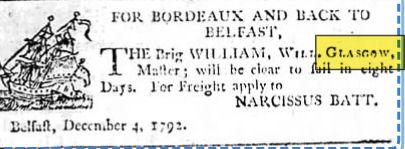
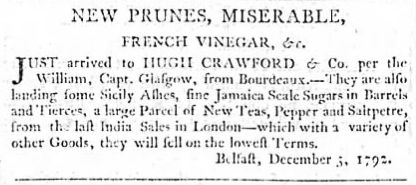
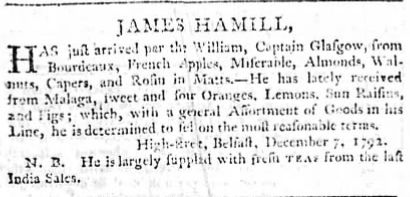
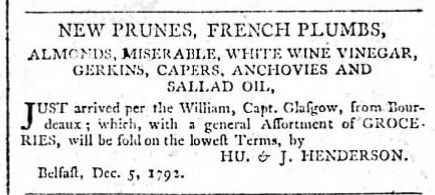
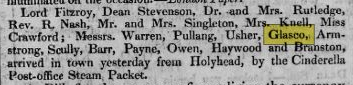
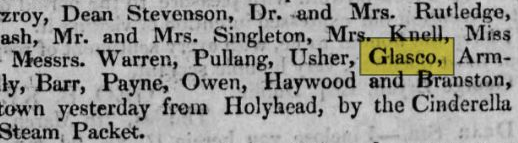
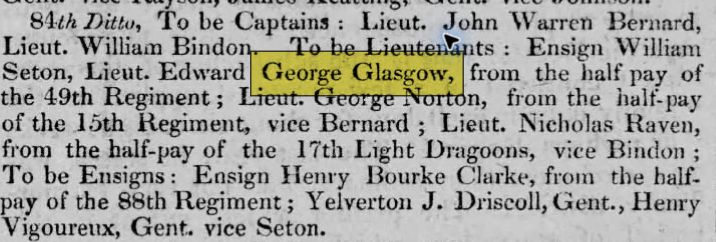
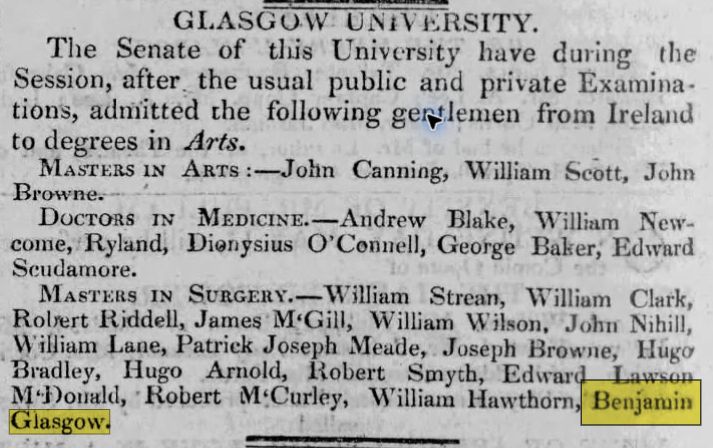
Reported events, notices, advertisements and letters. OCR matches need visual checking; place names, vessels and matches to other surnames are excluded from Glasgow surname evidence.
275 distinct notices · 439 newspaper pages
Reviewed newspaper notices
275 distinct notices from 439 retained pages, earliest first. Reprints of the same notice are merged; 439 pages have saved inline excerpts. Open a notice for its clipping, reading and profile assessment.
How to read these notices
Cards lead with the person named in the notice; profile candidates are assessed separately. Birth cutoffs labelled “by c.” are estimates, usually assuming an adult professional was at least 18; open the birth note for the basis. Event groups are broad navigation aids built from each notice’s record type. A relationship filter identifies family wording in the notice, not a proved match to a WikiTree family.
275 distinct notices · 439 retained pages
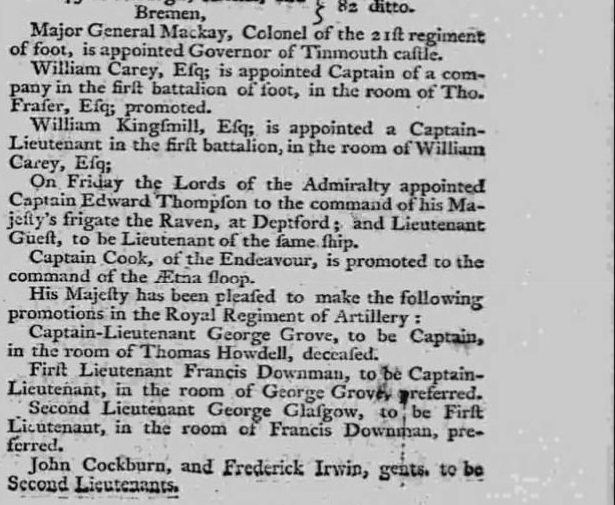
1737Verified surname passagemilitary/church appointmentStrong match
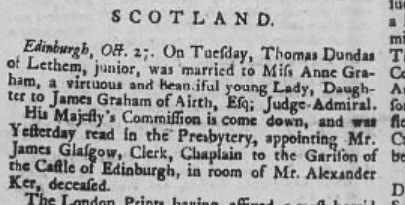
James Glasgow
Edinburgh Castle garrisonb. by c. 1719 adult estimate
Appointed chaplain to Edinburgh Castle garrison; commission reported read in presbytery.
Birth estimate / source
Adult clerical role (styled Clerk/chaplain) in 1737, assuming 18+; age not stated
Occupation / trade
Published 1737-11-03 · The Daily Gazetteer · p. 1
Faithful bounded excerpt of the inspected original. Supplemental context is separately preserved where needed; issue metadata supplied by Newspapers.com. Source reference: The Daily Gazetteer · 1737-11-03 · p. 1. Open for full size; inspect the original page for context.
What the notice says
James Glasgow, styled Clerk, is appointed chaplain to the garrison of Edinburgh Castle by a royal commission reported read in the presbytery.
Evidence and identity limits
Full notice retained with Scotland section heading, Edinburgh dateline, preceding sentence, full appointment sentence and following paragraph start. Printed long-s glyph in Glasſgow is f-shaped and can produce OCR Glafgow; normalized surname reading Glasgow. 'Yesterday' refers to the Edinburgh Oct. 21 dateline; identity with the 1738 notice is not asserted. The 1737 and 1738 notices are a probable same-officeholder sequence, not a proved profile identity. Clerk is a clerical style, not evidence of a separate clerk occupation. Neither relative date is calculated from the newspaper issue date. Identity review (6 October 2026): 1737 Edinburgh report that James Glasgow, Clerk, was commissioned chaplain to the Edinburgh Castle garrison. Fasti and the Kilbirnie Fasti entry identify the Castle minister as James, son of Rev. John Glasgow of Kilbirnie and Margaret Scott: Glasgow-1140, strong.
[b. c. 1700-03-17; d. ?] · appointee, chaplain/minister of Edinburgh Castle garrisonWhy this candidate?
Fasti Ecclesiae Scoticanae, new ed., vol. 1 (1915), Edinburgh Castle: 'JAMES GLASGOW, M.A. (Glasgow, 10th March 1718); commissioned by George II. 7th July 1737; ord. 14th Feb. 1738; died 9th Feb. 1746, aged about 48'. The notice's commission read in presbytery on 20 Oct 1737 ('yesterday' in the Edinburgh 21 Oct report) follows that 7 July 1737 commission. Fasti vol. 3 (1920), Kilbirnie, under JOHN GLASGOW, minister 1688-1721: 'He marr. (1) Jean ... Cunningham ... and had issue - Robert of Puddockholme, ancestor of the Montgreenan family: (2) Margaret Scott, and had issue - James, min. of Edinb
1738Verified surname passageordination noticeStrong match
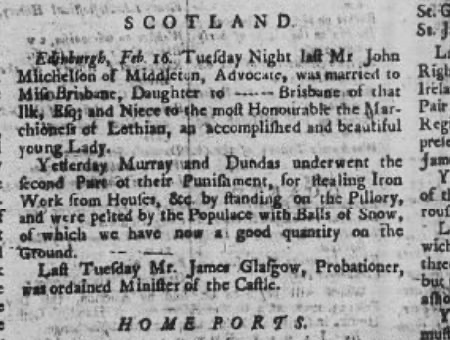
James Glasgow
Place not statedb. by c. 1720 adult estimate
Reported ordained minister of the Castle.
Birth estimate / source
Adult estimate from ordination as minister in 1738, assuming 18+; age not stated.
Occupation / trade
Published 1738-02-23 · The Daily Gazetteer · p. 1
Faithful bounded excerpt of the inspected original. Supplemental context is separately preserved where needed; issue metadata supplied by Newspapers.com. Source reference: The Daily Gazetteer · 1738-02-23 · p. 1. Open for full size; inspect the original page for context.
What the notice says
James Glasgow, probationer, is reported ordained minister of the Castle in an Edinburgh-datelined notice.
Evidence and identity limits
Full Scotland context retained, including dateline and complete Glasgow ordination sentence. The printed long-s glyph in Glasſgow is f-shaped and can produce OCR Glafgow; normalized surname reading Glasgow. Relative 'Last Tuesday' belongs to the Edinburgh Feb. 16 report, not the issue publication date. This notice is not linked to the 1737 appointment or to a profile here. The 1737 and 1738 notices are a probable same-officeholder sequence, not a proved profile identity. Clerk is a clerical style, not evidence of a separate clerk occupation. Neither relative date is calculated from the newspaper issue date. Identity review (6 October 2026): 1738 report that James Glasgow, probationer, was ordained minister of the Castle 'last Tuesday', which is 14 Feb 1738 exactly as in Fasti. He is the same man as the 1737 appointee: Glasgow-1140, strong.
[b. c. 1700-03-17; d. ?] · ordinand, minister of Edinburgh CastleWhy this candidate?
Fasti vol. 1: 'ord. 14th Feb. 1738'. The Edinburgh report dated Thursday 16 Feb 1738 (Old Style) says 'last Tuesday', and 14 Feb 1738 Julian was a Tuesday, so the date and office agree exactly. Fasti vol. 3 (Kilbirnie) names 'James, min. of Edinburgh Castle' as the son of Rev. John Glasgow and Margaret Scott, which is Glasgow-1140's baptism (Kilbirnie, 17 Mar 1700). The full argument and competitor eliminations are in group 1142270617.
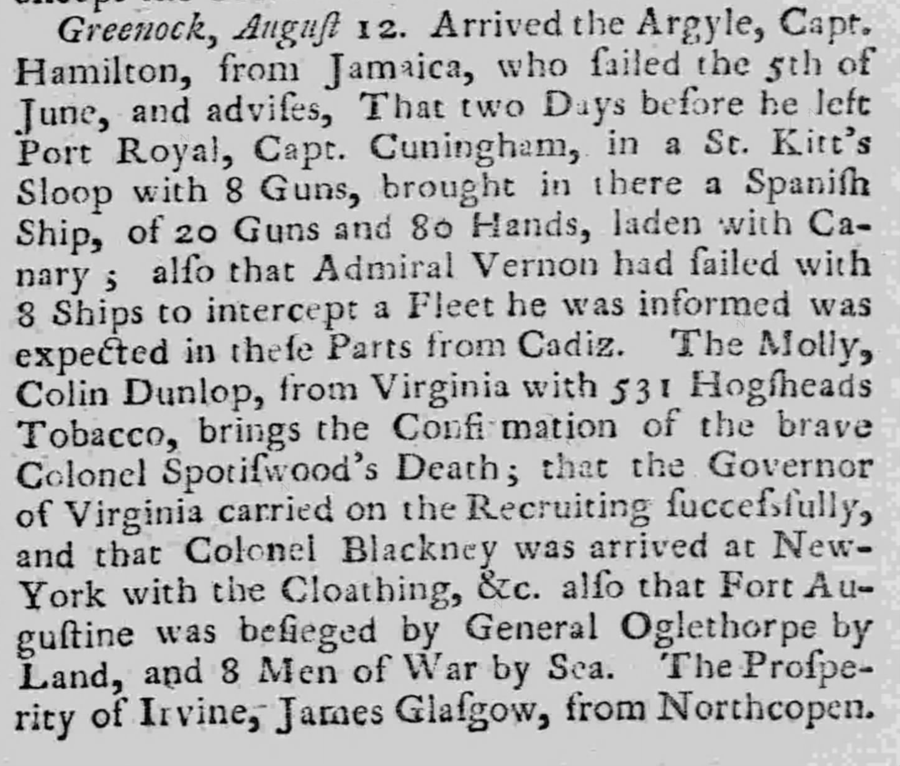
Named in a shipping line for The Prosperity of Irvine from Northcopen; exact role is not stated in the supplied reading.
Published 1740-08-18 · The Caledonian Mercury · p. 3
Bounded excerpt checked against the original on 4 October 2026; the issue heading is outside the crop. Source reference: The Caledonian Mercury · 1740-08-18 · p. 3. Open for full size; inspect the original page for context.
What the notice says
The Prosperity of Irvine, James Glasgow, from Northcopen.
Evidence and identity limits
James Glasgow appears in the master position in an arrival list under Greenock, August 12. The report supports a shipmaster inference; it supplies no age or relatives. Identity review (6 October 2026): 1740 Greenock arrival of the Prosperity of Irvine, master James Glasgow, from 'Northcopen'. A real Irvine shipmaster, but several Irvine James Glasgows fit and nothing in the notice separates them; no relationship is stated.
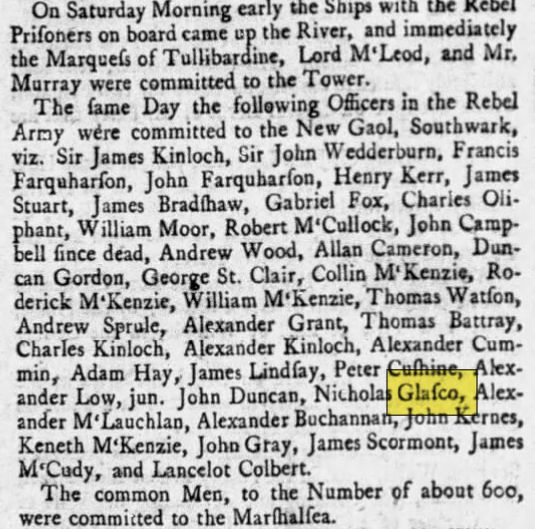
New Gaol, Southwark (reported confinement)b. by c. 1728 adult estimate
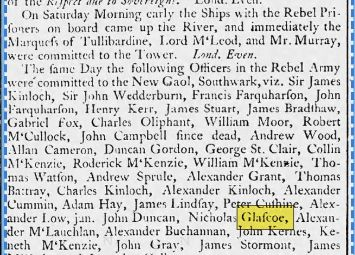
Listed among officers in the rebel army reported committed to New Gaol.
Birth estimate / source
Adult role: officer in rebel army in 1746; age unstated; estimate assumes the role holder was at least 18.
Occupation / trade
Published 1746-06-20 · Weekly Worcester Journal · p. 4
Complete prisoner-roster paragraph. Nicholas Glasco is reported among rebel-army officers committed to New Gaol, Southwark; conviction and individual rank are not stated. Date follows provider metadata. Source reference: Weekly Worcester Journal · 1746-06-20 · p. 4. Open for full size; inspect the original page for context.
What the notice says
Nicholas Glasco appears in the list of officers in the rebel army reported committed to New Gaol, Southwark.
Evidence and identity limits
Original roster inspected. Printed Glasco is retained as a surname variant; no Glasgow-family or Irish identity is established. This reports committal, not conviction or an individual rank. No compatible historical profile found in the bounded local lookup; a complete documentary draft is linked. Issue date follows provider metadata; masthead date has not been separately checked. Identity review (6 October 2026): 1746 Worcester roster of Jacobite officers committed to New Gaol, Southwark, naming Nicholas Glasco. He is Nicholas Glascoe/Glasgow, a French-born officer of Dillon's regiment and major in Ogilvy's; there is no WikiTree profile, so a new profile is needed. No compatible WikiTree profile after a duplicate search for: Nicholas Glasco (new-profile draft pending).
1746Verified surname passagecriminal proceedingPrinted in 4 issuesNo profile yet
Nicholas Glascoe
New Goal (location as printed)Birth unknown
described as calling himself Major Glascoe · reported as a principal engineer among the rebels · accused of raising a battery against the Hazard sloop of war and imprisoning its captain and officers; reported to be awaiting trial
Occupation / trade
Published 1746-06-27 – 1746-06-30 · The Weekly Worcester Journal · p. 2
CUA supported Newspapers.com viewer screenshot; bounded legible PNG crop; not a source-scan download; long s normalized in the maintained reading. Issue metadata follows Newspapers.com unless noted. Source reference: The Weekly Worcester Journal · 1746-06-27 · p. 2. Open for full size; inspect the original page for context.
What the notice says
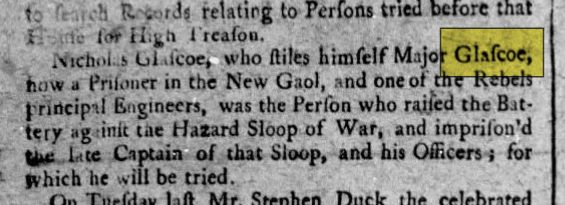
Nicholas Glascoe, who styles himself Major Glascoe, now a Prisoner in the New Goal, and one of the Rebels principal Engineers, was the Person who rais'd the Battery against the Hazard Sloop of War, and imprison'd the late Captain of that Sloop, and his Officers; for which he will be tried.
Evidence and identity limits
Reprint of the June Nicholas Glascoe allegation and self-styled rank. Original issue retained; neither guilt nor official rank is established. Identity review (6 October 2026): June 1746 reprinted report that Nicholas Glascoe, self-styled Major and a principal rebel engineer, raised the battery against the Hazard sloop and would be tried. This is the same Nicholas as the TNA SP 36 records; no WikiTree profile. No compatible WikiTree profile after a duplicate search for: Nicholas Glascoe ('Major Glascoe') (new-profile draft pending).
Listed among rebel-army officers reported committed to New Gaol, Southwark.
Occupation / trade
Published 1746-06-30 · The Western Flying Post; or, Sherborne and Yeovil Mercury (The Sherborne Mercury, or Weekly Advertiser) · p. 2
CUA supported Newspapers.com viewer screenshot; bounded legible PNG crop; not a source-scan download; long s normalized in the maintained reading. Issue metadata follows Newspapers.com unless noted. Source reference: The Western Flying Post; or, Sherborne and Yeovil Mercury (The Sherborne Mercury, or Weekly Advertiser) · 1746-06-30 · p. 2. Open for full size; inspect the original page for context.
What the notice says
Nicholas Glascoe is listed among officers in the rebel army reported committed to New Gaol, Southwark.
Evidence and identity limits
Reported committal, not conviction. This roster lists Alexander Low junior after Nicholas; its wording is not copied from the earlier Worcester roster. Identity review (6 October 2026): Sherborne Mercury roster of Jacobite officers committed to New Gaol, Southwark, including Nicholas Glascoe. Same man; no WikiTree profile. No compatible WikiTree profile after a duplicate search for: Nicholas Glascoe (new-profile draft pending).
1746Verified surname passageindictment / military servicePrinted in 6 issuesNo profile yet
Nicholas Glascoe
Place not statedb. by c. 1728 adult estimate
Listed as a major in the indictment; said to have raised the battery against the Hazard sloop and taken her.
Birth estimate / source
Adult estimate from major in military command in 1746, assuming 18+; age not stated.
Occupation / trade
Published 1746-08-22 – 1746-09-02 · The Weekly Worcester Journal · p. 4
CUA supported Newspapers.com viewer screenshot; bounded legible PNG crop; not a source-scan download; long s normalized in the maintained reading. Issue metadata follows Newspapers.com unless noted. Source reference: The Weekly Worcester Journal · 1746-08-22 · p. 4. Open for full size; inspect the original page for context.
What the notice says
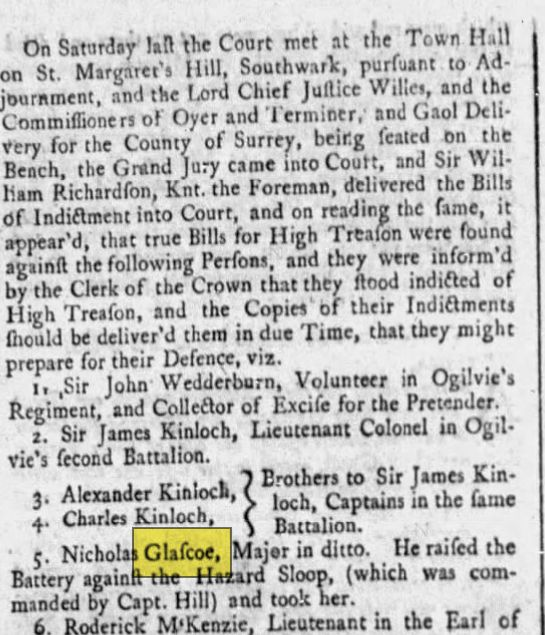
An indictment list for High Treason at St Margaret’s Hill, Southwark, includes “5. Nicholas Glascoe, Maj. in ditto. He raised the Battery against the Hazard Sloop (which was commanded by Capt. Hill) and took her.”
Evidence and identity limits
Reprinted indictment list, not proof of guilt. Each issue and clipping is preserved; repeated text is presented together. Identity review (6 October 2026): Reprinted Aug-Sep 1746 indictment list: '5. Nicholas Glascoe, Maj. in ditto' who took the Hazard sloop. Same man; no WikiTree profile. No compatible WikiTree profile after a duplicate search for: Nicholas Glascoe, Maj. (new-profile draft pending).
Named among officers or prisoners in a report on the 1746 proceedings.
Published 1746-09-21 · S Gravenhaegse Courant · p. 1
Newspapers.com original-page JPG saved through the visible CUA page controls; bounded PNG made by a pixel-preserving crop of that downloaded JPG. No image retouching or OCR reconstruction.; long s normalized in the maintained reading. Issue metadata follows Newspapers.com unless noted. Source reference: S Gravenhaegse Courant · 1746-09-21 · p. 1. Open for full size; inspect the original page for context.
What the notice says
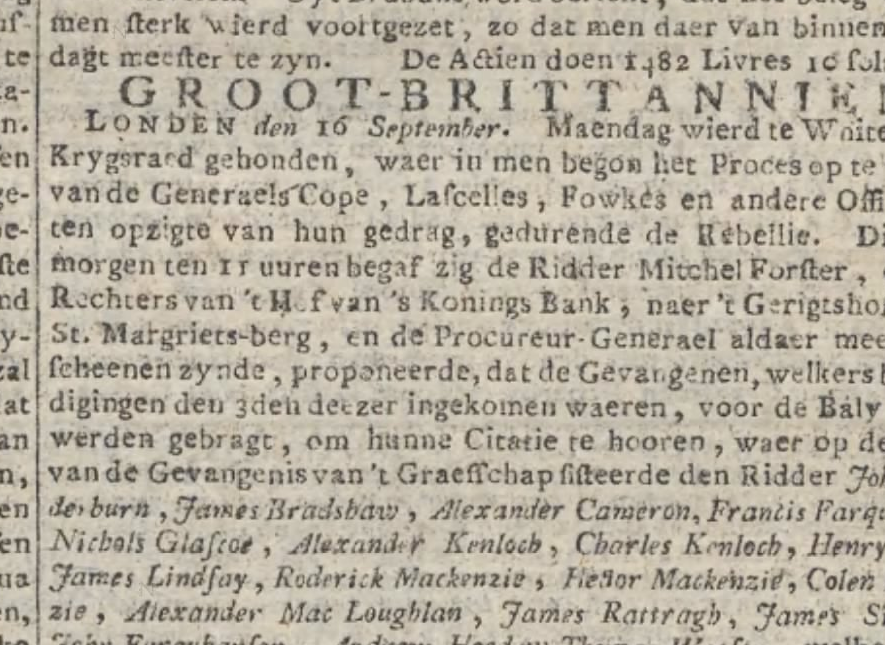
A Dutch London report dated 16 September lists Nicolas Glascoe among named officers or prisoners in the 1746 proceedings.
Evidence and identity limits
Original Dutch passage verified. This is a cautious English summary of the named list; detailed legal wording has not been translated or equated with the English indictment notice. Identity review (6 October 2026): Dutch report (16 Sept 1746) listing Nicolas Glascoe among Jacobite officers/prisoners. He is the Irish-French Major Nicholas Glascoe of Ogilvy's regiment; no WikiTree profile exists. No compatible WikiTree profile after a duplicate search for: Nicolas Glascoe.
Trial adjourned; accused of raising the battery against and taking the Hazard sloop. · Reported to call himself a French officer.
Birth estimate / source
Adult role: army major in 1746; age unstated; estimate assumes the role holder was at least 18.
Occupation / trade
Published 1746-11-07 · The Derby Mercury · p. 3
Bounded original passage visually checked; long s is transcribed as s. Issue date follows provider metadata. Saved from the accessible original viewer. Source reference: The Derby Mercury · 1746-11-07 · p. 3. Open for full size; inspect the original page for context.
What the notice says
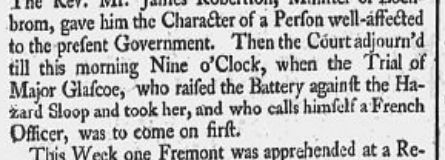
The Court adjourned until nine o’clock, when the trial of Major Glascoe, who raised the battery against the Hazard Sloop and took her, and who calls himself a French Officer, was to come on first.
Evidence and identity limits
Trial scheduling report; neither a verdict nor independent proof of French military service. Identity review (6 October 2026): Nov 1746 Derby Mercury: trial of Major Glascoe, who took the Hazard sloop and calls himself a French officer, to come on first. Probably Nicholas Glascoe from the unique Hazard detail; no WikiTree profile. No compatible WikiTree profile after a duplicate search for: Major Glascoe (forename not printed) (new-profile draft pending).
1746Verified surname passagetrial reportPrinted in 2 issuesNo profile yet
Nicholas Glascoe
St Germain-en-Laye, France (birthplace as reported)Birth unknown
described as Major in Lord Ogilvie’s Second Battalion · defence evidence described him as a lieutenant in Dillon’s Regiment in French service and native of France, born at St Germain-en-Laye · reported tried and acquitted; order to detain him as a French prisoner
Occupation / tradeBirth
Published 1746-11-08 – 1746-11-17 · The Newcastle Weekly Courant · p. 3
Bounded original passage visually checked; long s is transcribed as s. Issue date follows provider metadata. Saved from the accessible original viewer. Source reference: The Newcastle Weekly Courant · 1746-11-08 · p. 3. Open for full size; inspect the original page for context.
What the notice says
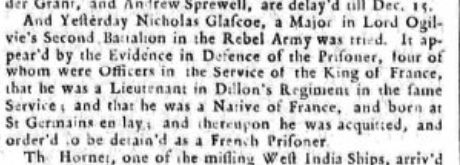
Nicholas Glascoe, described as a Major in Lord Ogilvie’s Second Battalion, was tried. Defence evidence described him as a lieutenant in Dillon’s Regiment in French service and a native of France, born at St Germain’s en lay. The paper reports acquittal and an order to detain him as a French prisoner.
Evidence and identity limits
Reported defence evidence and outcome, requiring comparison with original legal and military records. The paper does not identify relatives or a birth date. The 17 November reprint adds a Not Guilty verdict and removal of his bolts; the saved excerpt stops before the full cartel articles. Identity review (6 October 2026): Nov 1746 trial report: Nicholas Glascoe, Major in Ogilvie's 2nd battalion, proved a lieutenant in Dillon's and native of St Germain-en-Laye, was acquitted and detained as a French prisoner. TNA cabinet minute SP 36/89/2/32 (14 Nov 1746) independently records the acquittal. No WikiTree profile. No compatible WikiTree profile after a duplicate search for: Nicholas Glascoe (new-profile draft pending).
1746Verified surname passagecourt reportPrinted in 2 issuesNo profile yet
Major Glascoe
SouthwarkBirth unknown
Reported acquitted by direction of court after witnesses were examined and counsel opened the cartel signed at Francfort.
Occupation / trade
Published 1746-11-17 – 1746-11-18 · The Western Flying Post; or, Sherborne and Yeovil Mercury · p. 2
Newspapers.com original-page JPG saved through the visible CUA page controls; bounded PNG made by a pixel-preserving crop of that downloaded JPG. No image retouching or OCR reconstruction.; long s normalized in the maintained reading. Issue metadata follows Newspapers.com unless noted. Source reference: The Western Flying Post; or, Sherborne and Yeovil Mercury · 1746-11-17 · p. 2. Open for full size; inspect the original page for context.
What the notice says
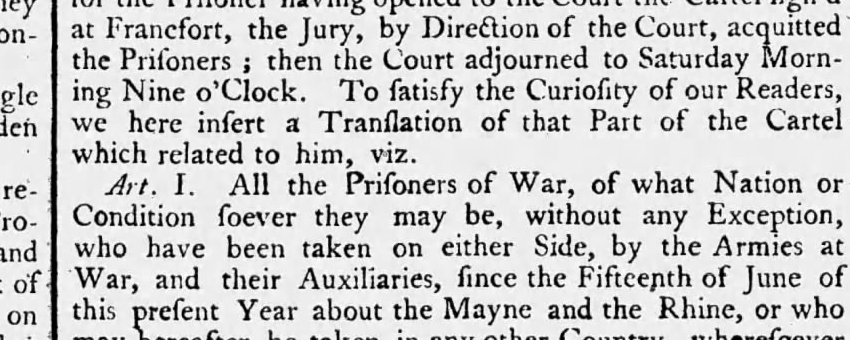
A Southwark report says Major Glascoe was acquitted by direction of the court after witnesses were examined and counsel opened the cartel signed at Francfort. A translated portion of the cartel follows.
Evidence and identity limits
Likely the Nicholas case, without a forename in this passage. The articles are preserved in the excerpt but their complete legal effect has not been assessed. No conviction is stated. Identity review (6 October 2026): Nov 1746 Southwark report: Major Glascoe acquitted by direction of the court on the Frankfurt cartel. This is Nicholas, by the Hazard/cartel context and TNA SP 36/89/2/32; no WikiTree profile. No compatible WikiTree profile after a duplicate search for: Major Glascoe (forename not printed) (new-profile draft pending).
Reported as a major in Lord Ogilvie’s second battalion and formerly lieutenant in Dillon’s Regiment in French service. · A Dutch report says an order was made to treat him as a prisoner of war.
Occupation / tradeBirth
Published 1746-12-01 · Opregte Haarlemsche Courant · p. 1
Newspapers.com original-page JPG saved through the visible CUA page controls; bounded PNG made by a pixel-preserving crop of that downloaded JPG. No image retouching or OCR reconstruction.; long s normalized in the maintained reading. Issue metadata follows Newspapers.com unless noted. Source reference: Opregte Haarlemsche Courant · 1746-12-01 · p. 1. Open for full size; inspect the original page for context.
What the notice says
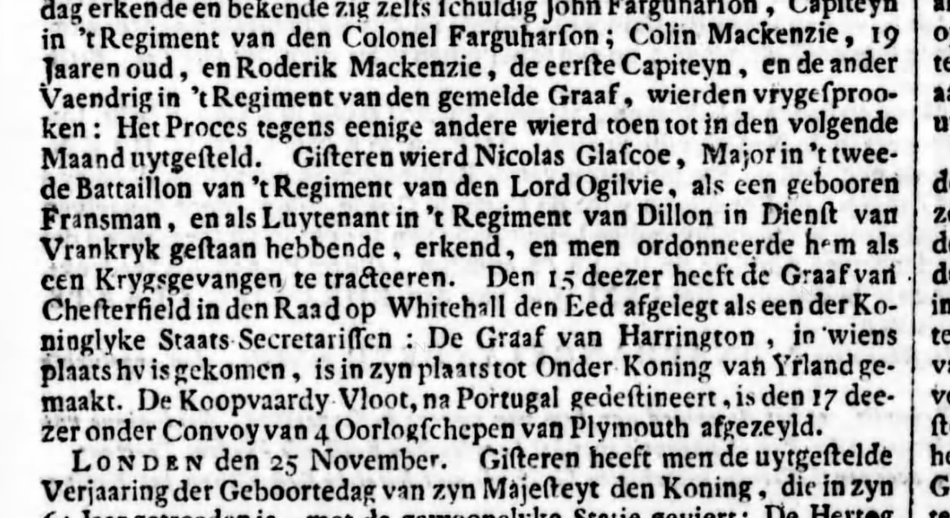
A Dutch report names Nicolas Glascoe, major in Lord Ogilvie’s second battalion, as French-born and formerly a lieutenant in Dillon’s Regiment in French service; it reports an order to treat him as a prisoner of war.
Evidence and identity limits
Working English summary of the original Dutch. The passage does not give a birth date, relatives or the specific French town named in other reports. Identity review (6 October 2026): Dutch report (Dec 1746) on Major Nicolas Glascoe of Ogilvy's 2nd battalion, French-born ex-lieutenant of Dillon's, to be treated as a prisoner of war. Same man as group 1334222061; no WikiTree profile. No compatible WikiTree profile after a duplicate search for: Nicolas Glascoe.
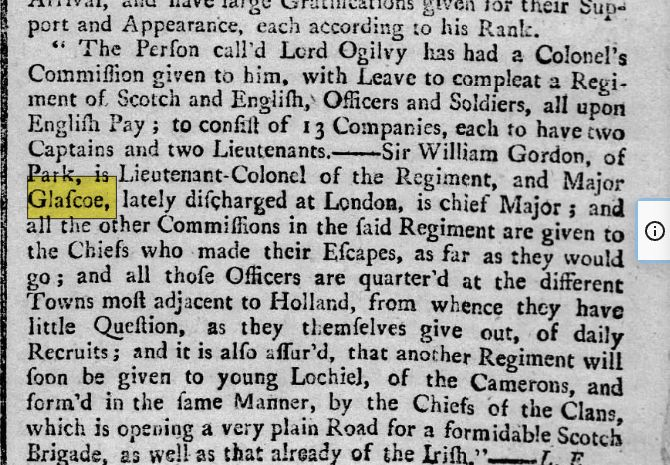
Reported as chief major in Lord Ogilvy’s projected regiment of thirteen companies, on English pay; lately discharged at London.
Birth estimate / source
Age is not printed; inferred only as an adult lower bound from the stated professional role (military major), assuming age 18 or older by the 1747 issue year.
Occupation / trade
Published 1747-04-28 · Gloucester Journal · p. 1
CUA supported viewer screenshot; bounded crop, no browser chrome; not a downloaded source scan; long s normalized in the maintained reading. Issue metadata follows Newspapers.com unless noted. Source reference: Gloucester Journal · 1747-04-28 · p. 1. Open for full size; inspect the original page for context.
What the notice says
Major Glascoe, lately discharged at London, is reported as chief major in Lord Ogilvy’s projected regiment of thirteen companies, on English pay. Officers are said to be quartered near Holland.
Evidence and identity limits
Probable contextual association with Nicholas in the 1746 proceedings; no forename or independent military-service bridge. The pay wording is not interpreted as British army service. Identity review (6 October 2026): April 1747 report: Major Glascoe, lately discharged at London, chief major in Lord Ogilvy's new regiment. Probably Nicholas: 'lately discharged at London' follows the Nov 1746 acquittal, and Hayes has him as major in Ogilvy's. No WikiTree profile. No compatible WikiTree profile after a duplicate search for: Major Glascoe (forename not printed) (new-profile draft pending).
1747Verified surname passagemilitary appointmentPrinted in 2 issuesNo profile yet
Major Glascoe (forename unknown)
Lord Ogilvy’s regiment (being raised)b. by c. 1729 adult estimate
Named “Mr Glascoe Major” in the regiment Lord Ogilvy was raising.
Birth estimate / source
Adult role: regimental major in 1747; age unstated; estimate assumes the role holder was at least 18.
Occupation / trade
Published 1747-05-08 – 1747-05-09 · The Weekly Worcester Journal · p. 2
Newspapers.com original-page JPG saved through the visible CUA page controls; bounded PNG made by a pixel-preserving crop of that downloaded JPG. No image retouching or OCR reconstruction.; long s normalized in the maintained reading. Issue metadata follows Newspapers.com unless noted. Source reference: The Weekly Worcester Journal · 1747-05-08 · p. 2. Open for full size; inspect the original page for context.
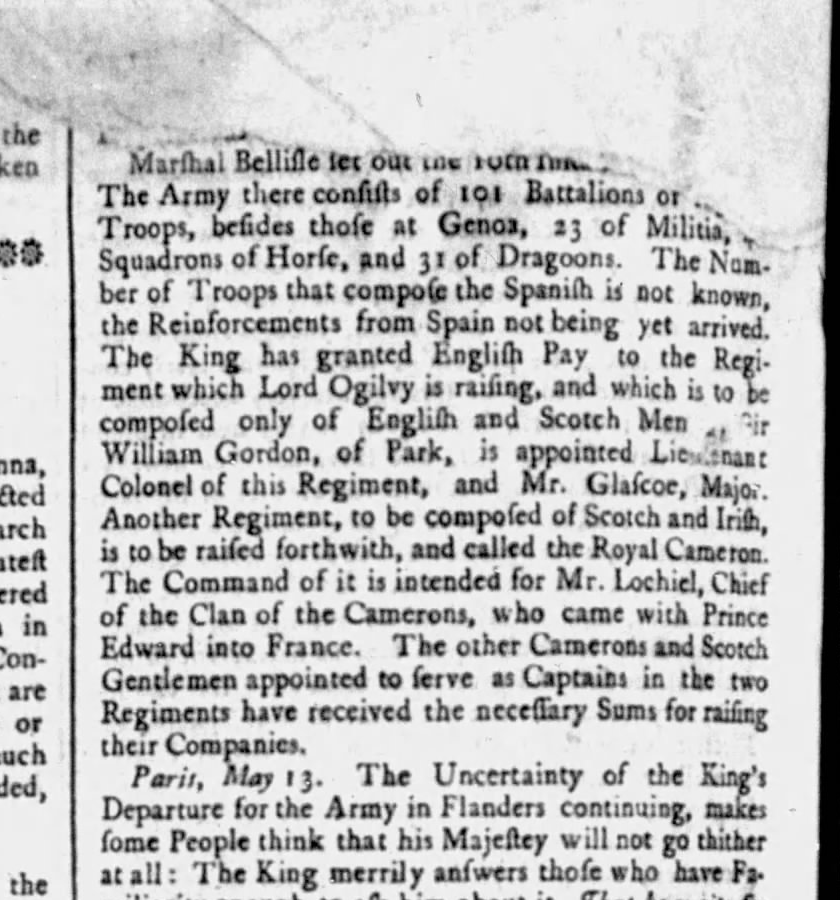
What the notice says
The King has granted English Pay to the Regiment which Lord Ogilvy is raising, to be composed only of English and Scotch Men. Sir William Gordon of Park is appointed lieutenant-colonel, and “Mr Glascoe Major.”
Evidence and identity limits
Reprint of the Ogilvy regiment report. No forename; Nicholas is a probable contextual candidate, not a proved identification. English pay is not interpreted as British service. Identity review (6 October 2026): May 1747 report naming 'Mr Glascoe Major' in Lord Ogilvy's regiment under Sir William Gordon of Park. Probably Nicholas; no WikiTree profile. No compatible WikiTree profile after a duplicate search for: Mr Glascoe, Major (forename not printed) (new-profile draft pending).
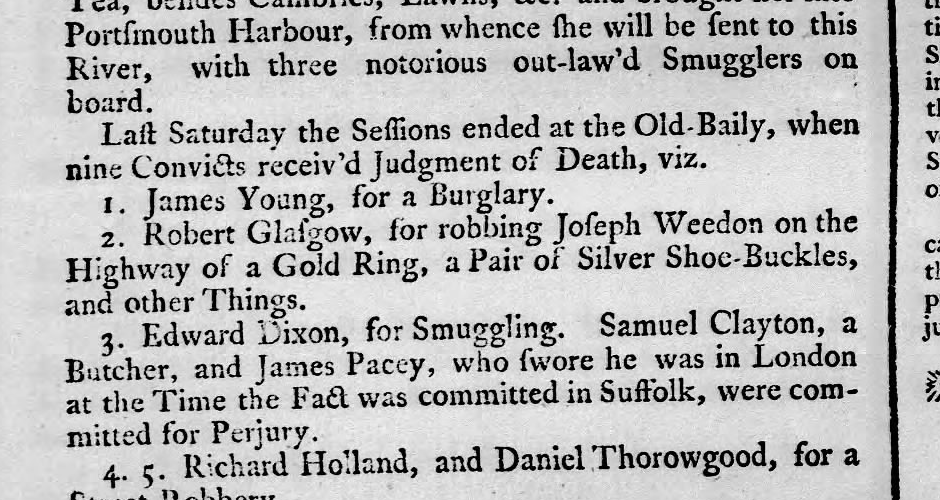
received judgment of death among nine convicts · convicted of highway robbery involving Joseph Weedon’s gold ring, silver shoe buckles and other property
Published 1751-07-16 · The Gloucester Journal · p. 2
Faithful bounded excerpt of the inspected original. Supplemental context is separately preserved where needed; issue metadata supplied by Newspapers.com. Source reference: The Gloucester Journal · 1751-07-16 · p. 2. Open for full size; inspect the original page for context.
What the notice says
Robert Glasgow is reported among nine Old Bailey convicts receiving judgment of death, for highway robbery of Joseph Weedon’s gold ring, silver shoe buckles and other things.
Evidence and identity limits
A conviction/sentence report. The Last Saturday trial reference has no saved report dateline; no exact trial date inferred. This is not proof of actual execution, death or family identity. Identity review (6 October 2026): July 1751 report that Robert Glasgow was among nine Old Bailey convicts sentenced to death for robbing Joseph Weedon. The Ordinary's Account shows he was a butcher aged 28, born at Chipping Ongar, Essex. All three Scottish candidates conflict, so he has no WikiTree profile and needs a new one. No compatible WikiTree profile after a duplicate search for: Robert Glasgow (new-profile draft pending).
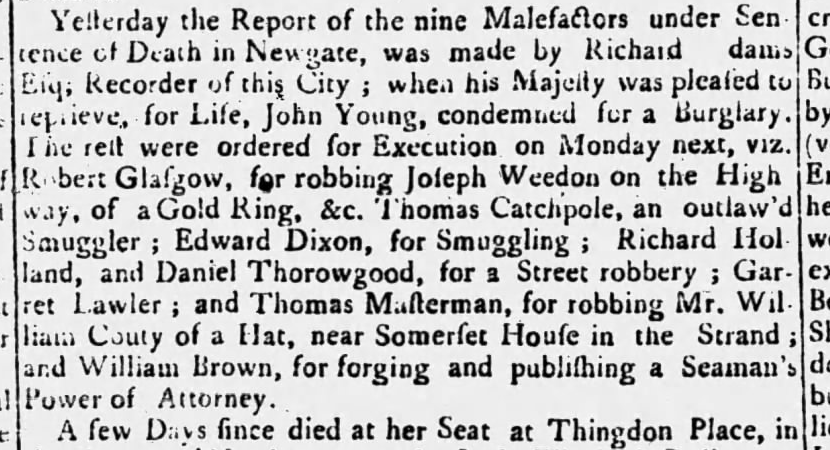
Condemned for robbing Joseph Weedon on the highway; included among Newgate prisoners ordered for execution.
Published 1751-07-29 · The Western Flying Post; or, Sherborne and Yeovil Mercury · p. 2
Faithful bounded excerpt of the inspected original. Supplemental context is separately preserved where needed; issue metadata supplied by Newspapers.com. Source reference: The Western Flying Post; or, Sherborne and Yeovil Mercury · 1751-07-29 · p. 2. Open for full size; inspect the original page for context.
What the notice says
Robert Glasgow, condemned for robbing Joseph Weedon on the highway, is included among Newgate prisoners ordered for execution on Monday next.
Evidence and identity limits
Same named case as the 16 July sentence report, but a different reported action. John Young is the prisoner reprieved for life. This execution order does not establish that Robert was executed. Relative Yesterday and Monday next are not converted to issue-based dates. Identity review (6 October 2026): July 1751 report that Robert Glasgow was ordered for execution. The Ordinary's Account confirms he was hanged at Tyburn on Monday 29 July 1751. He has no WikiTree profile; the new profile is flagged on group 971486582. No compatible WikiTree profile after a duplicate search for: Robert Glasgow (new-profile draft pending).
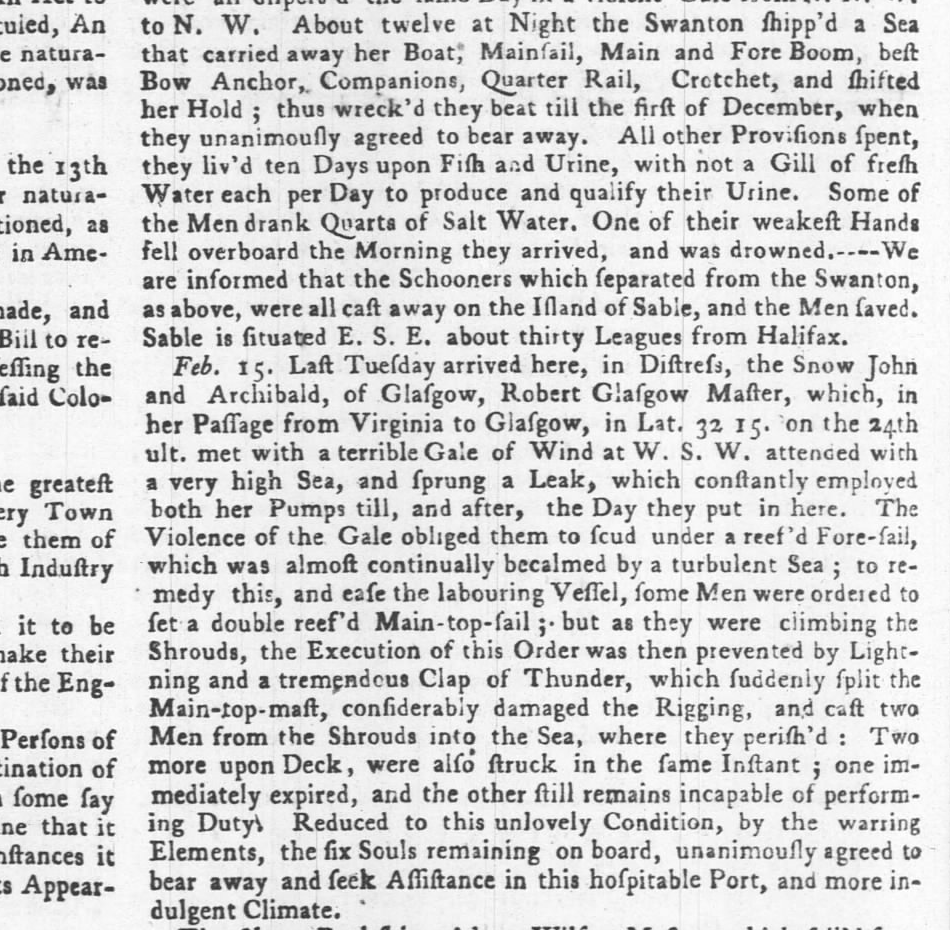
1754Verified surname passageshipping reportPrinted in 3 issuesStrong match
Robert Glasgow
Place not statedb. by c. 1736 adult estimate
Master of the snow John and Archibald, described as of Glasgow. · Reported arriving in distress on a Virginia-to-Glasgow passage.
Birth estimate / source
Adult estimate from ship master in 1754, assuming 18+; age not stated.
Occupation / trade
Published 1754-03-19 – 1754-06-27 · The Pennsylvania Gazette · p. 2
Faithful bounded excerpt of the inspected original. Supplemental context is separately preserved where needed; issue metadata supplied by Newspapers.com. Source reference: The Pennsylvania Gazette · 1754-03-19 · p. 2. Open for full size; inspect the original page for context.
What the notice says
Robert Glasgow, master of the snow John and Archibald, of Glasgow, is reported arriving in distress during a Virginia-to-Glasgow passage.
Evidence and identity limits
One distress report preserved in three issues, not three masters. Later reprints give St John’s, Antigua, 15 February. The passage describes gale damage, leakage and lightning; Glasgow is also the vessel’s designation/port, not the master’s birthplace. The preceding Swanton vessel’s provisions and urine story in the Pennsylvania page belongs to a different vessel. No family or link to the 1751 defendant established. Identity review (6 October 2026): One 1754 distress report (three printings) of Robert Glasgow, master of the snow John and Archibald of Glasgow, on a Virginia-to-Glasgow passage. WikiTree already has a documentary profile for exactly this shipmaster, Glasgow-2867, built on the Maryland Gazette printing of the same Antigua report; the notice adds no kin. Glasgow-2474 (Irvine shipmaster 1738) is a possible earlier/later identity of the same man (merge question), not a separate match.
[b. c. 1736 (estimated); d. after 1754] · master of the snow John and Archibald, of GlasgowWhy this candidate?
Glasgow-2867 is a profile whose biography is specifically 'Robert Glasgow was master of the snow John and Archibald, a vessel described in 1754 as of Glasgow', citing The Maryland Gazette no. 466 (11 Apr 1754) reprint of the St John's, Antigua, 15 Feb 1754 report and the Dublin Gazette reprint - the same report as these Pennsylvania Gazette/Gloucester Journal/Berrow's printings (same vessel, master, voyage Virginia-Glasgow, gale of 24 Jan 1754, lightning, Antigua). Name + unique vessel command + same dated event = record-level identity. Caveat: 2867's parents (William Glasgow-1026 and Ann McCook-217, status code 10, not confident) and 'death 1754 (after)' are not supported by this or any ins
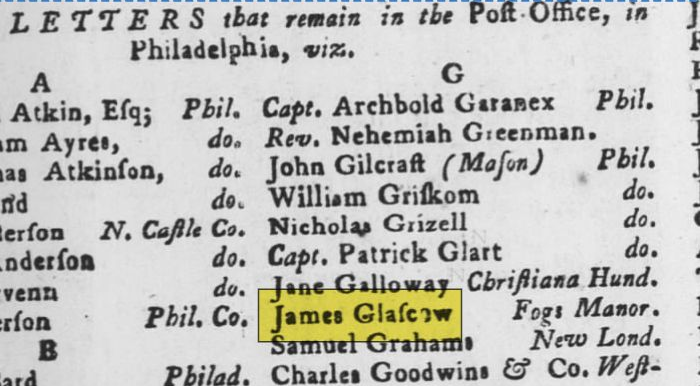
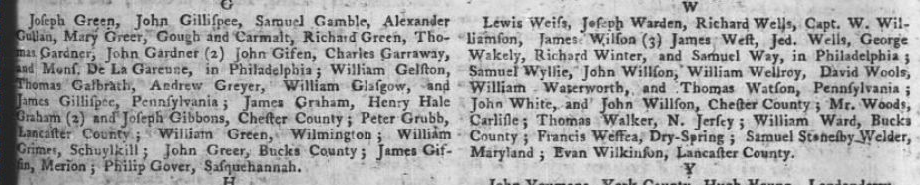
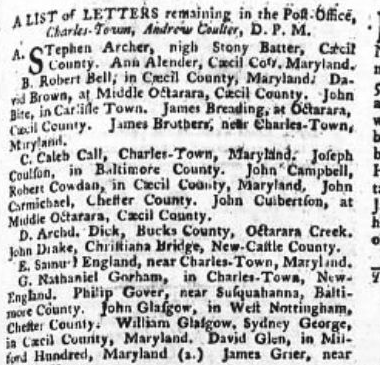
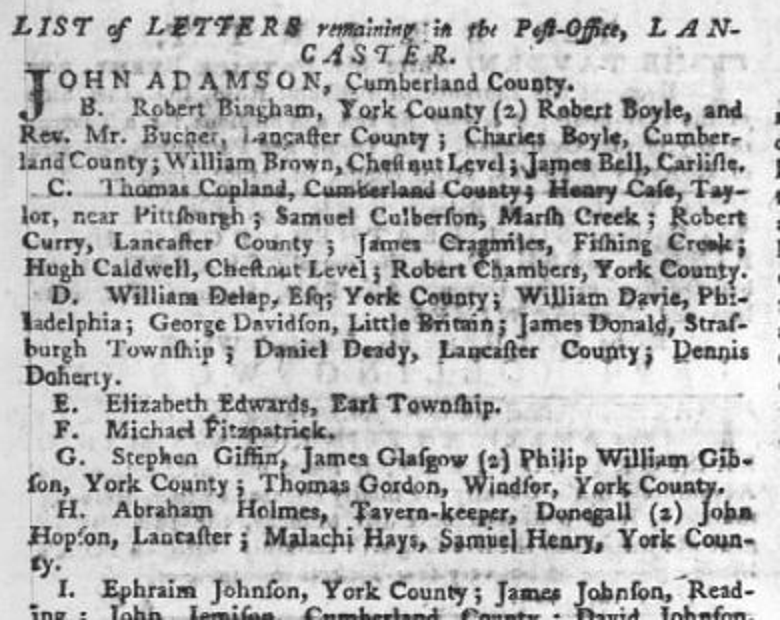
1757Verified surname passagepost-office listPossible match
James Glascow
Fogs Manor (place as printed in post-office list)Birth unknown
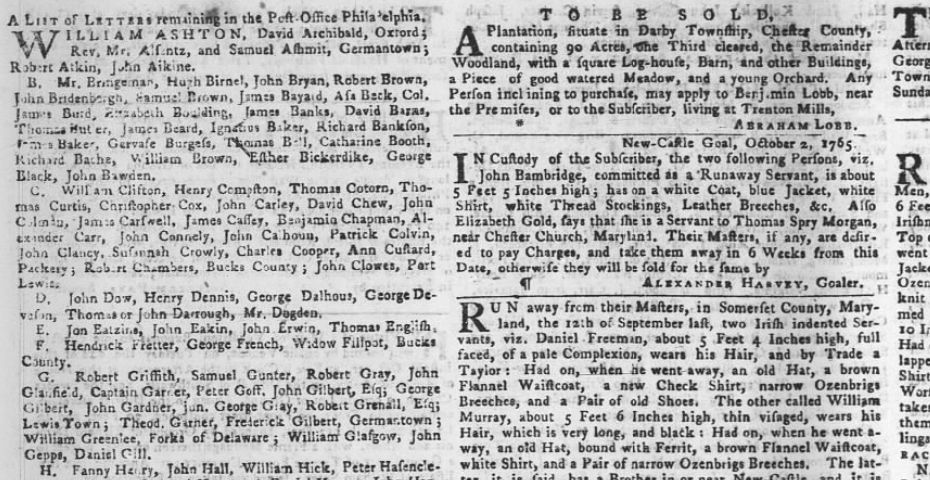
Listed among letters remaining at the Philadelphia post office.
Published 1757-04-07 · The Pennsylvania Gazette · p. 1
Faithful bounded excerpt of the inspected original; full context and identity qualifications are stated in the card. Issue metadata supplied by Newspapers.com. Source reference: The Pennsylvania Gazette · 1757-04-07 · p. 1. Open for full size; inspect the original page for context.
What the notice says
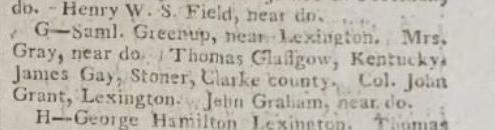
James Glascow, Fogs Manor, is listed among letters remaining in the Philadelphia post office.
Evidence and identity limits
Fogs Manor is preserved as printed. “Phil. Co.” is in the separate left-hand A column and is not assigned to James in the right-hand G column. Postal addressee only; occupation, exact jurisdiction and family are unstated. No identity bridge to the 1777 master or Irish James records. Identity review (6 October 2026): James Glascow, 'Fogs Manor' (Fagg's Manor, Londonderry Township, Chester County), 1757 Philadelphia letter list. The Chester County tax index shows a James Glascow/Glasgo landholding in Londonderry Township 1739-1740 and taxed in East/West Nottingham 1747-1758, so the addressee is very likely that local man; no WikiTree profile is documented in Chester County. Glasgow-2868 (Cecil County, d. c.1784) is the only regionally compatible profile, still only possible.
[b. 1720-02-14; d. c. 1784] · letter addressee, Fogs ManorWhy this candidate?
Fogs Manor = Fagg's Manor, the Presbyterian settlement in Londonderry Township, Chester County. Chester County Archives' 1715-1764 tax index has James Glascow/Glasgo, landholder, Londonderry 1739 and 1740, and the same name at Charlestown Twp 1735/36-1740, East Nottingham 1747/48, 1749/50, 1751, 1753, 1754 and West Nottingham 1758 - an actual resident of the Fagg's Manor/Nottingham district with the notice's own spelling 'Glascow'. WikiTree has no profile placed in Chester County. Glasgow-2868 (bap. 1720 Glencorse; colonial identity: James of Cecil County, Maryland, wife Ann Hartshorne, children born Cecil 1749-1767, d. c.1784) fits the Nottingham-Cecil border district (East/West Nottingham
1758Verified surname passagepost-office lettersPossible match
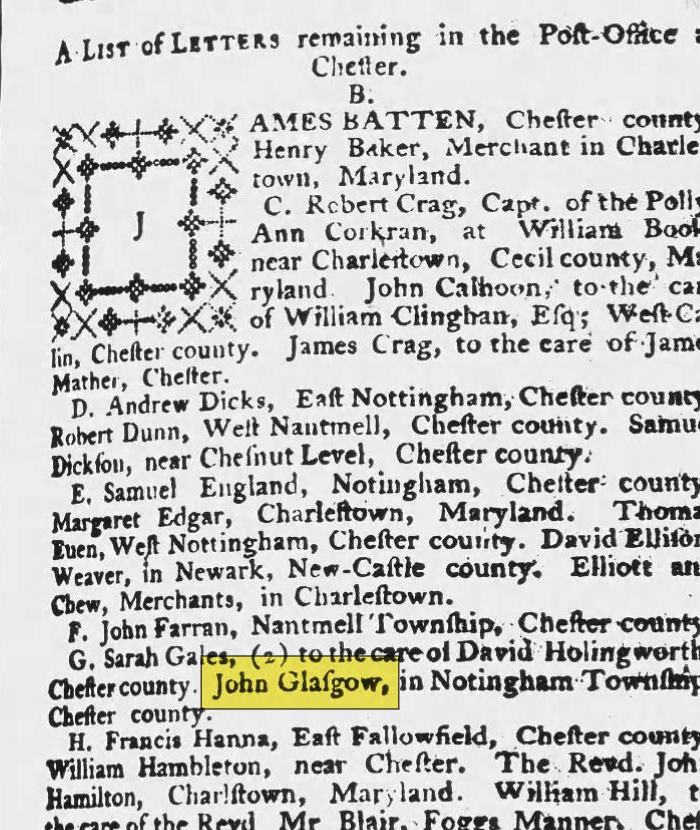
John Glasgow
Nottingham (post-office addressee)Birth unknown
Named as an addressee in letters remaining at Philadelphia post office.
Published 1758-01-12 · The Pennsylvania Gazette · p. 1
Faithful bounded original viewer excerpt; provider search highlighting retained where visible. No reconstructed text. Issue metadata supplied by Newspapers.com. Source reference: The Pennsylvania Gazette · 1758-01-12 · p. 1. Open for full size; inspect the original page for context.
What the notice says
John Glasgow, Nottingham, is an addressee in letters remaining at Philadelphia post office.
Evidence and identity limits
Postal-office and address context retained; an addressee is not proof of residence, letter collection, occupation, household or continued life. Nearby addressees and their localities are separate. The earlier Nottingham/Chester County/near-Oxford entries fit Glasgow-2870 as a probable candidate; Glasgow-2871 remains possible. This is a qualified regional documentary cluster, potentially more than one John. A postal list does not prove the addressee alive: the elder’s recorded May 1769 death does not absolutely exclude posthumous mail in 1771. No parent, spouse or child is proved by these notices. Identity review (6 October 2026): John Glasgow, Nottingham, Philadelphia letter list January 1758. No John Glasgow is on the Chester County tax lists before 1760 (the Nottingham Glasgows taxed in the 1750s are Samuel and James), so this addressee is either the young John who first appears as a West Nottingham freeman in 1760 (Glasgow-2871) or an untaxed elder; both Nottingham profiles stay possible.
[b. c. 1738; d. 1792-04-03] · letter addressee, NottinghamWhy this candidate?
Chester County tax index: John first appears in West Nottingham in 1760 as a 'Freeman' (single man), then householder 1762-1764, storekeeper 1765 and 1767, landholder to 1791; Hugh Glasgow then holds land in West Nottingham 1793-1799 (80 acres, as John did 1787-1791). That chain fits Glasgow-2871 (John, b. 1738, d. 3 Apr 1792 Chester County, father of Hugh Glasgow-2873). In 1758 that man was about 20, plausibly the addressee. Glasgow-2870 (b. 1722 Libberton, d. 23 May 1769 Nottingham per Find a Grave/family-Bible narrative) never appears as a taxed householder in Nottingham 1747-1764, which weakens the earlier 'probable' grade for him: the only basis was a shared place name and an age fit th
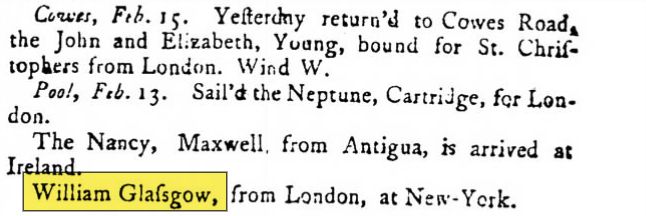
Named in a shipping report as arriving at New York from London.
Published 1758-02-18 · The Public Advertiser · p. 1
Faithful bounded original viewer excerpt; provider search highlighting retained where visible. No reconstructed text. Issue metadata supplied by Newspapers.com. Source reference: The Public Advertiser · 1758-02-18 · p. 1. Open for full size; inspect the original page for context.
What the notice says
A shipping report states: William Glasgow, from London, at New-York.
Evidence and identity limits
Adjacent entries pair vessel and master names, including The Nancy, Maxwell. Thus William is read as the vessel and Glasgow as its master’s surname; no personal forename is supplied. London and New-York are voyage context, not proved personal residence. The report supplies no exact arrival day, age, family or bridge to later masters. The master’s forename remains unknown: William is the vessel. The 1738/1754 Robert shipmaster candidate and older William namesakes are compatible comparisons, without a voyage or individual bridge. Do not identify this man with the 1792 Belfast captain solely by surname. Identity review (6 October 2026): 1758 shipping line 'William, Glasgow, from London, at New-York'. William is the vessel and Glasgow the master's surname; the master's forename is unknown, so he cannot be identified.
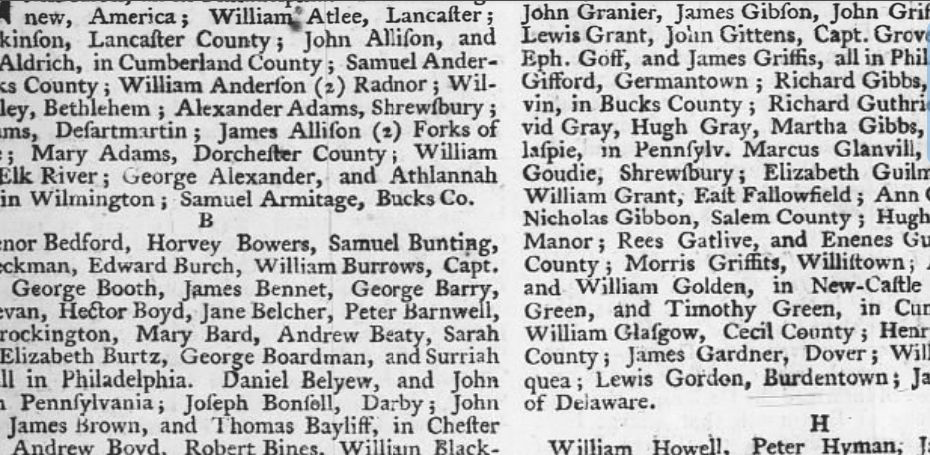
1759Verified surname passagepost-office listPossible match
William Glasgow
Cecil County, MarylandBirth unknown
Named among letters remaining at Philadelphia post office.
Place / address
Published 1759-08-09 · The Pennsylvania Gazette · p. 1
Faithful bounded excerpt of the inspected original. Supplemental context is separately preserved where needed; issue metadata supplied by Newspapers.com. Source reference: The Pennsylvania Gazette · 1759-08-09 · p. 1. Open for full size; inspect the original page for context.
What the notice says
William Glasgow, Cecil County, is listed among letters remaining in the Philadelphia post office.
Evidence and identity limits
Alphabetical postal-letter list, not a roster of residents or an advertisement. The printed long-s glyph in Glasſgow is the f-shaped character that can yield OCR Glafgow; the normalized surname reading is Glasgow. Cecil County immediately follows this entry. This is a distinct issue-page occurrence; no identity link to other Williams is inferred. Postal addressee, not proof of continuous residence, age, occupation, family, or identity across these issues. Identity review (6 October 2026): William Glasgow, Cecil County, Philadelphia letter list 1759. No WikiTree William Glasgow has any documented Maryland or Cecil County presence; the four previously listed Williams are Scottish/Irish baptism or tree profiles, one of which (Glasgow-3326) is documented in Larne in 1772 and 1783. No match above possible.
[b. c. 1735; d. c. 1829] · letter addressee, Cecil CountyWhy this candidate?
Only name + Cecil County. Glasgow-2426 (b. c.1735 'Moneymore', d. c.1829 USA; tree-sourced, no American record) is the only William with any American context, and that context is unproved. Glasgow-4101 (bap. 1733 Dundonald) and Glasgow-4120 (bap. 1723 Irvine) are baptism-only profiles: compatible but nothing points to Maryland. Glasgow-3326 (b. 1730 Kilwaughter) is unlikely: his profile documents him in Larne signing a 1772 petition and in a 1783 Larne will index. MSA's biography of Samuel Glasgow (SC 3520-17195) reports, from Cecil County probate, a William among the children of James Glasgow Sr. (d. 1784) and Ann of Cecil County - but those children were born from c.1749, so that William w
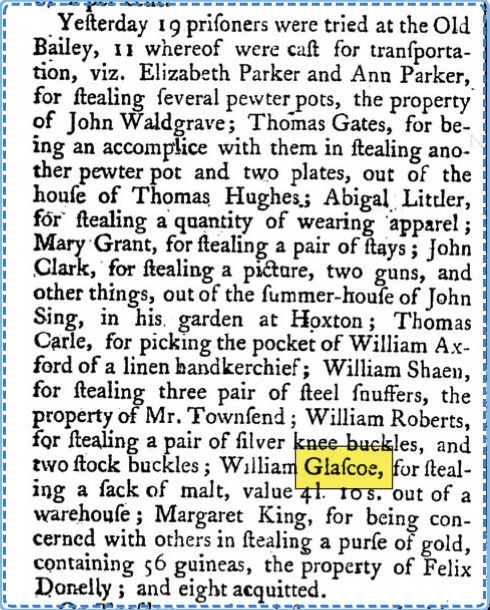
Among prisoners reportedly sentenced to transportation after Old Bailey trials for stealing a sack of malt valued at £4 10s.
Published 1760-04-18 · Public Ledger or Daily Register of Commerce and Intelligence · p. 2
CUA supported viewer screenshot; bounded crop, no browser chrome; not a downloaded source scan; long s normalized in the maintained reading. Issue metadata follows Newspapers.com unless noted. Source reference: Public Ledger or Daily Register of Commerce and Intelligence · 1760-04-18 · p. 2. Open for full size; inspect the original page for context.
What the notice says
William Glascoe is among prisoners reported sentenced to transportation after Old Bailey trials, for stealing a sack of malt from a warehouse, valued in the newspaper at £4 10s.
Evidence and identity limits
Strong candidate case match to William Glascow, Old Bailey session 16 April 1760, t17600416-27. The newspaper’s “Yesterday” and values differ from the proceedings; the session date is not asserted as the exact individual trial day. Sentence does not prove an actual voyage or Maryland arrival. Identity review (6 October 2026): 1760 report that William Glascoe was sentenced to transportation for stealing a sack of malt. The Old Bailey trial (t17600416-27) shows a London warehouse labourer. No WikiTree profile fits, so a new one is needed. No compatible WikiTree profile after a duplicate search for: William Glascoe (new-profile draft pending).
1760Verified surname passageland-sale noticePossible match
John Glasgow
Cecil County; planned Nottingham store (business context)Birth unknown
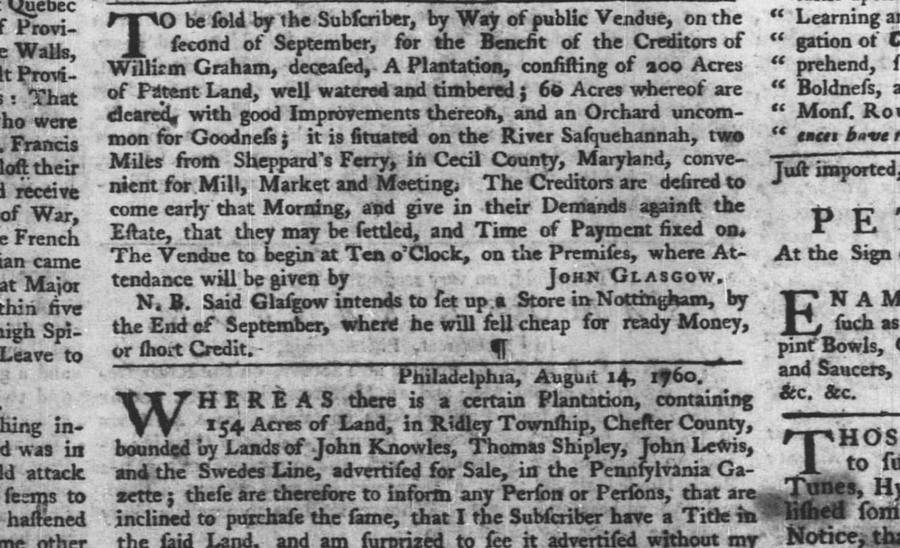
Signs a land vendue notice for William Graham’s creditors and plans to open a Nottingham store by the end of September.
Published 1760-08-14 · The Pennsylvania Gazette · p. 3
Bounded excerpt checked against the original on 4 October 2026; the issue heading is outside the crop. Source reference: The Pennsylvania Gazette · 1760-08-14 · p. 3. Open for full size; inspect the original page for context.
What the notice says
John Glasgow signs a Cecil County land vendue notice for William Graham’s creditors and plans a Nottingham store by the end of September.
Evidence and identity limits
Original inspected; candidates Glasgow-2870 and Glasgow-2871 remain unassigned. No Irish origin or family is stated. Identity review (6 October 2026): John Glasgow signs a 1760 vendue notice for William Graham's creditors (200-acre Susquehanna tract near Shepard's Ferry, Cecil County) and announces a store at Nottingham. The Chester County tax lists show John Glasgow as a West Nottingham freeman in 1760 and as storekeeper there in 1765 and 1767, with the same holding continuing to 1791 and passing to Hugh Glasgow in 1793: this is probably Glasgow-2871 (d. 1792), not the elder Glasgow-2870.
[b. c. 1738; d. 1792-04-03] · signer of creditors' vendue notice; prospective Nottingham storekeeperWhy this candidate?
Independent record chain: Chester County tax index - John Glasgow, West Nottingham, 1760 'Freeman' (the only John in Nottingham that year), 1762-1764 taxed, 1765 'Storekeeper' (50 acres), 1767 'Storekeeper' (50 acres), landholder 50 acres 1768-1786 and 80 acres 1787-1791; then Hugh Glasgow, West Nottingham, 1793-1799, 80 acres. The notice's intention to open a Nottingham store by end of September 1760 is fulfilled by the storekeeper entries; the holding series ends in 1791 and Glasgow-2871 died 3 Apr 1792 in Chester County; WikiTree and Gibson's History of York County make Hugh (b. 1769 Nottingham) his son, and Hugh takes up an 80-acre West Nottingham holding from 1793. Name + township + occ
1761Verified surname passagecriminal trial reportPrinted in 3 issuesNo profile yet
Samuel Glascow
Old Bailey, London (court)Birth unknown
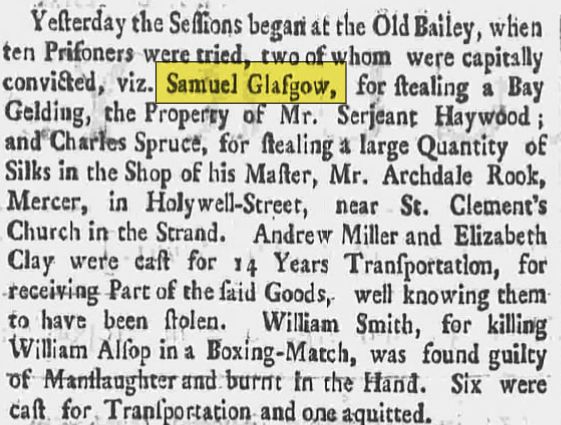
Reported capitally convicted at the Old Bailey for stealing a bay gelding belonging to Mr Serjeant Haywood.
Published 1761-05-08 – 1761-05-14 · The Derby Mercury · p. 2
Faithful bounded original source passage, visually checked 5 October 2026; long-s typography normalized to Glasgow in the reading. Issue heading outside crop; provider issue metadata retained. Source reference: The Derby Mercury · 1761-05-08 · p. 2. Open for full size; inspect the original page for context.
What the notice says
Samuel Glascow is one of two prisoners reported capitally convicted at the Old Bailey; his charge is stealing a bay gelding belonging to Mr Serjeant Haywood.
Evidence and identity limits
Two issues reprint the report that Samuel was capitally convicted for stealing Mr Serjeant Haywood’s bay gelding. The paragraph says Yesterday, but its own news dateline is outside these excerpts; do not derive a trial date from the issue day. Other defendants’ offences and punishments are separate. The existing Old Bailey case association does not identify an Ulster or Pennsylvania ancestor. Identity review (6 October 2026): May 1761 reports that Samuel Glascow was capitally convicted at the Old Bailey for stealing Serjeant Hayward's bay gelding. His own trial testimony describes a Holborn/High Wycombe tradesman. That conflicts with Glasgow-3175 (an Ulster-born Pennsylvania settler), so the London man has no compatible profile. No compatible WikiTree profile after a duplicate search for: Samuel Glascow (new-profile draft pending).
1761Verified surname passagecriminal reprievePrinted in 2 issuesNo profile yet
Samuel Glascow
Place not statedBirth unknown
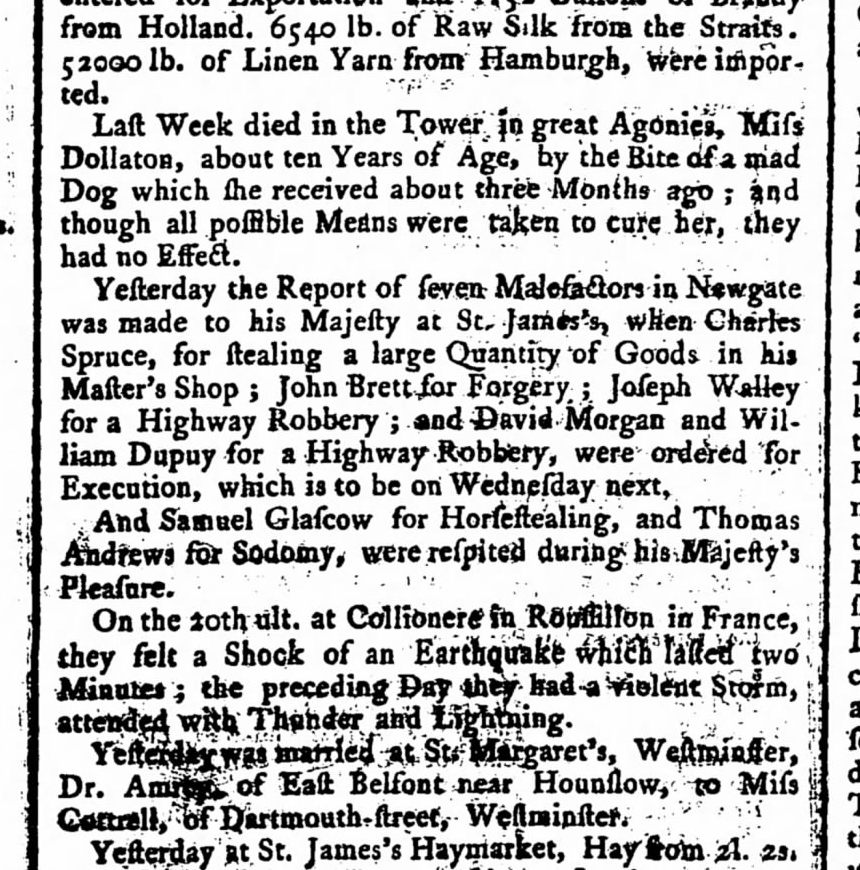
reported respited during His Majesty’s pleasure for horse-stealing
Published 1761-05-22 – 1761-05-22 · The Public Advertiser · p. 3
Faithful bounded excerpt of the inspected original; full context and identity qualifications are stated in the card. Issue metadata supplied by Newspapers.com. Source reference: The Public Advertiser · 1761-05-22 · p. 3. Open for full size; inspect the original page for context.Additional excerpts from this issue — 1Separate original page-1 masthead, Friday, 22 May 1761, of the issue containing the p.3 respite report. Original masthead page is image 34424813, linked separately. Distinct page excerpt, not a reconstructed image. Original excerpt page ↗
What the notice says
Samuel Glascow, for horse-stealing, and Thomas Andrews, for a separate offence, were reported respited during His Majesty’s pleasure.
Evidence and identity limits
The complete paragraph says “Yesterday” the report of seven Newgate malefactors was made to the King at St James’s. A separate original page-1 masthead reads Friday, 22 May 1761, supporting 21 May as the reported royal-review day. Respite is reported, not proof of pardon conditions, military service or ancestral identity. Thomas Andrews’s offence is not Samuel’s. Identity review (6 October 2026): May 1761 report that Samuel Glascow, horse-stealer, was respited during His Majesty's pleasure on 21 May 1761. This is the same London defendant; no compatible WikiTree profile (draft flagged on group 394296692). No compatible WikiTree profile after a duplicate search for: Samuel Glascow (new-profile draft pending).
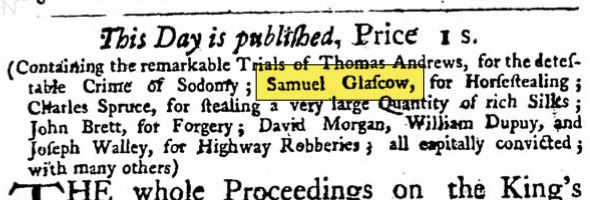
His horse-stealing case is listed among contents of an advertisement for printed Old Bailey trial proceedings.
Published 1761-05-26 · The Public Advertiser · p. 4
Faithful bounded excerpt of the inspected original; full context and identity qualifications are stated in the card. Issue metadata supplied by Newspapers.com. Source reference: The Public Advertiser · 1761-05-26 · p. 4. Open for full size; inspect the original page for context.
What the notice says
A one-shilling advertisement for printed Old Bailey trial proceedings lists Samuel Glascow’s horse-stealing case among its contents.
Evidence and identity limits
This is a publication notice, not another trial, conviction or respite. The other defendants’ crimes are separate. The case association does not identify an Ulster or Pennsylvania family. Identity review (6 October 2026): May 1761 advertisement for the printed Old Bailey Proceedings listing Samuel Glascow's horse-stealing trial. This is the same London defendant; it adds no new fact. No compatible WikiTree profile after a duplicate search for: Samuel Glascow (new-profile draft pending).
1762Verified surname passagepatent noticePrinted in 3 issuesNo profile yet
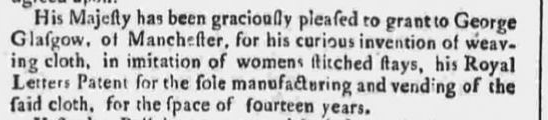
George Glasgow
Manchesterb. by c. 1744 adult estimate
Granted a royal patent for fourteen years for sole manufacture and vending of cloth imitating women’s stitched stays.
Birth estimate / source
Adult estimate from cloth manufacture and patent grant in 1762, assuming 18+; age not stated.
Occupation / tradePlace / address
Published 1762-07-20 – 1762-07-24 · The Leeds Intelligencer and Yorkshire General Advertiser · p. 2
Faithful bounded original viewer excerpt; provider search highlighting retained where visible. No reconstructed text. Issue metadata supplied by Newspapers.com. Source reference: The Leeds Intelligencer and Yorkshire General Advertiser · 1762-07-20 · p. 2. Open for full size; inspect the original page for context.
What the notice says
George Glasgow, of Manchester, is reported granted royal letters patent for fourteen years for the sole manufacture and vending of his cloth imitating women’s stitched stays.
Evidence and identity limits
Three issues report one fourteen-year royal patent. George is styled of Manchester; birth origin, later residence, family and individual identity with the Scottish merchant or officers are unproved. The patent report documents a George Glasgow of Manchester. Four compatible Scottish chronological comparisons remain possible; none has an inspected inventor/patent identity bridge. This subject remains separate from the Glasgow merchant and military subjects. Identity review (6 October 2026): 1762 royal patent to George Glasgow of Manchester. The State Papers petition shows he was a working weaver of Manchester, joint patentee with Robert Elsden, a London weaver, for weaving quilted cloth in the loom. No WikiTree profile fits him, and the earlier link to the Glasgow merchant of Nethermains (Glasgow-3312) is now weak. No compatible WikiTree profile after a duplicate search for: George Glasgow, of Manchester.
Listed among letters remaining in the Philadelphia post office in February 1763.
Published 1763-02-24 · The Pennsylvania Gazette · p. 1
Faithful bounded excerpt of the inspected original. Supplemental context is separately preserved where needed; issue metadata supplied by Newspapers.com. Source reference: The Pennsylvania Gazette · 1763-02-24 · p. 1. Open for full size; inspect the original page for context.Additional excerpts from this issue — 1Faithful bounded excerpt of the inspected original. Supplemental context is separately preserved where needed; issue metadata supplied by Newspapers.com. Original excerpt page ↗
What the notice says
William Glasgow is listed among letters remaining in the Philadelphia post office in February 1763.
Evidence and identity limits
Alphabetical postal-letter list. The printed long-s glyph in Glasſgow is f-shaped and can yield OCR Glafgow; normalized surname reading Glasgow. The excerpt preserves nearby punctuation and entries: Pennsylvania follows James Gillispie, not an independently assigned locality for William Glasgow. No identity link to other entries is inferred. Postal addressee, not proof of continuous residence, age, occupation, family, or identity across these issues. Identity review (6 October 2026): William Glasgow, Philadelphia letter list February 1763, no place given. Name only; no WikiTree profile can be singled out.
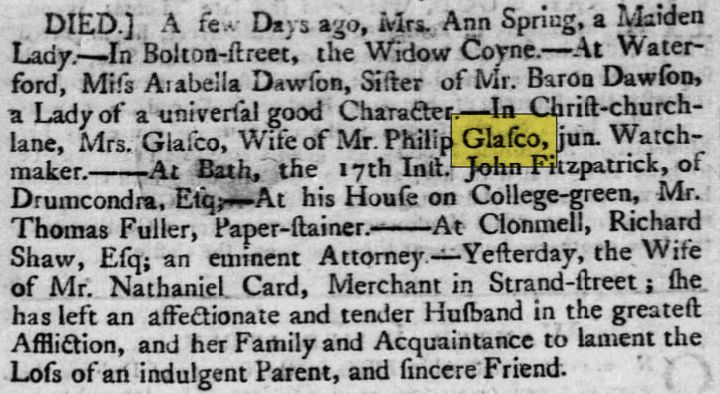
Death reported; identified as the wife of Philip Glasco, junior, watchmaker.
Spouse / marriageDeath
Published 1765-09-28 · The Public Register, or, Freeman's Journal · p. 3
Complete Deaths paragraph naming the unnamed wife of Philip Glasco junior, watchmaker, in Christ-church-lane. Exact death day and her given/maiden names are not stated. Source reference: The Public Register, or, Freeman's Journal · 1765-09-28 · p. 3. Open for full size; inspect the original page for context.
What the notice says
The death column reports Mrs. Glasco, wife of Mr. Philip Glasco, junior, watchmaker, in Christ-church-lane. Her given and maiden names are not printed.
Evidence and identity limits
The same junior designation, trade and Dublin lane make Glasgow-3932 a probable match to the younger Philip who married Teresa Plunkett in 1768. If the identification is correct, this records an earlier unnamed wife; do not identify her as Teresa or infer parents. The issue supplies a latest date for her death, not an exact day. Identity review (6 October 2026): Freeman's Journal death column (issue of 28 Sep 1765) for Mrs. Glasco, wife of Mr. Philip Glasco junior, watchmaker, Christ-church-lane, Dublin. Philip junior is the younger Dublin watchmaker, who already exists twice on WikiTree: Glasco-147 (the better-connected profile, with wives Braccan-2 and Plunkett-2805) and the project-created duplicate Glasgow-3932, whose live biography has been overwritten with an unrelated 1827 Kilrea Robert Glasgow text. The deceased wife is already modelled as Braccan-2. No new relationship is needed; the action is a merge and data clean-up.
[b. c. 1740; d. ?] · husband of the deceasedWhy this candidate?
The notice's exact designation 'Philip Glasco, jun.', the watchmaking trade and Christ-church-lane agree with the 1768 marriage of 'Phil. Glasco the younger', watchmaker of Christ-church-lane, and with the 1772 Prerogative intestacy index entry 'Philip Glasco, the younger, Dublin, watchmaker' that Glasco-147 is built on (cited on Mangan-824 and Glasco-147). Only one younger Philip Glasco watchmaker existed in Dublin. Glasco-147 (b. c.1740, son of Glasco-146, spouses Braccan-2 and Plunkett-2805, children Glasco-149/150/169/174) and Glasgow-3932 (Phillip, b. before 1750, Co. Dublin, father Glasgow-1241, no spouse) are the same man. Glasgow-3932 was created 22 Jul 2026 and the project's own fil
[b. before 1747; d. c. 1765] · deceased wife of Philip Glasco juniorWhy this candidate?
Braccan-2 ('Mary Braccan / Glasco', b. before 1747, d. 1765, spouse of Glasco-147) is the WikiTree profile created for this woman. Her only cited source is the Faulkner's Dublin Journal transcription of this same death. The notice identifies her only as the wife of Philip Glasco junior, so matching her to this profile is secure as a role match. However, the given name and maiden name on the profile are not supported. The RC baptism of Phil Glascoe at SS Michael & John, Dublin, in 1762 (DU-RC-BA-46402, quoted on Braccan-1) names the father Phil Glascoe and the mother only as 'Mary [nr]', and lists Mary Braccan as SPONSOR 2. 'Braccan' therefore seems to have been taken from the sponsor, not th
listed among letters remaining at the Philadelphia post office in October 1765
Published 1765-10-10 · The Pennsylvania Gazette · p. 4
Faithful bounded excerpt of the inspected original. Supplemental context is separately preserved where needed; issue metadata supplied by Newspapers.com. Source reference: The Pennsylvania Gazette · 1765-10-10 · p. 4. Open for full size; inspect the original page for context.Additional excerpts from this issue — 1Faithful bounded excerpt of the inspected original. Supplemental context is separately preserved where needed; issue metadata supplied by Newspapers.com. Original excerpt page ↗
What the notice says
William Glasgow is listed among letters remaining in the Philadelphia post office in October 1765.
Evidence and identity limits
Alphabetical postal-letter list; page 4 retains the list-purpose heading and G-section context. The printed long-s glyph in Glasſgow is f-shaped and can yield OCR Glafgow; normalized surname reading Glasgow. No locality or identity beyond the immediate printed sequence is assigned to William. Postal addressee, not proof of continuous residence, age, occupation, family, or identity across these issues. Identity review (6 October 2026): William Glasgow, Philadelphia letter list October 1765, no place given. Name only; unidentifiable.
1765Verified surname passagepost-office listPossible match
John Glasgow
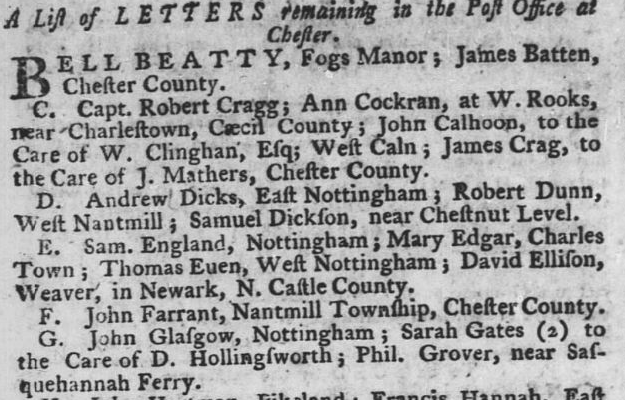
Nottingham Township, Chester County, PennsylvaniaBirth unknown
Named as an addressee in letters remaining at Chester post office.
Place / address
Published 1765-10-17 · The Pennsylvania Journal, or, Weekly Advertiser · p. 1
Faithful bounded original viewer excerpt; provider search highlighting retained where visible. No reconstructed text. Issue metadata supplied by Newspapers.com. Source reference: The Pennsylvania Journal, or, Weekly Advertiser · 1765-10-17 · p. 1. Open for full size; inspect the original page for context.
What the notice says
John Glasgow, in Nottingham Township, Chester County, is an addressee in letters remaining at Chester post office.
Evidence and identity limits
Postal-office and address context retained; an addressee is not proof of residence, letter collection, occupation, household or continued life. Nearby addressees and their localities are separate. The earlier Nottingham/Chester County/near-Oxford entries fit Glasgow-2870 as a probable candidate; Glasgow-2871 remains possible. This is a qualified regional documentary cluster, potentially more than one John. A postal list does not prove the addressee alive: the elder’s recorded May 1769 death does not absolutely exclude posthumous mail in 1771. No parent, spouse or child is proved by these notices. Identity review (6 October 2026): John Glasgow, Nottingham Township, Chester County, Chester post-office list October 1765. In 1765 the Chester County tax list has two Johns in West Nottingham: the storekeeper-landholder (probably Glasgow-2871) and an inmate; the merchant is the likelier addressee, but only possible.
[b. c. 1738; d. 1792-04-03] · letter addressee, Nottingham Township, Chester CountyWhy this candidate?
1765 Chester County tax index: John Glascow, West Nottingham, 50 acres, Storekeeper; and John Glasco, West Nottingham, Inmate. The storekeeper is probably Glasgow-2871 (see group 39404812: freeman 1760, storekeeper 1765/1767, holding to 1791, succeeded by Hugh 1793). A storekeeper is the likelier recipient of mail, but the inmate John is a real simultaneous namesake in the same township, so possible only. Glasgow-2870 (d. 1769) is not visible as a Nottingham taxpayer at any date and is downgraded to possible for want of any distinguishing evidence.
1765Verified surname passagepost-office listPossible match
John Glasgow
NottinghamBirth unknown
Named as an addressee in letters remaining at Chester post office.
Published 1765-11-28 · The Pennsylvania Gazette · p. 4
Faithful bounded original viewer excerpt; provider search highlighting retained where visible. No reconstructed text. Issue metadata supplied by Newspapers.com. Source reference: The Pennsylvania Gazette · 1765-11-28 · p. 4. Open for full size; inspect the original page for context.
What the notice says
John Glasgow, Nottingham, is an addressee in letters remaining at Chester post office.
Evidence and identity limits
Postal-office and address context retained; an addressee is not proof of residence, letter collection, occupation, household or continued life. Nearby addressees and their localities are separate. The earlier Nottingham/Chester County/near-Oxford entries fit Glasgow-2870 as a probable candidate; Glasgow-2871 remains possible. This is a qualified regional documentary cluster, potentially more than one John. A postal list does not prove the addressee alive: the elder’s recorded May 1769 death does not absolutely exclude posthumous mail in 1771. No parent, spouse or child is proved by these notices. Identity review (6 October 2026): John Glasgow, Nottingham, Chester post-office list November 1765 (same period as the October list). Same assessment: storekeeper John of West Nottingham, probably Glasgow-2871, is the likelier addressee; only possible.
[b. c. 1738; d. 1792-04-03] · letter addressee, NottinghamWhy this candidate?
As group 1033731085: two Johns taxed in West Nottingham in 1765 (storekeeper 50 acres; inmate). The storekeeper chain points to Glasgow-2871; the inmate cannot be excluded for a letter. Glasgow-2870 left possible.
1766Verified surname passagesubscription advertisementPossible match
John Glasgow
Near Oxford (as stated)Birth unknown
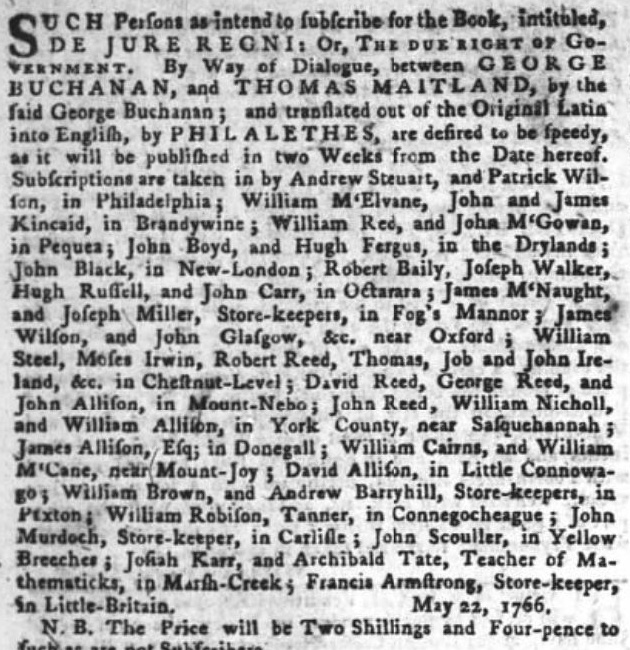
Listed among people taking subscriptions for De Jure Regni; advertisement dated 22 May 1766.
Published 1766-05-29 · The Pennsylvania Gazette · p. 4
Faithful bounded original viewer excerpt; provider search highlighting retained where visible. No reconstructed text. Issue metadata supplied by Newspapers.com. Source reference: The Pennsylvania Gazette · 1766-05-29 · p. 4. Open for full size; inspect the original page for context.
What the notice says
John Glasgow near Oxford is listed among people taking in subscriptions for De Jure Regni; advertisement dated 22 May 1766.
Evidence and identity limits
The notice explicitly says subscriptions are taken in by the named people: John is a listed subscription collector/agent, not a proved paying subscriber. Oxford is preserved without assigning a modern jurisdiction; locality comparison is qualified. The earlier Nottingham/Chester County/near-Oxford entries fit Glasgow-2870 as a probable candidate; Glasgow-2871 remains possible. This is a qualified regional documentary cluster, potentially more than one John. A postal list does not prove the addressee alive: the elder’s recorded May 1769 death does not absolutely exclude posthumous mail in 1771. No parent, spouse or child is proved by these notices. Identity review (6 October 2026): John Glasgow 'near Oxford' is one of the agents taking subscriptions for De Jure Regni (May 1766). Both the West Nottingham storekeeper (probably Glasgow-2871) and an East Nottingham landholder John (taxed 1768-1775) lived near Oxford, so identity stays possible.
[b. c. 1738; d. 1792-04-03] · local subscription agent for De Jure Regni, near OxfordWhy this candidate?
A subscription agent is typically a storekeeper or other local man of business, which favours the West Nottingham storekeeper John (taxed storekeeper 1765 and 1767; probably Glasgow-2871). But the Chester County tax index also has a John Glascow/Glasgow landholder in East Nottingham 1768-1775, and East Nottingham adjoins Oxford, so 'near Oxford' does not single out the West Nottingham man. Glasgow-2870 remains a possible namesake without distinguishing evidence.
King of Prussia (voyage Barry to Parkgate)Birth unknown
Reported sailing in the King of Prussia from Barry for Parkgate.
Published 1766-06-17 · The Public Register, or, Freeman's Journal · p. 2
Visually checked bounded original excerpt; long s is conventionally transcribed as s. Issue date follows provider metadata unless the notice supplies a separate event date. Source reference: The Public Register, or, Freeman's Journal · 1766-06-17 · p. 2. Open for full size; inspect the original page for context.
What the notice says
Mr. Glasco sailed in the King of Prussia, Barry, for Parkgate.
Evidence and identity limits
A surname-only passenger occurrence. No forename, age, residence or family is stated. The two 1766 passenger notices may concern the same person, but no identity or return journey is proved. Identity review (6 October 2026): Freeman's Journal 17 Jun 1766: Mr. Glasco sailed in the King of Prussia (Barry) for Parkgate. This is a surname-only passenger entry and cannot be identified.
listed among passengers arriving in the Fortescue packet from Holyhead
Published 1766-08-23 · The Public Register, or, Freeman's Journal · p. 3
Visually checked bounded original excerpt; long s is conventionally transcribed as s. Issue date follows provider metadata unless the notice supplies a separate event date. Source reference: The Public Register, or, Freeman's Journal · 1766-08-23 · p. 3. Open for full size; inspect the original page for context.
What the notice says
Glasco appears among the passengers who arrived in the Fortescue-packet from Holyhead; the paragraph is headed 22.
Evidence and identity limits
A surname-only passenger occurrence. No forename, age, residence or family is stated. The two 1766 passenger notices may concern the same person, but no identity or return journey is proved. Identity review (6 October 2026): Freeman's Journal 23 Aug 1766: Glasco listed among passengers arriving by the Fortescue packet from Holyhead. This is a surname-only entry and cannot be identified. It may be the June 1766 Parkgate traveller returning, but that is not proved.
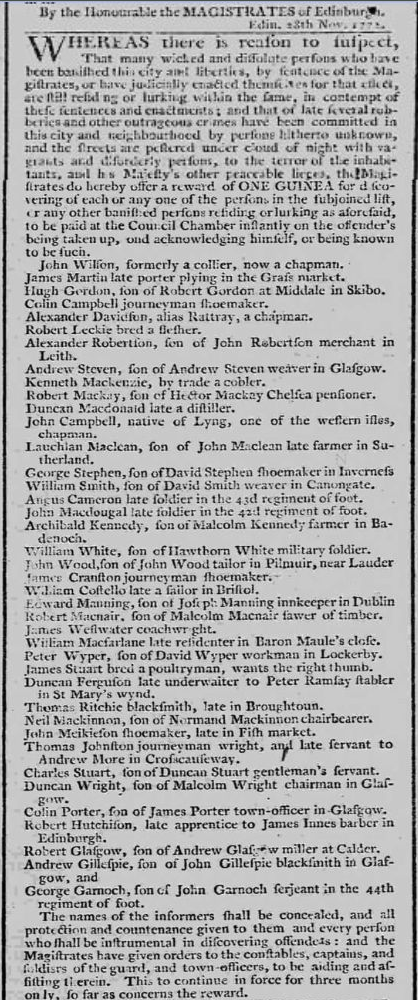
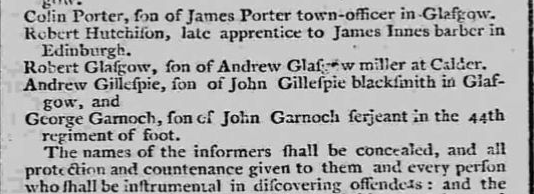
Named among prisoners convicted of theft; report gives sentence of public exposure and banishment from the city and liberties.
Published 1767-12-21 · The Caledonian Mercury · p. 3
Faithful bounded original viewer excerpt; provider search highlighting retained where visible. No reconstructed text. Issue metadata supplied by Newspapers.com. Source reference: The Caledonian Mercury · 1767-12-21 · p. 3. Open for full size; inspect the original page for context.
What the notice says
An Edinburgh city-gaol report names Robert Glasgow among prisoners convicted of theft and reports their sentence of public exposure and banishment from the city and liberties forever.
Evidence and identity limits
Original inspected. The notice reports conviction and sentence; it does not establish later removal or identity with any other Robert Glasgow. Two compatible Scottish profiles remain weak possibilities. No identity with the 1772 Robert son of Andrew at Calder, Maryland sale participant or Montgreenan man is established. Identity review (6 October 2026): Dec 1767: Robert Glasgow, with George Garnock, Niel M'Kinnon and Donald M'Donald, sentenced in Edinburgh for theft to be walked through the city and banished. The 1772 banished-persons list repeats Garnoch and Mackinnon beside 'Robert Glasgow, son of Andrew Glasgow miller at Calder', so this is that man; he has no WikiTree profile. No compatible WikiTree profile after a duplicate search for: Robert Glasgow.
1767Verified surname passagepartnership noticePossible match
George Glasgow
Glasgowb. by c. 1749 adult estimate
Merchant associated with the Incle Manufactory. · The partnership notice says he had previously given up management; future business was to be carried on by Archibald Ingram, Thomas Dunmoor and Co.
Birth estimate / source
Adult estimate from merchant in 1767, assuming 18+; age not stated.
Occupation / tradePlace / address
Published 1767-12-30 · The Caledonian Mercury · p. 3
Faithful bounded original viewer excerpt; provider search highlighting retained where visible. No reconstructed text. Issue metadata supplied by Newspapers.com. Source reference: The Caledonian Mercury · 1767-12-30 · p. 3. Open for full size; inspect the original page for context.
What the notice says
A partnership notice for the Incle Manufactory in Glasgow states that George Glasgow, merchant there, had previously given up management; future business is to be carried on under Archibald Ingram, Thomas Dunmoor and Co.
Evidence and identity limits
Reported prior management withdrawal, not a stated withdrawal day, completed dissolution or family relationship. Same name and Glasgow mercantile context permit a provisional comparison with the land notices, without proving personal continuity. One provisional merchant/property study consolidates the exact named Nethermains subject and compatible Glasgow partnership context, retaining separate sale stages. Compatible profiles remain possible. George-3312’s recorded 1768 death does not exclude later reprints or past-tense property references; no continuity of active life, ownership, completed sale or family is proved. The Manchester inventor and officers remain separate. Identity review (6 October 2026): Dec 1767 partnership notice: George Glasgow, merchant in Glasgow, had given up management of the Incle Manufactory. He is the George Glasgow of Nethermains (Glasgow-3312), probable.
[b. 1729-07-19; d. 1768-06-27] · merchant; former manager of the Incle ManufactoryWhy this candidate?
Same designation ('George Glasgow, merchant' in Glasgow) as the June 1768 Nethermains sale six months later. Name + unique estate designation + place + kin context agree. (1) The 1768 sale notice calls the owner of Nether-Mains, Nethermains Dean and Nethermains Niven at Kilwinning 'George Glasgow, merchant in Glasgow'; the 1777 judicial-sale notices call him 'George Glasgow of Nether Mains'. (2) The Glasgow Commissariot register (inspected via archive.org OCR) confirms on 27 June 1768 the testament of 'Margaret [Buchanan], wife of George Glasgow, of Nethermains, daughter of William B., of Drumakill' - the same designation, and Glasgow-3312 is already married on WikiTree to Margaret Buchanan
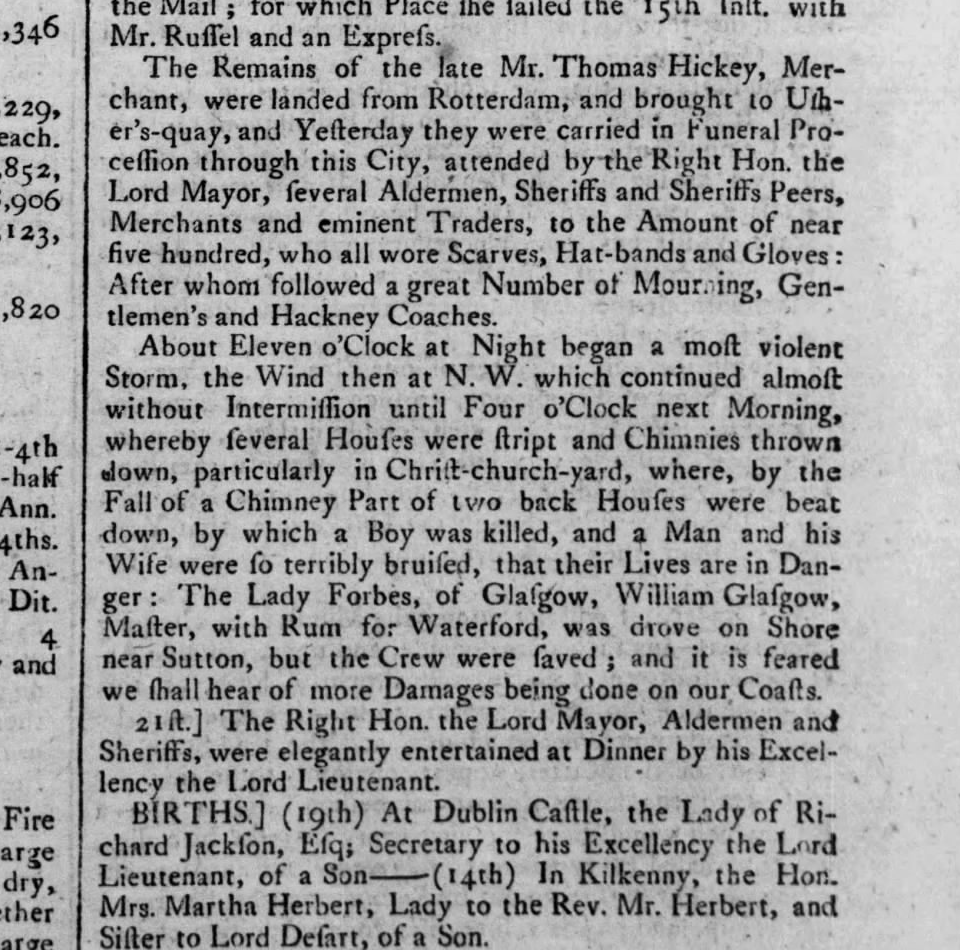
Named as master of the Lady Forbes, carrying rum for Waterford; the vessel was driven ashore near Sutton and the crew were saved.
Birth estimate / source
Age is not printed; inferred only as an adult lower bound from the stated professional role (ship master), assuming age 18 or older by the 1768 issue year.
Occupation / trade
Published 1768-01-23 · The Public Register, or, Freeman's Journal · p. 2
Bounded original passage visually checked; long s is transcribed as s. Issue date follows provider metadata. Faithful crop from saved original page. Source reference: The Public Register, or, Freeman's Journal · 1768-01-23 · p. 2. Open for full size; inspect the original page for context.
What the notice says
“The Lady Forbes, of Glasgow, William Glasgow, Master, with Rum for Waterford, was drove on Shore near Sutton, but the Crew were saved.”
Evidence and identity limits
William Glasgow is explicitly the master’s personal name; “of Glasgow” separately describes the vessel. Personal origin, age and family are unstated. No identification with the unnamed Glasgow captain of the brig William in 1796 is justified. Identity review (6 October 2026): Freeman's Journal 23 Jan 1768: the Lady Forbes, of Glasgow, William Glasgow master, carrying rum for Waterford, was driven ashore near Sutton and the crew were saved. The master is a real named William Glasgow. At least a dozen compatible William Glasgow profiles exist and nothing in the notice prefers one, so no identification is made.
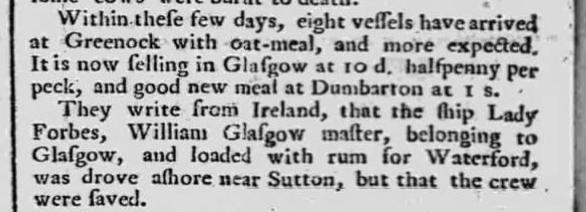
Lady Forbes (Sutton shipping casualty report)b. by c. 1750 adult estimate
Named as master of the Lady Forbes in the casualty report.
Birth estimate / source
Adult role: master of the Lady Forbes in 1768; age unstated; estimate assumes the role holder was at least 18.
Occupation / trade
Published 1768-02-06 · The Caledonian Mercury · p. 2
Faithful bounded original source passage, visually checked 5 October 2026; long-s typography normalized to Glasgow in the reading. Issue heading outside crop; provider issue metadata retained. Source reference: The Caledonian Mercury · 1768-02-06 · p. 2. Open for full size; inspect the original page for context.
What the notice says
William Glasgow is named as master of the Lady Forbes in the Sutton shipping casualty report.
Evidence and identity limits
The 6 February Caledonian report names William Glasgow master of Lady Forbes, loaded with rum for Waterford, driven ashore near Sutton, crew saved. It describes the same named master/vessel/grounding as the 23 January Freeman’s Journal report in different wording; this is a curated same-event grouping, not an exact-text reprint. Belonging to Glasgow describes the vessel, not personal residence or origin. Identity review (6 October 2026): Jan/Feb 1768: William Glasgow, master of the Lady Forbes (of Glasgow) with rum for Waterford, driven ashore near Sutton, crew saved. No WikiTree William can be singled out.
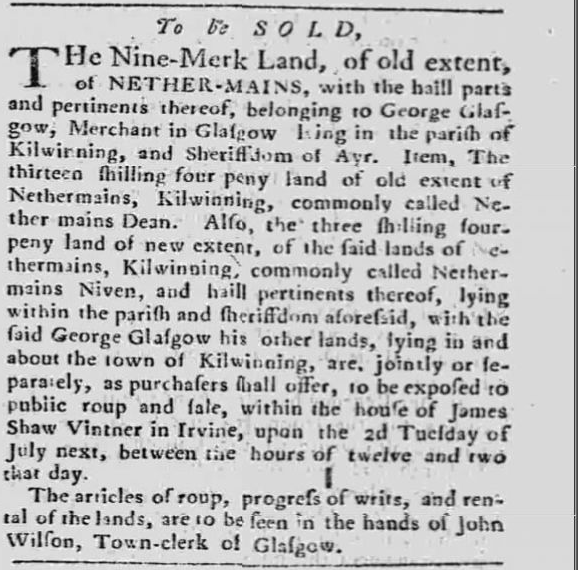
1768Verified surname passageland-sale advertisementPrinted in 13 issuesPossible match
George Glasgow
Glasgow (merchant designation); lands at Kilwinning; sale at Irvineb. by c. 1750 adult estimate
described as a Glasgow merchant · advertised for roup sale lands at Kilwinning including Nether-Mains, Nethermains Dean and Nethermains Niven · sale arranged at James Shaw’s, Irvine, on the second Tuesday of July
Birth estimate / source
Merchant role establishes adult status; assuming age 18+ by 1768, age unstated.
Occupation / trade
Published 1768-06-04 – 1768-07-11 · The Caledonian Mercury · p. 3
Faithful bounded original viewer excerpt; provider search highlighting retained where visible. No reconstructed text. Issue metadata supplied by Newspapers.com. Source reference: The Caledonian Mercury · 1768-06-04 · p. 3. Open for full size; inspect the original page for context.
What the notice says
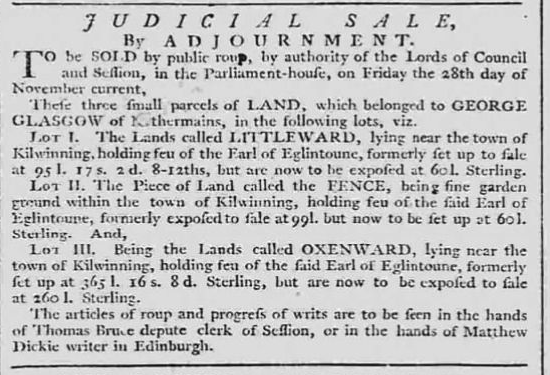
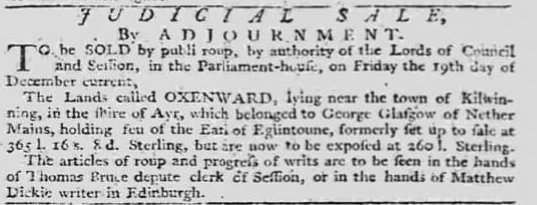
A private-sale advertisement describes Nether-Mains, Nethermains Dean, Nethermains Niven and other lands at Kilwinning as belonging to George Glasgow, merchant in Glasgow, offering them by roup at James Shaw’s, Irvine, on the second Tuesday of July.
Evidence and identity limits
Thirteen June/July 1768 issues preserve a private-sale notice. Earlier copies say July next and July copies July inst.; retain the issue-specific wording without asserting another sale or completed transfer. Merks/shillings of old/new extent are historical land valuations, not stated acreages. Belonging is the advertisement’s description, not an independently inspected title. One provisional merchant/property study consolidates the exact named Nethermains subject and compatible Glasgow partnership context, retaining separate sale stages. Compatible profiles remain possible. George-3312’s recorded 1768 death does not exclude later reprints or past-tense property references; no continuity of active life, ownership, completed sale or family is proved. The Manchester inventor and officers remain separate. Identity review (6 October 2026): June-July 1768 sale of Nether-Mains and other Kilwinning lands 'belonging to George Glasgow, merchant in Glasgow'. Identified as Glasgow-3312 (probable) through the Commissariot entry 'George Glasgow, of Nethermains' and the Martin/Ashinyards descent of Nethermains; also shows Glasgow-3312's 1768 death date is doubtful.
[b. 1729-07-19; d. 1768-06-27] · landowner / merchant named in noticeWhy this candidate?
Name + unique estate designation + place + kin context agree. (1) The 1768 sale notice calls the owner of Nether-Mains, Nethermains Dean and Nethermains Niven at Kilwinning 'George Glasgow, merchant in Glasgow'; the 1777 judicial-sale notices call him 'George Glasgow of Nether Mains'. (2) The Glasgow Commissariot register (inspected via archive.org OCR) confirms on 27 June 1768 the testament of 'Margaret [Buchanan], wife of George Glasgow, of Nethermains, daughter of William B., of Drumakill' - the same designation, and Glasgow-3312 is already married on WikiTree to Margaret Buchanan (Buchanan-12640), daughter of William (Buchanan-12641). (3) Paterson (Kilwinning parish) shows Nethermains ca
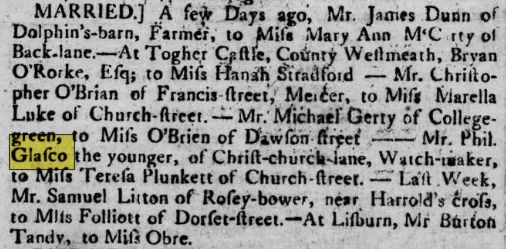
1768Verified surname passagemarriage noticeStrong match
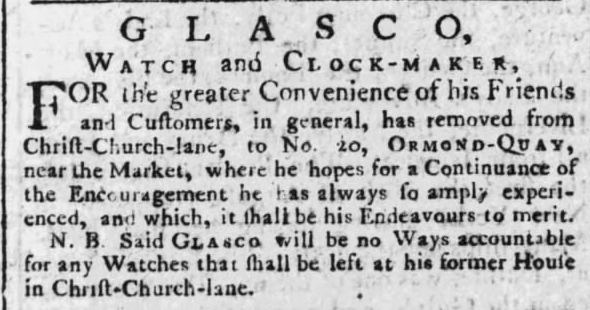
Phil. Glasco the younger
Christ-church-lane, DublinBirth unknown
Marriage column identifies him as a watchmaker.
Teresa Plunkett
Church-street, DublinBirth unknown
Named as his bride in the marriage notice.
Spouse / marriageOccupation / trade
Published 1768-09-20 · The Public Register, or, Freeman's Journal · p. 3
Bounded excerpt checked against the original on 4 October 2026; the issue heading is outside the crop. Source reference: The Public Register, or, Freeman's Journal · 1768-09-20 · p. 3. Open for full size; inspect the original page for context.
What the notice says
The marriage column names Mr. Phil. Glasco the younger, of Christ-church-lane, watchmaker, and Miss Teresa Plunkett of Church-street.
Evidence and identity limits
The rare name, younger designation, trade, address and bride agree with the existing Philip junior evidence draft and compatible profile Glasgow-3932. This original corroborates the marriage reported in the Public Gazetteer extraction dated 17 September 1768; it does not itself supply that exact wedding date or prove his father. Keep him separate from the elder Philip and the later surname-only watchmaker. OCR Glafco represents printed Glasco. Identity review (6 October 2026): Freeman's Journal 20 Sep 1768 marriage of Mr. Phil. Glasco the younger, watchmaker of Christ-church-lane, to Miss Teresa Plunkett of Church-street. Both people already exist and are already linked as spouses on WikiTree: Glasco-147 and Plunkett-2805. Glasgow-3932 is a duplicate of the groom.
The rare name, 'the younger', the watchmaking trade, Christ-church-lane and the bride all agree. Glasco-147 is already married on WikiTree to Plunkett-2805 (Teresa Plunkett), whose biography cites the 1768 Public Gazetteer extraction of this marriage. Glasco-147 is defined by the 1772 intestacy of 'Philip Glasco, the younger, Dublin, watchmaker'. Glasgow-3932 is the same man (duplicate, no spouse, biography now overwritten with an unrelated Kilrea text). See group 1050029120.
Plunkett-2805 (Teresa Plunkett / Glasco, b. before 1750, Co. Dublin, d. after 1771, spouse Glasco-147, child Glasco-174) was created from this marriage. Her biography quotes the Public Gazetteer: 'Mr. Philip Glasco Jnr of Christchurch-yard, Watchmaker, to the agreeable Miss Teresa Plunkett of Church-street'. The name, the street and the groom all agree, and no other Teresa Plunkett of the period exists on WikiTree (Plunkett-829, b. 1765 Westmeath, is too young and from a different place).
Named as an addressee in letters remaining at Philadelphia post office.
Published 1769-10-26 · The Pennsylvania Gazette · p. 1
Faithful bounded original viewer excerpt; provider search highlighting retained where visible. No reconstructed text. Issue metadata supplied by Newspapers.com. Source reference: The Pennsylvania Gazette · 1769-10-26 · p. 1. Open for full size; inspect the original page for context.Additional excerpts from this issue — 1Faithful bounded original source passage, visually checked 5 October 2026; long-s typography normalized to Glasgow in the reading. Issue heading outside crop; provider issue metadata retained. Original excerpt page ↗
What the notice says
John Glasgow, Kensing- / ton, is an addressee in letters remaining at Philadelphia post office.
Evidence and identity limits
Original Philadelphia post-office heading and entry saved separately. The place is printed across lines as Kensing- / ton; no individual, residence, life status or link to the Nottingham cluster is established. No existing profile is identified. Nottingham candidates Glasgow-2870 and Glasgow-2871 are compatible namesakes without a place or postal bridge; the elder’s earlier recorded death does not absolutely exclude posthumous mail. Keep this separate from the Nottingham cluster. Identity review (6 October 2026): John Glasgow, 'Kensing-/ton', Philadelphia letter list October 1769. Kensington (Northern Liberties, Philadelphia) has no link to the Nottingham Johns; unidentifiable.
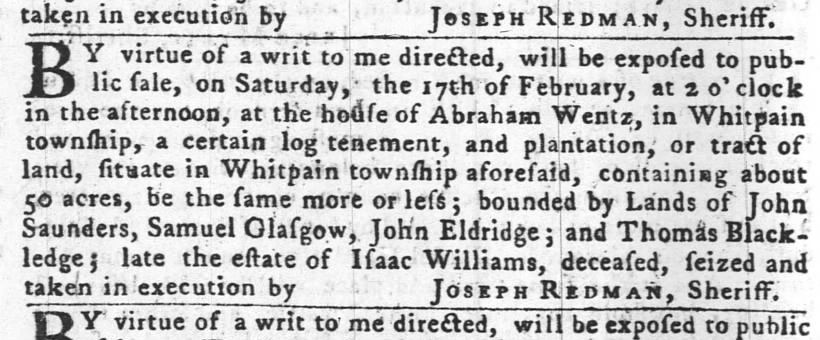
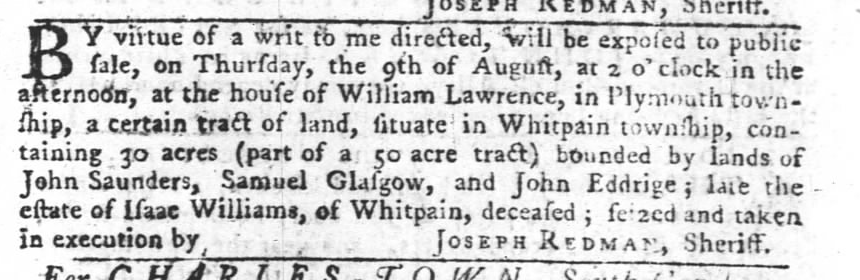
1770Verified surname passageexecution-sale noticePrinted in 4 issuesPossible match
Samuel Glasgow
Whitpain Township (adjoining land in sale notice; not asserted as residence)Birth unknown
Named as an adjoining landowner in a Whitpain Township execution-sale notice for about fifty acres, late Isaac Williams’s estate.
Published 1770-02-01 – 1770-08-23 · The Pennsylvania Gazette · p. 3
Original downloaded scan or supported original viewer screenshot, faithfully cropped; no reconstruction; long s normalized in the maintained reading. Issue metadata follows Newspapers.com unless noted. Source reference: The Pennsylvania Gazette · 1770-02-01 · p. 3. Open for full size; inspect the original page for context.
What the notice says
Samuel Glasgow is an adjoining landowner in a Whitpain Township execution-sale notice for about fifty acres, late Isaac Williams’s estate, bounded by John Saunders, Samuel Glasgow, John Eldridge and Thomas Blackledge.
Evidence and identity limits
A boundary name, not the deceased estate owner, buyer or executor. February and August notices concern the same described estate; their planned sale dates differ, preserved in each issue assessment. Planned sale: 17 February 1770, at Abraham Wentz’s house. No completed sale is established. Identity review (6 October 2026): Samuel Glasgow is a boundary landowner in a February 1770 Whitpain Township execution-sale notice (late Isaac Williams's estate). A 1769 Philadelphia County proprietary tax list (transcription) independently places a Samuel Glascow in Whitpain, confirming a resident there; no WikiTree Samuel has any eastern-Pennsylvania record, so the best fit, Glasgow-3175, stays only possible.
[b. c. 1740; d. c. 1801] · adjoining landowner, Whitpain TownshipWhy this candidate?
Independent corroboration of residence: 1769 Philadelphia County proprietary tax list, Whitpain Township, 'Samuel Glascow' (Friends Journal Gwynedd-area transcription; John Sanders of the same notice also listed in Whitpain). WikiTree candidates: Glasgow-3175 (b. c.1740 Ulster, d. 1801 Hanover Twp, Washington Co., PA; wife Mary Stephenson) is a Pennsylvania settler of the right age, with no record placing him in Whitpain - possible only (his biography's Old Bailey 1761 'Samuel Glascow' identification is itself unproved). Glasgow-1134 (Cecil County-born c.1749-1754; probably the First Maryland sergeant of 1776-77, see group 41048937) is weak. Glasgow-1492 (Moneymore, b. c.1726; possibly the 1
1770Verified surname passageland-sale noticePrinted in 3 issuesPossible match
Samuel Glasgow
Whitpain Township, Pennsylvania (land boundary)Birth unknown
Named as boundary landowner for thirty acres of a fifty-acre tract, late Isaac Williams’s estate.
Published 1770-07-12 – 1770-07-26 · The Pennsylvania Gazette · p. 3
Original downloaded scan or supported original viewer screenshot, faithfully cropped; no reconstruction; long s normalized in the maintained reading. Issue metadata follows Newspapers.com unless noted. Source reference: The Pennsylvania Gazette · 1770-07-12 · p. 3. Open for full size; inspect the original page for context.
What the notice says
Samuel Glasgow is a boundary landowner for thirty acres, part of a fifty-acre Whitpain Township tract, late Isaac Williams’s estate, also bounded by John Saunders and John Eldridge. A sale is advertised for 9 August at William Lawrence’s house in Plymouth Township.
Evidence and identity limits
Three issue appearances of one notice. The separate Limerick property’s 7 August sale does not apply here. No completed sale, occupation or kinship is established. Identity review (6 October 2026): Same Whitpain Township estate re-advertised July 1770: Samuel Glasgow is a boundary landowner of the 30-acre part. Same conclusion as group 39398014: a real Whitpain resident (1769 tax list), no profile beyond possible (Glasgow-3175).
[b. c. 1740; d. c. 1801] · boundary landowner, Whitpain TownshipWhy this candidate?
Same man as the February 1770 notice (same estate, same neighbours John Saunders and John Eldridge). 1769 Philadelphia County tax list has Samuel Glascow in Whitpain. No WikiTree profile documents him; Glasgow-3175 is a compatible Pennsylvania namesake only; 1134 and 1492 weaker (see group 39398014).
named Second Lieutenant in the Royal Regiment of Artillery · promoted to First Lieutenant in place of Francis Downman
Birth estimate / source
Second lieutenant role establishes adult status; assuming age 18+ by 1771, age unstated.
Occupation / trade
Published 1771-09-07 · The Caledonian Mercury · p. 1
Faithful bounded original viewer excerpt; provider search highlighting retained where visible. No reconstructed text. Issue metadata supplied by Newspapers.com. Source reference: The Caledonian Mercury · 1771-09-07 · p. 1. Open for full size; inspect the original page for context.
What the notice says
A Royal Regiment of Artillery promotion report names Second Lieutenant George Glasgow to be First Lieutenant in the room of Francis Downman, preferred.
Evidence and identity limits
Published 7 September 1771. A reported promotion in the explicitly named regiment; completed service, age and relatives are not established. Exact name and artillery context with progressive reported ranks support a provisional career study; individual continuity across the 22-year interval remains unproved. No checked existing profile is identified. The possible later chronological match George-1529 does not prove the early lieutenant’s identity. The 1774 unassigned Second Lieutenant notice remains a separate subject. Identity review (6 October 2026): Sept 1771: Second Lieutenant George Glasgow, Royal Artillery, to be First Lieutenant vice Francis Downman. This is an earlier RA officer, not the later Lt-Gen George Glasgow (only a cadet in 1771); no WikiTree profile. No compatible WikiTree profile after a duplicate search for: George Glasgow (2nd Lt to 1st Lt, Royal Artillery).
1771Verified surname passagepost-office listPossible match
John Glasgow
West Nottingham, Chester County, PennsylvaniaBirth unknown
Named as an addressee in the Charles-Town post-office list.
William Glasgow
Place not statedBirth unknown
Named separately as an addressee in the same post-office list.
Place / address
Published 1771-10-24 · Maryland Gazette · p. 3
Faithful bounded original viewer excerpt; provider search highlighting retained where visible. No reconstructed text. Issue metadata supplied by Newspapers.com. Source reference: Maryland Gazette · 1771-10-24 · p. 3. Open for full size; inspect the original page for context.
What the notice says
John Glasgow, in West Nottingham, Chester County, and William Glasgow are separate addressees in the Charles-Town, Maryland, post-office list headed 1 October 1771.
Evidence and identity limits
Postal-office and address context retained; an addressee is not proof of residence, letter collection, occupation, household or continued life. Nearby addressees and their localities are separate. The original heading says Charles-Town, Maryland, not Anne Arundel County. Sydney George is a separate next addressee; Cecil County accompanies Sydney, not a newly established address for William. The earlier Nottingham/Chester County/near-Oxford entries fit Glasgow-2870 as a probable candidate; Glasgow-2871 remains possible. This is a qualified regional documentary cluster, potentially more than one John. A postal list does not prove the addressee alive: the elder’s recorded May 1769 death does not absolutely exclude posthumous mail in 1771. No parent, spouse or child is proved by these notices. Identity review (6 October 2026): Charles-Town (Cecil County), Maryland letter list, 1 October 1771: John Glasgow in West Nottingham, Chester County, and a separate William Glasgow. Two Johns were taxed in West Nottingham in 1771 (landholder and inmate), so John is only possibly Glasgow-2871; Glasgow-2870 (d. 1769) is now unlikely. William has no WikiTree profile; the Cecil County William named among the children of James Glasgow Sr. (d. 1784) in Cecil probate is a plausible but unproved identity. No compatible WikiTree profile after a duplicate search for: William Glasgow.
[b. c. 1738; d. 1792-04-03] · letter addressee, West Nottingham, Chester CountyWhy this candidate?
1771 Chester County tax index: John Glasko, West Nottingham, 70 acres, landholder, and John Glascow, West Nottingham, inmate. The landholder is the continuing holding probably belonging to Glasgow-2871 (see group 39404812); the inmate is another adult John (possibly the Moneymore John, Glasgow-4027, whose family arrived in Nottingham c.1769 per Robert Glasgow's pension R4057 - he was in Peters Twp, Cumberland Co., by 1779). Glasgow-2870 is unlikely: recorded dead May 1769, and two living same-name residents of the township are available.
Published 1772-11-28 – 1772-11-30 · The Caledonian Mercury · p. 3
Faithful bounded original viewer excerpt; provider search highlighting retained where visible. No reconstructed text. Issue metadata supplied by Newspapers.com. Source reference: The Caledonian Mercury · 1772-11-28 · p. 3. Open for full size; inspect the original page for context.Additional excerpts from this issue — 1Faithful bounded original source passage, visually checked 5 October 2026; long-s typography normalized to Glasgow in the reading. Issue heading outside crop; provider issue metadata retained. Original excerpt page ↗
What the notice says
Robert Glasgow is listed as son of Andrew Glasgow, miller at Calder, in an Edinburgh magistrates’ notice dated 28 November 1772.
Evidence and identity limits
The notice offers one guinea for discovery within the city/liberties of listed persons previously banished or bound to leave. The printed father–son statement is documentary family evidence; it does not prove a particular robbery conviction, apprehension, reward payment or identity with the 1767 prisoner. Neither existing Wiki Tree profile is identified. The notice explicitly names Robert’s father Andrew. Compatible existing Robert and Andrew profiles remain possible assignments only. Robert-1445’s tree-only father James and sibling Andrew-3052 are unverified leads; no parent replacement follows from identifying only the documentary family. Calder alone does not distinguish East from West Calder. Identity review (6 October 2026): Nov 1772 Edinburgh magistrates' list of banished persons includes 'Robert Glasgow, son of Andrew Glasgow miller at Calder'. Robert is the 1767 theft convict; neither he nor a miller Andrew at Calder can be matched to a WikiTree profile. No compatible WikiTree profile after a duplicate search for: Robert Glasgow.
1773Verified surname passageexecution-sale noticePrinted in 2 issuesPossible match
John Glascow
West Nottingham Township, Chester County (adjoining land; not asserted as residence)Birth unknown
Named as an adjoining landholder in an execution-sale notice for 22½ acres, late Michael Dintz’s estate.
Published 1773-04-28 – 1773-05-05 · The Pennsylvania Gazette · p. 1
Faithful bounded excerpt of the inspected original; full context and identity qualifications are stated in the card. Issue metadata supplied by Newspapers.com. Source reference: The Pennsylvania Gazette · 1773-04-28 · p. 1. Open for full size; inspect the original page for context.
What the notice says
John Glascow is an adjoining landholder in a West-Nottingham Township, Chester County execution-sale notice for 22½ acres, late Michael Dintz’s estate, bounded by Abraham Bunting, John Glascow and others.
Evidence and identity limits
Planned sale 11 May at one o’clock on the premises; Henry Hayes, sheriff; notice dated 28 April 1773. John is the neighbouring landholder, not the deceased estate owner, buyer or executor. Sale completion is unproved. Identity review (6 October 2026): John Glascow is the neighbouring landholder of Michael Dintz's 22.5-acre West Nottingham tract in an April 1773 sheriff's sale. The only John taxed as a West Nottingham landholder in 1773 is the continuing storekeeper/landholder whose holding passes to Hugh Glasgow in 1793, i.e. probably Glasgow-2871.
[b. c. 1738; d. 1792-04-03] · adjoining landholder, West Nottingham TownshipWhy this candidate?
1773 Chester County tax index, West Nottingham: John Glasgow, 50 acres, Landholder, and John Glasgow, Inmate (an inmate is a non-landholding lodger and so cannot be the bounding landholder). The landholder's holding runs continuously 1765-1791 (storekeeper 1765/1767) and is followed by Hugh Glasgow's West Nottingham holding from 1793, matching Glasgow-2871 (d. 3 Apr 1792; father of Hugh, Glasgow-2873). Glasgow-2870 died 1769. Glasgow-4027 (Moneymore John, later of Peters Twp, Cumberland Co.) is at most the inmate. The East Nottingham landholder John (30 acres in 1773) is a residual competitor only if the Dintz tract straddled the township line. Name + township + landholder status + date agre
Listed among letters remaining at Lancaster post office.
Published 1773-07-21 · The Pennsylvania Gazette · p. 4
Faithful bounded original viewer excerpt; provider search highlighting retained where visible. No reconstructed text. Issue metadata supplied by Newspapers.com. Source reference: The Pennsylvania Gazette · 1773-07-21 · p. 4. Open for full size; inspect the original page for context.
What the notice says
James Glasgow (2) is listed among letters remaining in Lancaster’s post office.
Evidence and identity limits
Alphabetical letters-remaining list headed Post-Office, Lancaster. The (2) marker is preserved without reading it as an age. Nearby county names belong to other entries; the post office is not proof of James’s residence. Normalized Glasgow is the personal surname reading. The three checked profiles remain possible; none identifies the addressee. No link to the 1757 Philadelphia/Fogs Manor, 1775 Charlestown or 1777 shipmaster James is established. Identity review (6 October 2026): James Glasgow, with a '(2)' marker, in the Lancaster post-office letter list of July 1773. Name only; no profile can be singled out.
described as a gentleman · appointed Second Lieutenant, vice Barnes, promoted
Birth estimate / source
Second lieutenant role establishes adult status; assuming age 18+ by 1774, age unstated.
Occupation / trade
Published 1774-09-24 · The Caledonian Mercury · p. 2
Faithful bounded original viewer excerpt; provider search highlighting retained where visible. No reconstructed text. Issue metadata supplied by Newspapers.com. Source reference: The Caledonian Mercury · 1774-09-24 · p. 2. Open for full size; inspect the original page for context.
What the notice says
George Glasgow, gentleman, is reported appointed Second Lieutenant, vice Second Lieutenant Barnes, promoted.
Evidence and identity limits
Published 24 September 1774. Regiment is not stated in the bounded appointment paragraph. No identity bridge joins this Second Lieutenant appointment to the 1771 First Lieutenant or later Royal Artillery reports; completed service and family remain unproved. A separate reported appointment names George Glasgow, gentleman. Existing chronological comparisons remain weak; regiment and personal identity are unproved. Do not join this lower-rank appointment to the 1771 First Lieutenant solely by surname or assume a demotion. Identity review (6 October 2026): Sept 1774: George Glasgow, gentleman, appointed Second Lieutenant vice Barnes. This is the future Lt-Gen George Glasgow RA (DCB: 2nd Lt 8 Sept 1774); he has no WikiTree profile. No compatible WikiTree profile after a duplicate search for: George Glasgow, gentleman (Second Lieutenant).
1774Verified surname passageland sale advertisementNo profile yet
William Glasgow
Cleugh-head and ClovenfordsykeBirth unknown
Listed as tenant/possessor of lots offered at roup; tack stated to expire at Martinmas 1776.
Place / address
Published 1774-12-12 · The Caledonian Mercury · p. 3
Faithful bounded original source passage, visually checked 5 October 2026; long-s typography normalized to Glasgow in the reading. Issue heading outside crop; provider issue metadata retained. Source reference: The Caledonian Mercury · 1774-12-12 · p. 3. Open for full size; inspect the original page for context.
What the notice says
William Glasgow is tenant/possessor of Cleugh-head and Clovenfordsyke lots in a sale advertisement planning a roup on 5 January 1775; his tack is stated to expire at Martinmas 1776.
Evidence and identity limits
Notice published 12 December 1774. The land lies in West Calder; lots II and III name the tenant. William White is the proprietor, a different person. Tack expiry is stated, not independently verified, and the planned sale is not a completed transaction. Identity review (6 October 2026): Dec 1774 sale advertisement: William Glasgow tenant of lots at Cleugh-head and Clovenfordsyke (West Calder), tack to Martinmas 1776. No WikiTree profile can be fixed; the prior candidate Glasgow-1463 (bapt. 1816) is impossible.
1775Verified surname passagepost-office listPossible match
James Glasgow
Place not statedBirth unknown
Named in the list of letters remaining at Charlestown’s General Post Office, dated 21 August 1775.
Ezekiel Glasgow
Place not statedBirth unknown
Named in the same list of letters remaining at Charlestown’s General Post Office.
Published 1775-08-25 · The South-Carolina and American General Gazette · p. 1
Faithful bounded excerpt of the inspected original. Supplemental context is separately preserved where needed; issue metadata supplied by Newspapers.com. Source reference: The South-Carolina and American General Gazette · 1775-08-25 · p. 1. Open for full size; inspect the original page for context.Additional excerpts from this issue — 1Faithful bounded excerpt of the inspected original. Supplemental context is separately preserved where needed; issue metadata supplied by Newspapers.com. Original excerpt page ↗
What the notice says
James Glasgow and Ezekiel Glasgow appear in the list of letters remaining in Charlestown’s General Post Office, dated 21 August 1775.
Evidence and identity limits
Alphabetical entries printed surname first: Glasgow James, followed by a small 2 marker, and Glasgow Ezekiel. The marker is not read as an age. Letter-list appearance alone proves no kinship, occupation, continuous residence or identity with later James records. Identity review (6 October 2026): James Glasgow and Ezekiel Glasgow in the Charlestown, South Carolina, General Post Office letter list of 21 August 1775. James is possibly the Ayr-born James of Newberry District (Glasgow-804, arrived South Carolina 1769); the Kilwaughter James (Glasgow-1144) is unlikely because his children were still being born in County Antrim to 1775. No WikiTree Ezekiel fits.
[b. 1735-11-11; d. 1788-05-19] · letter addressee, Charlestown SCWhy this candidate?
Glasgow-804 (b. 11 Nov 1735 Ayr; d. 19 May 1788 Newberry SC) has a 1769 South Carolina passenger-list index entry, so he was in the colony in 1775: compatible, no bridge. Glasgow-1144 (b. 1731 Kilwaughter; d. c.1793 Newberry) has children born in County Antrim in 1772, 1773 and 1775 on his own profile, so he was most likely still in Ireland in August 1775 - unlikely (letters can await an expected immigrant, so not excluded). Glasgow-634 was in North Carolina (weak).
Maryland (described as the place the claimant says he belongs to; not asserted as residence)Birth unknown
John M’Connel, about 35, imprisoned as a suspected runaway servant, claimed to belong to William Glascoe in Maryland, about forty miles from Baltimore.
Published 1775-10-25 · Pennsylvania Gazette · p. 1
CUA supported viewer screenshot; bounded crop, no browser chrome; not a downloaded source scan; long s normalized in the maintained reading. Issue metadata follows Newspapers.com unless noted. Source reference: Pennsylvania Gazette · 1775-10-25 · p. 1. Open for full size; inspect the original page for context.
What the notice says
A Lancaster Goal notice dated 13 October says John M’Connel, about 35, imprisoned as a suspected runaway servant, claims to belong to William Glascoe in Maryland, about forty miles from Baltimore.
Evidence and identity limits
William is the attributed master, not the jailed man. John Carson belongs to a separate prisoner’s account. No link to the 1760 defendant, a shipmaster, or a family is proved. Identity review (6 October 2026): Lancaster jail notice, October 1775: John M'Connel, a suspected runaway servant, claims to belong to William Glascoe in Maryland, about forty miles from Baltimore. William is an attributed master only; no WikiTree William Glasgow/Glascoe has any Maryland record. No compatible WikiTree profile after a duplicate search for: William Glascoe.
1776Verified surname passageland-sale noticePrinted in 9 issuesNo profile yet
William Glasgow
Cleugh-head and ClovenfordsykeBirth unknown
Named tenant and co-possessor with William Wilson in a planned land sale.
Occupation / tradePlace / address
Published 1776-06-26 – 1776-07-30 · The Caledonian Mercury · p. 3
Faithful bounded original source passage, visually checked 5 October 2026; long-s typography normalized to Glasgow in the reading. Issue heading outside crop; provider issue metadata retained. Source reference: The Caledonian Mercury · 1776-06-26 · p. 3. Open for full size; inspect the original page for context.
What the notice says
William Glasgow, tenant and co-possessor with William Wilson of Cleugh-head and Clovenfordsyke, is named in a planned land-sale notice at John’s coffee-house, Edinburgh, for 31 July 1776.
Evidence and identity limits
Same prospective 31 July 1776 sale stage as saved Edinburgh Advertiser notices. Glasgow is tenant/possessor of the 71 Scots-acre parcel; combined farms held by Wilson and Glasgow total 96 acres and are offered for£1200, or two lots of about 36/60 acres at £600 each. This does not imply completed sale or kinship to Wilson. Identity review (6 October 2026): June-July 1776 sale notice: William Glasgow, tenant and co-possessor with William Wilson of Cleugh-head and Clovenfordsyke. Same tenant; no matchable profile.
1776Verified surname passageland-sale noticePrinted in 5 issuesNo profile yet
William Glasgow
Cleugh-head and Clovenfordsyke, ScotlandBirth unknown
named tenant and co-possessor with William Wilson of Cleugh-head and Clovenfordsyke · land sale planned at John’s coffee-house, Edinburgh, for 28 August 1776, by adjournment
Place / address
Published 1776-08-06 – 1776-08-27 · The Edinburgh Advertiser · p. 7
Faithful bounded original viewer excerpt; provider search highlighting retained where visible. No reconstructed text. Issue metadata supplied by Newspapers.com. Source reference: The Edinburgh Advertiser · 1776-08-06 · p. 7. Open for full size; inspect the original page for context.
What the notice says
William Glasgow, tenant and co-possessor with William Wilson of Cleugh-head and Clovenfordsyke, is named in a planned land-sale notice at John’s coffee-house, Edinburgh, for 28 August 1776, by adjournment.
Evidence and identity limits
William Glasgow is explicitly tenant and co-possessor with William Wilson, not a buyer, landlord or proved relative. West Calder and the named farms are land context. Planned roup dates are not completed sales. Nine original issues preserve an initial notice and its adjournment. No existing profile is identified. Glasgow-1463 is a weak name/region comparison with a broad uncertain before-1816 birth bound; no West Calder tenancy bridge. One tenant subject consolidates the two sale stages without inventing relatives. Identity review (6 October 2026): Aug 1776 adjourned sale: William Glasgow, tenant and co-possessor with William Wilson. Same tenant; no matchable profile.
1776Verified surname passagecommittee resolutionPossible match
John Glascow
Chester County, PennsylvaniaBirth unknown
Appointed to provide for distressed families of Associators in actual service by the county committee.
Occupation / trade
Published 1776-08-28 · The Pennsylvania Gazette · p. 3
Faithful bounded excerpt of the inspected original; full context and identity qualifications are stated in the card. Issue metadata supplied by Newspapers.com. Source reference: The Pennsylvania Gazette · 1776-08-28 · p. 3. Open for full size; inspect the original page for context.
What the notice says
John Glascow is appointed to provide for distressed families of Associators in actual service by the Chester County Committee of Inspection and Observation, in a resolution dated 13 August 1776.
Evidence and identity limits
Full heading and roster inspected. William Evans is chairman. This establishes an appointment, not that John was a soldier, Associator, recipient or relative of anyone listed. Same-name/county context with the 1773 land notice is compatible, but personal identity across the two events is unproved. Identity review (6 October 2026): John Glascow is appointed (13 Aug 1776) by the Chester County Committee of Inspection to provide for distressed families of Associators. Several Johns were taxed in Chester County in 1775-76 (West Nottingham landholder, East Nottingham landholder, East Bradford freeman), so the appointee is only possibly the West Nottingham man, Glasgow-2871.
[b. c. 1738; d. 1792-04-03] · committee appointee for relief of Associators' families, Chester CountyWhy this candidate?
Chester County tax index, 1775-76: John Glascow, West Nottingham, 50 acres, landholder (1775, 1776) - probably Glasgow-2871; John Glasgow, East Nottingham, 50 acres, landholder (1775); John Glascow, East Bradford, freeman (1776). Such appointments went to established local householders, which favours a landholder, but two landholding Johns existed and the notice gives no township. Glasgow-4027 (Moneymore John) was probably the West Nottingham inmate and later of Peters Twp, Cumberland Co. (will 1779): weak.
1777Verified surname passageshipping reportPrinted in 3 issuesNo profile yet
James Glascow
Place not statedb. by c. 1759 adult estimate
Master of the Greenwich Packet, owned by James Young. · The packet sailed from Philadelphia to Winyew, Carolina, carrying rum, bread, flour and porter.
Birth estimate / source
Adult estimate from ship master in 1777, assuming 18+; age not stated.
Occupation / trade
Published 1777-05-14 – 1777-05-19 · The Public Advertiser · p. 2
Faithful bounded excerpt of the inspected original; full context and identity qualifications are stated in the card. Issue metadata supplied by Newspapers.com. Source reference: The Public Advertiser · 1777-05-14 · p. 2. Open for full size; inspect the original page for context.
What the notice says
Greenwich Packet: James Glascow, master; James Young, owner; from Philadelphia to Winyew, Carolina; with rum, bread, flour and porter.
Evidence and identity limits
A vessel list headed “By the Orpheus and Daphne”; the master and owner are distinct people. Destination spelling is retained as read without modern normalization. No identity bridge to the 1757 postal addressee or Irish James records. Identity review (6 October 2026): 1777 prize list naming James Glascow as master of the Greenwich Packet (owner James Young), Philadelphia to Winyaw, South Carolina. He was a Philadelphia-trade master in wartime. Two dozen namesakes exist, none with any maritime or Philadelphia record, so he cannot be identified.
1777Verified surname passageproperty-sale noticePossible match
George Glasgow
Nether Mains (property association)Birth unknown
A sale notice concerning Nether Mains and other subjects belonging to him was adjourned; the new sale date was to be printed later.
Published 1777-06-23 · The Caledonian Mercury · p. 3
Faithful bounded original viewer excerpt; provider search highlighting retained where visible. No reconstructed text. Issue metadata supplied by Newspapers.com. The original has faded right-hand text; uncertain words are qualified in the reading. Source reference: The Caledonian Mercury · 1777-06-23 · p. 3. Open for full size; inspect the original page for context.
What the notice says
A notice concerning the sale of Nether Mains and other subjects belonging to George Glasgow announces an adjournment, with a future paper to give the new sale day.
Evidence and identity limits
Issue 23 June 1777. A separate adjournment notice, not the 1768 wording. Right-hand original text is faded; the former advertised day is not confidently transcribed. No completed sale, bankruptcy, death or estate administration is established. One provisional merchant/property study consolidates the exact named Nethermains subject and compatible Glasgow partnership context, retaining separate sale stages. Compatible profiles remain possible. George-3312’s recorded 1768 death does not exclude later reprints or past-tense property references; no continuity of active life, ownership, completed sale or family is proved. The Manchester inventor and officers remain separate. Identity review (6 October 2026): June 1777 adjournment of the sale of Nether Mains 'belonging to George Glasgow'. Same owner as 1768: Glasgow-3312, probable.
[b. 1729-07-19; d. 1768-06-27] · landowner / merchant named in noticeWhy this candidate?
Same owner and the same identity argument as group 395710454 (full reasoning there). The notice styles him 'George Glasgow' / 'George Glasgow of Nether Mains' as the man to whom the Kilwinning lands (Nether Mains, Littleward, Fence, Oxenward) belonged. The Commissariot of Glasgow names 'Margaret, wife of George Glasgow, of Nethermains, daughter of William B., of Drumakill' (27 June 1768), and Glasgow-3312 is already married on WikiTree to Margaret Buchanan, daughter of William. 3312 is the Kilwinning-born (1729) son of the 1728 George Glasgow and Margaret Martin marriage, which brought in the Martin of Ashinyards/Nethermains co-heiress. The past tense 'belonged' and the judicial sale in 1777
1777Verified surname passagejudicial sale noticePossible match
George Glasgow
Nether Mains (landholding named in judicial sale)Birth unknown
The advertised lands had belonged to him.
Published 1777-07-26 · The Caledonian Mercury · p. 3
Faithful bounded original viewer excerpt; provider search highlighting retained where visible. No reconstructed text. Issue metadata supplied by Newspapers.com. Source reference: The Caledonian Mercury · 1777-07-26 · p. 3. Open for full size; inspect the original page for context.
What the notice says
A judicial-sale notice by adjournment, under authority of the Lords of Council and Session, advertises Nether Mains and other lands which belonged to George Glasgow for 8 August next.
Evidence and identity limits
Issue 26 July 1777. Sale planned 8 August next; Nether Mains and Littleward are visible in the bounded passage. Past-tense belonged is preserved. No completed sale, insolvency or death follows; later properties/terms beyond the saved passage are not inferred. One provisional merchant/property study consolidates the exact named Nethermains subject and compatible Glasgow partnership context, retaining separate sale stages. Compatible profiles remain possible. George-3312’s recorded 1768 death does not exclude later reprints or past-tense property references; no continuity of active life, ownership, completed sale or family is proved. The Manchester inventor and officers remain separate. Identity review (6 October 2026): July 1777 judicial sale (Lords of Council and Session) of Nether Mains and Littleward 'which belonged to George Glasgow'. Glasgow-3312, probable.
[b. 1729-07-19; d. 1768-06-27] · landowner / merchant named in noticeWhy this candidate?
Same owner and the same identity argument as group 395710454 (full reasoning there). The notice styles him 'George Glasgow' / 'George Glasgow of Nether Mains' as the man to whom the Kilwinning lands (Nether Mains, Littleward, Fence, Oxenward) belonged. The Commissariot of Glasgow names 'Margaret, wife of George Glasgow, of Nethermains, daughter of William B., of Drumakill' (27 June 1768), and Glasgow-3312 is already married on WikiTree to Margaret Buchanan, daughter of William. 3312 is the Kilwinning-born (1729) son of the 1728 George Glasgow and Margaret Martin marriage, which brought in the Martin of Ashinyards/Nethermains co-heiress. The past tense 'belonged' and the judicial sale in 1777
1777Verified surname passageland-sale noticePrinted in 2 issuesNo profile yet
William Glasgow
Cleugh-head haughs, ScotlandBirth unknown
named as former possessor of the Cleugh-head haughs in an adjourned land-sale notice · sale planned for 17 September 1777
Place / address
Published 1777-08-30 – 1777-09-13 · The Caledonian Mercury · p. 4
Faithful bounded original source passage, visually checked 5 October 2026; long-s typography normalized to Glasgow in the reading. Issue heading outside crop; provider issue metadata retained. Source reference: The Caledonian Mercury · 1777-08-30 · p. 4. Open for full size; inspect the original page for context.
What the notice says
William Glasgow is named as former possessor of the Cleugh-head haughs in a further adjourned land-sale notice planning 17 September 1777.
Evidence and identity limits
The notice names current possessors Thomas and William For-rests, printed across a line break, while Glasgow is a former possessor of the haughs. The old meal-market house is excluded. Future entry terms and advertised lot prices£500/£400 do not establish completed sale, tenant death or kinship. Complete original-column repairs now resolve the earlier truncated co-tenant reading. Identity review (6 October 2026): Aug-Sept 1777 adjourned sale: William Glasgow now former possessor of the Cleugh-head haughs. Same tenant; no matchable profile.
1777Verified surname passagemilitary orderPrinted in 3 issuesPossible match
Samuel Glasgow
Place not statedb. by c. 1759 adult estimate
Named among absent soldiers of the First Maryland Regiment ordered to return by 10 November; notice threatens apprehension and punishment as deserters and offers influence toward pardons.
Birth estimate / source
Adult soldier ordered to return in 1777, assuming 18+; age not stated
Occupation / trade
Published 1777-10-23 – 1777-11-06 · Maryland Gazette · p. 2
Faithful bounded original viewer excerpt; provider search highlighting retained where visible. No reconstructed text. Issue metadata supplied by Newspapers.com. Source reference: Maryland Gazette · 1777-10-23 · p. 2. Open for full size; inspect the original page for context.
What the notice says
A notice dated Baltimore, 19 October 1777, signed Joseph Ford, orders absent soldiers of the First Maryland Regiment, including Samuel Glasgow, to return by 10 November. It threatens apprehension and punishment as deserters and offers influence toward pardons.
Evidence and identity limits
Samuel appears in the final unassigned group. Capt. Murray’s company belongs to William Wood, Thomas Kenady and William Langley immediately before the dash. The notice is dated 19 October 1777, sets 10 November as rendezvous, threatens punishment for failure and offers influence toward pardons. No adjudicated desertion, return, punishment, actual pardon or 1761 military commutation is proved. Three archive page URLs preserve one reprinted notice, including two scans labelled 23 October. Glasgow-1134 is the strongest contextual candidate through his estimated Cecil County birth; service identity remains possible, not proved. The other American candidates remain compatible. Identity review (6 October 2026): Baltimore notice of 19 Oct 1777 (Joseph Ford) ordering absent First Maryland Regiment soldiers, including Samuel Glasgow, to return by 10 November. The Maryland State Archives' biography of Samuel Glasgow (SC 3520-17195) documents exactly this soldier: born Cecil County c.1753-54, enlisted 4th Company, First Maryland, 20 May 1776, captured at Brooklyn, re-enlisted as corporal, sergeant 1777, deserted at Morristown 12 July 1777. MSA tentatively places him in the Cecil County family that WikiTree has under Glasgow-2868, whose son Samuel is Glasgow-1134; that WikiTree match remains possible.
[b. c. 1749; d. c. 1834] · absent soldier, First Maryland Regiment, ordered to returnWhy this candidate?
Soldier identity (not a WikiTree profile) is strong: the MSA Biographical Series entry for Samuel Glasgow, First Maryland Regiment (private 1776, corporal 1776, sergeant 1777), records his desertion from camp at Morristown on 12 July 1777 and a deserter advertisement (Maryland Journal, December 1777) giving his birth in Cecil County 1753/54 - the same man as this notice's absent Samuel of the First Maryland. The MSA biography says he 'may have been' the Samuel son of Ann and James Glasgow Sr. (d. 1784) of Cecil County, with siblings Ezekiel (d. 1780), Adam (d. 1782-83), James, Elizabeth Mary, William and Hannah - which is the WikiTree family of Glasgow-2868 and Hartshorne-320 (children 1134
1777Verified surname passagejudicial-sale noticePossible match
George Glasgow
NethermainsBirth unknown
Named as former holder of Littleward, Fence and Oxenward parcels offered for sale on 28 November 1777.
Place / address
Published 1777-11-24 · The Caledonian Mercury · p. 4
Faithful bounded original viewer excerpt; provider search highlighting retained where visible. No reconstructed text. Issue metadata supplied by Newspapers.com. Source reference: The Caledonian Mercury · 1777-11-24 · p. 4. Open for full size; inspect the original page for context.
What the notice says
An adjourned judicial-sale notice names George Glasgow of Nethermains as former holder of Littleward, Fence and Oxenward parcels offered for 28 November 1777.
Evidence and identity limits
Issue 24 November 1777; advertised 28 November current. Three parcels and reduced upset terms are stated. This is a separate judicial-sale stage, not proof the lots were sold, or proof of the former holder’s death or bankruptcy. One provisional merchant/property study consolidates the exact named Nethermains subject and compatible Glasgow partnership context, retaining separate sale stages. Compatible profiles remain possible. George-3312’s recorded 1768 death does not exclude later reprints or past-tense property references; no continuity of active life, ownership, completed sale or family is proved. The Manchester inventor and officers remain separate. Identity review (6 October 2026): Nov 1777 adjourned judicial sale of Littleward, Fence and Oxenward, formerly of George Glasgow of Nethermains. Glasgow-3312, probable.
[b. 1729-07-19; d. 1768-06-27] · landowner / merchant named in noticeWhy this candidate?
Same owner and the same identity argument as group 395710454 (full reasoning there). The notice styles him 'George Glasgow' / 'George Glasgow of Nether Mains' as the man to whom the Kilwinning lands (Nether Mains, Littleward, Fence, Oxenward) belonged. The Commissariot of Glasgow names 'Margaret, wife of George Glasgow, of Nethermains, daughter of William B., of Drumakill' (27 June 1768), and Glasgow-3312 is already married on WikiTree to Margaret Buchanan, daughter of William. 3312 is the Kilwinning-born (1729) son of the 1728 George Glasgow and Margaret Martin marriage, which brought in the Martin of Ashinyards/Nethermains co-heiress. The past tense 'belonged' and the judicial sale in 1777
1777Verified surname passagejudicial-sale noticePossible match
George Glasgow
Nether Mains (as styled)Birth unknown
A judicial-sale notice offers Oxenward near Kilwinning, which belonged to George Glasgow of Nether Mains, for 19 December 1777.
Published 1777-12-13 · The Caledonian Mercury · p. 3
Faithful bounded original viewer excerpt; provider search highlighting retained where visible. No reconstructed text. Issue metadata supplied by Newspapers.com. Source reference: The Caledonian Mercury · 1777-12-13 · p. 3. Open for full size; inspect the original page for context.
What the notice says
A judicial-sale notice offers Oxenward near Kilwinning, which belonged to George Glasgow of Nether Mains, for 19 December 1777.
Evidence and identity limits
Issue 13 December 1777; planned 19 December current, Oxenward only. Separate judicial-sale stage with an advertised upset price, not a completed transaction or proof of death/bankruptcy. One provisional merchant/property study consolidates the exact named Nethermains subject and compatible Glasgow partnership context, retaining separate sale stages. Compatible profiles remain possible. George-3312’s recorded 1768 death does not exclude later reprints or past-tense property references; no continuity of active life, ownership, completed sale or family is proved. The Manchester inventor and officers remain separate. Identity review (6 October 2026): Dec 1777 judicial sale of Oxenward near Kilwinning, 'which belonged to George Glasgow of Nether Mains'. Glasgow-3312, probable.
[b. 1729-07-19; d. 1768-06-27] · landowner / merchant named in noticeWhy this candidate?
Same owner and the same identity argument as group 395710454 (full reasoning there). The notice styles him 'George Glasgow' / 'George Glasgow of Nether Mains' as the man to whom the Kilwinning lands (Nether Mains, Littleward, Fence, Oxenward) belonged. The Commissariot of Glasgow names 'Margaret, wife of George Glasgow, of Nethermains, daughter of William B., of Drumakill' (27 June 1768), and Glasgow-3312 is already married on WikiTree to Margaret Buchanan, daughter of William. 3312 is the Kilwinning-born (1729) son of the 1728 George Glasgow and Margaret Martin marriage, which brought in the Martin of Ashinyards/Nethermains co-heiress. The past tense 'belonged' and the judicial sale in 1777
1778Verified surname passagegovernment proclamationStrong match
James Glasgow
Newbern, North Carolina (document location)b. by c. 1760 adult estimate
Signed by Governor Richard Caswell’s command a proclamation concerning the snow Diamond’s cargo after its wreck near Ocracoke Bar.
Birth estimate / source
Adult role: secretary signing a government proclamation in 1778; age unstated; estimate assumes the role holder was at least 18.
Occupation / trade
Published 1778-01-16 · The North-Carolina Weekly Gazette · p. 2
Faithful bounded original source passage, visually checked 5 October 2026; long-s typography normalized to Glasgow in the reading. Issue heading outside crop; provider issue metadata retained. Source reference: The North-Carolina Weekly Gazette · 1778-01-16 · p. 2. Open for full size; inspect the original page for context.
What the notice says
James Glasgow, Sec’ry, signs by Governor Richard Caswell’s command a North Carolina proclamation dated Newbern 10 January 1778 concerning the snow Diamond’s cargo after its wreck near Ocracoke Bar.
Evidence and identity limits
Signed official secretary context supports probable correspondence with Glasgow-634’s North Carolina office study; no family or personal life date is established. The 10 Januarycargo-taking accusation is the proclamation’s attributed claim, not a conviction or a charge against Glasgow. The 14 January proclamation begins on the preceding page and continues onpage 3. Identity review (6 October 2026): Proclamation dated New Bern 10 Jan 1778 about the wrecked snow Diamond's cargo, signed 'James Glasgow, Sec'ry' by Governor Caswell's command. The signer is North Carolina's first Secretary of State, who is WikiTree Glasgow-634; the exact office makes this a strong match. No kin stated.
[b. c. 1735; d. 1819-11-17] · Secretary of State of North Carolina, signing by the Governor's commandWhy this candidate?
Unique office: James Glasgow was elected North Carolina's first Secretary of State in late 1776 under Governor Richard Caswell, confirmed by the General Assembly in 1777, and held it until 1798/99 (carolana.com patriot-leader sketch; NC highway marker F-66 cited on the profile). Glasgow-634's biography records him as 'North Carolina's Secretary of State from 1777 to 1798', of Dobbs County, with Glasgow (now Greene) County named for him. One man held this office in January 1778, so name + exact office + date + place (New Bern, the seat of government) identify him with no surviving competitor. Upgraded from probable to strong.
1778Verified surname passagegovernment proclamationStrong match
James Glasgow
Newbern, North Carolina (proclamation dated there)b. by c. 1760 adult estimate
signed as Secretary by Governor Richard Caswell’s command · proclamation dated 14 January 1778 announced qualification of superior-court clerks
Birth estimate / source
Secretary role establishes adult status; assuming age 18+ by 1778, age unstated.
Occupation / trade
Published 1778-01-16 · The North-Carolina Weekly Gazette · p. 3
Faithful bounded original source passage, visually checked 5 October 2026; long-s typography normalized to Glasgow in the reading. Issue heading outside crop; provider issue metadata retained. Source reference: The North-Carolina Weekly Gazette · 1778-01-16 · p. 3. Open for full size; inspect the original page for context.Additional excerpts from this issue — 1Faithful preceding-page heading, root visually checked; continuation naming James Glasgow and14Januarydate is onpage3. Original excerpt page ↗
What the notice says
James Glasgow, Sec’ry, signs by Governor Richard Caswell’s command a North Carolina proclamation dated Newbern 14 January 1778 announcing the qualification of superior-court clerks.
Evidence and identity limits
Signed official secretary context supports probable correspondence with Glasgow-634’s North Carolina office study; no family or personal life date is established. The 10 Januarycargo-taking accusation is the proclamation’s attributed claim, not a conviction or a charge against Glasgow. The 14 January proclamation begins on the preceding page and continues onpage 3. Identity review (6 October 2026): Proclamation dated New Bern 14 Jan 1778 announcing the qualification of superior-court clerks, signed 'James Glasgow, Sec'ry' by Governor Caswell's command: North Carolina's Secretary of State, Glasgow-634 (strong). No kin stated.
[b. c. 1735; d. 1819-11-17] · Secretary of State of North Carolina, signing by the Governor's commandWhy this candidate?
Same unique office and date as group 55455707: the sole North Carolina Secretary of State in January 1778 was James Glasgow (elected late 1776, confirmed 1777, served to 1798/99), who is Glasgow-634.
Described as a chairman; gave evidence after the Martha Ray shooting and said he saw a man in black running with pistols.
Birth estimate / source
Adult role as chairman/witness in 1779, assuming 18+; age not stated
Occupation / trade
Published 1779 (exact publication date unresolved) · Derby Mercury · p. 2
Bounded witness passage from the original. Provider label 19 March 1779 predates the reported 7 April 1779 shooting; exact newspaper publication date remains unresolved. Issue heading outside the crop. Source reference: Derby Mercury · 1779 (exact publication date unresolved) · p. 2. Open for full size; inspect the original page for context.
What the notice says
John Glascow, described as a chairman, supported evidence after the Martha Ray shooting in Covent Garden and said he saw a man in black running with pistols.
Evidence and identity limits
The original Derby Mercury passage names John Glascow, described as a chairman, giving evidence after the Martha Ray shooting in Covent Garden. The provider label of 19 March 1779 is incompatible with the shooting on 7 April 1779, independently dated in the Old Bailey original. Exact publication date and personal identity remain unresolved; no Irish origin is stated. Listed profiles are compatible or conditional name/chronology leads, not proved assignments. Identity review (6 October 2026): 1779 Derby Mercury report that John Glascow, a chairman (sedan-chair carrier), gave evidence after the Martha Ray shooting in Covent Garden. He is a London working man with no WikiTree profile. No compatible WikiTree profile after a duplicate search for: John Glascow (new-profile draft pending).
Named signatory in a Leith and St Anthony’s journeymen-society notice dated 3 February 1779, under a grouped Preses annotation.
Published 1779-02-09 · The Edinburgh Advertiser · p. 7
Faithful bounded original viewer excerpt; provider search highlighting retained where visible. No reconstructed text. Issue metadata supplied by Newspapers.com. Source reference: The Edinburgh Advertiser · 1779-02-09 · p. 7. Open for full size; inspect the original page for context.
What the notice says
Andrew Glasgow is a named signatory in a Leith and St Anthony’s journeymen-society notice dated 3 February 1779, under the grouped Preses to annotation.
Evidence and identity limits
Notice dated Leith, 3 February 1779, printed 9 February. The grouped signatures are annotated Preses to; the brace does not independently assign Andrew a particular trade/society. The notice opposes proposed repeal of penal statutes; no individual religion, birth, household or family is inferred. No existing Andrew is identified. Three local candidates and other compatible chronological namesakes remain unresolved; missing records and uncertain bounds do not establish exclusions. The Leith notice does not prove family links or a particular society role. Identity review (6 October 2026): Feb 1779 Leith resolution against repeal of the penal laws: Andrew Glasgow signs as preses for the Porters (the three new companies of porters in Leith and St Anthony's). No WikiTree Andrew can be fixed.
Styled a chairman among those examined in the Hackman/Miss Ray affair; the report says he removed the pistol and gave it to Halliburton. Co-chairman Andrew Doyle is named. · Andrew Doyle is also styled a chairman in this report.
Published 1779-04-10 – 1779-04-15 · Jackson’s Oxford Journal · p. 3
Faithful bounded original source passage, visually checked 5 October 2026; long-s typography normalized to Glasgow in the reading. Issue heading outside crop; provider issue metadata retained. Source reference: Jackson’s Oxford Journal · 1779-04-10 · p. 3. Open for full size; inspect the original page for context.
What the notice says
James Glasgow and Andrew Doyle, styled chairmen, are named among persons examined in the Hackman/Miss Ray affair; Glasgow reportedly removed the pistol and gave it to Halliburton.
Evidence and identity limits
Further issue reprinting the Hackman/Miss Ray witness account. James and Andrew Doyle are styled chairmen; James reportedly removed the pistol and handed it to Halliburton. Newspaper testimony report, not a separate trial verdict or family identity. Chairmen is not expanded into a meeting role. Identity review (6 October 2026): April 1779 reports of the Hackman/Martha Ray shooting name James Glasgow, chairman (sedan-chair carrier), who took the pistol and handed it to Halliburton. A London chairman with no identifying detail; no WikiTree profile can be assigned.
1779–1780Verified surname passagebusiness advertisementPrinted in 16 issuesPossible match
Glasco (forename unknown)
Christ-Church-lane to 20 Ormond Quay, Dublinb. by c. 1761 adult estimate
Advertised a move from Christ-Church-lane to 20 Ormond Quay near the market.
Birth estimate / source
Adult role: watch and clock maker in 1779; age unstated; estimate assumes the role holder was at least 18.
Occupation / trade
Published 1779-10-05 – 1780-04-04 · The Public Register, or, Freeman's Journal · p. 1
Bounded excerpt checked against the original on 4 October 2026; the issue heading is outside the crop. Source reference: The Public Register, or, Freeman's Journal · 1779-10-05 · p. 1. Open for full size; inspect the original page for context.
What the notice says
Glasco, watch and clock maker, advertises moving from Christ-Church-lane to 20 Ormond Quay near the market; no first name is given.
Evidence and identity limits
Original inspected. Same address-change advertisement, not an independent family statement. Thomas candidates remain compatible but unassigned. Identity review (6 October 2026): A repeated 1779–80 Freeman's Journal advertisement: Glasco, watch and clock maker, moves from Christ-Church-lane to 20 Ormond Quay. Two other records point to Thomas Glasco as the advertiser: a July 1779 marriage of '[Thomas] Glasco of Christchurch-lane, watchmaker' to Miss Hynes of Ormond-quay (Saunders's News-Letter extraction; forename supplied by the extractor), and Watson's 1783 directory entry 'Glasco, Thomas, Watch maker, 20 Ormond quay'. Which WikiTree Thomas he is remains unproved.
[b. c. 1753; d. ?] · advertiserWhy this candidate?
Documentary identity, graded probable: the same trade, the move to exactly 20 Ormond Quay in Oct 1779, and Watson's 1783 listing of Thomas Glasco, watch maker, at 20 Ormond quay (same house number, four years later) identify the advertiser as Thomas Glasco. The July 1779 marriage of a Christchurch-lane watchmaker Glasco to Miss Hynes of Ormond-quay explains the move to Ormond Quay. The bracketed forename [Thomas] in that extraction is editorial and is not used as evidence. Profile assignment, graded possible only, among three Dublin Thomas profiles managed by the same user. (1) Glasco-144: Thomas, b. c.1753, the 1773 St Audoen's groom of Margaret Duffy (St Audoen's is next to Christ Church L
1780Verified surname passagecourt reportProbable match
Manasses Glasco
Place not statedb. by c. 1762 adult estimate
identified as the Reverend Manasses Glasco, victim of assault by Michael Rogers
Birth estimate / source
Clergyman role establishes adult status; assuming age 18+ by 1780, age unstated.
Michael Rogers
Place not statedBirth unknown
ordered to pay ten guineas after assaulting the Reverend Manasses Glasco
Occupation / trade
Published 1780-12-12 · The Public Register, or, Freeman's Journal · p. 6
Visually checked bounded original excerpt; long s is conventionally transcribed as s. Issue date follows provider metadata unless the notice supplies a separate event date. Source reference: The Public Register, or, Freeman's Journal · 1780-12-12 · p. 6. Open for full size; inspect the original page for context.
What the notice says
Michael Rogers, for assaulting the Rev. Manasses Glasco, ordered to pay ten guineas, to be distributed in public charities by the prosecutor.
Evidence and identity limits
The original directly supports the clerical title Rev. for Manasses Glasco in 1780. Glasco-170 is a probable match to the Monkstown family account; his recorded birth BEFORE 1766 is a boundary, not a 1766 birth. The notice names no relatives or parish appointment. No relationship is upgraded. Identity review (6 October 2026): Freeman's Journal 12 Dec 1780 court report: Michael Rogers was fined ten guineas for assaulting the Rev. Manasses Glasco. The only Manasses Glasco or Glasgow on WikiTree is Glasco-170 (Rev. Manasses, said to be assistant curate of Monkstown, died before his widow Susanna remarried in June 1784), and the identity is now graded strong. The notice names no kin.
[b. before 1766; d. before 1784] · assault victim (clergyman)Why this candidate?
The full name is unique in the surname study and the clerical title fits: duplicate searches for Manasses Glasco, Manasses Glasgow and Manasseh Glasgow return only Glasco-170. The YouWho Dowling family account calls Manasses Glasco assistant curate of Monkstown and says his widow Susanna married Dionysius Dowling at Monkstown in June 1784. The profile also cites M. Wade Mahon's note of a 'Rev. Mr Glasco' who was first assistant at a Blackrock school and advertised for boarders in 1782. A Rev. Manasses Glasco in Dublin in Dec 1780 fits all of this, and no rival Manasses exists. The match is strong for the person; it does not validate the profile's other claims. Two caveats. The profile's fath
1782Verified surname passageproperty advertisementPrinted in 16 issuesPossible match
James Glasgow
Christiana Bridge, Newcastle County, DelawareBirth unknown
Advertised for private sale a former tanyard in Wilmington; notice dated 5 August 1782.
Place / address
Published 1782-08-14 – 1782-12-14 · The Pennsylvania Journal, or, Weekly Advertiser · p. 4
Faithful bounded original viewer excerpt; provider search highlighting retained where visible. No reconstructed text. Issue metadata supplied by Newspapers.com. Source reference: The Pennsylvania Journal, or, Weekly Advertiser · 1782-08-14 · p. 4. Open for full size; inspect the original page for context.
What the notice says
James Glasgow, at Christiana Bridge in Newcastle county, advertises for private sale the former Charles Whitlock tanyard in the borough of Wilmington; notice dated 5 August 1782.
Evidence and identity limits
Sixteen issues repeat one private-sale advertisement dated 5 August 1782. James is the signed advertiser/contact; ownership, tanning occupation, completed sale, age and kinship are not proved. Printed places are borough of Wilmington and Christiana Bridge, Newcastle county; Delaware identification is a geographical interpretation, not the Philadelphia paper’s locality. The signed Wilmington/Christiana Bridge advertiser remains unidentified. Two Cecil County chronological/regional James profiles are compatible, without a property or individual bridge. The North Carolina secretary is another adult namesake but has a different documentary region; do not merge him solely because Wilmington is also a North Carolina place. Identity review (6 October 2026): James Glasgow 'at Christiana Bridge in Newcastle county' advertises (5 Aug 1782, sixteen insertions) the former Charles Whitlock tanyard in Wilmington. No profile is documented in New Castle County; the Cecil County James (Glasgow-2868) and his son (Glasgow-3290) are possible regional namesakes; the North Carolina Secretary of State (Glasgow-634) is unlikely because he was holding office and living in North Carolina at the time.
[b. 1720-02-14; d. c. 1784] · advertiser/contact for sale of a Wilmington tanyard, living at Christiana BridgeWhy this candidate?
The notice places the advertiser at Christiana Bridge, New Castle County (Delaware), about 10 miles from the Cecil County, Maryland, home of Glasgow-2868 (James, d. c.1784 guess; wife Ann Hartshorne) and his son Glasgow-3290 (James, b. c.1758 Cecil, d. 1789). Both are regional fits without any property, tanning or Christiana bridge; a 1785 notice by the same-named Christiana Bridge advertiser (lane us-1785-1799) sits awkwardly with 2868's guessed 1784 death and slightly favours the younger James (3290) if they are one advertiser. Glasgow-634 is unlikely: he was serving continuously as North Carolina's Secretary of State (1777-1798) and was a Dobbs County landholder - a simultaneous different
1785Verified surname passagebusiness noticePrinted in 3 issuesPossible match
James Glasgow
Christiana BridgeBirth unknown
Signed a notice dated 12 March offering a complete tanyard in Wilmington, Delaware, then occupied by Thomas Glenn.
Place / address
Published 1785-03-23 – 1785-04-09 · The Pennsylvania Journal, or, Weekly Advertiser · p. 2
Faithful bounded original source passage, visually checked 5 October 2026; long-s typography normalized to Glasgow in the reading. Issue heading outside crop; provider issue metadata retained. Source reference: The Pennsylvania Journal, or, Weekly Advertiser · 1785-03-23 · p. 2. Open for full size; inspect the original page for context.
What the notice says
James Glasgow, living at Christiana Bridge, signs a notice dated 12 March 1785 offering a complete tanyard in the borough of Wilmington, State of Delaware, then in the tenure of Thomas Glenn.
Evidence and identity limits
Three issues reprint this separate 1785 notice. The printed Delaware designation and Thomas Glenn occupancy are explicit. Advertiser is not necessarily owner or tanner; no completed sale or identity of this plot with the former Whitlock property in 1782 is proved. Glasgow-2868’s estimated c.1784 death is a chronology tension requiring source verification, not an exact exclusion. Identity review (6 October 2026): James Glasgow, living at Christiana Bridge (New Castle County, Delaware), advertised a Wilmington tanyard then occupied by Thomas Glenn in March 1785. He is very likely the same man as the 1782 Christiana Bridge advertiser of the former Whitlock tanyard, but no WikiTree profile can be identified: Glasgow-3290 is a possible candidate only, and Glasgow-2868 and Glasgow-634 conflict on chronology or residence.
[b. c. 1758; d. c. 1789] · advertiser of tanyard, resident at Christiana BridgeWhy this candidate?
The notice gives only the name, the residence 'living at Christiana Bridge' and a property in the borough of Wilmington, Delaware, held by Thomas Glenn. The same name and residence appear in the 1782 notice for the former Charles Whitlock tanyard in Wilmington (local findings for Glasgow-2868 and Glasgow-3290), so the two advertisements very probably refer to one Christiana Bridge man. Glasgow-3290 (James, b. 1758 Cecil County, d. 1789, son of Glasgow-2868 and Hartshorne-320) was alive in 1785 and belongs to a family recorded in neighbouring Cecil County, Maryland, about 10 miles from Christiana Bridge. However, his profile cites only Glasgow-2868 and has no Delaware, tanning or property rec
1785Verified surname passagemilitary appointmentProbable match
Robert Glasgow
St Vincent (appointment destination)b. by c. 1767 adult estimate
Formerly a hospital mate in the West Indies; announced for appointment as surgeon to the forces on St Vincent.
Birth estimate / source
Age is not printed; inferred only as an adult lower bound from the stated professional role (military surgeon), assuming age 18 or older by the 1785 issue year.
Occupation / trade
Published 1785-12-12 · The Times · p. 2
Faithful bounded original viewer excerpt; provider search highlighting retained where visible. No reconstructed text. Issue metadata supplied by Newspapers.com. Source reference: The Times · 1785-12-12 · p. 2. Open for full size; inspect the original page for context.
What the notice says
Robert Glasgow, formerly a hospital mate in the West Indies, is announced for appointment as surgeon to the forces on St Vincent.
Evidence and identity limits
Appointment notice. It proves a named Robert Glasgow formerly served as hospital mate in the West Indies and was appointed surgeon to forces on St Vincent; it gives no age, relatives, or birth origin. Glasgow-1076 is a probable candidate for the exact Montgreenan designation, consistent with a prior independently reviewed 1802 record. The 1785 surgeon and 1793 Loudoun doctor are compatible earlier contexts; their identity with him is inferred, not explicitly linked. No family relationship is proved. Identity review (6 October 2026): 1785 Times notice: Robert Glasgow, formerly hospital mate in the West Indies, appointed surgeon to the forces on St Vincent. He is the army surgeon of Johnston's Roll, and probably the 'Dr Robert Glasgow' who made a St Vincent fortune and bought Montgreenan (Glasgow-1076).
[b. before 1747-10-15; d. 1827-04-19] · surgeon to the forces, St Vincent (formerly hospital mate, West Indies)Why this candidate?
Several independent agreements. (1) The St Andrews Biographical Register, from Johnston's Roll of Commissioned Officers in the Medical Service no. 1067, gives Robert Glasgow M.A. and M.D. 6 Dec 1779, possibly an Edinburgh medical student 1767-70, Hospital Mate in the West Indies before 1785, Surgeon Staff St Vincent 1785, half-pay apothecary 1791, alive to at least 1825. That is the man in this notice. (2) Paterson, Ayr II, says Robert Glasgow (b.1747, son of Robert of Puddockholm) 'gained a fortune in St Vincent's' and died at Mountgreenan House on 19 April 1827. (3) UCL LBS styles the Montgr
1786Verified surname passageland vendue noticePrinted in 2 issuesPossible match
Robert Glasgow
North Susquehanna hundred, Cecil County, Maryland (plantation offered for vendue; immediate possession by Robert Glasgow and Joshua Hartshorn)Birth unknown
Named with Joshua Hartshorn in notice offering a 260-acre plantation for public vendue; immediate possession was to be given by them.
Joshua Hartshorn
North Susquehanna hundred, Cecil County, Maryland (plantation offered for vendue; immediate possession by Robert Glasgow and Joshua Hartshorn)Birth unknown
Named with Robert Glasgow in notice offering a 260-acre plantation for public vendue; immediate possession was to be given by them.
Published 1786-02-15 – 1786-03-01 · The Pennsylvania Gazette · p. 1
Faithful bounded original viewer excerpt; provider search highlighting retained where visible. No reconstructed text. Issue metadata supplied by Newspapers.com. Source reference: The Pennsylvania Gazette · 1786-02-15 · p. 1. Open for full size; inspect the original page for context.
What the notice says
A notice dated North Susquehanna hundred, Cecil county, Maryland, 10 February 1786 offers a 260-acre plantation for public vendue on 10 March, with immediate possession given by Robert Glasgow and Joshua Hartshorn.
Evidence and identity limits
Two issues repeat one proposed sale. Robert’s precise role is unstated: owner, agent or another participant is not resolved. No completed sale or relationship to Hartshorn is proved. Glasgow-395 is the strongest bounded regional/chronological lead, with no plantation, Hartshorn or personal identity bridge. Glasgow-2425 remains a weak possible namesake. Glasgow-1143’s estimated c. 1772 death is a material chronology tension, not a certain exclusion without its underlying source. No joining to the Scottish Roberts is warranted. Identity review (6 October 2026): Robert Glasgow and Joshua Hartshorn were to give possession of a 260-acre plantation in North Susquehanna Hundred, Cecil County, Maryland, offered at vendue in March 1786. Neither man can be identified on WikiTree. The joint Glasgow–Hartshorn role is a research lead pointing to the Cecil County family of James Glasgow (Glasgow-2868) and Ann Hartshorne (Hartshorne-320), but it is not a relationship. No compatible WikiTree profile after a duplicate search for: Joshua Hartshorn.
[b. c. 1750; d. c. 1800] · co-party giving possession of a Cecil County plantation offered for public vendueWhy this candidate?
The notice gives only the name, Cecil County (North Susquehanna Hundred) and a joint role with Joshua Hartshorn. It does not say whether he was owner, executor or agent. Glasgow-395 (Robert, c.1750–c.1800, wife Apphia Moores, named in an 1837 Baltimore court notice) has the right age and a Maryland family context, but his profile records no Cecil County residence, land or Hartshorn link, so he stays possible. The USGenWeb transcription of the 1790 Maryland census index lists no Robert Glasgow head of household in Cecil or Harford County (Cecil has only Jonathan Glasgow). That absence is not an exclusion, but it gives no support. Glasgow-2425 (c.1724 Ireland, death 'USA') is a name-only possi
Published 1786-09-05 · The Public Register, or, Freeman's Journal · p. 3
Visually checked bounded original excerpt; long s is conventionally transcribed as s. Issue date follows provider metadata unless the notice supplies a separate event date. Source reference: The Public Register, or, Freeman's Journal · 1786-09-05 · p. 3. Open for full size; inspect the original page for context.
What the notice says
Mr. James Glasco, of Omagh, publican, aged 61, to Miss Jane Murray, of same place, aged 16.
Evidence and identity limits
James is an Omagh publican, aged 61, marrying Jane Murray, aged 16. The report implies approximate birth c.1724–1725 and c.1769–1770 respectively; no exact ceremony day is printed. The 1793 Omagh contact is probably the same man. Glasgow-3944 is the leading compatible profile, with surviving alternatives; no profile identity, parent or new spouse attachment is proved. Identity review (6 October 2026): Freeman's Journal 5 Sep 1786 marriage: Mr. James Glasco of Omagh, publican, aged 61, to Miss Jane Murray of the same place, aged 16. Neither person has a compatible WikiTree profile with any Omagh link. All existing James namesakes are only possible, and the Dublin carpenter Glasco-148 is now unlikely. Recommend new profiles for James Glasco of Omagh (b. c.1725) and Jane Murray (b. c.1770), linked as spouses. No compatible WikiTree profile after a duplicate search for: Miss Jane Murray, of the same place (Omagh), aged 16.
1787Verified surname passagenews reportPossible match
Mrs Glascoe
Ormond Quay, DublinBirth unknown
Her shop was reported damaged; she requested police protection, which the paper says was refused.
Place / address
Published 1787-10-09 · Freeman’s Journal · p. 4
CUA supported viewer screenshot; bounded crop, no browser chrome; not a downloaded source scan; long s normalized in the maintained reading. Issue metadata follows Newspapers.com unless noted. Source reference: Freeman’s Journal · 1787-10-09 · p. 4. Open for full size; inspect the original page for context.
What the notice says
Mrs Glascoe’s shop on Ormond Quay, Dublin, is reported with shutters taken down and several panes broken. Passers-by alarmed the house; she requested police protection, which the paper says was refused.
Evidence and identity limits
Reported attempted robbery on the preceding Saturday, around one to two in the morning. No given name or husband is supplied; neither Dublin candidate is identified. Identity review (6 October 2026): Freeman's Journal 9 Oct 1787: the shop of Mrs Glascoe on Ormond Quay was attacked at night and she asked for police protection. She is very probably the wife or widow of Thomas Glasco, watchmaker at 20 Ormond Quay in 1783, but which wife cannot be determined. Candidates are Miss Hynes (m. 1779, no profile), Mary King (King-67628, 1785 licence with a Thomas Glasco) and Duffy-6026.
[b. c. 1755; d. ?] · shopkeeper on Ormond Quay (victim of attempted break-in)Why this candidate?
Ormond Quay is where the watchmaker Glasco moved in 1779 (group 1050086381) and where Thomas Glasco, watch maker, is listed at No. 20 in 1783. A 'Mrs Glascoe' with a shop there in 1787 is most likely his wife or widow. Thomas Glasco's known marriages are: 1773, Margaret Duffy (St Audoen's COI; on WikiTree as Duffy-6026, though that profile is named 'Ann'); 1779, Miss Hynes of Ormond-quay (Saunders's extraction); and a 1785 marriage licence, Thomas Glasco and Mary King (index quoted on Mangan-824; profile King-67628). It is not known whether these are one man marrying serially or two or three men. King-67628 is listed first because 1785 is closest to 1787. Miss Hynes is the bride tied to Ormo
1788Verified surname passagefraternal appointment noticeProbable match
James Glasgow
Place not statedBirth unknown
Named with Kingston Lodge No. 3 and as Grand Secretary among North Carolina Grand Lodge officers elected and installed at Tarborough on 9–11 December 1787.
Occupation / tradePlace / address
Published 1788-01-07 · The Columbian Herald, or Independent Courier of North-America · p. 2
Faithful bounded original viewer excerpt; provider search highlighting retained where visible. No reconstructed text. Issue metadata supplied by Newspapers.com. Source reference: The Columbian Herald, or Independent Courier of North-America · 1788-01-07 · p. 2. Open for full size; inspect the original page for context.
What the notice says
James Glasgow is named with Kingston Lodge No.3 and as Grand Secretary among elected and installed North Carolina Grand Lodge officers, at a Tarborough convention on 9–11 December 1787.
Evidence and identity limits
Newbern report dated 20 December 1787, printed 7 January 1788. W. is the roster’s Masonic style, not an inferred first-name initial. Membership and office are reported; no family is supplied. Glasgow-634 is a probable candidate for the explicit North Carolina Secretary of State records, matching the existing sourced public study. The Masonic officer, Dobbs candidate, Contentney and Raleigh addressee records form a compatible regional cluster; cross-record identity is inferred and remains qualified. Name, titles and locality do not prove spouse, parents or children. Identity review (6 October 2026): A Newbern report of 20 December 1787 lists James Glasgow, of Kingston Lodge No. 3, as Grand Secretary among the North Carolina Grand Lodge officers elected at Tarborough. Kingston (Kinston) was the Dobbs County seat where the Secretary of State lived 1777–81, so this is a probable match to Glasgow-634. No family is stated.
[b. c. 1735; d. 1819-11-17] · Grand Secretary, North Carolina Grand Lodge; member of Kingston Lodge No. 3 (Dec 1787)Why this candidate?
The notice ties James Glasgow to Kingston Lodge No. 3. Kingston is the eighteenth-century name of Kinston, the Dobbs County seat. Glasgow-634 lived at Harmony Hall in Kinston from 1777 to 1781, and otherwise on Dobbs County plantations. NCpedia records that he joined the Masonic order in 1768 at 'the First Lodge in Pitt County'. The independent agreements are lodge locality, residence, a known Masonic membership and a state-level leadership role fitting a sitting state officer. No officer roster from the Grand Lodge's own proceedings was found to confirm it independently, so the grade is probable rather than strong. Glasgow-634 (James Glasgow, c.1735 Maryland – 17 Nov 1819 Tennessee) is the
Named as master of the brig Ann, listed inward from Larne.
Birth estimate / source
Age is not printed; inferred only as an adult lower bound from the stated professional role (ship master), assuming age 18 or older by the 1788 issue year.
Occupation / trade
Published 1788-01-28 · The Columbian Herald, or, The Independent Courier of North-America · p. 2
Faithful bounded original viewer excerpt; visible provider search highlighting retained. No reconstructed text. Issue metadata supplied by Newspapers.com. Source reference: The Columbian Herald, or, The Independent Courier of North-America · 1788-01-28 · p. 2. Open for full size; inspect the original page for context.
What the notice says
The brig Ann is listed inward with Glasgow as master and Larne as origin.
Evidence and identity limits
Original checked under MARINE LIST / INWARD ENTRIES. Row reads “Brig Ann, Glasgow, Larne”; adjacent rows follow vessel, master, origin order. Retain Glasgow as the unnamed brig master, not the city. No forename, kin or personal residence stated. The two February prose notices reprint one report; continuity with the January inward and February clearance entries is possible, not proved. Tuesday is relative report wording, not an exact arrival day inferred from the issue date. Larne is voyage origin, not the captain’s birthplace. Identity review (6 October 2026): A Charleston marine list of January 1788 enters the brig Ann inward from Larne, with a master surnamed Glasgow. The master's forename is not given and he cannot be identified on WikiTree. The Larne-born William Glasgow (Glasgow-3324) remains only a possible comparison.
1788Verified surname passageshipping arrival reportPrinted in 2 issuesNo profile yet
Captain Glasgow
Brig Ann; voyage from Larneb. by c. 1770 adult estimate
Reported arriving from Larne after a tedious passage with nearly 200 passengers; report praised his humane and generous conduct.
Birth estimate / source
Adult role: captain of the brig Ann in 1788; age unstated; estimate assumes the role holder was at least 18.
Occupation / trade
Published 1788-02-13 – 1788-02-16 · The Pennsylvania Journal, or, Weekly Advertiser · p. 2
Faithful bounded original viewer excerpt; visible provider search highlighting retained. No reconstructed text. Issue metadata supplied by Newspapers.com. Source reference: The Pennsylvania Journal, or, Weekly Advertiser · 1788-02-13 · p. 2. Open for full size; inspect the original page for context.
What the notice says
The brig Ann, Captain Glasgow, is reported arriving from Larne after a tedious passage with near 200 passengers in good health; the report praises the captain’s humane and generous behaviour.
Evidence and identity limits
Original checked. “Tuesday arrived, after a tedious passage, the brig Ann, Capt. Glasgow, from Larne, with near 200 passengers, all in good health …” Passage continues with praise of the captain’s humane behaviour. Personal surname/title, but no forename. No forename, kin or personal residence stated. The two February prose notices reprint one report; continuity with the January inward and February clearance entries is possible, not proved. Tuesday is relative report wording, not an exact arrival day inferred from the issue date. Larne is voyage origin, not the captain’s birthplace. Identity review (6 October 2026): Philadelphia papers of February 1788 reprint a report that the brig Ann, Capt. Glasgow, arrived from Larne with nearly 200 passengers in good health, praising the captain's humanity. This is the same surname-only master as the Charleston marine-list entries. He remains unidentified.
master of the brig Ann, cleared out for Georgetown
Birth estimate / source
Ship’s master role establishes adult status; assuming age 18+ by 1788, age unstated.
Occupation / trade
Published 1788-02-18 · The Columbian Herald, or, The Independent Courier of North-America · p. 2
Faithful bounded original viewer excerpt; visible provider search highlighting retained. No reconstructed text. Issue metadata supplied by Newspapers.com. Source reference: The Columbian Herald, or, The Independent Courier of North-America · 1788-02-18 · p. 2. Open for full size; inspect the original page for context.
What the notice says
The brig Ann is listed cleared out with Glasgow as master and Georgetown as destination.
Evidence and identity limits
Original checked under MARINE LIST / CLEARED OUT. Row reads “Brig Ann, Glasgow, Georgetown”; surrounding table rows confirm vessel, master, destination order. Glasgow is the unnamed master, not a city. No forename, kin or personal residence stated. The two February prose notices reprint one report; continuity with the January inward and February clearance entries is possible, not proved. Tuesday is relative report wording, not an exact arrival day inferred from the issue date. Larne is voyage origin, not the captain’s birthplace. Identity review (6 October 2026): A Charleston marine list of February 1788 records the brig Ann cleared out for Georgetown, with master Glasgow. This is the same surname-only master as the January arrival from Larne, and he is unidentified.
1788Verified surname passagepost-office listProbable match
James Glasgow
ContentneyBirth unknown
Named as an addressee in letters remaining at Newbern post office.
Place / address
Published 1788-03-27 · The State Gazette of North-Carolina · p. 3
Faithful bounded original viewer excerpt; provider search highlighting retained where visible. No reconstructed text. Issue metadata supplied by Newspapers.com. Source reference: The State Gazette of North-Carolina · 1788-03-27 · p. 3. Open for full size; inspect the original page for context.
What the notice says
James Glasgow, Contentney, is an addressee in letters remaining at Newbern post office, notice dated 19 March 1788.
Evidence and identity limits
Original place spelling Contentney retained. The letters would be returned if not collected by 5 April; no proof of collection, family or permanent residence. Contentney is a geographic qualifier, not another person. Glasgow-634 is a probable candidate for the explicit North Carolina Secretary of State records, matching the existing sourced public study. The Masonic officer, Dobbs candidate, Contentney and Raleigh addressee records form a compatible regional cluster; cross-record identity is inferred and remains qualified. Name, titles and locality do not prove spouse, parents or children. Identity review (6 October 2026): A Newbern post-office list dated 19 March 1788 includes letters for 'James Glasgow, Contentney'. Contentnea Creek was the site of the Secretary of State's Fairfield plantation, so this is a probable match to Glasgow-634.
[b. c. 1735; d. 1819-11-17] · addressee, Newbern post office (Contentney)Why this candidate?
The addressee is qualified 'Contentney', the period spelling of Contentnea Creek, Dobbs County. Glasgow-634's home from 1765 until 1790 was the Fairfield plantation on Contentnea Creek, a gift from his father-in-law Col. Abraham Sheppard 'at Contentnea' (NCpedia; WikiTree biography). Newbern was the regional post office. Name, specific home locality and date agree, and no rival NC James exists. The entry is a postal address, not a residence statement, so it is graded probable. Identity context as in group 604128613: Glasgow-634 is the documented NC Secretary of State 1777–1798, Dobbs/Glasgow County resident and militia colonel; WikiTree has no other adult NC James Glasgow (son Glasgow-2492,
1788Verified surname passageshipping reportPossible match
William Glasgow
Place not statedb. by c. 1769 adult estimate
Named as master of the Falmouth, from Baltimore, in an Amsterdam-arrivals entry dated 10 June 1787.
Birth estimate / source
Adult estimate from ship master in 1787, assuming 18+; age not stated.
Occupation / trade
Published 1788-05-06 · Poulson’s American Daily Advertiser · p. 3
Faithful bounded original viewer excerpt; provider search highlighting retained where visible. No reconstructed text. Issue metadata supplied by Newspapers.com. Source reference: Poulson’s American Daily Advertiser · 1788-05-06 · p. 3. Open for full size; inspect the original page for context.
What the notice says
William Glasgow is named as master of the Falmouth, from Baltimore, in an Amsterdam-arrivals entry dated 10 June 1787, printed in a newspaper issue of 6 May 1788.
Evidence and identity limits
Provider labels the collection Poulson’s American Daily Advertiser; the contemporary masthead title has not been independently checked. The heading explicitly covers Amsterdam arrivals in 1787. June 10 is the listed 1787 arrival date; 6 May 1788 is the later newspaper issue date. Falmouth is the vessel, Baltimore its listed origin, and William Glasgow its named master. Another entry names a vessel Glasgow with Thomas Johnson as master; that is not a Glasgow surname person. Printed long-s is normalized to s. The named master is a documented subject. Glasgow-3324, the Larne maritime candidate, is possible by name, age and occupation only. No record here links him to Larne, the Belfast brig William, the Ann or a family. Do not combine those masters solely by name. Identity review (6 October 2026): An Amsterdam-arrivals list dated 10 June 1787, printed in May 1788, names William Glasgow as master of the Falmouth from Baltimore. He cannot be identified on WikiTree. The Larne-born William (Glasgow-3324) is a possible namesake by name, age and the later shipmaster lead only.
[b. c. 1763; d. c. 1816] · master of the Falmouth, from Baltimore, arrived Amsterdam 1787Why this candidate?
The entry gives the forename, the vessel (Falmouth), its origin (Baltimore) and the destination (Amsterdam), with no residence or kin. Glasgow-3324 (William, Larne, c.1763–1816) would have been about 24. A Wm. Glasgow commanded the Belfast brig William on European voyages (Rotterdam, Oporto, Bordeaux) in 1792–1799, according to his local findings, but that captain is not proved to be him, and nothing links either to a Baltimore vessel. The other William profiles of suitable age are Scottish or Irish baptisms with no seafaring record (Glasgow-1430, 1231, 1223, 1124, 1320, 1385, 2915, 3326, 4139). Glasgow-357 (William, 1757–1805, Currituck, North Carolina) is an American namesake, with no mari
1788Verified surname passagepolitical reportPrinted in 4 issuesProbable match
James Glasgow
Dobbs County, North Carolina (candidate context; residence Place not stated)Birth unknown
Listed among candidates supposed to favor the federal constitution for the Hillsborough convention in a report dated 16 April 1788.
Published 1788-05-12 – 1788-06-07 · Poulson's American Daily Advertiser · p. 2
Faithful bounded original viewer excerpt; provider search highlighting retained where visible. No reconstructed text. Issue metadata supplied by Newspapers.com. Source reference: Poulson's American Daily Advertiser · 1788-05-12 · p. 2. Open for full size; inspect the original page for context.
What the notice says
A Newbern report dated 16 April 1788 lists James Glasgow among Dobbs County candidates supposed to favor the federal constitution for the Hillsborough convention.
Evidence and identity limits
Candidate and supposed political stance are the report’s language. No election victory is proved. Four issues reprint the same report; they are one event, not independent confirmations. Provider collection label retained; contemporary masthead title has not been independently checked. Glasgow-634 is a probable candidate for the explicit North Carolina Secretary of State records, matching the existing sourced public study. The Masonic officer, Dobbs candidate, Contentney and Raleigh addressee records form a compatible regional cluster; cross-record identity is inferred and remains qualified. Name, titles and locality do not prove spouse, parents or children. Identity review (6 October 2026): A Newbern report of 16 April 1788 lists James Glasgow among the Dobbs County candidates supposed to favour the federal Constitution for the Hillsborough convention. This is a probable match to Glasgow-634, a Dobbs County resident. No family is stated.
[b. c. 1735; d. 1819-11-17] · Dobbs County candidate, supposed Federalist, for the 1788 Hillsborough conventionWhy this candidate?
Dobbs County was Glasgow-634's county of residence in 1788 (NCpedia), and he was one of its leading officeholders and largest landowners. The CSAC account of the 1788 Dobbs election names Benjamin Sheppard as a Federalist candidate. The Sheppards were the family of Glasgow's wife Pherebe, which is consistent with Glasgow on the same slate, though the article does not name him. County, name, political prominence and period agree. The report gives the candidacy only, not election or attendance. Identity context as in group 604128613: Glasgow-634 is the documented NC Secretary of State 1777–1798, Dobbs/Glasgow County resident and militia colonel; WikiTree has no other adult NC James Glasgow (so
1788Verified surname passagegovernment appointmentStrong match
James Glasgow, Esq.
North Carolinab. by c. 1770 adult estimate
Reported chosen Secretary of State.
Birth estimate / source
Adult role: Secretary of State of North Carolina in 1788; age unstated; estimate assumes the role holder was at least 18.
Occupation / trade
Published 1788-12-04 · The State Gazette of North-Carolina · p. 3
Faithful bounded original viewer excerpt; provider search highlighting retained where visible. No reconstructed text. Issue metadata supplied by Newspapers.com. Source reference: The State Gazette of North-Carolina · 1788-12-04 · p. 3. Open for full size; inspect the original page for context.
What the notice says
James Glasgow, Esq., is reported chosen Secretary of State of North Carolina.
Evidence and identity limits
The preceding councillors’ election is dated Tuesday the 11th ultimo; the separate secretary sentence does not explicitly assign that day to him. Issue date is 4 December 1788. No exact appointment day or household is inferred. Glasgow-634 is a probable candidate for the explicit North Carolina Secretary of State records, matching the existing sourced public study. The Masonic officer, Dobbs candidate, Contentney and Raleigh addressee records form a compatible regional cluster; cross-record identity is inferred and remains qualified. Name, titles and locality do not prove spouse, parents or children. Identity review (6 October 2026): The State Gazette of North-Carolina, 4 December 1788, reports James Glasgow, Esq., chosen Secretary of State. This is the documented Secretary of State, Glasgow-634: a strong match.
[b. c. 1735; d. 1819-11-17] · chosen North Carolina Secretary of State (reported Dec 1788)Why this candidate?
The notice names the exact state office, held by a single person, which Glasgow-634 is independently documented as holding from 1777 to 1798 (NCpedia; UNCA; Wikipedia). The record-level bridge is the office itself, and there is no competitor. Identity context as in group 604128613: Glasgow-634 is the documented NC Secretary of State 1777–1798, Dobbs/Glasgow County resident and militia colonel; WikiTree has no other adult NC James Glasgow (son Glasgow-2492, b. 1776, is the only other).
1788Verified surname passagefraternal society reportPrinted in 2 issuesProbable match
James Glasgow
Fayetteville (Grand Lodge election)Birth unknown
elected Grand Senior Warden for the ensuing year by the Fayetteville Grand Lodge
Published 1788-12-23 – 1788-12-24 · The Independent Gazetteer · p. 2
Faithful bounded original viewer excerpt; provider search highlighting retained where visible. No reconstructed text. Issue metadata supplied by Newspapers.com. Source reference: The Independent Gazetteer · 1788-12-23 · p. 2. Open for full size; inspect the original page for context.
What the notice says
A Fayetteville Grand Lodge report names James Glasgow, Esq., as elected Grand Senior Warden for the ensuing year.
Evidence and identity limits
The report says the lodge met on the 18th ultimo; its precise meeting date needs the complete dated report header or minutes. The two papers reprint one appointment report, not independent elections. Masonic role is distinct from Secretary of State. Glasgow-634 is a probable candidate for the explicit North Carolina Secretary of State records, matching the existing sourced public study. The Masonic officer, Dobbs candidate, Contentney and Raleigh addressee records form a compatible regional cluster; cross-record identity is inferred and remains qualified. Name, titles and locality do not prove spouse, parents or children. Identity review (6 October 2026): A Fayetteville report (December 1788) names James Glasgow, Esq., Grand Senior Warden of the North Carolina Grand Lodge for the ensuing year. This is a probable match to Glasgow-634, continuing his 1787 Grand Secretary and 1789 Deputy Grand Master offices.
[b. c. 1735; d. 1819-11-17] · Grand Senior Warden, North Carolina Grand Lodge (elected Nov 1788, Fayetteville)Why this candidate?
The election belongs to a sequence of North Carolina Grand Lodge offices held by a James Glasgow: Grand Secretary in December 1787, with the Kingston Lodge link to Glasgow-634's Kinston residence; Grand Senior Warden in November 1788; Deputy Grand Master in December 1789. The 1788 Grand Lodge met at Fayetteville while the General Assembly was sitting there, and the Secretary of State attended the Assembly by office. The 'Esq.' style fits his rank. These agreements are independent of each other, but no Grand Lodge minutes were inspected. Identity context as in group 604128613: Glasgow-634 is the documented NC Secretary of State 1777–1798, Dobbs/Glasgow County resident and militia colonel; Wik
1789Verified surname passagecertificate listPossible match
James Glasgow
Edinburghb. by c. 1771 adult estimate
Appears in the Mid-Lothian game-duty list of certificates issued since 8 September 1789.
Birth estimate / source
Adult role as Esq./game-duty certificate holder in 1789, assuming 18+; age not stated
Occupation / tradePlace / address
Published 1789-12-11 · The Edinburgh Advertiser · p. 8
Faithful bounded excerpt of the inspected original. Contrast adjusted 1.35 for legibility; no reconstruction. Supplemental context is separately preserved where needed; issue metadata supplied by Newspapers.com. Source reference: The Edinburgh Advertiser · 1789-12-11 · p. 8. Open for full size; inspect the original page for context.
What the notice says
James Glasgow, Esq., Edinburgh, appears in the Mid-Lothian game-duty list of certificates issued since 8 September 1789.
Evidence and identity limits
Entry reads Glasgow, James, Esq; Edinburgh. The list concerns issued game certificates, not a dated shooting event or a family relationship. Date scope is the list heading, not an exact certificate date. The clipping has a disclosed contrast adjustment, without reconstruction. Identity review (6 October 2026): Dec 1789 Mid-Lothian game-certificate list: 'Glasgow, James, Esq; Edinburgh'. Best lead is James Glasgow (Glasgow-1142), St Vincent planter and brother of Robert of Montgreenan, who died in Calder parish near Edinburgh, but this is unproved.
[b. 1750-03-18; d. c. 1803] · game-certificate holder (gentleman)Why this candidate?
'Esq.' and a Mid-Lothian game certificate imply a landed or monied gentleman. Paterson says James, brother of Robert Glasgow of Mountgreenan, 'went to St Vincent's. He died in the parish of Calder, near Edinburgh, unmarried' - a returned planter living near Edinburgh fits the description, and Robert's 1803 trust names James's natural sons. That is Glasgow-1142 (bapt. Dalry 1750; d.1803). But nothing places him in Edinburgh in 1789. The earlier candidates have nothing behind them: 4124 (Saltoun mariner/surgeon 1733), 3944 (no data), 2988 and 1024 (Ireland) - weak. Glasgow-2848 (bapt. 1750 West Calder, son of John) is another Calder-area possibility. Williamson's 1790 Edinburgh directory has n
1789Verified surname passagefraternal appointment noticeProbable match
James Glasgow
Place not statedBirth unknown
Named Deputy Grand Master among North Carolina Grand Lodge officers appointed for the ensuing year.
Occupation / tradePlace / address
Published 1789-12-17 · The State Gazette of North-Carolina · p. 3
Faithful bounded original viewer excerpt; provider search highlighting retained where visible. No reconstructed text. Issue metadata supplied by Newspapers.com. Source reference: The State Gazette of North-Carolina · 1789-12-17 · p. 3. Open for full size; inspect the original page for context.
What the notice says
An Edenton report dated 17 December 1789 names James Glasgow as Deputy Grand Master among North Carolina Grand Lodge officers appointed for the ensuing year.
Evidence and identity limits
Contemporary office report; actual appointment minutes and cross-record identity are not independently checked. The newspaper report date is not an exact appointment day. Glasgow-634 is a probable candidate for the explicit North Carolina Secretary of State records, matching the existing sourced public study. The Masonic officer, Dobbs candidate, Contentney and Raleigh addressee records form a compatible regional cluster; cross-record identity is inferred and remains qualified. Name, titles and locality do not prove spouse, parents or children. Identity review (6 October 2026): An Edenton report of 17 December 1789 names James Glasgow Deputy Grand Master of the North Carolina Grand Lodge for the ensuing year. This is a probable match to Glasgow-634.
[b. c. 1735; d. 1819-11-17] · Deputy Grand Master, North Carolina Grand Lodge (Dec 1789)Why this candidate?
This continues the Grand Lodge sequence for James Glasgow (Grand Secretary 1787 via Kingston Lodge No. 3; Grand Senior Warden 1788). The Grand Lodge and General Assembly met at Fayetteville in November–December 1789, where the Secretary of State served. His 1768 Masonic membership is recorded by NCpedia. No rival adult NC James Glasgow exists. Identity context as in group 604128613: Glasgow-634 is the documented NC Secretary of State 1777–1798, Dobbs/Glasgow County resident and militia colonel; WikiTree has no other adult NC James Glasgow (son Glasgow-2492, b. 1776, is the only other).
Kirkgate, Leith (business location)b. by c. 1772 adult estimate
Identified as a merchant and named as a contact for obtaining impost warrants.
Birth estimate / source
Age is not printed; inferred only as an adult lower bound from the stated professional role (merchant), assuming age 18 or older by the 1790 issue year.
Occupation / trade
Published 1790-12-07 – 1790-12-10 · The Edinburgh Advertiser · p. 3
Faithful bounded original source passage, visually checked 5 October 2026; long-s typography normalized to Glasgow in the reading. Issue heading outside crop; provider issue metadata retained. Source reference: The Edinburgh Advertiser · 1790-12-07 · p. 3. Open for full size; inspect the original page for context.
What the notice says
Andrew Glasgow, merchant in Kirkgate, Leith, is named as a contact where impost warrants may be obtained.
Evidence and identity limits
A contact named in the NOTA of a liquor-impost notice; not a charge against Andrew or proof he held an official tax office. Same notice repeated in two issues. Name and Leith locality permit comparison with the 1779 society signatory, without proving personal continuity or family. Identity review (6 October 2026): Dec 1790 liquor-impost notice: warrants obtainable from Andrew Glasgow, merchant, Kirkgate, Leith. No WikiTree Andrew can be fixed.
1791Verified surname passageofficials listPossible match
Samuel Glasgow
Washington County, Pennsylvaniab. by c. 1773 adult estimate
Listed among Pennsylvania justices of the peace in commission on 1 September 1791.
Birth estimate / source
Adult role: justice of the peace in 1791; age unstated; estimate assumes the role holder was at least 18.
Occupation / trade
Published 1791-09-21 · Aurora General Advertiser · p. 2
Original downloaded scan or supported original viewer screenshot, faithfully cropped; no reconstruction; long s normalized in the maintained reading. Issue metadata follows Newspapers.com unless noted. Source reference: Aurora General Advertiser · 1791-09-21 · p. 2. Open for full size; inspect the original page for context.Additional excerpts from this issue — 1Separate original-page heading establishes Pennsylvania justice-of-peace commissions on 1 September 1791. Original excerpt page ↗
What the notice says
Samuel Glasgow is listed under Washington in the names of Pennsylvania justices of the peace in commission on 1 September 1791.
Evidence and identity limits
The separate saved heading establishes office and date. Glasgow-3175 is the strongest contextual candidate through his uncertain Hanover Township, Washington County death locality. Identity, tenure and family are not proved. Identity review (6 October 2026): Samuel Glasgow is listed under Washington County among Pennsylvania justices of the peace in commission on 1 September 1791. County records identify him as Samuel Glasgow, Esquire, of Hanover Township: commissioned 7 May 1788, previously a Peters Township wheelwright, and still a JP in the 1800 Hanover assessment. Glasgow-3175 (died 1801, Hanover Township) is the better candidate, but Glasgow-1134 (later of Hanover, Beaver County) has not been excluded, so the match stays possible.
[b. c. 1740; d. c. 1801] · justice of the peace in commission, Washington County, Pennsylvania, 1791Why this candidate?
Independent county records fix the office-holder's identity and locality. Crumrine's History of Washington County (1882) lists 'Hon. Samuel Glasgow, commissioned May 7, 1788' among county justices, and puts him first in the Hanover Township justices' list ('Samuel Glasgow, May 7, 1788'). The 1800 Hanover Township assessment, quoted by Crumrine, lists 'Samuel Glasgow, justice of the peace'. The county slave register, as transcribed by Afrolumens, records Samuel Glasgow of Peters Township, wheelwright, in 1782, 'Samule Glasgow Esquire of Hanover township' on 2 June 1792, and Hanover through the 1800 septennial census. Glasgow-3175 (Samuel, c.1740 Ulster – 1801 Hanover Township, Washington Coun
1792Verified surname passageshipping advertisementPossible match
Glasgow
Place not statedb. by c. 1774 adult estimate
named as captain of the William from Rotterdam in an advertisement for goods
Birth estimate / source
Captain role establishes adult status; assuming age 18+ by 1792, age unstated.
Occupation / trade
Published 1792-01-18 · Northern Star · p. 4
Faithful bounded original source passage, visually checked 5 October 2026; long-s typography normalized to Glasgow in the reading. Issue heading outside crop; provider issue metadata retained. Source reference: Northern Star · 1792-01-18 · p. 4. Open for full size; inspect the original page for context.
What the notice says
Hugh Crawford & Co. advertise rum landing from the Cochrane, Captain Burns, and goods from the William, Captain Glasgow, from Rotterdam; notice dated 18 January 1792.
Evidence and identity limits
These notices name the vessel William and Captain Glasgow; no captain forename is stated in them. Independently inspected 1792 sailing advertisements explicitly name Wm./William Glasgow as master of the same brig, supporting probable continuity. Vessel names and voyage ports do not establish personal residence or kinship. Long-s typography is normalized to s. Identity review (6 October 2026): Northern Star 18 Jan 1792: Hugh Crawford & Co. advertise goods from the William, Captain Glasgow, from Rotterdam. Probably the Belfast master Wm. Glasgow; no WikiTree identity proved (Glasgow-3324 possible).
[b. c. 1763; d. c. 1816] · master of the vessel William (Rotterdam cargo)Why this candidate?
Captain surname only; William is the vessel. Continuity with the separately named master Wm. Glasgow of the Belfast brig William is probable (same brig, Belfast base, same trades). Profile assignment: Glasgow-3324 is possible only, as argued in group 72014483.
1792Verified surname passagegovernment appointmentPrinted in 2 issuesStrong match
James Glasgow
North Carolinab. by c. 1774 adult estimate
Reported appointed Secretary of State by the North Carolina legislature.
Birth estimate / source
Adult public office appointment in 1792, assuming 18+; age not stated
Occupation / trade
Published 1792-01-25 – 1792-01-25 · The North American · p. 1
Faithful bounded original viewer excerpt; provider search highlighting retained where visible. No reconstructed text. Issue metadata supplied by Newspapers.com. Source reference: The North American · 1792-01-25 · p. 1. Open for full size; inspect the original page for context.
What the notice says
A Newbern report dated 31 December names the Honorable James Glasgow as appointed Secretary of State by the North Carolina legislature.
Evidence and identity limits
Two issues dated 25 January 1792 reprint the same report. The reported Thursday last is not converted into an exact appointment date; year context suggests the preceding December. No family is stated. Provider collection label retained; contemporary masthead title has not been independently checked. Glasgow-634 is a probable candidate for the explicit North Carolina Secretary of State records, matching the existing sourced public study. The Masonic officer, Dobbs candidate, Contentney and Raleigh addressee records form a compatible regional cluster; cross-record identity is inferred and remains qualified. Name, titles and locality do not prove spouse, parents or children. Identity review (6 October 2026): A Newbern report of 31 December 1791, reprinted in Pennsylvania in January 1792, names the Hon. James Glasgow appointed Secretary of State by the North Carolina legislature. This is a strong match to Glasgow-634.
[b. c. 1735; d. 1819-11-17] · appointed North Carolina Secretary of State by the legislature (Dec 1791)Why this candidate?
The notice names the exact single-holder state office documented for Glasgow-634 from 1777 to 1798, with periodic legislative re-election (UNCA: three-year terms). The office is a record-level bridge, and there is no competitor. Identity context as in group 604128613: Glasgow-634 is the documented NC Secretary of State 1777–1798, Dobbs/Glasgow County resident and militia colonel; WikiTree has no other adult NC James Glasgow (son Glasgow-2492, b. 1776, is the only other).
1792Verified surname passageshipping advertisementPossible match
Captain Glasgow (forename unknown)
Place not statedb. by c. 1774 adult estimate
The William, captained by Glasgow, carried imported goods from Rotterdam for Hugh Kearns & Co. · Notice dated at Belfast, 9 March 1792.
Birth estimate / source
Adult estimate from ship command in 1792, assuming 18+; age not stated.
Occupation / trade
Published 1792-03-10 · Northern Star · p. 3
Faithful bounded original source passage, visually checked 5 October 2026; long-s typography normalized to Glasgow in the reading. Issue heading outside crop; provider issue metadata retained. Source reference: Northern Star · 1792-03-10 · p. 3. Open for full size; inspect the original page for context.
What the notice says
Hugh Kearns & Co. advertise imported goods per the William, Captain Glasgow, from Rotterdam; notice dated Belfast, 9 March 1792.
Evidence and identity limits
These notices name the vessel William and Captain Glasgow; no captain forename is stated in them. Independently inspected 1792 sailing advertisements explicitly name Wm./William Glasgow as master of the same brig, supporting probable continuity. Vessel names and voyage ports do not establish personal residence or kinship. Long-s typography is normalized to s. Identity review (6 October 2026): Northern Star 10 Mar 1792: Hugh Kearns & Co. advertise goods per the William, Captain Glasgow, from Rotterdam. Same Belfast captain cluster; Glasgow-3324 remains possible only.
[b. c. 1763; d. c. 1816] · master of the vessel WilliamWhy this candidate?
Captain surname only; William is the vessel. Continuity with the separately named master Wm. Glasgow of the Belfast brig William is probable (same brig, Belfast base, same trades). Profile assignment: Glasgow-3324 is possible only, as argued in group 72014483.
1792Verified surname passageshipping arrivalPossible match
Glasgow (master; forename unstated)
Unknownb. by c. 1774 adult estimate
Named as master of the vessel William, arriving from Oporto.
Birth estimate / source
Age is not printed; inferred only as an adult lower bound from the stated professional role (ship master), assuming age 18 or older by the 1792 issue year.
Occupation / trade
Published 1792-04-18 · Northern Star · p. 3
Faithful bounded original source passage, visually checked 5 October 2026; long-s typography normalized to Glasgow in the reading. Issue heading outside crop; provider issue metadata retained. Source reference: Northern Star · 1792-04-18 · p. 3. Open for full size; inspect the original page for context.
What the notice says
The Belfast shipping arrivals list pairs the vessel William with master Glasgow, from Oporto.
Evidence and identity limits
These notices name the vessel William and Captain Glasgow; no captain forename is stated in them. Independently inspected 1792 sailing advertisements explicitly name Wm./William Glasgow as master of the same brig, supporting probable continuity. Vessel names and voyage ports do not establish personal residence or kinship. Long-s typography is normalized to s. Identity review (6 October 2026): Northern Star 18 Apr 1792 Belfast arrivals: the William, master Glasgow, from Oporto. Same captain cluster; no WikiTree identity proved.
[b. c. 1763; d. c. 1816] · master of the William, arrived Belfast from OportoWhy this candidate?
Captain surname only; William is the vessel. Continuity with the separately named master Wm. Glasgow of the Belfast brig William is probable (same brig, Belfast base, same trades). Profile assignment: Glasgow-3324 is possible only, as argued in group 72014483.
1792Verified surname passageshipping advertisementPrinted in 5 issuesPossible match
William Glasgow
Belfast (advertised port and return destination)b. by c. 1774 adult estimate
Master of the brig William, advertised for Rotterdam and back to Belfast; notice dated Belfast, 18 April, with sailing in eight days. · Narcissus Batt named as freight contact.
Birth estimate / source
Adult role: master of brig William in 1792; age unstated; estimate assumes the role holder was at least 18.
Occupation / trade
Published 1792-04-21 – 1792-05-05 · The Northern Star · p. 1
Complete sailing notice checked on 4 October 2026. The issue heading is outside this crop; each repeated issue is preserved separately. Source reference: The Northern Star · 1792-04-21 · p. 1. Open for full size; inspect the original page for context.
What the notice says
William Glasgow, master of brig William, Rotterdam and back to Belfast; notice dated Belfast 18 April, sail in eight days; freight contact Narcissus Batt.
Evidence and identity limits
Original inspected. Repeated advertisement, surname divided across lines and indexed as Glascow. Possible Larne household identity stays HOLD; no kin. Identity review (6 October 2026): Northern Star 21 Apr–5 May 1792 (5 issues): William Glasgow, master of the brig William, for Rotterdam and back to Belfast; freight to Narcissus Batt. This is the key notice naming the master. He is a documentary person, but no WikiTree profile is proved (Glasgow-3324 possible).
[b. c. 1763; d. c. 1816] · master of the brig WilliamWhy this candidate?
The master is explicitly named William/Wm. Glasgow of the Belfast brig William (and in 1793–94 of the Jean, from Belfast). That gives a documentary person, but he cannot yet be placed on WikiTree. Glasgow-3324 (William of Larne, c.1763–1816, wife Elizabeth Stewart, daughters Jane Shutter, Eliza and Mary) is the only profile with any suggestion of seafaring. That suggestion comes from an inherited Kilwaughter family chronology ('could be the William Glasgow, captain of the "William"'), not from a record. In 1804 a Larne deed calls him a farmer. That is not a conflict (masters often held land) but it is not support either. Age about 29 in 1792 is compatible. No record names the master's reside
1792Verified surname passageshipping advertisementPrinted in 2 issuesPossible match
Glasgow
Place not statedb. by c. 1774 adult estimate
named as captain of the William from Rotterdam in advertisements for merchandise
Birth estimate / source
Captain role establishes adult status; assuming age 18+ by 1792, age unstated.
Occupation / trade
Published 1792-07-18 – 1792-07-21 · Northern Star · p. 3
Faithful bounded original source passage, visually checked 5 October 2026; long-s typography normalized to Glasgow in the reading. Issue heading outside crop; provider issue metadata retained. Source reference: Northern Star · 1792-07-18 · p. 3. Open for full size; inspect the original page for context.
What the notice says
J. and A. Cranston advertise smalts and other goods; Hugh and John Henderson advertise black soap, vinegar and French barley; both notices name the William, Captain Glasgow, from Rotterdam and are dated 18 July 1792.
Evidence and identity limits
These notices name the vessel William and Captain Glasgow; no captain forename is stated in them. Independently inspected 1792 sailing advertisements explicitly name Wm./William Glasgow as master of the same brig, supporting probable continuity. Vessel names and voyage ports do not establish personal residence or kinship. Long-s typography is normalized to s. Identity review (6 October 2026): Northern Star 18–21 Jul 1792: J. & A. Cranston and Hugh & John Henderson advertise goods from the William, Captain Glasgow, from Rotterdam. Same captain cluster.
[b. c. 1763; d. c. 1816] · master of the vessel WilliamWhy this candidate?
Captain surname only; William is the vessel. Continuity with the separately named master Wm. Glasgow of the Belfast brig William is probable (same brig, Belfast base, same trades). Profile assignment: Glasgow-3324 is possible only, as argued in group 72014483.
1792Verified surname passageshipping advertisementPrinted in 2 issuesPossible match
Captain Glasgow
Place not statedb. by c. 1774 adult estimate
Master of the William, which carried goods advertised by Hugh and John Henderson from Rotterdam.
Birth estimate / source
Adult shipmaster role in 1792, assuming 18+; age not stated
Occupation / trade
Published 1792-07-25 – 1792-08-08 · Northern Star · p. 1
Faithful bounded original source passage, visually checked 5 October 2026; long-s typography normalized to Glasgow in the reading. Issue heading outside crop; provider issue metadata retained. Source reference: Northern Star · 1792-07-25 · p. 1. Open for full size; inspect the original page for context.
What the notice says
Hugh and John Henderson advertise black soap, vinegar and French barley from the William, Captain Glasgow, from Rotterdam; notice dated 18 July 1792.
Evidence and identity limits
These notices name the vessel William and Captain Glasgow; no captain forename is stated in them. Independently inspected 1792 sailing advertisements explicitly name Wm./William Glasgow as master of the same brig, supporting probable continuity. Vessel names and voyage ports do not establish personal residence or kinship. Long-s typography is normalized to s. Identity review (6 October 2026): Northern Star 25 Jul and 8 Aug 1792: Hugh & John Henderson goods per the William, Captain Glasgow, from Rotterdam. Same captain cluster.
[b. c. 1763; d. c. 1816] · master of the vessel WilliamWhy this candidate?
Captain surname only; William is the vessel. Continuity with the separately named master Wm. Glasgow of the Belfast brig William is probable (same brig, Belfast base, same trades). Profile assignment: Glasgow-3324 is possible only, as argued in group 72014483.
1792Verified surname passageshipping reportPossible match
Wm. Glasgow
Place not statedb. by c. 1774 adult estimate
Master of the brig William on an Oporto voyage.
Birth estimate / source
Adult estimate from ship master in 1792, assuming 18+; age not stated.
Occupation / trade
Published 1792-07-28 · Northern Star · p. 1
Bounded excerpt checked against the original on 4 October 2026; the issue heading is outside the crop. Source reference: Northern Star · 1792-07-28 · p. 1. Open for full size; inspect the original page for context.
What the notice says
Wm. Glasgow, master of brig William; Oporto voyage.
Evidence and identity limits
Actual surname-bearing master, not merely ship name William. Larne candidate unproved. Identity review (6 October 2026): Northern Star 28 Jul 1792: Wm. Glasgow, master of the brig William, Oporto voyage. Named master; no WikiTree identity proved.
[b. c. 1763; d. c. 1816] · master of the brig WilliamWhy this candidate?
Named-master notice: compatible with the Belfast captain Wm. Glasgow of the brig William (and of the Jean, 1793-94). Profile assignment: Glasgow-3324 (William of Larne, c.1763-1816) is possible only. It rests solely on an inherited family-chronology suggestion; a 1804 Larne deed calls him a farmer; and no residence, owner or kin record bridges him to the captain. Full reasoning and competitors in group 72014483.
1792Verified surname passageshipping noticePossible match
Wm. Glasgow
Unknownb. by c. 1774 adult estimate
Master of the brig William on a voyage to Oporto and back to Belfast; notice dated 23 July.
Birth estimate / source
Age is not printed; inferred only as an adult lower bound from the stated professional role (ship master), assuming age 18 or older by the 1792 issue year.
Occupation / trade
Published 1792-07-28 · The Northern Star · p. 5
Complete advertisement checked on 4 October 2026. The issue heading is outside this crop; each repeated issue is preserved separately. Source reference: The Northern Star · 1792-07-28 · p. 5. Open for full size; inspect the original page for context.
What the notice says
Wm. Glasgow, master of brig William, Oporto and back to Belfast; notice dated 23 July.
Evidence and identity limits
Original inspected. Same service as existing July notice; no age, personal residence or kin. Identity review (6 October 2026): Northern Star 28 Jul 1792: Wm. Glasgow, master of the brig William, for Oporto and back to Belfast (dated 23 Jul). Named master; Glasgow-3324 possible only.
[b. c. 1763; d. c. 1816] · master of the brig WilliamWhy this candidate?
Named-master notice: compatible with the Belfast captain Wm. Glasgow of the brig William (and of the Jean, 1793-94). Profile assignment: Glasgow-3324 (William of Larne, c.1763-1816) is possible only. It rests solely on an inherited family-chronology suggestion; a 1804 Larne deed calls him a farmer; and no residence, owner or kin record bridges him to the captain. Full reasoning and competitors in group 72014483.
1792Verified surname passageshipping and goods advertisementsPossible match
Wm. Glasgow
Belfast (advertised return destination for the brig William)b. by c. 1774 adult estimate
Named as master of the brig William, advertised for Oporto and return to Belfast.
Birth estimate / source
Adult role: master of the brig William in 1792; age unstated; estimate assumes the role holder was at least 18.
Captain Glasgow (forename unknown)
Place not statedBirth unknown
A separate Henderson advertisement describes goods brought by Captain Glasgow from Rotterdam.
Occupation / trade
Published 1792-08-01 · The Northern Star · p. 1
Complete advertisement checked on 4 October 2026. The issue heading is outside this crop; each repeated issue is preserved separately. Source reference: The Northern Star · 1792-08-01 · p. 1. Open for full size; inspect the original page for context.Additional excerpts from this issue — 1Faithful bounded original source passage, visually checked 5 October 2026; long-s typography normalized to Glasgow in the reading. Issue heading outside crop; provider issue metadata retained. Original excerpt page ↗
What the notice says
Wm. Glasgow, master of brig William, Oporto and back to Belfast; notice dated 23 July. Hugh and John Henderson advertise black soap, vinegar and French barley from the William, Captain Glasgow, from Rotterdam; notice dated 18 July 1792.
Evidence and identity limits
Original inspected. Same service as existing July notice; no age, personal residence or kin. Rechecked 4 October: the notice itself reads 23 July; the earlier 25 July transcription was incorrect. Separate cargo passage preserved inline; These notices name the vessel William and Captain Glasgow; no captain forename is stated in them. Independently inspected 1792 sailing advertisements explicitly name Wm./William Glasgow as master of the same brig, supporting probable continuity. Vessel names and voyage ports do not establish personal residence or kinship. Long-s typography is normalized to s. Identity review (6 October 2026): Northern Star 1 Aug 1792: the Wm. Glasgow brig William sailing notice (Oporto) and a Henderson cargo notice naming Captain Glasgow from Rotterdam. Same master; no profile proved.
[b. c. 1763; d. c. 1816] · master of the brig WilliamWhy this candidate?
Named-master notice: compatible with the Belfast captain Wm. Glasgow of the brig William (and of the Jean, 1793-94). Profile assignment: Glasgow-3324 (William of Larne, c.1763-1816) is possible only. It rests solely on an inherited family-chronology suggestion; a 1804 Larne deed calls him a farmer; and no residence, owner or kin record bridges him to the captain. Full reasoning and competitors in group 72014483.
1792Verified surname passageshipping advertisementPrinted in 3 issuesPossible match
Glasgow
Place not statedb. by c. 1774 adult estimate
named as captain of the William from Oporto; advertised goods arrived by that vessel
Birth estimate / source
Captain role establishes adult status; assuming age 18+ by issue year 1792, age unstated.
Occupation / trade
Published 1792-09-15 – 1792-10-03 · Northern Star · p. 3
Faithful bounded original source passage, visually checked 5 October 2026; long-s typography normalized to Glasgow in the reading. Issue heading outside crop; provider issue metadata retained. Source reference: Northern Star · 1792-09-15 · p. 3. Open for full size; inspect the original page for context.
What the notice says
Davison, Graham & Co. advertise pot ashes from the London Packet, James Kearney, master, and a further arrival per the William, Captain Glasgow, from Oporto, alongside their usual stock of old red port wines; notice dated 14 September 1792.
Evidence and identity limits
These notices name the vessel William and Captain Glasgow; no captain forename is stated in them. Independently inspected 1792 sailing advertisements explicitly name Wm./William Glasgow as master of the same brig, supporting probable continuity. Vessel names and voyage ports do not establish personal residence or kinship. Long-s typography is normalized to s. Identity review (6 October 2026): Northern Star 15 Sep–3 Oct 1792: Davison, Graham & Co. advertise goods arrived per the William, Captain Glasgow, from Oporto. Same captain cluster.
[b. c. 1763; d. c. 1816] · master of the vessel WilliamWhy this candidate?
Captain surname only; William is the vessel. Continuity with the separately named master Wm. Glasgow of the Belfast brig William is probable (same brig, Belfast base, same trades). Profile assignment: Glasgow-3324 is possible only, as argued in group 72014483.
1792Verified surname passageshipping intelligencePossible match
Captain Glasgow
Place not statedb. by c. 1774 adult estimate
The William, under Captain Glasgow, reported arrived from Bordeaux.
Birth estimate / source
Adult shipmaster role in 1792, assuming 18+; age not stated
Occupation / trade
Published 1792-12-01 · Northern Star · p. 3
Faithful bounded original source passage, visually checked 5 October 2026; long-s typography normalized to Glasgow in the reading. Issue heading outside crop; provider issue metadata retained. Source reference: Northern Star · 1792-12-01 · p. 3. Open for full size; inspect the original page for context.
What the notice says
Shipping intelligence reports the William, Captain Glasgow, arrived from Bordeaux.
Evidence and identity limits
These notices name the vessel William and Captain Glasgow; no captain forename is stated in them. Independently inspected 1792 sailing advertisements explicitly name Wm./William Glasgow as master of the same brig, supporting probable continuity. Vessel names and voyage ports do not establish personal residence or kinship. Long-s typography is normalized to s. Identity review (6 October 2026): Northern Star 1 Dec 1792: the William, Captain Glasgow, arrived from Bordeaux. Same captain cluster.
[b. c. 1763; d. c. 1816] · master of the vessel WilliamWhy this candidate?
Captain surname only; William is the vessel. Continuity with the separately named master Wm. Glasgow of the Belfast brig William is probable (same brig, Belfast base, same trades). Profile assignment: Glasgow-3324 is possible only, as argued in group 72014483.
1792Verified surname passageshipping noticePrinted in 2 issuesPossible match
Wm. Glasgow
Place not statedb. by c. 1774 adult estimate
Master of the brig William on a Bordeaux and return-to-Belfast voyage. · Freight contact named as Narcissus Batt.
Birth estimate / source
Adult estimate from ship master in 1792, assuming 18+; age not stated.
Occupation / trade
Published 1792-12-05 – 1792-12-08 · The Northern Star · p. 2
Complete sailing notice checked on 4 October 2026. The issue heading is outside this crop; each repeated issue is preserved separately. Source reference: The Northern Star · 1792-12-05 · p. 2. Open for full size; inspect the original page for context.
What the notice says
Wm. Glasgow, master of brig William, Bordeaux and back to Belfast; notice dated 4 December; freight contact Narcissus Batt.
Evidence and identity limits
Original inspected. Repeat service notice; no household or kinship evidence. Identity review (6 October 2026): Northern Star 5–8 Dec 1792: Wm. Glasgow, master of the brig William, for Bordeaux and back to Belfast; freight to Narcissus Batt. Named master; no profile proved.
[b. c. 1763; d. c. 1816] · master of the brig WilliamWhy this candidate?
Named-master notice: compatible with the Belfast captain Wm. Glasgow of the brig William (and of the Jean, 1793-94). Profile assignment: Glasgow-3324 (William of Larne, c.1763-1816) is possible only. It rests solely on an inherited family-chronology suggestion; a 1804 Larne deed calls him a farmer; and no residence, owner or kin record bridges him to the captain. Full reasoning and competitors in group 72014483.
1792Verified surname passageshipping and cargo noticesPossible match
Wm. Glasgow
Unknownb. by c. 1774 adult estimate
Named as master of brig William on a Bordeaux voyage. Separate cargo notices report its arrival from Bordeaux and goods imported per the William, Captain Glasgow.
Birth estimate / source
Age is not printed; inferred only as an adult lower bound from the stated professional role (ship master), assuming age 18 or older by the 1792 issue year.
Occupation / trade
Published 1792-12-12 · Northern Star · p. 1
Bounded excerpt checked against the original on 4 October 2026; the issue heading is outside the crop. Source reference: Northern Star · 1792-12-12 · p. 1. Open for full size; inspect the original page for context.Additional excerpts from this issue — 2Separate cargo advertisement on the same original page, dated Belfast, 3 December 1792. It is distinct from the sailing notice above; issue heading outside the crop. Original excerpt page ↗Faithful bounded original source passage, visually checked 5 October 2026; long-s typography normalized to Glasgow in the reading. Issue heading outside crop; provider issue metadata retained. Original excerpt page ↗
What the notice says
Wm. Glasgow, master of brig William; Bordeaux voyage. A separate cargo advertisement says the William, Capt. Glasgow, arrived from Bourdeaux for Hugh Crawford & Co.; that notice is dated Belfast, 3 December 1792. James Hamill advertises French apples, almonds and other goods arrived per the William, Captain Glasgow, from Bordeaux; notice dated 7 December 1792.
Evidence and identity limits
Same vessel and named master; household still unproved. Two separate notices on this page are preserved inline; the captain/master identification remains the existing qualified shipping cluster. Separate cargo passage preserved inline; These notices name the vessel William and Captain Glasgow; no captain forename is stated in them. Independently inspected 1792 sailing advertisements explicitly name Wm./William Glasgow as master of the same brig, supporting probable continuity. Vessel names and voyage ports do not establish personal residence or kinship. Long-s typography is normalized to s. Identity review (6 October 2026): Northern Star 12 Dec 1792: Wm. Glasgow, master of the brig William (Bordeaux), plus Crawford and Hamill cargo notices for the William, Capt. Glasgow, from Bordeaux. Same master.
[b. c. 1763; d. c. 1816] · master of the brig WilliamWhy this candidate?
Named-master notice: compatible with the Belfast captain Wm. Glasgow of the brig William (and of the Jean, 1793-94). Profile assignment: Glasgow-3324 (William of Larne, c.1763-1816) is possible only. It rests solely on an inherited family-chronology suggestion; a 1804 Larne deed calls him a farmer; and no residence, owner or kin record bridges him to the captain. Full reasoning and competitors in group 72014483.
1792–1793Verified surname passagegoods advertisementPrinted in 7 issuesPossible match
Captain Glasgow
Place not statedb. by c. 1774 adult estimate
Hugh and John Henderson advertised goods received per the William, Captain Glasgow, from Bordeaux; notice dated 5 December 1792.
Birth estimate / source
Adult role: ship captain in 1792; age unstated; estimate assumes the role holder was at least 18.
Occupation / trade
Published 1792-12-15 – 1793-01-09 · Northern Star · p. 1
Faithful bounded original source passage, visually checked 5 October 2026; long-s typography normalized to Glasgow in the reading. Issue heading outside crop; provider issue metadata retained. Source reference: Northern Star · 1792-12-15 · p. 1. Open for full size; inspect the original page for context.
What the notice says
Hugh and John Henderson advertise prunes, French plums, almonds and other goods arrived per the William, Captain Glasgow, from Bordeaux; notice dated 5 December 1792.
Evidence and identity limits
These notices name the vessel William and Captain Glasgow; no captain forename is stated in them. Independently inspected 1792 sailing advertisements explicitly name Wm./William Glasgow as master of the same brig, supporting probable continuity. Vessel names and voyage ports do not establish personal residence or kinship. Long-s typography is normalized to s. Identity review (6 October 2026): Northern Star 15–26 Dec 1792 (7 copies): Hugh & John Henderson goods per the William, Captain Glasgow, from Bordeaux. Same captain cluster.
[b. c. 1763; d. c. 1816] · master of the vessel WilliamWhy this candidate?
Captain surname only; William is the vessel. Continuity with the separately named master Wm. Glasgow of the Belfast brig William is probable (same brig, Belfast base, same trades). Profile assignment: Glasgow-3324 is possible only, as argued in group 72014483.
1793Verified surname passagepublic meeting reportPrinted in 2 issuesPossible match
William Glasgow
Kildress (delegate designation); meeting held 16 January 1793Birth unknown
identified as a Kildress delegate · subsequently chaired the meeting held 16 January 1793
Published 1793-01-23 – 1793-01-30 · Northern Star · p. 2
User-supplied excerpt. The crop does not preserve its issue heading; the linked issue contains this notice. Source reference: Northern Star · 1793-01-23 · p. 2. Open for full size; inspect the original page for context.
What the notice says
William Glasgow, Kildress delegate and subsequent chairman; meeting 16 January 1793.
Evidence and identity limits
Candidate Glasgow-2915; no father or wife in notice. Identity review (6 October 2026): Northern Star 23 and 30 Jan 1793: William Glasgow, delegate for Kildress (Co. Tyrone), later chairman, at the meeting of 16 Jan 1793. He is an adult of the Kildress/Cookstown district. Glasgow-2915 (William of Cookstown, wife from Ballynasollus, Kildress) remains the leading but only possible profile. The notice names no relatives.
[b. c. 1760; d. ?] · delegate and chairman of a parish meetingWhy this candidate?
The notice establishes an adult William Glasgow acting for Kildress parish in Jan 1793. Glasgow-2915 (William, reported b. 1760, died Cookstown; spouse Mitchell-48576, Margaret Mitchell 'of Ballynasollus, Kildress'; sons born 1799 Tyrone, 1804, and 1815 at Killycurragh, Derryloran) fits the age and the Kildress/Derryloran district. However, his family links rest on a MyHeritage tree, and the project's findings say no primary record yet proves them. The 1796 Flax Growers' list for Tyrone has only one William of the surname: 'Glasco, William, Derryloran' (the parish next to Kildress). That fits a local William in the 1790s, but it is not in Kildress itself and does not bridge to any profile. O
1793Verified surname passagemeeting reportPossible match
William Glasgow
KildressBirth unknown
Appointed delegate from the 16 January meeting; later took the chair and signed the thanks resolution.
Occupation / trade
Published 1793-01-26 · The Northern Star · p. 4
Complete Kildress meeting article, checked 4 October 2026; the newspaper issue heading is outside this crop. Source reference: The Northern Star · 1793-01-26 · p. 4. Open for full size; inspect the original page for context.Additional excerpts from this issue — 2Larger reading supplement: heading and resolutions through the delegate paragraph. Original excerpt page ↗Larger reading supplement: delegate paragraph, change of chair and William Glasgow’s signature. Original excerpt page ↗
What the notice says
William Glasgow and Hugh Faulkner appointed delegates from the 16 January Kildress meeting; William later takes the chair and signs the thanks resolution.
Evidence and identity limits
Original inspected. Repeats the known 23 January report; candidate Glasgow-2915 remains compatible but unproved. Identity review (6 October 2026): Northern Star 26 Jan 1793: William Glasgow and Hugh Faulkner appointed delegates at the Kildress meeting of 16 Jan 1793; William takes the chair and signs the thanks resolution. This is the same event as group 72019090, with the same conclusion: Glasgow-2915 possible only.
[b. c. 1760; d. ?] · delegate and chairmanWhy this candidate?
Same man and meeting as group 72019090. Glasgow-2915 is compatible by age and district, but his own family and residence evidence is unsourced (MyHeritage), and nothing in the notice gives a townland, age or relative. The 1796 Tyrone flax list has one William Glasco, in Derryloran, as a collateral lead.
1793Verified surname passageshipping intelligencePossible match
Captain Glasgow (forename unknown)
Place not statedb. by c. 1775 adult estimate
The William, belonging to Belfast, sailed from Bordeaux on the 3rd instant under Captain Glasgow. · An embargo order from Paris reportedly arrived the next day, detaining British and Dutch vessels.
Birth estimate / source
Adult estimate from ship command in 1793, assuming 18+; age not stated.
Occupation / trade
Published 1793-02-20 · Northern Star · p. 3
Faithful bounded original source passage, visually checked 5 October 2026; long-s typography normalized to Glasgow in the reading. Issue heading outside crop; provider issue metadata retained. Source reference: Northern Star · 1793-02-20 · p. 3. Open for full size; inspect the original page for context.
What the notice says
Shipping intelligence says the William, Captain Glasgow, belonging to Belfast, sailed from Bordeaux on the 3rd instant; an embargo order from Paris arrived there the following day, detaining four British and thirty-three Dutch vessels.
Evidence and identity limits
The original reports an embargo, not capture of the William. The account does not explicitly say whether this vessel was among those detained after departure. The 3rd instant is relative to the report; no new exact voyage day is assigned. Captain forename unstated; continuity with the named 1792 master remains probable. Identity review (6 October 2026): Northern Star 20 Feb 1793: the William, Captain Glasgow, belonging to Belfast, sailed from Bordeaux on the 3rd just before the French embargo. This confirms a Belfast-owned vessel, not the captain's residence. Same captain cluster.
[b. c. 1763; d. c. 1816] · master of the William, belonging to BelfastWhy this candidate?
Captain surname only; William is the vessel. Continuity with the separately named master Wm. Glasgow of the Belfast brig William is probable (same brig, Belfast base, same trades). Profile assignment: Glasgow-3324 is possible only, as argued in group 72014483.
1793Verified surname passagepost-office listPossible match
John Glasgow
Carlisle (care-of address in list)Birth unknown
Addressee in the Carlisle post-office list headed 1 January 1793; the entry gives care of William Brown, Esq.
Published 1793-03-06 · The Carlisle Gazette, and the Western Repository of Knowledge · p. 1
Faithful bounded original viewer excerpt; provider search highlighting retained where visible. No reconstructed text. Issue metadata supplied by Newspapers.com. Source reference: The Carlisle Gazette, and the Western Repository of Knowledge · 1793-03-06 · p. 1. Open for full size; inspect the original page for context.Additional excerpts from this issue — 1Faithful bounded original source passage, visually checked 5 October 2026; long-s typography normalized to Glasgow in the reading. Issue heading outside crop; provider issue metadata retained. Original excerpt page ↗
What the notice says
John Glasgow, care of William Brown, Esq., is an addressee in the Carlisle post-office list headed 1 January 1793.
Evidence and identity limits
Care of is a mailing direction, not kinship, residence, occupation or proof the addressee was alive. Glasgow-2871 remains another weak Pennsylvania regional comparison, with recorded 1792 death allowing possible posthumous mail. Identity remains unresolved. Compatible candidates have chronology only, without an individual place, occupation or family bridge. These three John contexts may involve different men; the two Allegheny reprints are one list. Identity review (6 October 2026): A Carlisle post-office list headed 1 January 1793 includes letters for John Glasgow, care of William Brown, Esq. No WikiTree profile can be identified. Cumberland County-born John Glasgow (Glasgow-3726) is a newly noted regional possibility; the earlier namesake comparisons are weak or unlikely.
[b. 1764-03-06; d. 1833-08-29] · addressee, Carlisle post office, care of William Brown, Esq. (Jan 1793)Why this candidate?
The entry gives only the name and a care-of mailing direction ('care of William Brown, Esq.'). It states no residence, occupation or kin. Carlisle is the Cumberland County seat. Glasgow-3726 (John, b. 6 March 1764 Cumberland, Pennsylvania; d. 1833 Madison County, Kentucky, intestate) is the only WikiTree John recorded as born in Cumberland County and would have been 28. The match is name, county and age only, so it is possible. Glasgow-2871 (John, c.1738–3 April 1792, merchant of West Nottingham, buried at Rising Sun, Maryland) died nine months before the list. Mail can outlive its addressee, but his south-eastern Chester/York/Cecil locality offers no Carlisle link, so he is unlikely. Glasgo
1793Verified surname passagesubscription listPossible match
Dr. Robert Glasgow
Loudoun, Ayrshireb. by c. 1775 adult estimate
Listed among subscribers after an Ayrshire heritors’ meeting.
Birth estimate / source
Adult role: doctor and subscriber in 1793; age unstated; estimate assumes the role holder was at least 18.
Occupation / trade
Published 1793-04-09 · The Edinburgh Advertiser · p. 3
Faithful bounded original viewer excerpt; provider search highlighting retained where visible. No reconstructed text. Issue metadata supplied by Newspapers.com. Source reference: The Edinburgh Advertiser · 1793-04-09 · p. 3. Open for full size; inspect the original page for context.
What the notice says
Dr Robert Glasgow at Loudoun is listed among subscribers after an Ayrshire heritors’ meeting.
Evidence and identity limits
The issue is dated 9 April 1793; the original does not establish the meeting date or that the listed assessment was paid. Loudoun is printed as the person’s location/designation. Glasgow-1076 is a probable candidate for the exact Montgreenan designation, consistent with a prior independently reviewed 1802 record. The 1785 surgeon and 1793 Loudoun doctor are compatible earlier contexts; their identity with him is inferred, not explicitly linked. No family relationship is proved. Identity review (6 October 2026): April 1793 Ayrshire heritors' subscription list: 'Dr Robert Glasgow at Loudoun'. Probably Dr Robert Glasgow, later of Montgreenan (Glasgow-1076), the year before he bought Montgreenan.
[b. before 1747-10-15; d. 1827-04-19] · Ayrshire heritor / subscriberWhy this candidate?
Name + 'Dr' + Ayrshire landed status + date. The subscribers are Ayrshire heritors paying 'in lieu of their assessments by valuation', so Dr Robert held valued land in Ayrshire in 1793. Robert Glasgow of Montgreenan was a physician (UCL LBS 'Dr Robert Glasgow'; Montgreenan histories 'the doctor') who had made a St Vincent fortune, and Paterson says he bought Mountgreenan from John Bowman in 1794. The other Dr Robert in the family, his father Robert-1075 (surgeon at Kilbirnie), died in 1766. No other Dr Robert Glasgow is known in Ayrshire in 1793. The Loudoun address itself is not explained, which keeps this at probable. A new source supports the 'Dr': the St Andrews Biographical Register rec
1793Verified surname passageshipping advertisementPrinted in 2 issuesNo profile yet
James Glasco
OmaghBirth unknown
listed as contact at Omagh for freight or passage to Newcastle and Philadelphia aboard the Hope · notice signed by Robert Burnside and dated Londonderry, 25 April 1793
Published 1793-05-11 – 1793-05-18 · The Northern Star · p. 1
Visually checked bounded original excerpt; long s is conventionally transcribed as s. Issue date follows provider metadata unless the notice supplies a separate event date. Source reference: The Northern Star · 1793-05-11 · p. 1. Open for full size; inspect the original page for context.
What the notice says
For Newcastle and Philadelphia: the Hope, master Abner Lowell; freight or passage contact Mr. James Glasco, Omagh. Notice dated Londonderry, 25 April 1793, signed Robert Burnside.
Evidence and identity limits
Named Omagh business contact, probably the 1786 publican. He is not stated to be a passenger or emigrant. The 11 and 18 May copies carry the same maintained notice reading; the 25 May copy adds a sailing delay and remains distinct. All profile candidates are possible, with no proved connection. Identity review (6 October 2026): Northern Star 11 and 18 May 1793: the Hope (Abner Lowell master), Londonderry for Newcastle and Philadelphia; freight or passage enquiries to Mr. James Glasco, Omagh (notice signed by Robert Burnside, Londonderry, 25 Apr 1793). Very probably the 1786 Omagh publican. Same identity conclusion as group 1050075355: no existing profile is preferred, and a new profile draft is recommended.
Listed as freight or passage contact for the Hope, master Abner Lowell; sailing postponed.
Birth estimate / source
Adult merchant/agent role in 1793, assuming 18+; age not stated
Occupation / tradePlace / address
Published 1793-05-25 · The Northern Star · p. 1
Visually checked bounded original excerpt; long s is conventionally transcribed as s. Issue date follows provider metadata unless the notice supplies a separate event date. Source reference: The Northern Star · 1793-05-25 · p. 1. Open for full size; inspect the original page for context.
What the notice says
For Newcastle and Philadelphia: the Hope, master Abner Lowell; freight or passage contact Mr. James Glasco, Omagh. Notice dated Londonderry, 25 April 1793, signed Robert Burnside. The sailing is put off until the 25th instant.
Evidence and identity limits
Named Omagh business contact, probably the 1786 publican. He is not stated to be a passenger or emigrant. The 11 and 18 May copies carry the same maintained notice reading; the 25 May copy adds a sailing delay and remains distinct. All profile candidates are possible, with no proved connection. Identity review (6 October 2026): Northern Star 25 May 1793: a repeat of the Hope advertisement with the sailing put off; contact still Mr. James Glasco, Omagh. Same conclusion as the 11 and 18 May copies.
1793Verified surname passageshipping intelligencePossible match
William Glasgow
Place not statedb. by c. 1775 adult estimate
Master of the Jean, from Belfast; the vessel arrived safely at Oporto on the 5th instant and was expected to sail in twenty-one days.
Birth estimate / source
Adult estimate from ship master in 1793, assuming 18+; age not stated.
Occupation / trade
Published 1793-09-21 · Northern Star · p. 3
Faithful bounded original source passage, visually checked 5 October 2026; long-s typography normalized to Glasgow in the reading. Issue heading outside crop; provider issue metadata retained. Source reference: Northern Star · 1793-09-21 · p. 3. Open for full size; inspect the original page for context.
What the notice says
Shipping intelligence names William Glasgow as master of the Jean, from Belfast, arrived safe at Oporto on the 5th instant and expected ready to sail in twenty-one days.
Evidence and identity limits
Jean is a different vessel from the brig William. Same named master, Belfast and Oporto support compatible continuity, not a proved identity or vessel renaming. Expected departure is not a completed voyage. Identity review (6 October 2026): Northern Star 21 Sep 1793: William Glasgow, master of the Jean, from Belfast, arrived at Oporto. Same name, port and trade as the brig William master. Continuity is probable but the vessel is different; no profile proved.
[b. c. 1763; d. c. 1816] · master of the Jean (from Belfast)Why this candidate?
Named-master notice: compatible with the Belfast captain Wm. Glasgow of the brig William (and of the Jean, 1793-94). Profile assignment: Glasgow-3324 (William of Larne, c.1763-1816) is possible only. It rests solely on an inherited family-chronology suggestion; a 1804 Larne deed calls him a farmer; and no residence, owner or kin record bridges him to the captain. Full reasoning and competitors in group 72014483.
1793Verified surname passagemilitary appointmentPrinted in 2 issuesNo profile yet
George Glasgow
Unknownb. by c. 1775 adult estimate
Identified by rank as Captain-Lieutenant and promoted to Captain in the Royal Regiment of Artillery, vice Wright.
Birth estimate / source
Age is not printed; inferred only as an adult lower bound from the stated professional role (artillery officer), assuming age 18 or older by the 1793 issue year.
Occupation / trade
Published 1793-10-05 – 1793-10-06 · The Caledonian Mercury · p. 2
Faithful bounded original viewer excerpt; provider search highlighting retained where visible. No reconstructed text. Issue metadata supplied by Newspapers.com. Source reference: The Caledonian Mercury · 1793-10-05 · p. 2. Open for full size; inspect the original page for context.
What the notice says
An Office of Ordnance notice names Captain-Lieutenant George Glasgow to be Captain in the Royal Regiment of Artillery, vice Wright.
Evidence and identity limits
Published 5 October 1793. Original Office of Ordnance heading reads 25 September; the parallel Observer notice reads 27 September. Retain both printed dates without asserting two independent promotions or inventing a precise commission day. Exact name and artillery context with progressive reported ranks support a provisional career study; individual continuity across the 22-year interval remains unproved. No checked existing profile is identified. The possible later chronological match George-1529 does not prove the early lieutenant’s identity. The 1774 unassigned Second Lieutenant notice remains a separate subject. Identity review (6 October 2026): Oct 1793: Captain-Lieutenant George Glasgow to be Captain, Royal Artillery, vice Wright (Ordnance 25 Sept). This is Lt-Gen George Glasgow RA (DCB: captain 25 Sept 1793); no WikiTree profile. No compatible WikiTree profile after a duplicate search for: George Glasgow (Captain-Lieutenant to Captain, Royal Artillery).
1793Verified surname passagepost-office lettersPossible match
James Glasgow
Fayetteville (post-office addressee)Birth unknown
Named as an addressee in letters remaining at Fayetteville post office; list dated 5 November 1793.
Published 1793-11-19 · The Encyclopedian Instructor · p. 1
Faithful bounded original source passage, visually checked 5 October 2026; long-s typography normalized to Glasgow in the reading. Issue heading outside crop; provider issue metadata retained. Source reference: The Encyclopedian Instructor · 1793-11-19 · p. 1. Open for full size; inspect the original page for context.Additional excerpts from this issue — 1Faithful bounded original source passage, visually checked 5 October 2026; long-s typography normalized to Glasgow in the reading. Issue heading outside crop; provider issue metadata retained. Original excerpt page ↗
What the notice says
James Glasgow, Fayetteville, is an addressee in letters remaining at Fayetteville post office, list dated 5 November 1793.
Evidence and identity limits
Post-office heading and entry saved separately. Fayetteville is the printed address qualifier; neither collection, permanent residence, age, household nor continued life is established. Identity review (6 October 2026): A Fayetteville post-office list dated 5 November 1793 includes James Glasgow, Fayetteville. The only compatible profile is the Secretary of State, Glasgow-634, but a bare postal entry gives only a possible match.
[b. c. 1735; d. 1819-11-17] · addressee, Fayetteville post office (Nov 1793)Why this candidate?
The entry has no title or office. Fayetteville was a regular General Assembly and Grand Lodge meeting place in this period, where Glasgow-634 is placed in 1788–1789, and he is the only adult James Glasgow found in North Carolina. However, 'Fayetteville' here is only a postal address. No feature of the entry is unique to him, and a transient or unrecorded namesake cannot be excluded, so it stays possible. Identity context as in group 604128613: Glasgow-634 is the documented NC Secretary of State 1777–1798, Dobbs/Glasgow County resident and militia colonel; WikiTree has no other adult NC James Glasgow (son Glasgow-2492, b. 1776, is the only other).
1793Verified surname passageshipping listPossible match
William Glasgow
Place not statedb. by c. 1775 adult estimate
listed as master of the Jean in shipping list
Birth estimate / source
Ship’s master role establishes adult status; assuming age 18+ by 1793, age unstated.
Occupation / trade
Published 1793-12-12 · Northern Star · p. 3
Faithful bounded original source passage, visually checked 5 October 2026; long-s typography normalized to Glasgow in the reading. Issue heading outside crop; provider issue metadata retained. Source reference: Northern Star · 1793-12-12 · p. 3. Open for full size; inspect the original page for context.
What the notice says
A shipping list names Jean, William Glasgow, ditto, where the preceding entry establishes ditto as master.
Evidence and identity limits
Explicit personal name and master role; Jean remains a different vessel. No family, personal residence, age or completed voyage is supplied. Identity review (6 October 2026): Northern Star 12 Dec 1793 shipping list: Jean, William Glasgow, master. Same named master cluster; no profile proved.
[b. c. 1763; d. c. 1816] · master of the JeanWhy this candidate?
Named-master notice: compatible with the Belfast captain Wm. Glasgow of the brig William (and of the Jean, 1793-94). Profile assignment: Glasgow-3324 (William of Larne, c.1763-1816) is possible only. It rests solely on an inherited family-chronology suggestion; a 1804 Larne deed calls him a farmer; and no residence, owner or kin record bridges him to the captain. Full reasoning and competitors in group 72014483.
1794Verified surname passageshipping intelligencePossible match
William Glasgow
Place not statedb. by c. 1776 adult estimate
Master of the Jean, reported arrived safely at Derry from London.
Birth estimate / source
Adult shipmaster role in 1794, assuming 18+; age not stated
Occupation / trade
Published 1794-04-07 · The Northern Star · p. 4
Faithful bounded original source passage, visually checked 5 October 2026; long-s typography normalized to Glasgow in the reading. Issue heading outside crop; provider issue metadata retained. Source reference: The Northern Star · 1794-04-07 · p. 4. Open for full size; inspect the original page for context.
What the notice says
The Jean, William Glasgow, master, from London, is reported arrived safe at Derry on the 6th instant.
Evidence and identity limits
Explicit personal forename and master role. Jean is a different vessel from the brig William; continuity between named masters is compatible but unproved. The relative arrival day is preserved; no family or personal residence is supplied. Identity review (6 October 2026): Northern Star 7 Apr 1794: the Jean, William Glasgow master, from London, arrived at Derry on the 6th. Same named master cluster; no profile proved.
[b. c. 1763; d. c. 1816] · master of the JeanWhy this candidate?
Named-master notice: compatible with the Belfast captain Wm. Glasgow of the brig William (and of the Jean, 1793-94). Profile assignment: Glasgow-3324 (William of Larne, c.1763-1816) is possible only. It rests solely on an inherited family-chronology suggestion; a 1804 Larne deed calls him a farmer; and no residence, owner or kin record bridges him to the captain. Full reasoning and competitors in group 72014483.
Named as arriving from Glasgow in a shipping-arrival report dated 24 June 1794, alongside H. Jurriens from Riga and J. Mark from Königsbergen.
Published 1794-06-26 · Rotterdamse courant · p. 2
Faithful bounded crop of the original downloaded page: A. Glascow and adjacent shipping entries. Personal-name reading; probable master role, initial unexpanded. Issue date follows provider metadata. Source reference: Rotterdamse courant · 1794-06-26 · p. 2. Open for full size; inspect the original page for context.Additional excerpts from this issue — 1Separate original column lead-in: Rotterdam, 25 June; on 24 June arrived. This continues into the A. Glascow line in the next column. Separate excerpts, not a reconstructed or joined image. Original excerpt page ↗
What the notice says
A. Glascow from Glasgow is named with H. Jurriens from Riga and J. Mark from Königsbergen in a shipping-arrival report for 24 June 1794, under the Rotterdam dateline of 25 June.
Evidence and identity limits
Personal initial-and-surname reading supported by the parallel named entries and arrival-list syntax. Maritime-master role is probable, not expressly assigned to A. in this passage. The following commanded-by name is P. L. Markwaarden, a separate entry, not J. Mark. The given name, gender, vessel, residence, birthplace and family are unknown; the Glasgow port does not identify personal origin. All profile leads are weak, without a maritime or event bridge. Identity review (6 October 2026): June 1794 Rotterdam arrival list: 'A. Glascow' from Glasgow. Initial only, no vessel; cannot be identified.
1794Verified surname passagepost-office listPrinted in 2 issuesPossible match
James Glasgow
Newbern, North Carolina (post-office addressee context)Birth unknown
Named as an addressee in letters remaining at the Newbern post office; list headed 1 July 1794.
Published 1794-07-12 – 1794-08-02 · The North Carolina Gazette, or, Impartial Intelligencer, and Weekly General Advertiser · p. 1
Faithful bounded original source passage, visually checked 5 October 2026; long-s typography normalized to Glasgow in the reading. Issue heading outside crop; provider issue metadata retained. Source reference: The North Carolina Gazette, or, Impartial Intelligencer, and Weekly General Advertiser · 1794-07-12 · p. 1. Open for full size; inspect the original page for context.
What the notice says
James Glasgow is an addressee in letters remaining at Newbern post office, list headed 1 July 1794.
Evidence and identity limits
Two issues reprint one list. The complete heading and surname entry are saved; no identity, residence, collection, occupation, family or continued life is proved. Identity review (6 October 2026): A Newbern post-office list headed 1 July 1794 includes James Glasgow. This is a probable match to Glasgow-634, whose plantation in Glasgow County lay in the New Bern district. The 1799 university notice styles him 'of Newbern'.
[b. c. 1735; d. 1819-11-17] · addressee, Newbern post office (July 1794)Why this candidate?
New Bern was the post town of the district containing Glasgow-634's home county (Dobbs, renamed Glasgow County in 1791). His earlier mail, in 1788, was also listed at Newbern ('Contentney'), and the 1799 University trustee notice calls him 'Mr. James Glasgow, Newbern'. Name, regional post office, repeated association and the lack of any rival NC James make the match probable, although the entry itself has no title. Identity context as in group 604128613: Glasgow-634 is the documented NC Secretary of State 1777–1798, Dobbs/Glasgow County resident and militia colonel; WikiTree has no other adult NC James Glasgow (son Glasgow-2492, b. 1776, is the only other). [Independent check 6 October 2026:
Artillery, British Armyb. by c. 1777 adult estimate
Named among captains appointed to be majors in the army under a War Office notice dated 15 May 1795.
Birth estimate / source
Adult role: captain in the artillery in 1795; age unstated; estimate assumes the role holder was at least 18.
Occupation / trade
Published 1795-05-21 · The Caledonian Mercury · p. 2
Faithful bounded original viewer excerpt; provider search highlighting retained where visible. No reconstructed text. Issue metadata supplied by Newspapers.com. Source reference: The Caledonian Mercury · 1795-05-21 · p. 2. Open for full size; inspect the original page for context.
What the notice says
A War Office notice dated 15 May 1795 names Captain George Glasgow, artillery, among captains appointed to be majors in the army.
Evidence and identity limits
Published 21 May 1795; original War Office heading explicitly 15 May 1795. Both the Captains heading and final to be Majors in the army line are preserved. This announces an army-major appointment; technical brevet classification or completed service is not independently established. Exact name and artillery context with progressive reported ranks support a provisional career study; individual continuity across the 22-year interval remains unproved. No checked existing profile is identified. The possible later chronological match George-1529 does not prove the early lieutenant’s identity. The 1774 unassigned Second Lieutenant notice remains a separate subject. Identity review (6 October 2026): May 1795: Captain George Glasgow, artillery, made Major in the army. Probably Lt-Gen George Glasgow RA (DCB); the earlier RA George is a possible alternative. No WikiTree profile. No compatible WikiTree profile after a duplicate search for: Captain George Glasgow, artillery (to be Major in the army).
1795Verified surname passagesociety death noticePrinted in 2 issuesNo profile yet
Samuel Glasgow
Shaftesbury Place, Aldersgate Street; later Webber Street, Surrey Road, Londonb. by c. 1776
described as a pen-cutter · formerly of Shaftesbury Place, Aldersgate Street, and afterwards Webber Street, Surrey Road · listed as item 70 in a notice concerning Amicable Society deaths in 1794 (Old Style)
Birth estimate / source
Pen-cutter occupation and former residence establish adult status by the notice year; age unstated.
Occupation / tradePlace / addressDeath
Published 1795-07-14 – 1795-07-15 · The Times · p. 1
Original downloaded scan or supported original viewer screenshot, faithfully cropped; no reconstruction; long s normalized in the maintained reading. Issue metadata follows Newspapers.com unless noted. Source reference: The Times · 1795-07-14 · p. 1. Open for full size; inspect the original page for context.Additional excerpts from this issue — 1Separate original-page heading establishes Amicable Society death claims for 1794 (Old Style), office notice dated 10 July 1795. Original excerpt page ↗
What the notice says
Samuel Glasgow, pen-cutter, formerly of Shaftesbury Place, Aldersgate Street, and afterwards Webber Street, Surrey Road, is item 70 in an Amicable Society notice concerning deaths in 1794 (Old Style).
Evidence and identity limits
Heading dated 10 July 1795, printed 14 and 15 July. Preserve Old Style wording; no exact death day is given. This reported London death conditionally conflicts with the later uncertain or estimated deaths of the American candidates. No supported identity match. Identity review (6 October 2026): July 1795 Amicable Society notice listing Samuel Glasgow, pen-cutter, of Shaftesbury Place, Aldersgate Street, later Webber Street, Surrey Road, among members who died in 1794. He is a London tradesman with no WikiTree profile. No compatible WikiTree profile after a duplicate search for: Samuel Glasgow (new-profile draft pending).
1795Verified surname passagedirectory/listPrinted in 3 issuesNo profile yet
James Glasgow
Marsh CreekBirth unknown
Appears in a Carlisle names-and-addresses list reprinted in July–August 1795.
Place / address
Published 1795-07-15 – 1795-08-12 · Kline's Carlisle Weekly Gazette · p. 3
Faithful bounded original viewer excerpt; provider search highlighting retained where visible. No reconstructed text. Issue metadata supplied by Newspapers.com. Source reference: Kline's Carlisle Weekly Gazette · 1795-07-15 · p. 3. Open for full size; inspect the original page for context.Additional excerpts from this issue — 1Bounded address context, visually checked. No common list heading or list dateline established on inspected pages. Original excerpt page ↗
What the notice says
James Glasgow, Marsh creek, appears in a Carlisle names/address list reprinted in July–August 1795.
Evidence and identity limits
The printed Marsh creek qualifier immediately accompanies James, not the next Andrew Givin. Repeated list entries do not establish repeated acts, collected mail, family, permanent residence or continued life. No common list heading or list date was found on the inspected pages; postal interpretation remains qualified. No existing profile is identified. Glasgow-3290, Glasgow-2868 and Glasgow-634 remain weak compatible comparisons without a Marsh creek bridge. Do not join this addressee to the Lancaster 1773 or North Carolina subjects solely by name. Identity review (6 October 2026): James Glasgow, Marsh Creek, appears in a Carlisle names-and-addresses list reprinted in July–August 1795. No WikiTree profile fits: the Cecil County Jameses are recorded dead before 1795, and the North Carolina Secretary of State lived elsewhere. A profile draft is needed only if further records identify him. No compatible WikiTree profile after a duplicate search for: James Glasgow.
Gentleman Cadet announced as second lieutenant in the Corps of Royal Engineers, vice Lefebvre, promoted. · Appointment notice dated 1 October 1795.
Birth estimate / source
Adult estimate from second-lieutenant appointment in 1795, assuming 18+; age not stated.
Occupation / trade
Published 1795-10-15 · The Caledonian Mercury · p. 4
Faithful bounded original viewer excerpt; provider search highlighting retained where visible. No reconstructed text. Issue metadata supplied by Newspapers.com. Source reference: The Caledonian Mercury · 1795-10-15 · p. 4. Open for full size; inspect the original page for context.
What the notice says
Gentleman Cadet William Allen Glasgow is announced as second lieutenant in the Corps of Royal Engineers, vice Lefebvre, promoted, dated 1 October 1795.
Evidence and identity limits
The notice is under Office of Ordnance, October 9; its preceding all dated 1 October 1795 applies through Dated as above. Both William and Allen are printed personal forenames across the line break. This is an announced commission, not family proof, an age statement or independently checked service history. A separately documented William Allen Glasgow is announced as an engineer officer. Existing exact full-name catalogue entries are later-born men. Compatible William-only candidates remain possible because a missing middle name is not an exclusion; none has a Royal Engineers identity bridge. Identity review (6 October 2026): Oct 1795: Gentleman Cadet William Allen Glasgow commissioned Second Lieutenant, Royal Engineers. The RE roll gives 2nd Lt 1 Oct 1795, Lt 18 Aug 1797, died at Martinique 3 Jan 1798. No WikiTree profile; the earlier candidates lived into the 1840s-50s. No compatible WikiTree profile after a duplicate search for: William Allen Glasgow.
1795Verified surname passagepost-office listPrinted in 2 issuesProbable match
Hon. James Glasgow
Raleigh, North Carolina (post-office addressee context)Birth unknown
Named as an addressee in a Raleigh post-office letters list dated 1 October 1795.
Published 1795-10-26 – 1795-11-02 · The North-Carolina Journal · p. 4
Faithful bounded original viewer excerpt; provider search highlighting retained where visible. No reconstructed text. Issue metadata supplied by Newspapers.com. Source reference: The North-Carolina Journal · 1795-10-26 · p. 4. Open for full size; inspect the original page for context.
What the notice says
Hon. James Glasgow, Raleigh, is an addressee in a post-office letters list dated 1 October 1795.
Evidence and identity limits
Issue date 26 October 1795 differs from the list’s 1 October dateline. Thomas Banks is a separate addressee; this is not Thomas Glasgow. Raleigh is a geographic qualifier; no family or letter collection is proved. Glasgow-634 is a probable candidate for the explicit North Carolina Secretary of State records, matching the existing sourced public study. The Masonic officer, Dobbs candidate, Contentney and Raleigh addressee records form a compatible regional cluster; cross-record identity is inferred and remains qualified. Name, titles and locality do not prove spouse, parents or children. Identity review (6 October 2026): A Raleigh post-office list dated 1 October 1795 includes the Hon. James Glasgow. The honorific and Raleigh (seat of the Secretary of State's office from 1794) make this a probable match to Glasgow-634.
[b. c. 1735; d. 1819-11-17] · addressee, Raleigh post office (Oct 1795)Why this candidate?
'Hon.' marks a high public officer. Glasgow-634 was Secretary of State, whose office and land-grant registry were held in Raleigh once the capital was occupied (UNCA). Name, title, office seat and date agree, and there is no rival NC James Glasgow. Identity context as in group 604128613: Glasgow-634 is the documented NC Secretary of State 1777–1798, Dobbs/Glasgow County resident and militia colonel; WikiTree has no other adult NC James Glasgow (son Glasgow-2492, b. 1776, is the only other).
1796Verified surname passageshipping arrivalPossible match
Captain Glasgow
Petersburg (port of return)b. by c. 1778 adult estimate
Brig William returned from Petersburg with hemp and flax.
Birth estimate / source
Adult role: captain of brig William in 1796; age unstated; estimate assumes the role holder was at least 18.
Occupation / trade
Published 1796-01-07 · Northern Star · p. 3
Provider date: 7 January 1796; the notice itself reads Belfast, 11 January 1796. Exact publication date unresolved; issue heading outside this crop. Original page-1 masthead reads: No. 420. From Thursday, January 7, to Monday, January 11, 1796. The indexed issue date is the beginning of that printed range; the later advertisement date lies within it. Preserve the printed range without inferring a separate issue day. Source reference: Northern Star · 1796-01-07 · p. 3. Open for full size; inspect the original page for context.Additional excerpts from this issue — 1Original issue masthead, reached with the visible page picker; source link targets the masthead page. Range preserved as printed. Original excerpt page ↗
What the notice says
Captain Glasgow of brig William returned from Petersburg with hemp and flax.
Evidence and identity limits
Surname is the captain’s name; William is the vessel. Captain forename unstated; continuity with the named 1792 master is probable, not proved. Original page-1 masthead reads: No. 420. From Thursday, January 7, to Monday, January 11, 1796. The indexed issue date is the beginning of that printed range; the later advertisement date lies within it. Preserve the printed range without inferring a separate issue day. Identity review (6 October 2026): Northern Star 7–11 Jan 1796: Captain Glasgow of the brig William returned from Petersburg with hemp and flax. Same captain cluster, continuing to 1796.
[b. c. 1763; d. c. 1816] · master of the brig WilliamWhy this candidate?
Captain surname only; William is the vessel. Continuity with the separately named master Wm. Glasgow of the Belfast brig William is probable (same brig, Belfast base, same trades). Profile assignment: Glasgow-3324 is possible only, as argued in group 72014483.
1796Verified surname passageshipping arrivalPrinted in 2 issuesPossible match
Glasgow
Place not statedb. by c. 1778 adult estimate
Captain of the brig William, arrived from Petersburg with hemp, flax and codilla for M’Crackens & Co.
Birth estimate / source
Captain role establishes adult status; assuming age 18+ by 1796, age unstated.
Occupation / trade
Published 1796-01-11 – 1796-01-14 · The Northern Star · p. 1
User-supplied excerpt. The crop does not preserve its issue heading; the linked issue contains this notice. Source reference: The Northern Star · 1796-01-11 · p. 1. Open for full size; inspect the original page for context.
What the notice says
Brig William, Captain Glasgow, arrived from Petersburg with clean hemp, twelve head of flax and codilla for M’Crackens & Co.
Evidence and identity limits
Original inspected. Captain’s first name is not stated. Continuity with the 1792 master is probable, not proved. Identity review (6 October 2026): Northern Star 11–14 Jan 1796: brig William, Captain Glasgow, from Petersburg with hemp, flax and codilla for M'Crackens & Co. Same captain cluster.
[b. c. 1763; d. c. 1816] · master of the brig WilliamWhy this candidate?
Captain surname only; William is the vessel. Continuity with the separately named master Wm. Glasgow of the Belfast brig William is probable (same brig, Belfast base, same trades). Profile assignment: Glasgow-3324 is possible only, as argued in group 72014483.
1796Verified surname passagepost-office listPrinted in 3 issuesProbable match
James Glasgow
Raleigh, North CarolinaBirth unknown
Named as an addressee in a Raleigh post-office letters list headed 1 January 1795.
Place / address
Published 1796-01-11 – 1796-02-01 · The North-Carolina Journal · p. 3
Faithful bounded original source passage, visually checked 5 October 2026; long-s typography normalized to Glasgow in the reading. Issue heading outside crop; provider issue metadata retained. Source reference: The North-Carolina Journal · 1796-01-11 · p. 3. Open for full size; inspect the original page for context.
What the notice says
James Glasgow, Esq., is an addressee in a Raleigh post-office letters list headed 1 January 1795, as printed in 1796 issues.
Evidence and identity limits
Original heading and personal entry visually checked; long-s normalized to Glasgow. List date differs from issue date; postal title or address does not establish occupation, family, collection or that the addressee was still alive. All three saved headings actually print 1795; this anomalous year is retained, not silently corrected to 1796. Identity review (6 October 2026): A Raleigh post-office list, printed in January–February 1796 under a heading dated 1 January 1795, includes James Glasgow, Esq. This is a probable match to Glasgow-634.
[b. c. 1735; d. 1819-11-17] · addressee, Raleigh post office (list headed 1 Jan 1795, printed 1796)Why this candidate?
'Esq.' and the Raleigh post office fit the Secretary of State, whose office was in Raleigh (UNCA). Name, gentry style, office seat and period agree, and there is no rival NC James Glasgow. The printed heading year (1795) is anomalous and is retained as printed. Identity context as in group 604128613: Glasgow-634 is the documented NC Secretary of State 1777–1798, Dobbs/Glasgow County resident and militia colonel; WikiTree has no other adult NC James Glasgow (son Glasgow-2492, b. 1776, is the only other).
1796Verified surname passagepost-office listProbable match
James Glasgow
RaleighBirth unknown
Colonel and addressee in letters remaining at Raleigh post office; list dated 1 April 1796.
Occupation / tradePlace / address
Published 1796-05-16 · The North-Carolina Journal · p. 4
Faithful bounded original source passage, visually checked 5 October 2026; long-s typography normalized to Glasgow in the reading. Issue heading outside crop; provider issue metadata retained. Source reference: The North-Carolina Journal · 1796-05-16 · p. 4. Open for full size; inspect the original page for context.
What the notice says
Col. James Glasgow, at Raleigh, is an addressee in letters remaining at Raleigh post office, list dated 1 April 1796.
Evidence and identity limits
Original heading and personal entry visually checked; long-s normalized to Glasgow. List date differs from issue date; postal title or address does not establish occupation, family, collection or that the addressee was still alive. Identity review (6 October 2026): A Raleigh post-office list dated 1 April 1796 includes Col. James Glasgow, at Raleigh. The colonelcy matches Glasgow-634's Dobbs militia rank, so this is a probable match.
[b. c. 1735; d. 1819-11-17] · addressee, Raleigh post office (Apr 1796)Why this candidate?
The title 'Col.' matches Glasgow-634's documented rank: colonel of the Dobbs County militia from 1777 (NCpedia; Wikipedia, Dobbs County Regiment). 'At Raleigh' matches the seat of his Secretary of State's office. Rank, place, name and period agree independently, with no rival. Identity context as in group 604128613: Glasgow-634 is the documented NC Secretary of State 1777–1798, Dobbs/Glasgow County resident and militia colonel; WikiTree has no other adult NC James Glasgow (son Glasgow-2492, b. 1776, is the only other).
1796Verified surname passageshipping / commercial noticePrinted in 4 issuesPossible match
Glasgow (captain; forename unstated)
Unknownb. by c. 1778 adult estimate
Captain of the William, which brought red port wine of the 1790 vintage direct from Oporto; notice dated Belfast, 8 July 1796.
Birth estimate / source
Age is not printed; inferred only as an adult lower bound from the stated professional role (ship captain), assuming age 18 or older by the 1796 issue year.
Occupation / trade
Published 1796-07-04 – 1796-07-15 · The Northern Star · p. 3
Faithful bounded original source passage, visually checked 5 October 2026; long-s typography normalized to Glasgow in the reading. Issue heading outside crop; provider issue metadata retained. Original page-1 masthead reads: No. 471. From Monday, July 4, to Friday, July 9, 1796. The indexed issue date is the beginning of that printed range; the later advertisement date lies within it. Preserve the printed range without inferring a separate issue day. Source reference: The Northern Star · 1796-07-04 · p. 3. Open for full size; inspect the original page for context.Additional excerpts from this issue — 1Original issue masthead, reached with the visible page picker; source link targets the masthead page. Range preserved as printed. Original excerpt page ↗
What the notice says
Alex. Hill & Co. advertise red port wine of the vintage 1790 received per the William, Captain Glasgow, direct from Oporto; notice dated Belfast, 8 July 1796.
Evidence and identity limits
Vessel William and Captain Glasgow are distinct. These cargo notices give only the captain surname; continuity with the separately named 1792 master is probable, not proved. Repeated advertisements do not establish repeated voyages or arrival dates. Trade ports and merchant addresses are not personal residence or family evidence. Original page-1 masthead reads: No. 471. From Monday, July 4, to Friday, July 9, 1796. The indexed issue date is the beginning of that printed range; the later advertisement date lies within it. Preserve the printed range without inferring a separate issue day. Identity review (6 October 2026): Northern Star 4–15 Jul 1796: Alex. Hill & Co. port wine per the William, Captain Glasgow, direct from Oporto. Same captain cluster.
[b. c. 1763; d. c. 1816] · master of the vessel WilliamWhy this candidate?
Captain surname only; William is the vessel. Continuity with the separately named master Wm. Glasgow of the Belfast brig William is probable (same brig, Belfast base, same trades). Profile assignment: Glasgow-3324 is possible only, as argued in group 72014483.
1796–1797Verified surname passagegoods advertisementPrinted in 5 issuesPossible match
Captain Glasgow
Oporto to Lisburn (goods route)b. by c. 1778 adult estimate
Luke Teeling advertised red port received per the William, Captain Glasgow, from Oporto; notice dated at Lisburn, 11 July 1796.
Birth estimate / source
Adult role: master of brig William in 1796; age unstated; estimate assumes the role holder was at least 18.
Luke Teeling
Lisburn (advertisement location)Birth unknown
Advertised red port received per the William, Captain Glasgow, from Oporto.
Occupation / trade
Published 1796-07-08 – 1797-01-16 · The Northern Star · p. 3
Faithful bounded original source passage, visually checked 5 October 2026; long-s typography normalized to Glasgow in the reading. Issue heading outside crop; provider issue metadata retained. Source reference: The Northern Star · 1796-07-08 · p. 3. Open for full size; inspect the original page for context.
What the notice says
Luke Teeling advertises red port in pipes received per the William, Captain Glasgow, from Oporto; notice dated Lisburn, 11 July 1796.
Evidence and identity limits
Vessel William and Captain Glasgow are distinct. These cargo notices give only the captain surname; continuity with the separately named 1792 master is probable, not proved. Repeated advertisements do not establish repeated voyages or arrival dates. Trade ports and merchant addresses are not personal residence or family evidence. The dateline is visible in the complete reprints; the 29 August bounded crop stops before it. The 8 July provider issue date precedes this notice date; its masthead range has not been separately checked. Identity review (6 October 2026): Northern Star Jul–Nov 1796: Luke Teeling of Lisburn advertises red port per the William, Captain Glasgow, from Oporto. Same captain cluster. Luke Teeling is a merchant, not kin.
[b. c. 1763; d. c. 1816] · master of the vessel WilliamWhy this candidate?
Captain surname only; William is the vessel. Continuity with the separately named master Wm. Glasgow of the Belfast brig William is probable (same brig, Belfast base, same trades). Profile assignment: Glasgow-3324 is possible only, as argued in group 72014483.
1796Verified surname passagepost-office noticeProbable match
James Glasgow
Raleigh, North CarolinaBirth unknown
Hon. James Glasgow listed among letters remaining at Raleigh post office; list dated 1 July 1796
Published 1796-07-25 · The North-Carolina Journal · p. 3
Faithful bounded original source passage, visually checked 5 October 2026; long-s typography normalized to Glasgow in the reading. Issue heading outside crop; provider issue metadata retained. Source reference: The North-Carolina Journal · 1796-07-25 · p. 3. Open for full size; inspect the original page for context.
What the notice says
Hon. James Glasgow is an addressee in letters remaining at Raleigh post office, list dated 1 July 1796.
Evidence and identity limits
Original heading and personal entry visually checked; long-s normalized to Glasgow. List date differs from issue date; postal title or address does not establish occupation, family, collection or that the addressee was still alive. Identity review (6 October 2026): A Raleigh post-office list dated 1 July 1796 includes the Hon. James Glasgow. This is a probable match to Glasgow-634.
[b. c. 1735; d. 1819-11-17] · addressee, Raleigh post office (July 1796)Why this candidate?
As for the October 1795 list: 'Hon.' fits the Secretary of State, Raleigh was his office seat, and no rival NC James Glasgow is known. Identity context as in group 604128613: Glasgow-634 is the documented NC Secretary of State 1777–1798, Dobbs/Glasgow County resident and militia colonel; WikiTree has no other adult NC James Glasgow (son Glasgow-2492, b. 1776, is the only other).
1796Verified surname passageshipping advertisementPrinted in 2 issuesPossible match
Captain Glasgow
Place not statedb. by c. 1778 adult estimate
Master of the William, direct from Oporto; wine advertised alongside other stock.
Birth estimate / source
Adult shipmaster role in 1796, assuming 18+; age not stated
Occupation / trade
Published 1796-10-10 – 1796-10-14 · The Northern Star · p. 3
Faithful bounded original source passage, visually checked 5 October 2026; long-s typography normalized to Glasgow in the reading. Issue heading outside crop; provider issue metadata retained. Original page-1 masthead reads: No. 499. From Monday, October 10, to Friday, October 14, 1796. The indexed issue date is the beginning of that printed range; the later advertisement date lies within it. Preserve the printed range without inferring a separate issue day. Source reference: The Northern Star · 1796-10-10 · p. 3. Open for full size; inspect the original page for context.Additional excerpts from this issue — 1Original issue masthead, reached with the visible page picker; source link targets the masthead page. Range preserved as printed. Original excerpt page ↗
What the notice says
Alexander Hill & Co. advertise red port wine landing per the William, Captain Glasgow, direct from Oporto, alongside Dublin whiskey and other stock; notice dated Belfast, 14 October 1796.
Evidence and identity limits
Vessel William and Captain Glasgow are distinct. These cargo notices give only the captain surname; continuity with the separately named 1792 master is probable, not proved. Repeated advertisements do not establish repeated voyages or arrival dates. Trade ports and merchant addresses are not personal residence or family evidence. The full dateline is saved in the 14 October page-1 excerpt; the 10 October bounded cargo crop stops before it. Original page-1 masthead reads: No. 499. From Monday, October 10, to Friday, October 14, 1796. The indexed issue date is the beginning of that printed range; the later advertisement date lies within it. Preserve the printed range without inferring a separate issue day. Identity review (6 October 2026): Northern Star 10–14 Oct 1796: Alexander Hill & Co. port per the William, Captain Glasgow, direct from Oporto. Same captain cluster.
[b. c. 1763; d. c. 1816] · master of the vessel WilliamWhy this candidate?
Captain surname only; William is the vessel. Continuity with the separately named master Wm. Glasgow of the Belfast brig William is probable (same brig, Belfast base, same trades). Profile assignment: Glasgow-3324 is possible only, as argued in group 72014483.
1796Verified surname passageshipping advertisementPossible match
Captain Glasgow (forename unknown)
Place not statedb. by c. 1778 adult estimate
The William, captained by Glasgow, brought port directly from Oporto for Samuel and Andrew M’Clean. · Advertisement dated Belfast, 17 October 1796.
Birth estimate / source
Adult estimate from ship command in 1796, assuming 18+; age not stated.
Occupation / trade
Published 1796-10-14 · The Northern Star · p. 3
Faithful bounded original source passage, visually checked 5 October 2026; long-s typography normalized to Glasgow in the reading. Issue heading outside crop; provider issue metadata retained. Original page-1 masthead reads: No. 500. From Friday, October 14, to Monday, October 17, 1796. The indexed issue date is the beginning of that printed range; the later advertisement date lies within it. Preserve the printed range without inferring a separate issue day. Source reference: The Northern Star · 1796-10-14 · p. 3. Open for full size; inspect the original page for context.Additional excerpts from this issue — 1Original issue masthead, reached with the visible page picker; source link targets the masthead page. Range preserved as printed. Original excerpt page ↗
What the notice says
Samuel and Andrew M’Clean advertise genuine port received per the William, Captain Glasgow, direct from Oporto; notice dated Belfast, 17 October 1796.
Evidence and identity limits
Vessel William and Captain Glasgow are distinct. These cargo notices give only the captain surname; continuity with the separately named 1792 master is probable, not proved. Repeated advertisements do not establish repeated voyages or arrival dates. Trade ports and merchant addresses are not personal residence or family evidence. Original page-1 masthead reads: No. 500. From Friday, October 14, to Monday, October 17, 1796. The indexed issue date is the beginning of that printed range; the later advertisement date lies within it. Preserve the printed range without inferring a separate issue day. Identity review (6 October 2026): Northern Star 14–17 Oct 1796: Samuel & Andrew M'Clean genuine port per the William, Captain Glasgow, from Oporto. Same captain cluster.
[b. c. 1763; d. c. 1816] · master of the vessel WilliamWhy this candidate?
Captain surname only; William is the vessel. Continuity with the separately named master Wm. Glasgow of the Belfast brig William is probable (same brig, Belfast base, same trades). Profile assignment: Glasgow-3324 is possible only, as argued in group 72014483.
1796Verified surname passagesubscription noticePossible match
Robert Glasgow
Cookstown (subscription context; residence Place not stated)Birth unknown
Pledged two guineas to a reward subscription after a shot was fired at a soldier standing sentinel.
Published 1796-12-12 · The Northern Star · p. 1
Faithful bounded original viewer excerpt; provider search highlighting retained where visible. No reconstructed text. Issue metadata supplied by Newspapers.com. Source reference: The Northern Star · 1796-12-12 · p. 1. Open for full size; inspect the original page for context.
What the notice says
Robert Glasgow pledges two guineas in a Cookstown reward subscription after a shot was fired at a soldier standing sentinel.
Evidence and identity limits
Issue dated 12 December 1796; reported Cookstown dateline is 2 December. The original notice recounts Tuesday morning, 29 November, and pledges a reward for discovery/conviction after a shot at a soldier standing sentinel. Two guineas is the sum pledged by Robert, not proof of payment or the assailant’s identity. His residence and family are unstated. Glasgow-1189 is a possible local/age candidate, with no Cookstown bridge. Glasgow-1983 is a weaker Irish-born namesake with a South Carolina household context. Neither identity, kinship nor residence is proved. Identity review (6 October 2026): Northern Star 12 Dec 1796: Robert Glasgow pledges two guineas to the Cookstown reward subscription after a shot was fired at a sentinel on 29 Nov 1796. A newly found strongest candidate is Glasgow-3941, the only Robert Glasgow in the 1796 Tyrone Flax Growers' list (Lissan parish, next to Cookstown; later at Coltrim). He is possible, not proved. Glasgow-1983 is now unlikely (South Carolina household by 1785).
[b. before 1776; d. after 1831] · subscriber to a reward fundWhy this candidate?
The 1796 Flax Growers' list for County Tyrone (same year) contains exactly one Robert of the surname: 'Glasgow, Robert, Lissan'. Lissan parish adjoins Cookstown (Derryloran) to the north. Glasgow-3941 is built on that flax entry and later Lissan records (Drapers' Company lease of Coltrim 1820, Lissan tithe 1827, 1831 census at Coltrim, Presbyterian). So the name, year and district agree. It stays possible rather than probable for two reasons. A Cookstown reward subscription was a town and gentry list, and the Registry of Deeds has a 'Robert Glasgow junior, gent.' of Cookstown in 1817 (memorial 488398, cited in research/Glasgow-2915), which implies a Robert senior in Cookstown who has no prof
1797Verified surname passagepetitionPrinted in 2 issuesProbable match
James Glasgow
Raleigh, North Carolina (petition location)Birth unknown
Named as a signatory with Muscadine Mathews and John Gray Blount on a petition by holders of western land entries dated 23 December 1796.
Muscadine Mathews
Raleigh, North Carolina (petition location)Birth unknown
Named as a signatory with James Glasgow and John Gray Blount on a petition by holders of western land entries.
John Gray Blount
Raleigh, North Carolina (petition location)Birth unknown
Named as a signatory with James Glasgow and Muscadine Mathews on a petition by holders of western land entries.
Published 1797-02-18 – 1797-03-04 · The North American · p. 3
Faithful bounded original source passage, visually checked 5 October 2026; long-s typography normalized to Glasgow in the reading. Issue heading outside crop; provider issue metadata retained. Source reference: The North American · 1797-02-18 · p. 3. Open for full size; inspect the original page for context.
What the notice says
James Glasgow, Muscadine Mathews and John Gray Blount are named signatories for holders of western land entries in a petition dated Raleigh, 23 December 1796.
Evidence and identity limits
Two newspapers reprint one petition. The excerpt states land claims, a request for justice and conditional proposals concerning land possession; these are petitioners’ claims, not a judicial finding, a proved land grant to James individually or a family link. Provider collection title retained; contemporary masthead title not independently verified. Identity review (6 October 2026): A petition dated Raleigh, 23 December 1796, by holders of western land entries is signed for them by James Glasgow, Muscadine Mathews and John Gray Blount. A US Senate committee report of March 1797 refers to 'the petition of J. Glasgow and others, relative to lands entered in the office of John Armstrong', which identifies the James Glasgow signer as Glasgow-634 (probable). The co-signers are not kin. No compatible WikiTree profile after a duplicate search for: Muscadine Mathews.
[b. c. 1735; d. 1819-11-17] · signatory for holders of western land entries (petition, Raleigh, 23 Dec 1796)Why this candidate?
The UNC Asheville Speculation Lands biography of Secretary of State James Glasgow cites a US Senate committee report of 1 March 1797 on 'the petition of J. Glasgow and others, relative to lands entered in the office of John Armstrong, Esq. and since ceded to the United States'. That is the same subject as this petition of holders of western (Armstrong office) land entries. The place (Raleigh), date, subject and the Secretary's documented role in the western military land-warrant system all agree. The Senate report as cited gives only the initial 'J.', so the grade is probable rather than strong. Identity context as in group 604128613: Glasgow-634 is the documented NC Secretary of State 1777–
· co-signatory of the petition (non-kin associate)Why this candidate?
WikiTree Blount-181 is John Gray Blount (1752 Pitt County – 1833 Washington, Beaufort County, NC), the well-known North Carolina merchant and western-land speculator. The distinctive full name, the state, the period and the western land subject all agree. The notice states no kinship with Glasgow.
1797Verified surname passagepost-office noticePrinted in 3 issuesProbable match
James Glasgow
Raleigh, North CarolinaBirth unknown
James Glasgow, Esq., number 4, listed in Raleigh post-office letters list headed April 1
Published 1797-04-17 – 1797-05-08 · North-Carolina Journal · p. 3
Faithful bounded original source passage, visually checked 5 October 2026; long-s typography normalized to Glasgow in the reading. Issue heading outside crop; provider issue metadata retained. Source reference: North-Carolina Journal · 1797-04-17 · p. 3. Open for full size; inspect the original page for context.
What the notice says
James Glasgow, Esq., 4, is an addressee in a Raleigh post-office letters list headed April 1, reprinted in April–May 1797 issues.
Evidence and identity limits
Three issues repeat one list. The marker 4 is preserved without interpreting it as age or independently proving a letter count. The heading prints no year in the bounded excerpt; 1797 is the issue context. Neither residence, collection, household nor continued life is proved. Identity review (6 October 2026): A Raleigh post-office list headed 1 April, printed April–May 1797, includes James Glasgow, Esq. (marker 4). This is a probable match to Glasgow-634.
[b. c. 1735; d. 1819-11-17] · addressee, Raleigh post office (Apr 1797)Why this candidate?
'Esq.' and Raleigh, the seat of the Secretary of State's office, fit Glasgow-634, then in his last full year as Secretary, and no rival NC James Glasgow is known. The marker '4' is not interpreted. Identity context as in group 604128613: Glasgow-634 is the documented NC Secretary of State 1777–1798, Dobbs/Glasgow County resident and militia colonel; WikiTree has no other adult NC James Glasgow (son Glasgow-2492, b. 1776, is the only other).
1798Verified surname passagenews reportStrong match
James Glasgow
Edenton (State-House incident)Birth unknown
A chest belonging to him, containing Secretary of State’s office papers, was thrown from a State-House window during a burglary attempt.
Place / address
Published 1798-02-01 · State Gazette of North Carolina · p. 3
Faithful bounded original source passage, visually checked 5 October 2026; long-s typography normalized to Glasgow in the reading. Issue heading outside crop; provider issue metadata retained. Source reference: State Gazette of North Carolina · 1798-02-01 · p. 3. Open for full size; inspect the original page for context.
What the notice says
An Edenton proclamation dated February 1 reports that a chest belonging to James Glasgow, containing Secretary of State’s office papers, was thrown from a State-House window during a burglary attempt; the thieves had no time to carry it away.
Evidence and identity limits
Issue date is 1 February 1798. Wm. Tyrrel’s separate trunk is reported stolen; James’s chest was not carried off. Papers had been deposited for an enquiry into suspected military land-warrant fraud. Property ownership and the proclamation do not establish James’s guilt or by themselves prove his office. Identity review (6 October 2026): An Edenton printing (1 February 1798) of the state proclamation about the State-House burglary reports that a chest belonging to James Glasgow, containing Secretary of State's office papers deposited for the land-warrant enquiry, was thrown from a window but not carried off. This is a strong match to Glasgow-634.
[b. c. 1735; d. 1819-11-17] · owner of the chest of Secretary of State's office papers (State-House burglary, Jan 1798)Why this candidate?
The chest belongs to James Glasgow and contains 'papers appertaining to the Secretary of State's office', deposited for the enquiry into military land-warrant fraud. That is the exact office and the exact inquiry documented for Glasgow-634 (NCpedia; UNCA). The office and inquiry form a record-level bridge, with no competitor. The proclamation's account is not a finding against him. Identity context as in group 604128613: Glasgow-634 is the documented NC Secretary of State 1777–1798, Dobbs/Glasgow County resident and militia colonel; WikiTree has no other adult NC James Glasgow (son Glasgow-2492, b. 1776, is the only other).
1798Verified surname passageproclamationStrong match
James Glasgow
Place not statedBirth unknown
Named as owner of a chest containing papers belonging to the Secretary of State’s office. · A proclamation says thieves threw the chest into a yard and left it unopened.
Published 1798-02-08 · The North American · p. 2
Faithful bounded original source passage, visually checked 5 October 2026; long-s typography normalized to Glasgow in the reading. Issue heading outside crop; provider issue metadata retained. Source reference: The North American · 1798-02-08 · p. 2. Open for full size; inspect the original page for context.
What the notice says
A Halifax, North Carolina proclamation dated 21 January, printed 8 February 1798, names James Glasgow, Esq., as owner of a chest containing papers appertaining to the Secretary of State’s office; it reports thieves threw it into the yard and left it unopened.
Evidence and identity limits
Original pixels verify the personal name despite quoted viewer search returning No matches. The chest was reportedly deposited in the Comptroller’s office; a separate stolen trunk is attributed to William Tyrell. Claims about fraud/forgery evidence are the proclamation’s account, not an adjudicated finding. The thieves are not James Glasgow. Identity review (6 October 2026): A Halifax printing (8 February 1798) of the proclamation dated 21 January 1798 names James Glasgow, Esq., as owner of a chest of Secretary of State's office papers that thieves threw into the yard and left. This is the same event as group 55230363: a strong match to Glasgow-634.
[b. c. 1735; d. 1819-11-17] · owner of the chest of Secretary of State's office papers (proclamation dated 21 Jan 1798)Why this candidate?
As in group 55230363: the chest of 'papers appertaining to the Secretary of State's office' belonging to James Glasgow is tied to the land-warrant inquiry into Glasgow-634's office. The office is a record-level bridge, with no competitor. Identity context as in group 604128613: Glasgow-634 is the documented NC Secretary of State 1777–1798, Dobbs/Glasgow County resident and militia colonel; WikiTree has no other adult NC James Glasgow (son Glasgow-2492, b. 1776, is the only other).
1798Verified surname passageassociation / political noticeNo profile yet
John Glasco
Half Barony of Rathdown, County Dublin (association context)Birth unknown
Listed present in the Black-Rock Association meeting on 8 May 1798 to carry the county proclamation into effect.
Published 1798-05-29 · The Public Register, or, Freeman's Journal · p. 4
Visually checked bounded original excerpt; long s is conventionally transcribed as s. Issue date follows provider metadata unless the notice supplies a separate event date. Source reference: The Public Register, or, Freeman's Journal · 1798-05-29 · p. 4. Open for full size; inspect the original page for context.
What the notice says
John Glasco is listed PRESENT in the Black-Rock Association, Half Barony of Rathdown, County Dublin, meeting on 8 May 1798 to carry the county proclamation into effect.
Evidence and identity limits
This is an association attendance list, not a jury. His age, relatives and occupation are absent. The 1799 Londonderry namesake has not been linked to this attendee; different locations alone do not exclude shared identity. Identity review (6 October 2026): Freeman's Journal / Public Register 29 May 1798: John Glasco listed PRESENT at the Black-Rock Association (Half Barony of Rathdown, Co. Dublin), 8 May 1798. No WikiTree profile exists for a Dublin John Glasco. He may belong to the Monkstown/Blackrock Glasco circle of Rev. Manasses Glasco (Glasco-170), but nothing proves this. No compatible WikiTree profile after a duplicate search for: John Glasco.
1798Verified surname passagevoluntary subscription listProbable match
John Glasgow
Millrig, parish of KirklistonBirth unknown
Named among voluntary subscriptions in the parish.
Occupation / tradePlace / address
Published 1798-07-20 · The Edinburgh Advertiser · p. 6
Faithful bounded original viewer excerpt; provider search highlighting retained where visible. No reconstructed text. Issue metadata supplied by Newspapers.com. Source reference: The Edinburgh Advertiser · 1798-07-20 · p. 6. Open for full size; inspect the original page for context.Additional excerpts from this issue — 1Faithful bounded original source passage, visually checked 5 October 2026; long-s typography normalized to Glasgow in the reading. Issue heading outside crop; provider issue metadata retained. Original excerpt page ↗
What the notice says
John Glasgow, labourer, Millrig, is named among voluntary subscriptions in the parish of Kirkliston.
Evidence and identity limits
The heading establishes voluntary subscriptions and the Kirkliston section. It does not prove payment, a military enlistment, an individual amount, religion or family. Identity remains unresolved. Compatible candidates have chronology only, without an individual place, occupation or family bridge. These three John contexts may involve different men; the two Allegheny reprints are one list. Identity review (6 October 2026): July 1798 Kirkliston voluntary subscriptions: 'John Glasgow, labourer, Millrig'. He is very probably John Glasgow (Glasgow-159), agricultural labourer, married at Kirkliston in 1785, with children baptised there 1786-1797.
[b. c. 1761; d. ?] · subscriberWhy this candidate?
Name + occupation + parish + date agree independently: Glasgow-159 is John Glasgow, agricultural labourer (occupation from daughter Janet's 1874 death record), married Agnes Gray at Kirkliston 19 Sept 1785, with children Thomas (1786), Mary (1788), Janet (1790) and a child (1797) in the Kirkliston register - so he was a Kirkliston labourer in 1798. Millrig itself is not yet on the profile. The prior candidates are weaker: Glasgow-4090 is recorded in Desertoghill, Co. Londonderry in the 1796 flax list with a family there - unlikely; Glasgow-3927 is an 1831 Inishrush householder - unlikely; Glasgow-2964 (Edinburgh, 1841) has no Kirkliston link. Duplicate check (6 Oct 2026, wt.py search John Gl
1798Verified surname passagemilitia ballot listProbable match
James Glasgow
Kelso, ScotlandBirth unknown
named as son of David Glasgow in the Kelso parish militia ballot list · list accompanied a Jedburgh notice dated 29 September 1798
David Glasgow
Kelso, ScotlandBirth unknown
identified as father of James Glasgow in parish militia ballot list
Parents & childrenPlace / address
Published 1798-10-04 · The Caledonian Mercury · p. 1
Faithful bounded original viewer excerpt; provider search highlighting retained where visible. No reconstructed text. Issue metadata supplied by Newspapers.com. Source reference: The Caledonian Mercury · 1798-10-04 · p. 1. Open for full size; inspect the original page for context.
What the notice says
James Glasgow, son to David Glasgow, is named in the Kelso parish militia ballot list accompanying a Jedburgh notice dated 29 September 1798.
Evidence and identity limits
Roxburgh County Militia notice dated Jedburgh, 29 September 1798, names Kelso parish selections by ballot, instructing attendance at Kelso on 11 October or finding a substitute. Selection is not proof of completed service. David’s weaving descriptor appears stockfweaver; exact lexical expansion remains uncertain. The original does not call him junior. The original explicitly describes James as son of David Glasgow. James-1222 and David-1218 are compatible regional/chronological candidates, but neither identity is proved; their existing Wiki Tree father link does not independently identify this newspaper family. No certainty upgrade or live parent change is justified. Identity review (6 October 2026): Oct 1798 Roxburgh militia ballot, Kelso parish: 'James Glasgow, son to David Glasgow, [stocking-]weaver'. This is James Glasgow (Glasgow-1222, b. 25 Dec 1777 Kelso) and his father David (Glasgow-1218); the existing father-son link can be made confident.
[b. 1777-12-25; d. 1853-06-21] · balloted militiaman (son)Why this candidate?
Name + father's name + parish + age agree. Glasgow-1222 was born 25 Dec 1777 at Kelso to David Glasgow and Janet Hood; in Sept 1798 he was 20, inside the 19-23 age band balloted under the 1797 Scottish Militia Act. He is the only James son of a David in the Roxburghshire Glasgow families on WikiTree (James 'Glasgoue-1', b.1746, is David's brother, far too old). Duplicate check (6 Oct 2026): WikiTree searchPerson finds no other Roxburghshire/Berwickshire candidate in the right birth window.
[b. before 1744-04-13; d. ?] · father; weaver (stocking-weaver?) at KelsoWhy this candidate?
David Glasgow, bapt. Stitchel 1744, married Janet Hood; children Andrew (1767), John (1768), James (1777, Kelso), William (1786, Kelso). The only David on WikiTree with a Kelso family (other Davids are in Livingston, Ayrshire, Edinburgh, Ireland). Notice adds his weaving trade. Duplicate check (6 Oct 2026): WikiTree searchPerson finds no other Roxburghshire/Berwickshire candidate in the right birth window.
1798Verified surname passagegovernment reportPrinted in 2 issuesStrong match
James Glasgow
North Carolinab. by c. 1780 adult estimate
Reported resigned as North Carolina Secretary of State; Wm. White elected in his place.
Birth estimate / source
Adult Secretary of State in 1798, assuming 18+; age not stated
Occupation / trade
Published 1798-12-08 – 1798-12-24 · Newbern Gazette · p. 3
Faithful bounded original source passage, visually checked 5 October 2026; long-s typography normalized to Glasgow in the reading. Issue heading outside crop; provider issue metadata retained. Source reference: Newbern Gazette · 1798-12-08 · p. 3. Open for full size; inspect the original page for context.
What the notice says
Wm. White of Lenoir is reported elected North Carolina Secretary of State in the room of James Glasgow, resigned.
Evidence and identity limits
Newbern report dated 8 December 1798; parallel Halifax report dated 10 December printed 24 December. One appointment/resignation event, not separate resignations; no exact resignation day or cause is supplied. Identity review (6 October 2026): Newbern (8 Dec 1798) and Halifax (10 Dec 1798) reports say Wm. White of Lenoir was elected North Carolina Secretary of State in the room of James Glasgow, resigned. This is a strong match to Glasgow-634 and dates his resignation to before early December 1798.
[b. c. 1735; d. 1819-11-17] · resigned North Carolina Secretary of State (reported Dec 1798)Why this candidate?
The notice names the exact office and its succession ('in the room of James Glasgow, resigned'). This matches Glasgow-634's documented tenure ending in 1798 (Wikipedia: Secretary of State 1777–1798) and his resignation under the land-warrant inquiry (NCpedia; UNCA). Record-level bridge, no competitor. Identity context as in group 604128613: Glasgow-634 is the documented NC Secretary of State 1777–1798, Dobbs/Glasgow County resident and militia colonel; WikiTree has no other adult NC James Glasgow (son Glasgow-2492, b. 1776, is the only other).
Named in a list of letters remaining at the Lexington post office, printed 24 January 1799.
Place / address
Published 1799-01-24 · Kentucky Gazette · p. 3
Faithful bounded original viewer excerpt; provider search highlighting retained where visible. No reconstructed text. Issue metadata supplied by Newspapers.com. Source reference: Kentucky Gazette · 1799-01-24 · p. 3. Open for full size; inspect the original page for context.Additional excerpts from this issue — 1Separate faithful original list heading. The primary excerpt preserves the complete Thomas Glasgow, Kentucky entry; issue masthead lies outside both crops. Original excerpt page ↗
What the notice says
Thomas Glasgow, Kentucky, is named in a list of letters remaining at the Lexington post office, printed 24 January 1799.
Evidence and identity limits
Thomas is a named addressee, and Kentucky the geographic qualifier. The Lexington post-office heading is preserved separately. The notice says uncollected letters would be returned after three months; no collection, occupation, age, household or exact residence is proved. No existing profile is identified. Glasgow-3592 and Glasgow-1620 are weak chronology-only comparisons with no Kentucky or correspondence bridge. Other compatible namesakes remain open; a birthplace or absent migration field is not an exclusion. Identity review (6 October 2026): Thomas Glasgow, 'Kentucky', is listed among letters remaining at the Lexington post office (printed 24 January 1799). No WikiTree profile fits: the two prior comparisons are Irish- and Scottish-recorded men with no Kentucky link, and one died in Scotland. No compatible WikiTree profile after a duplicate search for: Thomas Glasgow.
Tinicum Island (house stated in notice)Birth unknown
Reported $115 stolen from his house on 31 March 1799 by a person calling himself William Steel; notice dated 9 April and offers a reward.
Place / address
Published 1799-04-09 – 1799-04-11 · Aurora General Advertiser · p. 3
Bounded original passage visually checked; long s is transcribed as s. Issue date follows provider metadata. Saved from the accessible original viewer. Source reference: Aurora General Advertiser · 1799-04-09 · p. 3. Open for full size; inspect the original page for context.
What the notice says
STOP THIEF. Thomas Glascoe reports $115 stolen from his house at Tinicum Island, within four miles of old Chester on the Delaware, on 31 March 1799, by a person calling himself William Steel. Reward: $20 if the money is recovered, or $15 for the thief only. Notice dated April 9.
Evidence and identity limits
Thomas is the subscriber and reported victim; William Steel is the alleged thief. The notice states Thomas’s location but gives no age or family. Reward checked visually as twenty dollars, not fifty. Identity review (6 October 2026): 'STOP THIEF': Thomas Glascoe reports $115 stolen from his house on Tinicum Island, near Chester on the Delaware, on 31 March 1799, by a man calling himself William Steel (notice dated 9 April 1799). No WikiTree profile fits this Thomas Glascoe; the Dublin-born Glasco profiles have no American record. No compatible WikiTree profile after a duplicate search for: Thomas Glascoe.
Bow Street magistrate hearing; incident after play at Covent Gardenb. by c. 1781 adult estimate
Said he had been an officer on the Staff; brought before the Bow Street magistrate charged with wounding patrolman John Smith after the play at Covent Garden.
Birth estimate / source
Adult role: officer on the Staff in 1799; age unstated; estimate assumes the role holder was at least 18.
Occupation / trade
Published 1799-05-02 · The Times · p. 3
Bounded excerpt checked against the original on 4 October 2026; the issue heading is outside the crop. Source reference: The Times · 1799-05-02 · p. 3. Open for full size; inspect the original page for context.
What the notice says
John Glasco, Esq., said he was an officer on the Staff and was brought before the Bow Street magistrate charged with wounding patrolman John Smith. The reported incident occurred on Tuesday night after the play in Covent Garden; Glasco was committed.
Evidence and identity limits
Allegation and committal are not conviction. Military status is self-reported and unconfirmed; no Irish origin or kin is stated. No unique profile match; no identity bridge to the 1779 chairman. Listed profiles are compatible or conditional name/chronology leads, not proved assignments. Identity review (6 October 2026): 1799 Bow Street report: John Glasco, Esq., claiming to be an officer on the Staff, was committed for wounding patrolman John Smith after the play at Covent Garden. He cannot be identified; no WikiTree candidate has any London or army-staff record.
1799Verified surname passageuniversity noticeStrong match
James Glasgow
Newbern, North CarolinaBirth unknown
named among trustees forming a visitation committee for the planned 4 July examination · identified as Mr James Glasgow of Newbern
Published 1799-06-13 · North-Carolina Gazette and Wilmington Weekly Post-Boy · p. 2
Faithful bounded original source passage, visually checked 5 October 2026; long-s typography normalized to Glasgow in the reading. Issue heading outside crop; provider issue metadata retained. Source reference: North-Carolina Gazette and Wilmington Weekly Post-Boy · 1799-06-13 · p. 2. Open for full size; inspect the original page for context.
What the notice says
A University notice dated 10 May 1799 names Mr. James Glasgow, Newbern, among trustees who would form the visitation committee for the planned 4 July examination.
Evidence and identity limits
Printed trustee and planned committee roster, not proof of attendance, completion of the examination, kinship or individual identity beyond the regional comparison. Identity review (6 October 2026): A University of North Carolina notice dated 10 May 1799 names Mr. James Glasgow, Newbern, among the trustees forming the visitation committee for the 4 July examination. The University's own catalogue lists James Glasgow (of Glasgow County) as a trustee from 1790 to 1801, and Battle's history names the Secretary of State James Glasgow among trustees at examinations. This is a strong match to Glasgow-634.
[b. c. 1735; d. 1819-11-17] · UNC trustee; visitation committee for the 4 July 1799 examinationWhy this candidate?
Trusteeship of the University was a unique, enumerated office. The 1889 UNC catalogue of officers lists a single James Glasgow trustee: 'JAMES GLASGOW, Glasgow [county]', appointed 1790, term expired 1801. Battle's History of the University (vol. 1) names 'the Secretary of State, James Glasgow' among trustees attending an examination. 'Newbern' is the district or post town of Glasgow County. The trustee office is a record-level bridge to Glasgow-634, and there is no competitor. Identity context as in group 604128613: Glasgow-634 is the documented NC Secretary of State 1777–1798, Dobbs/Glasgow County resident and militia colonel; WikiTree has no other adult NC James Glasgow (son Glasgow-2492,
1799Verified surname passagefreeholder rollPrinted in 2 issuesStrong match
Robert Glasgow
Montgreenan, AyrshireBirth unknown
Named in a lodged claim for enrolment on Ayr’s roll of freeholders.
Place / address
Published 1799-08-06 – 1799-08-08 · The Edinburgh Advertiser · p. 2
Faithful bounded original viewer excerpt; provider search highlighting retained where visible. No reconstructed text. Issue metadata supplied by Newspapers.com. Source reference: The Edinburgh Advertiser · 1799-08-06 · p. 2. Open for full size; inspect the original page for context.
What the notice says
Robert Glasgow, Esq. of Montgreenan, is named in a lodged claim for enrolment on Ayr’s roll of freeholders.
Evidence and identity limits
Issue dated 6 August; notice is dated Ayr, 3 August 1799. It reports a claim before the forthcoming Michaelmas head-court, not acceptance or completed enrolment. Glasgow-1076 is a probable candidate for the exact Montgreenan designation, consistent with a prior independently reviewed 1802 record. The 1785 surgeon and 1793 Loudoun doctor are compatible earlier contexts; their identity with him is inferred, not explicitly linked. No family relationship is proved. Identity review (6 October 2026): Aug 1799: Robert Glasgow, Esq. of Montgreenan, lodges a claim to be enrolled as a freeholder of Ayrshire. Glasgow-1076, strong; shows he was 'of Montgreenan' before 1802.
[b. before 1747-10-15; d. 1827-04-19] · claimant for enrolment as freeholderWhy this candidate?
Unique estate designation 'of Montgreenan' + Ayrshire + date; only one Robert Glasgow held Montgreenan (Paterson: bought from John Bowman in 1794; died at Mountgreenan House 19 Apr 1827). The 1799 claim contradicts UCL's 'estate purchased 1802' and supports Paterson's 1794.
1799Verified surname passagetownship listPrinted in 2 issuesPossible match
John Glasgow
Place not statedBirth unknown
Named under Allegheny Township in a township-grouped list accompanying Huntingdon County election-meeting material.
Published 1799-09-10 – 1799-09-18 · The North American (Philadelphia) · p. 3
Faithful bounded original viewer excerpt; provider search highlighting retained where visible. No reconstructed text. Issue metadata supplied by Newspapers.com. Source reference: The North American (Philadelphia) · 1799-09-10 · p. 3. Open for full size; inspect the original page for context.Additional excerpts from this issue — 2Faithful bounded original source passage, visually checked 5 October 2026; long-s typography normalized to Glasgow in the reading. Issue heading outside crop; provider issue metadata retained. Original excerpt page ↗Immediate list introduction, faithfully cropped and visually checked. John’s entry is saved separately. Citizen participation is inferred from this structure; no individual office or signature mark is assigned. Original excerpt page ↗
What the notice says
John Glasgow is named under Allegheny Township in a township-grouped list accompanying Huntingdon County election-meeting material.
Evidence and identity limits
Two issues repeat the same township list. Resolution V directs the proceedings to be signed by the chairman, secretary and citizens present; the township names follow Robert Galbraith, chairman. John is apparently a participating citizen, without an individually specified office or signature mark. This is Huntingdon County context, not modern Allegheny County; no family role is stated. Identity remains unresolved. Compatible candidates have chronology only, without an individual place, occupation or family bridge. These three John contexts may involve different men; the two Allegheny reprints are one list. Identity review (6 October 2026): John Glasgow is listed under Allegheny Township in a township-grouped list of Huntingdon County election-meeting participants (September 1799). Allegheny Township passed into Cambria County in 1804, where Glasgow-664 (John Glasgow, 1777–1845) was enumerated in Allegheny Township in 1820 and died at Glasgow, Cambria County. That makes Glasgow-664 a stronger possible match than before. An older John Glasgo, head of a Huntingdon County household in 1790, has no profile and competes.
[b. 1777-11-10; d. 1845-05-21] · participating citizen listed under Allegheny Township, Huntingdon County election meeting (1799)Why this candidate?
There is a township-level place continuity. Cambria County was created in 1804 from Huntingdon and Somerset Counties, and was 'originally divided into three townships, Allegheny, Cambria and Conemaugh' (Cambria County 'Origin of Cambria County'), so Allegheny Township was carried over from Huntingdon. Glasgow-664 (John Glasgow, b. 10 Nov 1777 per profile, d. 21 May 1845 at Glasgow, Cambria County; wife Elizabeth Bell, born Huntingdon) appears in the 1820 census of Allegheny Township, Cambria County (profile citation; confirmed in the USGenWeb 1820 Cambria transcription, which lists John and James Glasgow in Allegheny). He would have been about 21 in 1799. Name, township and region agree acro
Kingsessing Township (committee context; residence Place not stated)Birth unknown
Named on the township committee to act with the county committee and carry the preceding resolutions into effect.
Published 1799-09-13 · Aurora General Advertiser · p. 2
CUA supported viewer screenshot; bounded crop, no browser chrome; not a downloaded source scan; long s normalized in the maintained reading. Issue metadata follows Newspapers.com unless noted. Source reference: Aurora General Advertiser · 1799-09-13 · p. 2. Open for full size; inspect the original page for context.
What the notice says
Nathaniel R. Glascoe is named in the Kingsessing township committee to act with the county committee and carry the preceding resolutions into effect.
Evidence and identity limits
Full named paragraph recaptured and checked. Long s is normalized in Glascoe and Kingsessing. The full resolutions and political purpose have not been examined; no age or family is stated. Identity review (6 October 2026): Nathaniel R. Glascoe is named on the Kingsessing Township committee to act with the county committee (Aurora, 13 September 1799). He has no WikiTree profile under any spelling. No compatible WikiTree profile after a duplicate search for: Nathaniel R. Glascoe.
Appears in a continued roster under the heading County of Londonderry.
Published 1799-09-24 · The Public Register, or, Freeman's Journal · p. 2
Visually checked bounded original excerpt; long s is conventionally transcribed as s. Issue date follows provider metadata unless the notice supplies a separate event date. Source reference: The Public Register, or, Freeman's Journal · 1799-09-24 · p. 2. Open for full size; inspect the original page for context.Additional excerpts from this issue — 1Previous-page COUNTY OF LONDONDERRY heading, image 1214179139, p.1: https://www.newspapers.com/image/1214179139/. It does not establish the roster category. Original excerpt page ↗
What the notice says
John Glasco appears in the continued roster; the previous page has the heading COUNTY OF LONDONDERRY.
Evidence and identity limits
The linked previous-page heading supplies county context. The list category remains unresolved; do not label him a juror, freeholder or militiaman. The separate UNION paragraph concerning Grand Jurors does not classify this later roster. No bridge to the 1798 Dublin attendee is established. Identity review (6 October 2026): Public Register 24 Sep 1799: John Glasco in a continued roster under the heading COUNTY OF LONDONDERRY (list category unresolved). Several Londonderry John Glasgows are compatible. Glasgow-3927, whose 1831 census entry is itself spelled 'John Glasco', is listed first, but all remain possible.
[b. c. 1767; d. ?] · name in a County Londonderry rosterWhy this candidate?
The roster gives only name, spelling and county. Compatible Co. Londonderry adults in 1799: (1) Glasgow-3927, est. b. 1767, Inishrush, Tamlaght O'Crilly; his 1831 census entry spells the name 'John Glasco', matching this roster. (2) Glasgow-4090, in the 1796 Desertoghill flax list (two spinning wheels), b. before 1772. (3) Glasgow-822, b. 10 Apr 1767 Inishrush, children born in Ireland to 1815, later Ohio. (4) Glasgow-4179, father of 4090, b. c.1747. Glasgow-549 (John, Co. Londonderry, d. 1785) is excluded by his death. The shared spelling slightly favours Glasgow-3927, but spelling in a printed list is weak evidence, and 3927 and 822 may even be the same man (both b. 1767, Inishrush). That
1799Verified surname passagecommissioners’ reportPrinted in 3 issuesStrong match
James Glasgow
Place not statedb. by c. 1781 adult estimate
identified as the late Secretary · named in commissioners’ report concerning military land warrants
Birth estimate / source
Former Secretary and Esq. establish adult status; assuming age 18+ by 1799, age unstated.
Occupation / trade
Published 1799-12-17 – 1799-12-24 · Raleigh Minerva · p. 2
Faithful bounded original source passage, visually checked 5 October 2026; long-s typography normalized to Glasgow in the reading. Issue heading outside crop; provider issue metadata retained. Source reference: Raleigh Minerva · 1799-12-17 · p. 2. Open for full size; inspect the original page for context.
What the notice says
A commissioners’ report names James Glasgow, Esq., the late Secretary, while attributing irregular military land warrants to him.
Evidence and identity limits
Reported commissioners’ allegations and conclusions, not an adjudicated conviction. The bounded paragraph introduces the attributed practices; later continuation gives further allegations. No family connection is stated. Identity review (6 October 2026): A commissioners' report printed in the Raleigh papers in December 1799 names James Glasgow, Esq., 'the late Secretary', and attributes irregular military land warrants to him. This is a strong match to Glasgow-634.
[b. c. 1735; d. 1819-11-17] · subject of the commissioners' land-warrant report (Dec 1799)Why this candidate?
'The late Secretary' plus the military land-warrant inquiry is the exact office and affair documented for Glasgow-634 (NCpedia; UNCA). Record-level bridge, no competitor. The allegations are the commissioners', not an adjudication. Identity context as in group 604128613: Glasgow-634 is the documented NC Secretary of State 1777–1798, Dobbs/Glasgow County resident and militia colonel; WikiTree has no other adult NC James Glasgow (son Glasgow-2492, b. 1776, is the only other).
1799Verified surname passagepolitical reportStrong match
James Glasgow
Raleigh, North Carolinab. by c. 1781 adult estimate
Named in allegations involving a warrant and assignment concerning soldier James Harrison and witness Samuel Holladay, and grants issued by the Secretary to himself.
Birth estimate / source
Adult Secretary of State in 1799, assuming 18+; age not stated
Occupation / trade
Published 1799-12-17 · Raleigh Minerva · p. 3
Faithful bounded original source passage, visually checked 5 October 2026; long-s typography normalized to Glasgow in the reading. Issue heading outside crop; provider issue metadata retained. Source reference: Raleigh Minerva · 1799-12-17 · p. 3. Open for full size; inspect the original page for context.
What the notice says
The Raleigh Minerva continuation names James Glasgow in allegations about a warrant and assignment involving soldier James Harrison and witness Samuel Holladay, and grants issued by the Secretary to himself.
Evidence and identity limits
Continuation of the commissioners’ report: these are attributed allegations, including a proposed need for Holladay’s testimony, not independent evidence of guilt or an adjudicated conviction. Harrison and Holladay are distinct people; county of Glasgow is a place. Only the clean left column is preserved here. Identity review (6 October 2026): The Raleigh Minerva continuation of the commissioners' report (17 Dec 1799) alleges that James Glasgow handled a warrant and assignment involving soldier James Harrison and witness Samuel Holladay, and grants issued by the Secretary to himself. This is a strong match to Glasgow-634. Harrison and Holladay are not his kin.
[b. c. 1735; d. 1819-11-17] · subject of allegations: Harrison warrant, Holladay witness, grants to himself (Dec 1799)Why this candidate?
This is the continuation of the same commissioners' report on the late Secretary's military land warrants. The office and inquiry form the bridge to Glasgow-634. No kinship with Harrison or Holladay is stated. Identity context as in group 604128613: Glasgow-634 is the documented NC Secretary of State 1777–1798, Dobbs/Glasgow County resident and militia colonel; WikiTree has no other adult NC James Glasgow (son Glasgow-2492, b. 1776, is the only other).
1799Verified surname passagereproduced conveyancePrinted in 3 issuesStrong match
James Glasgow
Place not statedBirth unknown
A printed response to warrant accusations reproduces a conveyance dated 20 July 1785, purporting to transfer Francis Harrison’s claimed heir-at-law rights in Stephen and James Harrison’s military lands to James Glasgow. · The conveyance is stated to be witnessed by Samuel Holladay.
Published 1799-12-24 – 1799-12-31 · Raleigh Minerva · p. 4
Faithful bounded original source passage, visually checked 5 October 2026; long-s typography normalized to Glasgow in the reading. Issue heading outside crop; provider issue metadata retained. Source reference: Raleigh Minerva · 1799-12-24 · p. 4. Open for full size; inspect the original page for context.Additional excerpts from this issue — 1Faithful bounded original source passage, visually checked 5 October 2026; long-s typography normalized to Glasgow in the reading. Issue heading outside crop; provider issue metadata retained. Original excerpt page ↗
What the notice says
A printed response to warrant accusations reproduces a conveyance dated 20 July 1785, purporting to transfer Francis Harrison’s claimed heir-at-law rights in Stephen and James Harrison’s military lands to James Glasgow, witnessed by Samuel Holladay.
Evidence and identity limits
The document is reproduced as part of a response to allegations: this newspaper extract does not authenticate a signature, title or completed transfer. Francis claims Harrison kinship; it is not Glasgow kinship. Publication in December 1799 differs from the printed deed date 1785. The two Register 31 December URLs are archive copies of the same page. The supplementary reply passage attributes unsigned warrants to hurried business and denies fraudulent intention; this is his reported explanation, not a finding that the accusations were disproved. Identity review (6 October 2026): A printed reply to the warrant accusations (Raleigh, late December 1799) reproduces a conveyance dated 20 July 1785 by which Francis Harrison, claiming as heir-at-law, purportedly transferred his rights in the military lands of Stephen and James Harrison to James Glasgow, witnessed by Samuel Holladay. This is a strong match to Glasgow-634. The kinship stated is among the Harrisons, not with Glasgow.
[b. c. 1735; d. 1819-11-17] · grantee in the reproduced 1785 Harrison conveyance (reply to warrant charges, Dec 1799)Why this candidate?
The reproduced deed concerns exactly the Harrison warrant and Samuel Holladay witness named in the commissioners' allegations against the late Secretary (group 59123714), and is printed as part of his response. The specific transaction ties it to Glasgow-634 with no competitor. The deed's authenticity is not established by the newspaper. Identity context as in group 604128613: Glasgow-634 is the documented NC Secretary of State 1777–1798, Dobbs/Glasgow County resident and militia colonel; WikiTree has no other adult NC James Glasgow (son Glasgow-2492, b. 1776, is the only other).
1799Verified surname passagenewspaper editorial noticeProbable match
Mr. Glasgow (forename unstated)
UnknownBirth unknown
The Register reports seeing his reply to land-fraud charges and plans to print it in a future issue.
Published 1799-12-24 · Weekly Raleigh Register · p. 3
Faithful bounded original source passage, visually checked 5 October 2026; long-s typography normalized to Glasgow in the reading. Issue heading outside crop; provider issue metadata retained. Source reference: Weekly Raleigh Register · 1799-12-24 · p. 3. Open for full size; inspect the original page for context.
What the notice says
The Register says it has seen a reply by Mr. Glasgow to the land-fraud charges and plans to print it in a future paper.
Evidence and identity limits
This paragraph announces a reply without printing its text. Forename is not stated in this bounded notice; attribution to James follows the same issue’s late-Secretary report and remains contextual. It establishes neither guilt nor exoneration. Identity review (6 October 2026): The Weekly Raleigh Register (24 Dec 1799) says it has seen Mr. Glasgow's reply to the land-fraud charges and will print it. No forename is given, but the same-issue context of the late Secretary's land-warrant case makes Glasgow-634 probable.
[b. c. 1735; d. 1819-11-17] · author of a reply to the land-fraud charges (announced Dec 1799)Why this candidate?
There is no forename. The identification rests on the same issue's report on 'James Glasgow, Esq., the late Secretary', the subject (the land-fraud charges) and the reply printed in the following issues (group 59123730). Strong context but no explicit name, so probable. Identity context as in group 604128613: Glasgow-634 is the documented NC Secretary of State 1777–1798, Dobbs/Glasgow County resident and militia colonel; WikiTree has no other adult NC James Glasgow (son Glasgow-2492, b. 1776, is the only other).
1799Verified surname passagecommittee reportStrong match
James Glasgow
Place not statedBirth unknown
Named as the only person in the land-warrant matter whom the committee had considered an offender who had been arrested.
Published 1799-12-31 · Raleigh Minerva · p. 4
Faithful bounded original source passage, visually checked 5 October 2026; long-s typography normalized to Glasgow in the reading. Issue heading outside crop; provider issue metadata retained. Source reference: Raleigh Minerva · 1799-12-31 · p. 4. Open for full size; inspect the original page for context.
What the notice says
A committee report says that among those it considered offenders in the land-warrant matter, none had been arrested except James Glasgow.
Evidence and identity limits
This is the committee’s reported statement, not a conviction or an exact arrest date. Its language about offenders is attributed, not adopted as an independently proved description. Identity review (6 October 2026): A committee report (Raleigh Minerva, 31 Dec 1799) says that of those it considered offenders in the land-warrant matter, none had been arrested except James Glasgow. This is a strong match to Glasgow-634.
[b. c. 1735; d. 1819-11-17] · arrested in the land-warrant matter (reported Dec 1799)Why this candidate?
The land-warrant fraud matter and the named arrest correspond to Glasgow-634's documented prosecution (State v. Glasgow, 1 N.C. Reports 264, Spring Term 1800, cited by UNCA; NCpedia). Record-level bridge, no competitor. This is the committee's statement, not a conviction. Identity context as in group 604128613: Glasgow-634 is the documented NC Secretary of State 1777–1798, Dobbs/Glasgow County resident and militia colonel; WikiTree has no other adult NC James Glasgow (son Glasgow-2492, b. 1776, is the only other).
1799Verified surname passagelegislative debateStrong match
James Glasgow
Place not statedBirth unknown
A legislative debate reports a proposed amendment to include James Glasgow’s case if it should be thought proper to bring him to trial.
Published 1799-12-31 · Weekly Raleigh Register · p. 1
Faithful bounded original source passage, visually checked 5 October 2026; long-s typography normalized to Glasgow in the reading. Issue heading outside crop; provider issue metadata retained. Source reference: Weekly Raleigh Register · 1799-12-31 · p. 1. Open for full size; inspect the original page for context.
What the notice says
A legislative debate reports a proposed amendment to include James Glasgow’s case if it should be thought proper to bring him to trial.
Evidence and identity limits
Conditional proposed trial provision, not proof that a trial occurred, that an amendment became law or that guilt was adjudicated. Identity review (6 October 2026): A legislative debate report (Weekly Raleigh Register, 31 Dec 1799) mentions a proposed amendment to include James Glasgow's case, should it be thought proper to bring him to trial. This is a strong match to Glasgow-634, whose trial took place in 1800.
[b. c. 1735; d. 1819-11-17] · subject of a proposed trial provision (Dec 1799 legislative debate)Why this candidate?
The proposed amendment for trying James Glasgow in the land-warrant affair matches Glasgow-634's documented trial and conviction, State v. Glasgow, Spring Term 1800 (UNCA; NCpedia). Record-level bridge, no competitor. Identity context as in group 604128613: Glasgow-634 is the documented NC Secretary of State 1777–1798, Dobbs/Glasgow County resident and militia colonel; WikiTree has no other adult NC James Glasgow (son Glasgow-2492, b. 1776, is the only other).
1802Verified surname passagemarriage noticeStrong match
Robert Glasgow
Montgreenan, AyrshireBirth unknown
Married Miss Rachel Dunlop, daughter of the late John Dunlop of Dunlop, at Dunlop-house.
Rachel Dunlop
Dunlop-house (marriage venue)Birth unknown
Daughter of the late John Dunlop of Dunlop; married Robert Glasgow of Montgreenan.
Spouse / marriageParents & children
Published 1802-03-01 · The Caledonian Mercury · p. 3
Complete marriage notice. Printed 22 February differs from the maintained OPR 23 February; no mother is named. Source reference: The Caledonian Mercury · 1802-03-01 · p. 3. Open for full size; inspect the original page for context.
What the notice says
At Dunlop-house, on the 22d ult. Robert Glasgow of Montgreenan, Esq. to Miss Rachel Dunlop, daughter of the late John Dunlop of Dunlop, Esq.
Evidence and identity limits
The notice explicitly names Rachel’s father. Dunlop-2144 is a checked compatible John of Dunlop, whose biography lists Rachel’s 1769 baptism. Newspaper date is 22 February; the maintained OPR citation gives 23 February. Preserve both pending original-register comparison. No mother is stated. Identity review (6 October 2026): Marriage at Dunlop House, 22 Feb 1802, of Robert Glasgow of Montgreenan to Rachel Dunlop, daughter of the late John Dunlop of Dunlop. All three people are on WikiTree; the marriage is already linked, and Rachel's link to her father can be made confident.
[b. before 1747-10-15; d. 1827-04-19] · bridegroomWhy this candidate?
Unique designation 'of Montgreenan'; Paterson: 'Rachel, the fourth [daughter of John Dunlop of Dunlop], married to Robert Glasgow of Mount-greenan'; WikiTree spouse already Dunlop-2189; OPR marriage 23 Feb 1802 cited on the profile.
[b. 1769-05-17; d. 1828-07-19] · brideWhy this candidate?
Name, father 'the late John Dunlop of Dunlop', spouse and place (Dunlop House) all agree; Paterson's Dunlop of Dunlop account names her. Born 17 May 1769, Dunlop.
Unique designation 'of Dunlop' (the laird; d. 5 Jun 1785, consistent with 'the late'); Dunlop-2144 already lists Rachel (b.1769) among his children and Paterson's genealogy of Dunlop of that Ilk names Rachel as the daughter who married Robert Glasgow of Mountgreenan. Upgraded from probable to strong.
1802Verified surname passagegame-licence listStrong match
Robert Glasgow
Montgreenan, AyrshireBirth unknown
Listed as “Glasgow, Robert, Esq. of Montgreenan” in an Ayrshire game-licence list issued between 27 July and 7 September 1802.
Place / address
Published 1802-09-11 · The Caledonian Mercury · p. 1
Passage: crop. Game-licence list: named Robert Glasgow row and separate heading showing 27 July–7 September 1802. Source reference: The Caledonian Mercury · 1802-09-11 · p. 1. Open for full size; inspect the original page for context.Additional excerpts from this issue — 1Passage: heading. Game-licence list: named Robert Glasgow row and separate heading showing 27 July–7 September 1802. Original excerpt page ↗
What the notice says
Ayrshire list of game licences issued by the Sheriff’s Clerk between 27 July and 7 September 1802: Glasgow, Robert, Esq. of Montgreenan.
Evidence and identity limits
Contemporary use of the estate designation by 7 September 1802. It supports the 1802 Montgreenan association, without dating the purchase or establishing a family relationship. Identity review (6 October 2026): Ayrshire game-licence list, July-Sept 1802: 'Glasgow, Robert, Esq. of Montgreenan'. Glasgow-1076, strong.
Auction of mills, machinery, lands and lease interests.
Published 1804-09-10 · The Caledonian Mercury · p. 1
Complete mills auction advertisement. This is retained for the place study; no Glasgow person is named. Source reference: The Caledonian Mercury · 1804-09-10 · p. 1. Open for full size; inspect the original page for context.
What the notice says
Auction advertised for 22 September at the Donegall Arms, Belfast: Larne corn and wheat mills, Kilwaughter corn mill, and Inver flour mills, with machinery, lands and lease interests in James Holmes & Co.’s possession.
Evidence and identity limits
Place-study evidence only. Different mill interests were held under the heirs of the Marquis of Antrim and under the Marquis of Donegall. The passage names no Glasgow surname and does not connect the Glasgow families to these mills or to a seventeenth-century glassworks. Identity review (6 October 2026): 1804 auction of Larne, Kilwaughter and Inver mills held by James Holmes & Co. No Glasgow person is named; place context only.
Who this may be
No profile assigned; identity remains unresolved.
1806Verified surname passagegame-licence and deputation listStrong match
Robert Glasgow, Esq.
Montgreenan, AyrshireBirth unknown
Named in Ayrshire game-licence/deputation listings as “Robert Glasgow, Esq. of Montgreenan”; a gamekeeper deputation names him as principal.
Occupation / trade
Published 1806-09-22 · The Caledonian Mercury · p. 2
Passage: crop. Robert Glasgow licence row, separate 17 July–10 September 1806 heading and gamekeeper deputation table. Source reference: The Caledonian Mercury · 1806-09-22 · p. 2. Open for full size; inspect the original page for context.Additional excerpts from this issue — 2Passage: heading. Robert Glasgow licence row, separate 17 July–10 September 1806 heading and gamekeeper deputation table. Original excerpt page ↗Passage: deputation. Robert Glasgow licence row, separate 17 July–10 September 1806 heading and gamekeeper deputation table. Original excerpt page ↗
What the notice says
Game licences and deputations issued by the Sheriff Clerk of Ayrshire: Glasgow, Robert, Esq. of Montgreenan. A gamekeeper deputation also names Robert Glasgow of Montgreenan as principal.
Evidence and identity limits
List covers 17 July–10 September 1806. Supports continued Montgreenan estate association; a deputation is an appointment of a gamekeeper, not kinship. Identity review (6 October 2026): Ayrshire game licences and deputations, July-Sept 1806: Robert Glasgow, Esq. of Montgreenan, licence holder and principal of a gamekeeper deputation. Glasgow-1076, strong.
[b. before 1747-10-15; d. 1827-04-19] · game-licence holder; principal in gamekeeper deputationWhy this candidate?
Unique estate designation, Ayrshire, date within his tenure.
1808Verified surname passagelegal/business noticeStrong match
Mr. Glasgow
Montgreenan, County Ayr, ScotlandBirth unknown
Robert Morris of Craig acted for himself and as authorised by Mr Glasgow of Montgreenan
Place / address
Published 1808-01-25 · The Morning Chronicle · p. 2
Meeting introduction and participant roster. Robert Morris represents Mr. Glasgow; later resolutions continue outside this excerpt. Source reference: The Morning Chronicle · 1808-01-25 · p. 2. Open for full size; inspect the original page for context.
What the notice says
County of Ayr, Ayr, 13 January 1808: Robert Morris of Craig, for himself, and as authorised by Mr. Glasgow of Montgreenan.
Evidence and identity limits
The county meeting debated trial by jury in civil cases. Montgreenan’s Glasgow was represented by an authorised attendee; this does not place him physically at the meeting. Name, estate and chronology fit Robert-1076. Identity review (6 October 2026): 1808 Ayr county meeting: Robert Morris of Craig acted 'as authorised by Mr. Glasgow of Montgreenan'. This is Robert Glasgow of Montgreenan (Glasgow-1076), strong.
[b. before 1747-10-15; d. 1827-04-19] · Ayrshire heritor represented by proxy at county meetingWhy this candidate?
The unique territorial designation fits only one man. Robert Glasgow bought Montgreenan c.1800-02 and held it until his death on 19 April 1827 (Paterson; Wikipedia 'Montgreenan'; LBS). His successor Robert Robertson took the name Glasgow only after 1827. In Jan 1808 'Mr. Glasgow of Montgreenan' can only be Robert-1076.
1811Verified surname passagetheft noticePrinted in 4 issuesNo profile yet
Glasco and Son — watch mark
Dublin (maker’s mark)Birth unknown
The stolen watch bore the mark “Glasco and Son, Dublin”; no individual is named.
Published 1811-03-11 – 1811-03-18 · Freeman's Journal and Daily Commercial Advertiser · p. 2
Faithful bounded excerpt of the visually inspected original newspaper page; provider issue metadata retained. No reconstructed text. Source reference: Freeman's Journal and Daily Commercial Advertiser · 1811-03-11 · p. 2. Open for full size; inspect the original page for context.
What the notice says
Under ROBBERY AND REWARD, the shop of Messrs Peter and Semple at 108 Grafton Street was entered and stolen watches listed. One is a gold double-cased watch marked “Glasco and Son, Dublin.” The stolen watch bears the number 3203.
Evidence and identity limits
This is a maker/firm mark on a watch listed among stolen property in a robbery notice. The issue dates the printed notice, not manufacture or continuous business activity; “and Son” does not prove named father and son. The watch is not established as made in the existing watchmaker’s shop, and no individual or family identity follows. Identity review (6 October 2026): Robbery notice (Freeman's Journal, March 1811) listing a stolen gold watch marked 'Glasco and Son, Dublin'. It is only a firm's mark and names no individual, so no profile can be assigned and no relationship follows.
Named under the COLONELS heading in a list headed “To be MAJOR-GENERALS in the Army”; surname wraps across lines.
Birth estimate / source
Adult estimate from colonel in the Royal Artillery in 1811, assuming 18+; age not stated.
Occupation / trade
Published 1811-06-10 · Freeman’s Journal and Daily Commercial Advertiser · p. 4
Bounded excerpt checked against the original on 4 October 2026; the issue heading is outside the crop. Source reference: Freeman’s Journal and Daily Commercial Advertiser · 1811-06-10 · p. 4. Open for full size; inspect the original page for context.
What the notice says
The military list under COLONELS names George Glasgow, of the royal artillery; the name wraps across two lines. The printed section heading reads ‘To be MAJOR-GENERALS in the Army / COLONELS.’
Evidence and identity limits
The surname and Royal Artillery association were checked at increased magnification. The printed heading reads ‘To be MAJOR-GENERALS in the Army / COLONELS’; George Glasgow is named under the COLONELS subheading. The page supplies list-heading context but no individually stated order date. Continuity with the 1819 Royal Artillery George is compatible but inferred. Neither this list nor its Irish publication proves Irish birth, residence or family. Identity review (6 October 2026): June 1811 brevet list naming Colonel George Glasgow of the Royal Artillery among the new major-generals. He is the artillery general George Glasgow who served in Canada and died in London on 28 Oct 1820, documented by the Dictionary of Canadian Biography. He has no WikiTree profile, and chronology excludes the three Scottish namesakes offered earlier. No compatible WikiTree profile after a duplicate search for: George Glasgow, of the royal artillery.
1816Verified surname passagemilitary medical appointmentNo profile yet
J. Glasco
Unknownb. by c. 1798 adult estimate
Assistant Surgeon of the 59th Foot; appointment entry dated 8 February 1816 says he was to be surgeon vice Hagan, deceased.
Birth estimate / source
Age is not printed; inferred only as an adult lower bound from the stated professional role (assistant surgeon), assuming age 18 or older by the 1816 issue year.
Occupation / trade
Published 1816-02-28 · Freeman's Journal and Daily Commercial Advertiser · p. 3
Faithful bounded excerpt of the visually inspected original newspaper page; provider issue metadata retained. No reconstructed text. Source reference: Freeman's Journal and Daily Commercial Advertiser · 1816-02-28 · p. 3. Open for full size; inspect the original page for context.
What the notice says
The 59th Foot: Assistant Surgeon J. Glasco was to be surgeon vice Hagan, deceased; the appointment entry is dated 8 February 1816.
Evidence and identity limits
The entry date is 8 February, not a reported date of Hagan’s death. The issue was published on 28 February. Only the initial J. is printed. This documentary sequence may involve one or more men; identity continuity is unresolved. Weak possible comparisons: Glasgow-2058: Weak comparison only: compatible chronology and later Cookstown merchant context, but no service, Liverpool, family, or surname-spelling bridge. Glasgow-3927: Weak comparison only: 1831 John Glasco of Inishrush, but no age or occupation and no military bridge; keep separate from proposed Glasgow-822 identity. Glasgow-822: Weak comparison only: chronology and Irish family context fit broadly, but Ohio records by 1833 create location tension with later Liverpool notices; no service bridge. Identity review (6 October 2026): 1816 notice: Assistant Surgeon J. Glasco to be surgeon of the 59th Foot vice Hagan. The army medical roll identifies him as John Glasco, the junior of two army surgeons of that name (b. 4 Sept 1783, BA TCD, d. Dinan 1869). He has no WikiTree profile, and the three Ulster namesakes are excluded. No compatible WikiTree profile after a duplicate search for: J. Glasco.
Named among officers appointed by brevet to take rank as Lieutenant-Generals.
Birth estimate / source
Adult role: Major-General in Royal Artillery in 1819; age unstated; estimate assumes the role holder was at least 18.
Occupation / trade
Published 1819-09-06 · Freeman’s Journal and Daily Commercial Advertiser · p. 4
Bounded excerpt checked against the original on 4 October 2026; the issue heading is outside the crop. Source reference: Freeman’s Journal and Daily Commercial Advertiser · 1819-09-06 · p. 4. Open for full size; inspect the original page for context.
What the notice says
Military Promotions, War Office August 30: Major-General George Glasgow appears among Royal Artillery officers appointed to take rank by brevet as Lieutenant-Generals.
Evidence and identity limits
30 August 1819 is inferred from the contemporary September publication. This is brevet rank; no kin, age, birthplace or station is stated. The 1811 Royal Artillery name is a supported career comparison, not proved personal continuity. Younger George Mark and Edward George officers remain separate accounts. Identity review (6 October 2026): September 1819 War Office list naming Major-General George Glasgow of the Royal Artillery among brevet lieutenant-generals. He is the same man as in the 1811 notice: the Royal Artillery general George Glasgow (DCB), d. 1820, who has no WikiTree profile. No compatible WikiTree profile after a duplicate search for: Major-General George Glasgow.
1820Verified surname passagepublic noticePrinted in 2 issuesNo profile yet
William Glasgow
Belfast (location of banks’ confidence notice)Birth unknown
signed a Belfast banks confidence notice dated 15 June 1820
Published 1820-06-16 – 1820-06-23 · The Irishman · p. 3
User-supplied excerpt. The crop does not preserve its issue heading; the linked issue contains this notice. Source reference: The Irishman · 1820-06-16 · p. 3. Open for full size; inspect the original page for context.
What the notice says
William Glasgow signed Belfast banks confidence notice dated 15 June 1820.
Evidence and identity limits
Compatible with Belfast grocer; signature alone does not establish that identity. Identity review (6 October 2026): William Glasgow signed the Belfast banks confidence declaration of 15 June 1820. He is most likely the Belfast grocer William Glasgow who advertised later that year, but the signature list gives no trade. No WikiTree profile. No compatible WikiTree profile after a duplicate search for: William Glasgow.
Dublin (report heading)b. by c. 1802 adult estimate
Plaintiff in an Exchequer matter against Maxwell Lepper and Clotworthy Dobbin; defendants’ motion was refused with costs.
Birth estimate / source
Adult plaintiff in court proceedings in 1820, assuming 18+; age not stated
Occupation / trade
Published 1820-06-30 · The Irishman · p. 2
Source reference: The Irishman · 1820-06-30 · p. 2. Open for full size; inspect the original page for context.
What the notice says
James Glasgow was plaintiff against Maxwell Lepper and Clotworthy Dobbin in a Court of Exchequer report headed Dublin, 22 June 1820. The defendants’ motion to rescind the contempt process was refused with costs and liberty for the plaintiff to continue process.
Evidence and identity limits
The report gives a procedural decision, not final judgment on the dispute, and no age, occupation, residence or relatives for James. George Frederick Moulds is named as plaintiff’s agent. Identity with the later Belfast tobacco seller or any candidate is unproved. Identity review (6 October 2026): June 1820 Court of Exchequer report: James Glasgow was plaintiff against Maxwell Lepper and Clotworthy Dobbin, both Belfast spirit merchants, and the defendants' motion was refused with costs. The plaintiff is most probably the Belfast wholesale grocer James Glasgow of Rosemary Street. No WikiTree profile fits. No compatible WikiTree profile after a duplicate search for: James Glasgow.
34 Smith Street, Belfastb. by c. 1802 adult estimate
Moved from Rosemary Street to shop and stores at 34 Smith Street, Belfast. · Advertised teas, sugars and groceries; notice dated 30 October.
Birth estimate / source
Adult estimate from grocer and shopkeeper in 1820, assuming 18+; age not stated.
Occupation / tradePlace / address
Published 1820-11-03 · The Irishman · p. 1
User-supplied excerpt. The crop does not preserve its issue heading; the linked issue contains this notice. Source reference: The Irishman · 1820-11-03 · p. 1. Open for full size; inspect the original page for context.
What the notice says
William Glasgow removed from Rosemary Street to shop and stores at 34 Smith Street, Belfast; teas, sugars and groceries; notice dated 30 October.
Evidence and identity limits
Documented Belfast grocer; no inspected bridge to Cookstown men. Identity review (6 October 2026): November 1820 advertisement: William Glasgow, grocer, moved from Rosemary Street to 34 Smith Street, Belfast (teas, sugars, groceries). No WikiTree profile fits, so a profile for this Belfast grocer would be new. James Glasgow, a wholesale grocer of Rosemary Street in 1819, is a possible business or family connection, but the notice does not state one. No compatible WikiTree profile after a duplicate search for: William Glasgow.
Belfast (advertisement location; residence Place not stated)b. by c. 1804 adult estimate
Offers recently landed leaf tobacco, steamed and unstemmed; notice dated Belfast, 9 March 1822.
Birth estimate / source
Age is not printed; inferred only as an adult lower bound from the stated professional role (tobacco seller/trader), assuming age 18 or older by the 1822 issue year.
Occupation / trade
Published 1822-03-15 · The Irishman · p. 2
Source reference: The Irishman · 1822-03-15 · p. 2. Open for full size; inspect the original page for context.
What the notice says
James Glasgow offers leaf tobacco, steamed and unstemmed, recently landed; Belfast 9 March 1822.
Evidence and identity limits
Repeated name, trade and contact support a consolidated seller account. M’Master’s premises are a commercial contact, not a proved home or owned property. No age, family or link to William Glasgow the grocer is stated. Chronologically compatible regional James profiles remain leads; no profile is selected. Identity review (6 October 2026): March 1822 Belfast advertisement: James Glasgow offering recently landed leaf tobacco. He belongs to the Belfast wholesale-grocer James Glasgow cluster (Rosemary Street, 1819). No WikiTree profile fits. No compatible WikiTree profile after a duplicate search for: James Glasgow.
at Mr James M’Master’s (business contact/address)Birth unknown
Tobacco notice directs buyers to apply to him at Mr James M’Master’s; notice dated 20 August 1822.
Place / address
Published 1822-08-23 · The Irishman · p. 3
Source reference: The Irishman · 1822-08-23 · p. 3. Open for full size; inspect the original page for context.
What the notice says
Ten hogsheads of leaf tobacco plus some steamed tobacco; apply to James Glasgow at Mr James M’Master’s. 20 August 1822.
Evidence and identity limits
Repeated name, trade and contact support a consolidated seller account. M’Master’s premises are a commercial contact, not a proved home or owned property. No age, family or link to William Glasgow the grocer is stated. Chronologically compatible regional James profiles remain leads; no profile is selected. Identity review (6 October 2026): August 1822 notice: ten hogsheads of leaf tobacco; apply to James Glasgow at Mr James M'Master's. He is the same Belfast tobacco seller and wholesale grocer. No WikiTree profile fits. No compatible WikiTree profile after a duplicate search for: James Glasgow.
surgeon in the 60th Foot · appointed from half-pay of the 59th Foot to succeed William Burgess Marle, who exchanged
Birth estimate / source
Surgeon role establishes adult status; assuming age 18+ by 1822, age unstated.
Occupation / trade
Published 1822-10-02 · Freeman's Journal and Daily Commercial Advertiser · p. 4
Faithful bounded excerpt of the visually inspected original newspaper page; provider issue metadata retained. No reconstructed text. Source reference: Freeman's Journal and Daily Commercial Advertiser · 1822-10-02 · p. 4. Open for full size; inspect the original page for context.
What the notice says
The 60th Foot: Surgeon John Glasco, from half-pay of the 59th Foot, was to be surgeon vice William Burgess Marle, who exchanged.
Evidence and identity limits
The full name and prior 59th Foot half-pay provide a probable career link to the 1816 J. Glasco, not explicit identity proof. This documentary sequence may involve one or more men; identity continuity is unresolved. Weak possible comparisons: Glasgow-2058: Weak comparison only: compatible chronology and later Cookstown merchant context, but no service, Liverpool, family, or surname-spelling bridge. Glasgow-3927: Weak comparison only: 1831 John Glasco of Inishrush, but no age or occupation and no military bridge; keep separate from proposed Glasgow-822 identity. Glasgow-822: Weak comparison only: chronology and Irish family context fit broadly, but Ohio records by 1833 create location tension with later Liverpool notices; no service bridge. Identity review (6 October 2026): 1822 notice: Surgeon John Glasco, from half-pay of the 59th, to be surgeon of the 60th Foot. He is the same man as the 1816 J. Glasco: John Glasco junior (b. 1783, d. Dinan 1869). No WikiTree profile. No compatible WikiTree profile after a duplicate search for: John Glasco.
North Street (sample location; city Place not stated)Birth unknown
Named in a tobacco-for-sale notice; samples available at Mr James M’Master’s, North Street.
Published 1823-05-30 · The Irishman · p. 3
Source reference: The Irishman · 1823-05-30 · p. 3. Open for full size; inspect the original page for context.
What the notice says
Thirteen hogsheads of leaf tobacco for sale; samples at Mr James M’Master’s, North Street; James Glasgow;27 May 1823.
Evidence and identity limits
Repeated name, trade and contact support a consolidated seller account. M’Master’s premises are a commercial contact, not a proved home or owned property. No age, family or link to William Glasgow the grocer is stated. Chronologically compatible regional James profiles remain leads; no profile is selected. Identity review (6 October 2026): May 1823 notice: thirteen hogsheads of leaf tobacco, with samples at Mr James M'Master's, North Street, signed James Glasgow. He is the same Belfast tobacco seller. No WikiTree profile fits. No compatible WikiTree profile after a duplicate search for: James Glasgow.
Included in a list introduced by “The following were the Jury.”
Published 1823-11-03 · Freeman's Journal and Daily Commercial Advertiser · p. 3
Bounded crop from the provider-viewer screenshot, showing the cause description and complete jury list with James Glasgow. Yellow search highlight is viewer UI, not print. Issue/page verified from provider metadata; crop omits issue header. Party localities are not the juror’s residence; no court venue is asserted. Source reference: Freeman's Journal and Daily Commercial Advertiser · 1823-11-03 · p. 3. Open for full size; inspect the original page for context.
What the notice says
The report states “The following were the Jury” and includes James Glasgow in its list.
Evidence and identity limits
Confirms a person named James Glasgow served on the jury in the reported cause/cross-cause. The named parties’ localities (Newry, Ballymena, Lisburn) are not the juror’s residence. No court heading or venue is visible in the reviewed passage. This 1823 occurrence is compatible with, but not identified as, the James Glasgow in the 1828 Belfast petty jury report or 1820 Exchequer plaintiff. No profile assignment. Identity review (6 October 2026): November 1823 report naming James Glasgow among a jury in a cause involving parties from Newry, Ballymena and Lisburn. It is a bare juror listing: the venue is not visible and no residence is given, so he cannot be identified.
Who this may be
No profile assigned; identity remains unresolved.
1825Verified surname passagemilitary appointmentPossible match
George Mark Glasgow
Unknownb. by c. 1807 adult estimate
First Lieutenant, Royal Regiment of Artillery; from half pay, appointed vice Forster. The same appointment was reprinted in Freeman’s Journal on 16 February 1825.
Birth estimate / source
Age is not printed; inferred only as an adult lower bound from the stated professional role (artillery officer), assuming age 18 or older by the 1825 issue year.
Occupation / trade
Published 1825-02-14 · The Waterford Mirror · p. 3
Original page passage checked from root-approved crop. Issue header is not in this bounded excerpt; date and page follow provider issue metadata. Source reference: The Waterford Mirror · 1825-02-14 · p. 3. Open for full size; inspect the original page for context.
What the notice says
From the London Gazette, War Office Feb. 7, Royal Regiment of Artillery: First Lieutenant George Mark Glasgow, from half pay, to be First Lieutenant, vice Forster. Reprint of the same appointment reported in Freeman’s Journal on 16 February 1825; not an additional appointment.
Evidence and identity limits
From the London Gazette, War Office Feb. 7, Royal Regiment of Artillery: First Lieutenant George Mark Glasgow, from half pay, to be First Lieutenant, vice Forster. Reprint of the same appointment reported in Freeman’s Journal on 16 February 1825; not an additional appointment. The repeated notice is consolidated with the existing dated appointment; it does not independently identify a WikiTree profile or establish Irish origin, residence, or family. Identity review (6 October 2026): Feb 1825 reprint of the War Office notice: First Lieutenant George Mark Glasgow, Royal Artillery, from half pay. Glasgow-3785 (b. Quebec 1795, d. Kingston 1851) and Glasgow-3127 (Captain RA, d. by 1846) both fit and may be duplicates; the Quebec birth suggests he was a son of Lt-Gen George Glasgow RA, but nothing proves it.
[b. 1795-02-15; d. 1851-01-06] · Royal Artillery officerWhy this candidate?
Askwith's RA index has a single 'Glasgow, G. M.' (p.45), so only one RA officer bore the name; Glasgow-3127 (biography: Captain RA, deceased by 1846, father of Madeline) and Glasgow-3785 (b. 15 Feb 1795 Quebec; d. 6 Jan 1851 Kingston, Canada West) cannot both be him unless they are duplicates, and the '1846 late' claim on 3127 conflicts with 3785's 1851 death - one of those claims is wrong. 3785 is listed first because the DCB shows Captain George Glasgow RA commanding a company at Quebec from Oct 1794 with eight of his nine children born in Canada, and an RA officer's son born at Quebec in Feb 1795 who died at the garrison town of Kingston fits an artillery career - context, not proof. Glas
1825Verified surname passagemilitary appointmentStrong match
George Mark Glasgow
Royal Regiment of Artilleryb. by c. 1807 adult estimate
Office of Ordnance notice names him from half-pay to be First Lieutenant, vice Forster.
Birth estimate / source
Adult role: First Lieutenant in the Royal Regiment of Artillery in 1825; age unstated; estimate assumes the role holder was at least 18.
Occupation / trade
Published 1825-02-16 · Freeman’s Journal and Daily Commercial Advertiser · p. 3
Bounded excerpt checked against the original on 4 October 2026; the issue heading is outside the crop. Source reference: Freeman’s Journal and Daily Commercial Advertiser · 1825-02-16 · p. 3. Open for full size; inspect the original page for context.
What the notice says
Office of Ordnance, February 7: First Lieutenant George Mark Glasgow, from half-pay, to be First Lieutenant in the Royal Regiment of Artillery, vice Forster.
Evidence and identity limits
A return from half-pay to a post at the same rank, not a promotion from Second Lieutenant. 7 February 1825 is inferred from the contemporary issue. Glasgow-3127 has a matching Royal Artillery captain biography, but its live Sources section is empty; Glasgow-3785 is an exact-name chronology candidate and Glasgow-1536 a weaker linked comparison. No family identity, birth date, nationality or station is proved. Identity review (6 October 2026): February 1825 Ordnance notice: First Lieutenant George Mark Glasgow, from half-pay, to be First Lieutenant RA vice Forster. He is the George Mark Glasgow born at Quebec in 1795, later Captain RA, who died at Kingston, Canada West in 1851. His 1851 obituary calls him 'son of the late General Glasgow, of the same corps'. Glasgow-3785 is the match, Glasgow-3127 appears to be a duplicate of him, and a father link to the general (who has no profile yet) is supported.
[b. 1795-02-15; d. 1851-01-06] · First Lieutenant, Royal Regiment of Artillery (from half-pay)Why this candidate?
The unique full name George Mark Glasgow in the Royal Artillery traces one career: London Gazette 18 Jan 1825 (2nd Lt to be 1st Lt, dated 15 Nov 1824); London Gazette 8 Feb 1825 (1st Lt from half-pay to be 1st Lt, dated 26 Dec 1824; this is the notice transcribed in Freeman's Journal); Times 12 Apr 1843 (2nd Capt to be Captain vice Raynes); Monthly Army List Jan 1849 (captain vice George Mark Glasgow, retired, 15 Feb 1849). The Spectator of 1 Mar 1851 and the Gentleman's Magazine of Apr 1851 report his death on 26 Jan 1851: 'At Kingston, Canada West, George Mark Glasgow, late Captain Royal Artillery, son of the late General Glasgow, of the same corps.' Glasgow-3785 is George Mark Glasgow, b.
listed among passengers arriving in Dublin from Holyhead the previous day by the Cinderella Post Office Steam Packet
Published 1825-03-10 · Freeman's Journal and Daily Commercial Advertiser · p. 4
Faithful bounded excerpt of the visually inspected original newspaper page; provider issue metadata retained. No reconstructed text. Source reference: Freeman's Journal and Daily Commercial Advertiser · 1825-03-10 · p. 4. Open for full size; inspect the original page for context.Additional excerpts from this issue — 1Faithful bounded excerpt of the visually inspected original newspaper page; provider issue metadata retained. No reconstructed text. Original excerpt page ↗
What the notice says
A surname-only passenger list names Glasco among those who arrived in Dublin the previous day from Holyhead by the Cinderella Post Office Steam Packet.
Evidence and identity limits
The original establishes a passenger/transport context, not the earlier preview’s Cinderella performance. No first initial, occupation, kinship or residence is stated. Keep separate from the Staff-Surgeon Glasco notice of June 1825. Identity review (6 October 2026): March 1825 Dublin arrivals list naming a passenger 'Glasco' by surname only, from Holyhead by the Cinderella packet. Unidentifiable.
Lieutenant in the 84th Regiment, from half-pay of the 49th Regiment.
Birth estimate / source
Adult military officer rank in 1825, assuming 18+; age not stated
Occupation / trade
Published 1825-04-20 · Freeman’s Journal and Daily Commercial Advertiser · p. 3
Bounded excerpt checked against the original on 4 October 2026; the issue heading is outside the crop. Source reference: Freeman’s Journal and Daily Commercial Advertiser · 1825-04-20 · p. 3. Open for full size; inspect the original page for context.
What the notice says
84th Regiment: Lieutenant Edward George Glasgow, from the half-pay of the 49th Regiment, is listed among appointments to Lieutenants.
Evidence and identity limits
The complete name and shared 84th Regiment heading were read in one column. No exact Edward George Glasgow profile found in the bounded public historical catalogue; external duplicate checking remains incomplete. No Irish origin or relationship to the other officers is supplied. Identity review (6 October 2026): April 1825 notice: Lieutenant Edward George Glasgow, from half-pay of the 49th, appointed to the 84th. Army records trace one officer of this name: 84th c.1813-20, insolvent 1823, 84th again 1825, half-pay 18th Light Dragoons 1826, 41st Foot 1827, captain in India 1829, dead by 1849 leaving widow Emily Caroline. No WikiTree profile; a new profile is needed. No compatible WikiTree profile after a duplicate search for: Edward George Glasgow.
1825Verified surname passageuniversity reportProbable match
Benjamin Glasgow
Place not statedBirth unknown
Listed under Masters in Surgery in a Glasgow University report stating that gentlemen from Ireland were admitted to degrees during the session.
Published 1825-05-07 · Freeman’s Journal and Daily Commercial Advertiser · p. 2
Bounded excerpt checked against the original on 4 October 2026; the issue heading is outside the crop. Source reference: Freeman’s Journal and Daily Commercial Advertiser · 1825-05-07 · p. 2. Open for full size; inspect the original page for context.
What the notice says
Benjamin Glasgow is listed under Masters in Surgery in a Glasgow University report stating that gentlemen from Ireland were admitted to degrees during the session.
Evidence and identity limits
The newspaper reports a degree by May 1825; the university index, rechecked 4 October 2026, lists Benjamin Glasgow in 1826. Preserve the discrepancy: different dates, an index or printing error, or a namesake remain possible. Strong compatible candidate Glasgow-3412 and the Cookstown/New Orleans surgeon account; no father, hometown, age or overseas career appears here. Identity review (6 October 2026): May 1825 report of Glasgow University degrees conferred on gentlemen from Ireland lists Benjamin Glasgow as Master in Surgery. Glasgow-3412 is built solely on the university's record of this degree, so the match is probable: he is the only Benjamin Glasgow in the index, though it dates the degree 1826. The profile's 'born 1805 Scotland' is unsupported and contradicts 'from Ireland'.
[b. c. 1805; d. ?] · Master in Surgery, University of Glasgow (session 1824-25 per notice)Why this candidate?
Glasgow-3412's only sourced fact is the University of Glasgow Story entry 'Benjamin Glasgow ... Master of Surgery, 1826'. A fresh query of that index returns exactly one Benjamin Glasgow. The newspaper reports the same uncommon degree at the same university for a Benjamin Glasgow in the 1824-25 session. Name, institution and degree agree. The one-year discrepancy (1825 report, 1826 index) is unresolved, which is why the match is probable rather than strong. The profile's birthplace 'Scotland' and birth year 1805 have no source, and the notice places him among 'gentlemen from Ireland'. A WikiTree search for Benjamin Glasgow or Glasco born 1780-1820 returns only Glasgow-3412.
1825Verified surname passagemilitary medical appointmentNo profile yet
John Glasco
Unknownb. by c. 1807 adult estimate
Named among Hospital Staff to be Deputy Inspector of Hospitals by brevet; identified as Staff-Surgeon.
Birth estimate / source
Age is not printed; inferred only as an adult lower bound from the stated professional role (staff surgeon), assuming age 18 or older by the 1825 issue year.
Occupation / trade
Published 1825-06-21 · Freeman's Journal and Daily Commercial Advertiser · p. 3
Faithful bounded excerpt of the visually inspected original newspaper page; provider issue metadata retained. No reconstructed text. Source reference: Freeman's Journal and Daily Commercial Advertiser · 1825-06-21 · p. 3. Open for full size; inspect the original page for context.
What the notice says
Under Hospital Staff, “To be Deputy Inspectors of Hospitals by Brevet,” the notice names Staff-Surgeon John Glasco.
Evidence and identity limits
Appointment wording is explicit. The precise effective/commission date is not established; the issue date is the safe date. This documentary sequence may involve one or more men; identity continuity is unresolved. Weak possible comparisons: Glasgow-2058: Weak comparison only: compatible chronology and later Cookstown merchant context, but no service, Liverpool, family, or surname-spelling bridge. Glasgow-3927: Weak comparison only: 1831 John Glasco of Inishrush, but no age or occupation and no military bridge; keep separate from proposed Glasgow-822 identity. Glasgow-822: Weak comparison only: chronology and Irish family context fit broadly, but Ohio records by 1833 create location tension with later Liverpool notices; no service bridge. Identity review (6 October 2026): June 1825 notice: Staff-Surgeon John Glasco to be Deputy Inspector of Hospitals by brevet. This is the senior army surgeon John Glasco (Regimental Mate 1794, Staff Surgeon 1809, d. Lambeth 14 Jan 1834), not the 59th/60th surgeon. No WikiTree profile. No compatible WikiTree profile after a duplicate search for: Staff-Surgeon John Glasco.
1826Verified surname passagemilitary medical appointmentNo profile yet
Glasco (surgeon)
60th Foot (Army)b. by c. 1808 adult estimate
Assistant Surgeon John Winterscale from the 71st Foot was appointed surgeon vice Glasco, promoted.
Birth estimate / source
Adult role: surgeon in the 60th Foot in 1826; age unstated; estimate assumes the role holder was at least 18.
Occupation / trade
Published 1826-05-16 · Freeman's Journal and Daily Commercial Advertiser · p. 3
Faithful bounded excerpt of the visually inspected original newspaper page; provider issue metadata retained. No reconstructed text. Source reference: Freeman's Journal and Daily Commercial Advertiser · 1826-05-16 · p. 3. Open for full size; inspect the original page for context.
What the notice says
For the 60th Foot, Assistant Surgeon John Winterscale from the 71st Foot was to be surgeon vice Glasco, promoted; this replacement entry is dated 20 April 1826.
Evidence and identity limits
The source shows Glasco promoted from the 60th Foot surgeon post but does not specify the promotion destination. This documentary sequence may involve one or more men; identity continuity is unresolved. Weak possible comparisons: Glasgow-2058: Weak comparison only: compatible chronology and later Cookstown merchant context, but no service, Liverpool, family, or surname-spelling bridge. Glasgow-3927: Weak comparison only: 1831 John Glasco of Inishrush, but no age or occupation and no military bridge; keep separate from proposed Glasgow-822 identity. Glasgow-822: Weak comparison only: chronology and Irish family context fit broadly, but Ohio records by 1833 create location tension with later Liverpool notices; no service bridge. Identity review (6 October 2026): 1826 notice: Winterscale to be surgeon of the 60th Foot vice Glasco, promoted (dated 20 April 1826). The promoted man is John Glasco junior, who joined the Hospital Staff on 20 Apr 1826. No WikiTree profile. No compatible WikiTree profile after a duplicate search for: Glasco (surgeon, 60th Foot).
Lieutenant John James Peck appointed to the 84th Foot in his place · Edward George Glasgow reported retiring upon half-pay of the 18th Light Dragoons
Birth estimate / source
Lieutenant in the 84th Foot establishes adult status; assuming age 18+ by 1826, age unstated.
Occupation / trade
Published 1826-06-20 · Freeman’s Journal and Daily Commercial Advertiser · p. 1
Original page passage checked from root-approved crop. Issue header is not in this bounded excerpt; date and page follow provider issue metadata. Source reference: Freeman’s Journal and Daily Commercial Advertiser · 1826-06-20 · p. 1. Open for full size; inspect the original page for context.
What the notice says
84th ditto: Lieutenant John James Peck from the 89th Foot to be Lieutenant, vice Edward George Glasgow, who retires upon half-pay 18th Light Dragoons. Same full name and 84th Regiment as the 1825 notice; career continuity is plausible, not independently identified.
Evidence and identity limits
84th ditto: Lieutenant John James Peck from the 89th Foot to be Lieutenant, vice Edward George Glasgow, who retires upon half-pay 18th Light Dragoons. Same full name and 84th Regiment as the 1825 notice; career continuity is plausible, not independently identified. The 1825 and 1826 entries plausibly concern one career subject, but no profile is identified; no Irish origin, residence, or family is stated. Identity review (6 October 2026): June 1826 notice: Peck appointed to the 84th vice Edward George Glasgow, who retires on half-pay of the 18th Light Dragoons. He is the same officer as in the 1825 notice (Gazette continuity). He returned to the 41st Foot in 1827, became a captain, and was dead by 1849, leaving a widow, Emily Caroline. No WikiTree profile. No compatible WikiTree profile after a duplicate search for: Edward George Glasgow.
1826Verified surname passagemilitary medical noticeNo profile yet
John Glasco, senior
Place not statedBirth unknown
Surgeon Alexander Melville appointed in his place; John Glasco senior retired on half-pay.
Occupation / trade
Published 1826-08-18 · Freeman's Journal and Daily Commercial Advertiser · p. 1
Faithful bounded excerpt of the visually inspected original newspaper page; provider issue metadata retained. No reconstructed text. Source reference: Freeman's Journal and Daily Commercial Advertiser · 1826-08-18 · p. 1. Open for full size; inspect the original page for context.
What the notice says
Under Hospital Staff, Surgeon Alexander Melville, M.D., from the 25th Foot, was appointed vice John Glasco, sen., who retires upon half-pay. The printed surname wraps across a line.
Evidence and identity limits
The qualifier “sen.” is explicit and material; do not assume this retiree is the John Glasco reported in 1836–1839. Effective date is not established beyond the notice/issue dates. This documentary sequence may involve one or more men; identity continuity is unresolved. Weak possible comparisons: Glasgow-2058: Weak comparison only: compatible chronology and later Cookstown merchant context, but no service, Liverpool, family, or surname-spelling bridge. Glasgow-3927: Weak comparison only: 1831 John Glasco of Inishrush, but no age or occupation and no military bridge; keep separate from proposed Glasgow-822 identity. Glasgow-822: Weak comparison only: chronology and Irish family context fit broadly, but Ohio records by 1833 create location tension with later Liverpool notices; no service bridge. Identity review (6 October 2026): August 1826 notice: Melville appointed to the Hospital Staff vice John Glasco, sen., who retires on half-pay. This is the senior surgeon John Glasco (Deputy Inspector by brevet 1825, d. Lambeth 1834). 'Sen.' only distinguishes him from the younger John Glasco, who joined the Staff that April. No WikiTree profile, and no kinship is stated. No compatible WikiTree profile after a duplicate search for: John Glasco, sen..
1827Verified surname passagebirth announcementStrong match
Mrs Robertson Glasgow
MontgreenanBirth unknown
The notice reports that she had a daughter at Rome on the 22nd of the previous month.
Birth
Published 1827-12-19 · Aberdeen Journal, and General Advertiser for the North of Scotland · p. 4
Birth notice for Mrs. Robertson Glasgow at Rome; neither mother’s nor daughter’s given name is printed. Source reference: Aberdeen Journal, and General Advertiser for the North of Scotland · 1827-12-19 · p. 4. Open for full size; inspect the original page for context.
What the notice says
At Rome, on the 22d ult. Mrs Robertson Glasgow, of Montgreenan, of a daughter.
Evidence and identity limits
Reports a daughter born 22 November 1827 at Rome. Exact date, place and family designation support Charlotte Glasgow-3003’s recorded birth, but the notice does not give the child’s forename or the mother’s forename. Anne-2874 is the checked Montgreenan succession wife. Identity review (6 October 2026): Birth at Rome, 22 Nov 1827, of a daughter to Mrs Robertson Glasgow of Montgreenan. The mother is Anne (Glasgow) Robertson Glasgow (Glasgow-2874) and the child is Charlotte Marie Cecilia (Glasgow-3003, b. Rome 22 Nov 1827); the existing mother link can be made confident.
[b. 1788-03-11; d. 1867-07-29] · motherWhy this candidate?
Unique style: after Robert Glasgow of Montgreenan's death (19 Apr 1827) the estate passed to Anne and her husband Robert Robertson, who took the name Glasgow (Paterson: 'Mrs Robertson Glasgow, now proprietor ... resides at Pau'; UCL LBS). Glasgow-2874 is Anne, wife of Robertson-30564.
[b. 1827-11-22; d. c. 1875] · childWhy this candidate?
Exact date and place: Glasgow-3003 Charlotte Marie Cecilia Glasgow, born 22 Nov 1827 at Rome, daughter of Robert Robertson (Glasgow) and Anne Glasgow. No other child of the family was born at Rome on that day.
No. 32 Rosemary Street, Belfast (former business premises)Birth unknown
A shop and stores were described as formerly occupied by Mr James Glasgow; the leasehold was advertised for sale in 1828.
Published 1828-04-01 · Belfast News-Letter · p. 3
Source reference: Belfast News-Letter · 1828-04-01 · p. 3. Open for full size; inspect the original page for context.
What the notice says
An auction notice describes the large shop and stores at No.32 Rosemary Street, Belfast, as formerly occupied by Mr James Glasgow. The lease interest was offered for sale on 1 April 1828; the notice dated 21 March gives 34 years unexpired from 1 November next and £30 late Irish currency yearly rent.
Evidence and identity limits
Former occupancy is explicit; ownership, trade and residence are not. The surname is certain, but identity with the 1822–23 tobacco seller, William the grocer or another James remains unproved. Identity review (6 October 2026): March 1828 auction of the lease of the shop and stores at No. 32 Rosemary Street, Belfast, 'formerly occupied by Mr James Glasgow'. This ties the 1819 directory's Rosemary Street grocer to the premises, which he had left by 1828. No WikiTree profile fits. No compatible WikiTree profile after a duplicate search for: Mr James Glasgow.
1828Verified surname passagecollege examination awardsPossible match
Jas. Glasgow
BroughshaneBirth unknown
Listed for proficiency in the business of the Junior Division class at Belfast Institution College Department awards.
James Glasgow
Belfast Institution (Logic and Belles Lettres section)Birth unknown
Named for general eminence during the session in daily examinations and composition of exercises on class subjects.
Published 1828-05-09 · Belfast News-Letter · p. 3
Source reference: Belfast News-Letter · 1828-05-09 · p. 3. Open for full size; inspect the original page for context.
What the notice says
At the Belfast Institution College Department awards on 2 May 1828, Jas. Glasgow of Broughshane was listed for proficiency in the business of the Junior Division class. Separately, the Logic and Belles Lettres section named James Glasgow for general eminence during the session in daily examinations and composition of exercises on class subjects. The notice does not establish whether these two entries refer to one student or two.
Evidence and identity limits
The two 1828 entries are distinct mentions; whether they refer to one student or two remains unresolved. Glasgow-1780 remains a strong compatible candidate for the wider Institution, teaching and ministry sequence, but this award list alone does not establish the 1828 identity. These notices give no age, full middle name, parents or spouse; they establish no sibling relationship. Identity review (6 October 2026): Belfast Institution College Department awards, May 1828, list 'Jas. Glasgow of Broughshane' (Junior Division class) and, separately, James Glasgow (Logic and Belles Lettres, general eminence). The Broughshane student is probably James McClure Glasgow (Glasgow-1780), whose family burial ground is Racavan, Broughshane. The Logic entry is only a possible match.
[b. 1805-05-27; d. 1890-06-30] · student, Junior Division class, Belfast InstitutionWhy this candidate?
Glasgow-1780 is James McClure Glasgow, b. 27 May 1805 near Clough, Co. Antrim, d. 1890. His profile biography says he was educated at Ballymena Grammar School, Dr Paul's academy at Carrickfergus and the Royal Belfast Academical Institution (RBAI), and was licensed in 1834, minister of Castledawson in 1835 and an India missionary in 1840. He would have been 22-24 in 1828-29, which fits a collegiate student. The place link is Broughshane: the profile's family tombstone is in Racavan Burying-Ground, Broughshane. It names his brother William (d. 1823 aged 22), his father John (d. 1836 aged 70) and his sister Jane Armstrong, and his mother Jane died at Racavan in 1858. Name, place, institution an
listed on the petty jury for Friday 1 August 1828 · the newspaper distinguishes him from persons accused in the following riot-and-assault report
Published 1828-08-05 · Belfast News-Letter · p. 4
Source reference: Belfast News-Letter · 1828-08-05 · p. 4. Open for full size; inspect the original page for context.
What the notice says
A separate report lists James Glasgow on the petty jury for Friday 1 August 1828. He is a juror, not one of the accused in the following riot-and-assault report.
Evidence and identity limits
The name is James Glasgow, not the automated index’s combined William James Glasgow. No residence, occupation or kin is stated. This remains an unassigned legal occurrence; identity with the 1820 Exchequer plaintiff is unproved. Identity review (6 October 2026): Belfast News-Letter, August 1828: James Glasgow on the petty jury for Friday 1 August 1828. It is a bare juror listing without residence. He may be the Belfast merchant James Glasgow, but this listing alone cannot identify him.
1829Verified surname passageeducational awardPossible match
James Glasgow
Belfast College (named educational affiliation)Birth unknown
An 1829 Belfast College premium list names James Glasgow, Belfast College, for an essay on the application of testimony to miraculous events. This is a student/award entry; identity with the later minister is possible, not established.
Published 1829-05-05 · Belfast News-Letter · p. 3
Faithful bounded column excerpt; original issue page linked. Publication date is the issue date; any letter/event date is stated separately in the reading. Source reference: Belfast News-Letter · 1829-05-05 · p. 3. Open for full size; inspect the original page for context.
What the notice says
“Belfast College,” dated 1 May 1829, reports that premiums were distributed at the close of the session. Under “For Essays proposed to the Logic Class of last year,” it lists “On the Application of Testimony to Miraculous Events, James Glasgow, Belfast College.” James is listed as the essay award recipient, not as the proposer of the topic. The same page also has a separate geographic “near Glasgow” and a separate James M’Clatchey.
Evidence and identity limits
The named Belfast College student is a possible match to Glasgow-1780 by the broader education-to-ministry sequence only; this notice alone does not identify him as the later Castledawson minister. Identity review (6 October 2026): Belfast College premiums, 1 May 1829: an essay prize 'On the Application of Testimony to Miraculous Events' went to James Glasgow, Belfast College (Logic class of the previous year). This fits James McClure Glasgow (Glasgow-1780), later minister of Castledawson, but the list gives no place or parent, so the match stays possible.
[b. 1805-05-27; d. 1890-06-30] · essay prize winner (Logic class essay)Why this candidate?
Glasgow-1780 (James McClure Glasgow, b. 1805 near Clough) was educated at RBAI, licensed in 1834 and was minister of Castledawson from 1835, so chronology, institution and later ministry fit. Continuity with the 1828 Logic and Belles Lettres James is natural, since the essays were 'proposed to the Logic Class of last year'. But no place, age or relative is printed, and other RBAI students named James Glasgow are not excluded.
1829Verified surname passagefreehold registrationPossible match
Alex. Glasgow
Lisnagaver, KilconwayBirth unknown
Listed among persons applying to register freeholds; land identified in Kilconway, townland of Lisnagaver.
Place / address
Published 1829-06-05 · Belfast News-Letter · p. 4
Passage: crop. Lisnagaver applicant Alex. Glasgow, row 2324, with Kilconway barony heading in the supplementary excerpt. Overall application heading is outside these crops. Source reference: Belfast News-Letter · 1829-06-05 · p. 4. Open for full size; inspect the original page for context.Additional excerpts from this issue — 1Passage: heading. Lisnagaver applicant Alex. Glasgow, row 2324, with Kilconway barony heading in the supplementary excerpt. Overall application heading is outside these crops. Original excerpt page ↗
What the notice says
County of Antrim: List of Persons applying to Register their Freeholds, under 10 Geo. IV, cap. 8. No. 2324: Alex. Glasgow, Lisnagaver — Lands — Kilconway, townland of Lisnagaver.
Evidence and identity limits
Original page now inspected; replaces the earlier access-blocked heading/extract assessment. This is an application, not proof of admission. No age or relative is stated. Alexander-951 and older Alexander-3904 remain compatible; conflicting age estimates prevent an automatic identification. The property is Lisnagaver; Kilconway is the barony. Identity review (6 October 2026): County Antrim freehold-registration applications, June 1829: No. 2324, Alex. Glasgow, Lisnagaver, barony of Kilconway. Two existing Lisnagaver Alexanders remain compatible, Glasgow-951 and the older Glasgow-3904, and the notice gives nothing that separates them.
[b. c. 1811; d. 1888-05-16] · applicant to register a freehold at Lisnagaver (10 Geo. IV c. 8)Why this candidate?
The place agrees exactly: Lisnagaver, Rasharkin parish, barony of Kilconway. The 1834 Rasharkin tithe book has 'Alexr Glasgow' with 29 acres at Lisnagaver, a holding consistent with an 1829 £10 freehold, but which Alexander held it is unresolved on both profiles. Glasgow-951 was a farmer of Lisnagaver in 1851. His 1851 census age of 40 implies birth c.1811, which would make him about 18 in 1829, too young to register. His 1888 death at 84 implies birth c.1804, about 25 in 1829, so there is no firm age conflict. He was at Gortereghy in 1837-38. Glasgow-3904 is an older Alexander, born before c.1778 and reconstructed from descendant testimony. He is compatible but has no contemporary record of
1830Verified surname passagecollege prize reportProbable match
James Glasgow
Belfast (college prize event); Institution (affiliation as printed)Birth unknown
Received the senior-course voluntary mathematics award and a premium for the third book of Locke’s Essay at Belfast College on 1 May 1830. · The latter work had been proposed to the Logic class the previous year.
Published 1830-05-07 · Belfast News-Letter · p. 2
Source reference: Belfast News-Letter · 1830-05-07 · p. 2. Open for full size; inspect the original page for context.
What the notice says
At Belfast College premiums on 1 May 1830, James Glasgow of the Institution received the senior-course voluntary mathematics award and a premium for the third book of Locke’s Essay, proposed to the Logic class of the previous year.
Evidence and identity limits
The two 1828 entries are distinct mentions; whether they refer to one student or two remains unresolved. Glasgow-1780 remains a strong compatible candidate for the wider Institution, teaching and ministry sequence, but this award list alone does not establish the 1828 identity. These notices give no age, full middle name, parents or spouse; they establish no sibling relationship. Identity review (6 October 2026): 1 May 1830 Belfast College premiums: James Glasgow 'of the Institution' won the senior voluntary mathematics award and a Locke's Essay (logic) premium. He is the student James McClure Glasgow (Glasgow-1780), whose RBAI mathematics career and General Certificate of 1832 are recorded independently in the Irish Presbyterian Fasti and the Dictionary of Ulster Biography; no relationship is stated.
[b. 1805-05-27; d. 1890-06-30] · prize-winning student, Belfast Academical Institution college departmentWhy this candidate?
Name + institution + subject + chronology: McConnell's Fasti no. 1123 records James Glasgow (b. near Clough 27 May 1805) as 'ed. O.C.B.: G.C. 1832' (Old College Belfast = RBAI collegiate department; General Certificate 1832), and the Dictionary of Ulster Biography says he gained medals in mathematics and natural philosophy at RBAI. An 1830 senior-course mathematics/logic prize is the expected step before the 1832 General Certificate silver medal (group 390568466). No other James Glasgow appears in the Fasti, Glasgow University rolls or WikiTree as a Belfast student c.1828-32. Not strong because this list gives only 'of the Institution', and the 1828 entries (other lane) are not resolved here
1830Verified surname passageschool prize reportStrong match
Adam D. Glasgow
Broughshane (school report)Birth unknown
Named in Royal Belfast Academical Institution school prize results for trigonometry and astronomy; A. D. Glasgow also appears in geometry and algebra.
Published 1830-06-29 · Belfast News-Letter · p. 3
Source reference: Belfast News-Letter · 1830-06-29 · p. 3. Open for full size; inspect the original page for context.
What the notice says
Royal Belfast Academical Institution school prizes: Adam D. Glasgow (Broughshane), trigonometry/astronomy; A. D. Glasgow in geometry and algebra.
Evidence and identity limits
Adam Dickie Glasgow-1781 and James McClure Glasgow-1780 are strong compatible candidates. James’s checked live biography names the Institution and mathematics, but its underlying education source was not newly read. The newspaper gives no ages or parents and does not call these men brothers. Their already documented sibling relationship is a comparison, not a new relationship upgrade. Identity review (6 October 2026): June 1830 RBAI school prize list: Adam D. Glasgow of Broughshane won trigonometry/astronomy and (as A. D. Glasgow) geometry and algebra prizes. He is Adam Dickey Glasgow (Glasgow-1781), later a Presbyterian minister and missionary; no relationship is stated in the notice.
[b. c. 1815; d. 1863-03-18] · school prize-winner, Royal Belfast Academical InstitutionWhy this candidate?
'Adam D.' + RBAI + Broughshane + age: Fasti no. 1122 (Adam Dickey Glasgow, b. near Clough 1814, ed. O.C.B., G.C. 1837, brother of Rev. James Glasgow) - a 15-16-year-old pupil in 1830 fits; family memorial at Racavan burying-ground, Broughshane. No other Adam D. Glasgow in Ireland.
1830Verified surname passagesociety meeting noticePossible match
James Glasgow
May Street, Belfast (meeting location)b. by c. 1812 adult estimate
Named with Walter Moffat as a Society secretary at the sixth annual meeting announcement.
Birth estimate / source
Adult role: secretary of Belfast Juvenile Society in 1830; age unstated; estimate assumes the role holder was at least 18.
Walter Moffat
Belfast Juvenile SocietyBirth unknown
Named with James Glasgow as a Society secretary.
Occupation / trade
Published 1830-11-12 · Belfast News-Letter · p. 2
Source reference: Belfast News-Letter · 1830-11-12 · p. 2. Open for full size; inspect the original page for context.
What the notice says
The Belfast News-Letter of 12 November 1830 announced that the Belfast Juvenile Society’s sixth annual meeting would be held on Monday, 15 November, at seven o’clock at Rev. Dr Cooke’s meeting-house in May Street. Walter Moffat and James Glasgow were named as the Society’s secretaries.
Evidence and identity limits
The secretary role and scheduled meeting remain valid. This notice does not identify James as the Institution student or minister; the Walter Moffat association remains supporting network context only. Identity review (6 October 2026): 12 November 1830: James Glasgow and Walter Moffat, secretaries of the Belfast Juvenile Society, announced its sixth annual meeting at Dr Cooke's May Street meeting-house. The student James McClure Glasgow (Glasgow-1780) is the most plausible match but nothing in the notice proves it; no relationship is stated.
[b. 1805-05-27; d. 1890-06-30] · secretary, Belfast Juvenile SocietyWhy this candidate?
Only compatibility: a James Glasgow resident in Belfast in 1830-31 acting for a young people's religious society meeting at Dr Cooke's May Street meeting-house and sent as a deputation with Rev. Walter Moffat. James McClure Glasgow (Glasgow-1780) was then a student at the Belfast Institution (prizes 1830-32, licensed 1834, later the first Irish Presbyterian missionary), so he fits age, place and religious activity, but the notice gives no designation, Institution affiliation or relative. Glasgow-3986 (Larne merchant b. c.1773, d. 1831), Glasgow-3444 (Cookstown, b. c.1776) and Glasgow-2981 (Dunaghy day-labourer b. c.1801) are older men documented elsewhere with no Belfast connection; retained
1830Verified surname passagefreehold registrationPossible match
James Glasgow
Larne, County Antrim (described as “of Larne”); property in Upper GlenarmBirth unknown
no. 16 among applicants to register freeholds at Carrickfergus General Quarter Sessions on 13 January 1831 · entry lists houses and land in Upper Glenarm, townland of Larne, yearly value £10
Place / address
Published 1830-12-24 · Belfast News-Letter · p. 3
Source reference: Belfast News-Letter · 1830-12-24 · p. 3. Open for full size; inspect the original page for context.
What the notice says
James Glasgow of Larne is no.16 among persons applying to register freeholds at the Carrickfergus General Quarter Sessions on 13 January 1831. His December 1830 entry describes houses and land in Upper Glenarm, townland of Larne, with a yearly value of £10.
Evidence and identity limits
This is an application published on 24 December 1830, not proof that registration succeeded. Glasgow-3986 is the strongest compatible local candidate, but the notice gives no age, occupation, relatives or bridge to the 1795 merchant or 1797 junior. It does not connect Larne to Lisnagaver. Identity review (6 October 2026): December 1830 list of freehold-registration applicants for the Carrickfergus Quarter Sessions of 13 January 1831: no. 16 James Glasgow of Larne, houses and land in Upper Glenarm / Larne, GBP10 a year. Glasgow-3986 (James of Larne, b. c.1773, reported d. 1831) is compatible but unproved; the 1839 Demerara James (a native of Larne) is an unprofiled alternative. No relationship stated.
[b. c. 1773; d. c. 1831] · applicant to register a GBP10 freeholdWhy this candidate?
Name + Larne residence + adult property-holder in 1830 agree with Glasgow-3986 (Larne merchant/'junior' reconstruction of 1795-97, born c.1773, reported died 1831 from a St Cedma's tombstone). No age, occupation, relative or townland bridge; an 1831 death (month unknown) does not conflict with a January 1831 registration. A second Larne-born James (died Demerara 1839, group 390552249) was also an adult in 1830 and cannot be excluded.
1831Verified surname passagesociety meetingPossible match
James Glasgow
Knockbracken Meeting-house (meeting location); Belfast Juvenile Society affiliationb. by c. 1813 adult estimate
Attended the Belfast Juvenile Society deputation at Knockbracken Meeting-house.
Birth estimate / source
Adult deputation attendee in 1831, assuming 18+; age not stated
Published 1831-03-04 · Belfast News-Letter · p. 4
Source reference: Belfast News-Letter · 1831-03-04 · p. 4. Open for full size; inspect the original page for context.
What the notice says
The Belfast News-Letter of 4 March 1831 reports a Belfast Juvenile Society meeting at Knockbracken Meeting-house on “Tuesday evening last” to form an auxiliary society. Rev. Thomas Houston chaired the meeting; Rev. Walter Moffat and Mr James Glasgow attended as the Society’s deputation.
Evidence and identity limits
The March deputation role remains valid as a separate report from the November 1830 secretary notice. The two notices support one Society-role account, but do not by themselves prove identity with Glasgow-1780. Identity review (6 October 2026): 4 March 1831: Rev. Walter Moffat and Mr James Glasgow attended a Knockbracken meeting as the Belfast Juvenile Society's deputation. Same unproved James as the 1830 secretary notice; James McClure Glasgow (Glasgow-1780) remains only a possible match; no relationship is stated.
[b. 1805-05-27; d. 1890-06-30] · deputation member, Belfast Juvenile SocietyWhy this candidate?
As for group 390573239: a Belfast James Glasgow active in a young people's religious society in 1830-31; Glasgow-1780 (then an Institution student, later minister and missionary) fits age, place and activity but the notice has no designation or relative. Glasgow-3986, -3444, -2981 are older men documented elsewhere and are weak alternatives only.
1831Verified surname passagecollege reportStrong match
Adam D. Glasgow
BroughshaneBirth unknown
Named for mathematics in a Belfast College report dated 30 April 1831.
James Glasgow
Belfast InstitutionBirth unknown
Named for voluntary advanced mathematics in the Belfast College report, alongside Robert Finlay.
Published 1831-05-06 · Belfast News-Letter · p. 3
Source reference: Belfast News-Letter · 1831-05-06 · p. 3. Open for full size; inspect the original page for context.
What the notice says
Belfast College report dated 30 April 1831: Adam D. Glasgow, Broughshane, mathematics; James Glasgow, Institution, voluntary advanced mathematics with Robert Finlay.
Evidence and identity limits
Adam Dickie Glasgow-1781 and James McClure Glasgow-1780 are strong compatible candidates. James’s checked live biography names the Institution and mathematics, but its underlying education source was not newly read. The newspaper gives no ages or parents and does not call these men brothers. Their already documented sibling relationship is a comparison, not a new relationship upgrade. Identity review (6 October 2026): Belfast College report of 30 April 1831 names Adam D. Glasgow of Broughshane (mathematics) and James Glasgow of the Institution (voluntary advanced mathematics). They are the brothers Adam Dickey Glasgow (Glasgow-1781) and James McClure Glasgow (Glasgow-1780); the notice does not call them brothers, and their sibling link is already on WikiTree and independently stated in the Fasti.
[b. c. 1815; d. 1863-03-18] · college prize-winner, mathematicsWhy this candidate?
Unique name form 'Adam D.' + RBAI + Broughshane: Fasti no. 1122 'GLASGOW, ADAM DICKEY: b. near Clough, Co. Antrim, 1814: brother of Rev. Prof. Jas. Glasgow ... ed. O.C.B.: G.C. 1837'. The family memorial stands in Racavan burying-ground, Broughshane (father John d.1836, mother Jane d.1858). No other Adam D. Glasgow; Adam of Inishrush (b. c.1758) is a different generation.
[b. 1805-05-27; d. 1890-06-30] · college prize-winner, voluntary advanced mathematicsWhy this candidate?
Same RBAI mathematics sequence as the 1832 General Certificate silver medal (Fasti 'G.C. 1832'; DUB medals in mathematics and natural philosophy); printed alongside his brother Adam D. Glasgow in the same report. Probable rather than strong because this line names only 'James Glasgow, Institution'.
1831Verified surname passagepolitical declarationPossible match
Robert Glasgow
Barony of Loughinshollen, County Londonderry (freeholder context; no townland stated)Birth unknown
Co-signatory with John Glasgow on a declaration supporting Sir Robert Bateson; declaration gives no kinship, occupation, age, or individual townland.
John Glasgow
Barony of Loughinshollen, County Londonderry (freeholder context; no townland stated)Birth unknown
Co-signatory with Robert Glasgow on a declaration supporting Sir Robert Bateson; declaration gives no kinship, occupation, age, or individual townland.
Published 1831-08-16 · Belfast News-Letter · p. 3
Source reference: Belfast News-Letter · 1831-08-16 · p. 3. Open for full size; inspect the original page for context.
What the notice says
The 16 August 1831 declaration lists Robert Glasgow and John Glasgow among freeholders of the barony printed Loughinshollen (modern Loughinsholin), County Londonderry, supporting Sir Robert Bateson. They are co-signatories; no kinship, occupation, age or individual townland is given. Castledawson and 4 July 1831 refer to the opposing meeting discussed in the declaration, not their homes or their signing date.
Evidence and identity limits
Robert Glasgow-3941, the Coltrim land occupier documented in 1820–1831, is a strong compatible regional candidate; the newspaper lacks a townland or family bridge to prove it. Glasgow-2656 of the Cookstown district remains another adult comparison. Glasgow-12 has an Ohio record sequence and is a weaker comparison despite Moneymore origin; the newspaper does not resolve his travel or retained Irish property. No Robert is identified as John’s father or brother, or as the surgeon’s father, from this signature. Glasgow-1968 is a compatible chronology comparison, but the 1827 Drummeen tithe subject is itself unproved as that profile. Glasgow-2058, Glasgow-3927 (an indexed freeholder with uncertain locality), Glasgow-2990 and Glasgow-4090 remain adult regional comparisons. No same-name co-signature establishes descent, brotherhood or identity with the Cookstown merchant. The declaration concerns a holding in the barony, not necessarily residence there. Identity review (6 October 2026): 16 August 1831 declaration by freeholders of the barony of Loughinsholin, Co. Londonderry, supporting Sir Robert Bateson, signed among others by Robert Glasgow and John Glasgow. Robert is possibly Robert of Coltrim, Lissan (Glasgow-3941); John cannot be assigned among several namesakes. The co-signature states no relationship.
[b. before 1776; d. after 1831] · freeholder of Loughinsholin barony, signatoryWhy this candidate?
Robert of Coltrim (Glasgow-3941) held a Drapers' Company lease at Coltrim from 1820 (a lease for lives would make him a freeholder), paid tithe there in 1827 and was a householder in the 1831 census under 'Londonderry / Loughinshollin / Lissane / Coltrim' - a landholder in this barony in this year. But the declaration gives no townland, and the PRONI freeholders' database has no Robert Glasgow registered in Co. Londonderry (only Robert of Loy, Tyrone). Glasgow-2656 (Cookstown, Tyrone) and Glasgow-12 (in Ohio long before 1831) are weaker/unlikely; the 1827 Dunnabraggy occupier may be another Robert. Possible, not probable.
1832Verified surname passagecollege examination awardStrong match
James Glasgow
Royal Academical Institution, BelfastBirth unknown
Received the silver medal for General Certificate examinations in Mathematics and Natural Philosophy at the College Department awards on 28 April 1832.
Published 1832-05-04 · Belfast News-Letter · p. 3
Source reference: Belfast News-Letter · 1832-05-04 · p. 3. Open for full size; inspect the original page for context.
What the notice says
At Belfast Royal Academical Institution College Department awards on Saturday 28 April 1832, James Glasgow of the Institution received the silver medal for the General Certificate examinations in Mathematics and Natural Philosophy.
Evidence and identity limits
The 1832 medal award remains valid and supports the Institution mathematics sequence. Separate it from the later teacher-resignation notice; the candidate assessment of Glasgow-1780 can remain based on the full sequence. Identity review (6 October 2026): 28 April 1832 RBAI College Department awards: James Glasgow of the Institution received the silver medal for the General Certificate examinations in Mathematics and Natural Philosophy. This is James McClure Glasgow (Glasgow-1780): the Fasti gives him 'G.C. 1832' and the Dictionary of Ulster Biography says he gained medals in mathematics and natural philosophy.
[b. 1805-05-27; d. 1890-06-30] · silver medallist, General Certificate examinationsWhy this candidate?
Record-level bridge: Fasti no. 1123 (James Glasgow, b. near Clough 1805, brother of Adam Dickey Glasgow, minister of Castledawson) states 'ed. O.C.B.: G.C. 1832' - the same examination and year as this medal; DUB independently says he 'gained medals in mathematics and natural philosophy' at RBAI. Award type, subject and year agree; no competing James Glasgow at RBAI found.
Source reference: Belfast News-Letter · 1834-05-20 · p. 3. Open for full size; inspect the original page for context.
What the notice says
Benjamin Glasgow, surgeon, formerly of Vera Cruz, Mexico, died at New Orleans on 26 November last, according to a May 1834 notice. He was son of the late Robert Glasgow of Cookstown, County Tyrone. A Dublin notice repeats the surgeon, New Orleans and father details.
Evidence and identity limits
1833 is inferred from “last” in the 1834 publication; no age or mother is stated. Both notices concern one death, not independent witnesses. Glasgow-3412 is a strong compatible surgery-graduate candidate, not a proved identity. The father was dead by 20 May 1834, distinct from the mill father who died in 1856. Robert-3941 remains compatible by chronology only. No existing-profile father confidence is upgraded. Identity review (6 October 2026): Belfast News-Letter, 20 May 1834: Benjamin Glasgow, surgeon, formerly of Vera Cruz, died at New Orleans on 26 November 1833, son of the late Robert Glasgow of Cookstown. Benjamin is probably Glasgow-3412 (Glasgow University surgeon, 1825, 'Hibernus'); his father is not securely on WikiTree, so the parent link stays a research note.
[b. c. 1805; d. ?] · deceased (d. New Orleans 26 Nov 1833)Why this candidate?
Rare forename + occupation + Irish origin + chronology: Glasgow-3412 is the Benjamin Glasgow who took the Glasgow University Master of Surgery; Addison's Roll of Graduates (from the Graduation Album) prints 'GLASGOW, BENJAMIN, C.M. 1825. "Hibernus"' (an Irishman), agreeing with the Freeman's Journal report of 7 May 1825 listing him among Irish gentlemen admitted Masters in Surgery (the University Story index's 1826 is the outlier). A surgeon qualified 1825 who practised at Vera Cruz and died at New Orleans in 1833 fits; no other Benjamin Glasgow surgeon or Irish-born Benjamin of this generation exists on WikiTree (others b. 1827-1876). Probable, not strong, because no record yet joins the de
[b. before 1776; d. after 1831] · father of the deceasedWhy this candidate?
No WikiTree profile is clearly the 'late Robert Glasgow of Cookstown' (dead by 20 May 1834). Glasgow-3941 (Robert of Coltrim, Lissan parish, a few miles from Cookstown; flax grower 1796, Drapers' lease 1820, tithe 1827, householder 1831, death 'after 1831') is compatible by chronology and district but is described by Coltrim, not Cookstown, and has no recorded children. Glasgow-2656 (Robert Esq of Tullyveagh, d. 20 Aug 1856) is excluded: alive in 1834. Glasgow-1189 (d. 1858 New York), -1983 (d. 1835 South Carolina) and -1367 (Antrim, d. 1852) conflict on place/chronology. Strongest unprofiled candidate: Robert Glasgow, gentleman, of Loy (Derryloran, i.e. Cookstown town), Tyrone freeholder (P
1834Verified surname passagedeath noticeProbable match
Benjamin Glasgow
New OrleansBirth unknown
Surgeon; died there on 26 November 1833. Named as son of the late Robert Glasgow of Cookstown, County Tyrone.
Robert Glasgow
Cookstown, County TyroneBirth unknown
Described as the late Mr Robert Glasgow; father of Benjamin Glasgow.
Parents & childrenOccupation / tradeDeath
Published 1834-05-23 · Freeman’s Journal and Daily Commercial Advertiser · p. 4
Source reference: Freeman’s Journal and Daily Commercial Advertiser · 1834-05-23 · p. 4. Open for full size; inspect the original page for context.
What the notice says
Benjamin Glasgow, surgeon, died at New Orleans on 26 November last; son of the late Mr Robert Glasgow of Cookstown, County Tyrone.
Evidence and identity limits
Repeats the same 1833 death and father notice; no Vera Cruz detail here. Not an independent witness or a second death. Identity review (6 October 2026): Freeman's Journal, 23 May 1834, repeats the same death: Benjamin Glasgow, surgeon, died at New Orleans 26 November 1833, son of the late Mr Robert Glasgow of Cookstown. Same conclusions as the Belfast notice: Benjamin probably Glasgow-3412, father unidentified; this reprint is not an independent witness.
[b. c. 1805; d. ?] · deceased (d. New Orleans 26 Nov 1833)Why this candidate?
As group 390554297: Addison's Roll 'GLASGOW, BENJAMIN, C.M. 1825. "Hibernus"' + 1825 Freeman's Journal degree list of Irish gentlemen + surgeon occupation + chronology; no competing Benjamin; Cookstown parentage not yet bridged to the degree record.
[b. before 1776; d. after 1831] · father of the deceasedWhy this candidate?
As group 390554297: only Glasgow-3941 among WikiTree profiles survives the 'late by May 1834' test; the unprofiled Robert of Loy (will 1823) is at least as likely; Glasgow-2656 excluded (alive to 1856).
1834Verified surname passageschool presentation reportProbable match
Rev. James Glasgow
Belfast Institutionb. by c. 1816 adult estimate
Pupils presented him a patent lever watch on his resignation as principal assistant in the Mathematical and Mercantile School department. · The report calls him an assistant, not the school principal.
Birth estimate / source
Adult estimate from Reverend and school assistant in 1834, assuming 18+; age not stated.
Occupation / trade
Published 1834-12-12 · Belfast News-Letter · p. 2
Source reference: Belfast News-Letter · 1834-12-12 · p. 2. Open for full size; inspect the original page for context.
What the notice says
The Belfast News-Letter reports that on Thursday evening, 11 December 1834, pupils of the Institution’s Mathematical and Mercantile School presented Rev. James Glasgow with a patent lever watch on his resignation as principal assistant in that department. The notice describes him as an assistant, not the school principal.
Evidence and identity limits
The 1834 resignation and presentation remain valid as a separate event. The Rev. title is printed before the profile’s stated 14 December 1834 licence; keep that date question open pending the Presbytery register. The newspaper’s Rev. title predates the profile-stated 14 December licence; the Presbytery-register question remains open. Identity review (6 October 2026): 11 December 1834: pupils of the RBAI Mathematical and Mercantile School presented Rev. James Glasgow with a patent lever watch on his resignation as principal assistant. He is James McClure Glasgow (Glasgow-1780), licensed by Belfast Presbytery in 1834 and ordained to Castledawson in 1835; no relationship stated.
[b. 1805-05-27; d. 1890-06-30] · principal assistant, Mathematical and Mercantile School, Belfast Institution (resigning)Why this candidate?
Rev. title + RBAI mathematics + Belfast + 1834: Fasti no. 1123 has James Glasgow, educated at Old College Belfast, G.C. 1832 (mathematics/natural philosophy), 'lic. Belfast Pres. 1834', ordained Castledawson 1835; no other Glasgow licentiate of 1834 in the Fasti. His brother Adam D. Glasgow later held an assistantship in the same school (group 390542489). The 'Rev.' printed 12 Dec before DUB's 14 Dec licence date is a minor date tension (Fasti gives only the year), not an identity conflict. [Independent check 6 October 2026: downgrade — Neither cited source mentions this post. Fasti 1123 gives only 'ed. O.C.B.: G.C. 1832 : lic. Belfast Pres. 1834'. DUB gives his RBAI mathematics medals and s
1835Verified surname passagechurch appointmentStrong match
Rev. James Glasgow
Castledawson (congregation served; residence Place not stated)b. by c. 1817 adult estimate
The Belfast News-Letter reports the Castledawson congregation’s unanimous call for him to become its pastor; described as a former Northern Seminary student.
Birth estimate / source
Age is not printed; inferred only as an adult lower bound from the stated professional role (Presbyterian minister), assuming age 18 or older by the 1835 issue year.
Occupation / trade
Published 1835-07-10 · Belfast News-Letter · p. 2
Source reference: Belfast News-Letter · 1835-07-10 · p. 2. Open for full size; inspect the original page for context.
What the notice says
The Belfast News-Letter of 10 July 1835 reports that the Presbyterian congregation of Castledawson had given a unanimous call to Rev. James Glasgow to become its pastor. The account describes him as a former student at the Northern Seminary and praises his academic honours and ministerial qualities. It does not give the exact call date.
Evidence and identity limits
The call report remains valid and distinct from ordination. Use 10 July as the report date only; the call had occurred by then, but its exact date is unstated. The report date is not the exact call date; the October ordination is a separate event. Identity review (6 October 2026): Belfast News-Letter, 10 July 1835: the Castledawson Presbyterian congregation had given a unanimous call to Rev. James Glasgow, a former Northern Seminary (RBAI) student. This is James McClure Glasgow (Glasgow-1780); the exact call date is not given.
[b. 1805-05-27; d. 1890-06-30] · called by Castledawson Presbyterian congregationWhy this candidate?
Fasti no. 1123: 'GLASGOW, JAMES: b. near Clough, Co. Antrim, 27th May 1805: brother of Rev. Adam Dickey Glasgow ... lic. Belfast Pres. 1834: ord. Castledawson 6th Oct. 1835: res. 1840: mar., 1840, Mary Wightman ... Missionary to India'; the Fasti ministers' index lists 'Glasgow, James: Castledawson, 1835-40: Missionary to India, 1840-64'. He is the only Glasgow minister of Castledawson; DUB agrees. Exact office + place + date = record-level bridge; no competitor.
1835Verified surname passagecourt case concerning entailStrong match
Hugh Allan
Place not statedBirth unknown
Named in the case title Hugh Allan v. Trustees of Robert Glasgow.
Robert Glasgow
Seafield near AyrBirth unknown
Late Robert Glasgow; the report says he died in 1827 and refers to his 1818 and 1821 entails/trust involving Seafield. · Natural father of Mrs Robertson Glasgow; she was reported as first heir under the 1818 entail.
Mrs Robertson Glasgow
Seafield near Ayr (entail/property context)Birth unknown
Described in the report as Robert Glasgow’s natural daughter and first heir under his 1818 entail.
Parents & childrenDeath
Published 1835-08-26 · The Morning Post · p. 4
Passage: crop. Entail appeal report, from Hugh Allan heading to adjournment, in overlapping sections. The original deeds have not been inspected. Source reference: The Morning Post · 1835-08-26 · p. 4. Open for full size; inspect the original page for context.Additional excerpts from this issue — 3Passage: middle. Entail appeal report, from Hugh Allan heading to adjournment, in overlapping sections. The original deeds have not been inspected. Original excerpt page ↗Passage: continuation. Entail appeal report, from Hugh Allan heading to adjournment, in overlapping sections. The original deeds have not been inspected. Original excerpt page ↗Passage: ending. Entail appeal report, from Hugh Allan heading to adjournment, in overlapping sections. The original deeds have not been inspected. Original excerpt page ↗
What the notice says
Hugh Allan v. Trustees of Robert Glasgow: the report calls Mrs Robertson Glasgow the late Robert’s natural daughter and first heir under his 1818 entail. It reports his death in 1827 and a supplementary entail and trust dated 23 June 1821, involving Seafield near Ayr.
Evidence and identity limits
Contemporary account of the 25 August hearing, independently supporting Anne’s daughter/heir description and the 1827 death year. It does not verify 19 April. Hugh Allan-8034, the profile-defined nephew, is a compatible appellant candidate; older Allan-8028 has no death recorded but would be 109. Neither identity is proved. These later deeds are distinct from the uninspected 1803 trust. Identity review (6 October 2026): Aug 1835 report of the Lords appeal Hugh Allan v. Trustees of Robert Glasgow. The late Robert is Glasgow of Montgreenan (1076, strong) and 'Mrs Robertson Glasgow', his natural daughter and heir, is Anne (2874, strong), so Anne's father link can be made confident. Hugh Allan is probably the nephew Allan-8034 (heir-at-law).
· appellant, heir-at-law of Robert Glasgow of MontgreenanWhy this candidate?
The Shaw & Maclean digest shows Allan v. Glasgow's Trustees (1 Sept 1835) was brought by 'the heir at law' against the trustees. The 1846 report names 'Hugh Allan and John Smith' as claimant heirs-at-law of Robert Glasgow of Mountgreenan. Paterson, Ayr II, lists Robert's sisters 'Ann, married to Hugh Allan, in Kilwinning, 23d December 1757' and 'Margaret ... married to Andrew Smith of Todholes ... 1764', which explains why the heirs-at-law are an Allan and a Smith (sons of sisters, as heirs-portioners). Allan-8034, Hugh b. 15 Jan 1768 Kilwinning, is on WikiTree as a son of Hugh Allan (Allan-80
[b. before 1747-10-15; d. 1827-04-19] · the late entailer/truster whose settlement was litigatedWhy this candidate?
Record-level bridge. The report's late Robert Glasgow died in 1827, made an 1818 entail and supplementary deeds dated 23 June 1821, and held Seafield near Ayr. The 1846 House of Lords report (David Allan and John Smith v. Anne Robertson Glasgow) concerns 'Robert Glasgow, of Mountgreenan, deceased', with the same 1818 entail, the 23 June 1821 deeds, a death in 1827 and 'a villa and lands adjoining, called Seafield', and recites the 1 Sept 1835 reversal. LBS claim 466 names trustees 'under deeds of release dated 22 and 23 June 1821' acting with Robert Glasgow (late Robertson) and Anne his wife.
[b. 1788-03-11; d. 1867-07-29] · natural daughter and first heir of entail of Robert GlasgowWhy this candidate?
The report calls Mrs Robertson Glasgow the late Robert's natural daughter and first heir under the 1818 entail. The 1846 report quotes Robert's 1802 deed: 'Miss Anne Glasgow, my reputed natural daughter by Mrs. Anne Swan', later the wife of Mr Robertson Glasgow, with the estate settled on her and her issue. LBS (claim 466 and person 27300) has Robert Robertson, later Glasgow, marrying Anne Glasgow on 2 Aug 1804, both claiming Mt Greenan. Paterson says the estate was left to a daughter 'married to Mr Robertson of Prenderguest' and that 'Mrs Robertson Glasgow, now proprietor ... resides at Pau'.
1835Verified surname passagecourt appealStrong match
R. Glasgow
Place not statedBirth unknown
settlement clauses considered in House of Lords appeal; Lord Brougham recommended reversal and judgment was reversed · heading appears to read “Henry Allen v. Trustees of R. Glasgow”
Published 1835-09-03 · The Morning Chronicle · p. 4
Passage: opening. Appeal report, from the Henry Allen heading through judgment reversed, in three overlapping sections. Preserve the Hugh Allan/Henry Allen name discrepancy. Source reference: The Morning Chronicle · 1835-09-03 · p. 4. Open for full size; inspect the original page for context.Additional excerpts from this issue — 2Passage: middle. Appeal report, from the Henry Allen heading through judgment reversed, in three overlapping sections. Preserve the Hugh Allan/Henry Allen name discrepancy. Original excerpt page ↗Passage: ending. Appeal report, from the Henry Allen heading through judgment reversed, in three overlapping sections. Preserve the Hugh Allan/Henry Allen name discrepancy. Original excerpt page ↗
What the notice says
House of Lords appeals: the report reproduces clauses of Glasgow’s settlement and says Lord Brougham recommended reversing the judgment below; judgment reversed accordingly. The heading appears to read Henry Allen v. Trustees of R. Glasgow.
Evidence and identity limits
Reports the Wednesday judgment, 2 September 1835. The estate, Seafield dispute and counsel identify the same litigation as the 26 August report, whose appellant is Hugh Allan. Preserve the discrepant heading; compare the original court papers before resolving the name. Reported deed extracts are not an inspection of the original deed. Identity review (6 October 2026): Sept 1835 Morning Chronicle report of the House of Lords reversing the judgment in favour of the appellant against 'R. Glasgow's' trustees. R. Glasgow is Robert of Montgreenan (1076, strong). The heading's 'Henry Allen' is the same appellant as Hugh Allan.
[b. before 1747-10-15; d. 1827-04-19] · the late entailer/truster whose settlement was litigatedWhy this candidate?
Same as group 396909317. The settlement of Robert Glasgow of Montgreenan (d.1827), with its 1818 entail, 23 June 1821 deeds and Seafield, is identified by the 1846 House of Lords report, the Shaw & Maclean digest and LBS claim 466.
· appellant, heir-at-law of Robert Glasgow of MontgreenanWhy this candidate?
Same appellant as group 396909317 (Hugh Allan, heir-at-law). 'Henry Allen' is a heading misprint: the estate, the Seafield dispute, the counsel and the 1 Sept 1835 reversal are identical. Grading and reasoning are as in that group.
1835Verified surname passagechurch reportStrong match
James Glasgow
Castledawsonb. by c. 1817 adult estimate
Ordained to the pastoral charge of the Castledawson congregation; the congregation entertained the Presbytery and his friends after the service.
Birth estimate / source
Adult minister ordained in 1835, assuming 18+; age not stated
Occupation / trade
Published 1835-10-16 · Belfast News-Letter · p. 2
Source reference: Belfast News-Letter · 1835-10-16 · p. 2. Open for full size; inspect the original page for context.
What the notice says
The Belfast News-Letter reports that on Tuesday, 6 October 1835, Rev. James Glasgow was ordained to the pastoral charge of the Castledawson congregation in connection with the Synod of Ulster. Rev. Mr Wallace of Rasharkin preached, Rev. Mr Rogers of Kilrea gave the customary defence of Presbyterian ordination, and Rev. Mr Elder of Finvoy offered the ordination prayer. These clergy’s roles do not establish kinship or James’s residence in their locations. After the solemn service, the congregation entertained the Presbytery and Mr. Glasgow’s friends at a dinner at Mr. Oliver’s hotel.
Evidence and identity limits
The ordination and date 6 October remain valid. Keep separate from the earlier call report; correct any profile text that labels 6 October as the call date, while leaving the exact call date open. The exact call date remains unstated; do not label 6 October as the call. Identity review (6 October 2026): Tuesday 6 October 1835: Rev. James Glasgow ordained to the pastoral charge of Castledawson (Synod of Ulster), with Revs Wallace (Rasharkin), Rogers (Kilrea) and Elder (Finvoy) officiating. This is James McClure Glasgow (Glasgow-1780); the Fasti gives the same ordination date. The officiating clergy are not relatives.
Among men indicted after a procession and alleged riot at Kilrea on 13 July 1835. · The procession count was set aside under amnesty; trial proceeded on riot charge and the jury immediately acquitted the prisoners.
Published 1836-03-25 · Belfast News-Letter · p. 1
Passage: opening. Kilrea prosecution report in overlapping sections, including the named defendants and judgment. Source reference: Belfast News-Letter · 1836-03-25 · p. 1. Open for full size; inspect the original page for context.Additional excerpts from this issue — 2Passage: judgment. Kilrea prosecution report in overlapping sections, including the named defendants and judgment. Original excerpt page ↗Passage: end. Kilrea prosecution report in overlapping sections, including the named defendants and judgment. Original excerpt page ↗
What the notice says
James Glasgow was among the men indicted after a procession and alleged riot at Kilrea on 13 July 1835. The procession count was set aside under the amnesty; the trial proceeded on the riot charge and the jury immediately acquitted the prisoners.
Evidence and identity limits
The court report establishes an accused surname bearer and acquittal, not a conviction, residence, occupation or kinship. Regional James Glasgow candidates remain unassigned. No connection to Alexander or Robert of Lisnagaver is supplied. Identity review (6 October 2026): Belfast News-Letter, 25 March 1836: James Glasgow was among men tried for riot after the Kilrea procession of 13 July 1835; the procession count was dropped under the amnesty and the jury acquitted them at once. Several local James Glasgows are possible; none can be assigned, and no relationship is stated.
1836Verified surname passagechurch reportStrong match
James Glasgow
Castledawson (stated affiliation); Bellaghy serviceb. by c. 1818
The Magherafelt Presbytery ordained Gilbert Kirker Wilson to Bellaghy on 15 March 1836. Rev. James Glasgow of Castledawson preached at the service and later returned thanks; he was not the ordinand.
Birth estimate / source
Rev. ministerial role documented by 1836; estimated age 18+ at that role, not stated by the source and not a sourced birth date.
Occupation / trade
Published 1836-04-05 · Belfast News-Letter · p. 4
Faithful bounded excerpt of the identified newspaper passage; see private provenance for crop bounds and parent image. Source reference: Belfast News-Letter · 1836-04-05 · p. 4. Open for full size; inspect the original page for context.Additional excerpts from this issue — 1Additional excerpt continuing the Bellaghy ordination report: toast to the gentlemen who officiated that day, followed by Rev. James Glasgow’s thanks and the Bellaghy congregation toast. Original excerpt page ↗
What the notice says
Under ‘ORDINATION AT BELLAGHY,’ the report says the Magherafelt Presbytery ordained Rev. Gilbert Kirker Wilson to Bellaghy on ‘the 15th ult.’ Rev. James Glasgow, of Castledawson, commenced the service with a sermon. After the report of the service, the same account describes the toasts: the chairman gave ‘The Gentlemen who officiated this day,’ and Rev. James Glasgow returned thanks. With the 5 April issue date, ‘15th ult.’ means 15 March 1836.
Evidence and identity limits
A contemporaneous Castledawson ministerial occurrence, compatible with Glasgow-1780 in the established career sequence; the source does not state his middle name or family. Identity review (6 October 2026): At the ordination of Rev. Gilbert Kirker Wilson to Bellaghy on 15 March 1836, Rev. James Glasgow of Castledawson preached and later returned thanks. He is James McClure Glasgow (Glasgow-1780), minister of Castledawson 1835-40; no family relationship is stated.
[b. 1805-05-27; d. 1890-06-30] · preacher at Bellaghy ordinationWhy this candidate?
Exact office: Fasti no. 1123 and ministers' index make James Glasgow minister of Castledawson 1835-40 (ordained 6 Oct 1835); he is the only Rev. James Glasgow of Castledawson. Record-level bridge; no competitor.
1836Verified surname passageproperty-rental noticePossible match
Robert Glasgow
Cookstown (property-rental contact; residence not asserted beyond source wording)Birth unknown
Named as the contact for terms in an advertisement letting the King’s Arms Inn and about ten acres; notice dated 12 October 1836.
Published 1836-10-18 · Belfast News-Letter · p. 3
Complete King’s Arms Inn advertisement, with Robert Glasgow of Cookstown as contact. Source reference: Belfast News-Letter · 1836-10-18 · p. 3. Open for full size; inspect the original page for context.
What the notice says
King’s Arms Inn, Cookstown, to let from 1 November; about ten acres of land; terms from Mr Robert Glasgow, Cookstown. Notice dated 12 October 1836.
Evidence and identity limits
The notices name roles, not his age or family. The 1836 contact is not explicitly described as innkeeper or owner. The Academy is not described as a Sunday school. Consolidated as a same-name Cookstown research account; identity between the notices, the mill partner, Robert-2656 and Robert-3941 remains unproved. Neither notice identifies the already-deceased father of the surgeon. Identity review (6 October 2026): Advertisement dated 12 October 1836: the King's Arms Inn, Cookstown, with about ten acres, to let from 1 November; terms from Mr Robert Glasgow, Cookstown. Robert Glasgow Esq of Tullyveagh (Glasgow-2656, d. 1856) is the most plausible Cookstown Robert alive in 1836, but the notice is not proof; no relationship stated.
[b. c. 1798; d. 1856-08-20] · contact for letting the King's Arms InnWhy this candidate?
Name + Cookstown + adult property agent in 1836. Glasgow-2656 (Robert Esq, b. c.1798, of Tullyveagh, Cookstown, d. 20 Aug 1856; prerogative probate 1856; mill-owning family) was a gentleman of property in the town at this date. Glasgow-3941 (Coltrim, Lissan) is weaker (outside the town; last record 1831). The surgeon's father Robert was already dead by 1834 and is excluded. The advertisement gives no designation linking to Tullyveagh.
1836Verified surname passagemilitary medical appointmentNo profile yet
John Glasco
Liverpool Recruiting District (appointed post); formerly employed at Grenadab. by c. 1818 adult estimate
Appointed Surgeon of the Liverpool Recruiting District in place of Staff-Surgeon Elliott, removed to Barbados.
Birth estimate / source
Adult role: Staff-Surgeon in 1836; age unstated; estimate assumes the role holder was at least 18.
Occupation / trade
Published 1836-12-30 · Freeman's Journal and Daily Commercial Advertiser · p. 1
Faithful bounded excerpt of the visually inspected original newspaper page; provider issue metadata retained. No reconstructed text. Source reference: Freeman's Journal and Daily Commercial Advertiser · 1836-12-30 · p. 1. Open for full size; inspect the original page for context.
What the notice says
Staff-Surgeon John Glasco, lately employed at Grenada, was appointed Surgeon of the Liverpool Recruiting District in the room of Staff-Surgeon Elliott, removed to Barbadoes.
Evidence and identity limits
Full name, prior Grenada employment and Liverpool appointment are explicit. Relationship to the senior 1826 retiree remains unresolved. This documentary sequence may involve one or more men; identity continuity is unresolved. Weak possible comparisons: Glasgow-2058: Weak comparison only: compatible chronology and later Cookstown merchant context, but no service, Liverpool, family, or surname-spelling bridge. Glasgow-3927: Weak comparison only: 1831 John Glasco of Inishrush, but no age or occupation and no military bridge; keep separate from proposed Glasgow-822 identity. Glasgow-822: Weak comparison only: chronology and Irish family context fit broadly, but Ohio records by 1833 create location tension with later Liverpool notices; no service bridge. Identity review (6 October 2026): Freeman's Journal, 30 December 1836: Staff-Surgeon John Glasco, lately at Grenada, appointed Surgeon of the Liverpool Recruiting District. He is the army surgeon John Glasco of Drew's Roll (b. 1783, BA TCD, staff surgeon 1826-39, d. Dinan 1869), who has no WikiTree profile; none of the earlier comparison profiles fits. No compatible WikiTree profile after a duplicate search for: Staff-Surgeon John Glasco.
1837Verified surname passageschool noticeStrong match
Adam D. Glasgow
Royal Belfast Institution Mathematical and Mercantile School, Belfastb. by c. 1819 adult estimate
resigned as assistant at the Royal Belfast Institution Mathematical and Mercantile School · class presented him with a Greek Lexicon on 22 December 1836
Birth estimate / source
School assistant/teacher role establishes adult status; assuming age 18+ by resignation in 1837, age unstated.
Occupation / tradePlace / address
Published 1837-01-10 · Belfast News-Letter · p. 2
Source reference: Belfast News-Letter · 1837-01-10 · p. 2. Open for full size; inspect the original page for context.
What the notice says
Adam D. Glasgow resigns as assistant in the Royal Belfast Institution Mathematical and Mercantile School; class presentation of Greek Lexicon on 22 December 1836.
Evidence and identity limits
The repeated name and institutional setting support the education/teaching continuity; the ministerial continuation and attribution to Adam Dickie Glasgow-1781 remain qualified. The newspaper does not spell out Dickie or identify parents. 5 March is the presentation date, not a proved ordination date. Identity review (6 October 2026): Belfast News-Letter, 10 January 1837: Adam D. Glasgow resigned as assistant in the RBAI Mathematical and Mercantile School and was presented with a Greek Lexicon by his class on 22 December 1836. He is Adam Dickey Glasgow (Glasgow-1781), who held the same kind of post his brother James had resigned in 1834; the notice states no relationship.
[b. c. 1815; d. 1863-03-18] · assistant, Mathematical and Mercantile School, Royal Belfast Institution (resigning)Why this candidate?
'Adam D.' + RBAI + chronology: Fasti no. 1122 Adam Dickey Glasgow, ed. Old College Belfast, General Certificate 1837, licensed Magherafelt Presbytery 1839, ordained Berry Street, Belfast 1840 - a student-teacher at the Institution in 1836 fits; the same 'Adam D. Glasgow' appears in the RBAI prize lists of 1830-31 as of Broughshane. No other Adam D. Glasgow.
1837Verified surname passagemilitary promotionProbable match
George Mark Glasgow
Place not statedb. by c. 1819 adult estimate
First Lieutenant appointed Second Captain, vice Freer. A separate line names Second Lieutenant George Carter Evelegh vice Glasgow.
Birth estimate / source
Adult First Lieutenant in 1837, assuming 18+; age not stated
Occupation / trade
Published 1837-01-21 · Freeman’s Journal and Daily Commercial Advertiser · p. 2
Original page passage checked from root-approved crop. Issue header is not in this bounded excerpt; date and page follow provider issue metadata. Source reference: Freeman’s Journal and Daily Commercial Advertiser · 1837-01-21 · p. 2. Open for full size; inspect the original page for context.Additional excerpts from this issue — 1Original page passage checked from root-approved crop. Issue header is not in this bounded excerpt; date and page follow provider issue metadata. Original excerpt page ↗
What the notice says
Office of Ordnance list dated 16 January: First Lieutenant George Mark Glasgow, vice Freer, to be Second Captain; the next list names Second Lieutenant George Carter Evelegh, vice Glasgow. Reprint of the same order/promotion reported in Belfast News-Letter on 24 January 1837; one event, not an additional appointment.
Evidence and identity limits
Office of Ordnance list dated 16 January: First Lieutenant George Mark Glasgow, vice Freer, to be Second Captain; the next list names Second Lieutenant George Carter Evelegh, vice Glasgow. Reprint of the same order/promotion reported in Belfast News-Letter on 24 January 1837; one event, not an additional appointment. The repeated notice is consolidated with the existing dated appointment; it does not independently identify a WikiTree profile or establish Irish origin, residence, or family. Identity review (6 October 2026): Freeman's Journal, 21 January 1837, reprints the Ordnance list of 16 January: First Lieutenant George Mark Glasgow to be Second Captain, vice Freer. He is the Royal Artillery officer of Glasgow-3127 (probable), who is very probably also Glasgow-3785 (b. Quebec 1795, d. Kingston 1851) - a likely duplicate pair. No relationship stated.
[b. c. 1805; d. before 1846] · promoted Second Captain, vice Freer (Office of Ordnance, 16 Jan 1837)Why this candidate?
Full name 'George Mark Glasgow' is unique in WikiTree and the record set, and the office agrees: Glasgow-3127's biography quotes a printed county-families entry 'Madeline, dau. of the late George Mark Glasgow, Esq., Capt. R.A.' (m. George Nevile of Stubton 1846), i.e. he reached captain's rank in the Royal Artillery, which this 1837 promotion supplies; Askwith's RA officer list indexes a 'Glasgow, G. M.'. Glasgow-3785 (George Mark Glasgow, b. 15 Feb 1795 Quebec, d. 6 Jan 1851 Kingston, Canada West; death-duty index 1851) is almost certainly the same man: same rare full name, and a Quebec birth fits a son of Lt-Gen George Glasgow RA, eight of whose nine children were born in Canada (DCB). 312
1837Verified surname passagemilitary promotion listProbable match
George Mark Glasgow
Place not statedb. by c. 1819 adult estimate
Named as 1st Lieutenant promoted to Second Captain, vice Freer, under the Office of Ordnance heading dated 16 January.
Birth estimate / source
Adult estimate from first lieutenant and promotion to second captain in 1837, assuming 18+; age not stated.
Occupation / trade
Published 1837-01-24 · Belfast News-Letter · p. 1
Bounded passage visually checked against the original 5 October 2026; the Office of Ordnance heading appears in the companion excerpt. Issue date follows provider metadata. Source reference: Belfast News-Letter · 1837-01-24 · p. 1. Open for full size; inspect the original page for context.Additional excerpts from this issue — 1Companion excerpt shows ‘Office of Ordnance, 16 January 1837’ and ‘Royal Artillery.’ The 24 January issue date is verified separately from provider metadata and is not shown in this crop. Original excerpt page ↗
What the notice says
Under the Office of Ordnance heading dated 16 January: ‘TO BE SECOND CAPTAINS—1st Lieut. George Mark Glasgow, vice Freer’; then ‘TO BE FIRST LIEUTENANTS—2d Lieut. George Carter Evelegh, vice Glasgow.’
Evidence and identity limits
The notice reports George Mark Glasgow appointed Second Captain from First Lieutenant, vice Freer; the following appointment of George Carter Evelegh as First Lieutenant, vice Glasgow, is consistent with the vacancy. The order is dated 16 January 1837 and was published 24 January. Glasgow-3127 is compatible with a previously reviewed profile biography reporting captain rank; Glasgow-3785 remains an exact-name chronological alternative and Glasgow-1536 a weaker linked comparison. Continuity with the 1825 notice and identity with any WikiTree profile remain unproved. The newspaper does not identify a birthplace, Irish residence/origin, or family relationship. Identity review (6 October 2026): Belfast News-Letter, 24 January 1837: Office of Ordnance, 16 January - 1st Lieut. George Mark Glasgow to be Second Captain, vice Freer; 2nd Lieut. George Carter Evelegh to be First Lieutenant, vice Glasgow. Same promotion as the Freeman's Journal reprint; the officer is probably Glasgow-3127, itself probably a duplicate of Glasgow-3785. No relationship stated.
[b. c. 1805; d. before 1846] · promoted Second Captain, vice FreerWhy this candidate?
As group 1050121684: unique full name + Royal Artillery captaincy (county-families entry 'George Mark Glasgow, Esq., Capt. R.A.' quoted on Glasgow-3127) + Askwith index 'Glasgow, G. M.'; Glasgow-3785 (b. Quebec 1795, d. Kingston 1851) probably the same man; Glasgow-1536 unlikely.
1837Verified surname passagechurch event reportStrong match
Rev. J. Glasgow
Castledawson (ministerial affiliation)b. by c. 1819 adult estimate
Named among speakers at the dinner following Rev. Samuel Smith’s ordination on 28 March 1837 by the Presbytery of Magherafelt.
Birth estimate / source
Age is not printed; inferred only as an adult lower bound from the stated professional role (Presbyterian minister), assuming age 18 or older by the 1837 issue year.
Occupation / trade
Published 1837-04-04 · Belfast News-Letter · p. 4
Faithful bounded excerpt of the visually inspected original newspaper page; provider issue metadata retained. No reconstructed text. Source reference: Belfast News-Letter · 1837-04-04 · p. 4. Open for full size; inspect the original page for context.Additional excerpts from this issue — 1Faithful bounded excerpt of the visually inspected original newspaper page; provider issue metadata retained. No reconstructed text. Original excerpt page ↗
What the notice says
The report describes the ordination of Rev. Samuel Smith to the Draperstown congregation by the Presbytery of Magherafelt on Tuesday 28 March 1837. After the service, the congregation entertained the Presbytery and friends at dinner. In its account of the gathering, it names Rev. J. Glasgow of Castledawson among the other speakers.
Evidence and identity limits
The printed name is Rev. J. Glasgow, not an expanded full name. Castledawson and the ministerial context make James McClure Glasgow-1780 a probable compatible candidate for this record within the already supported career sequence; the newspaper alone does not establish that full identity. The report does not change the pending call-date or ordination-date review, and no family relationship is inferred. Identity review (6 October 2026): At the dinner after Rev. Samuel Smith's ordination to Draperstown on 28 March 1837, 'Rev. J. Glasgow of Castledawson' was among the speakers. He is James McClure Glasgow (Glasgow-1780); no relationship is stated.
[b. 1805-05-27; d. 1890-06-30] · speaker at Draperstown ordination dinnerWhy this candidate?
Exact office: Fasti no. 1123 and ministers' index make James Glasgow minister of Castledawson 1835-40; the initial 'J.' plus 'of Castledawson' in 1837 can only be the sitting minister. No competitor.
Published 1838-07-27 · Freeman’s Journal and Daily Commercial Advertiser · p. 3
Bounded trial report visually checked against the original page on 5 October 2026. Full-page context identifies the ANTRIM ASSIZES; issue heading is outside the crop. Printed place: Bally-cluck; no modern mapping asserted. Source reference: Freeman’s Journal and Daily Commercial Advertiser · 1838-07-27 · p. 3. Open for full size; inspect the original page for context.
What the notice says
Under Antrim Assizes, Jane Glasgow is named as the mother of the deceased Anne Armstrong. Euphemia Armstrong is named as mother of John Armstrong, who was married to Anne. The report says Anne died on 23 June 1838 at printed Bally-cluck; the manslaughter defendant William M’Gowan was found not guilty.
Evidence and identity limits
The original report directly establishes these named relationships, the printed locality and the acquittal. It does not give ages, Jane’s spouse or residence, or Anne’s birth surname. Retain Bally-cluck as printed. The checked catalogue supports compatible but unproved Jane Glasgow comparisons McClure-6341 and Glasgow-1779; neither is selected or attached. No concrete candidate was located for Anne, John or Euphemia. Identity review (6 October 2026): Antrim Assizes, July 1838: William M'Gowan, a man-midwife, was acquitted of the manslaughter of Anne Armstrong, who died in childbirth on 23 June 1838 at Bally-cluck (Ballyclug, beside Ballymena/Broughshane). Euphemia Armstrong was the mother of Anne's husband John Armstrong, and Jane Glasgow was Anne's mother. Jane Glasgow is probably the widow Jane (McClure) Glasgow (McClure-6341) of the Racavan/Broughshane family, and Anne is possibly her daughter Glasgow-1779 'Jane Armstrong', whose gravestone gives 1837 - so the notice may supply that daughter's husband and true death date. No compatible WikiTree profile after a duplicate search for: John Armstrong; Euphemia Armstrong.
[b. c. 1773; d. c. 1858-05] · mother of the deceased Anne Armstrong; witnessWhy this candidate?
Independent agreements: (1) a living Mrs Jane Glasgow in 1838 - Jane (McClure) Glasgow was widowed in 1836 and lived until 1858 (Racavan stone: 'Jane, his widow 1858, aged 85'); (2) place - the death was at Bally-cluck (Ballyclug parish, which Lewis 1837 places in one manor district with Racavan; the family is buried at Racavan, Broughshane, and son Adam D. Glasgow was 'of Broughshane' in 1830-31); (3) family - the same stone records her daughter 'Jane Armstrong' (married an Armstrong) dying about this time (1837, aged 38). No other Jane Glasgow of County Antrim exists on WikiTree. Not strong because the deceased's forename (Anne vs Jane) and year (1838 vs 1837) do not match the stone transc
[b. c. 1799; d. c. 1837] · died 23 June 1838 at Bally-cluck after a difficult childbirth; wife of John Armstrong; daughter of Jane GlasgowWhy this candidate?
Glasgow-1779 is Jane (Glasgow) Armstrong, b. c.1799, daughter of John Glasgow and Jane McClure, 'died 1837 aged 38' per the Racavan stone transcription. Agreements: Glasgow-born daughter of a Jane Glasgow, married to an Armstrong, of childbearing age (38-39), died c.1837-38 in the parish next to Racavan. Conflicts: forename Anne (notice, twice) vs Jane (stone transcript) and year 1838 (notice, confirmed by the July 1838 assize) vs 1837 (transcript). Both could be transcription slips or an 'Anne Jane' double name, but neither is resolved, so only possible. If accepted, 1779's death should become 23 June 1838 at Ballyclug.
Included as a subscriber to the Curran Monument fund.
Birth estimate / source
Adult role: Staff-Surgeon in 1838; age unstated; estimate assumes the role holder was at least 18.
Occupation / trade
Published 1838-08-31 · Freeman's Journal and Daily Commercial Advertiser · p. 2
Faithful bounded excerpt of the visually inspected original newspaper page; provider issue metadata retained. No reconstructed text. Source reference: Freeman's Journal and Daily Commercial Advertiser · 1838-08-31 · p. 2. Open for full size; inspect the original page for context.
What the notice says
A £1 Curran Monument subscription list includes “Staff-Surgeon Glasco, Liverpool.”
Evidence and identity limits
Surname only; compatible with the 1836 Liverpool appointment, but a contribution list is not a service record or independent continuity proof. This documentary sequence may involve one or more men; identity continuity is unresolved. Weak possible comparisons: Glasgow-2058: Weak comparison only: compatible chronology and later Cookstown merchant context, but no service, Liverpool, family, or surname-spelling bridge. Glasgow-3927: Weak comparison only: 1831 John Glasco of Inishrush, but no age or occupation and no military bridge; keep separate from proposed Glasgow-822 identity. Glasgow-822: Weak comparison only: chronology and Irish family context fit broadly, but Ohio records by 1833 create location tension with later Liverpool notices; no service bridge. Identity review (6 October 2026): Freeman's Journal, 31 August 1838: 'Staff-Surgeon Glasco, Liverpool' subscribed GBP1 to the Curran Monument. This is the same army surgeon John Glasco (Drew's Roll no. 2845), then Surgeon of the Liverpool Recruiting District; he has no WikiTree profile. No compatible WikiTree profile after a duplicate search for: Staff-Surgeon Glasco, Liverpool.
1838Verified surname passagepetition/requestPrinted in 2 issuesNo profile yet
J. Glasco
Place not statedBirth unknown
signed a parishioners’ request for a meeting at the Corn Exchange Rooms on 27 November 1838 to arrange collection for O’Connell’s Annuity
Published 1838-11-26 – 1838-11-27 · Freeman's Journal and Daily Commercial Advertiser · p. 1
Faithful bounded excerpt of the visually inspected original newspaper page; provider issue metadata retained. No reconstructed text. Source reference: Freeman's Journal and Daily Commercial Advertiser · 1838-11-26 · p. 1. Open for full size; inspect the original page for context.
What the notice says
A request by parishioners of St Andrew’s parish in Dublin, including St Mark’s, St Peter’s and St Anne’s, sought a meeting at the Corn Exchange Rooms at 3 p.m. on 27 November 1838 to arrange collection for O’Connell’s Annuity. J. Glasco signed the appeal.
Evidence and identity limits
This proves a signatory association with the appeal only. It does not establish occupation, age, family, residence, contribution amount or attendance. The 27 November issue is a reprint of the same planned event (“THIS DAY”), not proof of a second act. The 26 November issue says the planned meeting is tomorrow, 27 November. It repeats the same appeal, not a second act. Identity review (6 October 2026): Freeman's Journal, 26-27 November 1838: J. Glasco signed the St Andrew's parish (Dublin) requisition for a Corn Exchange meeting to collect O'Connell's Annuity. Initial only, no occupation or address beyond the parish; not identifiable on WikiTree. The staff surgeon John Glasco was posted at Liverpool at this time and is not indicated.
Described as a native of Larne; died at Bank Hall, Wakenham, Demerara, on 13 June 1839.
Place / addressDeath
Published 1839-08-13 · Belfast News-Letter · p. 3
Source reference: Belfast News-Letter · 1839-08-13 · p. 3. Open for full size; inspect the original page for context.
What the notice says
James Glasgow, Esq., a native of Larne, died on 13 June 1839 at Bank Hall, Wakenham, Demerara, according to an August Belfast notice. Wakenham is retained as printed; the modern place identification requires a separate check.
Evidence and identity limits
No age, parents, spouse or occupation is stated. Larne describes origin, not necessarily his last Irish residence. The 1830 Larne freeholder and earlier merchant are unproved comparisons. Known Larne profiles Glasgow-3986 (reported death 1831), Glasgow-3991 (1812) and Glasgow-1509 (1802) conflict in death chronology and are not assigned to this death. Check their underlying dates before proposing a correction or duplicate. Identity review (6 October 2026): Belfast News-Letter, 13 August 1839: James Glasgow, Esq., a native of Larne, died 13 June 1839 at Bank Hall, Wakenham (Wakenaam island, Essequibo), Demerara. No WikiTree profile fits: the Larne James profiles all died earlier. No relationship is stated. No compatible WikiTree profile after a duplicate search for: James Glasgow, Esq., native of Larne.
1839Verified surname passagemilitary medical appointmentNo profile yet
John Glasco
Place not statedb. by c. 1821 adult estimate
Surgeon A. Sinclair, M.D., from the 25th Foot, was appointed in his place. · John Glasco was reported retiring upon half-pay.
Birth estimate / source
Adult estimate from surgeon in 1839, assuming 18+; age not stated.
Occupation / trade
Published 1839-09-28 · The Drogheda Argus and Leinster Journal · p. 4
Faithful bounded excerpt of the visually inspected original newspaper page; provider issue metadata retained. No reconstructed text. Source reference: The Drogheda Argus and Leinster Journal · 1839-09-28 · p. 4. Open for full size; inspect the original page for context.
What the notice says
Under Hospital Staff, Surgeon A. Sinclair, M.D., from the 25th Foot, was appointed vice John Glasco, who retires upon half-pay.
Evidence and identity limits
Full name and retirement upon half-pay are stated; exact effective date was not seen. Links among this John, the 1836–1838 staff surgeon and the senior 1826 retiree remain qualified. This documentary sequence may involve one or more men; identity continuity is unresolved. Weak possible comparisons: Glasgow-2058: Weak comparison only: compatible chronology and later Cookstown merchant context, but no service, Liverpool, family, or surname-spelling bridge. Glasgow-3927: Weak comparison only: 1831 John Glasco of Inishrush, but no age or occupation and no military bridge; keep separate from proposed Glasgow-822 identity. Glasgow-822: Weak comparison only: chronology and Irish family context fit broadly, but Ohio records by 1833 create location tension with later Liverpool notices; no service bridge. Identity review (6 October 2026): Drogheda Argus, 28 September 1839: Surgeon A. Sinclair, M.D., from the 25th Foot, appointed to the Hospital Staff vice John Glasco, who retires upon half-pay. Drew's Roll dates this retirement 20 September 1839; the man has no WikiTree profile. No compatible WikiTree profile after a duplicate search for: John Glasco.
1840Verified surname passagechurch appointmentStrong match
Rev. Adam D. Glasgow
Berry Street Presbyterian Church, Belfast (call destination)b. by c. 1822 adult estimate
Received a unanimous call to Berry Street Presbyterian Church in connection with the General Synod of Ulster.
Birth estimate / source
Age is not printed; inferred only as an adult lower bound from the stated professional role (Presbyterian minister), assuming age 18 or older by the 1840 issue year.
Occupation / trade
Published 1840-01-17 · Belfast News-Letter · p. 2
Source reference: Belfast News-Letter · 1840-01-17 · p. 2. Open for full size; inspect the original page for context.
What the notice says
Rev. Adam D. Glasgow receives a unanimous call to Berry Street Presbyterian Church, Belfast, in connection with the General Synod of Ulster.
Evidence and identity limits
The repeated name and institutional setting support the education/teaching continuity; the ministerial continuation and attribution to Adam Dickie Glasgow-1781 remain qualified. The newspaper does not spell out Dickie or identify parents. 5 March is the presentation date, not a proved ordination date. Identity review (6 October 2026): Belfast News-Letter, 17 Jan 1840: Rev. Adam D. Glasgow gets a unanimous call to Berry Street Presbyterian Church, Belfast. The NZ Presbyterian register independently names Adam Dickie Glasgow as minister of Berry Street, so the subject is Glasgow-1781 (raised to strong).
[b. c. 1815; d. 1863-03-18] · minister called to Berry Street, BelfastWhy this candidate?
NZ Presbyterian register entry for Adam Dickie Glasgow (b. 1815 Clough, Co. Antrim): minister of Berry Street Presbyterian Church, Belfast; 15 years at Rajkot, India; wife Jane Thompson of Co. Down (b. 1822); brother Dr James Glasgow, missionary and professor. The notice prints the initial D and the congregation Berry Street. Name, initial, unique congregation and period all agree. No other Rev. Adam Glasgow in the catalogue fits: the other Adams (3902, 1622, 3373, 2959, 2605, 3151, 1395, 1405, 2419 etc.) are farmers, children or emigrants.
1840Verified surname passagechurch soiree reportStrong match
Rev. Adam D. Glasgow
Berry Street Church (soiree venue)b. by c. 1822 adult estimate
A pulpit dress was presented to him at the church soiree on Thursday 5 March.
Birth estimate / source
Adult role: newly ordained minister in 1840; age unstated; estimate assumes the role holder was at least 18.
Occupation / trade
Published 1840-03-10 · Belfast News-Letter · p. 2
Source reference: Belfast News-Letter · 1840-03-10 · p. 2. Open for full size; inspect the original page for context.
What the notice says
Berry Street church soiree on Thursday 5 March: pulpit dress presented to newly ordained minister Rev. Adam D. Glasgow. The event date is not an established ordination date.
Evidence and identity limits
The repeated name and institutional setting support the education/teaching continuity; the ministerial continuation and attribution to Adam Dickie Glasgow-1781 remain qualified. The newspaper does not spell out Dickie or identify parents. 5 March is the presentation date, not a proved ordination date. Identity review (6 October 2026): Belfast News-Letter, 10 Mar 1840: a Berry Street soiree on 5 Mar presents a pulpit dress to the newly ordained Rev. Adam D. Glasgow. This is Glasgow-1781 (strong).
Published 1840-07-01 · Freeman's Journal and Daily Commercial Advertiser · p. 2
Faithful bounded marriage excerpt. The issue heading is outside the crop; paper, issue date and page come from the original viewer/provider metadata. The source page is linked for full context. The viewer search overlay is preserved. Source reference: Freeman's Journal and Daily Commercial Advertiser · 1840-07-01 · p. 2. Open for full size; inspect the original page for context.
What the notice says
On Saturday last, the Rev. James Glasgow, of Castledawson, in the county Derry, to Miss Mary Wightman, of Belfast.
Evidence and identity limits
“Saturday last” is inferred as 27 June 1840, a Saturday. James McClure Glasgow-1780 is the strongest profile match: the checked profile records the same bride and date in Belfast, and his documented ministry was at Castledawson. The notice does not state a middle name. Identity review (6 October 2026): Freeman's Journal, 1 Jul 1840: Rev. James Glasgow of Castledawson married Miss Mary Wightman of Belfast on 27 June 1840. Groom is Glasgow-1780 and bride is Wightman-3457. The marriage is already linked, and the Dictionary of Ulster Biography and the Londonderry Sentinel corroborate it.
[b. 1805-05-27; d. 1890-06-30] · bridegroomWhy this candidate?
Dictionary of Ulster Biography: Rev James McClure Glasgow, b. 27 May 1805 near Clough; called to Castledawson 1835; married Mary Wightman 27 June 1840 at Fisherwick Place, Belfast; sailed for India Sept 1840. Castledawson, the bride's name and the date together form a record-level bridge.
[b. c. 1807; d. 1885-02-16] · brideWhy this candidate?
Bride in the same dated marriage. The Dictionary of Ulster Biography names James's wife as Mary Wightman, and the profile is already linked as his spouse.
1840Verified surname passagechurch/missionary appointmentStrong match
James Glasgow
Castledawson (stated affiliation); India mission appointmentb. by c. 1818
The General Assembly set apart Rev. James Glasgow of Castledawson and Rev. Alexander Kerr of Portadown as missionaries to India. A separate earlier passage on the same issue names Rev. Adam Glasgow among Synod missionaries; the passages are distinct and do not imply kinship.
Birth estimate / source
Rev. ministerial role documented by 1836; estimated age 18+ at that role, not stated by the source and not a sourced birth date.
Rev. Adam Glasgow
Synod foreign mission to IndiaBirth unknown
Offered himself with James Carr for the Synod’s India mission and was accepted; Kathiawar or Guzerat was selected as the first field, with a planned departure overland to Bombay on 4 August.
Occupation / trade
Published 1840-07-14 · Belfast News-Letter · p. 1
Faithful bounded excerpt of the identified newspaper passage; see private provenance for crop bounds and parent image. Source reference: Belfast News-Letter · 1840-07-14 · p. 1. Open for full size; inspect the original page for context.Additional excerpts from this issue — 2Faithful bounded excerpt from the inspected original; source issue metadata is shown in the caption. Original excerpt page ↗Faithful bounded excerpt from the inspected original; source issue metadata is shown in the caption. Original excerpt page ↗
What the notice says
In the General Assembly report, “The Assembly then proceeded to set apart two Missionaries to India—namely, the Rev. James Glasgow, of Castledawson, and the Rev. Alexander Kerr, of Portadown.” They stated their motives and were set apart for the India mission. No exact meeting date is supplied in this excerpt. Elsewhere on the same page, a separate report says two Synod ministers, Messrs. Adam Glasgow and James Carr, offered for the Synod’s foreign mission to India; this is a distinct passage and establishes no relationship to James. A separate General Synod report says ordained ministers Messrs. Adam Glasgow and James Carr offered themselves for the Synod’s foreign mission in India and were accepted; Kathiawar or Guzerat was selected as their first field, with a planned 4 August departure overland to Bombay. This is separate from the General Assembly passage about Rev. James Glasgow and Alexander Kerr.
Evidence and identity limits
Castledawson and India mission career are probable matches to Glasgow-1780 as a continuing subject; the printed source does not state a middle name. Do not describe this appointment as made by the Synod: the selected paragraph explicitly says the Assembly. Adam Glasgow in a separate earlier clause is a separate person occurrence; no kinship is inferred. The printed line breaks the place across lines as “Porta-/down,” read as Portadown. The place is printed across a line break as “Porta-/down,” read as Portadown. The Adam Glasgow passage is a distinct occurrence; no kinship with James or Robert Glasgow is implied. Identity review (6 October 2026): Belfast News-Letter, 14 Jul 1840: the General Assembly sets apart Rev. James Glasgow of Castledawson and Rev. Alexander Kerr of Portadown as missionaries to India. A separate Synod passage says Adam Glasgow and James Carr offered themselves for India. James is Glasgow-1780 (strong) and Adam is Glasgow-1781 (probable). The notice states no kinship.
[b. 1805-05-27; d. 1890-06-30] · missionary set apart for IndiaWhy this candidate?
Castledawson plus the 1840 India mission with Kerr is a unique designation. The Dictionary of Ulster Biography and PHSI both record that Glasgow and Kerr were the General Assembly's first two missionaries.
[b. c. 1815; d. 1863-03-18] · volunteer for the Synod's India missionWhy this candidate?
An ordained Synod minister named Adam Glasgow volunteers for India in 1840. The NZ register confirms the Berry Street minister later served at Rajkot. No middle name is given, and the planned Aug 1840 departure did not happen (he was designated in Jan 1842).
Officiated at the marriage of James Small of Lottery Cottage, county Armagh, and Margaret Small of this town; notice says “25th ult.”
Occupation / trade
Published 1840-08-07 · Belfast News-Letter · p. 3
Faithful bounded excerpt from the inspected original; source issue metadata is shown in the caption. Source reference: Belfast News-Letter · 1840-08-07 · p. 3. Open for full size; inspect the original page for context.
What the notice says
Marriage notice: on 25 July 1840 (reported as “25th ult.”), Mr James Small, of Lottery Cottage, county Armagh, married Miss Margaret Small of this town; the officiant was Rev. Adam Glasgow.
Evidence and identity limits
Minister/officiant occurrence, not kinship. Keep adjacent London/St George’s wedding separate. Strongly compatible with Glasgow-1781, without unique identification. Identity review (6 October 2026): Belfast News-Letter, 7 Aug 1840: Rev. Adam Glasgow officiated at the 25 July 1840 marriage of James Small of Lottery Cottage, Co. Armagh, and Margaret Small. The officiant is probably Glasgow-1781. No Glasgow kinship.
[b. c. 1815; d. 1863-03-18] · officiantWhy this candidate?
A Belfast officiant in 1840, when Glasgow-1781 was minister of Berry Street (NZ register). No other Rev. Adam Glasgow is known in Belfast then. No congregation is printed, so probable rather than strong.
1840Verified surname passageCongregational soiree reportStrong match
Rev. Adam Glasgow
Berry Street, Belfast (church association)b. by c. 1822 adult estimate
Conducted devotional exercises at the Townsend-street congregational and Sabbath-School soiree.
Birth estimate / source
Adult minister styled Rev. in an issue dated 21 August 1840, assuming 18+; age not stated; no profile date used.
Rev. James Glasgow
India (mission connection)b. by c. 1822 adult estimate
Named separately among speakers as “Missionary to India”.
Birth estimate / source
Adult minister styled Rev. in an issue dated 21 August 1840, assuming 18+; age not stated; no profile date used.
Occupation / tradePlace / address
Published 1840-08-21 · Belfast News-Letter · p. 2
Bounded crop of the soiree report naming Rev. Adam Glasgow of Berry-street. Viewer search highlighting is not printed ink. Source reference: Belfast News-Letter · 1840-08-21 · p. 2. Open for full size; inspect the original page for context.Additional excerpts from this issue — 1Separate later passage in the same report: Rev. James Glasgow is named “Missionary to India.” This is a separate man/role from Rev. Adam Glasgow; it is compatible with, but does not uniquely identify, Glasgow-1780. Original excerpt page ↗
What the notice says
At a Congregational and Sabbath-School Soiree connected with the Presbyterian Church, Townsend-street, devotional exercises were conducted by “the Rev. Adam Glasgow, of Berry-street.”
Evidence and identity limits
“Of Berry-street” is the printed church association for Rev. Adam Glasgow, not proof of residence. The name, church, and chronology strongly fit the existing qualified Glasgow-1781 Belfast minister candidate; the newspaper does not give Adam’s middle name or a unique profile bridge. A separate later passage names Rev. James Glasgow, Missionary to India; this is compatible with Glasgow-1780 but does not uniquely identify him. Their co-occurrence is not evidence of kinship. Identity review (6 October 2026): Belfast News-Letter, 21 Aug 1840: devotions at a Townsend Street soiree led by 'the Rev. Adam Glasgow, of Berry-street', with a separate mention of Rev. James Glasgow, Missionary to India. Adam is Glasgow-1781 and James is Glasgow-1780, both strong. No kinship stated.
1840Verified surname passagesubscription listPrinted in 2 issuesNo profile yet
John Glasgow
Place not statedBirth unknown
Named in a Loyal National Repeal Association subscription report under “Per Mr. Edward Byrne, Dundrum.”
Published 1840-10-19 – 1840-10-19 · Freeman’s Journal and Daily Commercial Advertiser · p. 4
Source reference: Freeman’s Journal and Daily Commercial Advertiser · 1840-10-19 · p. 4. Open for full size; inspect the original page for context.
What the notice says
John Glasgow occurs in the Loyal National Repeal Association subscription report, under “Per Mr. Edward Byrne, Dundrum,” published on 19 October 1840. This is a personal surname occurrence in a named collection list.
Evidence and identity limits
The list supplies no age, occupation, exact address, relatives or individual subscription amount. Dundrum identifies the collection context; it is not an explicit statement of John’s residence. Glasgow-2058, Glasgow-1968 and Glasgow-2056 survive as chronology comparisons only; none has a checked Dublin or Dundrum bridge. No identification or religious affiliation is inferred from the political subscription. Identity review (6 October 2026): Freeman's Journal, 19 Oct 1840 (images 1050137248 and 1380778107): John Glasgow appears in a Repeal Association subscription list 'Per Mr. Edward Byrne, Dundrum'. With no residence, age or kin, he cannot be identified.
1840Verified surname passageschool advertisementProbable match
Robert Glasgow
CookstownBirth unknown
Chairman of Cookstown Academy’s superintending committee and applicant contact for a classical/commercial teacher. · Notice dated 28 October 1840.
Rev. Adam Glasgow
Townsend-street Presbyterian Church soiréeBirth unknown
Opened proceedings at the 27 October 1840 soirée; Rev. Josias Wilson closed with prayer.
Occupation / tradePlace / address
Published 1840-10-30 · Belfast News-Letter · p. 2
Source reference: Belfast News-Letter · 1840-10-30 · p. 2. Open for full size; inspect the original page for context.Additional excerpts from this issue — 1Faithful bounded excerpt from the inspected original; source issue metadata is shown in the caption. Original excerpt page ↗
What the notice says
Cookstown Academy seeks a classical/commercial teacher; Mr Robert Glasgow, chairman of the superintending committee, is the Cookstown applicant contact. Dated 28 October 1840. A separate Townsend-street soirée passage says Rev. Adam Glasgow opened the proceedings on Tuesday evening, 27 October 1840; Rev. Josias Wilson closed with prayer. This is distinct from the Cookstown Academy passage about Robert Glasgow.
Evidence and identity limits
The notices name roles, not his age or family. The 1836 contact is not explicitly described as innkeeper or owner. The Academy is not described as a Sunday school. Consolidated as a same-name Cookstown research account; identity between the notices, the mill partner, Robert-2656 and Robert-3941 remains unproved. Neither notice identifies the already-deceased father of the surgeon. The Adam Glasgow passage is a distinct occurrence; no kinship with James or Robert Glasgow is implied. Identity review (6 October 2026): Belfast News-Letter, 30 Oct 1840: Mr Robert Glasgow is chairman of the Cookstown Academy committee, and a separate Townsend Street soiree on 27 Oct was opened by Rev. Adam Glasgow. Adam is Glasgow-1781 (probable). Robert is most plausibly Robert Glasgow Esq. of Tullyreagh (Glasgow-2656), but only possible.
[b. c. 1798; d. 1856-08-20] · chairman, Cookstown Academy superintending committeeWhy this candidate?
A committee chairman would be a man of local standing. Glasgow-2656 is 'Robert Glasgow, Esq.', who died at Tullyreagh, Cookstown, on 20 Aug 1856 (Londonderry Sentinel 29 Aug 1856, transcription); his age (b. c.1798) fits. Slater's 1846 also lists a Robert Glasgow, oatmeal merchant, William Street, Cookstown, who may be the same man. Nothing links the chairman to Tullyreagh. Glasgow-3941 died in 1831 per the catalogue, a concrete conflict, so unlikely. Glasgow-587 (b. c.1830) is too young.
1840Verified surname passagepublic meeting reportProbable match
Rev. Adam Glasgow
Belfast Town Mission meeting, Fisherwick-placeBirth unknown
Listed among speakers at the 13th annual Belfast Town Mission meeting held “on Wednesday evening last.”
Occupation / trade
Published 1840-11-06 · Belfast News-Letter · p. 2
Faithful bounded excerpt from the inspected original; source issue metadata is shown in the caption. Source reference: Belfast News-Letter · 1840-11-06 · p. 2. Open for full size; inspect the original page for context.
What the notice says
Belfast Town Mission annual meeting in the new school-room, Fisherwick-place, was held “on Wednesday evening last”; Rev. Adam Glasgow is among listed speakers.
Evidence and identity limits
Preserve relative date wording; do not infer 28 October. Separate anti-slavery meeting on page is unrelated. Strongly compatible with Glasgow-1781; no kinship. Identity review (6 October 2026): Belfast News-Letter, 6 Nov 1840: Rev. Adam Glasgow is among the speakers at the Belfast Town Mission annual meeting. Probably Glasgow-1781.
1840Verified surname passageschool advertisementPossible match
Robert Glasgow
CookstownBirth unknown
Chairman of Cookstown Academy’s superintending committee and applicant contact for a classical/commercial teacher. · Notice dated 28 October 1840.
Occupation / tradePlace / address
Published 1840-11-20 · Belfast News-Letter · p. 3
The notice date is 28 October 1840; the issue date is 20 November 1840. This is a reprint, not a separate Academy event. Source reference: Belfast News-Letter · 1840-11-20 · p. 3. Open for full size; inspect the original page for context.
What the notice says
Cookstown Academy seeks a classical/commercial teacher; Mr Robert Glasgow, chairman of the superintending committee, is the Cookstown applicant contact. Dated 28 October 1840.
Evidence and identity limits
The notices name roles, not his age or family. The 1836 contact is not explicitly described as innkeeper or owner. The Academy is not described as a Sunday school. Consolidated as a same-name Cookstown research account; identity between the notices, the mill partner, Robert-2656 and Robert-3941 remains unproved. Neither notice identifies the already-deceased father of the surgeon. Identity review (6 October 2026): Belfast News-Letter, 20 Nov 1840: a repeat of the Cookstown Academy advertisement naming Mr Robert Glasgow as chairman. Same subject as group 390563103; Glasgow-2656 possible.
[b. c. 1798; d. 1856-08-20] · chairman, Cookstown Academy committeeWhy this candidate?
Repeat advertisement; see group 390563103. Glasgow-2656 is the most plausible profile, but there is no record bridge. Glasgow-3941 is unlikely (d. 1831).
Baddinstown, County Meath (place as printed; reading uncertain)Birth unknown
A list records £1 per Mr Owen Glasco and says he was admitted a member of the association. The printed place reading is uncertain.
Published 1841-03-10 · Freeman's Journal and Daily Commercial Advertiser · p. 3
Faithful bounded excerpt of the visually inspected original newspaper page; provider issue metadata retained. No reconstructed text. Source reference: Freeman's Journal and Daily Commercial Advertiser · 1841-03-10 · p. 3. Open for full size; inspect the original page for context.
What the notice says
The list reads “From Baddinstown, county Meath, per Mr. Owen Glasco, 1l. Mr. Glasco was admitted a member of the association.” The printed place reading remains uncertain.
Evidence and identity limits
The uncommon full name, association roles and Meath place context support probable continuity, but the 1843 list layout does not securely attach Raddinstown specifically to Owen. Retain the separate Baddinstown/Raddinstown readings; no modern place is identified. Neither notice proves birth, kinship or residence. “1l.” is £1; “20 Repealers” counts people collected, not money. Identity review (6 October 2026): Freeman's Journal, 10 Mar 1841: 'From Baddinstown, county Meath, per Mr. Owen Glasco, 1l. Mr. Glasco was admitted a member of the association.' No WikiTree profile was found for Owen Glasco. One draft combining this and the 1843 list is warranted once a live duplicate search confirms there is none. No compatible WikiTree profile after a duplicate search for: Mr. Owen Glasco.
1841Verified surname passageClergy list at public meetingProbable match
Rev. Adam Glasgow
Rosemary Street, Belfast (meeting venue)b. by c. 1823 adult estimate
Named among clergy “on and around the platform” at the meeting. · Malone follows Rev. Joseph M’Kenzie; it is not Adam Glasgow’s locality.
Birth estimate / source
Adult clergyman styled Rev. at a meeting reported 12 March 1841, assuming 18+; age not stated; no profile date used.
Occupation / tradePlace / address
Published 1841-03-12 · Belfast News-Letter · p. 3
Bounded crop showing the clergy list and Rev. Adam Glasgow. A separate context excerpt preserves the meeting/date framing. Source reference: Belfast News-Letter · 1841-03-12 · p. 3. Open for full size; inspect the original page for context.Additional excerpts from this issue — 1Supplementary excerpt showing the meeting date, Rosemary-street church and deputation context for the platform list. Original excerpt page ↗
What the notice says
At a meeting in the Rev. Dr. Hanna’s Rosemary-street Church on the evening of Wednesday 10 March 1841, with an Edinburgh Anti-Patronage Society deputation present, a list of people “on and around the platform” names “Rev. Adam Glasgow” among the clergy. “Malone” follows Rev. Joseph M’Kenzie, not Adam Glasgow.
Evidence and identity limits
The original page resolves both Adam Glasgow search positions. This report identifies Rev. Adam Glasgow among clergy at the meeting; it does not state his residence or uniquely identify him as Glasgow-1781. Malone belongs to Rev. Joseph M’Kenzie. The context crop is retained as a supplemental excerpt. Identity review (6 October 2026): Belfast News-Letter, 12 Mar 1841: Rev. Adam Glasgow is among the platform clergy at the anti-patronage meeting in Rosemary Street church on 10 Mar 1841. Probably Glasgow-1781.
[b. c. 1815; d. 1863-03-18] · clergyman at meetingWhy this candidate?
Listed among Belfast Presbyterian clergy in March 1841; no congregation printed. The NZ register puts the Berry Street minister in Belfast at this time.
1841Verified surname passageretirement entertainment reportPossible match
Rev. A. J. Glasgow
Royal Temperance Hotel, Waring Street, Belfast (event venue)b. by c. 1823 adult estimate
Spoke on the importance of elocution for candidates for the sacred ministry at an entertainment for Robert L. Rogers.
Birth estimate / source
Adult role: minister and speaker in 1841; age unstated; estimate assumes the role holder was at least 18.
Robert L. Rogers
Belfast (event location)Birth unknown
Retired as teacher of elocution; his class held an entertainment at the Royal Temperance Hotel.
Occupation / trade
Published 1841-04-20 · Belfast News-Letter · p. 2
Faithful bounded original newspaper excerpt, visually checked 5 October 2026. Provider search highlighting retained. Paper, date and page verified in the original viewer heading; no reconstructed text. Source reference: Belfast News-Letter · 1841-04-20 · p. 2. Open for full size; inspect the original page for context.
What the notice says
At an entertainment for Robert L. Rogers on retiring as teacher of elocution, his class met at the Royal Temperance Hotel, Waring Street, Belfast, and during the session in Rev. Dr. Cooke’s Church. On Thursday 8 April 1841, the Rev. A. J. Glasgow spoke on elocution’s importance for candidates for the sacred ministry.
Evidence and identity limits
Identity unresolved. The printed name is Rev. A. J. Glasgow, with no expanded forename, age, congregation, kin or birthplace. Glasgow-1781 is possible despite the material printed-J / other-notice D conflict; Glasgow-1780 is unlikely given the documented Bombay chronology. Identity review (6 October 2026): Belfast News-Letter, 20 Apr 1841: 'Rev. A. J. Glasgow' spoke on elocution in Belfast on 8 Apr 1841. Possibly Adam Dickie Glasgow despite the J/D initial conflict. James McClure Glasgow was in India.
[b. c. 1815; d. 1863-03-18] · speaker at elocution class entertainmentWhy this candidate?
A Belfast clergyman in April 1841 fits Glasgow-1781, but the printed J conflicts with the D of the other notices and may be a misprint. Glasgow-1780 is unlikely: the Dictionary of Ulster Biography places him at Bombay from 26 Feb 1841 and Rajkot by June 1841, and his daughter was born in India on c.16 Mar 1841.
1841Verified surname passagemissionary correspondence/reportStrong match
James Glasgow
India mission context (no dateline in report)b. by c. 1818
A report in the India mission context identifies Rev. James Glasgow as the source of a letter received by Mrs. Wilson concerning proceeds from two boxes of ladies’ work sent to Bombay.
Birth estimate / source
Rev. ministerial role documented by 1836; estimated age 18+ at that role, not stated by the source and not a sourced birth date.
Occupation / trade
Published 1841-05-25 · Belfast News-Letter · p. 4
Faithful bounded excerpt of the identified newspaper passage; see private provenance for crop bounds and parent image. Source reference: Belfast News-Letter · 1841-05-25 · p. 4. Open for full size; inspect the original page for context.
What the notice says
Under “THE GENERAL ASSEMBLY’S MISSIONARIES IN INDIA,” a report says a very interesting letter had been received “from the Rev. James Glasgow, by Mrs. Wilson, of Townsend-street,” about the sale of two boxes of ladies’ work sent from Derry and Belfast to Bombay; about 500 rupees (£50) was realised. The issue date is 25 May 1841; this excerpt does not give the letter’s date.
Evidence and identity limits
The named India-mission correspondent is a probable match to Glasgow-1780 within the wider career sequence; this passage gives no unique profile identifier or family link. Identity review (6 October 2026): Belfast News-Letter, 25 May 1841: a letter from Rev. James Glasgow of the India mission about selling ladies' work at Bombay. This is Glasgow-1780 (strong).
1841Verified surname passagedeath noticeStrong match
Margaret Jane Glasgow
Rajkote, East Indiesc. 1841-03-16
infant daughter of the Reverend James Glasgow, missionary to Kattywar for the Presbyterian Church in Ireland · died at Rajkote on 11 June 1841, aged two months and 26 days
Birth estimate / source
Born circa 16 March 1841, derived from reported age two months and 26 days at death on 11 June 1841.
James Glasgow
Kattywar (mission assignment)b. by c. 1823 adult estimate
identified as Margaret Jane’s father · missionary to Kattywar for the Presbyterian Church in Ireland
Birth estimate / source
Missionary role establishes adult status; assuming age 18+ by 1841, age unstated.
Parents & childrenOccupation / tradeBirthDeath
Published 1841-09-10 · Belfast News-Letter · p. 2
Source reference: Belfast News-Letter · 1841-09-10 · p. 2. Open for full size; inspect the original page for context.
What the notice says
Margaret Jane, infant daughter of Rev. James Glasgow, missionary to Kattywar for the Presbyterian Church in Ireland, died at Rajkote, East Indies, on 11 June 1841, aged two months and 26 days. This agrees with Margaret Jane Glasgow-2898’s current death date and its 16 March birth chronology.
Evidence and identity limits
Strong matching name, father, place and date support Glasgow-2898 and her already attached father Glasgow-1780. The notice does not name her mother or birthplace. Mary Wightman-3457 remains a mother hypothesis for this child pending a direct record or documented family bridge; the already recorded father is corroborated, not a new uncertain-to-certain relationship upgrade. Identity review (6 October 2026): Belfast News-Letter, 10 Sep 1841: Margaret Jane, infant daughter of Rev. James Glasgow, missionary to Kattywar, died at Rajkote on 11 June 1841 aged 2 months 26 days. The child is Glasgow-2898 and the father Glasgow-1780 (already linked). Read with the 1840 marriage and the Dictionary of Ulster Biography, her mother is Mary Wightman-3457. That link is missing and is proposed as uncertain.
[b. 1841-03-16; d. 1841-06-11] · deceased infantWhy this candidate?
Name, missionary father, Rajkot and exact death date all agree. The Dictionary of Ulster Biography lists a daughter Margaret Jane, b. 1841, d. June 1841.
1841Verified surname passagemissionary letterStrong match
James Glasgow
Rajkote (letter dateline)b. by c. 1818
A letter signed James Glasgow and dated Rajkote, 14 August 1841, reports on fellow missionary Alexander Kerr. “Brother missionary” is occupational language here, not evidence of sibling relationship.
Birth estimate / source
Rev. ministerial role documented by 1836; estimated age 18+ at that role, not stated by the source and not a sourced birth date.
Occupation / trade
Published 1841-10-19 · Belfast News-Letter · p. 2
Faithful bounded excerpt of the identified newspaper passage; see private provenance for crop bounds and parent image. Source reference: Belfast News-Letter · 1841-10-19 · p. 2. Open for full size; inspect the original page for context.
What the notice says
Under “GENERAL ASSEMBLY’S FOREIGN MISSION—SICKNESS AND DEATH OF THE REV. A. KERR,” the newspaper says a communication from Rev. Mr. Glasgow was read about fellow missionary Alexander Kerr. The letter is dated “Rajkote, 14th August, 1841” and is signed “James Glasgow.” In this context “brother missionary” means colleague/fellow worker, not a biological brother. A separate second letter dated 18 August begins below the signature; its author/signature is outside this crop and should not be attributed by adjacency.
Evidence and identity limits
The signed India-mission letter is a probable match to Glasgow-1780 in the established career sequence. The letter’s date (14 August) is separate from the newspaper publication date (19 October). Identity review (6 October 2026): Belfast News-Letter, 19 Oct 1841: a letter dated Rajkote 14 Aug 1841 and signed James Glasgow on the illness and death of Rev. Alexander Kerr. This is Glasgow-1780 (strong). 'Brother missionary' means colleague.
[b. 1805-05-27; d. 1890-06-30] · letter writer, RajkotWhy this candidate?
A signed letter from Rajkot about his fellow missionary Kerr; Glasgow and Kerr were the pair commissioned in 1840 (PHSI; Dictionary of Ulster Biography).
1842Verified surname passageMarriage noticeStrong match
Rev. Adam Glasgow
May Street, Belfast (wedding venue)b. by c. 1823 adult estimate
Married Miss Jane Thompson on 30 December 1841.
Birth estimate / source
Adult groom styled Rev. in a notice for a marriage on 30 December 1841, assuming 18+; age not stated; no profile date used.
Miss Jane Thompson
May Street, Belfast (uncle’s house; wedding venue)Birth unknown
Married Rev. Adam Glasgow; Thomas Corbett, Esq., is named as her uncle.
Thomas Corbett, Esq.
May Street, Belfast (house named as wedding venue)Birth unknown
Described by the notice as the bride’s uncle; no family branch or parentage stated.
Spouse / marriageOther kinPlace / address
Published 1842-01-04 · Belfast News-Letter · p. 3
Bounded crop of the complete marriage notice under MARRIED. Viewer search highlighting is not printed ink. Source reference: Belfast News-Letter · 1842-01-04 · p. 3. Open for full size; inspect the original page for context.
What the notice says
Under “MARRIED”: “On the 30th ult. by the Rev. Dr. Cooke, at the house of the lady’s uncle, Thomas Corbett, Esq. May-street, the Rev. Adam Glasgow to Miss Jane Thompson.”
Evidence and identity limits
The notice records Rev. Adam Glasgow as groom and Miss Jane Thompson as bride, married on 30 December 1841 (derived from “30th ult.” in the 4 January 1842 issue). Thomas Corbett is described as the bride’s uncle; no parentage or family branch is stated. May-street identifies the house where the notice says the wedding took place, not Adam’s residence. This is compatible with, but does not prove, identification of the bride as the tree-linked Jane Fulton (Thompson) Glasgow or the groom as Glasgow-1781. Keep the profile/spouse matches qualified. Identity review (6 October 2026): Belfast News-Letter, 4 Jan 1842: Rev. Adam Glasgow married Miss Jane Thompson on 30 Dec 1841 at the house of her uncle Thomas Corbett, May Street, Belfast. The NZ register says Adam Dickie Glasgow of Berry Street married Jane Thompson of Co. Down (b. 1822), so both identities are strong: Glasgow-1781 and Thompson-100184, already linked as spouses. No compatible WikiTree profile after a duplicate search for: Thomas Corbett, Esq., May-street.
[b. c. 1815; d. 1863-03-18] · groomWhy this candidate?
The NZ register gives Adam Dickie Glasgow's wife as Jane Thompson of Co. Down, b. 1822, matching the bride. He was the Berry Street minister in Belfast at the time.
[b. c. 1822; d. c. 1912] · brideWhy this candidate?
Thompson-100184 is Jane Fulton (Thompson) Glasgow, b. c.1822 Co. Down, d. 1912 Dunedin, spouse of Glasgow-1781. The NZ register independently names Adam's wife as Jane Thompson of Co. Down, b. 1822. No competing Jane Thompson.
1842Verified surname passagechurch appointmentStrong match
Adam Glasgow
Belfastb. by c. 1824 adult estimate
Set apart as one of four General Assembly missionaries to Hindostan with Rev. James Glasgow, James M’Kee, Robert Montgomery, and James Henry Spears.
Birth estimate / source
Adult minister in 1842, assuming 18+; age not stated
Occupation / trade
Published 1842-01-14 · Freeman's Journal and Daily Commercial Advertiser · p. 1
Faithful crop of the full “Designation of Four Missionaries of the General Assembly” paragraph. Issue heading is outside the crop; title, date and page come from original viewer/provider metadata. The source page is linked for context. The viewer search overlay is preserved; this is separate from the adjacent Repeal report. Source reference: Freeman's Journal and Daily Commercial Advertiser · 1842-01-14 · p. 1. Open for full size; inspect the original page for context.
What the notice says
“Designation of Four Missionaries of the General Assembly”: the Presbytery of Belfast set apart four ministers as fellow-labourers in Hindostan with Rev. James Glasgow: Rev. Adam Glasgow, James M’Kee, Robert Montgomery, and James Henry Spears.
Evidence and identity limits
The source is a missionary account, not the adjacent Repeal report. James McClure Glasgow-1780 is a probable match to Rev. James Glasgow from his documented Presbyterian Church in Ireland missionary career. Adam Dickie Glasgow-1781 is a possible match to Rev. Adam Glasgow based on his checked minister profile, but the article supplies no middle name or other identity bridge. Their co-occurrence establishes no kinship. Identity review (6 October 2026): Freeman's Journal, 14 Jan 1842: the Presbytery of Belfast designated four missionaries (Rev. Adam Glasgow, James M'Kee, Robert Montgomery and James Henry Spears) to join Rev. James Glasgow in Hindostan. Adam is Glasgow-1781 and James is Glasgow-1780, both strong. This report states no kinship.
[b. c. 1815; d. 1863-03-18] · missionary designated for IndiaWhy this candidate?
His designation to India alongside James matches the NZ register's Berry Street minister who served 15 years at Rajkot and had a brother, Dr James Glasgow, also a missionary.
1842Verified surname passageMissionary designation reportStrong match
Rev. Adam Glasgow
May Street, Belfast (designation service)b. by c. 1824 adult estimate
Named among four ministers set apart as missionaries to India. · Report explicitly calls him brother of Rev. Jas. Glasgow.
Birth estimate / source
Adult minister styled Rev. in a designation report dated 14 January 1842, assuming 18+; age not stated; no profile date used.
Rev. Jas. Glasgow
Place not statedb. by c. 1824 adult estimate
Named as Adam Glasgow’s brother in the missionary designation report.
Birth estimate / source
Adult minister styled Rev. in a designation report dated 14 January 1842, assuming 18+; age not stated; no profile date used.
SiblingsOccupation / tradePlace / address
Published 1842-01-14 · Belfast News-Letter · p. 2
Bounded crop of the missionary-designation report, retaining its explicit brother wording. Search highlight is viewer interface. Source reference: Belfast News-Letter · 1842-01-14 · p. 2. Open for full size; inspect the original page for context.
What the notice says
Under the designation of four missionaries to India, the report names the Rev. Adam Glasgow and says he was “brother of the Rev. Jas. Glasgow.” The ceremony is reported as a Belfast Presbytery service at Dr. Cooke’s church, May Street.
Evidence and identity limits
The report explicitly describes the named Rev. Adam Glasgow as brother of Rev. Jas. Glasgow. This wording corroborates the already documented Adam/James sibling relationship in James McClure Glasgow’s first-person journal and the Knox Church history; do not treat this as an additional independent relationship or a certainty upgrade. Adam Dickie Glasgow-1781 and James McClure Glasgow-1780 remain compatible profile candidates, but the newspaper does not spell out either middle name or uniquely identify either person. This is a report of the same missionary-designation service also reported by the Freeman’s Journal on 14 January 1842; independence between reports is not assumed. Identity review (6 October 2026): Belfast News-Letter, 14 Jan 1842: at the designation of four missionaries, Rev. Adam Glasgow is called 'brother of the Rev. Jas. Glasgow'. Both identities are strong, and the NZ register independently names Adam's brother as Dr James Glasgow. The brothers are already linked through shared parents.
Faithful bounded excerpt from the inspected original; source issue metadata is shown in the caption. Source reference: Belfast News-Letter · 1842-02-01 · p. 3. Open for full size; inspect the original page for context.
What the notice says
Marriage notice: On 14 January 1842, Mr John Kyle of Tyanee married Nancy, sixth daughter of Mr Adam Glasgow of Inishrush, county Derry.
Evidence and identity limits
Identifies the already documented Nancy Glasgow-3907 and father Adam Glasgow-3902; direct evidence for father-child relationship and marriage, with no age, mother, or place of marriage stated. Separate preceding notice uses Glasgow as Rev John Rogers’s place, not surname. Identity review (6 October 2026): Belfast News-Letter, 1 Feb 1842: John Kyle of Tyanee married Nancy, sixth daughter of Mr Adam Glasgow of Inishrush, Co. Derry, on 14 Jan 1842. Nancy Glasgow-3907, Adam Glasgow-3902 and John Kyle-3461 are already linked as daughter and father and as spouses. The Londonderry Sentinel of 29 Jan 1842 reports the same marriage.
Nancy Glasgow of Inishrush, daughter of Adam-3902 and spouse of Kyle-3461. Her name, her father's name, Inishrush and the groom together form a record-level bridge, and there is no competing Nancy.
[b. c. 1758; d. 1844-06-30] · bride's fatherWhy this candidate?
'Of Inishrush' is a unique designation in 1842, and Adam-3902 (d. 1844) is already Nancy's linked father. The later Adam of Inishrush (Glasgow-2419, b. 1853) is excluded by chronology. His son Adam-1622 (b. c.1794) is a much weaker alternative. [Independent check 6 October 2026: downgrade — 'Of Inishrush' is not unique. Adam Glasgow-1622 is a separate, record-defined Adam (named as father of James, 38, farmer of Inishrush, in the 1851 marriage). The local findings keep him distinct, and his being 3902's son is 'not proved'. A sixth daughter marrying in 1842 fits Adam-1622 (b. by c.1792) at least as well as 3902 (b. c.1758, wife Rose b. 1767; Nancy's guessed 1822 birth is impossible for Rose)
The profile already records John Kyle as Nancy-3907's husband; name and marriage agree.
1842Verified surname passageeditorial/reference passagePossible match
Glasgow (forename unidentified)
IndiaBirth unknown
The passage invokes “Glasgow in India” in a comparison of missionary and clerical conduct in the Indies and Ireland. · No forename or particular event is stated.
Place / address
Published 1842-04-05 · Belfast News-Letter · p. 1
Faithful, root-approved crop of the 5 April 1842 passage; issue masthead is outside the crop. Source reference: Belfast News-Letter · 1842-04-05 · p. 1. Open for full size; inspect the original page for context.
What the notice says
The 5 April 1842 Belfast News-Letter passage invokes “Glasgow in India” in a comparison of missionary and clerical conduct in the Indies and Ireland. It names no forename and describes no particular event.
Evidence and identity limits
The surrounding passage treats Glasgow as an individual missionary in India, not a place. James McClure Glasgow-1780 is a probable contextual candidate because his documented missionary career places him in India in this period; this surname-only comparison does not identify him by forename or independently prove the profile assignment, origin, or any family relationship. Identity review (6 October 2026): Belfast News-Letter, 5 Apr 1842: a surname-only reference to 'Glasgow in India'. Probably James McClure Glasgow-1780; Adam-1781 had only been designated in Jan 1842.
[b. 1805-05-27; d. 1890-06-30] · missionary referred toWhy this candidate?
James had been in India since Feb 1841 and was the established Glasgow missionary there. Adam was designated in Jan 1842 and reached Rajkot by 16 May 1842 (BNL 29 Jul 1842), so he is a weaker competitor for an April 1842 reference. [Independent check 6 October 2026: downgrade — A surname-only rhetorical reference with no forename or event. Adam was designated in Jan 1842 and wrote from Rajkote on 16 May 1842, so he may already have been in India. A single contextual agreement does not reach probable.]
1842Verified surname passagemissionary editorialStrong match
James Glasgow
India mission / first Indian Presbytery contextb. by c. 1818
A July 1842 editorial calls Rev. James Glasgow the first Moderator of the first Indian Presbytery and discusses his India missionary work. A separate Adam Glasgow letter in the issue is not evidence of kinship.
Birth estimate / source
Rev. ministerial role documented by 1836; estimated age 18+ at that role, not stated by the source and not a sourced birth date.
Occupation / trade
Published 1842-07-29 · Belfast News-Letter · p. 2
Faithful bounded column excerpt; original issue page linked. Publication date is the issue date; any letter/event date is stated separately in the reading. Source reference: Belfast News-Letter · 1842-07-29 · p. 2. Open for full size; inspect the original page for context.
What the notice says
A separate editorial passage says: “The Rev. James Glasgow is much to be envied. The first Moderator of the first Indian Presbytery—he who stood alone among millions of heathens—will occupy an honoured page in the history of Christian missions.” Publication date is 29 July 1842. The same issue separately prints a letter by Rev. Adam Glasgow, datelined Rajkote, 16 May 1842; that date belongs to Adam’s letter, not to the James editorial.
Evidence and identity limits
The named James is a probable match to Glasgow-1780 in the documented Castledawson/India missionary sequence. The editorial supplies no full middle name or kinship statement; Adam’s adjacent letter is a distinct source passage. Identity review (6 October 2026): Belfast News-Letter, 29 Jul 1842: an editorial praises Rev. James Glasgow as 'first Moderator of the first Indian Presbytery', and a separate letter by Rev. Adam Glasgow is dated Rajkote 16 May 1842. James is Glasgow-1780 and Adam is Glasgow-1781, both strong.
Cookstown (Fever Hospital context; residence Place not stated)Birth unknown
Received £5 from executors of Mrs Margaret Lynd, bequeathed for the Fever Hospital.
Published 1842-12-27 · Belfast News-Letter · p. 3
User-supplied excerpt. Issue heading is preserved in the crop. Source reference: Belfast News-Letter · 1842-12-27 · p. 3. Open for full size; inspect the original page for context.
What the notice says
William Glasgow received £5 from executors of Mrs Margaret Lynd, Cookstown, bequeathed for the Fever Hospital.
Evidence and identity limits
No age, family or business address; remains unassigned among Cookstown Williams. Identity review (6 October 2026): Belfast News-Letter, 27 Dec 1842: William Glasgow received £5 left to the Cookstown Fever Hospital by Mrs Margaret Lynd. He cannot be told apart from several Cookstown William Glasgows.
Named on a Repeal Association list of members who had each collected 20 Repealers.
Published 1843-02-25 · Freeman's Journal and Daily Commercial Advertiser · p. 4
Faithful bounded excerpt of the visually inspected original newspaper page; provider issue metadata retained. No reconstructed text. Source reference: Freeman's Journal and Daily Commercial Advertiser · 1843-02-25 · p. 4. Open for full size; inspect the original page for context.
What the notice says
A Repeal Association list of members “having each collected 20 Repealers” names Owen Glasco; a later place label reads “Raddinstown County Meath,” but the layout does not securely attach it to Owen.
Evidence and identity limits
The uncommon full name, association roles and Meath place context support probable continuity, but the 1843 list layout does not securely attach Raddinstown specifically to Owen. Retain the separate Baddinstown/Raddinstown readings; no modern place is identified. Neither notice proves birth, kinship or residence. “1l.” is £1; “20 Repealers” counts people collected, not money. Identity review (6 October 2026): Freeman's Journal, 25 Feb 1843: Owen Glasco is listed among Repeal members who each collected 20 Repealers, near the label 'Raddinstown County Meath'. Same Owen as in 1841; he has no WikiTree profile. No compatible WikiTree profile after a duplicate search for: Owen Glasco.
1843Verified surname passageIndia Mission prayer-meeting noticeStrong match
Rev. Adam Glasgow
Place not statedb. by c. 1825 adult estimate
Named as a letter author in the India Mission report.
Birth estimate / source
Adult minister styled Rev. in a letter report dated 28 March 1843, assuming 18+; age not stated; no profile date used.
Occupation / trade
Published 1843-03-28 · Belfast News-Letter · p. 2
Bounded crop of the India Mission notice naming the letter’s author; viewer search highlighting is not print. Source reference: Belfast News-Letter · 1843-03-28 · p. 2. Open for full size; inspect the original page for context.
What the notice says
“General Assembly’s India Mission.—Yesterday evening, the usual monthly prayer meeting was held in the Rosemary-street Church, when two highly interesting letters from Rev. Adam Glasgow and Rev. Mr. Spier were read by Mr. Morgan.”
Evidence and identity limits
The notice names Rev. Adam Glasgow as a letter author in the India Mission context. It gives no middle name, home locality, or unique identity bridge. The Belfast church is the meeting venue, not a stated residence or congregation for Adam. This is consistent with, but does not uniquely identify, Glasgow-1781. Identity review (6 October 2026): Belfast News-Letter, 28 Mar 1843: letters from Rev. Adam Glasgow and Rev. Mr. Spier were read at the India Mission prayer meeting. This is Glasgow-1781 (strong).
[b. c. 1815; d. 1863-03-18] · India mission letter writerWhy this candidate?
The General Assembly's India missionary Adam Glasgow in 1843 is the Rajkot missionary of the NZ register; there was no other Rev. Adam Glasgow in that mission.
1845Verified surname passageparliamentary testimonyPrinted in 2 issuesPossible match
Samuel Glasgow
Moneymore, County Londonderry (examination location)b. by c. 1827 adult estimate
described as an intelligent farmer examined at Moneymore · advocated secure tenure and protection against rent charged on improvements · described land reclamation on Sir Thomas Staples’s land in his neighbourhood
Birth estimate / source
Farmer role establishes adult status; assuming age 18+ at examination in 1845, age unstated.
Occupation / trade
Published 1845-03-19 – 1845-03-19 · Freeman’s Journal and Daily Commercial Advertiser · p. 1
Source reference: Freeman’s Journal and Daily Commercial Advertiser · 1845-03-19 · p. 1. Open for full size; inspect the original page for context.
What the notice says
An 1845 tenant-right discussion quotes Samuel Glasgow, described as an intelligent farmer examined at Moneymore, advocating secure tenure and protection against rent charged on improvements. He described seeing reclamation on Sir Thomas Staples’s land in his neighbourhood.
Evidence and identity limits
Moneymore is where he was examined, not an explicit home townland. The date of his examination, age and relatives are unstated. Cookstown farmers Samuel-2054 and Samuel-1698 are compatible; Lisnagaver Samuel-2908 is a weaker regional comparison, without a locality or occupation bridge. No connection to Lisnagaver is established. Identity review (6 October 2026): Freeman's Journal, 19 Mar 1845 (images 1050103241 and 1380777866): Samuel Glasgow, a farmer examined at Moneymore by the Devon Commission, describes reclamation on Sir Thomas Staples's land in his neighbourhood. Glasgow-2054 is a possible candidate, with Glasgow-1698 equally compatible.
[b. c. 1792; d. 1865-06-22] · farmer examined at MoneymoreWhy this candidate?
The Staples estate centred on Lissan, between Cookstown and Moneymore. Glasgow-2054 (c.1792-1865, Gortin, Derryloran) was a Cookstown farmer whose son John-2537 died at Cluntyganny, Lissan, which slightly favours him. Glasgow-1698 (c.1800-1857, Killycurragh) is equally compatible. Glasgow-2908 (Lisnagaver, Rasharkin, Co. Antrim) lives far from Moneymore, so he is weaker, but no concrete conflict excludes him. The Devon Commission's witness heading, which usually gives residence and holding, was not retrieved.
Named among Cookstown collectors and donors for the Claggan Presbyterian Church opening; one 10-shilling contribution.
Place / address
Published 1846-11-10 · Belfast News-Letter · p. 4
Source reference: Belfast News-Letter · 1846-11-10 · p. 4. Open for full size; inspect the original page for context.
What the notice says
Claggan Presbyterian Church opening on 15 October: Wm. Glasgow among Cookstown collectors and Cookstown donors in the 10-shillings-each list. Inishrush labels James M’Caw separately.
Evidence and identity limits
Cookstown is supplied by the shared group punctuation; the separate Inishrush entry concerns James M’Caw. No age, trade or kin is stated. The occurrence is unassigned among the same-name Cookstown accounts and does not identify the later uncle or younger mill partner. Identity review (6 October 2026): Belfast News-Letter, 10 Nov 1846: Wm. Glasgow is among the Cookstown collectors and donors at the opening of Claggan Presbyterian Church. He cannot be identified.
1847Verified surname passagemarriage noticeStrong match
Robert Glasgow
Montgreenan, AyrshireBirth unknown
Identified as the late Robert Glasgow, Esq., of Montgreenan and father of two brides named in the notice.
Anne
Place not statedBirth unknown
Second daughter of the late Robert Glasgow, Esq.; married George Sherbrooke Airey on 25 August 1847, inferred from “25th ult” in the 2 September issue.
Charlotte Maria Cecilia
Place not statedBirth unknown
Youngest daughter of the late Robert Glasgow, Esq., of Montgreenan; married Rev. George Drake in the same notice.
Spouse / marriageParents & children
Published 1847-09-02 · Freeman’s Journal and Daily Commercial Advertiser · p. 4
Root-approved passage crop. Issue date/page are separately verified from provider metadata; issue header is outside this excerpt. Source reference: Freeman’s Journal and Daily Commercial Advertiser · 1847-09-02 · p. 4. Open for full size; inspect the original page for context.
What the notice says
Marriage notice reports that on 25th ult at Paisley George Sherbrooke Airey, Esq., Lieutenant in the Royal Navy, son of the late Lieutenant-General Sir George Airey, married Anne, second daughter of the late Robert Glasgow, Esq.; at the same time Rev George Drake, son of Rev John Drake, rector of Stourton, married Charlotte Maria Cecilia, youngest daughter of the late Robert Glasgow, Esq., of Montgreenan, county Ayr. Original passage visually checked. 25 August 1847 is inferred from ‘25th ult’ and the 2 September issue date.
Evidence and identity limits
The notice directly reports the two marriages and names the two brides as daughters of the same late Robert Glasgow; it explicitly places the latter Robert at Montgreenan, Ayr. Robertson-30564 is a probable candidate for this Robert because his local profile account says he inherited Montgreenan, took the Glasgow surname in 1828, and died in 1845; do not conflate him with Glasgow-1076 (1747–1827). Anne Glasgow-3000 is a possible daughter match; Charlotte Glasgow-3003 is a strong compatible match by her distinctive names and existing Drake profile link; Rev George Drake-13873 is a probable match. No compatible George Sherbrooke Airey profile was found in the bounded approved local lookup. Record-level father and marriage claims are separate from assigning the record people to profiles; profile-level relationship transitions remain pending, with prior local status unknown/tree-only. The notice names no mothers and says nothing about Irish origin. Identity review (6 October 2026): Freeman's Journal, 2 Sep 1847: a double wedding at Paisley on 25 Aug 1847. Lt George Sherbrooke Airey RN married Anne, second daughter, and Rev George Drake married Charlotte Maria Cecilia, youngest daughter, of the late Robert Glasgow Esq. of Montgreenan. The father is Robertson-30564 (strong): he died in 1845, his son lived to 1860, and Dr Robert Glasgow (d. 1827) had no issue. Charlotte-3003 is strong, Anne-3000 and Drake-13873 probable. Airey has no profile. No compatible WikiTree profile after a duplicate search for: George Sherbrooke Airey, Esq., Lieutenant R.N..
[b. 1775-11-06; d. 1845-01-27] · father of both bridesWhy this candidate?
Unique designation 'of Montgreenan', described as 'the late' in Sept 1847. Of the Montgreenan owners: Dr Robert Glasgow-1076 died in 1827 with no offspring (Wikipedia), so he is excluded. Robert Robertson of Prenderguest, son-in-law, inherited in 1828 and took the name Glasgow; the LBS claim names 'Robert Glasgow Esq. (late Robertson) and Anne his wife'. His son Robert Robertson-Glasgow inherited in 1845 and lived to 1860 (thepeerage), so he cannot be 'the late' in 1847. Only Robertson-30564 survives.
[b. c. 1805; d. ?] · bride (second daughter)Why this candidate?
The only Anne among Robertson-30564's daughters on WikiTree (her sisters are Jane, Mary and Charlotte). A birth of c.1805 fits a second daughter of a marriage made before 1821. She has no spouse on the profile, and the notice gives no age.
1848Verified surname passagebirth noticeStrong match
Unnamed daughter of Rev. James Glasgow
Surat, East Indies (birthplace reported)22 February 1848
Born to the wife of Rev. James Glasgow, missionary of the Presbyterian Church in Ireland; the child is unnamed.
Birth estimate / source
Explicit birth date reported in the 11 April 1848 notice.
Unnamed wife of Rev. James Glasgow
UnknownBirth unknown
Identified only as the wife of the missionary Rev. James Glasgow and mother of the daughter born at Surat.
Rev. James Glasgow
UnknownBirth unknown
Named as the child’s father; described as a Presbyterian Church in Ireland missionary in the East Indies.
Spouse / marriageParents & childrenBirth
Published 1848-04-11 · Belfast News-Letter · p. 2
Source reference: Belfast News-Letter · 1848-04-11 · p. 2. Open for full size; inspect the original page for context.
What the notice says
At Surat, East Indies, the wife of Rev. James Glasgow, Presbyterian Church in Ireland missionary, gave birth to a daughter on 22 February, reported on 11 April 1848. The child is unnamed; Annie Coulson Glasgow-2901, whose checked profile gives 1848 in India, is a compatible candidate.
Evidence and identity limits
1848 is inferred from the contemporary notice’s February date. Neither child nor mother is named. The notice cannot alone make Annie’s exact birth date/place certain or establish Mary Wightman’s motherhood of another child. Her existing father/mother connections are not changed. Identity review (6 October 2026): Belfast News-Letter, 11 Apr 1848: the wife of Rev. James Glasgow gave birth to a daughter at Surat on 22 Feb 1848. The child is probably Annie Coulson Glasgow-2901, the only daughter the Dictionary of Ulster Biography lists for 1848. Both parent links already exist.
The Dictionary of Ulster Biography lists the daughters as Margaret Jane (1841), Jane Henrie (c.1844), Mary Elizabeth (1845), Annie Coulson (1848) and Harriet (1851). Annie Coulson is the only one born in 1848, and the profile gives 1848, India.
1848Verified surname passagecoffee agent advertisementPossible match
John Glasgow
Cookstownb. by c. 1830 adult estimate
Named in John Cassell’s coffee agent list on 30 September 1848.
Birth estimate / source
Adult role: merchant and coffee agent in 1848; age unstated; estimate assumes the role holder was at least 18.
Occupation / trade
Published 1848-09-30 · The Sligo Champion · p. 3
Source reference: The Sligo Champion · 1848-09-30 · p. 3. Open for full size; inspect the original page for context.
What the notice says
Cookstown—John Glasgow, merchant, in John Cassell’s coffee agent list on 30 September 1848. The original product text and agents were inspected.
Evidence and identity limits
Glasgow-2058 is compatible by name, Cookstown district and the merchant occupation independently recorded in Benjamin-2059’s 1856 marriage. None of these advertisements names relatives, age or street address. Repeated agent lists are advertisements for one trading role, not independent family proofs. John’s parents remain unknown. Glasgow-1968 remains a weaker comparison: his family histories give migration to Michigan in 1844 or 1848; the Drummeen tithe and 1850/1851 probate leads are not securely assigned to him, and probate year is not a death date. Identity review (6 October 2026): Sligo Champion, 30 Sep 1848: John Glasgow, merchant, Cookstown, in John Cassell's list of coffee agents. Glasgow-2058 is a possible candidate. New lead: the Londonderry Sentinel reports that Mr John Glasgow, merchant, died at Cookstown on 4 May 1851 aged 49, which conflicts with 2058's 1788 birth estimate.
[b. before 1788; d. ?] · coffee and tea agentWhy this candidate?
Glasgow-2058 fits by name, trade and district: he is the father of merchant Benjamin-2059 (married 1856). The Londonderry Sentinel of 9 May 1851 (transcription) reads 'At Cookstown, on the 4th inst., aged 49 years, Mr. John Glasgow, merchant', so this merchant was born c.1802. If he is Glasgow-2058, the 1788 birth estimate is wrong, and Henry-1735 (b. c.1810) could not be his son. Glasgow-1968 is weaker, since his family histories have him emigrating to Michigan in 1844 or 1848. Glasgow-2056 (1812-1898) is not the 1851 decedent. Slater's 1846 lists no John Glasgow in Cookstown trades.
1849Verified surname passagetrade advertisementPrinted in 2 issuesPossible match
John Glasgow
Cookstown (trade listing)b. by c. 1831 adult estimate
described as a merchant in Cookstown · listed as agent for the Russian Company’s Caravan Tea and Arabian Coffee
Birth estimate / source
Merchant role establishes adult status; assuming age 18+ by 1849, age unstated.
Occupation / trade
Published 1849-02-02 – 1849-04-13 · Belfast News-Letter · p. 3
Source reference: Belfast News-Letter · 1849-02-02 · p. 3. Open for full size; inspect the original page for context.
What the notice says
Cookstown—Mr John Glasgow, Merchant, in agents for the Russian Company’s Caravan Tea and Arabian Coffee.
Evidence and identity limits
Glasgow-2058 is compatible by name, Cookstown district and the merchant occupation independently recorded in Benjamin-2059’s 1856 marriage. None of these advertisements names relatives, age or street address. Repeated agent lists are advertisements for one trading role, not independent family proofs. John’s parents remain unknown. Glasgow-1968 remains a weaker comparison: his family histories give migration to Michigan in 1844 or 1848; the Drummeen tithe and 1850/1851 probate leads are not securely assigned to him, and probate year is not a death date. Identity review (6 October 2026): Belfast News-Letter, 2 Feb and 13 Apr 1849: Mr John Glasgow, merchant, Cookstown, agent for the Russian Company's Caravan Tea. Same advertiser; Glasgow-2058 possible.
1849Verified surname passagecommercial agent listPrinted in 4 issuesPossible match
John Glasgow
Cookstownb. by c. 1831 adult estimate
Named as a merchant in John Cassell’s coffee-agent list.
Birth estimate / source
Adult merchant in 1849, assuming 18+; age not stated
Occupation / tradePlace / address
Published 1849-02-20 – 1849-11-03 · Belfast News-Letter · p. 3
Source reference: Belfast News-Letter · 1849-02-20 · p. 3. Open for full size; inspect the original page for context.
What the notice says
Cookstown—John Glasgow, merchant, in John Cassell’s coffee agent list.
Evidence and identity limits
Glasgow-2058 is compatible by name, Cookstown district and the merchant occupation independently recorded in Benjamin-2059’s 1856 marriage. None of these advertisements names relatives, age or street address. Repeated agent lists are advertisements for one trading role, not independent family proofs. John’s parents remain unknown. Glasgow-1968 remains a weaker comparison: his family histories give migration to Michigan in 1844 or 1848; the Drummeen tithe and 1850/1851 probate leads are not securely assigned to him, and probate year is not a death date. Identity review (6 October 2026): Belfast News-Letter 20 Feb 1849, Impartial Reporter 22 Feb 1849 and Sligo Champion 28 Jul and 3 Nov 1849: John Glasgow, merchant, Cookstown, in Cassell's coffee agent lists. Same advertiser; Glasgow-2058 possible.
1849Verified surname passageagents listPossible match
Jno. Glasgow
Cookstownb. by c. 1831 adult estimate
Named as merchant in Cookstown in a Cassell agents list.
Birth estimate / source
Adult estimate from merchant in 1849, assuming 18+; age not stated.
Occupation / tradePlace / address
Published 1849-05-31 · Impartial Reporter and Farmers’ Journal · p. 3
Approved bounded agents list checked against the original; the issue date comes from the provider page metadata. Source reference: Impartial Reporter and Farmers’ Journal · 1849-05-31 · p. 3. Open for full size; inspect the original page for context.Additional excerpts from this issue — 1Approved companion advertisement heading; it does not contain the newspaper masthead or issue date. Original excerpt page ↗
What the notice says
Cassell agents list: “Cookstown—Jno. Glasgow, merchant”; “Coleraine—John Wilson” is a separate entry. Heading names John Cassell, London, and T.P. Goodbody & Co. wholesale agents and consignees.
Evidence and identity limits
One Cookstown merchant/agent in a repeated Cassell advertisement; same documentary subject, with no proven profile identity or kinship. Identity review (6 October 2026): Impartial Reporter, 31 May 1849: 'Cookstown—Jno. Glasgow, merchant' in Cassell's agents list. Same advertiser; Glasgow-2058 possible.
1849Verified surname passagecommercial agent advertisementPrinted in 11 issuesNo profile yet
James Glasgow
Cookstown (tea-agent listing)b. by c. 1831 adult estimate
Named as a merchant in John Cassell’s tea-agent list, repeated in issues from 23 June through 25 October 1849.
Birth estimate / source
Age is not printed; inferred only as an adult lower bound from the stated professional role (merchant), assuming age 18 or older by the 1849 issue year.
Occupation / trade
Published 1849-06-23 – 1849-10-25 · The Sligo Champion · p. 1
Root-approved crop from inspected original. Issue metadata supplies date and page; issue header is outside this bounded excerpt. Source reference: The Sligo Champion · 1849-06-23 · p. 1. Open for full size; inspect the original page for context.Additional excerpts from this issue — 1Root-approved crop from inspected original. Issue metadata supplies date and page; issue header is outside this bounded excerpt. Original excerpt page ↗
What the notice says
John Cassell’s tea-agent list names James Glasgow as a merchant in Cookstown.
Evidence and identity limits
The original page names James Glasgow as a Cookstown merchant in a John Cassell tea-agent list. This is a documented commercial role and locality, not a proved profile identity, residence, kinship, or link to John Glasgow. Identity review (6 October 2026): Sligo Champion (23 and 30 Jun 1849) and Fermanagh Mail (Aug-Oct 1849), 11 issues: John Cassell's tea-agent list names James Glasgow, merchant, Cookstown. He cannot be told apart from several Cookstown James Glasgows.
1850Verified surname passagecoffee and tea advertisementPossible match
John Glasgow
Cookstownb. by c. 1832 adult estimate
Named among agents appointed by John Cassell in a coffee and five-shilling tea advertisement.
Birth estimate / source
Adult role: appointed agent for coffee and tea in 1850; age unstated; estimate assumes the role holder was at least 18.
Occupation / trade
Published 1850-02-22 · Belfast News-Letter · p. 3
Bounded excerpt checked against the original on 4 October 2026; the issue heading is outside the crop. Source reference: Belfast News-Letter · 1850-02-22 · p. 3. Open for full size; inspect the original page for context.
What the notice says
John Cassell coffee and five-shilling tea advertisement: COOKSTOWN—John Glasgow, among the appointed agents.
Evidence and identity limits
A further original advertisement in the 1848–1850 Cookstown trading sequence, including Cassell tea as well as coffee. Repeated advertisements do not provide independent family proof. John Glasgow-2058 remains compatible by name, locality and merchant occupation; no age, address, parents or uncle link appears. Identity review (6 October 2026): Cassell coffee and five-shilling tea advertisement (Belfast News-Letter, 22 Feb 1850) naming John Glasgow as Cookstown agent. He stays a possible match to John Glasgow-2058 (merchant per his son's 1856 marriage); no relationships are stated.
[b. before 1788; d. ?] · Cookstown retail agent for John Cassell's coffee/teaWhy this candidate?
Notice gives only 'John Glasgow', Cookstown, appointed retail agent for John Cassell's coffee/tea (a shopkeeper role); no age, street or kin. Glasgow-2058 (John, b. before 1788, father of Henry-1735 and Benjamin-2059; named 'John Glasgow, merchant' in Benjamin's 15 April 1856 First Cookstown marriage per the live profile) agrees on name, district and trade, but nothing bridges the shop agent to him: his Cookstown-town residence is undocumented, and Slater's 1846 Cookstown directory lists no John Glasgow among traders (only William, draper, and Robert, oatmeal merchant, both William St). Pigot 1824 lists a John Glasgow, publican, Cookstown, a possible earlier trading John but also unbridged.
1850Verified surname passagetrade advertisementPossible match
John Glasgow
Cookstown (trade listing)b. by c. 1832 adult estimate
listed in Cookstown as an agent for Cassell coffee and five-shilling tea
Birth estimate / source
Trade agent role establishes adult status; assuming age 18+ by 1850, age unstated.
Occupation / trade
Published 1850-03-08 · Belfast News-Letter · p. 3
Approved bounded agents list checked against the original; the issue date comes from the provider page metadata. Source reference: Belfast News-Letter · 1850-03-08 · p. 3. Open for full size; inspect the original page for context.Additional excerpts from this issue — 1Approved companion advertisement heading; it does not contain the newspaper masthead or issue date. Original excerpt page ↗
What the notice says
Cassell coffee and five-shilling tea agents: “COOKSTOWN—John Glasgow.” George Nesbitt at Ballyshane is a separate agent.
Evidence and identity limits
One Cookstown merchant/agent in a repeated Cassell advertisement; same documentary subject, with no proven profile identity or kinship. Identity review (6 October 2026): Repeat Cassell coffee/tea agent listing (Belfast News-Letter, 8 Mar 1850): 'COOKSTOWN—John Glasgow'. Same documentary subject; possible match to Glasgow-2058 only, no kin stated.
[b. before 1788; d. ?] · Cookstown retail agent for John Cassell's coffee/teaWhy this candidate?
Same subject and same reasoning as group 390556388. Name, district and merchant trade fit Glasgow-2058 ('John Glasgow, merchant' in son Benjamin-2059's 1856 marriage). There is no bridge: Slater 1846 lists no John Glasgow trader in Cookstown. Glasgow-1968 is weaker (Michigan migration); 2056 and 2537 are farmers, so weaker.
1850Verified surname passageschool subscription listPossible match
Benjamin Glasgow
CookstownBirth unknown
Named as “Master Benjamin Glasgow of Cookstown”; listed for one shilling toward support of scholars in the agricultural school.
Place / address
Published 1850-06-28 · Belfast News-Letter · p. 2
Source reference: Belfast News-Letter · 1850-06-28 · p. 2. Open for full size; inspect the original page for context.
What the notice says
Master Benjamin Glasgow of Cookstown is listed for one shilling towards support of scholars in the agricultural school in June 1850.
Evidence and identity limits
A donor list, not proof that Benjamin attended the school. “Master” supplies no exact age. Benjamin-2059 (reported born about 1835) and Benjamin-2566 (about 1840) are compatible young catalogue namesakes; assignment to either, or to the Drapersfield Benjamin, is unresolved. The surgeon who died in 1833 is excluded. Identity review (6 October 2026): Subscription list (Belfast News-Letter, 28 Jun 1850): 'Master Benjamin Glasgow of Cookstown' gave one shilling to the agricultural school. Three Cookstown Benjamins are compatible and none is proved; no relationships.
[b. c. 1835; d. 1870-02-08] · subscriber (boy)Why this candidate?
'Master' marks a boy or youth, with no age. Glasgow-2059 (b. c.1835; aged 20 at his April 1856 marriage, son of John, merchant) would be about 15 in 1850, which fits. Glasgow-2566 (b. c.1840, son of George, farmer, Killycurragh) would be about 10, which also fits. The Drapersfield Benjamin, Glasgow-4340, was managing his father's mill from 1850 (1858 testimony), so 'Master' fits him less well, though his birth year is unknown. The 1833 surgeon is excluded because he died before this. Nothing in the list discriminates, so possible only.
1850Verified surname passagecommercial agent advertisementPrinted in 3 issuesPossible match
John Glasgow
Cookstown (retail-agent listing; residence not asserted)b. by c. 1832 adult estimate
Listed as a Cookstown sales agent for John Cassell’s coffees.
Birth estimate / source
Age is not printed; inferred only as an adult lower bound from the stated professional role (retail agent), assuming age 18 or older by the 1850 issue year.
Occupation / trade
Published 1850-08-17 – 1850-10-04 · The Sligo Champion · p. 3
Faithful bounded source pixels checked against the original. Issue date and page follow the checked provider viewer; these excerpts do not show the newspaper masthead. Source reference: The Sligo Champion · 1850-08-17 · p. 3. Open for full size; inspect the original page for context.Additional excerpts from this issue — 2Faithful bounded source pixels checked against the original. Issue date and page follow the checked provider viewer; these excerpts do not show the newspaper masthead. Original excerpt page ↗Faithful bounded source pixels checked against the original. Issue date and page follow the checked provider viewer; these excerpts do not show the newspaper masthead. Original excerpt page ↗
What the notice says
John Glasgow is listed at Cookstown among agents selling John Cassell’s coffees.
Evidence and identity limits
The advertisement states the agent’s name, Cookstown and the coffee product. It gives no merchant title, age, street address or kin. The August and October 1850 issues document the same named agency role; repeated advertisements are not independent family proof. Glasgow-2058 remains a possible match by the wider Cookstown and merchant chronology; Glasgow-1968 remains the weaker comparison because reported Michigan migration weakens a later Irish assignment. Identity review (6 October 2026): Cassell coffee agent listing repeated in the Sligo Champion, Fermanagh Mail and Belfast News-Letter (Aug-Oct 1850) naming John Glasgow at Cookstown. Same subject; Glasgow-2058 remains possible, Glasgow-1968 weaker; no relationships.
[b. before 1788; d. ?] · Cookstown retail agent for John Cassell's coffeesWhy this candidate?
Same subject and reasoning as group 390556388: name, district and merchant trade fit 2058 without a bridge. Slater 1846 lists no John Glasgow trader in Cookstown. 1968, 2056 and 2537 are weaker.
Sub-constable explicitly of the Drogheda police and witness in an oatmeal-theft court report. · He found the prisoner running away with a bag of meal; he was not the accused.
Birth estimate / source
Adult estimate from sub-constable in the Drogheda police in 1850, assuming 18+; age not stated.
Occupation / tradePlace / address
Published 1850-10-19 · The Drogheda Argus and Leinster Journal · p. 2
Source reference: The Drogheda Argus and Leinster Journal · 1850-10-19 · p. 2. Open for full size; inspect the original page for context.
What the notice says
Sub-constable John Glasgow, explicitly of the Drogheda police, appears in a court report on 19 October 1850. He found the prisoner running away with a bag of meal in an oatmeal-theft case. John is the police witness, not the accused.
Evidence and identity limits
Occupation and police station are explicit; age, birthplace, relatives and exact service dates are unstated. Glasgow-2056, Glasgow-2537 and Glasgow-867 are adult chronology comparisons only, with no checked constabulary connection. An administrative Drogheda probate label on a different John lead is not evidence of Drogheda residence or police service. Royal Irish Constabulary service records and local directories are the next identity tests. Identity review (6 October 2026): Drogheda Argus court report (19 Oct 1850): Sub-constable John Glasgow of the Drogheda police caught an oatmeal thief. No existing WikiTree John fits a constable serving at Drogheda in 1850, and the obvious namesakes conflict.
1850Verified surname passagecommercial agent advertisementPossible match
John Glasgow
Cookstown (retail-agent listing; residence not asserted)b. by c. 1832 adult estimate
Listed among retail agents for John Cassell’s coffees in November 1850.
Birth estimate / source
Age is not printed; inferred only as an adult lower bound from the stated professional role (retail agent), assuming age 18 or older by the 1850 issue year.
Occupation / trade
Published 1850-11-05 · Belfast News-Letter · p. 3
Source reference: Belfast News-Letter · 1850-11-05 · p. 3. Open for full size; inspect the original page for context.
What the notice says
John Glasgow is listed at Cookstown among retail agents for John Cassell’s coffees in November 1850. The search had matched adjacent James Small of Ballymoney; the original agent list reads John Glasgow.
Evidence and identity limits
John Glasgow-2058, later described as a merchant in his son’s 1856 marriage, is compatible by name, trade and district. The advertisement gives no age, exact address or relatives, so it does not prove that identification or identify Benjamin’s grandparents. Other local Johns remain comparisons; no parent or brother is attached from this advertisement. Identity review (6 October 2026): Cassell coffee agent list (Belfast News-Letter, 5 Nov 1850) naming John Glasgow at Cookstown. Same subject as the other 1850 agent adverts; possible match to Glasgow-2058, no kin stated, so no relationship can be added.
1854Verified surname passagehuman-interest reportPossible match
William Glasgow
CookstownBirth unknown
Reported to rescue a child whose clothes were burning, rolling the child in snow.
Published 1854-01-06 · Belfast News-Letter · p. 2
User-supplied excerpt. Issue heading is preserved in the crop. Source reference: Belfast News-Letter · 1854-01-06 · p. 2. Open for full size; inspect the original page for context.
What the notice says
Mr William Glasgow rescued a child whose clothes were burning at Cookstown, rolling it in snow.
Evidence and identity limits
The child is unnamed and no relationship to William is stated. No age/family identification for William. Identity review (6 October 2026): Belfast News-Letter (6 Jan 1854): Mr William Glasgow of Cookstown put out a child's burning clothes by rolling it in snow. The rescuer is most plausibly the Cookstown draper William Glasgow-3814, but this is unproved; no kin are named.
[b. c. 1796; d. 1883-07-04] · rescuer, CookstownWhy this candidate?
'Mr William Glasgow', Cookstown, 1854. Glasgow-3814 (b. c.1796; died at Loy, Cookstown, 1883, retired merchant and bachelor) fits the Slater 1846 William Glasgow, linen and woollen draper, William St, and the 1856 retirement presentation, so he was a prominent Cookstown William. Competitors: the Drapersfield partner William (no profile; active 1858-1866); Glasgow-1737 and -1694 (Killycurragh). Glasgow-1675 was in Ohio. Nothing discriminates, so possible.
1855Verified surname passagedeath noticeStrong match
William Glasgow
Killycurragh near Cookstown; later Sandusky City, Ohioc. 1800
died at Sandusky City, Ohio, on 21 January 1855, aged 55 · formerly of Killycurragh near Cookstown · ruling elder at First Cookstown before emigration
Birth estimate / source
Reported age 55 at death on 21 January 1855.
Place / addressBirthDeath
Published 1855-04-02 · Belfast News-Letter · p. 2
User-supplied excerpt. Issue heading is preserved in the crop. Source reference: Belfast News-Letter · 1855-04-02 · p. 2. Open for full size; inspect the original page for context.
What the notice says
William Glasgow died 21 January at Sandusky City, Ohio, age 55; formerly Killycurragh near Cookstown; ruling elder at First Cookstown before emigration.
Evidence and identity limits
Identified as Glasgow-1675. Preserve News-Letter age 55 alongside attributed Mercury age 56; not living uncle in 1858. Identity review (6 October 2026): Death notice (Belfast News-Letter, 2 Apr 1855): William Glasgow died at Sandusky City, Ohio, on 21 Jan 1855, aged 55, formerly of Killycurragh near Cookstown and a ruling elder of First Cookstown. This is firmly Glasgow-1675; no relatives are named.
[b. 1799-03-28; d. 1855-01-21] · deceased emigrantWhy this candidate?
Exact death date 21 January 1855, Sandusky, Ohio, Killycurragh origin and First Cookstown eldership all agree with the live profile, which already cites the Belfast Mercury version (age 56). The duplicate search finds no other William Glasgow who died in Ohio in 1855.
1856Verified surname passagepresentation reportProbable match
William Glasgow
Cookstownb. by c. 1838 adult estimate
Retired from business; received a silver ewer and cake basket at a presentation at Belfast’s Imperial Hotel.
Birth estimate / source
Adult retired businessman in 1856, assuming 18+; age not stated
Occupation / tradePlace / address
Published 1856-01-04 · Belfast News-Letter · p. 1
User-supplied excerpt. The crop does not preserve its issue heading; the linked issue contains this notice. Source reference: Belfast News-Letter · 1856-01-04 · p. 1. Open for full size; inspect the original page for context.
What the notice says
William Glasgow Esq., Cookstown, retired from business; presentation at Imperial Hotel, Belfast, 1 January: silver ewer and cake basket.
Evidence and identity limits
Retired merchant Glasgow-3814 is a strong compatible candidate; kinship to 1858 partners remains unproved. Identity review (6 October 2026): Report (Belfast News-Letter, 4 Jan 1856) of a presentation at the Imperial Hotel, Belfast, to William Glasgow Esq. of Cookstown on his retirement from business. This is probably the draper and retired merchant William Glasgow-3814; no kin are named.
[b. c. 1796; d. 1883-07-04] · retiring Cookstown businessmanWhy this candidate?
Three independent agreements. (1) Slater's 1846 lists one William Glasgow trading in Cookstown: linen and woollen draper, William Street. (2) Glasgow-3814's 1883 civil death return (Loy, Cookstown; aged 87; bachelor) calls him a retired merchant. (3) A retirement in 1856 fits a man born c.1796. Competitors are weaker: Glasgow-1675 died in Ohio in 1855; 1737 and 1694 were Killycurragh farmers; the Drapersfield partner William was still trading in 1858-1866. No relative is named, so this is not strong.
1857Verified surname passagedeath noticeStrong match
John George Glasgow
Place not statedc. 1857
Son of Benjamin Glasgow of Cookstown. · Died 4 August 1857 aged six months.
Birth estimate / source
Approximate birth inferred from death on 4 August 1857 aged six months.
Parents & childrenDeath
Published 1857-08-06 · Belfast News-Letter · p. 2
Complete John George infant death notice. The named father is Benjamin Glasgow of Cookstown; mother is unrecorded. Source reference: Belfast News-Letter · 1857-08-06 · p. 2. Open for full size; inspect the original page for context.
What the notice says
John George Glasgow, infant son of Benjamin Glasgow of Cookstown, died 4 August 1857 aged six months.
Evidence and identity limits
Strong match to John-2542. The inspected gravestone calls John son of the Benjamin who died 8 February 1870, identifying father-2059. George is a new middle name; proposed previously ungraded father link → Confident remains unsaved. Mother is not named in the newspaper. Identity review (6 October 2026): Death notice (Belfast News-Letter, 6 Aug 1857): John George Glasgow, infant son of Benjamin Glasgow of Cookstown, died 4 August 1857 aged six months. This is firmly Glasgow-2542, son of Benjamin-2059, and supports raising that father link (now uncertain) to confident.
[b. c. 1857-01; d. 1857-08-04] · deceased infantWhy this candidate?
Exact death date 4 Aug 1857 and age six months agree with the profile and the headstone it cites, which names the Benjamin who died 8 Feb 1870. The middle name George is new to WikiTree.
[b. c. 1835; d. 1870-02-08] · fatherWhy this candidate?
Benjamin-2059 married Jane Little, daughter of George Little, in April 1856, and his headstone carries this child. The Drapersfield Benjamin (Glasgow-4340) did not marry until 1864, so he is excluded.
1858Verified surname passagecourt testimonyProbable match
Benjamin Glasgow
UnknownBirth unknown
Witness who said he managed his late father’s mill from 1850; identified his father as Robert Glasgow and dated Robert’s death to 1856.
Robert Glasgow (deceased)
UnknownBirth unknown
Identified by son Benjamin as his father and late mill owner; Benjamin dated his death to 1856.
Unnamed Mr Glasgow, senior (identified as witness’s uncle)
UnknownBirth unknown
Benjamin described a companion as “witness’s uncle, Mr. Glasgow, sen.”; the name William is not asserted from this quotation.
Passage: witness. Water-course case testimony. Benjamin explicitly names his father Robert and an uncle as “Mr. Glasgow, sen.”; the uncle’s forename is attributed to separate case context. Some horse-power continuation lines are outside these saved passages. Source reference: Belfast News-Letter · 1858-07-22 · p. 3. Open for full size; inspect the original page for context.Additional excerpts from this issue — 6Passage: opening. Water-course case testimony. Benjamin explicitly names his father Robert and an uncle as “Mr. Glasgow, sen.”; the uncle’s forename is attributed to separate case context. Some horse-power continuation lines are outside these saved passages. Original excerpt page ↗Passage: middle. Water-course case testimony. Benjamin explicitly names his father Robert and an uncle as “Mr. Glasgow, sen.”; the uncle’s forename is attributed to separate case context. Some horse-power continuation lines are outside these saved passages. Original excerpt page ↗Passage: case. Water-course case testimony. Benjamin explicitly names his father Robert and an uncle as “Mr. Glasgow, sen.”; the uncle’s forename is attributed to separate case context. Some horse-power continuation lines are outside these saved passages. Original excerpt page ↗Passage: father. Water-course case testimony. Benjamin explicitly names his father Robert and an uncle as “Mr. Glasgow, sen.”; the uncle’s forename is attributed to separate case context. Some horse-power continuation lines are outside these saved passages. Original excerpt page ↗Passage: uncle. Water-course case testimony. Benjamin explicitly names his father Robert and an uncle as “Mr. Glasgow, sen.”; the uncle’s forename is attributed to separate case context. Some horse-power continuation lines are outside these saved passages. Original excerpt page ↗Passage: cross. Water-course case testimony. Benjamin explicitly names his father Robert and an uncle as “Mr. Glasgow, sen.”; the uncle’s forename is attributed to separate case context. Some horse-power continuation lines are outside these saved passages. Original excerpt page ↗
What the notice says
The named witness Benjamin Glasgow identifies the late Robert Glasgow as his father, says he managed his father’s mill from 1850, and dates Robert’s death to 1856. Benjamin’s evidence describes a companion as “witness’s uncle, Mr. Glasgow, sen.”; identification as William belongs to the separate case context, not this quotation.
Evidence and identity limits
Certain documentary father–son relationship; identification of Robert with Glasgow-2656 or Glasgow-3941 remains qualified. Counsel’s reference to Robert’s sons supports a qualified brother inference for co-plaintiff William. The uncle’s paternal or maternal side and all mothers are unstated. No parents are established for John Glasgow-2058. Identity review (6 October 2026): Court report (Belfast News-Letter, 22 July 1858): the witness Benjamin Glasgow says his late father Robert Glasgow died in 1856 and that he had managed Robert's mill since 1850; he calls a companion 'witness's uncle, Mr. Glasgow, sen.' Benjamin is probably the Drapersfield Benjamin, Glasgow-4340, and Robert probably Glasgow-2656, so a father link 4340 to 2656 can be added as uncertain.
· witness and plaintiff, mill managerWhy this candidate?
Identity chain for the Drapersfield Benjamin: (a) he is co-plaintiff with William against Sloan in 1858, a mill water-course case, and testifies that he managed his late father Robert's mill from 1850; (b) 'Benjamin and William Glasgow, Drapersfield Mills, Cookstown' are the contacts in Jan 1864 for a house formerly occupied by the late Robert Glasgow; (c) 'Benjamin Glasgow of Drapersfield, Cookstown' married Wilhelmina Pike at Dungannon on 16 Feb 1864, the exact date and district of the GRONI index entry (M/1864/T1/1447/2/35) on Glasgow-4340, whose Cookstown children 1865-1876 have mother's maiden name Pike; (d) Slater's 1846 lists 'Glasgow & Wool[s], flax & tow spinners, Draper's field' an
[b. c. 1798; d. 1856-08-20] · father of witness; mill owner, d. 1856Why this candidate?
Robert died in 1856 (son's sworn testimony) and owned the mill Benjamin managed from 1850. Glasgow-2656, 'Robert Glasgow Esq', died 20 Aug 1856 at Tullyveigh, Cookstown (Prerogative probate 1856, PRONI pre-1858 wills index cited on profile), and married on 10 Mar 1829, as 'Mr Robert Glasgow, of Cookstown', Margaret, daughter of John George of Coagh (BNL 13 Mar 1829, quoted on George-14386). That fits a son of mill-managing age by 1850 and agrees with Slater 1846 (Robert Glasgow, oatmeal merchant; Glasgow & Wool[s] spinners, Draper's field). Naming supports it: Benjamin's eldest daughter is 'Margaret George Glasgow' (1891), and John George Glasgow-3889 (c.1831-1870; daughter married at Newry,
[b. c. 1796; d. 1883-07-04] · uncle of witnessWhy this candidate?
'Sen.' and the uncle relationship fit an older Cookstown Glasgow of Robert's generation. Glasgow-3814 (b. c.1796, the William St draper who retired in 1856, a bachelor at his death in 1883) is the only such man in the 1846 directory besides Robert. The forename is not given, and 'Mr. Glasgow' implies a paternal uncle or one by marriage bearing the name. Possible only.
1858Verified surname passagecourt case reportProbable match
Benjamin Glasgow
Place not statedBirth unknown
Named with William Glasgow in the action against John Sloan; Benjamin approached Sloan about levels in 1856.
William Glasgow
Place not statedBirth unknown
Named with Benjamin Glasgow in the action against John Sloan; a jury awarded 6d damages and 6d costs.
Published 1858-07-23 · Belfast News-Letter · p. 4
Passage: opening. Next-day water-course case continuation in overlapping sections, including the 6 d damages and 6 d costs verdict. Source reference: Belfast News-Letter · 1858-07-23 · p. 4. Open for full size; inspect the original page for context.Additional excerpts from this issue — 6Passage: middle. Next-day water-course case continuation in overlapping sections, including the 6 d damages and 6 d costs verdict. Original excerpt page ↗Passage: final witness. Next-day water-course case continuation in overlapping sections, including the 6 d damages and 6 d costs verdict. Original excerpt page ↗Passage: expert. Next-day water-course case continuation in overlapping sections, including the 6 d damages and 6 d costs verdict. Original excerpt page ↗Passage: lower. Next-day water-course case continuation in overlapping sections, including the 6 d damages and 6 d costs verdict. Original excerpt page ↗Passage: verdict. Next-day water-course case continuation in overlapping sections, including the 6 d damages and 6 d costs verdict. Original excerpt page ↗Passage: end. Next-day water-course case continuation in overlapping sections, including the 6 d damages and 6 d costs verdict. Original excerpt page ↗
What the notice says
Continuation of Benjamin and William Glasgow v John Sloan; Benjamin approached Sloan about levels in 1856; jury awarded 6d damages and 6d costs.
Evidence and identity limits
Confirms same named partners; no ages or additional parental identification. Identity review (6 October 2026): Continuation of Benjamin and William Glasgow v John Sloan (Belfast News-Letter, 23 July 1858): Benjamin approached Sloan about levels in 1856, and the jury awarded 6d damages and 6d costs. Benjamin is probably Glasgow-4340. Partner William has no secure profile; he is probably Benjamin's brother but is not stated as such here.
Same case as 22 July 1858. The identity chain (partnership naming shared with the 1864 Drapersfield Mills notice; Drapersfield marriage on 4340's exact GRONI date) is given in group 390574459.
[b. c. 1796; d. 1883-07-04] · co-plaintiff (mill partner)Why this candidate?
The partner William of Drapersfield Mills (1858-1866) has no secure profile. Counsel's reference to Robert's sons (22 July report) makes him probably Benjamin's brother. If so, Glasgow-1737 conflicts, because his 1846 marriage names his father David and he was a Killycurragh farmer, so he is unlikely. The other option is the uncle, Glasgow-3814 (bachelor draper, retired 1856), who could have stayed a mill partner. The 1858 evidence names 'Mr. Glasgow, sen.' separately from the co-plaintiff, which favours a younger William. Glasgow-1694 and -2316 are farmers with no mill link. Possible against 3814 only; no draft until the partnership is resolved.
1861Verified surname passageaccident reportProbable match
Robert Glasgow
Lisnagaver, County AntrimBirth unknown
described as a neighbour at Lisnagaver · warned James M’Caughern about a dangerous gable, narrowly escaped its fall, and raised the alarm
James M’Caughern
Rasharkin, County Antrim (accident location)Birth unknown
was warned by neighbour Robert Glasgow about a dangerous gable before it fell
Place / address
Published 1861-01-07 · Belfast News-Letter · p. 4
Passage: opening. Rasharkin catastrophe report in two overlapping sections, including Robert Glasgow’s warning and escape. Source reference: Belfast News-Letter · 1861-01-07 · p. 4. Open for full size; inspect the original page for context.Additional excerpts from this issue — 1Passage: ending. Rasharkin catastrophe report in two overlapping sections, including Robert Glasgow’s warning and escape. Original excerpt page ↗
What the notice says
Shocking catastrophe at Rasharkin: Robt. Glasgow, described as a neighbour at Lisnagaver, warned James M’Caughern about a dangerous gable before it fell; Glasgow narrowly escaped while leaving the doorway and raised the alarm.
Evidence and identity limits
Genuine Glasgow surname in a local incident. Robert-938 and Robert-3449 remain compatible candidates; no age, parents, occupation or link to a valuation holding is stated. A later Scottish death does not exclude Robert-938 being in Ireland in 1861. Identity review (6 October 2026): Accident report (Belfast News-Letter, 7 Jan 1861) from Rasharkin: Robert Glasgow, a neighbour at Lisnagaver, warned James M'Caughern about a dangerous gable, escaped its fall and raised the alarm. Robert is probably Glasgow-938, who lived at Lisnagaver in 1851 and 1866. James M'Caughern is unresolved. No kin are stated.
[b. about 1840–1841; d. 1902-11-27] · neighbour at LisnagaverWhy this candidate?
Glasgow-938 (b. c.1840) was in his father Alexander's Lisnagaver household in the 1851 census (age 10), and his 5 Apr 1866 civil marriage calls him a bachelor farmer of Lisnagaver. Lisnagaver residence is documented on both sides of 1861. Competitors: Glasgow-3449 (b. c.1797, married labourer, died in Ballymoney Workhouse 1868) is linked to Lisnagaver only by an unproved 1834 tithe candidacy; Robert Irvine Glasgow-3897 (b. 1827) belongs to Daniel's Kilrea family. Probable, not strong: no age or father is given.
WikiTree has McCaughern-22 (James, farmer, father of John McCaughern of Gortereghy, 1851 Rasharkin marriage; probable 1834 Gortereghy tithe occupier) and Mc_Caughern-19 (James, 1824-1889, Ballydonnelly, Rasharkin; Ancestry-tree source only). Robert-938 later held a house at Gortereghy (1864 revision), which slightly favours McCaughern-22. Possible only. Robert-938's mother Mary McCaughan has a similar surname, but no kinship is stated.
1861Verified surname passageland sale noticePossible match
William Glasgow
Cookstownb. by c. 1843 adult estimate
Named as the person to contact about sale of Tin Tenement and Main Street and Monrush town parks.
Birth estimate / source
Adult named as land-sale contact in 1861, assuming 18+; age not stated
Occupation / tradePlace / address
Published 1861-08-19 · Belfast News-Letter · p. 2
User-supplied excerpt. The crop does not preserve its issue heading; the linked issue contains this notice. Source reference: Belfast News-Letter · 1861-08-19 · p. 2. Open for full size; inspect the original page for context.
What the notice says
Tin Tenement, Main Street, and Monrush town parks for sale at Cookstown; apply to Mr William Glasgow, Cookstown; notice dated 15 August 1861.
Evidence and identity limits
Unassigned same-name contact. No kinship or proof that William owned the entire property. Identity review (6 October 2026): Sale notice (Belfast News-Letter, 19 Aug 1861) for the Tin Tenement, Main Street and Monrush town parks, Cookstown: apply to Mr William Glasgow, Cookstown. The contact is either the retired draper Glasgow-3814 or the Drapersfield partner William; it cannot be decided, and no kin are stated.
[b. c. 1796; d. 1883-07-04] · contact for property saleWhy this candidate?
A Cookstown William in 1861 acting for town property. Glasgow-3814 (retired merchant and draper, in Cookstown until his 1883 death at Loy) fits, but so does the Drapersfield partner William (unprofiled, or the same as 3814). Killycurragh farmers 1737/1694 are weaker. The notice does not say William owned the property.
1864Verified surname passageproperty noticeStrong match
Robert Glasgow
CookstownBirth unknown
The house was formerly the residence of the late Robert Glasgow.
Benjamin Glasgow
Drapersfield Mills, CookstownBirth unknown
Named with William Glasgow as contact at Drapersfield Mills, Cookstown, for a house formerly occupied by Joseph M’Cormick.
William Glasgow
Drapersfield Mills, CookstownBirth unknown
Named with Benjamin Glasgow as contact at Drapersfield Mills, Cookstown, for a house formerly occupied by Joseph M’Cormick.
Place / address
Published 1864-01-19 · Belfast News-Letter · p. 2
User-supplied excerpt. The crop does not preserve its issue heading; the linked issue contains this notice. Source reference: Belfast News-Letter · 1864-01-19 · p. 2. Open for full size; inspect the original page for context.
What the notice says
House occupied by Joseph M’Cormick, formerly residence of late Robert Glasgow; apply to Benjamin and William Glasgow, Drapersfield Mills, Cookstown; notice dated 16 January.
Evidence and identity limits
Partners named. The former occupant Robert died before 16 January 1864, but identity with 1842 partner still requires a bridge. Identity review (6 October 2026): Notice (Belfast News-Letter, 19 Jan 1864): the house occupied by Joseph M'Cormick, formerly the residence of the late Robert Glasgow, is offered; apply to Benjamin and William Glasgow, Drapersfield Mills, Cookstown. Benjamin is the Drapersfield Benjamin Glasgow-4340, and the late Robert is probably Glasgow-2656. No kinship is stated.
[b. c. 1798; d. 1856-08-20] · former resident of the houseWhy this candidate?
As group 390574459 (1856 death, 'of Cookstown' 1829 marriage to Margaret George, Slater 1846 Robert and the Draper's field spinning firm). Here the late Robert's former house is handled by the Drapersfield mill partners, which ties the mill-owner Robert of 1858 to the Drapersfield firm. Glasgow-3941 (d. 1831) is unlikely.
A Drapersfield Benjamin acting in Jan 1864, four weeks before 'Benjamin Glasgow of Drapersfield' married at Dungannon on the exact date indexed on 4340 (GRONI M/1864/T1/1447/2/35). No competitor is at Drapersfield: 2059 was a Killycurragh/Cookstown merchant, and 2566 was the unmarried son of a farmer in 1876.
1864Verified surname passagemarriage noticeStrong match
Benjamin Glasgow
Drapersfield, Cookstown (as styled in marriage notice)Birth unknown
Married Wilhelmina, eldest daughter of Richard Pike of Beechgrove, Dungannon, at Dungannon on 16 February 1864.
Wilhelmina Pike
Beechgrove, Dungannon (as styled in marriage notice)Birth unknown
Identified as eldest daughter of Richard Pike and married Benjamin Glasgow at Dungannon on 16 February 1864.
Richard Pike
Beechgrove, Dungannon (as styled)Birth unknown
Named as father of Wilhelmina, eldest daughter.
Spouse / marriageParents & children
Published 1864-02-18 · Belfast News-Letter · p. 2
Complete Benjamin Glasgow–Wilhelmina Pike marriage notice. Source reference: Belfast News-Letter · 1864-02-18 · p. 2. Open for full size; inspect the original page for context.
What the notice says
Benjamin Glasgow of Drapersfield, Cookstown, married Wilhelmina, eldest daughter of Richard Pike, Esq., of Beechgrove, Dungannon, at Dungannon on 16 February 1864.
Evidence and identity limits
The original notice gives his wife and her father but no groom age or father. It belongs to the consolidated Drapersfield account; do not assign Wilhelmina as mother of every later child without further evidence. Identity review (6 October 2026): Marriage notice (Belfast News-Letter, 18 Feb 1864): Benjamin Glasgow of Drapersfield, Cookstown, married Wilhelmina, eldest daughter of Richard Pike Esq. of Beechgrove, Dungannon, at Dungannon on 16 Feb 1864. The groom is Glasgow-4340. The bride is Wilhelmina Pike-9903 (Quaker birth 1842, eldest child of Richard Pike-9902). The 'Unknown Pike' Pike-17078 now married to 4340 is the same woman and should be merged into Pike-9903.
Glasgow-4340 rests on the GRONI index 'Benjamin Glasgow and Pike, 16 February 1864, Dungannon district' (M/1864/T1/1447/2/35). Date, district and bride's surname are exact. His Cookstown children with mother's maiden name Pike include Richard (b. 10 Apr 1865, named for Richard Pike) and Margaret (b. 7 Nov 1867, the 'eldest daughter' of 1891). No other Benjamin Glasgow/Glascow/Glasco is married to a Pike. 2059 (married Jane Little 1856) and 2566 (bachelor in 1876) are excluded.
Pike-9903 is 'Wilhemina' [sic] Pike, born 11 Nov 1842 at Torren Hill, Co. Tyrone, daughter of Richard and Margaret Pike (Grange Quaker birth register, cited on profile). She is the first child of Richard-9902 (married 1842), so she exactly fits 'eldest daughter'. Pike-17078 ('Unknown' Pike, est. b. 1839, spouse of Glasgow-4340, created from the marriage index without a forename) is the same woman. Propose merging 17078 into 9903 and correcting the spelling to Wilhelmina. Searches for Wilhelmina/Minnie Pike and Wilhelmina Glasgow found no other candidate.
Pike-9902 Richard Pike was born 13 June 1815 at Beechgrove (Quaker birth register) and died 3 Feb 1885 at Dungannon, 'of Beechgrove'. That is a unique designation, and his eldest child is Wilhelmina, b. 1842. His father Jonathan of Beechgrove died in 1860. His son Richard (b. 1856) was too young. No competitor.
1866Verified surname passagecourt case evidenceProbable match
Benjamin Glasgow
Place not statedBirth unknown
Named with William Glasgow as drawer of a £71 12s 7d cheque in favour of John Finlay junior, in the William Adair case.
William Glasgow
Place not statedBirth unknown
Named with Benjamin Glasgow as drawer of a £71 12s 7d cheque in favour of John Finlay junior, in the William Adair case.
Published 1866-08-11 · Belfast News-Letter · p. 4
User-supplied excerpt. Issue heading is preserved in the crop. Source reference: Belfast News-Letter · 1866-08-11 · p. 4. Open for full size; inspect the original page for context.
What the notice says
Cheque for £71 12s 7d drawn by Benjamin and William Glasgow in favour of John Finlay junior, mentioned in William Adair case.
Evidence and identity limits
Business partnership confirmed; age and relatives unstated. William Adair is another person. Identity review (6 October 2026): Court report (Belfast News-Letter, 11 Aug 1866): a cheque for £71 12s 7d drawn by Benjamin and William Glasgow in favour of John Finlay junior is mentioned in the William Adair case. It is the Drapersfield partnership: Benjamin is probably Glasgow-4340, and William is unresolved. No kin are stated.
· joint drawer of cheque (firm)Why this candidate?
The joint 'Benjamin and William Glasgow' signature matches the Drapersfield Mills partnership of 1858-1864 (chain in group 390574459), but no place is given, hence probable.
1869Verified surname passageproperty auction noticeStrong match
Benjamin Glasgow
Drapersfield, CookstownBirth unknown
named as contact for auction of Eary House and lands in the estate of the late William Magee
Place / address
Published 1869-12-22 · Belfast News-Letter · p. 2
Complete Eary House auction notice naming Benjamin Glasgow of Drapersfield as a contact. Source reference: Belfast News-Letter · 1869-12-22 · p. 2. Open for full size; inspect the original page for context.
What the notice says
Benjamin Glasgow Esq., Drapersfield, Cookstown, contact for Eary House and lands auction, estate of late William Magee.
Evidence and identity limits
Contact, not explicitly executor. Matches the documented Drapersfield business context. Identity review (6 October 2026): Auction notice (Belfast News-Letter, 22 Dec 1869): Benjamin Glasgow Esq., Drapersfield, Cookstown, is the contact for Eary House and lands in the estate of the late William Magee. This is firmly Glasgow-4340; no kin are stated.
The same 'of Drapersfield, Cookstown' designation as his 1864 marriage notice (= Glasgow-4340 by exact GRONI index date). 2059 is not a Drapersfield man (died 8 Feb 1870), and 2566 was an unmarried farmer's son.
1870Verified surname passageevent reportStrong match
Benjamin Glasgow
Drapersfield, CookstownBirth unknown
Granted use of a field for the 12 July Cookstown gathering.
Place / address
Published 1870-07-15 · Belfast News-Letter · p. 4
Cookstown anniversary heading and complete opening paragraph naming Benjamin Glasgow of Drapersfield. The larger report continues beyond this excerpt. Source reference: Belfast News-Letter · 1870-07-15 · p. 4. Open for full size; inspect the original page for context.
What the notice says
Benjamin Glasgow Esq., of Drapersfield, granted use of a field for the 12 July Cookstown gathering.
Evidence and identity limits
Later identity control: current action after Benjamin-2059’s February death strongly distinguishes the two Benjamins. Identity review (6 October 2026): Report (Belfast News-Letter, 15 July 1870): Benjamin Glasgow Esq. of Drapersfield lent a field for the 12 July gathering at Cookstown. This is firmly Glasgow-4340. Benjamin-2059 (died Feb 1870) is excluded, and Glasgow-2566, the earlier possible, is unlikely.
· lent field for 12 July gatheringWhy this candidate?
'Of Drapersfield' is the unique designation of the Benjamin who married Wilhelmina Pike in 1864 (= 4340). His Pike-mothered children were still registered at Cookstown in 1872 and 1876. Glasgow-2059 died 8 Feb 1870, so he is excluded. Glasgow-2566 is unlikely: his 11 Jan 1876 marriage register describes him as the unmarried son of George, farmer of Killycurragh, while the Drapersfield Benjamin was a married mill owner whose Pike wife bore twins at Cookstown in Aug 1876. These are simultaneous different households.
1871Verified surname passagedeath noticeStrong match
Daniel Glasgow
Church Street, Kilreac. 1796
Died 16 October 1871, aged 75.
Birth estimate / source
Approximate birth inferred from death on 16 October 1871 aged 75.
Place / addressDeath
Published 1871-10-21 · Belfast Evening Telegraph · p. 3
Complete Daniel Glasgow death notice; the Evening Telegraph prints aged 75. Source reference: Belfast Evening Telegraph · 1871-10-21 · p. 3. Open for full size; inspect the original page for context.
What the notice says
Daniel Glasgow; died 16 October; residence Church Street, Kilrea; age 75.
Evidence and identity limits
Identified as Glasgow-3896 by name, place and exact death date. Two appearances of the same death notice; the Telegraph gives age 75, agreeing with the civil register, while the News-Letter gives age 73. The prior both-73 reading was corrected by original-capture review on 4 October 2026. No kin or parents stated. Identity review (6 October 2026): Death notice (Belfast Evening Telegraph, 21 Oct 1871): Daniel Glasgow of Church Street, Kilrea, died 16 Oct 1871 aged 75. This is firmly Glasgow-3896, and the age agrees with the civil register. No kin are named.
[b. c. 1796; d. 1871-10-16] · deceased, Church Street, KilreaWhy this candidate?
Glasgow-3896's original civil death return records Daniel Glasgow, watchmaker, widower, died at Kilrea on 16 Oct 1871, aged 75. Name, Kilrea, Church Street (Griffith's, per profile) and the exact date agree. The search for Daniel Glasgow born 1785-1805 returns only 3896. This issue gives age 75.
1871Verified surname passagedeath noticeStrong match
Daniel Glasgow
Church Street, Kilrea (reported residence)c.1798
Obituary reports his death on 16 October at age 73.
Birth estimate / source
Estimated from reported age 73 at death on 16 October 1871; year approximate, no birth date supplied.
Place / addressDeath
Published 1871-10-21 · Belfast News-Letter · p. 1
Complete Daniel Glasgow death notice; the News-Letter prints aged 73. Source reference: Belfast News-Letter · 1871-10-21 · p. 1. Open for full size; inspect the original page for context.
What the notice says
Daniel Glasgow; died 16 October; residence Church Street, Kilrea; age 73.
Evidence and identity limits
Identified as Glasgow-3896 by name, place and exact death date. Two appearances of the same death notice; the Telegraph gives age 75, agreeing with the civil register, while the News-Letter gives age 73. The prior both-73 reading was corrected by original-capture review on 4 October 2026. No kin or parents stated. Identity review (6 October 2026): The same death notice in the Belfast News-Letter (21 Oct 1871) gives age 73 instead of 75. This is firmly Glasgow-3896; keep the age discrepancy. No kin are named.
Second son of Robert Treacy; married Emma at St Thomas’s Church, Belfast.
Emma
ParsonstownBirth unknown
Daughter of the late William Alexander Glasgow; married William Treacy at St Thomas’s Church, Belfast.
Robert Treacy
Place not statedBirth unknown
Named as father of William Treacy, his second son.
William Alexander Glasgow
Place not statedBirth unknown
Named as Emma’s late father. · Deceased before Emma’s marriage in 1875.
Spouse / marriageParents & childrenDeath
Published 1875-09-04 · Belfast Evening Telegraph · p. 2
User-supplied excerpt. The crop does not preserve its issue heading; the linked issue contains this notice. Source reference: Belfast Evening Telegraph · 1875-09-04 · p. 2. Open for full size; inspect the original page for context.
What the notice says
William Treacy, second son of Robert Treacy, married Emma, daughter of late William Alexander Glasgow, 4 September, St Thomas’s Church, Belfast; both of Parsonstown.
Evidence and identity limits
Later family lead, outside pre-1870 publication window. William groom is Treacy, not Glasgow. Identity review (6 October 2026): Marriage notice (Belfast Evening Telegraph, 4 Sep 1875): William Treacy, second son of Robert Treacy, married Emma, daughter of the late William Alexander Glasgow, at St Thomas's, Belfast; both were of Parsonstown. Neither Emma nor her father is on WikiTree, so new profiles are needed. No compatible WikiTree profile after a duplicate search for: Emma (Glasgow); William Alexander Glasgow (late); William Treacy; Robert Treacy.
Complete Broadbent–Glasgow marriage notice, including the bride’s father’s Hull and Drapersfield locations. Source reference: Belfast News-Letter · 1891-10-16 · p. 1. Open for full size; inspect the original page for context.
What the notice says
Margaret George Glasgow, eldest daughter of Benjamin Glasgow of Hull, formerly Drapersfield, Cookstown, married W. Brooke Broadbent, formerly Manchester, in New York on 5 October 1891.
Evidence and identity limits
This directly bridges the father’s Hull and Drapersfield locations. The bride’s mother and age are unstated; W. is not expanded. Do not automatically identify every Hull namesake or preacher. Identity review (6 October 2026): Marriage notice (Belfast News-Letter, 16 Oct 1891): Margaret George Glasgow, eldest daughter of Benjamin Glasgow of Hull, formerly Drapersfield, Cookstown, married W. Brooke Broadbent, formerly of Manchester, in New York on 5 Oct 1891. She is Glasgow-4293 (b. 1867, mother Pike), daughter of Benjamin Glasgow-4340, so that father link can be confirmed. Broadbent needs a new profile. No compatible WikiTree profile after a duplicate search for: W. Brooke Broadbent.
· bride, eldest daughter of Benjamin GlasgowWhy this candidate?
The father's Drapersfield designation identifies Benjamin-4340 (married Wilhelmina Pike 1864). Glasgow-4293 Margaret was born 7 Nov 1867 in Cookstown district, mother's maiden name Pike (GRONI U/1867/98/1009/2/171), and is the earliest-born daughter among 4340's recorded children (Richard 1865 is a son), which fits 'eldest daughter'. Her age (~23) fits. Other Cookstown-area Margaret Glasgows born 1855-1875 (2021, 1798, 4301, 2029, 2252, 1792, 4335) have other parents. 'George' as a middle name is new and matches the surname of her probable grandmother Margaret George.
'Formerly Drapersfield, Cookstown' bridges the Hull residence to the 1864-1870 Drapersfield Benjamin (= 4340 by exact marriage-index date; chain in group 390574459). Do not assume other Hull Glasgows are kin.
1892Verified surname passagedeath noticeStrong match
Robert Glasgow
Place not statedBirth unknown
Wife Jane Graham died on 28 December, aged 51; notice says she was formerly of Rasharkin.
Jane Graham
Glasgow; formerly Rasharkinb. c. 1840
Wife of Robert Glasgow; died 28 December at 534 Gallowgate, Glasgow.
Birth estimate / source
Reported age 51 at death on 28 December 1891, in the issue dated 6 January 1892; approximate birth period 1839–1840.
Spouse / marriagePlace / addressDeath
Published 1892-01-06 · Belfast News-Letter · p. 1
Deaths heading and complete Jane Graham notice naming husband Robert Glasgow, formerly of Rasharkin. Source reference: Belfast News-Letter · 1892-01-06 · p. 1. Open for full size; inspect the original page for context.
What the notice says
GRAHAM: Jane Graham, wife of Robert Glasgow, died 28 December at 534 Gallowgate, Glasgow, aged 51; “formerly of Rasharkin.”
Evidence and identity limits
Original enlarged notice strongly matches Jane Graham-21720 and spouse Robert Glasgow-938 on name, spouse, exact address and death date 28 December 1891. Supporting an existing marriage, not a parent confidence upgrade. The Rasharkin phrase follows Robert’s name; do not assign it exclusively to Jane. Identity review (6 October 2026): Death notice (Belfast News-Letter, 6 Jan 1892): Jane Graham, wife of Robert Glasgow, died 28 Dec 1891 at 534 Gallowgate, Glasgow, aged 51, 'formerly of Rasharkin'. She is Graham-21720 and her husband Robert Glasgow-938; the marriage is already on WikiTree.
[b. c. 1839-07-31; d. 1891-12-28] · deceased wifeWhy this candidate?
Exact address 534 Gallowgate, exact date 28 Dec 1891 and age 51 agree with the ScotlandsPeople death entry cited on the profile, and the husband is named Robert Glasgow. No duplicate was found.
[b. about 1840–1841; d. 1902-11-27] · husbandWhy this candidate?
Spouse of Graham-21720 by their 5 Apr 1866 civil marriage (bachelor farmer of Lisnagaver, Rasharkin). He was in Glasgow from 1867 and died at 58 East Rose St, Glasgow, in 1902. 'Formerly of Rasharkin' fits.
1896Verified surname passagechurch call reportStrong match
B.A. and student of Tyrone Presbytery. · Accepted the unanimous First Dromara call at a Cookstown meeting on 28 January.
Occupation / tradePlace / address
Published 1896-01-30 · Belfast News-Letter · p. 6
Complete Tyrone Presbytery paragraph recording W. G. Glasgow’s acceptance of the First Dromara call. Source reference: Belfast News-Letter · 1896-01-30 · p. 6. Open for full size; inspect the original page for context.
What the notice says
W. G. Glasgow, B.A., a student of Tyrone Presbytery, accepted the unanimous First Dromara call at the Cookstown meeting of 28 January.
Evidence and identity limits
Strong match to Rev. William George Glasgow-2135 by initials, qualification, church and the live profile’s December 1896 Dromara marriage. This is acceptance of a call, not proof of ordination or parentage. Identity review (6 October 2026): Church report (Belfast News-Letter, 30 Jan 1896): W. G. Glasgow, B.A., a student of Tyrone Presbytery, accepted the unanimous call from First Dromara at Cookstown on 28 Jan 1896. This is firmly Rev. William George Glasgow-2135; no kin are named.
[b. 1868-06-05; d. 1918-01-25] · licentiate accepting call to First DromaraWhy this candidate?
Initials, B.A., Tyrone Presbytery (Cookstown) origin and Dromara all agree with Glasgow-2135, Rev. William George Glasgow (b. 5 June 1868, Cookstown; 'Rev. Glasgow B.A., Dromara' at his Dec 1896 marriage to Margaret Isabella Bertram; died minister in 1918). A local Dromara history lists 'Rev. W.G. Glasgow' among the ministers. No other W. G. Glasgow was found.
1897Verified surname passagemarriage noticeStrong match
Henry Little Glasgow
UnknownBirth unknown
Married on 16 March 1897 at Ballywillan Presbyterian Church; described as the second son of the late Benjamin of Cookstown, editor of the Mid-Ulster Mail and Dungannon News, and brother of Rev. W. G. Glasgow, B.A., of Dromara.
Benjamin Glasgow (deceased)
Cookstown (as styled)Birth unknown
Named as Henry Little Glasgow’s late father and described as editor of the Mid-Ulster Mail and Dungannon News.
Rev. W. G. Glasgow, B.A.
Dromara (ministerial affiliation)Birth unknown
Named as Henry Little Glasgow’s brother.
Parents & childrenSiblingsOccupation / trade
Published 1897-03-19 · Belfast News-Letter · p. 1
Complete Glasgow–Stayton marriage notice, including editor Henry Little Glasgow, his late father and minister brother. Source reference: Belfast News-Letter · 1897-03-19 · p. 1. Open for full size; inspect the original page for context.
What the notice says
Henry Little Glasgow married on 16 March 1897 at Ballywillan Presbyterian Church. The contemporary notice names him second son of the late Benjamin of Cookstown, editor of the Mid-Ulster Mail and Dungannon News, and brother of Rev. W. G. Glasgow, B.A., Dromara.
Evidence and identity limits
Strong profile match on name, occupation, wedding date and brother. The live profile’s attributed 1950 obituary calls him third son; preserve the discrepancy. Existing family support, not a newly certain live parent link. Identity review (6 October 2026): Marriage notice (Belfast News-Letter, 19 Mar 1897): Henry Little Glasgow, second son of the late Benjamin Glasgow of Cookstown, editor of the Mid-Ulster Mail and Dungannon News, and brother of Rev. W. G. Glasgow, B.A., Dromara, married at Ballywillan Presbyterian Church on 16 March 1897. The notice firmly identifies Henry (Glasgow-2131), his father Benjamin-2059 and his brother W.G.-2135, and supports marking Henry's father link confident.
[b. c. 1866-03-06; d. 1950-12-24] · groomWhy this candidate?
Full name, editor of the Mid-Ulster Mail (founded 1891 by Henry and John), Cookstown, and marriage date agree. The profile's GRONI index shows Henry Glasgow and Staunton, 16 Mar 1897, Coleraine district (which covers Ballywillan). His named brother is the Dromara minister. 'Second son' differs from the 1950 obituary's 'third son'; the first son, John George, died in 1857. Keep the discrepancy.
[b. c. 1835; d. 1870-02-08] · groom's fatherWhy this candidate?
Henry's middle name Little equals the maiden name of Benjamin-2059's wife Jane Little (married 1856), and 2059 died in 1870. The Drapersfield Benjamin-4340 is excluded: he had a Pike wife and was alive in Hull in 1891.
These are search leads or exclusions, not confirmed surname records.
1850reading pendingNewspaper noticeNo profile yet
Unresolved newspaper lead
Place not statedBirth unknown
Published 1850-08-23 · Belfast News-Letter · p. 3
Faithful crop of the notice; the issue heading is outside the crop. The full page is linked for context. Source reference: Belfast News-Letter · 1850-08-23 · p. 3. Open for full size; inspect the original page for context.
What the notice says
On the 16th instant, in the Presbyterian Church, Orritor, by the Rev. M. M’Murray, Waringstown, county Down, Mr. David Brown, Wellbrook, county Tyrone, to Margaret Glasgow, eldest daughter of the Rev. J. G. M’Gowan, Orritor.
Evidence and identity limits
Original page visually checked. The notice names the bride “Margaret Glasgow” and calls her the eldest daughter of Rev. J. G. M’Gowan, Orritor. It does not establish whether Glasgow is a birth surname, a prior married surname, or a middle/given name with the father’s surname omitted. No profile or subject match is established; this remains pending and is not counted as a confirmed Glasgow-surname record.
Who this may be
No profile assigned; identity remains unresolved.
1853–1894reading pendingNewspaper noticePrinted in 147 issuesNo profile yet
Unresolved newspaper lead
Place not statedBirth unknown
Published 1853-04-29 – 1894-10-04 · Belfast News-Letter · p. 3
What the notice says
Search hit captured; original-passage and identity review pending.
Evidence and identity limits
No surname or kinship assertion; root review pending.
Who this may be
No profile assigned; identity remains unresolved.
Unverified search lead; the original passage still needs inspection.
These are search leads or exclusions, not confirmed surname records.
1690Excluded matchNewspaper noticeNo profile yet
Excluded search match
Place not statedBirth unknown
Published 1690-01-26 · Opregte Haarlemsche Courant · p. 1
What the notice says
na Glascow
Evidence and identity limits
Dutch report names Glascow as a destination; place name.
Who this may be
No profile assigned; identity remains unresolved.
Place, vessel or other-surname OCR match; excluded from surname evidence.
1725Excluded matchNewspaper noticeNo profile yet
Excluded search match
Place not statedBirth unknown
Published 1725-07-17 · The Ipswich Journal · p. 4
What the notice says
William Hamilton; Glasgow
Evidence and identity limits
A letter signature and Glasgow dateline, not a man surnamed Glasgow. The indexed issue date differs from July 22/24 dates printed within the page; retain the index date as metadata.
Who this may be
No profile assigned; identity remains unresolved.
Place, vessel or other-surname OCR match; excluded from surname evidence.
1725Excluded matchNewspaper noticeNo profile yet
Excluded search match
Place not statedBirth unknown
Published 1725-07-30 · S Gravenhaegse Courant · p. 1
What the notice says
Glasgow
Evidence and identity limits
Dutch report concerns troops going to Glasgow; place name.
Who this may be
No profile assigned; identity remains unresolved.
Place, vessel or other-surname OCR match; excluded from surname evidence.
1728Excluded matchNewspaper noticeNo profile yet
Excluded search match
Place not statedBirth unknown
Published 1728-03-22 · Leydse courant · p. 1
What the notice says
te Glascow Kapt. Hamilton
Evidence and identity limits
Dutch shipping report places Captain Hamilton at Glascow; place name.
Who this may be
No profile assigned; identity remains unresolved.
Place, vessel or other-surname OCR match; excluded from surname evidence.
1728Excluded matchNewspaper noticeNo profile yet
Excluded search match
Place not statedBirth unknown
Published 1728-11-07 · The American Weekly Mercury · p. 2
What the notice says
Brigt. Mary, James Giles for Glasco: outward shipping destination, not a person surnamed Glasgow.
Evidence and identity limits
Original highlighted context visually inspected; excluded from surname evidence. Private context capture retained.
Who this may be
No profile assigned; identity remains unresolved.
Place, vessel or other-surname OCR match; excluded from surname evidence.
1733Excluded matchNewspaper noticeNo profile yet
Excluded search match
Place not statedBirth unknown
Published 1733-08-30 · The Caledonian Mercury · p. 3
What the notice says
The St. Andrew of Glasgow, Capt. Brown
Evidence and identity limits
Original page names the vessel St. Andrew, wrecked after the hurricane at St. Christopher’s. Andrew is a ship name, not a Glasgow forename.
Who this may be
No profile assigned; identity remains unresolved.
Place, vessel or other-surname OCR match; excluded from surname evidence.
1734Excluded matchNewspaper noticeNo profile yet
Excluded search match
Place not statedBirth unknown
Published 1734-02-04 · The Caledonian Mercury · p. 3
What the notice says
the Joseph of Glasgow
Evidence and identity limits
Joseph is a vessel name; Glasgow is its homeport.
Who this may be
No profile assigned; identity remains unresolved.
Place, vessel or other-surname OCR match; excluded from surname evidence.
1734Excluded matchNewspaper noticeNo profile yet
Excluded search match
Place not statedBirth unknown
Published 1734-07-11 · The American Weekly Mercury · p. 3
What the notice says
Snow Port-Glasco, David Blair for Ireland: vessel name, not a person. Provider issue date is used; internal price-list dating differs.
Evidence and identity limits
Original highlighted context visually inspected; excluded from surname evidence. Private context capture retained.
Who this may be
No profile assigned; identity remains unresolved.
Place, vessel or other-surname OCR match; excluded from surname evidence.
1735Excluded matchNewspaper noticeNo profile yet
Excluded search match
Place not statedBirth unknown
Published 1735-03-27 · The American Weekly Mercury · p. 1
What the notice says
Glasco appears between Gibraltar and Jamaica in a port-count table: place, not a surname.
Evidence and identity limits
Original highlighted context visually inspected; excluded from surname evidence. Private context capture retained.
Who this may be
No profile assigned; identity remains unresolved.
Place, vessel or other-surname OCR match; excluded from surname evidence.
1736Excluded matchNewspaper noticePrinted in 2 issuesNo profile yet
Excluded search match
Place not statedBirth unknown
Published 1736-01-26 – 1736-01-29 · The Caledonian Mercury · p. 4
What the notice says
The St. ANDREW of Glasgow
Evidence and identity limits
St. Andrew is a vessel advertised with Captain John Brown.
Who this may be
No profile assigned; identity remains unresolved.
Place, vessel or other-surname OCR match; excluded from surname evidence.
1737Excluded matchNewspaper noticeNo profile yet
Excluded search match
Place not statedBirth unknown
Published 1737-08-12 · S Gravenhaegse Courant · p. 1
What the notice says
William Smith na Glasgow
Evidence and identity limits
William Smith is named; Glasgow is the destination.
Who this may be
No profile assigned; identity remains unresolved.
Place, vessel or other-surname OCR match; excluded from surname evidence.
1739–1741Excluded matchNewspaper noticePrinted in 6 issuesNo profile yet
Excluded search match
Place not statedBirth unknown
Published 1739-06-25 – 1741-08-08 · The Caledonian Mercury · p. 3
What the notice says
the Mary of Glasgow
Evidence and identity limits
Mary is a ship commanded by Wilson.
Who this may be
No profile assigned; identity remains unresolved.
Place, vessel or other-surname OCR match; excluded from surname evidence.
1740Excluded matchNewspaper noticeNo profile yet
Excluded search match
Place not statedBirth unknown
Published 1740-02-26 · Derby Mercury · p. 3
What the notice says
The Margaret of Glasgow, William Chambers, Master.
Evidence and identity limits
Glasgow is a vessel/place reference, not a person surname. This assessment concerns the inspected passage; other highlights on the page have not been systematically excluded.
Who this may be
No profile assigned; identity remains unresolved.
Place, vessel or other-surname OCR match; excluded from surname evidence.
1740Excluded matchNewspaper noticeNo profile yet
Excluded search match
Place not statedBirth unknown
Published 1740-06-16 · Caledonian Mercury · p. 3
What the notice says
Arrived the Jean of Renfrew ... the Glasgow Packet ... the Margaret of Glasgow.
Evidence and identity limits
Vessel names; no person surname. This assessment concerns the inspected passage; other highlights on the page have not been systematically excluded.
Who this may be
No profile assigned; identity remains unresolved.
Place, vessel or other-surname OCR match; excluded from surname evidence.
1740–1743Excluded matchNewspaper noticePrinted in 2 issuesNo profile yet
Excluded search match
Place not statedBirth unknown
Published 1740-06-23 – 1743-08-16 · Caledonian Mercury · p. 3
What the notice says
The Margaret of Glasgow, Wm. Chalmers.
Evidence and identity limits
Vessel name. This assessment concerns the inspected passage; other highlights on the page have not been systematically excluded.
Who this may be
No profile assigned; identity remains unresolved.
Place, vessel or other-surname OCR match; excluded from surname evidence.
1740Excluded matchNewspaper noticeNo profile yet
Excluded search match
Place not statedBirth unknown
Published 1740-06-30 · Caledonian Mercury · p. 4
What the notice says
Greenock shipping paragraph includes the Margaret of Glasgow; adjacent highlight is place/name context.
Evidence and identity limits
No person surname. This assessment concerns the inspected passage; other highlights on the page have not been systematically excluded.
Who this may be
No profile assigned; identity remains unresolved.
Place, vessel or other-surname OCR match; excluded from surname evidence.
1740Excluded matchNewspaper noticePrinted in 6 issuesNo profile yet
Excluded search match
Place not statedBirth unknown
Published 1740-08-14 – 1740-11-29 · The Caledonian Mercury · p. 3
What the notice says
the Thomas of Glasgow
Evidence and identity limits
Thomas is a vessel; the passage names Matthew Murchie and George Buchanan.
Who this may be
No profile assigned; identity remains unresolved.
Place, vessel or other-surname OCR match; excluded from surname evidence.
1740–1749Excluded matchNewspaper noticePrinted in 6 issuesNo profile yet
Excluded search match
Place not statedBirth unknown
Published 1740-11-27 – 1749-07-27 · The Caledonian Mercury · p. 3
What the notice says
St. Andrew of Glasgow
Evidence and identity limits
St. Andrew is a vessel in a shipping report.
Who this may be
No profile assigned; identity remains unresolved.
Place, vessel or other-surname OCR match; excluded from surname evidence.
1741Excluded matchNewspaper noticeNo profile yet
Excluded search match
Place not statedBirth unknown
Published 1741-01-02 · The Caledonian Mercury · p. 3
What the notice says
the Janet of Glasgow
Evidence and identity limits
Janet is a vessel commanded by Samuel Bowman.
Who this may be
No profile assigned; identity remains unresolved.
Place, vessel or other-surname OCR match; excluded from surname evidence.
1741Excluded matchNewspaper noticeNo profile yet
Excluded search match
Place not statedBirth unknown
Published 1741-02-12 · The Caledonian Mercury · p. 3
What the notice says
the Prince William
Evidence and identity limits
The query crossed ship-name/homeport wording in a shipping list; no William Glasgow is named in the matched passage.
Who this may be
No profile assigned; identity remains unresolved.
Place, vessel or other-surname OCR match; excluded from surname evidence.
1741Excluded matchNewspaper noticeNo profile yet
Excluded search match
Place not statedBirth unknown
Published 1741-02-16 · Caledonian Mercury · p. 2
What the notice says
Arrived ... the Margaret of Glasgow.
Evidence and identity limits
Vessel name. This assessment concerns the inspected passage; other highlights on the page have not been systematically excluded.
Who this may be
No profile assigned; identity remains unresolved.
Place, vessel or other-surname OCR match; excluded from surname evidence.
1741Excluded matchNewspaper noticeNo profile yet
Excluded search match
Place not statedBirth unknown
Published 1741-02-21 · Newcastle Weekly Courant · p. 2
What the notice says
Arriv'd the 9th the Margaret of Glasgow; second highlight is Glasgow place context.
Evidence and identity limits
No person surname. This assessment concerns the inspected passage; other highlights on the page have not been systematically excluded.
Who this may be
No profile assigned; identity remains unresolved.
Place, vessel or other-surname OCR match; excluded from surname evidence.
1741–1748Excluded matchNewspaper noticePrinted in 4 issuesNo profile yet
Excluded search match
Place not statedBirth unknown
Published 1741-03-02 – 1748-04-05 · The Caledonian Mercury · p. 3
What the notice says
the Jean of Glasgow
Evidence and identity limits
Jean is a vessel in a shipping report.
Who this may be
No profile assigned; identity remains unresolved.
Place, vessel or other-surname OCR match; excluded from surname evidence.
1741Excluded matchNewspaper noticeNo profile yet
Excluded search match
Place not statedBirth unknown
Published 1741-04-09 · The Caledonian Mercury · p. 2
What the notice says
Prince George of Glasgow, Capt. Hamilton, Clyde from Port Royal/Jamaica.
Evidence and identity limits
Prince George is a vessel; Glasgow is its homeport. Not a person surnamed Glasgow.
Who this may be
No profile assigned; identity remains unresolved.
Place, vessel or other-surname OCR match; excluded from surname evidence.
1741–1744Excluded matchNewspaper noticePrinted in 4 issuesNo profile yet
Excluded search match
Place not statedBirth unknown
Published 1741-05-05 – 1744-07-30 · The Caledonian Mercury · p. 3
What the notice says
Prince William of Glasgow
Evidence and identity limits
Prince William is a vessel in a shipping list.
Who this may be
No profile assigned; identity remains unresolved.
Place, vessel or other-surname OCR match; excluded from surname evidence.
1741Excluded matchNewspaper noticeNo profile yet
Excluded search match
Place not statedBirth unknown
Published 1741-06-16 · The Caledonian Mercury · p. 4
What the notice says
Prince George of Glasgow, Rob Hamilton, in Greenock shipping.
Evidence and identity limits
Prince George is a vessel; Glasgow is its homeport. Not a person surnamed Glasgow.
Who this may be
No profile assigned; identity remains unresolved.
Place, vessel or other-surname OCR match; excluded from surname evidence.
1741Excluded matchNewspaper noticeNo profile yet
Excluded search match
Place not statedBirth unknown
Published 1741-09-28 · The Caledonian Mercury · p. 3
What the notice says
Prince George of Glasgow, Rob Hamilton.
Evidence and identity limits
Prince George is a vessel; Glasgow is its homeport. Not a person surnamed Glasgow.
Who this may be
No profile assigned; identity remains unresolved.
Place, vessel or other-surname OCR match; excluded from surname evidence.
1741Excluded matchNewspaper noticeNo profile yet
Excluded search match
Place not statedBirth unknown
Published 1741-10-06 · The Caledonian Mercury · p. 3
What the notice says
Princess Mary of Glasgow
Evidence and identity limits
Princess Mary is a vessel in a shipping list.
Who this may be
No profile assigned; identity remains unresolved.
Place, vessel or other-surname OCR match; excluded from surname evidence.
1742Excluded matchNewspaper noticeNo profile yet
Excluded search match
Place not statedBirth unknown
Published 1742-01-12 · Caledonian Mercury · p. 3
What the notice says
Greenock shipping: the Nelly of Glasgow, the Margaret of Glasgow, the Glasgow of Port-Glasgow.
Evidence and identity limits
Vessel/place names; no person surname. This assessment concerns the inspected passage; other highlights on the page have not been systematically excluded.
Who this may be
No profile assigned; identity remains unresolved.
Place, vessel or other-surname OCR match; excluded from surname evidence.
1743Excluded matchNewspaper noticeNo profile yet
Excluded search match
Place not statedBirth unknown
Published 1743-06-16 · Caledonian Mercury · p. 3
What the notice says
The John and Roberts of Glasgow; the Margaret of Glasgow.
Evidence and identity limits
Vessel names. This assessment concerns the inspected passage; other highlights on the page have not been systematically excluded.
Who this may be
No profile assigned; identity remains unresolved.
Place, vessel or other-surname OCR match; excluded from surname evidence.
1744Excluded matchNewspaper noticePrinted in 2 issuesNo profile yet
Excluded search match
Place not statedBirth unknown
Published 1744-02-16 – 1744-04-16 · The Caledonian Mercury · p. 2
What the notice says
Prince George of Glasgow shipping.
Evidence and identity limits
Prince George is a vessel; Glasgow is its homeport. Not a person surnamed Glasgow.
Who this may be
No profile assigned; identity remains unresolved.
Place, vessel or other-surname OCR match; excluded from surname evidence.
1745Excluded matchNewspaper noticeNo profile yet
Excluded search match
Place not statedBirth unknown
Published 1745-03-14 · The Caledonian Mercury · p. 3
What the notice says
George of Glasgow shipping.
Evidence and identity limits
George is a vessel; Glasgow is its homeport. Not a person surnamed Glasgow.
Who this may be
No profile assigned; identity remains unresolved.
Place, vessel or other-surname OCR match; excluded from surname evidence.
1746Excluded matchNewspaper noticeNo profile yet
Excluded search match
Place not statedBirth unknown
Published 1746-12-27 · The Newcastle Weekly Courant · p. 3
What the notice says
Robert and John of Glasgow
Evidence and identity limits
Robert and John is one vessel: the report uses singular she. The indexed issue date and later dates printed within the page conflict; no two men surnamed Glasgow are established.
Who this may be
No profile assigned; identity remains unresolved.
Place, vessel or other-surname OCR match; excluded from surname evidence.
1747Excluded matchNewspaper noticeNo profile yet
Excluded search match
Place not statedBirth unknown
Published 1747-08-13 · The Caledonian Mercury · p. 3
What the notice says
the Robert of Glasgow, Orr
Evidence and identity limits
Robert is a vessel; Orr appears as its master.
Who this may be
No profile assigned; identity remains unresolved.
Place, vessel or other-surname OCR match; excluded from surname evidence.
1748Excluded matchNewspaper noticeNo profile yet
Excluded search match
Place not statedBirth unknown
Published 1748-02-08 · The Caledonian Mercury · p. 4
What the notice says
Mr. Andrew Millar Merchant in Glasgow; Mr. Andrew Millar, Glasgow
Evidence and identity limits
Original lost-letter advertisement names Andrew Millar. Glasgow is the merchant’s city, not his surname.
Who this may be
No profile assigned; identity remains unresolved.
Place, vessel or other-surname OCR match; excluded from surname evidence.
1762Excluded matchNewspaper noticeNo profile yet
Excluded search match
Place not statedBirth unknown
Published 1762-12-29 · The Caledonian Mercury · p. 4
What the notice says
Two Glasgow hits: Robert Donald at Glasgow in Tibbie shipping advertisement; Daniel M’Lean merchant in Glasgow in winding-up notice.
Evidence and identity limits
Original checked via both visible Glasgow matches after full quoted query showed no match; Glasgow is locality, not a William Glasgow person.
Who this may be
No profile assigned; identity remains unresolved.
Place, vessel or other-surname OCR match; excluded from surname evidence.
1764Excluded matchNewspaper noticeNo profile yet
Excluded search match
Place not statedBirth unknown
Published 1764-02-09 · The Maryland Gazette · p. 4
What the notice says
First inspected passage names John Glassford and Company, merchants in Glasgow.
Evidence and identity limits
Glassford is the surname and Glasgow the city in this passage. Another query highlight on the same page remains unread; this is not a page-wide exclusion.
Who this may be
No profile assigned; identity remains unresolved.
Place, vessel or other-surname OCR match; excluded from surname evidence.
1775Excluded matchNewspaper noticeNo profile yet
Excluded search match
Place not statedBirth unknown
Published 1775-11-24 · The Public Advertiser · p. 4
What the notice says
The inspected match uses Glasgow as a port heading; Samuel is in adjacent shipping text, not a Glasgow surname.
Evidence and identity limits
Original opened and screened in the Samuel worldwide batch. Exclusion applies to this inspected passage only.
Who this may be
No profile assigned; identity remains unresolved.
Place, vessel or other-surname OCR match; excluded from surname evidence.
1779Excluded matchNewspaper noticeNo profile yet
Excluded search match
Place not statedBirth unknown
Published 1779-04-10 · The Public Register, or, Freeman's Journal · p. 3
What the notice says
The Cork report describes the capture of the Liverpool privateer of Glasgow near Cape Clear.
Evidence and identity limits
Only this inspected passage is excluded: Glasgow identifies the vessel’s port, not a person.
Who this may be
No profile assigned; identity remains unresolved.
Place, vessel or other-surname OCR match; excluded from surname evidence.
1780Excluded matchNewspaper noticeNo profile yet
Excluded search match
Place not statedBirth unknown
Published 1780-10-10 · The Edinburgh Advertiser · p. 7
What the notice says
Shipping notice: ‘THE Ship JESSIE, Neil Campbell master’ ... freight/passages apply to Steeles, Jamieson, Lyon and Co., Port Glasgow, or John Steele, Glasgow.
Evidence and identity limits
Confirmed exclusion: John Steele is named; Glasgow is a locality/port. No John Glasgow person in the notice.
Who this may be
No profile assigned; identity remains unresolved.
Place, vessel or other-surname OCR match; excluded from surname evidence.
1781Excluded matchNewspaper noticeNo profile yet
Excluded search match
Place not statedBirth unknown
Published 1781-04-26 · The Public Register, or, Freeman's Journal · p. 3
What the notice says
An extract of a letter from Glasgow dated 19 April describes a coal-pit accident.
Evidence and identity limits
Only this inspected passage is excluded: Glasgow is the letter’s city dateline.
Who this may be
No profile assigned; identity remains unresolved.
Place, vessel or other-surname OCR match; excluded from surname evidence.
1781Excluded matchNewspaper noticeNo profile yet
Excluded search match
Place not statedBirth unknown
Published 1781-11-06 · The Edinburgh Advertiser · p. 6
What the notice says
Sea-Lock Shipping Company notice for brigantine Sea-Lock Packet, William Simpson master; freight/passages contact list includes ‘Mr. John Gibson, Glasgow’.
Evidence and identity limits
Confirmed exclusion: John Gibson is the person; Glasgow is his listed locality.
Who this may be
No profile assigned; identity remains unresolved.
Place, vessel or other-surname OCR match; excluded from surname evidence.
1786Excluded matchNewspaper noticeNo profile yet
Excluded search match
Place not statedBirth unknown
Published 1786-09-16 · The Public Register, or, Freeman's Journal · p. 4
What the notice says
An account of an event at Glasgow names a young gentleman called M’Leod.
Evidence and identity limits
Only this inspected passage is excluded: the surname is M’Leod and Glasgow is a city.
Who this may be
No profile assigned; identity remains unresolved.
Place, vessel or other-surname OCR match; excluded from surname evidence.
1789Excluded matchNewspaper noticeNo profile yet
Excluded search match
Place not statedBirth unknown
Published 1789-12-04 · The Edinburgh Advertiser · p. 3
What the notice says
For The Margarets, Robert Lindsay master, goods at Rappahannock River, Virginia: ‘John Galloway, Glasgow; Robert Boy, Greenock, or the Master on board.’ Nearby Grandvale notice names Robert Baines/Baine and Port Glasgow.
Evidence and identity limits
Confirmed exclusion: John Galloway is named; Glasgow is a locality. No John Glasgow person.
Who this may be
No profile assigned; identity remains unresolved.
Place, vessel or other-surname OCR match; excluded from surname evidence.
1791Excluded matchNewspaper noticeNo profile yet
Excluded search match
Place not statedBirth unknown
Published 1791-10-22 · The Caledonian Mercury · p. 1
What the notice says
Andrew, George and Andrew Thomson are agents at Glasgow in a Bristol Fire Office notice; Thomson is the surname, Glasgow the locality.
Evidence and identity limits
Original ambiguous context visually checked. No personal Glasgow surname in the reviewed passage; this is not an assertion about all text elsewhere on the page.
Who this may be
No profile assigned; identity remains unresolved.
Place, vessel or other-surname OCR match; excluded from surname evidence.
1791Excluded matchNewspaper noticeNo profile yet
Excluded search match
Place not statedBirth unknown
Published 1791-10-25 · The Public Register, or, Freeman's Journal · p. 3
What the notice says
An Edinburgh letter describes George Davidson and James Plunket, condemned at Glasgow circuit, escaping.
Evidence and identity limits
Only this inspected passage is excluded: Glasgow describes the court circuit, not either person’s surname.
Who this may be
No profile assigned; identity remains unresolved.
Place, vessel or other-surname OCR match; excluded from surname evidence.
1792Excluded matchNewspaper noticeNo profile yet
Excluded search match
Place not statedBirth unknown
Published 1792-06-14 · The Waterford Herald · p. 3
What the notice says
Under ‘Waterford’ / ‘ARRIVED.’: ‘9th—James, Glasgow, M’Kendy, Newfoundland, coal and brick.’ Neighboring arrival rows place Dublin, Whitehaven, Ballymoney Bay, and Wexford in the same apparent column position.
Evidence and identity limits
Original arrival rows put Drogheda,Dublin,Whitehaven,Wexford and Glasgow in the same port column. James is the vessel, Glasgow its port field and M’Kendy the apparent master; no James Glasgow person is established. Destination/column details beyond this surname exclusion remain qualified.
Who this may be
No profile assigned; identity remains unresolved.
Place, vessel or other-surname OCR match; excluded from surname evidence.
1794Excluded matchNewspaper noticeNo profile yet
Excluded search match
Place not statedBirth unknown
Published 1794-03-21 · The Edinburgh Advertiser · p. 6
What the notice says
‘LETTER FROM LORD STANHOPE’, addressed to James Freeland; text describes him as ‘weaver of Glasgow’ and ends ‘To Mr. James Freeland, Glasgow.’
Evidence and identity limits
Confirmed exclusion: surname Freeland; Glasgow is address/locality.
Who this may be
No profile assigned; identity remains unresolved.
Place, vessel or other-surname OCR match; excluded from surname evidence.
1797Excluded matchNewspaper noticeNo profile yet
Excluded search match
Place not statedBirth unknown
Published 1797-04-22 · The Newcastle Weekly Courant · p. 2
What the notice says
Stewart, Campbell and Company at St Andrew’s Square, Glasgow; Glasgow Packet is a vessel with Jacob James as master.
Evidence and identity limits
Original ambiguous context visually checked. No personal Glasgow surname in the reviewed passage; this is not an assertion about all text elsewhere on the page.
Who this may be
No profile assigned; identity remains unresolved.
Place, vessel or other-surname OCR match; excluded from surname evidence.
1797Excluded matchNewspaper noticeNo profile yet
Excluded search match
Place not statedBirth unknown
Published 1797-08-20 · The Observer · p. 2
What the notice says
Archbishops Sharp and Burnet, of St Andrew’s and Glasgow; Glasgow is the see/place designation, not personal surname.
Evidence and identity limits
Original ambiguous context visually checked. No personal Glasgow surname in the reviewed passage; this is not an assertion about all text elsewhere on the page.
Who this may be
No profile assigned; identity remains unresolved.
Place, vessel or other-surname OCR match; excluded from surname evidence.
1798Excluded matchNewspaper noticeNo profile yet
Excluded search match
Place not statedBirth unknown
Published 1798-07-23 · The Caledonian Mercury · p. 1
What the notice says
Leith for New York notice: American ship Pearl, William Latimer master; freight/passage apply to ‘Messrs. William and Thomas Irvin, Glasgow; to the master on board, or to James Whyte, within the Exchange, Edinburgh.’ Also reviewed the other four OCR co-occurrence hits on the same page; none is a person named Thomas Glasgow.
Evidence and identity limits
Confirmed exclusion: Thomas belongs to the compound given-name ‘William and Thomas’; surname Irvin. Glasgow is locality. Original scan legible; no surname candidate.
Who this may be
No profile assigned; identity remains unresolved.
Place, vessel or other-surname OCR match; excluded from surname evidence.
1799Excluded matchNewspaper noticeNo profile yet
Excluded search match
Place not statedBirth unknown
Published 1799-04-02 · The Edinburgh Advertiser · p. 3
What the notice says
Book notice seller list: ‘And sold by James Dickson, E. Balfour, William Laing, Peter Hill, Manners & Miller, and Robert Jack, Edinburgh; and [Reid], and John Murdoch, Glasgow.’
Evidence and identity limits
Confirmed exclusion: John Murdoch is the named person; Glasgow is a bookseller location. No John Glasgow person established.
Who this may be
No profile assigned; identity remains unresolved.
Place, vessel or other-surname OCR match; excluded from surname evidence.
1816Excluded matchNewspaper noticeNo profile yet
Excluded search match
Place not statedBirth unknown
Published 1816-12-27 · Freeman's Journal and Daily Commercial Advertiser · p. 2
What the notice says
The property-sale passage names Messrs Talbot Glascock, Richard Hill & Co., solicitors at 32 Baggot Street; the surname is Glascock, not Glasco.
Evidence and identity limits
Original passage visually inspected. This is a different surname and not a Glasco person.
Who this may be
No profile assigned; identity remains unresolved.
Place, vessel or other-surname OCR match; excluded from surname evidence.
1818Excluded matchNewspaper noticeNo profile yet
Excluded search match
Place not statedBirth unknown
Published 1818-07-13 · Freeman's Journal and Daily Commercial Advertiser · p. 2
What the notice says
The grand ball/supper notice names Talbot Glascock as steward; the highlighted surname is Glascock, not Glasco.
Evidence and identity limits
Original passage visually inspected. This is a different surname and not a Glasco person.
Who this may be
No profile assigned; identity remains unresolved.
Place, vessel or other-surname OCR match; excluded from surname evidence.
1823Excluded matchNewspaper noticeNo profile yet
Excluded search match
Place not statedBirth unknown
Published 1823-06-27 · The Irishman · p. 2
What the notice says
Position 2 (place): A letter dated Maghera, 24 June 1823 recounts an Orangemen chase and violence. The writer says the party had to give up the chase at Rasharkin; the passage discusses local Orangemen and the law, not a person surnamed Glasgow. The visible column begins mid-sentence, but the Rasharkin clause and following account are legible. Classify the highlighted word as a place; this crop does not establish the full article context or exclude other page occurrences.
Evidence and identity limits
Original-position final review: the quoted Glasgow/Rasharkin passage(s) on this page are classified as place, vessel, or other context, not a Glasgow personal surname. This is a passage-level result, not a claim that the entire page contains no relevant name.
Who this may be
No profile assigned; identity remains unresolved.
Place, vessel or other-surname OCR match; excluded from surname evidence.
1828Excluded matchNewspaper noticeNo profile yet
Excluded search match
Place not statedBirth unknown
Published 1828-04-11 · Belfast News-Letter · p. 2
What the notice says
The stock-show report names Messrs Elches and Lang, gentlemen who attended as judges from Liverpool and Glasgow. Glasgow is the city from which a judge attended, not the judges’ surname.
Evidence and identity limits
Original alternate passage inspected. The narrow preview separated Messrs from the actual names and placed Glasgow nearby; both highlighted Glasgow instances in the viewed paragraph are places. This is not a full-page absence assertion.
Who this may be
No profile assigned; identity remains unresolved.
Place, vessel or other-surname OCR match; excluded from surname evidence.
1828Excluded matchNewspaper noticeNo profile yet
Excluded search match
Place not statedBirth unknown
Published 1828-07-15 · Belfast News-Letter · p. 2
What the notice says
Position 4 (vessel): Shipping passage: “The unrivalled Sheffield, steam-ship, Richards, sails for Greenock and Glasgow, this day, at twelve o'clock noon.” The adjacent arrivals/clearances list also contains Glasgow among vessel entries. Glasgow is the destination/port in a steam-ship notice. The fragment “Eve, Glasgow” belongs to the neighboring shipping-list column, not a personal surname.
Evidence and identity limits
Original-position final review: the quoted Glasgow/Rasharkin passage(s) on this page are classified as place, vessel, or other context, not a Glasgow personal surname. This is a passage-level result, not a claim that the entire page contains no relevant name.
Who this may be
No profile assigned; identity remains unresolved.
Place, vessel or other-surname OCR match; excluded from surname evidence.
1828Excluded matchNewspaper noticeNo profile yet
Excluded search match
Place not statedBirth unknown
Published 1828-08-22 · Belfast News-Letter · p. 1
What the notice says
Position 2 (place): Quoted anecdote about an inn sign and coach: “The Duchess leaves the Duke’s Arms every morning at five o’clock, for Glasgow,” followed by clarification that “the Duchess” means a coach; the reply says “although not for Glasgow.” The highlighted uses refer to Glasgow as a city/destination in quoted prose, not a personal surname. The article is clipped around the story but the full relevant paragraph is visible.
Evidence and identity limits
Original-position final review: the quoted Glasgow/Rasharkin passage(s) on this page are classified as place, vessel, or other context, not a Glasgow personal surname. This is a passage-level result, not a claim that the entire page contains no relevant name.
Who this may be
No profile assigned; identity remains unresolved.
Place, vessel or other-surname OCR match; excluded from surname evidence.
1829Excluded matchNewspaper noticeNo profile yet
Excluded search match
Place not statedBirth unknown
Published 1829-09-11 · Belfast News-Letter · p. 3
What the notice says
Position 2 (place): The match is the destination heading ‘FOR GREENOCK & GLASGOW’ in steam-packet notices. Nearby text says a Belfast packet, Captain Leitch, will sail from Donegall-quay with goods and passengers, and a separate notice names the Belfast and Glasgow Steam Boat Company. Glasgow is a route destination here; this is vessel/service advertising, not a person or a Rasharkin place reference. clear page image; Rasharkin appears in a separate neighboring column, so the two search terms are unrelated in this passage
Evidence and identity limits
Original-position final review: the quoted Glasgow/Rasharkin passage(s) on this page are classified as place, vessel, or other context, not a Glasgow personal surname. This is a passage-level result, not a claim that the entire page contains no relevant name.
Who this may be
No profile assigned; identity remains unresolved.
Place, vessel or other-surname OCR match; excluded from surname evidence.
1830Excluded matchNewspaper noticeNo profile yet
Excluded search match
Place not statedBirth unknown
Published 1830-09-03 · Belfast News-Letter · p. 2
What the notice says
Position 3 (vessel): Within “BELFAST SHIP NEWS,” the cleared-out list reads “…September 1, Anna Sophia, Butcher, Liverpool; Trial, Driscoll, Quebec; Eden, Glover, Glasgow; 3 vessels for Ayr; 2 for Troon; 1 for Maryport…”. The heading and syntax identify a shipping list: Eden is the vessel, Glover its listed master, and Glasgow its destination. Lower surrounding column material is partly cropped/obscured, but the matching entry is legible; no whole-page absence claim is made.
Evidence and identity limits
Original-position final review: the quoted Glasgow/Rasharkin passage(s) on this page are classified as place, vessel, or other context, not a Glasgow personal surname. This is a passage-level result, not a claim that the entire page contains no relevant name.
Who this may be
No profile assigned; identity remains unresolved.
Place, vessel or other-surname OCR match; excluded from surname evidence.
1831Excluded matchNewspaper noticeNo profile yet
Excluded search match
Place not statedBirth unknown
Published 1831-08-19 · Belfast News-Letter · p. 3
What the notice says
Position 3 (vessel): Belfast Ship News, arrivals and clearances: entries include “Glasgow, Wedd, Hewett, Maryport” and “Glasgow” among ports/vessels. The selected passage is a shipping list; Glasgow is a port/place, not a surname.
Evidence and identity limits
Original-position final review: the quoted Glasgow/Rasharkin passage(s) on this page are classified as place, vessel, or other context, not a Glasgow personal surname. This is a passage-level result, not a claim that the entire page contains no relevant name.
Who this may be
No profile assigned; identity remains unresolved.
Place, vessel or other-surname OCR match; excluded from surname evidence.
1831Excluded matchNewspaper noticeNo profile yet
Excluded search match
Place not statedBirth unknown
Published 1831-11-29 · Belfast News-Letter · p. 2
What the notice says
Position 3 (vessel): In a “Steam Vessels” technical report: “…the saving of fuel from 20 to 30 per cent. … compared with that of the old… as two to one.—Glasgow Charon.” The surrounding item describes Clyde steamers, a boiler experiment and its results; “Glasgow Charon” appears as an attribution/name in that steam-vessel context. The lower clipping/page content is partially obscured/cropped; the exact relationship between “Glasgow” and “Charon” remains uncertain. No personal surname reading is supported by this passage. Caveat: The phrase “Glasgow Charon” is partly obscured/cropped, leaving the exact name or label relationship uncertain; the review places it in a steam-vessel technical context, with no supported personal-surname reading.
Evidence and identity limits
Original-position final review: the quoted Glasgow/Rasharkin passage(s) on this page are classified as place, vessel, or other context, not a Glasgow personal surname. This is a passage-level result, not a claim that the entire page contains no relevant name.
Who this may be
No profile assigned; identity remains unresolved.
Place, vessel or other-surname OCR match; excluded from surname evidence.
1833Excluded matchNewspaper noticeNo profile yet
Excluded search match
Place not statedBirth unknown
Published 1833-08-30 · Belfast News-Letter · p. 3
What the notice says
Position 2 (vessel): Under “Weekly Communication with London, Plymouth, Liverpool, and Dublin by First-rate Steamers,” a schedule for Plymouth and London lists “The Royal Tar; Thames; William Fawcett; Liverpool; and Glasgow,” then gives sailing times. “Glasgow” is included in a list of steamers/vessels in a route schedule, not a personal surname. This excerpt does not resolve whether the vessel name also alludes to a city; classification as vessel-list hit is clear. Caveat: The schedule lists Glasgow among steamer/service names; the crop does not resolve whether this is itself a vessel name or a port/city label. It is not read as a personal surname.
Evidence and identity limits
Original-position final review: the quoted Glasgow/Rasharkin passage(s) on this page are classified as place, vessel, or other context, not a Glasgow personal surname. This is a passage-level result, not a claim that the entire page contains no relevant name.
Who this may be
No profile assigned; identity remains unresolved.
Place, vessel or other-surname OCR match; excluded from surname evidence.
1833Excluded matchNewspaper noticeNo profile yet
Excluded search match
Place not statedBirth unknown
Published 1833-12-03 · Belfast News-Letter · p. 3
What the notice says
Position 6 (place): Marriage notice: “On Friday last, at Rasharkin Church, by the Rev. William Dickson, John Robinson ... to Jane, the youngest daughter of William M'Reynolds ...” A separate right-column advertisement offers goods “via Glasgow from Malaga.” The marriage passage names no Glasgow person. Rasharkin is the church location; the visible Glasgow occurrence is a separate trade-route place reference.
Evidence and identity limits
Original-position final review: the quoted Glasgow/Rasharkin passage(s) on this page are classified as place, vessel, or other context, not a Glasgow personal surname. This is a passage-level result, not a claim that the entire page contains no relevant name.
Who this may be
No profile assigned; identity remains unresolved.
Place, vessel or other-surname OCR match; excluded from surname evidence.
1834Excluded matchNewspaper noticeNo profile yet
Excluded search match
Place not statedBirth unknown
Published 1834-03-07 · Belfast News-Letter · p. 3
What the notice says
John Gemmill, 6 Horse Street, Glasgow, steamer agent; notice dated Glasgow, 4 March 1834.
Evidence and identity limits
This inspected occurrence is a city, not Glasgow surname. Other page highlights were not exhausted; exclusion applies to this occurrence.
Who this may be
No profile assigned; identity remains unresolved.
Place, vessel or other-surname OCR match; excluded from surname evidence.
1835Excluded matchNewspaper noticeNo profile yet
Excluded search match
Place not statedBirth unknown
Published 1835-03-24 · Belfast News-Letter · p. 4
What the notice says
Position 2 (place): Trial report: “Alex. Killop, John Mays, and John Shields, for an assault on Malcolm Connolly, on the 17th November last, at Ra[sharkin]. This was a party affray …” The highlighted fragment begins “Ra-”; surrounding word and syntax support Rasharkin as the location. Rasharkin is the place of the assault. This is a passage-level classification only, not a whole-page claim.
Evidence and identity limits
Original-position final review: the quoted Glasgow/Rasharkin passage(s) on this page are classified as place, vessel, or other context, not a Glasgow personal surname. This is a passage-level result, not a claim that the entire page contains no relevant name.
Who this may be
No profile assigned; identity remains unresolved.
Place, vessel or other-surname OCR match; excluded from surname evidence.
1837Excluded matchNewspaper noticeNo profile yet
Excluded search match
Place not statedBirth unknown
Published 1837-02-07 · Belfast News-Letter · p. 2
What the notice says
The notice names Charles Bryson, merchant of Glasgow city; Glasgow is a place, not the person’s surname.
Evidence and identity limits
Original passage visually inspected. The person named is Bryson; Glasgow is the city context. Retained as a legacy place-or-ship exclusion.
Who this may be
No profile assigned; identity remains unresolved.
Place, vessel or other-surname OCR match; excluded from surname evidence.
1846Excluded matchNewspaper noticeNo profile yet
Excluded search match
Place not statedBirth unknown
Published 1846-02-17 · Belfast News-Letter · p. 3
What the notice says
Position 1 (place): In “Ship News,” a 13 February entry reads “Sea-King (st.), Gowen, Glasgow”; Glasgow follows steamer/master information as its port/place. Other vessel entries are adjacent. Glasgow is the port/place attached to a vessel entry, not the vessel or a surname. Passage-level finding only.
Evidence and identity limits
Original-position final review: the quoted Glasgow/Rasharkin passage(s) on this page are classified as place, vessel, or other context, not a Glasgow personal surname. This is a passage-level result, not a claim that the entire page contains no relevant name.
Who this may be
No profile assigned; identity remains unresolved.
Place, vessel or other-surname OCR match; excluded from surname evidence.
1846Excluded matchNewspaper noticeNo profile yet
Excluded search match
Place not statedBirth unknown
Published 1846-03-03 · Belfast News-Letter · p. 3
What the notice says
Position 6 (place): A County Antrim road-contract notice proposes a new road from Rasharkin to Randalstown, between Samuel Morrell’s house and Chapel-lane. Rasharkin is a route endpoint, not a Glasgow surname occurrence in this notice. The road item is legible in the saved original. A separate Glasgow highlight appears in a different, adjacent-column advertisement; it is not part of this road notice. This review is limited to the Rasharkin position and makes no page-wide exclusion.
Evidence and identity limits
Original-position final review: the quoted Glasgow/Rasharkin passage(s) on this page are classified as place, vessel, or other context, not a Glasgow personal surname. This is a passage-level result, not a claim that the entire page contains no relevant name.
Who this may be
No profile assigned; identity remains unresolved.
Place, vessel or other-surname OCR match; excluded from surname evidence.
1846Excluded matchNewspaper noticeNo profile yet
Excluded search match
Place not statedBirth unknown
Published 1846-03-06 · Belfast News-Letter · p. 3
What the notice says
Position 7 (place): A county road-contract entry gives a route from Rasharkin toward Randalstown; a separate adjoining steam-conveyance advertisement places agents in Glasgow. Page and text render clearly; no loading failure. Capture includes adjacent columns, so the two query terms occur in separate passages.
Evidence and identity limits
Original-position final review: the quoted Glasgow/Rasharkin passage(s) on this page are classified as place, vessel, or other context, not a Glasgow personal surname. This is a passage-level result, not a claim that the entire page contains no relevant name.
Who this may be
No profile assigned; identity remains unresolved.
Place, vessel or other-surname OCR match; excluded from surname evidence.
1846Excluded matchNewspaper noticeNo profile yet
Excluded search match
Place not statedBirth unknown
Published 1846-04-10 · Belfast News-Letter · p. 2
What the notice says
Position 2 (place): A Belfast Medical School report lists candidates awarded diplomas after examination by Dr. Burden’s class, with associated localities including Malone, Crumlin, Ballyclare, Newtownards, Belfast, Rathfriland, Portglenone, Portadown and Rasharkin. Rasharkin appears as a place at the list’s end; no Glasgow surname is visible in this passage. The clipping shows the complete medical-school item through its end, though Rasharkin is a dangling terminal locality without a visible associated name. Do not infer which candidate, if any, it qualifies. No Glasgow person is shown in the reviewed passage; this is not a full-page exclusion.
Evidence and identity limits
Original-position final review: the quoted Glasgow/Rasharkin passage(s) on this page are classified as place, vessel, or other context, not a Glasgow personal surname. This is a passage-level result, not a claim that the entire page contains no relevant name.
Who this may be
No profile assigned; identity remains unresolved.
Place, vessel or other-surname OCR match; excluded from surname evidence.
1846Excluded matchNewspaper noticeNo profile yet
Excluded search match
Place not statedBirth unknown
Published 1846-04-28 · Belfast News-Letter · p. 2
What the notice says
Position 2 (place): A town list headed by a request to subscribers names “Kilrea, Rasharkin, Portglenone, Randalstown” among places where orders may be left. Rasharkin is a locality in a list of towns. This is one appearance; similar lists occur in the next two captures.
Evidence and identity limits
Original-position final review: the quoted Glasgow/Rasharkin passage(s) on this page are classified as place, vessel, or other context, not a Glasgow personal surname. This is a passage-level result, not a claim that the entire page contains no relevant name.
Who this may be
No profile assigned; identity remains unresolved.
Place, vessel or other-surname OCR match; excluded from surname evidence.
1846Excluded matchNewspaper noticeNo profile yet
Excluded search match
Place not statedBirth unknown
Published 1846-05-01 · Belfast News-Letter · p. 2
What the notice says
Position 2 (place): The same subscriber/order notice lists “Kilrea, Rasharkin, Portglenone, Randalstown” and nearby towns. Rasharkin is a locality. The notice resembles the 28 April list; compare full text/layout before treating as an independent report.
Evidence and identity limits
Original-position final review: the quoted Glasgow/Rasharkin passage(s) on this page are classified as place, vessel, or other context, not a Glasgow personal surname. This is a passage-level result, not a claim that the entire page contains no relevant name.
Who this may be
No profile assigned; identity remains unresolved.
Place, vessel or other-surname OCR match; excluded from surname evidence.
1846Excluded matchNewspaper noticeNo profile yet
Excluded search match
Place not statedBirth unknown
Published 1846-05-05 · Belfast News-Letter · p. 2
What the notice says
Position 2 (place): The subscriber/order notice again lists “Kilrea, Rasharkin, Portglenone, Randalstown” and nearby towns. Rasharkin is a locality. The notice resembles the 28 April and 1 May lists; comparison needed to establish repetition.
Evidence and identity limits
Original-position final review: the quoted Glasgow/Rasharkin passage(s) on this page are classified as place, vessel, or other context, not a Glasgow personal surname. This is a passage-level result, not a claim that the entire page contains no relevant name.
Who this may be
No profile assigned; identity remains unresolved.
Place, vessel or other-surname OCR match; excluded from surname evidence.
1846Excluded matchNewspaper noticeNo profile yet
Excluded search match
Place not statedBirth unknown
Published 1846-05-08 · Belfast News-Letter · p. 2
What the notice says
Position 2 (place): The highlighted references are in column articles. One reads that at Royal College, Glasgow, on the 29th ultimo, the M.D. degree was conferred on Surgeon Henry Boyd of Dromore, County Down. Another is the attribution “Glasgow Constitutional” following a Free Church of Scotland report. Glasgow is a place/publication attribution, not a person in either passage. replacement capture fully loaded and legible; previous blank/loading capture superseded
Evidence and identity limits
Original-position final review: the quoted Glasgow/Rasharkin passage(s) on this page are classified as place, vessel, or other context, not a Glasgow personal surname. This is a passage-level result, not a claim that the entire page contains no relevant name.
Who this may be
No profile assigned; identity remains unresolved.
Place, vessel or other-surname OCR match; excluded from surname evidence.
1846Excluded matchNewspaper noticeNo profile yet
Excluded search match
Place not statedBirth unknown
Published 1846-07-10 · Belfast News-Letter · p. 3
What the notice says
Position 4 (place): A county road-contract notice places Rasharkin on a proposed road route; an adjacent steam-packet advertisement is separate from the road passage. Page loaded and is legible. Handwritten marks cross part of the road text; no loading failure. Caveat: Handwriting obscures part of the route wording; the visible Rasharkin locality is clear, but the exact route wording remains uncertain.
Evidence and identity limits
Original-position final review: the quoted Glasgow/Rasharkin passage(s) on this page are classified as place, vessel, or other context, not a Glasgow personal surname. This is a passage-level result, not a claim that the entire page contains no relevant name.
Who this may be
No profile assigned; identity remains unresolved.
Place, vessel or other-surname OCR match; excluded from surname evidence.
1846Excluded matchNewspaper noticeNo profile yet
Excluded search match
Place not statedBirth unknown
Published 1846-07-14 · Belfast News-Letter · p. 3
What the notice says
Position 3 (place): County of Antrim road tenders include a new-road line from the Cullybackey area to Kilrea via Rasharkin. In the separate right column, Glasgow appears in transport-agent addresses at Enoch’s Square and the company offices, and in horse/livestock accommodation information; these are city references, not a surname. Wider replacement capture is loaded and shows the road-tender passage and adjacent transport references. Handwriting still obscures some exact road wording; this does not affect the visible Rasharkin locality or the separation of the Glasgow city references. Position 7 (place): A railway/steamer notice advertises passengers to Glasgow and Paisley, rail connections from Glasgow, fares between Belfast and Glasgow, and a livestock holding place at Glasgow station. The highlighted Glasgow is the Scottish city. No material clipping in the captured passage; the commercial notice is legible. Position 9 (place): The same railway/steamer notice gives fares between Belfast and Glasgow or Paisley and says to apply to McKean & Lamont at Glasgow or the Ayrshire Railway Company's Glasgow and Paisley offices. Glasgow is the Scottish city. No material clipping in the captured passage; fare and office lines are legible.
Evidence and identity limits
Original-position final review: the quoted Glasgow/Rasharkin passage(s) on this page are classified as place, vessel, or other context, not a Glasgow personal surname. This is a passage-level result, not a claim that the entire page contains no relevant name.
Who this may be
No profile assigned; identity remains unresolved.
Place, vessel or other-surname OCR match; excluded from surname evidence.
1846Excluded matchNewspaper noticeNo profile yet
Excluded search match
Place not statedBirth unknown
Published 1846-07-17 · Belfast News-Letter · p. 2
What the notice says
Position 2 (other): Charles Lanyon's county surveyor report discusses a proposed road from Cullybackey toward Ballymena and the old road near the Globe at Rasharkin; it gives comparative distance and cost. This is a local-road reference, not a person named Glasgow. The captured column passage is legible; page viewport crops neighboring columns, but not the relevant local-road text. Position 3 (other): In the same surveyor's report, the listed grant is to improve the road from Rasharkin to Kilrea, with £350 allocated. Rasharkin is a locality; no Glasgow person or vessel is in the captured passage. No material clipping in the relevant line; the allocation and route are legible.
Evidence and identity limits
Original-position final review: the quoted Glasgow/Rasharkin passage(s) on this page are classified as place, vessel, or other context, not a Glasgow personal surname. This is a passage-level result, not a claim that the entire page contains no relevant name.
Who this may be
No profile assigned; identity remains unresolved.
Place, vessel or other-surname OCR match; excluded from surname evidence.
1846Excluded matchNewspaper noticeNo profile yet
Excluded search match
Place not statedBirth unknown
Published 1846-11-13 · Belfast News-Letter · p. 3
What the notice says
Position 5 (place): In a Bill for Drainage of Lough Neagh notice, the scheduled works include land in the parish of Rasharkin, in the barony of Kilconway, County Antrim; neighboring parish/townland names follow. Image loaded and passage legible; crop shows surrounding schedule text. No material clipping at the highlighted place. Position 6 (vessel): Steam-packet advertisement headed ‘For Greenock and Glasgow’; it names the Clyde Steam Navigation Company's vessels, including Thetis, Captain William Stewart, sailing from Belfast. A later ‘From Glasgow’ heading gives return sailings. Image loaded and advertisement legible; the passage is sufficiently visible to identify Glasgow as route destination/origin, not a person. Position 7 (vessel): Continuation of the steam-packet advertisement: sailing schedule under ‘From Glasgow,’ followed by cabin/steerage fares and shipping-agent information for the advertised steamers. Image loaded; visible continuation is legible, with no relevant text clipped. Glasgow is a route place. Position 8 (place): In the Lough Neagh drainage bill's townland/parish schedule, ‘Culmore, Gortoreagh, and Tamlaght, in the parish of Kilconway’ is followed by ‘Rasharkin, in the barony of Kilconway’ and a list of townlands. Image loaded and schedule legible; highlighted place is visible with surrounding locality list. No material clipping. Position 9 (place): “First Class Steam Packets for Greenock, Glasgow & Carlisle”; “For Glasgow, calling at Greenock”; “From Glasgow”; Glasgow agents listed below. The highlighted Glasgow references are the Scottish city/port in steam-packet routes and agency context, not a personal surname or vessel name.
Evidence and identity limits
Original-position final review: the quoted Glasgow/Rasharkin passage(s) on this page are classified as place, vessel, or other context, not a Glasgow personal surname. This is a passage-level result, not a claim that the entire page contains no relevant name.
Who this may be
No profile assigned; identity remains unresolved.
Place, vessel or other-surname OCR match; excluded from surname evidence.
1846Excluded matchNewspaper noticeNo profile yet
Excluded search match
Place not statedBirth unknown
Published 1846-11-27 · Belfast News-Letter · p. 3
What the notice says
Position 4 (place): Drainage notice for Lough Neagh lists “the Barony of Upper Dunluce, in the parishes of Finvoy and Rasharkin, in the barony of Kilconway…” Rasharkin is a parish/locality in the legal description of a proposed drainage district. No Glasgow surname is visible in this position. Position 8 (place): Same Lough Neagh drainage notice: “…Culmore, Gorteregh, and Rasharkin, in the barony of Kilconway…” Rasharkin is a locality in a list of townlands/places within the proposed works. This is a separate visible mention in the same notice, not a person. Position 9 (place): “First Class Steam Packets for Greenock, Glasgow & Carlisle”; “For Glasgow, calling at Greenock”; schedule from Belfast; “From Glasgow”; agents in Glasgow at 9 Buchanan-street. The highlighted Glasgow references are city/port route and agent addresses in a steam-packet advertisement, not a personal surname or ship name.
Evidence and identity limits
Original-position final review: the quoted Glasgow/Rasharkin passage(s) on this page are classified as place, vessel, or other context, not a Glasgow personal surname. This is a passage-level result, not a claim that the entire page contains no relevant name.
Who this may be
No profile assigned; identity remains unresolved.
Place, vessel or other-surname OCR match; excluded from surname evidence.
1847Excluded matchNewspaper noticeNo profile yet
Excluded search match
Place not statedBirth unknown
Published 1847-02-05 · Belfast News-Letter · p. 2
What the notice says
Position 2 (other): Marriage notice: “On the 19th Jan., in the Presbyterian Church of Rasharkin, by the Rev. W. Wallace, Samuel Wallace to Mary Ann Wallace, both of Culmore.” This visible passage is a marriage notice naming Rasharkin as the church location. Glasgow is not visible in this clipped second match, so this excerpt does not classify or connect the Glasgow hit.
Evidence and identity limits
Original-position final review: the quoted Glasgow/Rasharkin passage(s) on this page are classified as place, vessel, or other context, not a Glasgow personal surname. This is a passage-level result, not a claim that the entire page contains no relevant name.
Who this may be
No profile assigned; identity remains unresolved.
Place, vessel or other-surname OCR match; excluded from surname evidence.
1848Excluded matchNewspaper noticeNo profile yet
Excluded search match
Place not statedBirth unknown
Published 1848-02-08 · Belfast News-Letter · p. 3
What the notice says
Position 12 (place): Prize-essay notice: “All the Essays must be forwarded to David Robertson, Esq., Bookseller, Glasgow, before the 30th of March next.” Glasgow follows the bookseller’s occupation/address and is a city. Other visible occurrences are publication/place references; no surname is supported in the inspected passage.
Evidence and identity limits
Original-position final review: the quoted Glasgow/Rasharkin passage(s) on this page are classified as place, vessel, or other context, not a Glasgow personal surname. This is a passage-level result, not a claim that the entire page contains no relevant name.
Who this may be
No profile assigned; identity remains unresolved.
Place, vessel or other-surname OCR match; excluded from surname evidence.
1848Excluded matchNewspaper noticeNo profile yet
Excluded search match
Place not statedBirth unknown
Published 1848-02-11 · Belfast News-Letter · p. 3
What the notice says
Position 2 (place): A Grand Jury notice calls for road works in the barony of Kilconway, including a route “from Rasharkin to Portglenone”; elsewhere in a separate right-hand transport advertisement, Glasgow appears as a route/destination. The two words occur in separate page columns/items, not as a personal surname or a single linked phrase. The page capture clips some material at the top/right and below.
Evidence and identity limits
Original-position final review: the quoted Glasgow/Rasharkin passage(s) on this page are classified as place, vessel, or other context, not a Glasgow personal surname. This is a passage-level result, not a claim that the entire page contains no relevant name.
Who this may be
No profile assigned; identity remains unresolved.
Place, vessel or other-surname OCR match; excluded from surname evidence.
1848Excluded matchNewspaper noticeNo profile yet
Excluded search match
Place not statedBirth unknown
Published 1848-02-29 · Belfast News-Letter · p. 3
What the notice says
Position 7 (place): A separate transport/railway advertisement in the right column mentions Glasgow in a route/service and fares context; the visible matching Glasgow is a city/destination. The central Grand Jury road notice separately mentions Rasharkin. The Glasgow text is partly clipped at the top/right; it is separate from the Rasharkin road notice. No Glasgow personal surname is indicated. Position 8 (place): Under “Steam Communication,” the notice says steamers are intended to sail “from Belfast to Fleetwood, London, Glasgow, via Ardrossan, Whitehaven, Liverpool, and Stranraer.” Glasgow is a destination in a steamer route. This is distinct from the Rasharkin road-contract passage elsewhere on the page; the saved image shows only part of the full page.
Evidence and identity limits
Original-position final review: the quoted Glasgow/Rasharkin passage(s) on this page are classified as place, vessel, or other context, not a Glasgow personal surname. This is a passage-level result, not a claim that the entire page contains no relevant name.
Who this may be
No profile assigned; identity remains unresolved.
Place, vessel or other-surname OCR match; excluded from surname evidence.
1848Excluded matchNewspaper noticeNo profile yet
Excluded search match
Place not statedBirth unknown
Published 1848-03-03 · Belfast News-Letter · p. 3
What the notice says
Position 9 (place): Under “BARONY OF KILCONWAY,” a road-contract entry describes a line “from Kilrea to Cullybackey” and a stretch “between the road from Rasharkin to Portglenone and the Cullybackey new road.” Rasharkin is a road-end/locality reference, not a personal surname. Passage-level finding only.
Evidence and identity limits
Original-position final review: the quoted Glasgow/Rasharkin passage(s) on this page are classified as place, vessel, or other context, not a Glasgow personal surname. This is a passage-level result, not a claim that the entire page contains no relevant name.
Who this may be
No profile assigned; identity remains unresolved.
Place, vessel or other-surname OCR match; excluded from surname evidence.
1849Excluded matchNewspaper noticeNo profile yet
Excluded search match
Place not statedBirth unknown
Published 1849-04-06 · Belfast News-Letter · p. 3
What the notice says
Position 9 (place): The shipping advertisement says “For Greenock and Glasgow,” naming the ports served by the Clyde Steam Navigation Company’s vessel The Thetis, Captain William Stewart. This hit is Glasgow as a route endpoint/port. Passage also names a vessel, but Glasgow itself is not a vessel or surname. Position 10 (place): The same page’s timetable has a “FROM GLASGOW” sailing schedule; the surrounding ad is for the Clyde line/steam packet service. This hit is Glasgow as a departure place/port, not a surname. Another Glasgow occurrence elsewhere on this page may be a separate match; this review is limited to the shown ordinal.
Evidence and identity limits
Original-position final review: the quoted Glasgow/Rasharkin passage(s) on this page are classified as place, vessel, or other context, not a Glasgow personal surname. This is a passage-level result, not a claim that the entire page contains no relevant name.
Who this may be
No profile assigned; identity remains unresolved.
Place, vessel or other-surname OCR match; excluded from surname evidence.
1849Excluded matchNewspaper noticeNo profile yet
Excluded search match
Place not statedBirth unknown
Published 1849-12-31 · Freeman’s Journal and Daily Commercial Advertiser · p. 4
What the notice says
The marriage paragraph names Andrew Goudie, Glasgow, Esq., and Jessy Newall; it also identifies her as relict of the late John Ferg… followed by Glasgow, Esq. The right edge is intrinsically damaged and the intervening surname is not fully legible. Both highlighted positions refer to the same paragraph. Glasgow supplies a location; the scan does not establish a person bearing the Glasgow surname.
Evidence and identity limits
Exclusion applies to both query positions, not a claim that the entire newspaper page contains no Glasgow surname. The unreadable surname ending is not reconstructed.
Who this may be
No profile assigned; identity remains unresolved.
Place, vessel or other-surname OCR match; excluded from surname evidence.
1850Excluded matchNewspaper noticeNo profile yet
Excluded search match
Place not statedBirth unknown
Published 1850-04-23 · Belfast News-Letter · p. 2
What the notice says
Position 3 (place): In the article “Extraordinary Combination for Trade Monopoly,” the passage says “the orders of both these gentlemen [Mr. Donnell of Strabane and Mr. M’Ginn of Omagh] having been declined to be executed by the Glasgow firms with whom they corresponded.” Glasgow identifies the firms’ city. The surrounding article discusses merchants of Glasgow and Londonderry and trade with inland Ulster towns; no Glasgow person is named. replacement capture fully loaded and legible Position 4 (place): The same trade-monopoly article says that a public meeting at Omagh adopted resolutions “denouncing the system sought to be carried into effect by the Derry monopolists and their abettors in Glasgow,” then pledging the meeting to resist it. Glasgow is the city associated with the merchants/“abettors,” not a person. replacement capture fully loaded and legible
Evidence and identity limits
Original-position final review: the quoted Glasgow/Rasharkin passage(s) on this page are classified as place, vessel, or other context, not a Glasgow personal surname. This is a passage-level result, not a claim that the entire page contains no relevant name.
Who this may be
No profile assigned; identity remains unresolved.
Place, vessel or other-surname OCR match; excluded from surname evidence.
1850Excluded matchNewspaper noticeNo profile yet
Excluded search match
Place not statedBirth unknown
Published 1850-09-10 · Belfast News-Letter · p. 4
What the notice says
Position 6 (place): Local news reads: “A child was burned to death on Sunday sen., at Rasharkin, whilst its parents were at divine service.” The abbreviation after Sunday is reproduced as visible; it is not expanded. Rasharkin is the place of the reported event. This is a passage-level finding, not a whole-page absence claim.
Evidence and identity limits
Original-position final review: the quoted Glasgow/Rasharkin passage(s) on this page are classified as place, vessel, or other context, not a Glasgow personal surname. This is a passage-level result, not a claim that the entire page contains no relevant name.
Who this may be
No profile assigned; identity remains unresolved.
Place, vessel or other-surname OCR match; excluded from surname evidence.
1850Excluded matchNewspaper noticeNo profile yet
Excluded search match
Place not statedBirth unknown
Published 1850-10-04 · Belfast News-Letter · p. 2
What the notice says
Position 2 (vessel): “The fine screw steamer City of Glasgow, celebrated for the regularity of her trips between Glasgow and New York, has been sold for £40,000 to a Liverpool house, to ply between that port and Philadelphia…” “City of Glasgow” is the steamer name; other Glasgow mentions in the same sentence refer to the route/cities. Position 3 (other): “…The Earls of Antrim, Wicklow, Meath, Glasgow, &c.” Glasgow is in a list of earldom titles, not a personal surname occurrence. The clipped wider paragraph concerns named eminent patrons/associates. Position 4 (place): “September 23, at Rasharkin, the Rev. Wm. Henry Dickson, Prebendary of …” Rasharkin is the place in a death notice for Rev. William Henry Dickson. The visible words do not show a Glasgow-surname person. Position 5 (place): Same visible death-notice line: “September 23, at Rasharkin, the Rev. Wm. Henry Dickson, Prebendary of …” Same locality occurrence as ordinal 4 is highlighted again; treat as duplicate/overlapping search position, not a second independent passage.
Evidence and identity limits
Original-position final review: the quoted Glasgow/Rasharkin passage(s) on this page are classified as place, vessel, or other context, not a Glasgow personal surname. This is a passage-level result, not a claim that the entire page contains no relevant name.
Who this may be
No profile assigned; identity remains unresolved.
Place, vessel or other-surname OCR match; excluded from surname evidence.
1881Excluded matchNewspaper noticeNo profile yet
Excluded search match
Place not statedBirth unknown
Published 1881-11-08 · Belfast News-Letter · p. 1
What the notice says
James Lennox, of Glasgow, in Scotland, is plaintiff; Hugh M’Cann of Ballymena is defendant.
Evidence and identity limits
Original incumbrance notice gives Lennox’s city, not a Glasgow surname. The Lisnagaver notice on the same page concerns Thomas Stott and John Hamilton and is a separate proceeding.
Who this may be
No profile assigned; identity remains unresolved.
Place, vessel or other-surname OCR match; excluded from surname evidence.
1899Excluded matchNewspaper noticeNo profile yet
Excluded search match
Place not statedBirth unknown
Published 1899-06-14 · Belfast Evening Telegraph · p. 1
What the notice says
Richard appears in a separate boat-sale advertisement. The inventions advertisement names H. D. Fitzpatrick, registered patent agent, Glasgow, with Belfast representative James Best at Clarence Place.
Evidence and identity limits
Cross-column forename/city false match. No Richard Glasgow person is named in this inspected passage; prior thumbnail-based surname assessment and candidate draft withdrawn.
Who this may be
No profile assigned; identity remains unresolved.
Place, vessel or other-surname OCR match; excluded from surname evidence.
Use the collection search for a county, parish, townland or address. Newspaper country groups identify the place of publication; the subject may have lived elsewhere.
703 pages catalogued · 556 original passages reviewed · 438 surname pages retained · 1 place-study page · 116 place/vessel/other-name pages excluded · 148 readings pending. Searches are selective and incomplete; these totals do not measure all newspaper holdings or all Glasgow mentions.
OCR hits and highlighted search words are leads. Saved excerpts may show only part of a notice; inspect the original page before treating a reading or namesake as proved. Missing issues, uneven digitisation, spelling variants and poor OCR can hide a relevant record. Free promotional access is temporary; original links may later require a subscription.
Search coverage and detailed qualifications
Irish pre-1800 priority search completed for the documented accessible result sets: broad surname queries, catalogue-led quoted names and abbreviations, and bounded spelling checks. Supplemental worldwide quoted-name and Glascow audits are recorded. Every confirmed pre-1800 page has an inline clipping. The 1800–1850 Irish extension remains in progress.
Coverage is a record of the named queries, provider collections, dates, loaded cards and actually screened positions. OCR omissions, name variants, unavailable titles and gaps in surviving holdings prevent a literal claim to every newspaper mention. A highlighted Glasgow can be a city, a vessel, a see, a military unit or another person’s address. Only inspected personal-surname passages are treated as surname evidence; clear preview dismissals are not full-page original exclusions. Original image, provider index/entity label and viewer OCR are different evidence. Viewer No matches can occur despite a printed name, as in the 1798 Secretary chest proclamation. Entity crime labels alone do not prove the name, a perpetrator or a conviction. Issue dates/pages normally follow provider metadata; checked printed masthead ranges and notice datelines are preserved separately. The 1793 Ordnance heading dates 25 and 27 September differ in parallel reports. No invented commission day or silently corrected year is supplied. Repeated advertisements and parallel archive scans are grouped by reading, with every issue/excerpt linked. They are not independent events or corroboration. Private-sale, adjournment and judicial-sale stages retain their distinct terms; offers do not establish completed transfers, bankruptcy or death. Approved inline PNGs are faithful bounded source pixels. Faded text and scan/fold damage remain visible and qualified; fuller parallel excerpts and originals remain linked. No full private viewer capture, reconstructed image or private browser state is published. Profile matches are confirmed, probable, possible or unlikely as individually assessed. Same name/locality, absent fields or a tree-only parent link do not identify a person. Uncertain before dates are upper bounds; estimated dates are not exact exclusions. An explicit documentary father–son statement does not identify either existing WikiTree profile. Postal addressees may be deceased; vessel William does not supply its master’s forename. Military selection or appointment reports do not prove completed service; allegations and proclamations retain their attribution. Core Irish pre-1800 displayed queries and promising original leads are closed. The 1800–1850 quoted-name pass records all 66 catalogue name forms in both Ireland and Northern Ireland (132 name/collection pairs), plus 15 bounded variant pairs. Current available result positions and promising surname passages have been reviewed; all verified retained surname pages have approved inline excerpts. Three provider limitations remain: John’s Ireland query is captured through the complete reported 108-image union of oldest/newest sorts without a physical End control; Ann’s Ireland query shows End after 13 cards against a 16-match header; Ellen’s current two-card run differs from a historic three-card run. A separately saved 1850 Margaret Glasgow marriage notice remains uncounted because Glasgow’s surname or given-name function is unresolved. These are bounded search and reading limits, not proof that every surviving newspaper mention has been found. OCR omissions, variants and unavailable titles remain outside a literal completeness claim; no live WikiTree relationship upgrade is claimed.
Collected references 170
Reference items in this project, not the total surviving archive. A reference can appear in several types or locations; several references can concern the same record. Countries are inferred from source descriptions and recorded places, so check the citation. Undated and ambiguous items remain available.